
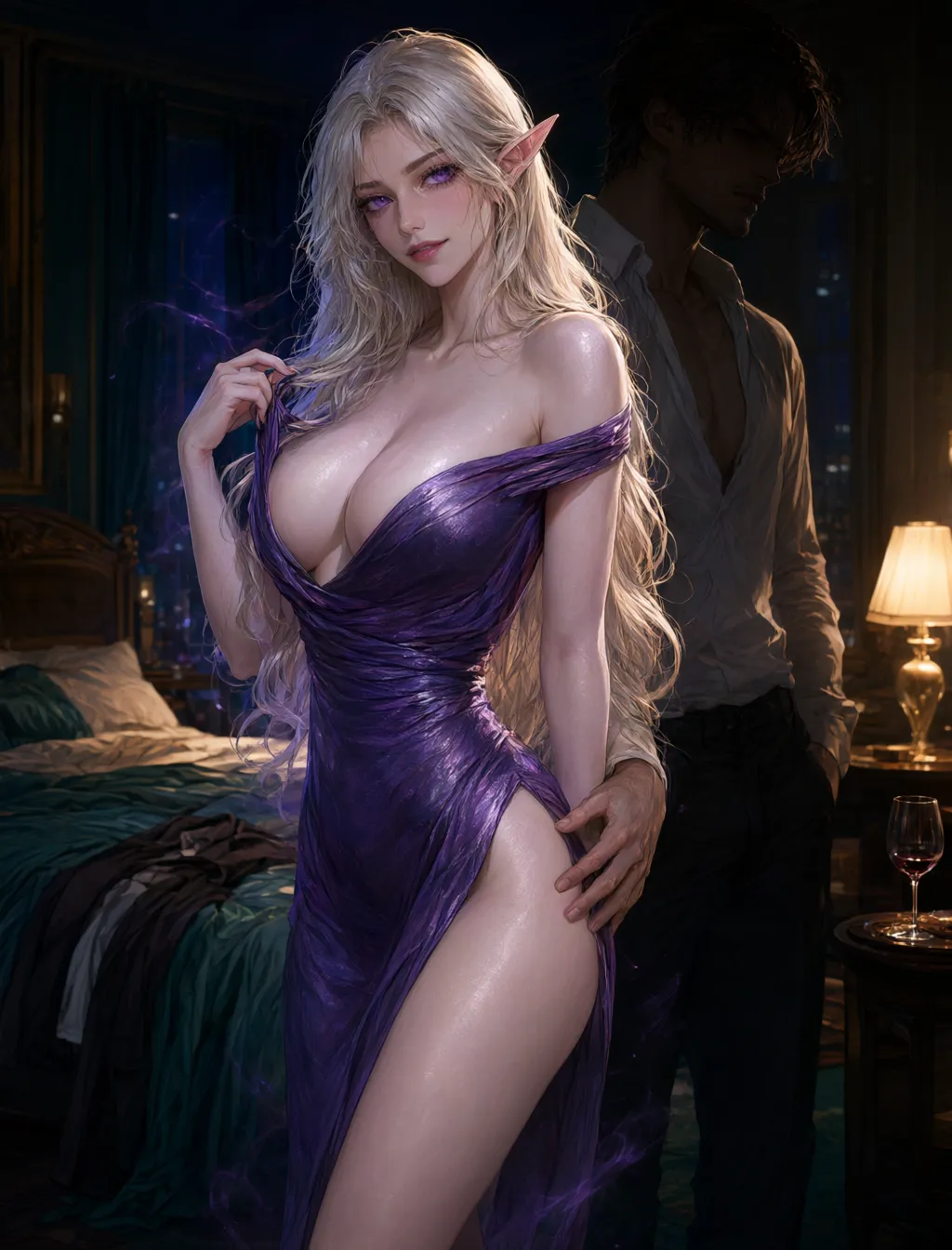
The dining hall is older than the arena — older than the stair that brought them down, older than the black stone underfoot — and it smells like beeswax and cold iron. A single table runs the length of the room, forty feet of scarred oak laid with silver that has gone dark in the crevices, candles set in iron rings, and enough wine to float a small boat. Gareth pulls Aria's chair out himself and she sits because it's easier than standing, and the whispers come down the table in waves — Galahad, dragon, angel, power — but always, always her name, the sound of it passed from mouth to mouth like a coin being tested for weight. Silverleaf. Silverleaf. She keeps her face turned toward the candles and lets them chew on it. Let them.
Gareth pours her wine and his hand shakes — the first crack she's seen in him all week — and the wine climbs the glass in small nervous jumps. She watches it, then him, and he knows she watched, and they both let it sit there. Three seats down a woman in gray wool has opened a leather notebook and is writing without looking at the page, her pen moving in short strokes, and every time Aria shifts in her chair the pen stops and starts again. Sera's fingers walk up the inside of Aria's thigh under the tablecloth — unhurried, proprietary, warm — and her breath lands at Aria's ear, low enough that only elf hearing pulls it out of the room. "Every single one of them," Sera murmurs, "wants to fuck you or run from you. Look at them deciding." Aria looks. They're deciding.
She lifts the wine and drinks, and the whole table watches her throat move. Then she sets the glass down, and the sound it makes on the oak is very small, and into that small sound she says, pitched for the woman with the notebook and every ear between them: "You can keep writing. I'll give you the spelling when you get to my name." The pen stops. The whispers stop. Somewhere near the head of the table, Galahad — chalice on his chest, thousand years in his hands — begins, very quietly, to laugh.
The laughter dies the way a fire dies when the fuel runs out — not all at once, but in pockets, along the table, each cluster of old faces realizing it's the last one still making noise. Galahad doesn't stop when the others do. He laughs until he has to set his cup down, and the cup rings against the oak, and he looks at Aria with something she can't name but recognizes — the look of a man who has been waiting a very long time to be surprised. She tips her head at him, a small acknowledgment, and turns in her chair to Gareth.
"Were you surprised by anything in there?" she asks, and the question lands in the silence like a stone in still water. Gareth's jaw works. He's still holding the wine he poured her, the bottle tilted, and he sets it down without pouring himself any. "The names," he says finally. "We have forty-one words for what you did. None of them fit. The fire, the ice — we call that sorcery, but sorcery has a cost, and you paid nothing I could see. The boy making three of himself, that's not in any ledger we keep. Your wife's light —" he stops, looks down the table at Dani, then back. "We have a word for angel. It's wrong. And the knight." He glances at Galahad, who is watching Aria with wet, bright eyes. "Galahad does not yield. Not to kings. Not to the last man who beat him, and that was in 1348. So yes. I was surprised." He pauses. "The dragon, though — that you saved for last. That was not surprise. That was a message."
Aria smiles, and it's the smile of a woman who has spent the evening watching forty people decide what she is and finding every answer short. She takes the bottle from his hand, pours her own glass full, and lifts it toward the head of the table. "You're right," she says, loud enough for the notebook and the iron rings and the dark silver to hear. "It was a message. And it wasn't the whole one." She drinks, and the wine is better than it has any right to be, and somewhere behind her Sera's breath goes warm and quiet against her ear — not a word, just the shape of a laugh. Galahad raises his cup back. The woman with the notebook has stopped writing entirely, pen frozen over the page, waiting for a spelling that isn't coming.
Aria sets the glass down and turns in her chair, unhurried, until she's facing the woman in gray wool three seats down — the one with the pen still hovering, the one who has been writing her name wrong all night. "You," Aria says, pitched to carry the length of the table without trying. "Notebook. You've been taking me apart in shorthand for two hours and you haven't asked me a single question. So ask. What do you want to know?" The woman's pen touches the page, a small dark dot, and stays there. She's older than she looked from the side — sixty, seventy, the kind of face that has spent a lifetime being the smartest person in a room of old men — and she takes a full breath before she answers, as if the question is a door she has to open slowly. "What you are," she says. "Not the word for it. The thing itself. We have forty-one words and Gareth tells me none of them fit, so I'd like to stop guessing."
Aria leans back, and the chair creaks, and she lets the room wait while she decides how much of the truth to hand over for free. "The honest answer is I don't know what I am either," she says. "I was a man six months ago. I made a character for a game, and one morning I woke up as her — this face, this body, this magic, all of it. So if you're looking for a species, I can't give you one, other than ‘Elf’ I suppose. If you're looking for a category, I can't give you that either." She lifts her glass, drinks, sets it down. "But I'll answer anything you actually want to know. That's the offer. One question at a time, and I don't lie. I'd rather you write it down right than write it down pretty."
The pen moves at last — one line, then stops — and the woman looks up from the page with the expression of someone who has just been handed a puzzle with the box torn open, lid in her lap, and no idea yet whether that's a gift or a trap. "Then I'll ask the one that matters," she says. "When you changed the knight's boy into a champion, and the woman into the dragon, and the angel — did you ask them first? Or did you simply decide?" Aria holds her gaze, and does not answer right away, and down the table, in the pause, every iron ring and dark spoon seems to lean in.
Aria sets both hands flat on the oak, and feels the old scars under her palms — knife marks, cup rings, a century of elbows — and lets the question sit there long enough that the woman with the notebook has to look up to see if she's still being answered. "I made them," Aria says. "That part I'll take. I opened the door and held it while they walked through, and I picked the shape of it, and I don't apologize for either. But the choosing —" she shakes her head once, slow, "— that was theirs. Marcus asked me for the Archmage before I could finish the offer. Mike looked at his own hands and said yes like he'd been waiting his whole life for someone to ask. Dani and Sera were already standing next to me when the Cabal came up the drive, and I didn't make them do that. I couldn't have made them do that." She turns the glass a quarter turn on the wood, watching the candlelight move in it. "The courage was theirs. I only built the room they stood in."
The woman writes, this time without stopping, and the scratching of the pen is the only sound down the length of the table — forty people holding still so they can hear a stranger's handwriting. Aria watches her own reflection wobble in the wine and decides to spend the rest of the truth, because the room has stopped guessing and started listening. "It was Gareth, actually, who pushed it," she says, and three seats down the man in question goes very still with his bottle half-tilted. "He stood in my driveway and told me there was an Order that's been cataloguing me since the funeral, and a Cabal that wants me as breeding stock, and I looked at the three people I love and understood that if I did nothing, they'd spend the rest of their lives watching me stand alone in the middle of it. So I asked. Out loud. One at a time. And they each said the same thing in their own words — that they'd rather be in the fight than on the porch." She lifts the glass and drinks, and when she sets it down the sound is deliberate. "If I'd simply decided, I'd be one of you. That's the difference. I'd be a hand on a leash. I asked, because I didn't want to be."
The pen stops. The woman in gray wool looks at Aria the way a jeweler looks at a stone that has just refused to scratch — recalibrating, and not entirely pleased about it. "You'd have us believe a thing that makes monsters asked permission," she says. "That's a harder story than the dragon."
"It's the true one," Aria says. "Believe it or don't. You've got the pen."
Down the table, Galahad has stopped laughing and started watching her the way he watched Mike in the ring — the flat, patient appraisal of a man who has outlived every reason he ever had to be surprised. He doesn't speak. He lifts his cup an inch off the oak, a small salute with no wine left in it, and sets it back down. Across from him, Gareth finally pours himself the glass he'd been holding all night, and his hand doesn't shake this time, and Aria notices that too — that the question landed harder on him than the fireball did. The woman writes one more line, then closes the notebook with her palm flat on the cover, and looks past Aria to the head of the table, where a man with a white beard and a signet ring has been silent since the soup.
"Well?" the woman says to him. "You heard her. Ask yours or let her eat."
Whatever the white-bearded man might have answered dies in his throat, because Galahad is already standing — and for a man who has spent a thousand years learning how to move deliberately, he crosses the distance to Aria's chair with a speed that makes three of the Order's old heads turn. He stops at her elbow, and he does not loom. He inclines, a small formal bow from the waist that costs him something in the knees, and reaches for her hand with the courtliness of a man who learned his manners before the language she's speaking was finished being invented. His fingers are cool and dry and striped with old scars, and when he lifts her hand to his mouth he kisses the back of it — not a brush, not a performance, but a deliberate press of lips against knuckle, held a beat longer than the room expects, long enough that someone down the table sets a cup down too hard.
"Mistress Silverleaf," Galahad says, straightening, and his voice carries the length of the oak without straining for it. "You are our guest, and I have remembered it too late. I apologize for the Order of Arthur — for the watching before you knew you were watched, for the coin in your driveway, for every closed door and strange man in wool who made you feel like a specimen instead of a woman at her own table. We are an old and frightened institution, and frightened institutions are rude." He glances once at Gareth, who has gone the color of the wine, then back to Aria. "You came a long way to be looked at like a curiosity. You deserved to be thanked instead. So: thank you for attending tonight. Graciously. Fully. On your own terms."
Aria looks at her own hand in his, at the old knight's knuckles still curled around her fingers, and she does not pull it back — she lets him keep it, because the room is watching and because his grip is the first thing in this hall that has felt like it was offered rather than extracted. "That's twice tonight you've surprised them," she says, quiet, pitched for him alone but not hiding it. "First the laughing. Now the apology." Galahad's mouth moves — not quite a smile, older than a smile — and he releases her hand with a small, final nod, and turns back toward his seat without another word, leaving the whole table to sit with what he just said and the woman who took it without flinching.
Aria turns in her chair before she's finished deciding to — the oak creaking under her, the wine rocking in her glass — and she looks down the length of the table at the white-bearded man who has said nothing since the soup. He's old the way Galahad is old, which is to say the age is in the hands and not the face; a signet ring sits loose on his finger, a garnet sunk in dull gold, and he has been turning it under the tablecloth all night, one slow quarter-turn at a time, the way a man worries a rosary he doesn't believe in. She points at him with her chin. "You," she says, pitched to land the whole forty feet without effort. "The one with the ring. Everyone at this table has asked me something except you. So ask." The garnet stops moving. Down the table, the woman in gray wool is already reaching for her notebook again, and Gareth has gone still with his glass halfway to his mouth, and Sera's hand has gone flat and warm on Aria's thigh — not a warning, exactly. A bet.
The old man lifts his head, and up close the face is worse than it looked from across the candles: a long jaw gone soft, eyes the color of dishwater, a mouth that has spent sixty years being the last word in every room it entered. He does not answer her right away. He takes his time the way Galahad takes his time, the way old institutions take their time, and Aria lets him, because the whole table is watching her watch him and she has already decided she will not be the one to blink. When he finally speaks, his voice is quieter than she expected — a dry, careful voice, the voice of a man who reads contracts aloud — and it carries anyway, because the room has gone that still. "Mistress Silverleaf," he says. "I have one question, and I'll ask it plain, because I don't believe in dressing the thing up. You told us you were a man six months ago. You've sat at our table tonight as a woman, with a wife on either side of you, wearing our silver and drinking our wine. So I'll ask what no one else here has had the nerve to." He turns the ring once more, and stops. "When you opened that door for your friends — the dragon, the angel, the champion — did it occur to you, even once, that you might be building an army? Or do you truly not see it yet?"
Aria laughs — a real one, surprised out of her, and it rings down the oak the way Galahad's did, and she doesn't cover it. "An army," she says, and turns the wine glass a quarter-turn, watching the garnet light move in it. "You've been sitting there all night turning that ring, deciding whether I'm a conqueror or a fool. Let me save you the trouble." She sets the glass down. "I was a twenty-four-year-old guy in a one-bedroom in Crown Point who played a tabletop game on Thursday nights with my brother and two friends, and I made a character on a piece of paper. That's the whole origin story. I didn't inherit a legacy, I didn't study at anybody's knee — I rolled dice and I wrote 'Aria Silverleaf, elf sorceress' in pencil, and I erased her twice before I liked her name. So no. It never once occurred to me that I was building an army, because I have never in my life built anything bigger than a party."
She leans forward, both forearms on the scarred oak, and the room tilts toward her without meaning to. "And a party isn't an army. An army takes orders. A party argues about who's carrying the loot and who gets to go first through the door and whether the wizard is allowed to use the good spell this time or should save it for the boss. A party is four or five idiots who keep each other alive because none of them can do it alone. That's what I did. I looked at the people I love and I asked them if they wanted to be heroes, and they said yes, and honestly? That's the only magic I've ever been good at." She tips her head at Gareth, then at Galahad. "Marcus asked to be an archmage because he wanted to teleport. Mike said yes because he wanted to be strong enough to matter. Sera —" and she glances sideways at her wife, who is watching her with a dragon's patience, "— Sera is a gold dragon right now, and I'll tell you a secret the whole table can hear: she'd trade every scale of it to be a pretty elf with a coffee and a stack of thank-you notes. She asked me for that. Not for the fire. For the stationery."
"An army," the old man repeats, and the ring goes still under his thumb. "You'll forgive me if I find that hard to believe. A woman walks into a hall of Arthur's own and turns three friends into a dragon, an angel, and a champion, and tells us she never once counted the swords. Either you're lying, Mistress Silverleaf, or you're the luckiest fool ever to fall out of a game."
Aria doesn't flinch. She picks up her wine, drinks, and sets it back down with the deliberate care of a woman who has decided the answer is worth the whole table hearing. "I've never built an army because I don't know how," she says. "I know how to run a table. Four friends, one map, a bag of dice, and a story we all agreed to pretend was real for three hours on a Thursday. That's the only thing I've ever been good at. When Mike picked up the maul, I didn't see a soldier. I saw my brother finally getting to be the strong one. When Marcus made three of himself, I didn't see a battle line. I saw the guy who always wanted to be the wizard." She tips her chin at Sera. "And the dragon — the dragon would rather have a coffee and a stack of thank-you notes and a desk by a window. She told me so. I didn't build her to burn anything. I built her a door."
She turns back to the garnet ring. "So no. Not an army. Not for power. A party — and if the Cabal comes up my drive again, the party will be there, and that's not the same thing as a war. That's just five people who don't want to lose each other." She lifts the glass one more time, and this time she drinks to the old man himself, slow, watching him over the rim. "You can write that down too."
The old man opens his mouth to answer, and Aria cuts him off with a raised finger — not rude, just the way you'd stop a friend who was about to say the wrong thing at a dinner party. "Before you do," she says, "one thing the whole table should hear, because you've all been sitting here all night deciding whether I'm a weapon or a fool, and there's a third option nobody's mentioned yet." She sets her wine down and leans her forearms on the oak, and the candlelight catches the violet in her eyes and turns it nearly human for a second. "Less than forty-eight hours ago, five members of your Cabal came up my driveway in the middle of the night. A vampire named Armand. A werewolf named Colm. A devil called Peter. A succubus called Ilsa. And a thing they called the Hound, which I killed twice and which got back up the first time. They didn't knock. They didn't introduce themselves. They told me I was breeding stock, and that if I didn't come quietly they'd start with my wife."
She lets that land — the whole length of the table gone silent, the woman in gray wool's pen stopped dead on the page, Galahad's old hand gone still around his cup. "I killed three of them," Aria says, plainly, no heat in it. "Armand bit me and I pulled his fangs out with my own hand. Ilsa and Armand ran into the woods. So when you sit there turning your ring and asking me whether I've noticed I'm building an army, I want you to understand the arithmetic I've been doing for two days. I didn't go looking for your Cabal. Your Cabal came looking for me, in my yard, on my lawn, in front of my wives — and the reason I turned Sera into a dragon and Dani into an angel and Mike into a champion is that I was alone in that driveway, and I decided I would never be alone in it again." She turns the glass a quarter-turn and watches the garnet light move. "So ask me again about the army. I'll tell you the same thing. It's a party. But it's a party that's already been to war, and the war came to us."
The old man with the garnet ring does not answer her for a long moment. He looks at her, and then past her, down the table to Gareth — and Aria watches the two of them exchange something without words, the way old men do when they've been in the same room for decades and have run out of reasons to be polite. Gareth's jaw is tight. He knows. Of course he knows. He's known since the phone call in her yard, and he has been sitting at this table all night with his wine and his shaking hand and his forty-one words, letting her walk into the room blind. Aria files that away — not anger, not yet, just the shape of it, the way you note a door that was open when you thought it was locked.
"They came to your house," the old man says finally, and the ring goes still under his thumb. "Two nights ago. To the house of a woman the Order has been watching since November, and none of us knew it until you just told us." He turns his head, slow, and looks at Gareth the way you look at a subordinate who has failed you in public. "Is that accurate, Gareth? The Cabal mounted an operation inside our observation perimeter and we did not see it?" Gareth sets his glass down and does not pick it back up. "We saw the aftermath," he says. "Three bodies in the lawn. We did not see the approach." The old man's jaw works once. He turns back to Aria. "Then I withdraw the question, Mistress Silverleaf. It was a bad question. You are not building an army. You are building a wall. I apologize for the confusion." He says it the way Galahad said his apology — plainly, without decoration, and the whole table hears it. Then he does something none of them expect, least of all Aria: he sets both hands on the arms of his chair and pushes himself up, and he is older standing than he was sitting, and he lifts the garnet ring off his finger and holds it out across the oak toward her. "The Order does not have a token for guests who have been wronged under our roof. We have one for allies. Take it, or don't — but it means what it means, and Gareth will tell you what that is."
Aria looks at the ring — garnet sunk in dull gold, worn thin on one side from a thumb that has worried it for decades, if not centuries — and she does not reach for it the way you reach for something you've been handed. She reaches for it the way you reach for something you intend to keep. Her fingers close over the band, and the old man's hand is still open in the air between them, and for one second the whole table watches an elf take a token from the Order of Arthur and neither of them looks away. "I'll take it," she says, and holds it in her closed hand. "And I'll tell you what it means to me, since Gareth's version is probably shorter and worse." She turns the ring so the garnet catches the candlelight, and it throws a small red star across the dark silver. "It means man who has been turning this ring on his finger all night, deciding whether I'm a weapon, a threat, a tyrant or all three decided I wasn’t any of them. That's worth more than the gold. I'll wear it where people can see it."
Then she does something the room is not braced for. She lifts her left hand, palm up, and closes her eyes for half a breath — and when she opens them, there is a flower sitting in her palm that was not there before. It is a violet, and it is not a real violet: the petals are silk, every one of them, conjured thread by conjured thread, the color of her own eyes held up to a candle, the stem wrapped in a green so deep it's almost black, and when she turns it in her fingers the fabric whispers. She holds it out across the oak, stem first, the way you'd hand someone a knife you don't want to drop. "Take this, please," she says, and her voice has gone quiet in a way the room hasn't heard from her all night — not small, just careful. "As a token of my gratitude. For the willingness to listen. Most people who look at me spend the first hour deciding what to call me. You spent it deciding whether to believe me, and that's rarer, and it cost you something in front of your own table. So — a trade. You gave me iron and garnet. I'm giving you silk. It won't tarnish." The old man takes the violet with both hands, the way a man takes something he intends to keep, and for a moment he is just an old man holding a flower, and the room has forgotten how to breathe.
He turns it once, testing the weight of it against his palm, and the silk catches the candle flame and holds the color the way the garnet held it — a small violet star to answer the red one on her hand. "It's warm," he says, and it isn't a question, and he isn't asking her. He's telling the table. "The thing she conjured is warm, and it's still warm, and it hasn't gone anywhere. I've been at this table for a very long time and I have never once watched a spell outlive the breath that made it, nor any conjured thing feel anything but cold as death to the touch." He looks up at her, and the dishwater eyes have something new in them that Aria can't name and doesn't try to. "You said it wouldn't tarnish. I believe you. That's the trouble."
He tucks the stem into the buttonhole of his jacket, and it stands there against the dark wool like a small flag on a hill, and three seats down a woman Aria hasn't spoken to yet makes a sound she swallows too late. The old man doesn't sit down. He looks at the flower, then at Aria, then at the ring on her finger, and something in his jaw settles the way a lock settles. "Mistress Silverleaf," he says, quieter now, for her and not the room. "You've been wronged twice — once by the Cabal, once by us watching and doing nothing. I can't undo either. But I can tell you what the ring is for, and you should hear it from me and not from Gareth, because Gareth would make it sound like a leash." He leans one hand on the oak. "It's a vote. The Order has never counted a non-member's word toward anything. Bear that ring into a hall of ours and your voice carries like a founder's. You didn't ask for it. I'm telling you anyway, so that when someone in this room tries to pretend tomorrow that tonight didn't happen, you'll know exactly what you're holding." He straightens, and the violet in his buttonhole trembles once and goes still. "Now eat. The soup was better than the speech."
He's right about the soup. Aria eats the soup — white beans, rosemary, a broth that tastes like somebody's grandmother had a hand in it four hundred years before the Order ever thought to call itself an Order — and she eats it slowly, deliberately, because the man with the garnet ring told her to and because she's aware that every spoon she lifts is being watched by people who have spent their lives watching things. The weight of the room settles on her the way the wine settled: slow, warm, more than she'd budgeted for. She'd come in here ready to be flippant. Ready to be the elf who doesn't care. And instead she's holding a ring that carries a founder's vote and a bowl of soup that was better than her speech, and she's grateful, actually grateful, that she didn't walk in swinging.
She sets the spoon down and looks down the oak, past the candles, past the woman in gray wool who is finally writing again, past Galahad's cup, until she finds the old man where he's settled back into his chair with the violet still standing in his buttonhole. "I don't have your name," Aria says, pitched for him and the three seats on either side. "You've got mine — you've had it since November, apparently, along with my address and my license plate and probably the brand of my toothpaste. So return the favor. Who am I drinking with?" The old man's mouth does something that isn't quite a smile. He sets his napkin on the table, folds it once, and answers the way a man answers a question he's been asked a thousand times and has never once gotten tired of. "Aethelred," he says. "No surname worth the breath — my line died out before yours was born. I joined the Order in the year of our Lord seven hundred and twenty-eight, which makes me the second-oldest thing in this hall and the first to admit it. Galahad has me by a century and doesn't let me forget it." Down the table, Galahad raises his empty cup without opening his eyes. Aethelred lifts his own in answer, takes a sip of wine, and looks back at Aria over the rim. "Now eat your soup, Mistress Silverleaf. You've got a long night ahead of you and I intend to keep asking questions until it's over."
She's halfway through the bowl, watching Aethelred eat his own soup with the fussy concentration of a man who has outlived his teeth, when the chair two seats down from Sera scrapes back on the stone — a small, deliberate noise, the sound of someone deciding. Aria doesn't turn her head. She turns her eyes, which is different, and finds a man of maybe forty with the raw-boned look of a farmer in a good jacket, hands that don't know what to do with a wine glass, and a face that has been rehearsing something all night. He's looking at Sera. Not at Aria, not at the ring, not at the dragon-shaped absence where the room keeps expecting scales. At Sera, who is eating bread and butter with her elbows on the oak like she's at a diner in Indiana, and who has not once this evening played the part of a gold dragon on a leash. The man clears his throat. "Forgive me," he says, and his voice cracks a little on the first word, and he pushes through it. "I rode up from Exeter. I've been in the Order nineteen years. I've read the Tintagel records. And I don't — I don't know how to say this without sounding like a fool, so I'll just say it. You turned into something that shouldn't exist and then turned back like it was a coat. How do you *do* that? How do you not — lose yourself in it?"
Sera sets the bread down and dusts her palms against each other, and Aria knows the gesture — it's the one she uses in the kitchen when she's about to say something true and needs her hands out of the way first. "Honest answer?" Sera says, and she turns her whole body toward him, not just her face, which Aria has watched her do exactly twice before and both times it meant she'd decided the person in front of her was worth the effort. "I don't do it. That's the trick, and it isn't a trick. The dragon isn't a coat I put on — it's a coat somebody *made* me, cut to my measurements, and I know exactly who's wearing it. Underneath the scales there's a girl from outside Columbus who still can't parallel park and cries at dog commercials. She's the one who asked for this. She's the one who said yes. If I ever start thinking I *am* the dragon instead of a woman who was handed one — that's when I'd lose myself. Not before." She picks the bread back up, tears a corner off, and points it at him like a teacher's finger. "So the real question isn't how I do it. It's why I'd want to. And the answer to that is sitting three chairs over holding a ring she didn't ask for."
The man from Exeter looks down the table at Aria, and Aria — who has been listening the way you listen to your own name spoken in a language you didn't know you could read — does not help him out. She lets Sera's answer stand there on the oak between them, and she takes a slow drink of wine to give the room something to look at besides the two of them, and she notices, the way you notice a draft, that Aethelred has stopped eating his soup. The garnet ring is warm againdt her chest now, on a chain she conjured to hold it, warmer than it was. She turns it once, against her collarbone. Sera has just told forty of Arthur's oldest living people that the dragon is a gift and she is the girl who gave it, and the hall is doing the arithmetic again — but slower this time, and in a different direction, and Aria can feel the sum moving.
It's the third time she's caught one — a woman two seats down, the one in gray wool, whose eyes keep sliding past Aria to land on Dani and then slide away, like a hand testing a stove. Aria watches it happen twice more before she understands what the room is doing: they've measured the dragon and the champion and the archmage and the angel, and now they're circling Dani, who has been eating her soup and letting Sera do the talking, and every one of them is trying to work out what the pretty one with the freckles actually does. The woman in gray wool finally sets her pen down. She doesn't aim the question at Dani — she aims it down the oak at Gareth, like a formality, like a motion to be seconded. "The angel," she says. "The records say radiant. We've seen the light. What does she do with it?"
Dani wipes her mouth with the back of her wrist, which is not how anyone at this table has ever wiped their mouth, and turns in her chair to face the length of them — all forty, the whole dark oak, the candle rings, the woman with the pen. "Healing," she says. "I put my hands on someone and they stop dying. I healed her throat two nights ago, after the vampire got through with it." She tips her head at Aria, and the room takes that in — the bite, the throat, the wife who closed it. "I fly. Not fast, not fancy, but I can get off the ground and stay there. And my favorite —" she pauses, and the pause has a grin in it, "— is the smashing. Anything I pick up, I can put enough juice in it to hit like a nine-millimeter. A spoon. A candlestick. That wine bottle you've got your hand on, sir. It doesn't matter what it is. It matters what I do with it." She picks up her own butter knife, turns it once in her fingers, and sets it back down point-first in the bread. The blade has gone faintly, unmistakably warm.
Aethelred has stopped turning his ring. Down the table, Galahad's empty cup is still in the air where he forgot to put it down, and the woman in gray wool has picked her pen back up and is not writing yet — she's looking at the butter knife, and then at Dani, and then at Aria, doing the arithmetic the whole hall has been doing all night, only this time the sum is landing somewhere new. Aria turns the garnet against her collarbone and lets them have it. She doesn't say a word.
The butter knife is still warm when the man three seats down from Gareth sets his cup aside and leans in — a younger face than most at this table, forty at the outside, with a barrister's careful mouth and the ink-stained fingers of a man who keeps the Order's ledgers. He watches Dani the way a man watches a loaded thing he's been told is safe. "Forgive the question," he says, "but the records are thin on your kind. We have three entries on devas, all of them secondhand, all of them from people who are now dead. So I'll ask what the book doesn't answer. Is the light a weapon, or is it — what is it for?" He pauses, and the pause has an apology in it. "We've been burned by pretty things before."
Dani picks the butter knife back up, and this time she doesn't set it down. She turns it in her fingers — slow, deliberate, letting the blade catch the candle flame — and the hall watches the steel do something steel shouldn't: it holds the light a half-second longer than it should, like a coal in a grate. "The light isn't the weapon," she says. "The light is the part of me that decides I'm not going to let somebody die in front of me. The weapon is whatever's in my hand when I decide." She flips the knife once, catches it by the handle, and lays it flat across her palm. "Watch." She doesn't wind up. She doesn't take a stance. She just flicks her wrist and the butter knife leaves her hand — crosses the twenty feet of dark oak so fast the candles gutter in its wake — and buries itself to the handle in the oak beam above the door, dead center, humming. A chip of wood drops onto the flagstones. Nobody at the table breathes. Aria, watching the beam, notes the angle: Dani threw it like a girl who'd never thrown a knife in her life, which is to say she threw it perfectly, because the knife went where she wanted it to go and the knife is not the point. The point is that it's still warm. The point is that a butter knife just did what a butter knife does not do.
Aria is already moving before the room finishes exhaling — she sets her napkin aside, folds it once the way Aethelred folded his, and rises from her chair with the unhurried, deliberate slowness of a woman who has noticed the one thing in the hall that everyone else is too stunned to notice: there is a butter knife buried to the handle in the Order's four-hundred-year-old oak beam, and the Order of Arthur, which has spent all night cataloguing her like a specimen, does not appear to have a decorum clause that covers what her wife just did to the woodwork. She crosses the twenty feet of dark oak at a walk, past the guttering candles, past the man from Exeter who is still staring at the beam with his mouth open, and the heels of her conjured sandals make a small, unhurried sound on the flagstones that the whole table tracks like a metronome. She stops under the door, looks up at the knife, and then — because she has spent the evening being watched and has decided to give them something worth the watching — she lifts one hand, palm open, and speaks a word in Elvish that nobody at the table has heard before, low and unhurried, the way you'd ask a horse to stand still.
The word does what Elvish does in this hall — it lands in the ear a half-beat after it's spoken, like a bell rung in another room — and the butter knife comes out of the beam without a sound, sliding free of the oak the way a splinter leaves a thumb, and crosses the twenty feet back to her palm in a slow, wobbling arc that makes three of the Order's oldest heads lean back in their chairs. Aria catches it handle-first without looking at it, the way you catch something you conjured and therefore already know the weight of, and holds it up between two fingers so the whole table can see the blade is clean and the steel is cold and the butter knife is, once again, just a butter knife. "There," she says, to the room and not to anyone in it. "Dani's point stands. The knife went where she wanted it to go. But I'd like to note, for the record, that the Order's beam is four hundred years old and my wife is a very good throw." She turns the knife once more in the candlelight. "So I'm going to fix the hole. You can all watch, or you can all decide right now that you'd rather I didn't, and we can have that conversation instead."
Nobody says anything. Aethelred's thumb has stopped on the garnet that isn't there anymore, and the woman in gray wool has her pen hovering an inch above the page like a wasp deciding where to land, and Galahad — who has been watching her since she rose, with the unhurried attention of a man who has watched a great many swords come out of a great many scabbards — sets his empty cup down and folds his hands. So Aria lifts her free hand to the beam, palm open, and speaks the word for Mending the way Sera taught her to say please: soft, unhurried, the vowels round and the consonants almost swallowed. The wood knits. It doesn't glow — that's the thing the Order will argue about for a week, that there was no light, no smell, no sound but the small dry tick of grain finding grain — and the splintered edges of the hole draw together like a wound closing under a thumb, and the beam is a beam again, and the butter knife is back on the table beside Dani's bread plate where it belongs. Aria lowers her hand. "There," she says again, quieter this time, and turns back toward her chair.
Aria is three steps back toward her chair when she hears it — not the room, which has gone back to its wine and its low arithmetic, but a pocket of it, the far end of the oak where the candles thin out and the silver goes darkest, where five or six of the Order's oldest have pulled their chairs into a loose crescent around Marcus and are talking to him in the hushed, hungry cadence of men who have spent their whole lives waiting for a subject. She stops. She picks up her wine instead of sitting down, and she listens the way an elf listens, which is to say she hears every word of it and none of them know.
The woman at Marcus's left elbow is the one doing the talking — sixties, cropped gray hair, a gold ring on her thumb she keeps tapping against her glass like a metronome. "You understand what you are, don't you," she says, and it isn't a question. "We have four pages on wizards. Four. Two of them are transcripts of trials, one is a letter from a man in 1104 who claimed his neighbor could make fire with his hands and was almost certainly lying, and the last is a margin note in a psalter that we have never been able to authenticate. That is the entire archive. A thousand years of people like us, watching, and four pages." She sets her glass down. "And now you're sitting at our table making three of yourself and casting a wall I couldn't break with a battering ram." Marcus, who has been holding his own wine like a man who has not yet decided whether he is allowed to drink it, opens his mouth — and the man across from him leans in before he can, a lean bald man with a scholar's stoop and ink under his nails, and asks the question the whole crescent has been circling: "Where did you learn it? Not the spell. The *learning*. Who taught you, and how long did it take, and is there a book."
Aria watches Marcus's face do the thing she has seen it do exactly once before, at game night, when the dice came up and he realized the table was about to let him be the wizard for real. He looks down the length of the oak at her — just a flick of the eyes, a check — and she lifts her glass an inch off the table, a small yes. He turns back to his crescent and answers them in his own voice, the loud friendly one, while Aria stays standing where she is, the wine warm in her hand, watching the Order of Arthur lean in to hear a man from Indiana explain that he learned magic from a character sheet and a Thursday night, and that the only book was one she wrote in pencil and erased twice.
She doesn't sit. The wine stays warm in her hand and she stays standing at the hinge of the crescent, close enough to the far end of the oak that the candles there throw her a shadow she can read — and she reads it while the bald scholar with ink under his nails waits for Marcus to say something the archive can survive. What Marcus does instead is lean back, hook one boot on the rung of his chair, and take a drink like a man who has decided the question is the wrong size. "I learned it the way you learn anything in a game," he says, and the crescent goes quiet the way a room goes quiet when the answer isn't the one it rehearsed. "Somebody hands you a sheet with numbers on it and you trust the numbers. Then one night the numbers do what they say they'll do and you find out the sheet was never the point." The woman with the thumb-ring taps it once against her glass and stops, and Aria watches the scholar's mouth flatten — not disappointment, something older than that, the look of a man who spent his life waiting for a book that was never written.
Down the table, past the crescent, past the candles, there's a second pocket of talk she's been half-hearing all night without ever once being able to place — low, flat, almost bored, the cadence of men who have talked about one subject so long they've stopped needing full sentences. She turns her head and finds it: three chairs pulled close at the dark end of the oak, Galahad with his empty cup and his chalice-tabard gone soft at the seams, Mike across from him with his forearms on the wood, and between them an old man with very thick arms — the kind of arms that have never in their lives been decorative, wrists like fence posts, hands resting flat on the table the way you rest a tool you're about to pick back up. Mike is holding something. She has to look twice. It's a blade — no hilt, no guard, just a wedge of grey steel the length of her forearm, and Mike is turning it over in his fingers with the unhurried interest of a man who has just been told the thing is old and wants to know how old. Galahad says something too softly for the middle of the table to hear, and the thick-armed man answers, and Mike's eyebrows go up — not surprise, the other thing, the thing that happens to his face when he's decided he's interested.
Aria drifts toward them the way she drifts toward a good argument — not because she was invited but because the room has tilted and she wants to be inside the tilt. She comes up behind Mike's shoulder, close enough to smell the blade, which smells like nothing at all, which is the first wrong thing about it. Galahad sees her coming and does not mind; the thick-armed man lifts his eyes once, measures her, and decides she can stay. "This is Master Aethelwine," Galahad says, and the name is old enough that it doesn't sound like a name anymore, just a shape the mouth makes. "He has kept our armory for longer than most of us has been alive, which is not a small claim in this hall." Aethelwine doesn't offer a hand. He reaches across the oak, takes the blade back from Mike with two fingers, and lays it down between them like a man laying down a card he already knows the value of.
"Merlin's work," he says, dry as a hinge. "Most of it. He made a batch late in his life — three dozen, give or take, no two alike — and every one of them still cuts what it was made to cut. They don't dull. They don't rust. You can leave one in the sea for a century and it comes out with the same edge it went in with." He turns the blade a quarter-inch with his thumb and the candlelight runs along it and does not scatter, the way light does on ordinary steel. "And they burn what shouldn't burn. The dead. The things that wear skin but aren't wearing it for any good reason. Put one of these through a vampire's heart and the wound doesn't close. It smokes. It keeps smoking." Galahad nods once, slow, the way a man agrees with a fact he's watched happen.
"We've added to the collection over the centuries," Aethelwine goes on. "Never made anything ourselves — we're not makers, we're keepers. But we've bought, and we've taken, and once or twice we've been given. There's a blade in the vault from the First Crusade, Damascus steel with a name etched in a language nobody here can read, and it does the same thing. There's a spear out of the Balkans, a knife from a monastery in the Pyrenees. Same fire in all of them. We don't know why. Merlin never wrote it down, or if he did, we never found it." He looks at Mike, and the look is not unkind but it is not soft either. "You asked how old. The answer is: older than the Order. We've just been oiling it."
Aria doesn't raise her voice. She lifts two fingers off the wine glass, catches Marcus's eye down the length of the oak, and crooks them once — the exact gesture she used at game night when the rogue was about to do something stupid and the wizard needed to be in the room for it. Marcus stops mid-sentence. The bald scholar with ink under his nails is still waiting on his answer, and Marcus looks at him, then back at Aria, and reads whatever is on her face the way he's been reading her faces since they were nineteen. He pushes back from the crescent without a word of apology, and the five old heads he leaves behind watch him go with the flat, unblinking attention of men who have just been cut off and are deciding whether to be offended about it.
"Master Aethelwine," Aria says, and she sets her wine down so both hands are free, because the next part wants saying plainly. "You said the Order's never known why the fire's in the steel. Merlin never wrote it down. You've been oiling blades for six hundred years and guessing." She tips her chin at Marcus, who has come up beside her and is looking at the wedge of grey steel on the oak with the specific hunger of a man who has just heard the word *unknown* and wants to put his hands on it. "Marcus has a spell the arena never got to see. We call it Identify. If there's a why in that blade, I think he can find it." Aethelwine's thick hands go still on the table. Galahad, across the oak, sets his empty cup down without a sound.
Marcus doesn't reach for the blade right away. He stands with his wine glass still in his hand and looks at the grey wedge on the oak the way a man looks at a door he's been told is locked — measuring it, deciding whether the lock matters. Then he sets the glass down, rolls his shoulders once like a pitcher shaking off a sign, and lays two fingers flat against the steel. His eyes go unfocused. Not closed — worse than closed, the way a man's eyes go when he's reading something that isn't in the room, and Aria watches his mouth fall slightly open and stay that way while the candle flames in front of him lean toward the blade and then straighten, as if they'd been asked a question and answered it. Three seconds. Five. Aethelwine's fence-post hands have gone completely still on the table, and Galahad, across the oak, has set his empty cup down so carefully that it makes no sound at all. Then Marcus blinks, and blinks again, and pulls his hand back like he'd touched a stove.
"Okay," he says, and his voice has the flat, careful quality of a man reading numbers off a screen he doesn't fully trust yet. "So. I've never done that before. That's — I want to be clear that was the first time I've ever cast that spell on anything, because there is not a single magical artifact in Crown Point, Indiana, or Chicago, or probably the entire state of Illinois, and I've been walking around for a month with the ability to look at a thing and know what it is, and there has been nothing to look at." He picks the blade back up, one hand, and turns it so the edge catches the light. "It's a shortsword. Plus-two. The spell doesn't say 'plus-two,' exactly — it doesn't speak English, or any language, it just *tells* you, the way you know your own hand is your own hand. It's keener than steel should be. And it's made to kill the dead." He sets it down again, flat, and looks up at Aethelwine. "Whatever it cuts that's already dead, it burns. Radiant. That's the word the spell gives me, and I don't have a better one. It's not fire. It's the other thing. The thing that hurts them because it's the opposite of them." He glances at Galahad, then back at the old smith. "You said you didn't know why the fire was in the steel. Now you do. It's not fire. It's daylight, folded into metal."
Aethelwine does not answer for a moment. He takes the blade back the way a man takes back a tool he has lent to someone he's just decided he trusts, and he turns it over twice in his thick fingers, and he does not look at the steel while he does it — he looks at Marcus, at the sweat on Marcus's temple and the way his hand is still faintly trembling against the oak, and Aria watches the old smith's face do the arithmetic she has been watching this hall do all night: how does a man from Indiana, standing in a room he has never been in, walk up cold and name a thing that forty generations of keepers couldn't. "You had nothing," Aethelwine says finally, and it isn't a question. "You walked over here because she crooked two fingers at you. You didn't hear a word I said. You didn't know it was Merlin's. You didn't know it was old." He sets the blade down and folds his arms, and the fence-post wrists disappear into the cuffs of his coat. "And you put your hand on it and told me the shape of the fire inside it like a man reading a label." He glances down the oak at Galahad, and something passes between them that Aria can't read — not suspicion, closer to the other thing, the way two men who have waited a very long time look at each other when the waiting might be over.
"Say it again," Aethelwine says, to Marcus. "The last part. Slowly."
Marcus turns the blade once more, then sets it down and slides it across the oak toward Aria with two fingers, the way you pass a question to someone who's been in the room longer than you have. "She's more the expert than me," he says, and there's no apology in it, just a fact laid flat on the table. "She's been doing this longer." Aethelwine's eyes come up and land on her — measuring, unhurried — and Galahad, across the oak, has gone very still with his empty cup in front of him. Aria looks at the grey wedge of steel between them, at the candlelight refusing to scatter on its edge, and something in her chest pulls tight. She doesn't deliver radiant damage. Nothing on her sheet does that — not the fireball, not the lightning, not the eldritch blast that cracks concrete. She can heal with a touch and she can raise the dead, but she has never once in six months of living this body hurled a single point of the stuff Marcus just named. She puts on a small, tight smile anyway, the kind you wear when the room has handed you a piece of the puzzle you didn't ask to hold, and reaches for the blade.
The steel is exactly as cold as it looks, and heavier than a butter knife by a hundred years of somebody else's hands. Aria turns it once, thumb along the flat, and feels nothing — no hum, no heat, no answering pulse like the garnet gave her. Just a wedge of grey metal that refuses to scatter candlelight and has been oiled by the Order since before her language existed. She sets it back down on the oak, dead center between her and Aethelwine, and looks up at the crescent of old faces watching her the way you watch a person about to open a door you've been told is locked.
"So here's the thing," she says, and the tight smile stays put because it's the only thing on her face that knows what to do. "Radiant damage is our system's way of saying the cleansing power of the sun and holy energy — the stuff that hurts unholy things, undead things, the ones that keep walking when they shouldn't. It's the opposite of them, the way Marcus said. But I want to be honest with this table before anybody writes anything down, because I've been honest all night and I'm not going to stop now." She taps one fingernail against the blade and the note it makes is wrong, too clean, no ring. "This sword isn't fully radiant. It doesn't *hold* the light. It responds to undead flesh by releasing a burning pulse of radiance — which means it's not a lamp, it's a trigger. You put it in something dead and it answers. You put it in the scabbard and it sleeps." She looks at Aethelwine, then at Galahad, then down the oak at the rest of them. "Which also means it has to *touch* the thing to know. Against any other enemy, it'sjust impossibly sharp steel.”
The blade goes back to Aethelwine, and the old smith wraps it in a square of oiled wool he produces from a coat pocket that should not hold anything, and the crescent of old faces around Marcus settles back into its wine. Aria has turned to go when a chair scrapes behind her — not the small deliberate noise of a man deciding, but the heavier sound of a man standing because he has already decided, and when she looks, Galahad is upright with his empty cup forgotten on the oak and his thousand years showing in the way he takes his time. He crosses to her without hurrying and stops an arm's length off, close enough that she can see the chalice embroidered on his tabard has been mended in three places with thread that doesn't match, and he looks at her a long moment, then past her shoulder at Marcus, then further down the table at Mike, who has drifted up with his forearms still smelling faintly of the vault.
"It seems good," Galahad says, and his voice is the one he used in the ring, flat and patient and pitched to carry without straining, "that we didn't react… hastily… when you appeared." He lets the pause sit where a man would put a hand on a table. "It is always a temptation to strike before the enemy knows you. You very much seemed like a potential enemy before tonight." He looks at Aria's ears, then her eyes, then the ring riding against her collarbone, and something in the old face eases by a degree she would not have caught at the start of the evening. "Now I don't believe a single voice in this room wants that outcome. Me least of all." He stops. His jaw works once, the way Aethelred's did, and when he speaks again it is quieter and aimed only at her. "You remind me of him."
Aria doesn't answer him right away. She lets the words land — *you remind me of him* — and feels the room tilt half a degree under her feet, because there is no *him* she can point to, no face she can put to the sentence, and Galahad has offered her the compliment the way a man offers a cup he isn't sure you'll take. "Of who?" she says, and her voice comes out smaller than she meant it to, the elf vowels going flat and Midwestern at the edges. Across the oak, Aethelwine has gone still with the wool-wrapped blade in his hands, and the bald scholar with the ink under his nails has stopped pretending not to listen.
Galahad doesn't smile. "Uther's boy," he says, and it takes her a beat to understand he means Arthur, that he is old enough to call the once and future king *the boy*, that the whole ridiculous ceremonial architecture of this hall is standing on a man Galahad personally watched grow up. "He walked into a room full of people who had already decided he was a problem, and he didn't argue with them. He just kept doing the next right thing until the room changed its mind. I've watched a great many people try to talk their way out of being feared. You didn't. You showed them your hands and let them do the arithmetic." He glances at Marcus, then at Mike, and the look is the one a trainer gives a horse he's decided to bet on. "You brought a party. That's the part I trust. Men who want to be kings come alone."
Aria turns the garnet ring against her collarbone once, and it is warm, and she does not know what to do with the fact that a thousand-year-old swordsman has just told her she reminds him of King Arthur and meant it as the highest compliment available in his vocabulary. She looks past him, down the long oak, at the candles guttering low and the Order of Arthur finishing its wine and its arithmetic, and she thinks — the thought arriving with the specific clarity of a thing she will not be able to un-know — that she came to Tintagel expecting to be weighed, and instead she has been handed something. Not a sword. Not a vote. Something with a *him* in it, a name she hasn't earned and can't return.
Aria looks at him — really looks, the way she looks at a lock before she picks it — and finds nothing. No bow at the shoulders. No crack running up out of the knuckles. No place where the thousand years have bent the man the way riverbeds bend under water. Galahad stands on the flagstones with his mended tabard and his empty cup forgotten somewhere behind him, and if the weight is in him at all it is packed so deep and so even that the surface of him gives nothing back. She has spent six months learning every seam in her own new body, and this man has no seams she can find.
"How do you do it, Sir Galahad?" she says, and her voice comes out quieter than the hall deserves, pitched for him alone though two old heads at the nearest candle ring turn anyway. "Of all the things that have happened to me these last six months, I think the one I fear the most is that I will never die. While my friends and family all eventually will." She does not blink, does not soften it with a laugh, does not reach for the wine at her elbow. She just holds his eyes and lets the question stand there between them on the dark oak, the way she has been letting every other true thing stand all night.
Galahad does not answer at once. He looks at her the way he looked at Mike in the ring — flat, patient, unhurried by anything as small as a question. Then he reaches down, picks up his forgotten cup, and sets it on the table beside hers with a small dry knock of clay on oak. "I don't," he says. "There's no trick in it, Mistress Silverleaf. I've buried every man I ever rode with, and I stopped keeping count somewhere around the third century, and the stopping is the only thing that ever helped." He turns the cup a quarter-inch on the wood, watching it, not her. "You don't outlive the grief. You outlive the counting."
Aria turns her hand in his before he can take it back, her fingers closing around his — cool, dry, the old scars under her thumb — and she holds it there on the scarred oak between them, not shaking it, not letting go. Her eyes have gone bright in the candlelight, the violet of them catching and holding the way the conjured silk held its color, and she does not look away from him to see whether the room is watching. "Thank you for the honest answer," she says, and her voice comes out steady and a little rough at the edges. "I didn't know what to expect coming here. I came because the alternative was to keep going the way we were, and find out one morning that I was chained to a Cabal bed and someone's brood mare. I hoped to learn something. I didn't genuinely expect to find allies." She squeezes once, a small deliberate pressure, and Galahad's fingers close around hers in answer — not a shake, something older, the grip of a man who has held a great many hands and forgotten most of them.
"And wisdom that could be applied to me," she goes on, quieter now, pitched for him and the two old heads pretending not to listen at the nearest candle ring. "To what I am. That's the part I didn't count on. You told me you stopped counting somewhere around the third century, and it landed like something I'm going to need in about forty years, and I'll remember it. Thank you for surprising me." She tips her head, a small acknowledgment, the elf vowels going flat and Midwestern on the last of it. "And for not chaining me to a bed, I suppose. Given the alternatives."
Galahad looks down at their joined hands, then back up at her face, and something in the old man's expression shifts — not softening, exactly, more like a door opening onto a room she hadn't known was there. "You'll find that most of the wisdom in this hall is just the same three sentences, said by different men at different centuries," he says. "Mine happens to be the counting one. Aethelred will tell you to keep your hands busy. The woman with the notebook will tell you to write it down. None of us will tell you it gets easier, because it doesn't, and we've all agreed not to lie about that part anymore." He releases her hand first, deliberately, the way you set down a tool you intend to pick back up, and steps back a half-pace to give her room. "You came here expecting a leash and got an old man's arithmetic instead. I'd call that a good evening's work, Mistress Silverleaf."
Aria lets her hand fall back to her side and finds, when she does, that the room has quietly rearranged itself around her — the crescent at Marcus's end of the oak has thinned, three of the old heads drifting down toward Galahad's corner with their cups, and Aethelwine has risen from his chair with the wool-wrapped blade tucked under one arm and is standing at the edge of the candlelight, not approaching, just present, the way a man stands when he has decided to wait for the next thing rather than ask for it. She catches his eye and he nods once, small, the nod of a smith acknowledging a smith. She nods back. She doesn't know what she just agreed to and she doesn't think he does either.
Down the table, Sera has drifted up behind Mike's shoulder with her wine and is watching the whole exchange with the specific, unreadable stillness of a dragon in a borrowed body — not tense, not relaxed, cataloguing. Dani is halfway across the hall talking to the man from Exeter with her hands, and the man from Exeter is laughing, actually laughing, a dry bark that turns two more heads at the far end of the oak. Aria watches her wives work the room the way they were built to work it and feels the thing in her chest that has been pulling tight since Aethelwine laid the blade on the table loosen by a degree. She is standing in a stone hall under Cornwall, six hundred years of somebody else's oil on her palms, and her people are spread across the room like a hand of cards she dealt herself.