
“Drainage,” Eloise said. “Of agricultural land. Volume two.”
“Nobody has ever read volume two.” Ambrose leaned in the study doorway, arms folded, the storm flaring white in the library windows behind him. “Not even the author.”
She had found it wedged between Gibbon and a stack of Field magazines gone soft with damp. Inside, the pages had been cut away in a neat rectangle, and in the hollow lay a letter folded twice, yellowed to the colour of weak tea.
She read it aloud because her hands needed something steady to do.
“‘Grieves. I have now seen the second will and I am satisfied it is a forgery. My uncle’s hand is well imitated, but he never in his life crossed a seven. I mean to lay the matter before you on Monday. You asked who witnessed it. Dr. Edmund Vosse. I have known Vosse since boyhood and I no longer trust him. Keep this safe. A.T.’”
Thunder walked across the roof.
“Grieves?” Eloise asked.
“My solicitor. I never posted it. I died on the Saturday.” His voice was very quiet. “I’d forgotten where I put it. A century is a long time to keep track of your own shelves.”
“Vosse witnessed a forged will.” She looked at the brown ink. “And then Vosse signed your death certificate.”
“Two lies with one pen.”
“Okay. Forged will, compromised witness, motive. We find who inherited under the second will, we pull the probate records, we...” She stopped, because he had gone still in a way that was different from his ordinary stillness. “What?”
“When you name him,” Ambrose said, “I think I’ll go.”
“Go where?”
“Wherever the others went.” He looked down at the silver dissolving at his cuff. “I’ve seen it twice. A housemaid in 1951. A boy who drowned in the lake. They stayed until the truth came out, and then one morning they simply weren’t here. The house keeps what’s unfinished.”
The letter rustled. She hadn’t noticed she was shaking it.
“So I solve it,” she said, “and you...”
“Yes.”
The lights died.
. . .
Every bulb in the house went out with a soft tick. Upstairs the camera units beeped in sequence and fell silent. Eloise heard Margit swear faintly from the gallery, a thud, then Margit’s voice: “I’m fine! Swapping cards! Nobody touch me!”
She found the candle on the library mantel by feel and struck a match from her coat pocket. The flame stood up and the room came back in gold: dust turning in the light, the cracked leather chairs, the fender where her boots had steamed eight years ago.
And him. Gilded along one side, silver along the other, the candle caught in the blue of his eyes.
“Same storm,” she said.
“Not the same. That one came from the south.” He hadn’t moved from the doorway. “You sat there. You had my mother’s tartan blanket round you and you were furious that your car had died.”
“I was furious that I was scared.”
“Yes. That too.”
She sat in the chair, because her legs insisted. He came and stood by the cold grate.
“Why did you leave?” he asked. Not an accusation. A question he’d held so long he had worn it smooth.
“You said you’d tell me in the morning if you were real.” She watched the candle. “I woke up at six and you were sitting exactly there. You’d been there all night. You were looking at me as if...” She stopped. “And I knew if I stayed to hear the answer, I’d believe it. Whatever it was. So I took my boots and went out the kitchen door before you could open your mouth.”
“I heard the door.”
“I know. I heard you say my name.”
The rain hammered the glass. Somewhere in the walls the house settled with a long groan of timber.
“Two thousand nine hundred and twenty-two days,” Ambrose said. “I didn’t mean to count. There isn’t much else to do.”
She laughed, and it broke in the middle.
“Four seasons,” she said. “Forty episodes of telling people there’s nothing in the dark. I bought your house so I could stand in your hall and say it to your face.”
“And?”
“And you remembered the toast.” She was crying, which was absurd. “You remembered he was buttering toast.”
He knelt in front of her chair so their eyes were level. He didn’t reach. He couldn’t. The candle leaned toward him, as flames do toward a draught.
“Eloise.” The first time he’d said it since the kitchen door. “Tell me what you want.”
She wanted him not to go. She wanted to burn the letter. She wanted to find the man who had put two hands between his shoulders and make him answer for every one of those days.
“Hold me,” she said. “Please. Hold me.”
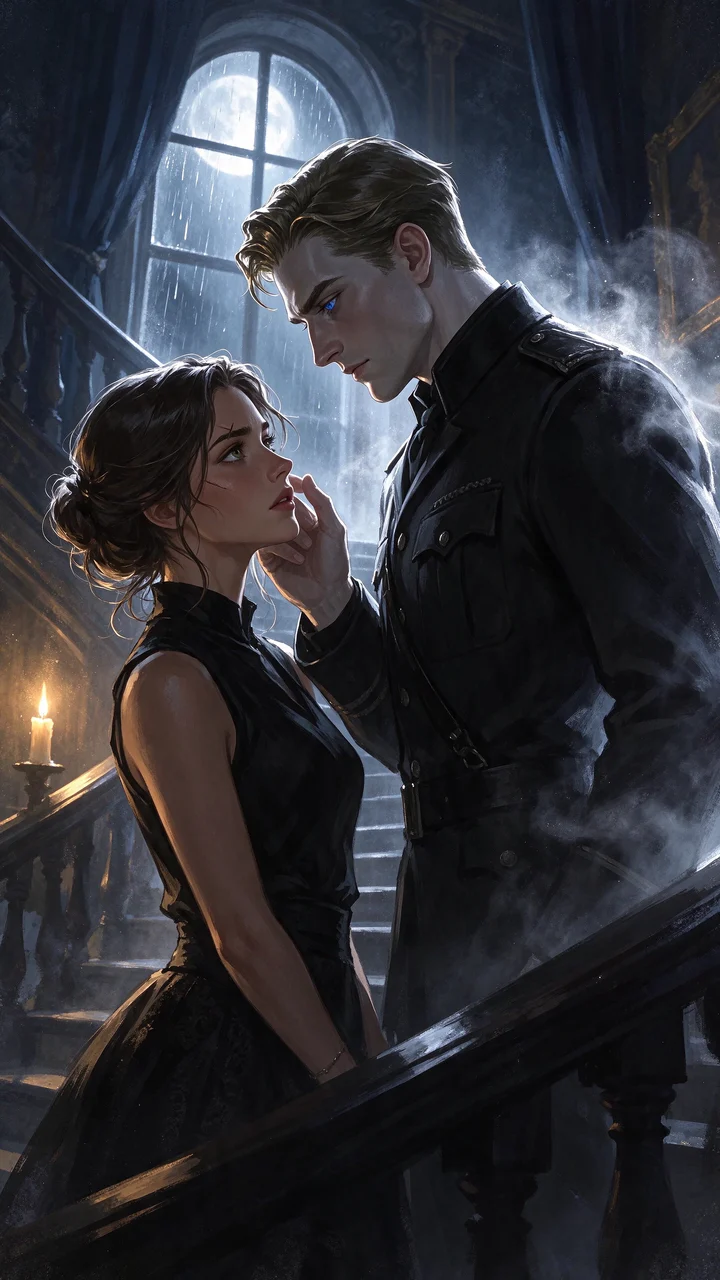
He rose and drew her up with him, and it was nothing like the wrist. One hand came to her waist, cold through the thin black knit, settling with a weight that was real. The other found her jaw, palm along the bone, thumb at the corner of her mouth. She shook. He held her through it. The cold of him was everywhere now, at her ribs, her hip, the whole length of her, and beneath it a pressure that was purely him, steady, an officer’s patience worn thin as paper.
She tipped her face up. His mouth was a breath from hers, close enough that she felt the not-quite-air of him on her lips.
“Ambrose.”
“That, too,” he murmured, and his thumb moved, barely, along the edge of her lower lip, “you’ll have to ask for.”
She opened her mouth to say it.
The library door crashed back against the panelling.
“Lo!” Margit’s headlamp swept the room, blinding. She had the camera in both hands, its side monitor glowing. “The gallery unit, the one on battery, it kept recording, you have to...” The beam found Eloise, standing alone in the candlelight with her arms half raised around nothing. Margit’s mouth worked. Then she thrust the monitor forward. “Look.”
Eloise looked.
Night-vision green. The gallery rail. And at the rail, where the floor fell away to the hall, a man in a long overcoat with the soft high collar of a hundred years ago. A hat brim shadowing his face. Gloved hands resting on the rail as though he owned it. He was looking down at the bottom stair.
Behind her, Ambrose had gone utterly still. The cold at her back turned bitter, frost on iron.
“That isn’t me,” he said, very low. “That’s the man who pushed me, and he’s never shown himself before you came home.”