
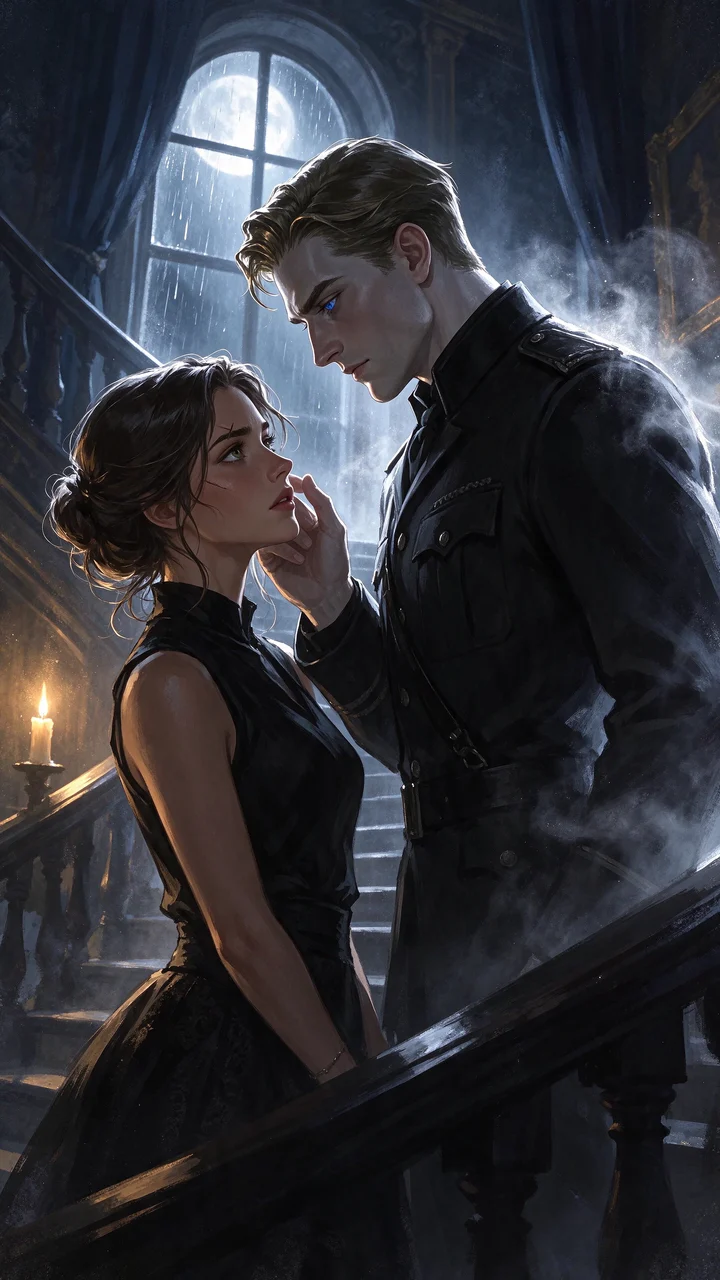
“Play it again,” Eloise said.
Margit didn’t argue. She dragged the cursor back and the gallery wide jumped to 18:47. Grey morning light fell through the warped library glass, across the laptop and the crumbling leather spines behind it, and on the screen, in night-vision green, Eloise crouched by the dead camera.
Then she stood. She looked up at nothing. She talked to it.
There was no sound on that unit, and there didn’t need to be. Eloise watched her own mouth shape no. Watched herself lift the thermal monitor toward an empty patch of landing. Watched her face go soft, then furious, in a way she had never once let it go on camera.
“Thermal,” she said.
Margit switched files. The handheld recording: rail in violet, floor in blue, Eloise’s knee in orange. And beside it, wall. A smooth, unbroken gradient where last night a man-shaped cold had stood.
“It was on the live feed,” Margit said. “I saw it. It’s gone from the file.”
“Corrupted.”
“Only that bit? Neatly? In the shape of a person?” Margit tapped a key. “Now this. Half-landing unit. Headphones.”
Eloise put them on. Rain. The creak of her weight on the stairs. Her own voice, small: Margit. Then underneath, so close to the mic it bloomed, a single breathed word.
Ask.
She took the headphones off and set them down very carefully on the table.
“That wasn’t there live,” Margit said. “I was listening. I’d have heard.”
“Pareidolia. Your brain builds words out of white noise.”
“My brain has been listening to white noise for four seasons, babe, and it has never once built me a posh man.” Margit leaned back. Behind the frames her eyes were kind and very sharp. “Who were you talking to?”
The bell rang. Old wire, a real bell somewhere deep in the house, the sound of a spoon on a cracked cup.
“Saved,” Margit murmured.
. . .
Harriet Vosse came in with a basket on one arm and three archive boxes stacked in the other, and before Eloise could stop her she had found the kitchen, boiled the kettle and laid out tea in the library on a tray with a lace cloth she must have brought from home.
“I couldn’t bear to think of you girls up here without a proper cup.” She poured. Pearls at her throat, reading glasses on a chain, a silver-blonde bob that didn’t move when she bent. “I keep the parish archive. Unpaid, of course. When I heard someone had finally bought the Hall, I thought, she’ll want the history. Everyone does.”
“That’s very kind.” Eloise took the cup. It was too hot to drink and she held it anyway. “We’re mostly here for the structure. Drafts, damp, acoustics.”
“Of course. Your little programme. I’ve watched it.” Harriet smiled, and fine lines gathered at her mouth. “You’re very good at telling people they’re silly.”
Margit choked quietly into her tea.
Harriet opened the top folder. Photocopies, a coroner’s summary, a newspaper column with a grainy photograph of a young officer in that same tunic, unsmiling. Eloise did not let her eyes stay on it.
“Captain Ambrose Thale. Came home from France in 1919 with a medal and a thirst. One night in November 1924 he went over the gallery rail, drunk as a lord, and broke his neck on the bottom stair. My grandfather attended. Dr. Edmund Vosse.” She tapped a signature full of hooks. “He was very clear.”
“Was there an inquest?”
“There was hardly need.” Harriet slid the folder across with pale, perfect nails. “People come to these old places wanting a story, Miss Ashdown. Murders, lovers, curses. And the Hall obliges. It makes people see what they want.” Her pale blue eyes rested on Eloise’s face. “I’d hate for that to happen to a sensible woman like you.”
Drunk as a lord. Very clear. Hardly need. Every phrase had the gloss of a banister rubbed by a thousand hands.
. . .
He waited until Harriet’s car had gone and Margit’s van went grinding down the drive for batteries. Eloise was alone in the library with the folders, and then she wasn’t.
“I was sober,” Ambrose said.
He stood at the window, and the grey light went through the edges of him. Eloise did not jump. She had decided, at about four that morning, that she would never jump again.
“She seems very sure.”
“She wasn’t born.” He turned. “One glass of claret at dinner. I went up to bed. Someone stepped out of the dark at the rail and put both hands flat between my shoulders. I never saw a face. I saw the hall floor coming up very fast, and then I saw it from above for a hundred years.”
“A hundred and two.”
The corner of his mouth moved. “You’ve done the arithmetic.”
“Arithmetic is my job.” She stood and put the desk between them. “Last night. You said I had to ask.”
“I did.”
“Why?”
“Because that’s the law of it.” He said it plainly, a man stating the range of a gun. “The dead may never take. We can only be given. I can’t open a door you haven’t opened. I can’t touch a hand that hasn’t been offered.” His gaze travelled, unhurried, over the line of her throat and the slim watch on her wrist, and came back to her eyes. “Believe me, Miss Ashdown. I’ve tested it.”
Heat climbed her neck. She ignored it.
“Then let’s test it again,” she said. “Controlled conditions.”
. . .
Ambrose had stood in this room through a hundred winters and never once felt time move quickly. It was moving now.
She came around the desk with her chin up and her scarred brow drawn down, a soldier walking into fire she had decided did not exist. She stopped an arm’s length from him and pushed back her sleeve.
He knew that scar. He knew her left hand curled when she lied. He knew the precise colour of her eyes by firelight, because he had spent one night looking at nothing else and eight years remembering it.
She held out her wrist.
“Touch my wrist,” she said. Her voice was perfectly level. Only he could hear what it cost. “Just there.”
. . .
His fingertips came down on the inside of her wrist.
Cold. Not grave cold. Snowmelt cold, the first breath outdoors on a January morning, and under it, impossibly, the press of real fingers, the faint ridge of a knuckle. He did not grip. He laid two fingers over her pulse as if he meant to count it, and then he did count it; she saw his lips move.
Her pulse ran away from him.
Neither of them breathed. He didn’t need to and she couldn’t. His thumb traced once, slowly, along the fine tendon toward her palm and stopped there, waiting, and she understood he would go no further than the words had allowed. Just there. Not an inch over.
That was what took her knees. Not the cold. The restraint.
She pulled back first.
“Fine,” she said, and her voice came out rough. “That’s a result.”
“Is it.”
“Don’t.” She tugged the sleeve down over skin that still burned with cold. “Here’s the deal. I look into your death. Off camera. Records, not feelings. And you stay out of Margit’s shots. All of them. No whispering into microphones.”
“That wasn’t meant for her. That was impatience. I apologise.”
“No appearances. No footsteps outside my door at two in the morning.”
“You heard that.”
“I heard that.”
He inclined his head. Then he looked past her, to a narrow door half hidden by a dust sheet at the far end of the library.
“My study,” he said. “Second shelf from the top. Look for the book nobody would read.”
She glanced at the door. When she looked back, the window held only grey light, and her wrist was still counting.