
“Stress, a storm, and a stranger’s empty house.” Eloise Ashdown held the line to the lens for a two-count, chin tipped, the way the network liked it. “That’s all it was. Tonight, I’m going to prove it.”
“And cut.” Margit lowered the camera from the passenger seat and pushed her headlamp higher on her forehead. “Gorgeous. Very brave. Your wipers were doing a little dance behind your head the whole time.”
“Leave them in. It reads as atmosphere.”
“It reads as a Vauxhall.” Margit twisted to look up through the streaming glass. “Oh. Oh, Lo. That’s a house.”
Thale Hall rose out of the dusk the way it had eight years ago, all chimneys and blind windows, the east wing furred with ivy gone black in the rain. Eloise had the keys in her coat pocket. She had signed for them in a solicitor’s office in Exeter with a pen that skipped, and she had not let herself think about why her hand was steady.
“It’s a set,” she said. “Get the cases.”
. . .
The entrance hall smelled the way she remembered, and she hated that she remembered. Cold stone. Beeswax sunk into the grain of the banisters. Something under it, faint and sulphurous, a church after the candles are pinched.
Dust sheets humped over the furniture and stirred whenever the front door shifted in its frame. Margit walked straight into the middle of the floor and turned a slow circle with the camera at her hip.
“Talk me through it again,” she said. “The bit where you bought it.”
“It was cheaper than three weeks’ location fees.”
“It was not.”
“It was cheaper than three weeks’ location fees plus insurance plus a landlord asking why we’re drilling into his panelling.” Eloise knelt by the first flight of the grand staircase and unclipped a motion camera from its foam. “Pass me the zip ties.”
Margit passed them. “People rent haunted houses, babe. They don’t buy them. Buying them is what the people in the stories do, right before the second act.”
“There’s no second act. There’s forty-four minutes, a sponsor read and a renewal.” Eloise cinched the camera to a baluster and checked the angle on her phone. Twelve stairs, a half landing, then the long sweep up to the gallery where the rail curved away into dark. “Thermal on the half landing. Another on the gallery.”
“You’re avoiding my question.”
“I’m answering it badly. That’s different.”
Margit crouched beside her, close enough that the copper tips of her coils brushed Eloise’s shoulder. Her voice dropped out of its teasing register. “You never told me what actually happened here.”
“I got lost on a back road, my car died, it was pouring, the door was unlocked. I slept in a chair by the fire and left in the morning.” Eloise tugged the zip tie until it bit. “That’s the whole story.”
“You said ‘I slept.’ Last season you said ‘I didn’t sleep.’”
“Last season I was jet-lagged.”
Margit looked at her through her tortoiseshell frames with the unhurried patience she used on a slow focus pull. Then she stood and slung the thermal rig over her shoulder.
“Fine,” she said. “But if a man in a cravat shows up, I’m getting his good side.”
. . .
By the time the windows had gone from pewter to ink, five cameras were blinking red on the staircase and one was not.
“Gallery unit’s dead,” Margit called from the monitor table by the door, swaddled in her mustard jumper. “Battery or cable. I can do it.”
“Stay on the feeds.” Eloise was already climbing, the handheld thermal monitor in one hand and a spare battery in the other. “I want it on the wides if anything happens.”
“If anything happens,” Margit said, “I want hazard pay.”
The stairs were wide and shallow, built for women in long skirts and men with no reason to hurry. Each tread gave a little under her boot. Rain needled the tall windows on the landing, and the ivy outside tapped its knuckles on the glass.
At the top, the gallery opened left and right, a long railed corridor above the hall. The dead camera sat on its tripod exactly where she’d left it. She crouched, popped the battery, slotted the spare.
The light stayed off.
She glanced at the thermal monitor out of habit. The rail in cool violet, the floorboards a muddy blue, her own knee a blot of orange at the edge of the frame.
And beside her, a figure.
Tall. Upright. Standing exactly where a man would stand if he were looking down at her. Not orange, not violet. A deeper colour than the wall behind it, a shape cut out of the room by cold, from the crown of its head to the floor.
Eloise did not look up. She tapped the screen, the way you tap a phone that has frozen. She tilted the monitor. The edge of the frame slid; the shape did not.
“Margit,” she said, too quietly to carry.
Something at the top of the stairs moved out of the dark.
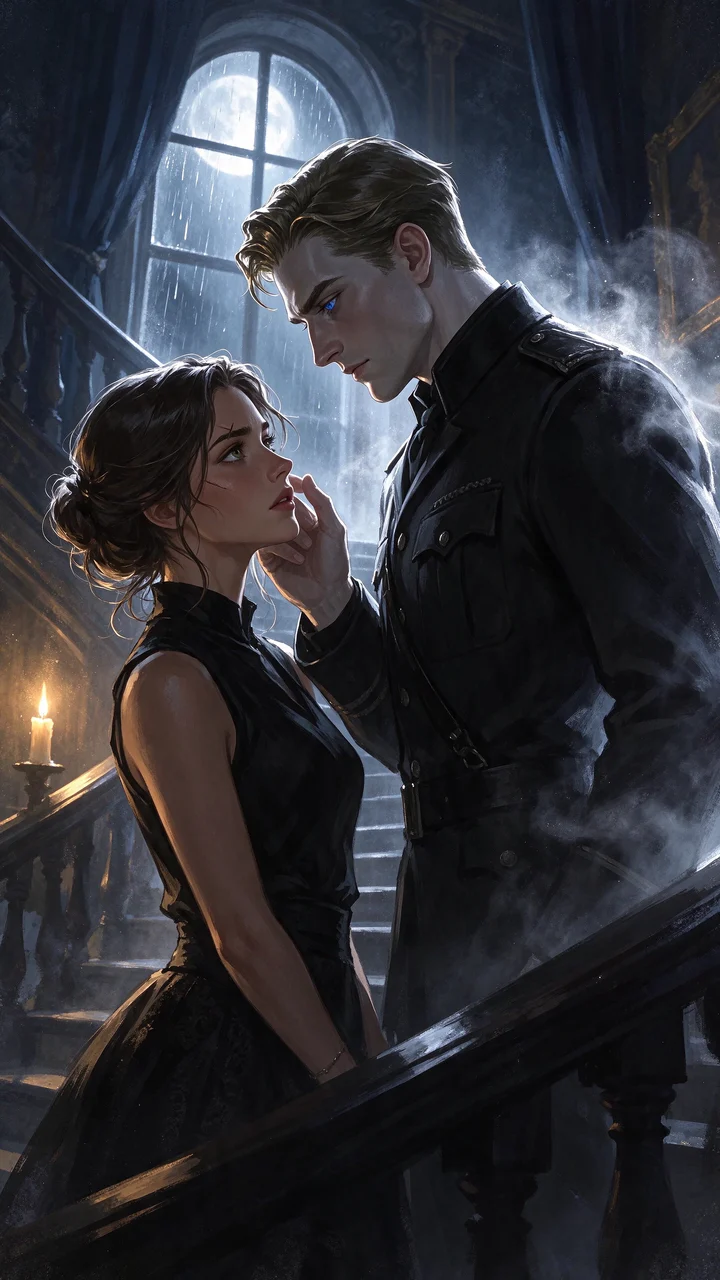
He came forward the way the tide comes in, without hurry, and when the last of the light from the landing window found him she saw the brass buttons first. A dark wool tunic buttoned to a high collar. Then the face above it, long and austere, dark gold hair combed back from a high forehead, and the eyes. Storm-blue. The only colour on him. Everything else was moonlight and silver, and where his shoulders met the air they frayed softly into cold.
Captain Ambrose Thale held out his hand.
It stopped a breath from hers. She felt the chill of it on her knuckles, an open freezer door.
“You know the rule, Miss Ashdown,” he said. His voice was low and very English and amused at something it was too polite to share. “You’ll have to ask.”
Her heart was going so hard it hurt her teeth. She stood, slowly, because standing slowly was a thing she could control.
“No.”
“No?”
“I don’t ask things of hallucinations. I don’t negotiate with low blood sugar. You’re a pressure change and an old staircase and eight years of me telling myself a story.” She lifted the monitor. “You’re a cold spot.”
He considered the screen, and then her, with grave attention.
“You told me,” he said, “that when you were nine you came down on the morning after your father’s funeral and he was sitting at the kitchen table, buttering toast. He looked up and said your name. You went back upstairs and got into bed and never told anyone. And you said, ‘I’ve built my whole life so that nobody will ever have to believe me.’”
The house went silent. The rain stopped needling. Even the ivy held still.
“And then,” he said gently, “you asked me whether I was real. And I said I’d tell you in the morning.”
She had said it by the fire in the library, in a borrowed tartan blanket, her boots steaming on the fender. She had said it because he was a stranger. Because she was twenty-three and frozen and certain she would never see him again.
Not one person alive knew it.
Not one.
“Eloise?” Margit’s voice floated up from the hall. “Your thermal’s doing something weird on my end.”
Eloise turned. She went down with one hand on the cold rail, not running, every muscle begging to run. At the half landing she looked back.
The gallery was empty.
“Draught,” she said, when she reached the bottom. “Window’s cracked up there. It’s throwing the readings.”
Margit studied her face. “You’re white.”
“I’m cold.”
. . .
She took the small bedroom off the hall because it had a lock. She lay in her sleeping bag on the stripped mattress with the torch on, the door bolted and her watch ticking against her wrist, and she recited the facts. Exhaustion. Suggestion. A memory she had dragged up herself and dressed in a uniform.
At ten past two, footsteps came along the corridor.
Slow. Measured. An officer’s stride on old boards, each step given its full weight.
They stopped outside her door.
Nothing knocked. Nothing tried the handle. Through the gap beneath the door the cold came in and found her bare feet, which were somehow on the floor, though she didn’t remember swinging them down.
Whoever stood out there did not move away.
And Eloise, who believed in nothing, found her lips already parting around a word.