
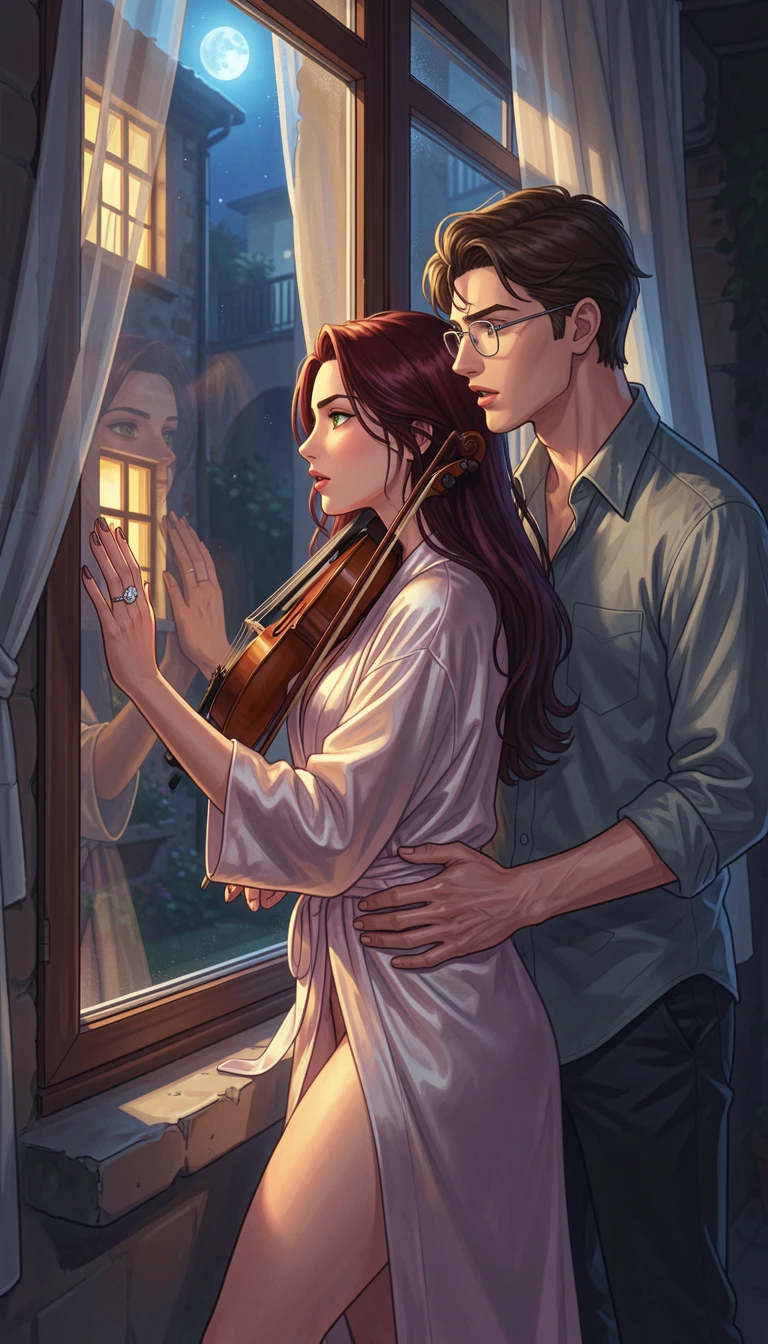
His hand stays against the glass, the tips of his fingers pressing just hard enough that he feels the faint resistance of the pane, the cool surface holding him back. Across the courtyard, the curve she drew is already half-eaten by the night air, the condensation flooding back into the shape she carved, and he watches it disappear as if she never touched the glass at all. But she did. He saw her do it. The ghost of her fingertip lingers at the edge of his vision, a path he could follow if he chose.
The lamp behind her is low, casting her silhouette in soft amber, and she hasn't moved—her hand still pressed flat, her body still waiting. He wonders if she can see him as clearly as he sees her, or if the reflection of his own window blurs him into the dark. His breath fogs the glass again, spreading white across his view, and for a moment she disappears behind the cloud of his own wanting.
He thinks of the graph paper on his desk. The word Love. Dry ink, clean lines, a confession he left sitting in the yellow kitchen light because he didn't know what else to do with it. He thinks about pressing the pen to paper and writing the rest—Why can't I stop watching you? — but the sentence feels too heavy, too honest, too much like giving her the key to a room he hasn't finished locking.
His thumb traces the edge of the windowsill, finding a rough splinter where the paint has chipped. He presses into it, the small bite of wood against skin, grounding himself in something he can feel. The courtyard below hums with the distant sound of a television from another apartment, someone's laughter, the clatter of dishes. Ordinary life. The life he used to have before he started timing his evenings to her metronome.
Her hand lifts from the glass. She doesn't turn away—just lets her arm fall to her side, the silhouette of her body softening as she takes a half-step back. He feels the space between them widen, feels the loss of her palm against the pane as acutely as if she had pulled away from his touch. The window across the courtyard is empty now, just a rectangle of dim gold, the condensation on her side already healing over.
His own hand is still pressed to the glass. He notices, suddenly, how ridiculous he must look—a grown man with his palm flat against an empty window, staring at a woman who cannot see him, waiting for her to perform again so he can pretend he isn't starving for it. But he doesn't lower his arm. He can't. To let his hand fall would be to admit that the night is over, that the conversation has ended, that he is alone in his apartment with a half-written word and the fading echo of a violin.
The bare bulb in his kitchen flickers. He should replace it. He's had the same box of lightbulbs on the counter for three weeks, a small domestic chore he keeps forgetting because the dim light feels appropriate, feels like the right setting for a man who spends his evenings watching something he cannot touch. He wonders what she would think if she saw his apartment—the empty takeout containers, the stack of unread books, the half-finished sketches pinned to the wall. Would she see a man who is healing? Or a man who is hiding?
Her silhouette returns to the window. She is holding something—a piece of paper, he realizes, a small white rectangle that catches the lamplight. She presses it to the glass, her fingers smoothing the edges, and then she steps back so he can see what it says.I drew a curve that wanted to close. But I stopped because you stopped first.
His breath catches. The words blur as the fog of his exhale spreads across the pane, and he has to wipe it away with his sleeve, a desperate, awkward gesture that would be funny if he weren't so afraid of missing a single letter. The ink is dark, her handwriting small and careful, theo of "because" closed with a deliberate loop that reminds him of the way she holds the last note of a phrase, unwilling to let it end. And he feels it then—the answer to the question that has been hardening in his chest, the one he has been too afraid to ask of the silence between them. She understands.
His hand drops from the glass. He turns, finally, and walks to the kitchen, where the graph paper sits under the yellow bulb, the word Love staring up at him like a dare. He picks up the pen. And this time, when his hand moves across the page, he does not stop.
The pen meets the paper with a sound so small he almost misses it—the scratch of ink against fiber, the first stroke of the first word. Why. The W is angular, the way he draws every straight line, but the y curves downward, trailing into a tail he didn't plan. He lets it fall. Lets it become what it wants to be.
can't. The apostrophe is a flick, a dark punctuation he used to spend too long perfecting in architecture sketches. Now it's just a mark, like the tick of her bow against a string. He keeps moving, the ink wet and bleeding into the grain of the graph paper, the blue lines guiding him even as he strays from them.
I stop watching you. The words run together at the end—you with its o that he closes tight, a circle like the one she drew with her finger on the glass. He stops. Reads it. His breath is shallow, caught in the ribs where the shape of her last note is still lodged.
The question hangs on the page like a confession he hasn't finished making. Why can't I stop watching you? It isn't a question he needs her to answer. It's the only truth he has left, the one thing he knows with certainty after weeks of evenings spent mapping the shape of her through a pane of glass.
He signs his name. Ethan. The E is a single stroke, a vertical line with three horizontals that he draws without lifting the pen. The n curves into the a into the n, all of them connected, a single breath of ink that ends in a tail that matches the tail of the y above it. He presses the pen down once more, dotting nothing, just leaving a dark point beside his name as if to say I meant this.
The yellow bulb flickers. He looks up from the paper, suddenly aware of the silence in the room—the hum of the refrigerator, the distant murmur of traffic on the street below, the absence of her violin. The paper feels light in his hand, a flimsy thing to carry the weight of what he's just written.
He stands. The chair scrapes against the linoleum, a sound too loud for the hour, and he carries the paper to the window. The courtyard is dim, the streetlamp casting long shadows across the wet pavement below, but her window is still lit, her silhouette still there, her hand pressed flat against the glass as if she knew he would come back.
He lifts the paper. Presses it to the pane, the graph paper crinkling against the cool surface, the ink facing outward, toward her. His fingers spread across the edges to hold it flat, and he waits, his heart a dull thud against his ribs, his breath fogging the glass around the paper's edges.
He watches her read. Her silhouette doesn't move for a long moment—just stands there, her hand still against the glass, the amber light behind her softening the outline of her body into something almost abstract. Then her hand curves, and she presses her palm flat against the pane, directly opposite his paper, as if she is touching the words he wrote.
She does not look away. And neither does he.