
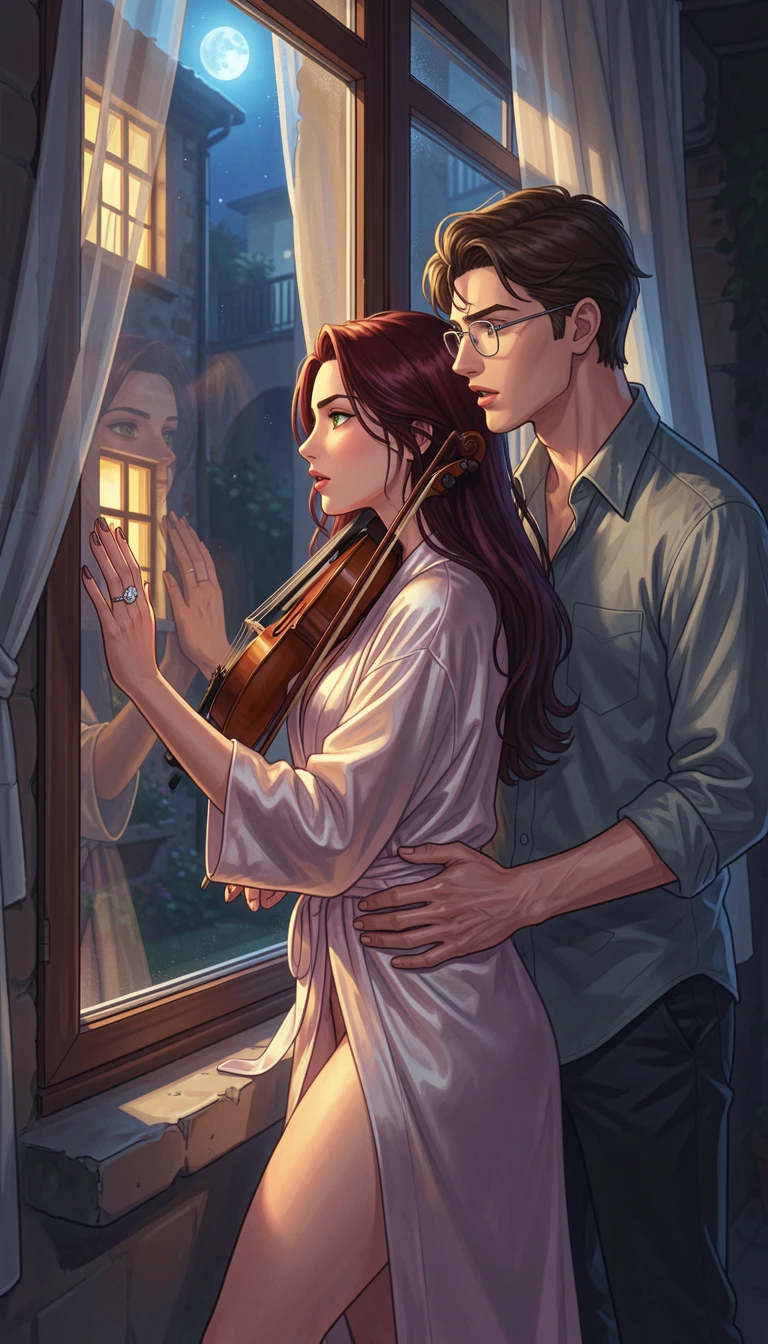
The bare bulb flickers again—third time now—and still he doesn't move to fix it. The kitchen goes dark for half a heartbeat, then bright, and in that pulse of shadow his reflection vanishes from the glass, leaving only her silhouette opposite, palm still pressed, still watching. When the light returns, he sees himself superimposed over her again, and he wonders if this is what it means to haunt someone: to become visible only when the world goes wrong.
Her hand hasn't dropped. He counts the seconds by the ache spreading through his own shoulder, the graph paper growing damp where his palm sweats against it. The ink from the first note has bled through the fibers, transferring something permanent to the glass, and he thinks about how impossible it would be to scrub it clean now. How he doesn't want to.
A car passes somewhere below, headlights sweeping across the courtyard, and for a moment her silhouette sharpens—the curve of her jaw, the line of her throat, the way her fingers splay against the pane like she's trying to press through it. Then the dark swallows her again, and he's left with the afterimage burning behind his eyes.
The violin is silent. It's been silent for—he checks the clock on the wall, his neck protesting the motion—fourteen minutes. She never stops for fourteen minutes. She pauses between pieces, yes, sips water, adjusts her music stand, but never this long. Never this still. He wonders if she's waiting for him to do something, to write something, to break the spell by moving first. But his feet have forgotten how to obey.
The flicker comes again, and this time when the dark hits, he doesn't blink. He holds the image of her in the negative space behind his lids, traces the shape of her shoulder, the fall of her hair, the precise angle of her wrist. When the light returns, she's still there. Still holding. Still refusing to look away.
His kitchen clock ticks. Somewhere in the building, a dog barks once and falls silent. The graph paper beneath his palm is warm now, absorbing the heat of his skin, and he feels the edge of it where his fingertips press into the glass—a thin border between what he's written and what he hasn't. Between the word on the page and the one he still can't say.
Her lamp shifts. No—she shifts, a subtle adjustment of weight that tilts the light across her face, and he sees her lips part like she's about to speak. But she doesn't. She closes them again, presses her palm harder against the glass, and he watches her knuckles whiten with the effort of staying.
The bulb holds steady now, and the kitchen is bright, and he can see her clearly—the silver glint of her ring catching the light as she lifts her other hand. She touches her own reflection, traces the line of her jaw in slow motion, and he feels his throat tighten because she is not looking at herself. She is looking at him through the ghost of her own fingers.
He wants to write something. He wants to press a new note to the glass, something that says more than the last one, something that bridges the fourteen-foot gap between his kitchen and hers. But his other hand stays at his side, and the pen is on the table behind him, and he cannot reach for it without breaking the seal of this moment. He holds.
Her hand finally, finally lowers. But she doesn't step away. She stands there, arms loose at her sides, and she tilts her head—a question he can read even through the glass, even across the dark, even with the flickering bulb between them. She is asking him what comes next. And he has no answer except to stay exactly where he is, palm against the paper, ink bleeding through, watching her watch him hold.
He turns. The motion costs him—his palm peeling from the glass leaves a wet print, a ghost of himself drying on the pane, and he feels the sudden cool air against his skin where her absence should be. The table is three steps behind him but it feels like the full width of the courtyard, like crossing a border he'd drawn around himself hours ago. The pen is where he left it, nested in a crease of graph paper, its cap off and waiting, and he picks it up and the weight of it is familiar in a way that makes his chest hurt.
He doesn't turn back immediately. He stands with his back to the window, the pen in his hand, and he feels the question she is still asking across the dark—feels it as a pressure between his shoulder blades, a warmth at the nape of his neck where he knows her gaze is fixed. The kitchen hums around him. The fridge kicks on and he counts the seconds of its labor, counts the distance between the word he wrote and the one he still needs to write.
When he looks down, he sees the sketch from earlier still on the table—the two curves intersecting, the spine and the violin neck, the body of a building that became a person. He touches the line with the tip of the pen, traces where the second curve crosses the first, and he thinks about adding a third. A third curve that closes the shape. A third curve that makes it a cage or a shelter, he can't decide which.
He presses the pen to the paper. The ink bleeds into the fiber, a dark comma that wants to become a sentence, and he watches his hand move without knowing yet what it will write. His hand knows things his mouth forgot how to say. His hand drew her spine before he understood he was drawing a person. His hand wrote Love before he meant to. His hand is moving now because it has learned to trust itself more than his restraint.
The pen shapes a letter. Then another. He forms the word slowly, deliberately, the way you handle something fragile that could shatter if gripped too hard. The word is not an answer. The word is a bridge. He writes it at the bottom of the paper, below the curves, below the almost-building, below the ink that has seeped through to the glass and stained the pane with something permanent.
He sets the pen down. The sound of it against the table is loud in the quiet kitchen, louder than the fridge, louder than his own breathing. He stares at what he's written and feels the shape of it in his mouth, the consonants and vowels he hasn't spoken aloud in months, the word that undid him once and might undo him again.
He picks the paper up. His fingers find the edges, the corners curled from the damp of his palm, and he turns toward the window. The bulb holds steady. No flicker. No mercy of darkness to hide what he's about to do. The courtyard is a gap he has to cross with nothing but paper and glass and the terrible hope that she will read what he has written and not look away.
He steps forward. One step. Two. The window frame comes into view, and through it, her silhouette—still there, still waiting, still framed in the amber light of her kitchen. She has not moved. She has given him this space to turn away and return, and she has held the question in her stillness the entire time.
He presses the paper to the glass. His new words face her: Because I see you.
He holds it there, the paper flat against the pane, the ink dark against the kitchen light behind him, and he watches her read. Her lips part. Her hand rises to her mouth. And then she does something he did not expect—she laughs. A silent laugh, a shaking of her shoulders, a hand pressed to her chest like he has just told her a joke she has been waiting her whole life to hear.
He feels his own mouth curve into something he hasn't done in months—a raw, startled smile that cracks through the tension in his jaw. The muscles there protest, stiff from holding, and the shape of it is unfamiliar, a foreign landscape spreading across his face. It surprises him so much that his hand nearly slips from the paper, and he has to press harder to keep it flat against the glass, the ink dark and steady between them.
Her laugh stops. She sees his smile—he watches it register, the way her eyes widen for half a heartbeat before they soften. Her hand drops from her mouth and she presses both palms to the glass now, flat and wide, like she's bracing herself against something too big to hold with one. And she smiles back. A real smile, not the guarded half-curves she's given him through the distance of earlier nights. It's full and unguarded and it reaches her eyes, and he feels something shift in his chest—a vertebra unlocking, a rib cage expanding to make room for a lungful of air he didn't know he'd been holding.
The paper trembles against the pane. His hands are shaking. He doesn't try to stop them. He lets the tremor travel through his arms, his shoulders, settling somewhere deep in his chest where the smile still lives. She sees it. She must see it. And she doesn't look away. She holds his gaze through her own reflection, through the ghost of her own hands, through the fourteen feet of courtyard air that separates his kitchen from hers.
He wants to say something. He wants to write something that matches the size of this moment, something that explains the months of watching, the nights of drawing, the word he wrote before he meant to. But his hand stays on the paper, and his mouth stays closed, and he lets the smile do the work instead. It feels more honest than anything he could press into ink.
Her hands slide down the glass, palms leaving faint smears, until they rest at her sides. She takes a step back from the window—but not away from him. She reaches for something on her counter, out of his sight, and when she turns back she's holding a piece of paper and a pen. The same graph paper. The same gesture he's made himself a hundred times. She presses it to her own window, and he watches her write, the pen moving in short, deliberate strokes, her brow furrowed in concentration.
She finishes. She holds the paper up, facing him. The words are simple, written in a careful arch: Tell me your name.
He reads it once. Then again. The smile widens, and he feels it crack the remaining seal of his restraint, pulling his face into something he hasn't been in years—open, exposed, not caring. He releases the paper from the glass and it curls in his hand, the ink still warm from his skin. He turns to the table, picks up the pen, and writes beneath the curve of the spine and the violin neck: Ethan. He turns back to the window, presses it to the pane, and watches her step forward to read.
Her lips move around the shape of his name. She says it silently, tasting the syllables, and he watches her mouth form the th, the n, the way her tongue touches the roof of her mouth at the end. She nods once, a small, private acknowledgment, and then she writes again. A single line. She holds it up: I'm Clara.
His thumb finds the edge of the paper where her name touches the grain. He presses it there, right where the ink would be if they were on the same side of the glass. The courtyard between them feels thinner now—less a gap, more a membrane, something that could tear if he leaned on it too hard. He does not lean. He holds.
The flickering bulb beside him sputters and catches, steadying to a warm, unwavering glow. He doesn't look away from her. She doesn't look away from him. The kitchen behind him hums with the dull labor of appliances, the fading heat of the evening sun bleeding through the glass, and he stands there, paper in hand, name exchanged, the impossible word Because I see you still drying on a sheet he's not ready to retrieve.
The glass is warm against his palm—warmer than he expected, warmer than the paper was, as if the ink has absorbed the heat of both their apartments and concentrated it into this single pane. The permanent stain spreads beneath his touch, the ghost of letters bleeding into the grain of the glass, and he feels the slight unevenness where the ink pooled thicker, a topography he could read blind. He presses harder, and the flesh of his palm flattens, spreads, becomes a surface that mirrors hers across the courtyard.
Her hand rises. He watches it lift from her side, the motion slow and deliberate, like she's moving through water, and when her palm meets her glass, the distance between them is still fourteen feet but it feels shorter now—a gap you could close with a held breath, with a word spoken at the right volume. Her fingers splay against the pane, and the silver ring catches the amber light, and he sees the precise alignment of their hands, how hers matches the position of his down to the angle of the wrist.
He counts his heartbeats. One. Two. The third catches in his throat and refuses to complete itself, and he lets it hang there, incomplete, a debt he doesn't know how to pay. Her reflection hovers over his, layered ghost against ghost, and he watches her lips move around a word he can't read from this angle—maybe his name again, maybe something else, maybe the shape of a question she is learning she doesn't need to speak aloud.
The graph paper on his counter catches his eye. The curve of it at the edge, curling from the damp of his palm, the ink still dark where he wrote Because I see you and beneath it, Ethan, and beneath that, the phantom outline of two curves intersecting—the spine and the violin neck, the thing he drew before he knew what he was building. He looks back at her, at her hand pressed to the glass, at the way her fingertips whiten with the pressure, and he thinks about the third curve. The one that would close the shape. The one that would make a cage or a shelter, and he still doesn't know which he would choose.
She tilts her head. A shift so small that if he blinked he would miss it, but he doesn't blink, and he sees the question in the angle: What now? The same question she asked with her silence fourteen minutes ago, the same question he answered with paper and ink, and now he has nothing left to give her except the pressure of his palm against the glass, the warmth of his skin transferring to the stain, the evidence that he is still here and still holding.
He wants to write something. The pen is still on the table, the graph paper still has empty space, the ink is still wet in the uncapped bottle. But his hand won't leave the glass. His other hand remains at his side, and his body is a bridge between two surfaces—the kitchen floor beneath his feet and the window in front of him, the fourteen feet of air and the woman on the other side who is doing the exact same thing.
A thin line of condensation rises where his palm meets the glass. His skin leaves a mark, a precise outline of his hand, and he watches it spread, the moisture catching the light, turning into a frame around his fingers. He wonders if her side does the same. He wonders if her handprint will overlap with his in the morning, if the sun will burn both of them into the same pane, two ghosts refusing to fade.
Her hand shifts. Not pulling away—sliding. She moves it an inch to the left, then up, and he watches her trace a pattern against the glass with her fingertip, a slow curve that starts at her thumb and arcs toward the center of the pane. She does it again, the same gesture, and he understands: she is drawing something for him. A curve that wants to close. A curve that wants to meet his.
He lifts his own hand. The motion leaves a wet print behind, the ghost of himself drying on the glass, and he presses his fingertip to the same spot where hers is on her side. The distance between their hands is still fourteen feet, but he imagines closing it—imagines the arc of her curve overlapping with his, the two lines meeting in the middle of the courtyard where neither of them can stand. He traces the same path she traced, slow and deliberate, his fingertip leaving a clear line through the condensation.
She stops. He stops. Their hands hover at the same height, their fingers at the same point in the same invisible gesture, and he feels the word rising in his throat—a word he hasn't spoken in months, a word that undid him once and might undo him again. It sits behind his teeth, heavy and warm, and he lets it stay there, unspoken, because saying it now would break the spell of the moment. It is the third curve. It is the word he wrote before he meant to. It is the reason he cannot look away from her kitchen window at night when the lamp is on.
Her hand returns to the glass, palm flat, fingers spread, and he mirrors the gesture without thinking. They stand like that for a long moment—seconds or minutes, he can't tell—and the bulb holds steady, the kitchen hums, the courtyard stays silent between them. He presses his palm against the permanent stain, feels the ink bleeding through to his skin, and he knows that even if he washed his hands now, some of it would stay.