The radiator ticked, a slow iron pulse against the silence. Ethan's thumb found the pen clip again, rolled it once, the metal worn smooth and warm. The page held two curves — the neck of a violin, the line of a spine, a building that had forgotten it was a building. They intersected where a bridge might go, or a throat, or the space between two people who had never touched.
He lifted the pen a third time. His hand hung above the paper, knuckles washed in halogen light, the shadow of his fingers pooling between the drawn lines. The radiator hissed. The air smelled of dust and graphite and the faint metallic tang of the ink. Across the courtyard, her lamp was a pale square of amber behind the glass.
The tip descended.
It touched the paper where the two curves almost met — where Clara's spine might have bent into the bow of her violin. And instead of another curve, a line swept out. Long. Straight. Unbroken. An architect's line, the kind he had drawn a thousand times before the grief came and taught him to falter.
The ink pooled for a half-second at the head of the stroke before the nib dragged it thin. He watched it happen, watched his hand betray a precision he thought he had lost. The line kept going, past the intersection, past the margin, until it formed the first letter of a word he had never let himself finish even inside his own head.
His wrist locked. The pen stopped.
He stared at the letter. An L. Or perhaps the beginning of something else — a word that started with a single straight spine, a word that changed the shape of everything it touched. He had drawn the first stroke of it without deciding to, the way heat finds a seam in glass.
His thumb pressed the clip again. The radiator clicked. The rest of the alphabet waited on the other side of the next stroke — the vowel that would give the letter breath, the consonants that would lock it into meaning. He could still stop. He could still lay the pen down and pretend the line was nothing, a nervous mark, a scratch he meant to erase.
But his hand did not move toward the cap. His hand stayed open over the page, the pen angled in his grip, the nib a hair's breadth above the paper where the next letter would begin.
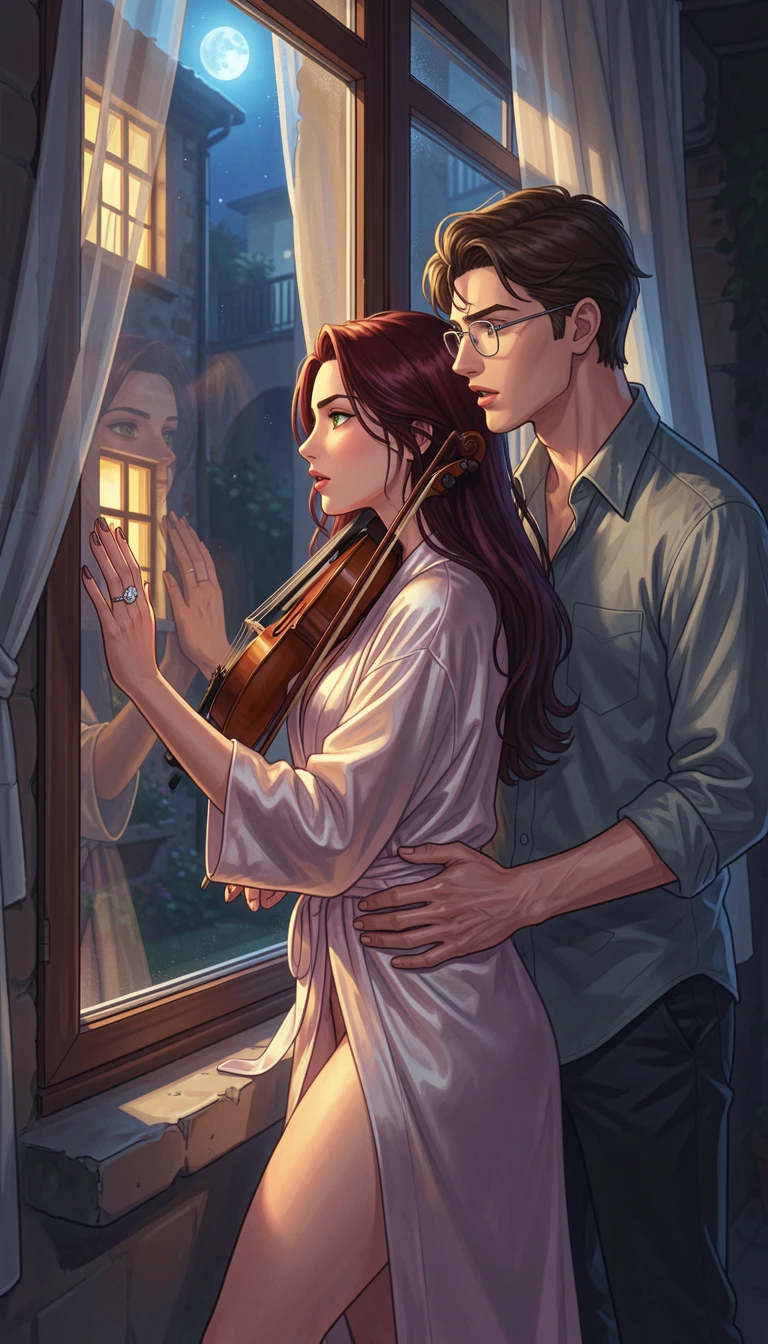
Across the courtyard, her silhouette crossed the window. She paused at the glass, her arm lifting, and he could not tell if she was reaching for a curtain or pressing her palm against the pane. The light caught the curve of her wrist, the line of her jaw, the shape of her waiting.
He looked down at the letter on his page. One stroke. One word. A confession he had not yet learned to speak aloud.
The radiator ticked. The ink dried. And above the paper, his hand trembled — not from the cold, but from the weight of all the letters he still had to write.
The tremor was not fear. It was the opposite of fear — a sound forming in a throat that had forgotten how to speak. He let the pen descend.
The nib kissed the paper where the straight spine of the first letter ended. Then it moved. Not forward in another line, but sideways, arcing, curving back toward itself. An architect does not draw circles. An architect draws right angles and load-bearing walls. But his hand was not an architect's hand anymore. It was a man's hand, learning the shape of an opening.
The curve widened. Ink pooled at the belly of it, dark and wet, catching the halogen light. He could feel the motion in his wrist, the slow rotation of bone and tendon that turned a straight line into something that bent back toward its own beginning. A loop. A zero. A door left ajar.
Halfway through the stroke, he understood what he was doing. The 'L' had been a spine — straight, unyielding, a wall he had built against the world. The 'o' was a breath. It was the vowel that gave the consonant a voice. Together, they were the first two syllables of a word that required a verb, an object, a confession he could not take back.
The nib completed the circuit. The ink met itself at the starting point, a seamless reunion of line and curve. He lifted the pen. The 'o' sat on the page, perfect and dark and unerasable. It was a mouth. It was an absence. It was the shape the air makes when it leaves the body in a sigh.
He stared at the two letters. 'L' and 'o'. Waiting for the third. The word could be anything. Lost. Lone. Loath. Love. The possibilities pressed against his chest, each one a different kind of wound. Each one a door he could still choose not to open.
Across the courtyard, she had not moved. Her silhouette was a dark seam against the amber light, her hand still pressed to the glass. He wondered what she saw — a man bent over a page, a shadow among shadows, a stranger drawing a word he had not earned the right to finish.
His thumb found the pen clip again. Rolled it. The metal was warm now, slick with the heat of his palm. He looked down at the page. The ink was drying. The 'o' was losing its shine, settling into the fiber of the paper like a secret becoming a scar.
The third stroke would decide. A consonant to lock the meaning. A line that would turn the breath into a name. He could write 'v' and make it love. He could write 'n' and make it lone. Either way, the word would belong to her. Either way, he would be speaking a language he had forgotten how to speak.
The pen hovered. The radiator ticked. The lamp across the courtyard held steady. And above the drying ink, his hand waited — caught between the word he was afraid to speak and the silence that had been his home for so long.
The pen's tip touched the paper where the 'o' had curved back to meet itself, a hair's breadth from the joining. He didn't decide to move. His hand moved the way heat follows a seam—diagonal, descending, a stroke that cut across the silence between two letters like a bridge thrown over a divide that had seemed insurmountable. The line swept down toward the belly of the 'o', a 'v' forming before his wrist knew what his fingers were naming, the ink dark and certain against the blue lines of the graph paper that had once held buildings.
His thumb pressed the pen clip hard enough to leave an imprint. The nib dragged through the descending stroke, the angle narrowing as it approached the curve of the vowel, and he felt the word taking shape in his chest—the consonant locking into place, the first vowel already waiting for its partner, the third letter completing a sequence that had begun as a spine and a breath and was now becoming a confession he could not take back even if he laid down the pen and walked away from the table forever.
The diagonal stroke ended at the base of the 'o'. The pen paused there, the nib resting in the space between completed and complete, and he stared at the two marks that now sat side by side: an 'L' and an 'o' and a 'v' that had not yet found its partner—it needed one more line, a vertical stroke rising from the base of the diagonal, a clean ascent that would lock the letter into its final shape and leave him holding a word that had no home but this page and no audience but the woman across the courtyard whose silhouette had not moved from the window.
The radiator coughed. Steam hissed through the pipes somewhere in the walls. His hand remained still above the paper, the pen angled in his grip, the nib hovering where the last stroke would begin. He could feel the word sitting in his throat, pressing against the back of his teeth—love, the shape of it in his mouth, the weight of it on his tongue. He had not spoken it aloud in months. He had not written it in years. The last time he had put that word on paper, it had been a different name, a different life, a grief that had settled into his bones and taught him that some confessions leave scars even when they are true.
His wrist unlocked. The nib touched the paper at the base of the diagonal stroke—the same point where the descent had ended, the same vulnerable place where the 'v' had paused to ask if he was sure. The vertical stroke rose. Clean. Steady. An architect's line this time—the kind he had drawn a thousand times, the kind that knew where it was going even when the hand that guided it did not. The ink trailed behind the nib, dark and glossy, catching the halogen light as it climbed toward the curve of the 'o', and he watched the stroke complete itself with the inevitability of something that had been moving toward this moment since the night he had first heard her play.
The nib reached the top of the stroke. The vertical line met the opening of the 'o'—the space between the curve's two ends, the gap where the vowel had been left ajar. The 'v' was complete. The word was whole. He lifted the pen and stared at what his hand had made: an 'L', an 'o', a 'v', an 'e'—no, there was no 'e' yet, but the 'v' curved into the 'o', completing 'Love' before he could stop himself, the letters sitting on the page like a scar he had chosen to receive.
The ink was glossy at the junctions where the strokes met, the word still wet, still settling into the fibers of the paper. He could see the shape of it reflected in the lamp's light—a sheen that would dry into permanence, a confession that would sit on this table until morning, until the sun rose and the courtyard filled with ordinary light and he had to decide whether to find a piece of tape and press this paper to his window.
He looked up from the page. Across the courtyard, her silhouette had not moved. Her hand was still pressed to the glass, the line of her arm a dark seam against the amber light of her lamp. He could not see her face, could not read her expression, but he could feel her watching—a weight across the distance that had always been there and had only now begun to feel bridgeable. She had seen every letter. She had watched him draw the word. She was waiting for him to do something with it, or to stand up, or to look away, or to press his palm against his own glass and let the word mean what it had always meant, even when he had been too afraid to finish it.
He did not look away. He held her gaze across the courtyard, his hand still holding the pen, the ink on his page beginning to dry into the shape of a confession he had not yet learned to deliver. The radiator ticked. The lamp across the courtyard held steady. And between them, the word sat in the space between the letters, waiting for the next stroke—a period, perhaps, or a question mark, or the first syllable of the response he did not know if she would ever give.
His hand did not move toward the cap. It did not lay the pen down with the careful precision of an architect closing a finished draft. The pen stayed where it was—angled between his fingers, the nib resting in the dried trough of the 'e'—while his arm began to lift, the elbow rising from the table, the shoulder rotating, the whole weight of his upper body shifting forward as if the word on the page had become a spring he was finally releasing.
The pen clattered against the graph paper. A soft sound, the click of plastic meeting fiber, and then the silence swallowed it. His hand was empty. His hand was rising. He watched it cross the cone of halogen light, the shadow of his fingers stretching across the desk, the cuff of his rumpled button-down riding up to expose the pale skin of his wrist and the faint blue veins that mapped a pulse he could feel but not name.
The glass met his palm before he was ready for it—cool and smooth and impossibly solid against the heat of his skin. The contact sent a small shock through his forearm, a sensation that was almost sound, and he pressed harder, flattening his fingers, spreading them until his hand was a star against the pane. The glass fogged at the edges of his touch, a faint ghost of his body's warmth condensing into visibility, and he saw his own reflection layered over the courtyard beyond—a man with wire-rim glasses and a face that looked older than his thirty-four years, a man whose palm was pressed flat against a window he had never touched this way before.
Across the sixty feet of air and darkness, she was still there. Her silhouette had not moved. Her hand was still pressed to her own glass—the same gesture, the same posture, the same impossible bridge of palm and pane and the space between. He could see the shape of her fingers, the way they splayed against the amber light, the slight bend of her wrist where the sleeve of her white shirt fell back. She was waiting. She had been waiting, perhaps, since the moment he had first lifted his pen, since the first stroke of the 'L', since the night she had played that old and hungry piece and watched him shake his head in refusal.
His thumb pressed into the glass. The pressure left a smear, a print, a mark that would remain until the next rain or the next cleaning or the next time he forgot to breathe. He traced a line down the pane with the tip of his middle finger, watching the condensation follow the curve of his touch, and he realized he was drawing the shape of the word he had left on the table—an 'L' in fog, a 'v' in moisture, a confession written on the wrong side of the barrier that separated them.
The radiator hissed somewhere in the baseboard, a long exhalation of steam and iron. He did not look away from her silhouette. He could feel the heat of the lamp on the back of his neck, the cool of the glass against his palm, the dry taste of graphite and dust in the back of his throat. And between them, the word sat not on the page but in the air itself—a thing that had been spoken in ink and was now being repeated in the only language he had left.
Her hand moved. A small shift—the heel of her palm lifting, then settling again, as if she were adjusting her weight against the glass. He watched the motion, the subtle adjustment of bone and tendon beneath the skin, and he felt his own hand respond in kind, a mirror he had not decided to become. His palm rotated, the angle of his wrist shifting to match hers, until their hands were aligned—the same height, the same tilt, the same distance from the edges of their respective frames.
He could not tell if she was watching his hand or his face. The light was against him; she would see only a silhouette against a halogen glow, a dark shape pressed against a rectangle of amber. But she had seen him write the word. She had watched the letters form. And now she was watching him press his hand to the glass, and he was watching her do the same, and the silence between them was no longer empty—it was filled with the weight of a confession that had not yet been spoken aloud but had already been witnessed.
His hand began to tremble. Not from cold—the glass was cool but not punishing, and his palm had warmed it now to something near his own skin—but from the strain of holding a gesture that felt too large for his body to contain. The tremor ran up his forearm, past his elbow, into his shoulder, and he felt it settle in his chest like a second heartbeat, a rhythm that had no meter but the distance between them. He pressed harder against the glass, as if he could push through it, as if the pane were a membrane and his palm was a word trying to cross an impossible threshold.
Behind him, the ink was dry. The word was permanent. And across the courtyard, her hand remained on the glass, her silhouette dark against the amber light, her silence a question he had finally begun to answer.