
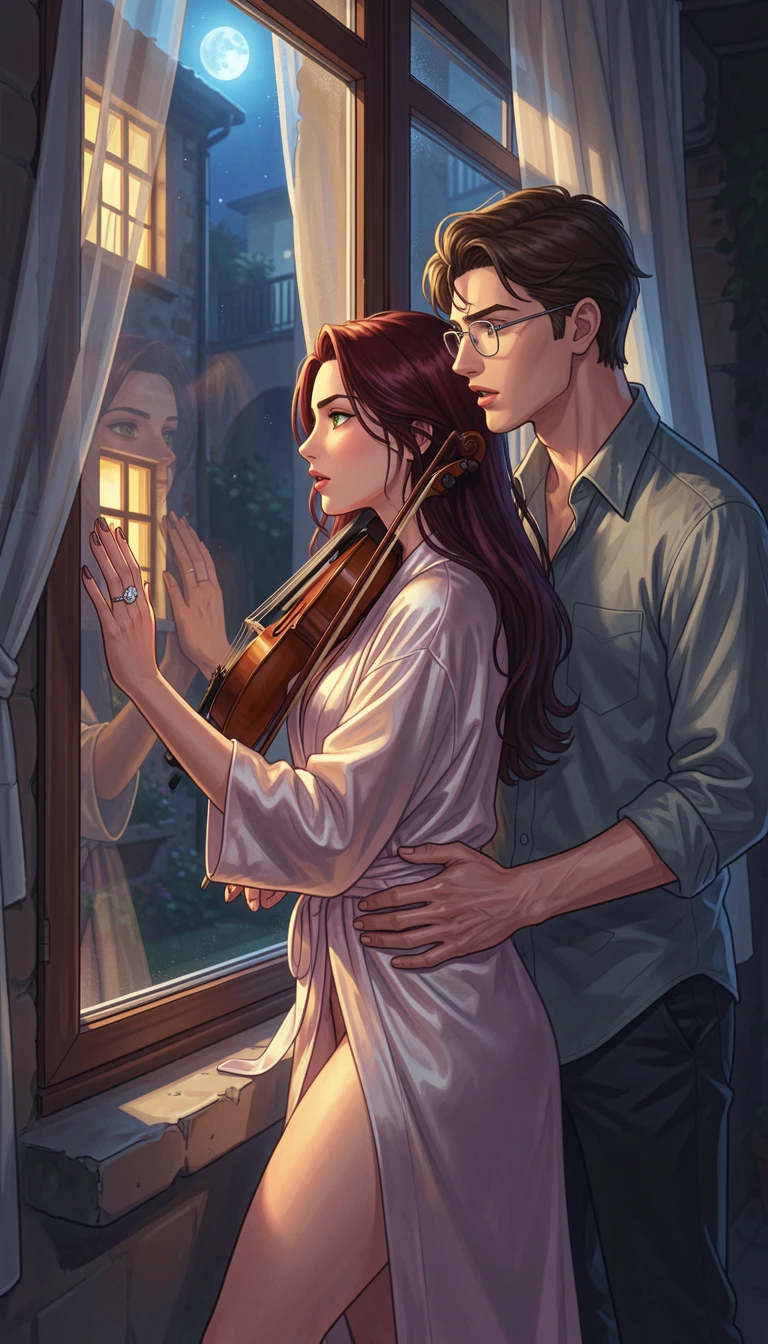
His palm stays pressed to the glass long after her hand lowers. The heat of his skin blooms against the cool pane, fogging a small circle that blurs her silhouette as she turns. She leaves the lamp on—a square of warm amber in the dark, an invitation he doesn't know how to read.
Her silhouette moves through the apartment with the same measured grace she plays with. Kitchen. Refrigerator. A glass of water raised, the light catching the curve of her throat as she drinks. She pauses at the counter—frozen mid-motion, the glass still at her lips—and for a dangerous second he thinks she might look back.
She doesn't.
The pause stretches, a held breath he can feel in his own chest. Then she sets the glass down, turns, walks out of frame. The lamp burns on, empty.
He lowers his hand. The glass where his palm pressed is cooler now, the fog already fading. His fingers ache from the pressure, from holding himself to the window like a man afraid of floating away.
He turns to the drafting table. The pen is where he left it, next to the half-finished sketch of a building that looks like nothing he's ever designed—curves where he usually draws lines, a roofline that arcs like the neck of a violin. He picks it up, feels the familiar weight, the cool metal clip against his thumb.
But he doesn't touch it to paper.
He rolls it between his fingers instead. Once. Twice. The motion is mindless, a habit from years of thinking through a project. But tonight the habit feels wrong—too small for what's pressing against his ribs.
The silence across the courtyard is louder than her music was. He can still hear the last note, a phantom vibration in the walls, in the floorboards, in the hollow of his chest where something is taking root.
He sets the pen down.
The lamp across the way is still on, a single square of light in a dark building. He doesn't know what she's doing now—if she's lying in bed, or reading, or staring at her own ceiling, counting the cracks the way he's been counting the minutes. He doesn't know her name. Doesn't know the shape of her voice. Doesn't know if she'll leave another note tomorrow, or if tonight was a door she opened just long enough to see what was on the other side before closing it again.
He presses his palm to the glass a second time, the heat weaker now, the window already cooling. Across the courtyard, the lamp stays on, waiting for something he can't name.
The glass is cool against his forehead, a seam of cold that sinks through skin into bone, into the chambers of his skull where the silence has taken up residence. His breath fogs the pane in slow pulses—in, out, in—each one a question he can't form into words. The lamp across the courtyard blurs into a smear of gold through the condensation, and he lets it stay blurred, lets himself exist in this half-world where her silhouette might reappear at any moment or might never come back at all.
The silence isn't empty. It's dense, packed with the echo of her last note, the one that climbed through his chest and settled somewhere behind his ribs. He can feel it still, a low vibration that isn't sound but memory, the way a struck bell keeps ringing in the ear long after the metal has gone still.
His fingers curl against the glass, nails scraping lightly, the friction a small anchor. The radiator hisses behind him, a steam-whistle of a sound that belongs to this apartment, this life, this version of himself he'd been trying to rebuild with straight lines and clean angles. The building in his sketch looks nothing like that now. It looks like a question mark built from glass and steel and the curve of a neck he's never seen up close.
He opens his eyes. Her lamp still burns, but the light has shifted—warmer, softer, as if she's dimmed it before lying down. He imagines her in bed, her dark hair fanned across a pillow, her fingers still carrying the ghost of the bow. He imagines the ring on her left hand catching the lamplight, a thin band of silver he's seen flash across the courtyard a hundred times and chosen not to name.
He imagines her fiancé beside her. The thought lands like a blade slipped between his ribs—clean, precise, and he feels it before he understands it's there. He presses harder into the glass, as if the pressure can push the image out. The cold doesn't help. Nothing helps.
His hand falls to his side. He stands there, a man in a dark apartment with a dead coffee cup and a half-finished sketch of a building that wants to be something else, something he can't yet draw because he doesn't have the vocabulary for it. His fingers find the edge of the windowsill, trace the wood where the paint has worn thin from years of this same gesture—someone before him, some other tenant, must have stood here too, must have watched the courtyard for reasons they couldn't name.
He doesn't know how long he stays. Minutes. Maybe more. The lamp across the way holds steady, unwavering, and he takes it as permission—to stay, to wait, to stand in the dark and let the silence press against him like a hand he's learning to hold.
His forehead leaves the glass. The spot is warm now, a ghost of his own heat trapped against the pane, and he touches it once with his fingertips—a goodbye, or a promise, he isn't sure which.
He doesn't go to bed. He goes back to the drafting table, picks up the pen, and draws a single curve that begins at the bottom of the page and arcs upward like the neck of a violin, like the line of her spine as she leaned into the music, like something he has never known how to say out loud.
He lifts the pen. The tip hovers above the paper, a fraction of an inch from the page, and he feels the weight of the motion before it lands—the way a held note hangs in the air before the bow touches string. His hand is steady, the same hand that has drawn a thousand straight lines, measured angles, calculated load bearings. But this isn't calculation. This is the thing he has been avoiding all night, all week, all the nights since he first saw her through the glass.
The pen descends.
He draws a second curve, beginning where the first one ends and arcing in the opposite direction—crossing it, completing it, turning a single line into the shape of something he can almost name. The neck of a violin. The slope of a shoulder. The place where a jaw meets the hollow of a throat, the place he has imagined without permission, without knowing he was imagining it at all.
The two lines intersect like a question mark built from bone and wood and the ghost of a note still living in his chest.
He sets the pen down, the clip clicking against the edge of the table, and stares at what he's made. It looks like nothing he's ever drawn professionally. It looks like a confession he hasn't yet learned to speak. The building in the sketch has become something else entirely—a structure that curves and bends, that has a spine, that breathes. He traces the second line with his fingertip, following the arc, feeling the slight ridge where the ink has dried, and his finger lingers at the point where the two curves cross.
The lamp across the courtyard flickers once—a brief dimming, then steady again. His eyes lift from the page, drawn to the square of gold through the glass. Her shadow doesn't cross it. The apartment is still. But the lamp is still on, and that means something, even if he isn't sure what.
He looks back at the sketch. The second curve has changed everything. It is no longer a building. It is a fragment of a person, a story reduced to two intersecting arcs, and he knows—with a certainty that settles in his gut like a stone dropped into deep water—that he will not sleep tonight. He does not want to. Sleep would mean leaving this moment, this page, this half-formed question that he has finally begun to learn how to ask.
He picks up the pen again. His thumb finds the clip, rolls it once. The radiator hisses. Somewhere in the building, a pipe knocks. The lamp across the way holds steady, and he looks at the page, at the two curves crossing, and thinks about what it would mean to add a third.