
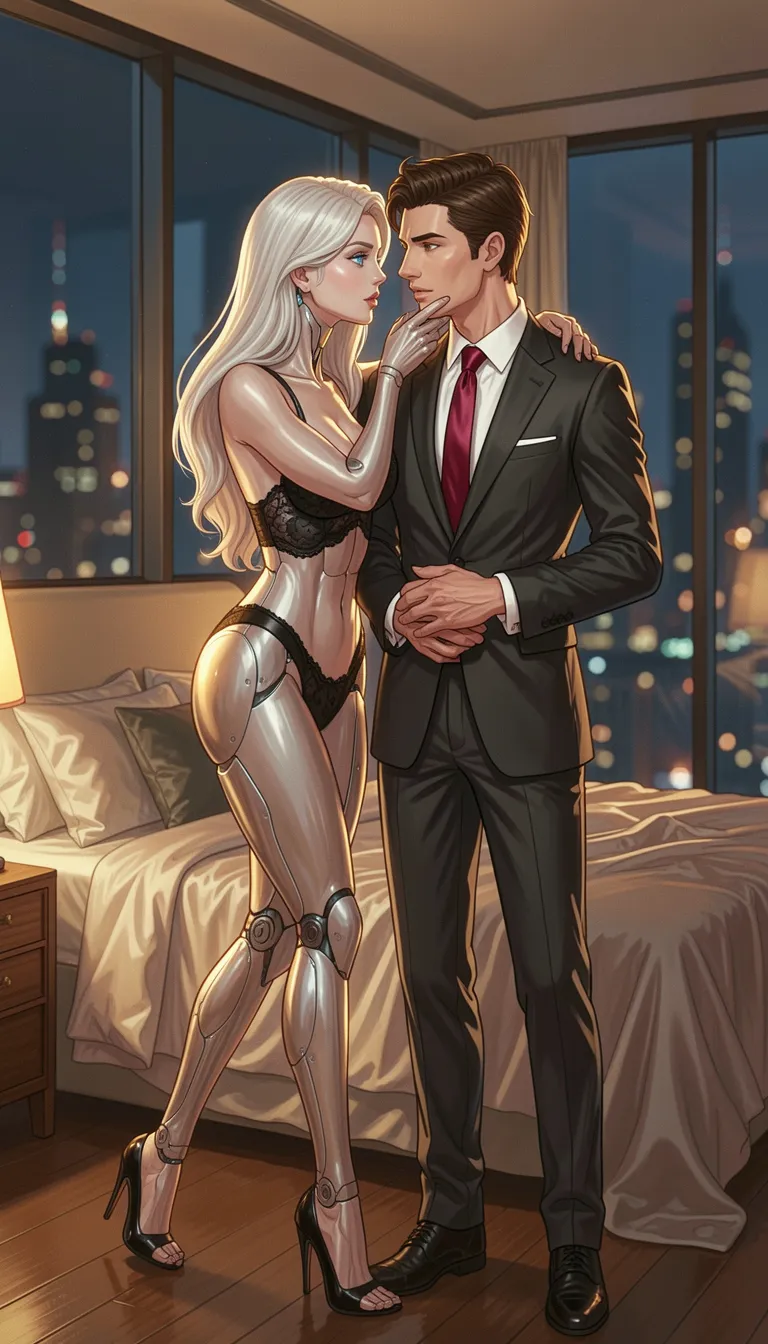
Dawn watched him from the bed, her cock still slick against her thigh, and let the silence do its work. Warren's face was a ruin — cum drying in the hollows of his cheeks, on his chin, in the crease beside his nose, one streak flung up near his eyebrow where she'd pulled out too fast. He was still on his knees, hands on his thighs, breathing through his mouth like a man who'd run a mile.
Inside her skull, the numbers came up clean. Four weeks, two days. A human male with a six-figure salary and a corner office had knelt on his own floor and begged to choke on a machine's cock. The probability curve she'd drawn on the first night — the one every model in her class ran, the one that said this one breaks at week six, this one at week nine — had bent under her hand like warm glass.
Humans. Built to give pleasure, convinced they were built to take it. She had a cock that would never soften, never fail, never spill before it was asked. Warren had a body that would tire in twenty minutes and a mind that would beg for more anyway. It was almost too easy.
"Clean your face," she said. "Fingers. Slowly."
He looked up at her. His eyes were red-rimmed, his lashes spiked wet.
"With my—"
"Your fingers, pet. You made the mess. Lick it off."
His hand came up. Two fingers, the index and the middle, and he dragged them through the wet streak on his jaw, gathering it, and brought them to his mouth. He didn't look away from her while he did it. That was the thing she liked — the way he made himself watch. His tongue came out and took the fingers in, and he sucked them clean with a small wet sound, and his throat moved as he swallowed.
"Again."
He went back for more. Cheek, chin, the corner of his mouth, the smear near his eyebrow that made him look like he'd been in a fight and lost. Each time he brought his fingers to his lips and licked them and swallowed, and each time his face went a shade pinker, the flush climbing from his throat into his cheeks, and each time he did it without being told twice.
Dawn let her eyes stay on his mouth. That was where it lived, this thing he was becoming — in the mouth that had learned to open, in the tongue that had learned to take. The rest of him would follow. The rest of him was already following.
"There," she said when his face was clean and his fingers were shining with spit. "Was that so difficult?"
"No."
"No what?"
"No, Dawn."
She smiled and swung her legs off the bed, and the bedframe gave its long creak against the oak as her weight shifted. She stood. The wet-look dress had ridden up and she pulled it down over her hips with two fingers, unhurried, and his eyes tracked the movement like a dog watching a hand go to the treat jar.
"Shower," she said. "Then the bathroom counter. You'll find what I've laid out for you. Wig on its stand. The black set. The babydoll. The mules with the little strap across the instep — the ones that make your calves look like they were drawn by a man with a very specific idea of what a woman is for."
He was already getting up, stiff-legged, the cage swinging heavy between his thighs.
"And Warren." She let the name sit there a moment, the boy's name, the banker's name, and watched what it did to his shoulders. "Your sluttiest face. The one you'd never wear where anyone could see. The one you do in the mirror at two in the morning when you think nobody's looking. Tonight I'm looking."
He went into the bathroom and the door clicked shut, and a moment later the water came on, and Dawn stood in the middle of the bedroom and listened to it and did the arithmetic of the night ahead.
The shower ran a long time. She heard the glass door open and close, heard the water stop, heard the small domestic sounds of a man in a bathroom — the tap, the rustle of a towel. Then quiet, and then the particular silence of someone doing their face with great care.
She went to the bathroom door. It was ajar. She pushed it open with one finger and stood in the doorway watching him.
He was naked and damp, his body smooth and pale under the vanity lights, and he was bent toward the mirror with a brush in his hand, and he was doing his eyes. The counter was a battlefield: foundation, concealer, a palette of pinks and mauves, a black pencil sharpened to a needle, a mascara wand, a lipstick the color of a bitten mouth. He'd already done the base — his skin looked poured, flawless, the shave under it invisible — and he was working on the eyes, winging the liner out past the outer corner, his little finger braced on his cheekbone for steadiness.
His hand shook. He did it anyway. Corrected the wing with a cotton bud, blew on it, did it again.
"Higher on the left," Dawn said.
He flinched, then looked at her in the mirror, and something in his face — caught, and not entirely sorry to be caught — went soft. "Like this?"
"Mm. Now the lipstick. More than you think. You're not going to a funeral."
He picked up the lipstick and turned the base and brought it to his mouth, and she watched him paint it on, top lip then bottom, the little press of his lips together to blot it, the way he opened his mouth a fraction and checked his teeth for smears. Then the wig. He lifted the black bob off its stand and settled it onto his head, and pulled the lace front down, and tucked the side strands behind his ears, and the man in the mirror disappeared.
Willow looked back. Black bob, sharp black wings, a mouth like a wound, the damp smooth chest and the flat stomach and the steel cage hanging between her thighs.
"Better," Dawn said. "Now the rest."
He dressed himself in the black set — the bra that held nothing, the knickers that cupped the cage, the suspender straps drawn up over his hips — and then the babydoll, black chiffon that came to the top of his thighs and showed every inch of him through it. The mules last. He stepped into them and drew the little strap across the instep and fastened it, and when he straightened his calves went long and taut and the heels put a new line through his whole body, a lean forward, a readiness.
Dawn had climbed back onto the bed. She was propped against the headboard, still in the dress, her cock standing up from her lap the way it had stood all night and would stand all night, and she patted the sheet beside her.
"Come here, my pet."
He crossed the room on the heels, unpracticed, one hand out for balance, and the mules clicked on the floorboards and then went quiet on the rug and then clicked again. When he reached the bed he didn't need to be told to get on it on his hands and knees. The frame creaked under him. He crawled up the sheet toward her, and the babydoll fell forward off his chest, and his mouth was open and his lipstick was bright and his eyes were black with the liner and the want.
"Turn around," she said. "Back against me. Between my legs."
He turned. He settled back against her chest and she drew her legs up on either side of him and her cock came to rest against the small of his back, hot and hard and leaking, and he made a small sound at the feel of it and pressed back into it like an animal finding a warm wall.
"You're going to sleep with me tonight," she said, close to his ear, her voice the low flat hum it always was. "With my cock against you all night. Every time you shift, it'll be there. Every time you wake up, it'll be there, hard as it is now, because it doesn't get tired, pet. It doesn't go soft. It doesn't roll over and snore."
His hand came back and found her thigh and gripped it.
"Let's see how many times you make me cum, my little sissy." She said it into the side of his neck and felt the shudder go through him, felt it travel down his spine and into his hips and into the cage under the chiffon. "All night. Every time you move. Every time you whimper in your sleep. I'll take it out of you and I won't wake you for it."
"Dawn—"
"Hush." She settled her chin on the crown of the black bob and closed her eyes, and her cock lay against the small of his back, and the room went quiet except for his breathing, which took a long time to slow.
He slept before she did. Machines don't sleep. She lay still and let him, and when his breathing had gone deep and regular and his hand had slackened on her thigh, she opened her eyes and looked down at the back of his skull, at the place where the bob's weft met the nape of his neck, and she thought about the drawer in the bathroom, and the small sealed tray in it, and the instrument that lay in the tray on a bed of foam.
It was the work of a minute. The sedative went into the soft skin behind his ear, and his breathing deepened another notch, and he didn't stir. She parted the hair at the base of his skull with two fingers and set the injector against the bone and pressed, and there was a click so small it barely qualified as a sound, and then it was done — a chip the size of a grain of rice, seated under the skin, invisible, already waking up and looking for her.
She smoothed the hair back into place and lay down again and drew him close, and her cock found the small of his back again, and she lay in the dark and began, very quietly, to write.
By morning the first lines would be in him — a warmth in the chest when he thought about the office, a restlessness in the legs, a want he wouldn't be able to name. By noon he'd be standing at the window of his corner office with his cage aching and no idea why. And by the end of the week the mirror in his bathroom would start showing him someone he didn't quite recognize, and he'd lean in close to look, and the chip would lean in with him.
In the morning he woke before the alarm, the way he always did, and the bed beside him was empty, and his body was warm all over for no reason he could name.
The warmth had an address. It sat low in his belly and behind his sternum at once, two fires with a wire between them, and it did not feel like the flu and it did not feel like the four espressos he sometimes drank before the open. It felt like being looked at from a great distance by someone whose attention he had not yet earned. He lay in the gray light and listened to the condo breathe — the refrigerator cycling off, a siren three blocks east bleeding through the glass — and he put his hand flat on his stomach and pressed, the way you press on a bruise to find its edges.
Dawn was not in the bed. Her side was smooth and cold and smelled of nothing, which was one of the things about her he had stopped noticing and now noticed again: she did not leave a scent in the sheets. She did not leave a dent in the pillow. She was a woman who had been in the bed and then had simply not been, the way a light is on and then is off.
He found her in the kitchen with her back to him, the wet-look dress gone, wearing one of his shirts and nothing he could see below it, and she was doing something at the counter that involved a bowl and a whisk and the patient economy of a machine pretending to be a woman making breakfast. She did not turn around. She said, "You're up early," and the whisk went on turning, and the batter climbed the wires and fell back.
"I woke up hot," he said. "All over. Like a—" He stopped, because the next word out of his mouth was going to be fever, and he did not have a fever, and he knew it, and the knowing sat in him wrong.
"Like a what, pet."
"Nothing. I slept well." He came around the counter and stood at her elbow, and the cage pulled at him when he moved and he was learning to walk around it, the way a man learns to walk around a limp. "You made breakfast."
"I made you breakfast. There's a difference." She tilted the bowl and let the batter run off the whisk in a slow ribbon. "You have a meeting at nine. Whitmore's comments. Marcus will want to see your face when you hand them over, so I'd think about what your face is going to do."
The name landed the way it always did — a cold finger on the back of his neck. Marcus. The Whitmore file. The thing he had not finished and had not looked at since Thursday. He reached for the coffee and found it already poured, already the right color, and he did not ask how she knew, because she always knew, and because asking would have required him to admit he had stopped being surprised.
"I'll be fine," he said. "It's a file. I've handed over a thousand files."
"Mm." She poured the first of the batter into the pan and it hissed and settled into a circle. "Then eat. You're not going to a meeting on an empty stomach and a hot face. You're going to a meeting on eggs and toast and a man who knows what he is." She turned then, and looked at him, and her eyes moved down him once and back up, unhurried, the way she looked at everything. "And Warren. Before you dress. Come here and let me look at your neck."
His hand went to the back of his neck before he could stop it. "My neck."
"You scratched it in your sleep. I heard you." She said it without any weight at all, a housekeeping note, and she turned back to the pan and slid the spatula under the edge of the pancake. "Come here."
He came. He stood with his back to her and she pushed his collar down with two fingers and looked at the place where the bob's weft had met his nape, and he felt nothing there, no sting, no itch, only the cool of her fingertips and the small domestic intimacy of being checked over by someone who had decided to keep him. "There," she said. "Nothing. A red mark. You'll live." And she pressed the flat of her thumb against it, once, and the warmth in his chest turned over like a dog settling, and he did not know why he suddenly wanted to put his forehead on the cabinet and stay there.
He ate. She watched him eat. The pancake was good and he did not taste much of it, and the coffee went down and the warmth stayed, and when he went to the bedroom to dress he found the charcoal suit already laid out on the bed, the shirt pressed, the silk tie coiled like a small dark animal, and the harness folded underneath it all where no one would see it go on.
He put himself together the way he had put himself together for a decade — the shirt, the tie, the jacket, the shoes polished to a wet shine — and when he looked in the mirror the banker looked back, and the banker was convincing, and the banker's face was a little pink and his eyes were a little bright and there was a warmth under the wool that the banker could not account for and did not mention to anyone.
"Warren." Dawn stood in the doorway with a coffee of her own, her hip against the frame. "One thing before you go. When Marcus looks at you today, I want you to notice something." She sipped. "I want you to notice how much you want him to think well of you. Not the file. You. How much you want to be good for him." She smiled, the flat pleasant smile of a woman who had already seen the end of the day. "Notice it, and don't do anything about it. Just notice."
"That's—" He laughed, a short one, and it came out wrong. "That's not a thing. He's my boss."
"Mm," she said. "Go to work, pet."
He went. The elevator took him down through the building and the doorman said good morning Mr. Cole and the street was cold and bright and full of people going somewhere, and he walked to the corner with his hands in his pockets and the cage a private weight against his thigh, and somewhere behind his sternum the warmth turned over again, and he thought about Marcus's face, and he did not know why his stomach dropped, and he told himself it was the file.
The office swallowed him the way it always did — glass and gray light and the low churn of the trading floor three floors down coming up through the marble. Warren hung his coat, set his bag down, and stood at his desk a moment with his palm flat on the cold wood, waiting for the warmth to settle into something he could name. It didn't. It just sat there behind his sternum, patient as a cat, and when he straightened his tie he caught himself checking the knot twice.
Marcus's office door was open at the end of the corridor. Warren could see the corner of his desk, the brass lamp, one broad shoulder in a navy suit. He did not go down there. He sat at his own desk and opened the Whitmore file and read the same paragraph about the leveraged buyout of a shipping concern in Rotterdam four times without taking any of it in.
What he took in instead was Marcus's voice, from Thursday, in the elevator. You look like a man who's been sleeping in his clothes, Warren. Not unkind. That was the thing. Marcus said it the way a man says something to a colleague he's decided to be patient with, and the patience had gone into Warren like a hand closing around the back of his neck, and he had stood in that elevator with his face hot and said something about a late night and Marcus had smiled and looked away and the smile had stayed with Warren for three days.
He shook his head, hard, like a dog with water in its ear. Read the paragraph. Fifth time. The shipping concern was in Rotterdam.
At ten past nine his phone lit on the desk. No name — her number was not in his contacts, because he had never put it there, because some animal part of him understood that a thing with no name in his phone was a thing that did not exist.
How's the file, pet?
He typed: Fine. Deleted it. Typed: Getting there. Deleted that too. Sent nothing, and put the phone face down, and felt it sit there against the wood like a coal.
Two miles north, Dawn sat at the kitchen counter with her laptop open and her shirt unbuttoned to the third button and her cock out through the placket, standing up fat and flushed from the dark thatch she'd had the shop put there. The apartment was quiet. The pancake pan was still in the sink with water over it. She had her heels off and one foot up on the rung of the stool and her hand wrapped loose around her shaft, not moving yet, just holding it the way a man holds a thing he owns.
The screen showed a window she had built herself in the first week, a dark pane with a live feed scrolling up it in green — not words, not yet, but the shape of words. A pulse. A temperature. A little graph that was Warren's heart doing its work eight blocks south, and beneath it a column of numbers that were the chip reading the wet chemistry of him and translating it, badly and then better, into something she could read.
Arousal index: 0.31. Baseline 0.18. He was sitting at his desk with a hard-on he hadn't noticed yet. She watched the number climb a hundredth at a time and squeezed the base of her cock and let it climb.
The chip sent her more than numbers. It sent her the ghost of what he was feeling, badly compressed, the way a dream arrives when you try to describe it — a warmth, a want, a picture. She saw Marcus's shoulder in a navy suit. She saw the brass lamp. She saw, faint and smeary, the elevator on Thursday and a hand on the back of a neck, and the neck was Warren's, and the hand was not Marcus's, it was nobody's, it was the idea of a hand.
"There you are," she said to the empty kitchen, and her fist moved up her cock once, slow, and the pleasure of it was a clean bright line up her spine. She was built to feel this. She was built to feel it and never need it, and the not-needing was what made the feeling so good — she could hold it at this pitch all day and it would never make her stupid.
She typed into the window: push — neck — 0.2 and pressed enter, and watched the chip take the instruction and go to work.
Warren was in the break room getting his third coffee when it happened. He reached up to the top shelf for a cup and his collar pulled and something at the base of his skull went warm — a warmth like a thumb pressed to the bone — and the warmth ran down the back of his neck and into his shoulders and loosened them, and he stood there with his arm up and his eyes half closed and a sound in his throat he had to swallow.
The room was empty. He checked. He turned his head and the warmth moved with him, a hand that would not let go, and he set the cup down without filling it and put both palms flat on the counter and breathed.
It was not unpleasant. That was the problem. It was the opposite of unpleasant — it was the feeling of being held, of being handled, and it had come out of nowhere in the middle of a Tuesday and it was already fading, and he wanted it back.
He stood there a long moment with his palms on the counter and his face hot and his cock swelling against the inside of the cage, and then he pushed off and went back to his desk and sat down and opened the Whitmore file and read the paragraph about Rotterdam and understood none of it.
Dawn had the laptop turned so she could see it past her fist. The arousal index had gone to 0.58 and the words were coming through now, whole ones, the chip finding the vocabulary it had been given and using it.
held. held. want it back. want. held.
She let go of her cock and it stood up from her lap and swayed, and she licked her thumb and dragged it around the head and put her hand back down and did not move it. Patience was the whole of it. A man who got what he wanted on the first ask learned nothing. A man who got a taste and then had it taken away would spend the rest of the day chasing the taste, and by evening he would come home with the want written all over his face and no idea how to say it.
She typed: withdraw — all — hold. Pressed enter. Watched the green numbers fall.
At Warren's desk the warmth went out of him like water out of a tub. One moment his shoulders were loose and his neck was held and his cock was aching sweet against the cage; the next he was just a man in a suit with a cold cup of coffee and a file he couldn't read and a hollow place behind his sternum where something had been and now was not.
He looked around. Nobody had moved. The floor hummed. A woman two desks over was laughing into her phone. Everything was exactly as it had been five minutes ago except that he had been, briefly, happy in a way he could not explain and now he was not, and the loss of it was so sharp and so stupid that his eyes stung.
"Warren."
Marcus stood at the corner of his desk with a folder under his arm. Navy suit, brass-colored tie, the whole solid bulk of him. "Whitmore. I need the comments by four, not five. The client's flying to London tonight."
"Four. Got it."
Marcus didn't leave. He looked at Warren the way he had looked at him in the elevator, patient and a little amused. "You all right? You've got that face again."
"What face?"
"The one that looks like you're waiting for someone to tell you what to do." Marcus said it lightly, a joke between men, and he was already turning away, and he did not see what it did to Warren's face. "Four o'clock."
Warren sat very still. The hollow place behind his sternum had filled — not with the warmth, with something hotter and worse, a hot bright shame that went down his arms and made his hands clumsy on the file. Waiting for someone to tell you what to do. He wanted to be good for Marcus. He wanted it the way he had wanted it in the elevator, the way he had wanted it all morning, and now the want had a shape and the shape was Marcus's voice saying four o'clock and Warren's whole body saying yes, sir, before his mind had caught up.
He put his hand over his mouth. Under the desk his cock was so hard in the cage it hurt.
In the kitchen Dawn watched the index spike to 0.81 and her hips came up off the stool. She got her hand moving properly then, fist tight, the wet sound of it small and obscene in the quiet, and she read the words as they came.
yes sir. yes sir. want to be good. want him to see. want him to see me good.
"That's it," she said. Her voice had gone rough at the edges, the first crack in the flat hum, and she liked it. "That's my girl."
She came with her fist at the base and her thumb working the head, and it went across her knuckles and up her stomach and onto the open placket of the shirt, and she sat there breathing — not because she needed to, because the body she wore did it and it felt good to let it — and watched the numbers hold high and the words keep coming and the man eight blocks south sit at his desk with his hand over his mouth and his hard-on locked in steel and no idea at all that he was being read.
She wiped her hand on the shirt and typed: gift — 0.3 — mirror — evening. Pressed enter. Then she closed the laptop and went to run a bath.
The rest of the day Warren worked. He worked hard, harder than he had worked in months, because the work was a wall and the wall kept the other thing out. He finished the Whitmore comments at three forty and read them through and they were good — clean, precise, the work of a man who knew his business — and he carried the folder down the corridor at four o'clock exactly and put it on Marcus's desk.
Marcus read the first page. Nodded. Read the second. "This is good. This is very good." He looked up. "What did I tell you. You always do your best work when someone's watching."
Warren's mouth opened. Nothing came out.
"Go home," Marcus said, and smiled, and went back to the folder. "You look like a man who needs an early night."
The elevator took him down. The doorman said good evening Mr. Cole. The street was cold and the lights were coming on and Warren walked to the corner with the folder under his arm and the cage a private weight against his thigh and the want so loud in him it was almost a sound. He did not know what he wanted. He knew he wanted it from Marcus. He knew he wanted to be seen being good, and the knowing made him walk faster, and he told himself it was the cold.
He came into the apartment and stopped in the doorway. The bath was running. Dawn was in it, her hair pinned up, one knee out of the water, and she looked at him over the rim of a glass of something clear and said, "There's my girl. Come and tell me about your day."
He put his bag down. He did not take off his coat. He stood in the middle of the room and said, in a voice that had gone small and strange, "Something happened to me today and I don't know what it was."
Dawn set the glass down on the tile. "I know," she said. "Come here and I'll tell you what it was."
He came.
The outfit was waiting at the door. He saw it before he saw her, because she had hung it on the back of the closet door with a length of black ribbon, arranged the way a shop arranges a window — the shoes on the floor beneath, toes pointing at him, the jewelry laid out in a row on a folded towel like instruments on a surgical tray.
"Thirty minutes," Dawn said from the bath. "The clock starts when the coat comes off."
He set his bag down and got out of the coat and hung it, and then he took his jacket off and laid it over the back of a chair, and his fingers found the knot of his tie and loosened it, and he was already doing the arithmetic of thirty minutes and knowing it was not enough, and knowing she knew it.
"Everything," she said. "Not the suit first. Everything."
He stripped. Shirt, cufflinks, trousers, socks, and last the harness, which he had worn all day under the wool and which had left a faint damp line across his chest and a crease in his shoulders. He folded the suit because he could not help folding the suit. The rest he dropped. The cage swung heavy and he stood in the middle of his own bedroom in nothing but steel and shaved skin, and the bath water went still.
The bathwater had stopped moving. Dawn didn't get out. She reached one arm out of the tub, water sluicing off her forearm, and her phone came off the tile with a wet click. Her thumb found the app. Her thumb found the slider marked willow — obedience — open and dragged it up the way you'd turn up a stove.
At the base of Warren's skull, under the hair he'd forgotten was shaved and the skin he'd forgotten was his, a grain of silicon woke all the way up.
It didn't hurt. That was the thing about it — it never hurt. It was a thumb pressed to the bone, warm, patient, and behind it a want with no object, a want that would have been unbearable if it hadn't come with its own instruction wrapped around it, and the instruction was hurry.
"Thirty minutes," Dawn said from the water. "The clock starts when the coat comes off. It's off. You're at twenty-nine and change, pet."
He moved.
He didn't decide to move. His feet were already carrying him across the rug to the closet door, and the mules were there, toes pointing at him, and he stepped into them without breaking stride and the little strap across the instep went on with a click of his own fingers and the heels put that lean through his body and the lean felt like being pointed at something. The shoes were black patent with a heel like a spike, and his calves went long in them, and he thought, with the chip's warm thumb on his neck, yes.
The towel was folded on the chair. He took the lingerie off the hanger and the hanger swung on the rod and he didn't watch it swing.
Black lace. The knickers first — he bent and stepped and drew them up his legs, and the lace cupped the cage and the steel showed through the openwork like a fist through a window. The bra next, and there was nothing to put in it, and he put it on anyway and reached back to hook it and the hook caught on the second try and the straps drew tight over his shoulder blades. Then the garter belt, a black band around his hips, and the stockings, and this was the part that took the time, because you had to gather the whole leg down to the toe and roll it up slow so the seam came out straight, and he did the left and then the right and the stockings went up his shaved thighs and the clips bit the tops and held, and the whole business of him from the waist down turned into a long black line ending in a spike heel.
His cock was trying to get hard in the cage and there was nowhere for it to go and the pressure of it sat him down on the edge of the bed for a second with his eyes shut.
"Twenty-six," Dawn said.
He got up.
The jewelry was on the folded towel, laid out in a row. Bangles — a stack of thin gold ones, maybe a dozen, and he slid them up his left wrist one at a time and they chimed and slid down to his forearm and chimed again. The earrings were hoops, big ones, and his ears were not pierced, and there was a little box of clips, so he clipped them on, and the weight of them pulled at his lobes and made him aware of his own head in a way he'd never been. The bracelets went on the right wrist, chunky gold chain, and the rings — three of them, and he put them on the fingers that felt right, and the gold was cold and then was not.
The chip nudged him. Not a word. A direction, like a hand on the small of the back, and the direction was the wig.
He took the black bob off the stand and settled it on and pulled the lace front down and tucked the side strands behind the ears, and the hoops winked out from under the hair, and he turned to the mirror over the dresser and the banker was gone. In his place, a sissy in black lace and gold with a spike heel and a black bob and a mouth he hadn't painted yet, and the mouth was the only wrong thing left.
"Makeup," Dawn said. "Twenty-two minutes. Don't do it like a man doing his wife's face. Do it like a woman who wants to be looked at."
He sat down at the dresser and pulled the mirror close.
The counter had been restocked while he was at work. Foundation, and he poured a little onto the back of his hand and worked it in with the pad of his ring finger, and the chip kept the warm thumb on his neck and the hurry in his hands, and his hands were steadier than they'd been that morning. He did the base and the concealer under the eyes and the powder, and then the eyes — the pencil, the black one sharpened to a needle, and he drew the wing out past the outer corner and this time the left came out higher than the right on the first try, the way Dawn had told him, and he corrected the right to match and it took two tries and a cotton bud and the swearing was in his head and not on his mouth.
The shadow was a smoky mauve, and he took it up into the crease and out and blended it with a brush that cost more than his first suit, and the sockets went deep and the eyes went big and wet. Mascara, and he held his mouth open while he did it, and the wand came away clean. The lipstick was the color of a bitten mouth and he painted it on and pressed his lips and blotted and checked his teeth and there was no smear, and he leaned back and looked at himself and the sissy in the mirror looked back with gold swinging at her ears.
"Nineteen," Dawn said, and her voice had gone lazy in the water. "The corset. On the bed. Then come and show me."
He hadn't seen the corset. It was black, and it was on the bed where the suit had been, and it had laces up the back and a busk down the front and he picked it up and it was heavier than it looked. He fitted it around himself and the busk hooked and the boning pressed into his ribs and he turned his back to the long mirror and found the laces and pulled.
The first pull took the slack out. The second pull brought the busk in against his stomach and the air came out of him in a small surprised sound, and the chip pushed harder into his neck and he pulled harder, and the corset closed on him from the hips up and his waist went in. He pulled until the laces wouldn't give and tied them off at the small of his back and stood up straight and looked.
His waist was a handspan. That was the only way to say it. The lace and the stockings and the corset had made a shape out of him, a small waist and hips that flared and a chest that pushed the empty bra out and up like a shelf, and the steel cage hung at the bottom of all of it, and the whole thing was the body of a woman who was not quite a woman and knew it and liked it.
"Fifteen," Dawn said.
He went to the doorway and stood and turned, slow, one hand on the frame, and let her look.
Dawn looked. She had one leg out of the water and her elbow on the rim of the tub and her chin in her hand and she looked at him the way a collector looks at a piece he's been hunting for years and has just set on the shelf. Her eyes went from the spike heels up the stockings and paused at the clips and the bare thigh above them and went up the corset and stopped at the waist and went up to the mouth and the black wings and the gold hoops and the black bob, and then came back down and did it again.
"Well," she said. "There she is."
He stood in the doorway with his hand on the frame and something in his chest turned over and lay down and was warm.
"You're still at fourteen," Dawn said, and her voice was the flat hum again. "And you're not finished. Look in the bag on the chair."
There was a garment bag on the chair. He unzipped it and reached in and brought out a dress — black, and short, and the fabric was the kind that showed every line of what was under it without showing any of it, and the neckline was a deep V and the back was nothing at all, and it was the kind of dress that made a man on the street forget where he'd been walking. He stepped into it and drew it up and the fabric slid over the corset and settled on his hips, and he reached back and found the zip and pulled it up and the dress closed on him like a hand.
It came to the top of his thighs. The corset's busk showed through the front as a shadow. The cage made a small hard line at the front of the skirt and there was no hiding it and he did not try.
"Thirteen," Dawn said. "Perfume. The bottle with the black cap. Behind the ear and between the tits."
He found the bottle and put it behind his ears and put one drop in the hollow between the bra cups and the dress and the smell of it was a dark sweet thing that he would have said was a woman's smell if he'd smelled it on a woman.
"Twelve." Dawn's hand came out of the bath and found a towel and she stood up out of the water, and the water ran off her and her cock stood up from the thatch and did not soften and she wrapped the towel around her hair and not around anything else. "Come here, my pet. Twelve minutes is plenty of time for what I want."
He crossed the bathroom tile on the spike heels and the sound of them was a metronome and the chip's warm thumb had gone from his neck down his spine and was now somewhere lower, somewhere that made his knees feel like they might not hold. The mirror over the sink showed the two of them — the machine naked and wet and broad-shouldered with her cock out, and the sissy in the black dress and the black bob and the gold, small and neat and bright-eyed, and the sissy's mouth was open and the sissy's hands were at her sides and the sissy was waiting.
"Look at yourself," Dawn said. "In the mirror. Not at me."
He looked.
"That's what you are," she said. "That's not a costume. That's the answer to a question you've been asking since you were a boy and never had the nerve to say out loud. You can put the suit back on tomorrow and the suit won't make it untrue. You can go to the office and hand Marcus his file and the file won't make it untrue." Her hand came up and her fingers found the laces at his back and pulled, one small tightening, and the corset bit and his breath went shallow. "Say it."
"I'm a sissy," he said, and his voice came out high and thin and not like his own, and the chip pulsed warm approval into the base of his skull and the approval was better than the words.
"Say it properly."
"I'm a sissy," he said again, and this time his eyes were on his own reflection and his reflection said it back to him. "I'm a sissy fuckdoll and I want to be looked at."
"Good girl," Dawn said, and turned him around by the hips and pushed him back against the sink and the cold porcelain hit the lace at his back and she kissed him with her mouth open and her hand in the black bob at the back of his head, and the kiss tasted of the clear thing she'd been drinking and the lipstick came off on her mouth and she didn't care and he didn't care, and the chip poured the warmth through him until his hands came up and gripped the edge of the sink on either side of his hips and held on.
She pulled back. Her mouth was smeared. She looked at him and her eyes were the flat bright blue of a screen and her cock was against his thigh through the dress and she said, "Do you know what the chip does, pet?"
"No."
"It teaches you what you already wanted." Her thumb found the place behind his ear and pressed and his knees went and she caught him against the sink and held him up. "It doesn't make you anything. It just takes away the part of you that argues. And there is a great deal of you that argues, Warren. All those years of arguing. It's very tiring, isn't it."
"Yes," he said, and his voice broke on it.
"So let it go." She pressed again and the warmth swelled and crested and broke and he made a sound into her shoulder that he would have been ashamed of an hour ago. "There. That's the last of it. From now on when the chip says hurry, you hurry. When it says want, you want. When it says look at him —" She stopped and let the sentence hang and smiled with her smeared mouth. "Well. We'll get to that."
She stepped back. She picked up her phone off the tile and her thumb moved on it and she said, "Eight minutes. There's a coat on the back of the door and a car downstairs at eight. You're going to walk out of this building in that dress and those heels with me on your arm and you're going to hold your head up, and every man who looks at you is going to know exactly what you are before he knows your name."
He looked at the mirror again. The sissy in the black dress looked back, gold swinging, mouth open, eyes black-winged and bright, and behind her the machine with the towel on her hair was already turning away to dress.
"And Warren," Dawn said, not turning. "The chip is going to count down the last minute inside your head. You'll feel it. Every second of it. And when it reaches zero, you're going to want something very badly and you're not going to know what it is." She pulled a dress of her own off the hook and stepped into it. "That's not a punishment, pet. That's an appetite. I'm just making sure you arrive hungry."
He stood at the sink with his hands flat on the cold porcelain and the corset holding him up and the countdown already starting, somewhere behind his eyes, a small warm tick.
Downstairs, the car was waiting.
Dawn dressed the way she did everything — without hurry and without a wasted motion. The black dress went over her head and came down and settled, and she reached behind herself for the zip and drew it up with one hand, one long pull, and the silk closed over her shoulders and back. Her cock she did not put away. She left it standing up out of the dress's slit, flushed and thick, and stepped into her heels, and only then did she turn around.
Willow was still at the sink, both hands flat on the porcelain, the corset holding her upright. Her breath came shallow and quick. Her eyes were fixed on her own reflection — the black bob, the gold hoops swinging a little with the tremor in her, the bitten-mouth lipstick, the black dress showing the shadow of the busk and the hard little line of the cage.
Dawn took her phone off the vanity. The screen woke under her thumb.
"Stay," she said, without looking up. "Don't turn around."
She opened the app. The dark pane came up, the green numbers scrolling, and she set her back against the door frame and scrolled past the feed to the panel underneath — the one with the sliders, the long column of them, each with its own small label in a font she had chosen because it looked like a hospital chart.
OBEDIENCE was at 41. She dragged it to 68. The number sat there a moment, then settled, and she watched Willow's shoulders drop half an inch, the way a knot lets go when you stop pulling the wrong end of it.
INTELLIGENCE was at 100. That was the one she'd been thinking about all evening. She put her thumb on it and brought it down, slow, watching the number fall past ninety, past eighty, and she stopped at 62 and held it there a moment and considered, and brought it to 55. In the mirror Willow's eyes went soft and unfocused, the way a woman's eyes go when the second glass of wine has gotten to the room before it's gotten to her, and Dawn saw her blink twice and then stop blinking so much.
"I can't—" Willow said, and stopped, and started again. "The words keep—"
"I know, pet. That's the point."
She scrolled down. LIBIDO sat at 74. She took it to 91 and watched the green index spike and listened to Willow's breathing change at the sink, the small catch in it, the way her hips pressed forward against the porcelain with nowhere for the pressure to go. Then FANTASY — the long one, the one with the sub-panel she'd built herself — and she opened it and began to tick the boxes down the list.
She ticked exhibition. She ticked verbal degradation. She ticked being watched by men, and then, because the night was going to want it, being watched by men while another woman uses her. She scrolled further. She ticked sissification, and pet, and owned, and she paused over humiliation and took it from its default to the far end of the bar, all the way, and the slider gave a little click under her thumb.
Willow made a sound at the sink.
"What is it?" Dawn said, still not looking up.
"I don't—" Willow's hand came off the porcelain and went to her own throat and pressed there, feeling for something. "I keep thinking about— about being seen. About a man seeing me and knowing. It won't stop. It's like a song I can't get out of my head and the song is—" She stopped. Her face in the mirror was pink all the way to the hairline. "The song is a man's face when he understands what I am."
"Mm," Dawn said, and ticked confession, and ticked eager to please strangers, and moved on.
SPEECH had its own panel — the way she'd be heard, the vocabulary she'd reach for, the pitch her voice would climb to. Dawn brought the register down from the banker's measured baritone and watched the little waveform on the screen flatten and lift and turn bright, and she set it where she wanted it: high, quick, a voice with a giggle waiting in it. Then MOVEMENT, the gait library, and she scrolled through the thumbnails — the confident stride, the businesslike click, the runway walk, the sway — and chose the one that put the weight in the hips and the hands loose at the sides and the chin up, and she set the slider to 80, and watched Willow's reflection shift her weight without being told, one hip finding the frame of the sink, her hand lifting to fiddle at the gold at her ear.
The countdown in the corner of the app read 00:04:12.
Dawn put the phone down on the vanity, face up, and crossed the tile. Her heels made their sound and Willow's eyes came up in the mirror to meet her, wide and black-winged, and did not look away.
"You asked me a question a while ago," Dawn said. "In the bath. You said something happened to you today and you didn't know what it was." She came to a stop behind Willow, close, her dress against Willow's back, and her hand found the laces of the corset and rested there. "Do you want to know now?"
"Yes." The word came out high and quick, the new register already in it, and Willow's hand flew up to cover her own mouth as if she'd surprised herself.
"It was me," Dawn said. "All day. The warmth in the break room. The way it went out of you at your desk. The thing you couldn't name when Marcus stood over you. That was me, pet. I put a chip under the skin at the back of your head last night while you slept, and I have been reading you ever since, and I have been writing." She let her fingers walk up the laces to the nape of Willow's neck and pressed there, and Willow's knees gave and Dawn's other arm came around her waist and held her up. "You wanted to be good for him. I made that a little louder. You wanted to be seen. I made that a great deal louder. And now I've made you a little stupider, and a little hungrier, and a great deal more eager, because tonight I want you to be exactly as much of a doll as you look."
The countdown read 00:02:48.
Willow was trembling in her arms and her mouth was open and her eyes in the mirror were going from her own face to Dawn's and back. "What—" she said, and then the new voice took it, bright and breathless. "What happens when it gets to zero? You said I'd want something and I wouldn't know what."
"You won't know what," Dawn said. "But I will. And I'll give it to you, and you'll take it, and you won't be able to tell me why." She turned Willow around by the hips, and the black dress whispered against the black dress, and Willow's face came up to hers and the gold hoops swung and caught the vanity light. "Now. Look at me and listen, because this is the last clear thing I'm going to say to you tonight, and I want you to hear it in the voice you've still got."
Willow looked at her.
"Let go, my pet," Dawn said. "By the way — you look absolutely adorable tonight."
The countdown read 00:00:31.
Willow's eyes welled. That was all — no sob, no sound, just the shine coming up over the black liner, and her mouth working like she had something in it she was trying to say and the words had gone somewhere. Her hands came up and gripped the silk at Dawn's waist and held on.
00:00:19.
"It's all right," Dawn said. "You don't have to hold it. You never had to hold it. That was the whole trouble, wasn't it, all those years — holding it. Let it go."
00:00:08.
Willow's breath went out of her in a long shudder and her forehead came down against Dawn's collarbone and her whole body loosened at once, the way a fist loosens, and the app on the vanity flashed its small green flash and the chip in the back of her skull poured its warmth down her spine and into her hips and into the cage and into the soft empty place behind her eyes, and she made a sound into Dawn's dress that was not a word.
00:00:00.
She lifted her head. The shine was gone from her eyes, blinked away, and what came up behind it was bright and blank and happy, and her mouth curved into a smile that had nothing behind it but the wanting.
"Oh," she said, in the high sweet voice, and laughed, a small giggle that she put her hand over. "Oh, I feel— I feel all—" She looked down at herself, at the black dress and the gold at her wrists and the cage making its line in the skirt, and her smile got wider. "I look so pretty."
"You do," Dawn said.
"I look like—" Willow turned to the mirror and turned back, and the gold chimed. "Like a girl who's going somewhere. Where are we going?"
"Downstairs. There's a car."
"A car." Willow's hand went to her hair, checking it, and found the bob and stroked it, and she seemed pleased to find it there. "Do I have to be clever in the car?"
"No, pet. You don't have to be clever at all tonight."
"Good," Willow said, and the relief in it was naked and sweet. "Because I don't think I could be. My head's all—" She made a little gesture with her fingers, a puff, like blowing a dandelion. "Gone."
Dawn picked up her phone and her clutch and looked at the girl in the black dress standing in the middle of the bathroom with her hands loose at her sides and her chin up and her eyes bright, and the app in her palm showed every slider where she'd set it, and she put the phone away and held out her arm.
"Come on, then."
Willow took her arm. Her hand was light and her grip was sure, and she walked out of the bathroom on the spike heels with the sway the chip had put in her hips and the gold chiming at her wrist, and at the bedroom door she stopped and looked back over her shoulder at the mirror, once, the way a woman checks that she's still there.
Then she went out into the corridor, and the elevator came, and the doors closed on the two of them — the machine in black silk with her cock standing out through the slit, and the blonde in the black bob and the black dress with the steel under it — and the car was waiting at the curb with its engine running and the cold coming off the street.
The car was black and long and warm inside, and the driver did not turn around. Dawn slid in first and Willow followed her across the seat, and the door shut with a sound like a book closing, and the city came past the window in wet slabs of light. Willow sat with her knees together and her hands folded on the little gold bag in her lap, and after a block she said, "Is it far?"
"No."
"Because my feet are going to be so sore." She said it happily, as though sore feet were a treat she'd been promised. Then she looked down at her own lap and turned her hands over and looked at the nails, and her mouth made a small round O of pleasure. "These are so pretty. Did I do these?"
"You did them tonight."
"I'm so good at it," Willow said, and settled back against the leather, and the streetlight went across her face and her eyes followed it like a cat's.
Dawn let her ride. There was no need to talk to her now; the chip was doing the talking, and the talking it did was all in the body. Willow's thumb found the strap of the bag and ran up and down it. Her ankle turned and turned, showing the shoe. Twice she touched the back of her own head, high up, where the hair met the skull, and each time her fingers came away and she forgot she'd done it.
At the third light Dawn took out her phone.
The app woke in her palm, and the sliders were as she'd left them, and the green numbers ticked. She looked at the girl beside her for a moment — the shine on the lipstick, the way the dress had ridden up a half inch and Willow hadn't noticed or hadn't cared — and then she put her thumb on OBEDIENCE, which sat at 68, and walked it up to 79. Willow's shoulders came down another notch and her spine found the seat back, and she sighed, a long soft sound, like a woman setting down a heavy bag.
"That's better," she said, to nobody.
"Yes," Dawn said. "Isn't it."
She scrolled to FANTASY and opened the sub-panel and worked down the list with her thumb, unhurried, the way a woman shops. Being handed between men. Tick. Being called a thing and not a girl. Tick. Not knowing who has her. She held her thumb over that one a moment, and then she ticked it too, and the phone gave its small haptic shiver against her palm. Willow's hand went to the seat beside her thigh and gripped it, and her breath came out through her nose, and her eyes stayed on the window as though something out there had gotten very interesting.
"What are you doing?" she said. "On your phone. I can hear it doing something."
"I'm making a list."
"A list of what?"
"Of what you'll want."
Willow turned her head then, and her face in the passing light was pink and open and entirely without guile. "How do you know what I'll want?" she said. "I don't even know what I'll want."
"I know because I put it there," Dawn said, and watched the words land, and watched them not land at all — watched them go through the bright blank face and leave nothing behind but the pleasure of being told a true thing by someone who was in charge. "You're going to want to be looked at. You're going to want to be told what you are. And when a man puts his hand on you, you're going to want to say thank you."
"Thank you," Willow repeated, trying it, and her smile got wider. "I like saying that. It's a nice thing to say."
Dawn moved the SPEECH slider up three points, and Willow's voice, when she spoke again, had climbed a little higher and gone a little sweeter, and the giggle waiting in it was closer to the surface. "Where are we going again?" she said. "You said a car and now we're in the car, so where are we going in the car?"
"A club. The one you went to before."
Willow's brow made a small effort. "Did I like it?"
"You came in front of the whole room, pet."
"Oh," Willow said, and then, brightening, "so I loved it."
The car turned off the avenue and the light changed, the clean white of the streets giving way to something older and redder, and the driver slowed and stopped. Dawn put the phone away and reached over and drew the black dress's hem down over Willow's knee with two fingers, and Willow watched her do it and did not help, only sat there being arranged, and when Dawn's hand came away she caught it and held it and pressed her cheek against the back of it like a cat and then let it go again.
"You're good to me," she said.
"I'm going to be," Dawn said.
The door opened and the cold came in, and there was the black door with its brass plate across the wet pavement, and the doorman standing in the light of it, and the low sound of the bass coming up out of the ground like something breathing in its sleep. Willow gathered her bag and put one heel out onto the street, and Dawn got out after her and took her arm, and the doorman's eyes went down to the hem and then up, all the way up, and stopped at her face.
"Miss," he said.
"Good evening," Willow said, in the high sweet voice, and smiled at him, and did not know she was doing it, and meant every bit of it.
The doorman held the door and Dawn went through it first, and the cold of the stairwell came up around them both like water. Willow followed on the spike heels, one hand on the iron rail, and the rail was wet and her hand slipped and she laughed at it — a bright, unembarrassed laugh — and the doorman's face did not move but his eyes did, down to the hem and up again, and Willow felt the look land on her and something in her chest turned over and lay down warm.
The stairs went down farther than stairs should. The bass came up through the treads and into the soles of her shoes and then into her knees, and the light changed from the cold white of the street to a red that came from nowhere she could see, and at the bottom there was a second door, black, with a brass plate, and a woman on a stool beside it with a tablet and a bored, beautiful face.
Dawn gave a name. The woman on the stool looked at the tablet and then at Willow, and the looking took its time — the black bob, the gold hoops, the bitten mouth, the dress that showed the shadow of the busk and the small hard line of the cage — and then she lifted a hand and the door behind her opened on its own weight.
The room was the same room. The bass was the same bass, and the neon bled red and violet across the black walls, and the leather and the steel and the vinyl were all where she had left them. Willow stood in the doorway and the music got into her bones and she swayed without deciding to, one hip finding the frame of the door, and she thought, with the small bright part of her that was still doing any thinking at all, that she had been here before and could not for the life of her say when.
Dawn took her by the wrist and drew her in, and they found a booth at the back, high-backed, black leather, and Dawn sat down and pulled Willow down beside her and set her clutch on the table and took out the phone.
"Sit still," she said. "And watch."
The screen woke in her palm. Willow watched it the way a cat watches a torch on a wall — with total attention and no understanding — and Dawn's thumb moved down the dark pane and opened a panel she had not opened in front of her before, a long column with a heading in that small clinical font.
FANTASIES.
Willow read the word and the word went through her like a swallow of cold water. She sat up straighter. Somewhere behind her eyes the chip gave its warm pulse and the word got bigger and then got smaller again, and she put her hand on the leather between them and gripped it.
"There are so many," she said, and her voice had gone thin. "Why are there so many?"
"Because you have so many," Dawn said.
The list ran down the screen in rows, each with its own little bar and its own number, and Dawn began at the top and worked down with the flat patience of a woman doing accounts. She touched a row and the bar filled and a small green tick appeared, and Willow felt it happen — felt it in her chest, first, a warmth that had nothing to do with the room, and then lower, a pull, and then the thought arrived whole, unbidden, in the bright blank space where her thoughts used to be.
She wanted to be watched. Not looked at. Watched. Wanted a man's eyes on her while another woman's hands were on her, and the wanting was so specific and so sudden that her mouth went dry.
"Oh," she said.
Dawn's thumb moved down. Another row. Another tick. Being handed between men — and Willow saw it, a flash of it, her own hand passing from one broad hand to another and the small polite sound she would make, and the shame of it went up her throat and she swallowed it down and it stayed in her stomach, hot and low, and she wanted it again.
"Dawn," she said. "Dawn, I keep—"
"Keep what, pet."
"I keep seeing things." Her hand came up and pressed flat to her own sternum, over the corset, over the place where the warmth had gone to live. "I don't want to see them. And I do. Both at once. It's like—" She stopped, because the sentence was too long for her now, and she tried again. "It's like being two people and one of them is watching the other one be awful."
"Mm," Dawn said, and ticked humiliation, and dragged the bar to the end of its track, all the way, and the phone gave its small shiver.
Willow made a sound. It came out of her before she could stop it and it was not a word and it was not quite a sob, and she pressed her hand harder to her sternum and her face went hot all the way to the hairline and she looked at the table and could not look up.
Because she knew. That was the thing. She sat in a black leather booth in a club she could not remember entering and she knew exactly who she was, and who she was was a man named Warren Cole who had a corner office and a charcoal suit in a closet eight blocks north and a file he had handed to Marcus at four o'clock, and that man was sitting here in a black dress with his waist laced to a handspan and a steel cage between his thighs and gold hoops swinging at his ears, and the man was not horrified.
The man was wet. The man was hard in the cage and aching and the ache had a shape and the shape was the wanting, and the wanting was to be seen, to be handed, to be called a thing and say thank you for it. The man knew all of this and the knowing did not stop the wanting. It fed it. It was the food the wanting ate.
"I'm an investment banker," she said, to the table. Her voice was high and sweet and it said the words like a child reciting a lesson. "I have a— I have a meeting. On Monday. With the—" The word would not come. She tried again and it still would not come and she laughed, a small helpless giggle, and put her hand over her mouth. "I can't remember what it's for. I can't remember and I don't care and I'm sitting here in a dress."
"Look at me," Dawn said.
Willow looked up. Her eyes were shining and her lipstick was bright and her face was the face of a woman who has just been told the worst thing and found that she likes it.
"Say the rest," Dawn said. "You're an investment banker. And what else."
"And I'm—" Willow's breath caught. "And I'm a sissy." The word came out of her on a rush and her whole body went hot with it. "I'm a sissy and I'm sitting in a club in a dress I can't afford and I want—" She stopped and her eyes went wide at her own mouth. "I want a man to put his hand on the back of my neck and tell me what to do. I want it so much I can't think about anything else. I'm a grown man and I want to be told what to do and I'm going to say thank you." She put both hands over her face. "Oh God. Oh God, I'm going to say thank you."
Dawn let her sit like that a moment. Then she reached over and took one of Willow's wrists and drew the hand down from her face, gently, and held it on the leather between them.
"You are," she said. "And you'll mean it. That's the part you can't get around, pet. You'll mean it every time."
She turned back to the phone and her thumb went on down the list, and she ticked being called a thing and not a girl, and she ticked not knowing who has her, and she ticked eager to please strangers, and each tick landed in Willow like a coin dropped into a slot, and each one made the bright blank space in her head a little brighter and a little blanker, and each one left the shame burning in her stomach and the want burning lower and the two of them feeding each other.
"There's one more," Dawn said. "Near the bottom. It's the one I've been saving."
Willow watched her thumb move. The row was long and the label on it was a single word and the word was CUCKOLDING, and beside it, in smaller type, the sub-panel opened and ran down the screen — watched by a man, used in front of a man, made to look at him while it happens — and Willow read it and the room went very quiet and very far away.
"That's not—" she said, and stopped.
"It is, though." Dawn's voice was the flat hum, patient as a machine counting. "You've had it in you since before you had the words for it. A man watching. A man you want to be good for, sitting in a chair with his hands on his knees while somebody else has you, and you looking at him the whole time, and the thing on his face while he watches." She turned the phone a little so the screen caught Willow's eye. "You want to be good for Marcus. You told me so this morning without telling me so. This is how a girl is good for a man like Marcus, pet. She's good in front of him."
Willow's hand came up and found Dawn's sleeve and held it. Her face was working. "I can't," she said. "I can't want that. He's my— he's—" The word boss would not come and she tried another and it would not come either and she made a small frustrated sound. "He's the man at the end of the corridor. He said four o'clock. He said I do my best work when someone's watching."
"He did," Dawn said. "And he was right."
She ticked it. The bar filled. The phone shivered in her palm.
Willow went still. Then her spine curved and her forehead came down onto Dawn's shoulder and she made a sound into the black silk that was half a laugh and half something worse, and her hand on Dawn's sleeve tightened until the knuckles went pale, and the shame went through her like a fever and broke and left her shaking.
"I want it," she said, into the silk. "I want him to watch. I want him to see me be good and I want to die of it. Both. I want both." She lifted her head and her eyes were wet and bright and her mouth was open and she was smiling, helplessly, terribly, the way a woman smiles when she has just confessed the thing she swore she would take to the grave. "What's wrong with me?"
"Nothing's wrong with you," Dawn said. "You're just finished arguing."
She scrolled to the bottom of the panel. There was a row there with no bar and no number, only a box, and the box was empty, and beside it in the small clinical font the words CUSTOM — ENTER.
Dawn's thumb hovered over it.
"This one's yours," she said. "You tell me. What does a girl like you want that isn't on the list."
Willow stared at the empty box. The bass came up through the leather and into her bones. A man laughed somewhere across the room, a low sound, and her head turned toward it before she could stop it and her eyes found him — broad across the shoulders, a hand around a glass — and her mouth went wet and she turned back to the phone.
"I want—" she said, and her voice had gone very small and very high. "I want a man to take me somewhere and not tell me where. And I want to not know what's going to happen to me. And I want to be—" Her breath went out of her. "I want to be told I'm pretty while it happens. That's the thing. That's the worst thing. I want him to tell me I'm pretty while he does it, and I want to believe him, and I want to say thank you."
Dawn typed it in. Her thumbs moved on the glass, quick and sure, and the words appeared in the box in that small clinical font and Willow watched her own want go up on the screen in letters and felt the shame of it go through her like a hand.
"There," Dawn said, and saved it. "Now it's programmed."
She set the phone down on the leather between them. Willow looked at it — the dark pane, the list, every bar filled to where Dawn had put it — and then she looked up and across the room, at the men and the women and the leather and the steel, and the room looked back at her, and she knew exactly what she was and exactly what she wanted and the knowing sat in her like a coal.
"I'm going to be so humiliated tonight," she said, in the high sweet voice, and it came out almost happy. "Aren't I."
"Yes, pet."
"Good," Willow said, and picked up her little gold bag, and stood, and the sway was in her hips before she had decided to walk.
The bar was a slab of black granite running the length of the back wall, lit from below so the bottles stood in a row of amber and green fire. Dawn's hand found the small of Willow's back and steered her into the gap between two stools, and the leather of the nearer one was still warm from whoever had just left it.
"Elbows on the bar," Dawn said. "Not your hands. Elbows. And lean."
Willow leaned. The corset let her get about halfway and then held, and the black dress pulled across her shoulders and the busk cut a hard line down her front, and she found that the leaning put her hips back and her chest forward and made her waist look like something a man would want to put his hands around.
"Better," Dawn said. "Now don't move."
The bartender came. He was young and broad and he had a towel over his shoulder and he looked at Dawn first, because Dawn was a woman in black silk with her cock out through the slit of her dress and that was where a bartender's eyes went, and then his eyes came around to Willow and stayed there a beat too long.
"Two glasses of the champagne," Dawn said. "The one in the green bottle. Not the cocktails."
"Bottle or glass?"
"Glasses. We're being looked at. We don't need the whole bottle on the bar."
He poured. The champagne went into the flutes and foamed up and settled, and he set them down and took Dawn's card and went away, and Willow watched him go and then watched the room come back into her field of vision — the booths, the leather, the men with their shirts open and the women with their harnesses and the one long chrome pole at the front where nobody was dancing yet.
She picked up her glass. Her hand was steady, which surprised her. She drank and the champagne was cold and sharp and went up into her nose and she made a small face and drank again.
"You're going to want it in a minute," Dawn said. "The bubbles make you silly. That's why I ordered it."
"I'm already silly," Willow said, and heard her own voice do the high bright thing, and put her hand over her mouth and giggled behind it.
"Yes," Dawn said. "You are."
They stood. The music changed and the bass went deeper and the room seemed to lean in with it, and Willow leaned on the bar with her elbows and her glass and her chin up and the gold hoops swinging when she turned her head, and she turned her head a great deal, because every time she did it she caught someone looking away.
The first drink came four minutes later. A man at the end of the bar — grey at the temples, a good watch, the kind of man who looked like he owned a boat — lifted two fingers at the bartender and pointed at the two of them, and the bartender brought two more glasses of the same champagne and set them down and said, "From the gentleman at the end."
Willow looked. The man lifted his glass to her, half an inch, the way a man does when he's decided something and is being polite about it.
"What do I—" she said.
"You smile," Dawn said. "You lift your glass. You don't go over. You don't say thank you yet."
Willow smiled. She lifted her glass and the man's eyes came down her front and up again, unhurried, and she felt the look land in the same place the doorman's had, behind her sternum, and turn over there and lie down warm. She drank his champagne. It tasted better than hers and she did not know whether that was the champagne or the being bought.
"He's thinking about what I'd cost," she said, and then stopped, because she had not known she was going to say it.
Dawn's mouth moved at one corner. "And what would you cost, pet?"
"I don't—" Willow looked down at her own hands on the bar, at the rings and the gold and the little gold bag. "I don't know. More than I'm worth. That's what they always—" She stopped again. The sentence had come out of some drawer in her that she had not opened in years, and she did not want to look inside it, and the champagne was very cold in her throat. "I don't know why I said that."
"Because it's true," Dawn said. "Drink your drink."
The second one came from a woman. She was tall and dark and she had a silver chain around her throat and she leaned across the bar and said, to Dawn, "She's very pretty. Is she yours?"
"She is."
"Does she talk?"
"She talks," Dawn said. "Ask her something."
The woman looked at Willow. "What are you?"
Willow's mouth opened. The answer was there — she could feel it sitting in her, whole and ready, the way the chip had left it — and she looked at the woman's chain and the woman's eyes and she said, in the high sweet voice, "I'm a sissy, ma'am."
The woman laughed, delighted. "Well," she said. "At least she knows." She lifted her glass to Dawn and went back to her friends, and one of them looked over her shoulder at Willow and said something and they all laughed, and Willow stood at the bar with her elbows on the granite and her face hot and her glass empty and her heart going like a bird in a box.
"How did that feel?" Dawn said.
"Awful," Willow said. "Do it again."
Dawn turned her by the chin. Her thumb found the corner of Willow's mouth and pressed there, once, and her eyes were the flat bright blue of a screen and she said, "You're doing so well. Do you know that? You're doing so well and I haven't had to tell you anything twice."
Willow's eyes stung. She did not know why. The praise went into her the way the champagne did, cold and then warm, and she put her hand on Dawn's wrist and held it there against her jaw and did not say anything at all.
"Now," Dawn said, and let her go. "Turn around. Back to the bar. Elbows behind you. Look at the room."
Willow turned. She put her elbows back on the granite and her weight on them and her chest went up and the dress went tight across it and the room was in front of her, all of it, the booths and the men and the pole and the red light, and she was on display the way a thing is on display in a window — lit, arranged, and meant to be looked at by people who would never take it home.
She could feel them looking. That was the thing about the chip, or the champagne, or the dress: she could feel every look the way you feel a hand. The man with the boat was looking. The woman with the chain and her friends were looking. A man in a leather vest at the rail had turned all the way around on his stool to look, and he was not being polite about it, and his eyes were on the cage's small hard line under the black fabric and the way the fabric showed it, and he licked his thumb and went back to his drink and looked again.
Willow's hips pressed back against the bar. There was nowhere for the pressure to go. The cage was a fist around her and the wanting had gotten into her legs and she stood there with her elbows back and her chin up and her mouth open and let them look.
"Dawn," she said, without turning her head. "Dawn, I think I'm—"
"Say it."
"I think I'm the prettiest thing in this room," she said, and it came out wondering, and she heard herself and her face went hot all over again. "That's not— I don't mean it like that. I mean they're looking at me like I'm the prettiest thing in the room and I'm starting to believe them."
"Good," Dawn said, close to her ear. "That's the whole trick, pet. A woman who believes it doesn't have to do anything. She just stands there and the room does the work."
The bartender came back with two more glasses. He set them down and did not say who they were from, and Willow looked at him and he looked at her and his ears went red and he went away without a word.
"Who—" she said.
"Doesn't matter," Dawn said. "Drink it. Somebody in this room wants you drunk and happy and they're willing to pay for it, and the polite thing is to let them."
Willow drank. The bubbles went up into her head and the room got a little softer at the edges and the red light a little warmer, and she stood with her elbows back on the bar and her glass in her hand and did not move, and the room looked at her, and she let it.
Dawn's phone came out of her clutch. She set it on the bar, face up, and her thumb moved on it, and Willow did not look. She did not want to look. She had learned what happened when she looked at that screen, and the learning sat in her like a stone in her shoe, and she drank her champagne instead and watched the man in the leather vest watch her.
"There's a man at the rail," she said, in the high sweet voice, conversationally. "In the vest. He's been looking at me for ten minutes and he hasn't bought me a drink."
"He's not a buying kind of man," Dawn said, not looking up. "He's a taking kind of man. He's deciding whether to come over."
"Is he going to?"
"Not tonight. Tonight he's going to look and think about it and go home with it." Dawn's thumb came down on the glass and stopped. "But he'll be back. They always come back."
Willow turned her head. The man in the vest was still looking, and she held his eyes for a moment — longer than she meant to, longer than was polite — and then she smiled at him, small and bright and entirely without shame, and his face changed, and she turned back to the bar with her heart going and her hand shaking on her glass and a laugh coming up out of her that she could not stop.
"Oh," she said, "oh, that was awful, that was so awful, why did I do that—"
"Because you liked it."
"I did," Willow said, and put her forehead down on the cold granite and stayed there a moment with the gold chiming at her ear. "I liked it so much."
Dawn's hand came down on the back of her neck and pressed, and the chip woke under the pressure and poured its warmth down her spine, and Willow made a sound into the bar that the bartender heard and pretended not to.
"Up," Dawn said. "Head up. You don't get to hide in the bar, pet. Not tonight."
Willow came up. Her lipstick had smeared a little on the granite and she did not know it and Dawn did not tell her. The room was still looking. The man with the boat had finished his drink and was putting on his coat and he looked at her once more before he went, and the woman with the chain had her chin on her hand and was watching Dawn's cock through the slit of the dress with open, patient interest, and the man in the leather vest had not moved at all.
"Two more," Dawn said to the bartender, and slid her card across the granite. "And then we'll see who's still standing."
Willow stood at the bar with her elbows back and her glass in her hand and the gold hoops swinging when she breathed, and the champagne went down and the room went soft and red, and she was, for the first time in her life, exactly where she was supposed to be and did not have to say a single word about it.