
The hawk came at dusk on the third day, while Juniper was waxing her bowstring and pretending she wasn’t listening for his step on the stair.
It dropped onto the sill of the arrow loop in her chamber, the one opening in the palace too narrow for anyone to have bothered bricking. A goshawk, hooded in red leather, a brass tube lashed to its leg. The tube was stopped with grey wax, and pressed into the wax was a crest: a closed fist around a length of chain.
She knew that crest. It hung over every tax office in Eldmere. It had been stamped on the order that took her father’s orchards.
The note inside was brief, the hand elegant.
Miss Ashcombe. I am told you are inside. How enterprising. Deliver him by the new moon and the crowns are yours. Fail, and they will buy rope instead, and I will not need to look far for a neck. O.T.
The hawk turned its hooded head toward her, as if waiting for a reply. She shoved it off the sill and watched it beat away over the snow toward the valley.
Then she went looking for him.
. . .
He was on the long gallery, still a man, standing before a bricked arch with one gloved palm flat against the stone. The light through the chimney flues had gone the colour of weak tea.
“Why are the windows bricked?”
He didn’t turn. “Good evening to you too.”
“Answer me.”
“You promised.”
“I know what I promised.” Her voice came out harder than she meant. The note was a cold square against her ribs. “Things have changed.”
“What things?”
She said nothing. He turned then, and looked at her, and his face closed.
“No,” he said.
“Rhydian.”
“I said no.” It rang off the stone and came back twice. He had never once raised his voice to her, not on the ridge, not with claws in the snow. Now his chest was heaving and his hand on the wall had curled into a fist. “You don’t get that. You get everything else. You get the key and the beast and every hour between moonrise and dawn. You do not get that.”
The silence afterward was very large.
“Fine,” she said.
“Juniper.” Softer. Too late.
She was already walking away.
. . .
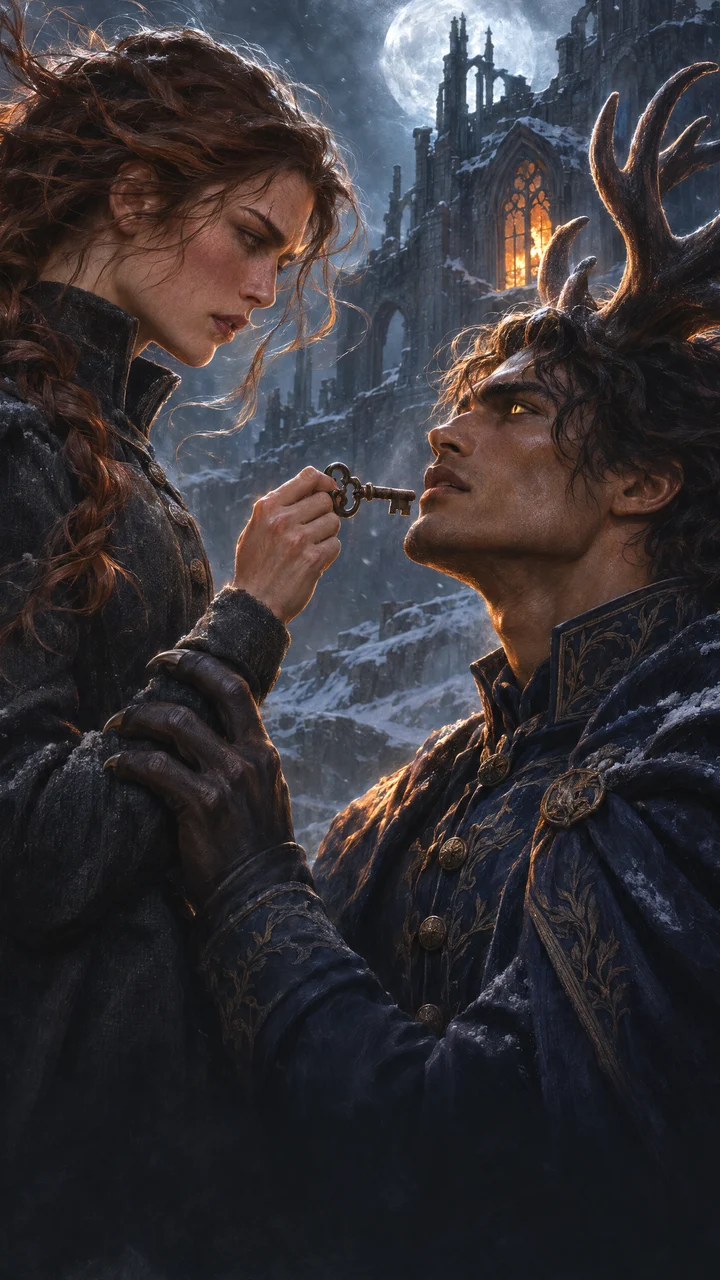
The moon rose an hour later, and she found him where she knew she would, kneeling at the foot of the tower stair, waiting to be spoken to.
She held up the key so he could see it. The gold eyes followed it, slit and bright.
“Show me,” she said. Then, because it mattered: “You can refuse. I’ll hear it.”
For a long moment the beast didn’t move. Then he rose, antlers scraping the low ceiling, and climbed.
The stair wound up and up, so narrow his shoulders brushed both walls. At the top was a door with no handle, only a keyhole. He stepped aside and let her open it with her own key, and the lock turned under her hand with a sound like a held note.
The room beyond was barely wider than a cell. Dust lay thick on a velvet chair gone grey with cold. Candle stubs crowded a shelf, dozens of them, burnt to puddles. At the far end, the window had been bricked like all the others, except for one brick near the top, set slightly crooked, its mortar scratched away.
Scratched. She looked closer. Faint parallel lines, four at a time, worn into the stone around it.
“That one,” he said. His voice was the deep, travelled rasp of the beast. “Pull it.”
She did. It came free heavier than she expected, and moonlight poured through the gap in a single silver shaft, the dust turning in it in long threads. The room smelled of candle wax and cold velvet and, beneath it, the faint musk of him.
When she turned, he was kneeling in the light.
He had gone down without being told. His head was bowed, antlers casting branching shadows across the floor, every button of his coat fastened, his bound wrist resting on his thigh. He looked like a man waiting for an executioner he had personally invited.
“Look at me,” she said.
He lifted his head.
The gold eyes found hers and held. She stepped into the moonlight. Slowly, giving him every chance to pull away, she raised her gloved hand and set her fingertips against his jaw.
He didn’t pull away. He leaned in. His whole weight came into her palm, the bronze skin warm through the leather, and his eyes slid half closed. She traced the line of his jaw to his chin and back, felt the breath shudder out of him, felt the restraint in every inch of him.
“Juniper.” Rough. Barely holding. “Are you going to order me to stop?”
She knew the word. Ember. It was right there, warm on her tongue.
She did not say it.
She bent toward him instead. He rose to meet her, only a little, the smallest permission he had taken in three nights, and their mouths were a breath apart. She could feel the heat of his. She could hear him not moving.
Below them, Hester’s bell began to clang.
Not the supper bell. The other one, hard and frantic and wrong, iron hammered on iron. And under it, faint, Hester’s voice bellowing up the stairwell: “Riders on the ridge! Riders!”
Juniper jerked back. Her hand fell from his face. The key, still clenched in her other fist, swung into the shaft of moonlight.
She had held it for three nights. She had never once looked at it in good light.
Worn into the iron bow, so faint that only moonlight at this angle could raise it, was a crest. A closed fist around a length of chain.
The same mark she had broken off the wax at dusk.
She looked up at him. He was still kneeling, still waiting for her word, and in his gold eyes she saw that he knew exactly what she had just found.
“Who,” she said, very quietly, “held this before me?”