
The shutter went at two in the morning with a crack loud enough to shake dust out of the bell.
Lenka was up the ladder before she had thought about it, blanket abandoned, lantern swinging. The belfry was all wind. The north louvre had torn half off its hinges and was slamming open and shut, and every time it opened the storm flung a bucket of snow across the boards and onto the bell’s green shoulder. Moonlight came and went through the broken slats.
“Leave it,” Aurel called from the ledge. He was braced outside in the gale with his wings half spread, holding back the drift that wanted to pour in from the far side.
“It’ll take the frame with it.”
“Lenka. Leave it.”
She didn’t leave it. She climbed onto the bell frame, onto the iced crossbeam, got her left hand on the louvre and her shoulder under it and shoved. It went home. She reached for the iron bar to drop across it, and her right hand closed on the bar and the splinted fingers didn’t, and her boot found ice instead of oak.
She fell for less than a second.
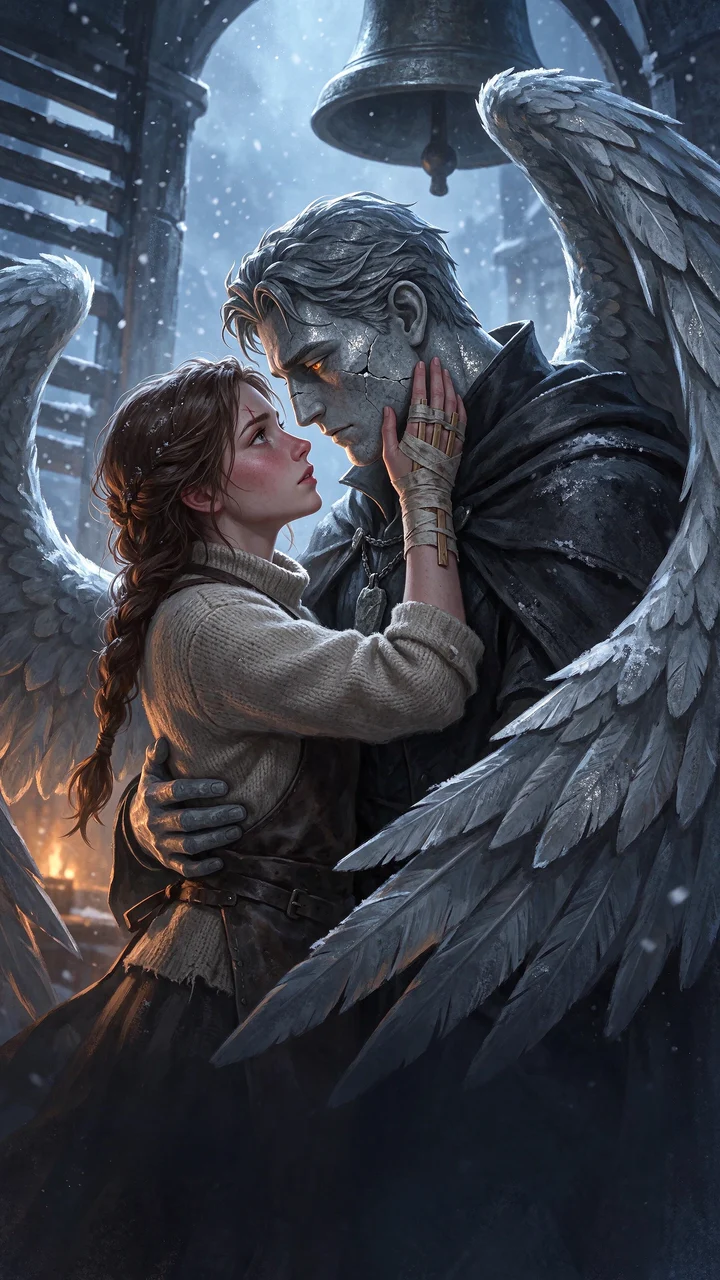
He caught her, one arm under her knees and one across her back, and the wings came round. All the noise went away. The wind still howled on the other side, she could hear it, but inside there was only a hollow of dark feathered stone, frost melting off the tips into her hair, and the smell of lime mortar and cold and, under that, something warm as a hearthstone.
She was shaking. So was he, faintly, through the arms that held her.
“I said leave it,” he said into her hair.
“You say a lot of things.”
“You don’t listen to any of them.”
“I listened to the bell one.”
His laugh was hardly a laugh, only breath let go against her temple. They stayed that way while the storm wore itself out against his back. She felt it happen gust by gust. When the last of it dropped to a moan he still didn’t open his wings, and she didn’t ask him to.
Her heart wouldn’t settle. Her face was a hand’s width from his throat, from the place above his collar where the grey had gone to living colour, and she could see a pulse there. She hadn’t known he had one.
“Aurel.”
“Yes.”
“May I touch your face?”
His own question, handed back. She felt him recognise it. For a long moment the only sound was snow ticking on the bell.
“Yes,” he said.
She lifted her right hand, splint and all. Found his cheekbone with the two crooked fingers, high and carved and cool, and followed the fine line that ran from it toward his jaw: an old crack, mended so well you could only find it by touch. He closed his eyes. His lashes lay dark against the grey. She traced the line to its end and back again, and he turned his face a fraction into her palm, as if he hadn’t meant to and couldn’t stop.
Under her fingers, the stone was warming.
She let her forehead tip forward. His met it. His breath was on her mouth, cold at first and then not, and the whole long length of him had gone still around her, holding, the way he had held her hand on the fourth night and not let go. She tilted her chin. One more inch. Less.
He stopped.
“If I kiss you,” he said against her lips, without touching them, “I will want to stay, and I cannot let you pay for that.”
Then the wings opened and the cold came in, and he set her on her feet in the drift as carefully as he did everything, and stepped back out onto the ledge with his back to her.
. . .
She couldn’t sit. She couldn’t sleep. She had been refused gently, which was worse than being refused at all, and her mouth still felt the inch.
So she searched.
There was nothing else to do in a belfry at three in the morning, and in eleven days she had never once looked properly behind the bell frame. Oak beams, pigeon bones, a crate of rusted wedges. In the west corner, where the louvres were whole and the snow had drifted waist-high, a shape stood under a canvas so stiff with ice it crackled when she touched it.
She dug. She got her good hand under the hem and pulled, and the frozen canvas came away in one creaking sheet.
A woman.
Life-size, the same pale granite, standing with her weight on one hip the way someone stands who has been working all day. She wore an apron. Her hair hung in a braid down her back. In her right hand, held loose at her side, was a chisel, and the fingers around it were perfect, every knuckle, every crease.
Except no one had made her. Lenka knew carving. Nobody carves the shine of an old burn across a thumb. Nobody carves stone dust in a braid.
She crouched at the plinth and rubbed the frost away with her sleeve.
ILONA KÁLNA. CARVER. And a year she had to count back on her fingers: sixty winters gone, near enough the year Dorota would have been born. Below it, in letters cut deep and not quite straight, as if the hand cutting them had been shaking:
SHE WARMED HIM FIRST.
Lenka stayed crouched a long time.
Kálna. Dorota’s name. Dorota’s keys, Dorota’s rope basket, Dorota’s I mean it this time.
When she stood, the sky past the louvres had gone from black to pewter. She turned. He was on the ledge, half in and half out, one hand on the frame, looking at the statue and then at her, and for the first time since the night he splinted her fingers, he was looking her in the eyes.
“You should have told me,” she said.
“Lenka.” The grey was climbing back up his throat. “I meant to...”
“When?”
He opened his mouth. The frost took it.
She watched it happen: white racing out across his wings, his hair going dull as slate, the amber banking down in his eyes while they were still on hers. Then he was a statue on a ledge, one hand reaching, and the sun came up over Morvaczek pink and clean, as if nothing in the world had changed.
Lenka looked down at her right hand on the louvre frame.
Under the splint, the tips of her two healing fingers had gone cool. And grey. The pale, dove grey of new-split granite.