
“Hundred and forty,” Dorota said over her shoulder, “and mind the next. It’s been loose since the old king died.”
Lenka minded it. She minded every one of them, left hand on the rope rail, right hand tucked against her ribs where it could shake without an audience. The stair wound up through the tower’s throat, so narrow her toolbag scraped stone on both sides, and the air tasted of coal smoke, cold iron and old candle wax gone sour in the cracks.
“Which king?”
“Does it matter? He’s dead and the step’s loose.” Dorota’s ring of keys clanked at her belt with every stride. For a woman past sixty in a sheepskin coat, she climbed like a goat with a grudge. “Here’s your room.”
It was hardly a room. A squat iron stove, a cot with two grey blankets, a workbench, a lantern hook, and one window so thick with frost it glowed the colour of skimmed milk. Above, through a square hatch, a last ladder climbed toward the belfry, and the wind was up there moaning through the louvres as if it wanted something back.
Dorota went up the ladder without pausing. Lenka followed, left hand on each rung, right elbow hooked over, and arrived at the top pink-faced and pretending she wasn’t.
“There,” Dorota said.
The tracery filled the east arch of the belfry, a window of stone lace: four quatrefoils stacked under a pointed head, the mullions thin as wrists. A crack ran from the apex down through two of the petals, and the lowest foil had slumped, its cusps sheared off and lying in the snow along the sill like dropped teeth.
Lenka’s chest did the thing it always did before good work. She ran her left thumb along the break. Sandstone, honey under the grime, laid by someone who had known what they were about.
“The guild sent three men to look at it,” Dorota said. “All three said wait for spring.”
“The guild says a great many things.”
“It said your name. Eventually.” Dorota’s pale eyes dropped to the hand Lenka wasn’t using. “When nobody else would climb a frozen hill for winter wages.”
“Then they were right twice in one year. Someone should mark the calendar.”
Dorota’s mouth creased, but she didn’t laugh. She turned instead toward the north louvres, where snow had drifted knee-deep on a ledge outside the bell’s iron shadow.
Something crouched there.
Not a grotesque with jug ears, not a lion worn to a smile. A man, carved down on one knee with his broad back to the town, wings folded high behind him so the stone feathers overlapped like roof slates, each tip furred white with frost. His head was bowed. His hands rested open on his thigh, as if he had just set something down.
“Who carved him?”
“Nobody you’d know.” Dorota stepped between her and the ledge, small and square and immovable. “Listen to me, Brezan. You can carve, you can curse, you can burn every scrap of coal I send. That one, you leave alone. Not after dark. Not a finger.”
“And in daylight?”
“In daylight he’s a statue and you’re a sensible woman.” The keys clanked once. “Be one.”
. . .
By the third hour the cold had found the old break.
It began, as it always did, in the two smallest fingers: a dull pull, then a hook, then the slow curl inward that no amount of telling could stop. Lenka set the claw chisel to the new block, tapped, and watched the line wander a hair wide. She tapped again. The mallet slid in her grip.
“No,” she told her hand, quite reasonably. “Not today.”
The hand disagreed. It cramped so hard the chisel dropped, rang off the sill and vanished into the snow, and the pain went up her wrist bright and white. Before she could stop it, something cracked open behind her ribs.
She cried once. Short and ugly, both palms against her eyes, stone dust gritting her lashes. Eighteen months since the scaffold folded under her at Saint Havel’s. Eighteen months of the bonesetter’s apologies and the guildmaster’s careful kindness, of lettering jobs and gravestone jobs, the work a girl could do sitting down.
Then she wiped her face on her sleeve, said a word that would have got her thrown out of chapel, fished the chisel out of the drift with her fingerless glove, and went back to carving.
. . .
The blizzard came off the mountains at four, swallowing the far roofs first, then the market cross, then the square. Snow hissed against the frosted glass. By the time the light went, the wind had a voice like a man shouting down a well.
Lenka took the hundred and forty steps down with the lantern and put her shoulder to the tower door. It didn’t move. She kicked it. It didn’t move then either, and when she held the light close she saw frost had grown through the keyhole and along the seam in white feathers, cementing oak to stone.
“Brezan!”
The voice came thin and far, from above. She climbed again, thighs burning, and leaned out between the louvres into the wind.
Below, a green headscarf and a smear of lantern light. “Door’s iced through!” Dorota bellowed. “Hinges and all! Nobody’s coming up that hill till spring!”
“Spring?”
“I’ll send the basket at dusk! Bread, coal, write down what you need!” A gust tore the next words away and gave a few back. “Keep the stove fed! And Brezan! Remember what I told you!”
Lenka looked sideways. Two metres off, the guardian knelt in his drift, frost thickening on his wings, his face hidden.
“Hard to forget,” she muttered.
. . .
The pain woke her.
It sat in her knuckles like hot nails, throbbing with her pulse, and she lay curled toward the wall with her jaw locked, counting, waiting for it to ease. It didn’t. The stove ticked.
The stove should have been ash by now.
She rolled over.
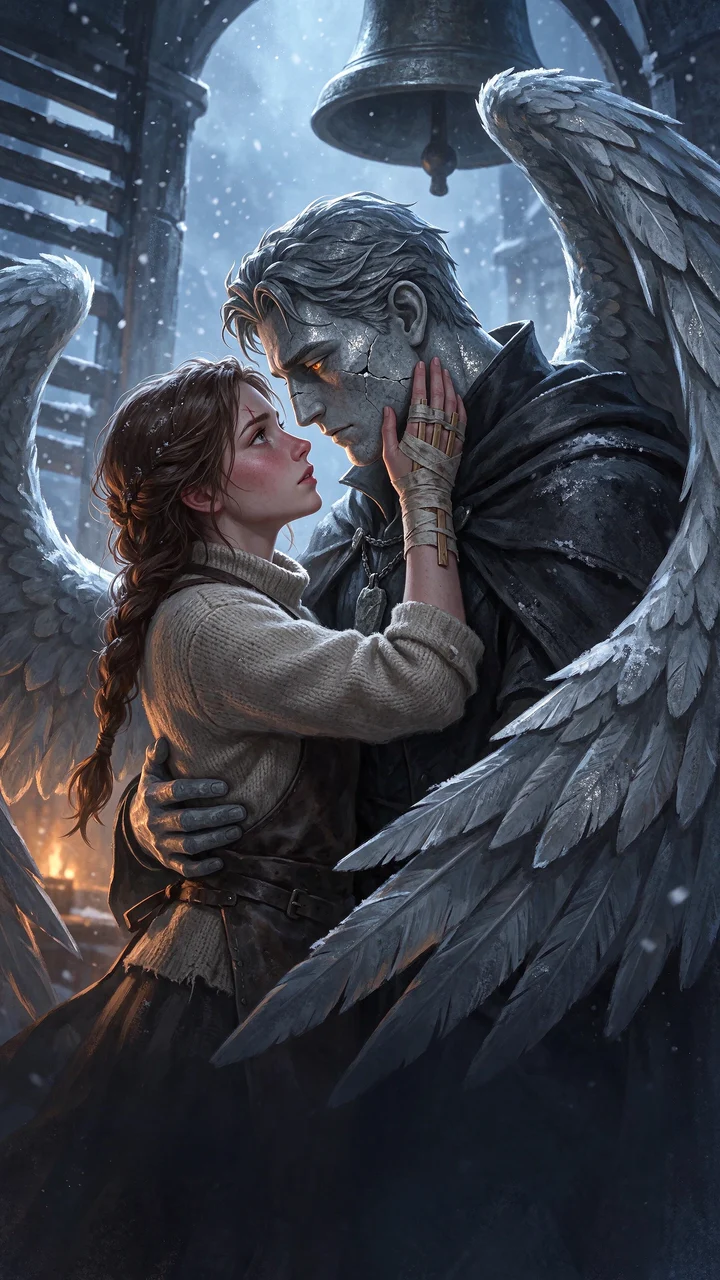
A man knelt at the open stove door, feeding coal in one lump at a time with his bare hand. The glow lit the side of his face: the pale dove grey of new-split granite, a jaw cut hard, a nose broken once and set a fraction off true. Behind him two wings rose folded to the rafters, and water dripped from their frosted tips onto the boards. Tap. Tap. Tap.
Lenka’s left hand found the chisel under her pillow.
He didn’t turn. “You’ve been holding that hand all night,” he said. His voice was low and rough, a voice not much used. “It’s worse when it’s cold.”
“Who told you that?”
“You did. Every time you swore at it.” He closed the stove door. Then, still kneeling, he held out his palm toward her, not touching, only offered. “May I?”
She should have said no. She should have said get out, though there was nowhere for either of them to go. She looked at his hand, broad and grey and patient in the firelight, and she set the chisel down and held out her right hand instead.
He took it as though it might spill.
From the pocket of his long charcoal coat he drew two slips of pale wood, curved and smooth, and a roll of linen. His fingers were cold enough to make her hiss, and he stopped at the sound until she nodded. Then he straightened her two smallest fingers by degrees, so slowly she felt each joint give, and laid the wood along them. Over, under, a turn around the wrist, firm without biting.
His hands were warming. She could feel it happen, the chill draining out of the thumb that rested in her palm, until it was simply skin against skin and her pulse was knocking at it.
“What’s your name?” she asked.
He tied off the linen. His eyes stayed on the knot. In the stove light she caught their colour, amber gone molten at the edges, and then his lashes came down.
“Sleep,” he said. “It will ease now.”
“That’s not a name.”
“No.” He rose, and the wings rose with him, scraping the beam. “It isn’t.”
She meant to stay awake. She meant to follow him up the ladder and make him answer. But the throb had dulled to a hum and the stove was warm, and the last thing she saw was his back at the hatch, head bowed beneath it, waiting for her to close her eyes first.
. . .
Dawn came white and silent. Lenka climbed to the belfry in her blanket.
He was where he had always been, knee in the drift, wings thick with fresh frost, face turned to the town. Stone through and through, snow settled on his shoulders. A dream, then. A fever of cold and crying.
She looked down.
The splint was bound around her two smallest fingers, and on the pale wood, small as a fingernail, someone had carved a row of tiny leaves.
Lenka crouched at the louvres, close enough to see frost in the crease of his closed mouth.
“Tonight,” she told him, “you’re going to tell me your name.”