
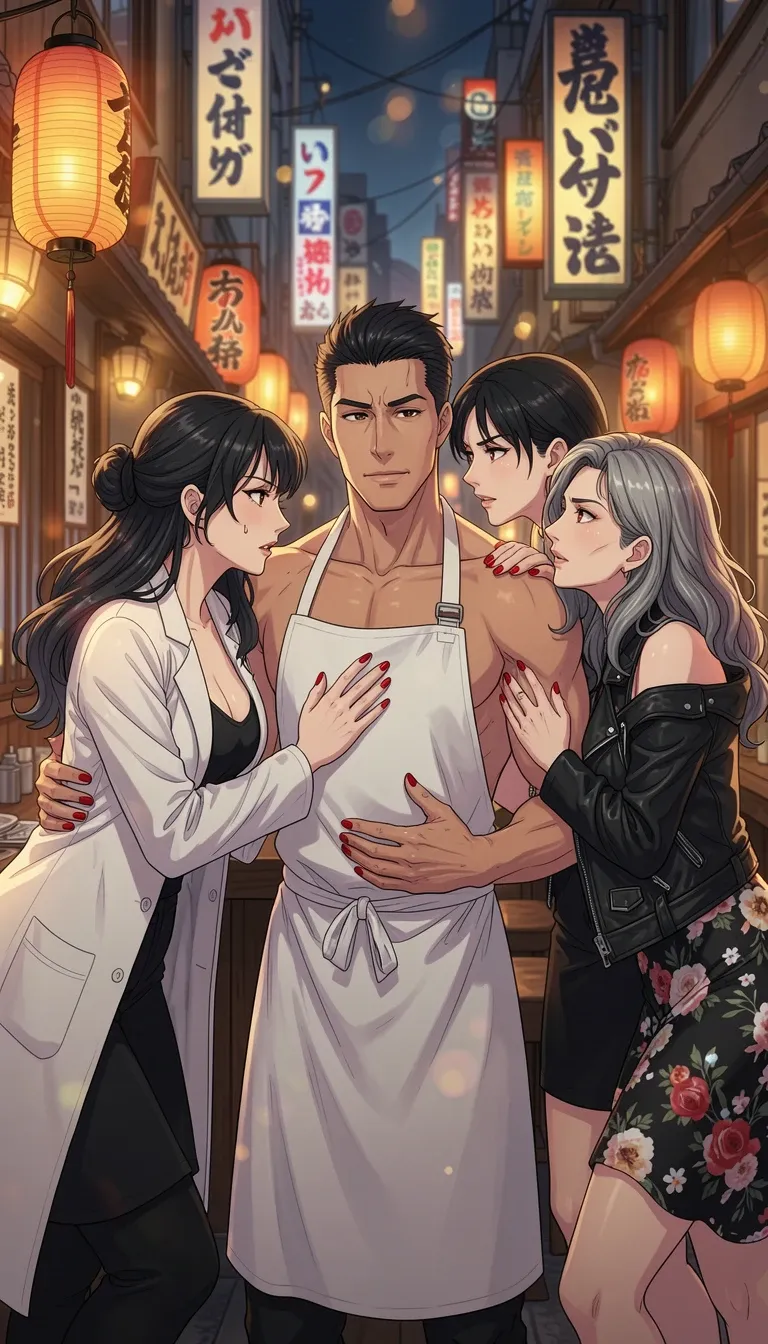
Rain had been falling since six, and by eleven it had settled into the kind of patient, steady drum that made the alley outside sound like a room with the walls taken down. Keisuke Arima folded the noren curtain in half, then in half again, the indigo cotton damp and cool against his palms. He set it on the shelf above the door, where it would dry by morning, and the last of the night seemed to come in with it — the smell of wet asphalt and somebody's frying oil from two doors down, the distant hiss of a taxi's tires in the standing water.
Behind him, three women had not moved.
"Taishō." Haruka Mizuno's voice, precise as a pill counted onto a tray. She was thirty-six, and she had not taken off her grey suit jacket even after two hours. "One more. The junmai, not the honjozo. You poured the honjozo for Sana and she's been smug about it since."
"I'm not smug," Sana Okabe said, from the end stool, where her black leather jacket hung open and her keys sat in a little heap of scratched brass and a rental receipt. She was forty-four. The grey streak in her loose hair caught the overhead light every time she turned her head, which she did now, slowly, to grin at Haruka. "I'm vindicated. There's a difference. Taishō knows the difference."
"I poured what was open," Keisuke said, which was true, and which pleased neither of them.
From the middle stool, Bruna Macedo laughed — a bright, unembarrassed sound that filled the seven-seat counter from end to end. She was twenty-nine, tall enough that her knees did not fit under the counter properly, and she had come in with an armful of stock flowers and set them by the door in a bucket she'd brought herself, because she said the alley was too sad without something growing in it. "He poured what was open," she repeated, her accent curling the words. "You see? A diplomat. He should work at the embassy."
"He should work less," Sana said, and tipped her cup toward him. "Sit down for once. You've been on your feet since I got here and I got here before the rain."
Keisuke wiped the counter. The cedar had gone dark where the water had been, and he pushed the cloth in long slow passes, feeling the grain under it. His forearms were a map of twenty years — a pale ridge near the left wrist where a sheet pan had come out of a four-hundred-degree oven at the wrong angle, a scatter of small white burns across the right like stars someone had pressed into him. The cloth snagged on the oldest one, the long one, and he smoothed it flat again.
"Last orders was an hour ago," he said.
"And yet." Haruka slid her empty cup forward, one centimeter, with the tip of her finger. "Here we are. Three women with nowhere to be and a chef with nowhere to go. Statistically, Taishō, this is the most interesting thing happening in Shinjuku tonight."
"Statistically," Bruna said, "she is right. I closed the shop at seven. Sana finishes her shift at four in the morning, so she is only early—"
"I'm off tonight," Sana said. "Don't make me sound like a workaholic. I'm a woman of leisure till Tuesday."
"—and Haruka came straight from the pharmacy with her name tag still on."
Haruka's hand went to her lapel, and found the tag, and did not take it off. "I forgot," she said, in a tone that suggested she had never forgotten anything in her life.
Keisuke poured the junmai. He poured it the way he did everything, slowly, watching the surface, and set the cup down in front of her with a small sound of ceramic on wood. They're all still here, he thought. Eleven forty on a Tuesday and they're all still here, and the rain's not letting up, and I don't want any of them to go. He folded the cloth and put it under the counter and did not sit down.
"You're doing the thing," Sana said.
"What thing."
"The thing where you stand there with your hands full so nobody can make you talk." She pushed the stool beside her with her foot. It scraped. "Sit."
He sat. He sat because she was forty-four and had a broken nose and had once told him, without any self-pity at all, that she'd driven a fare to the hospital at three in the morning and stayed until his wife arrived, and he had never quite stopped being a little afraid of her. The stool was warm. He put his hands flat on the counter, and the three of them looked at him, and he looked at the counter.
"You're blushing," Bruna said, delighted. "Taishō. You are forty years old and you are blushing."
"I'm not."
"The tips of your ears," Haruka said, without looking up from her cup. "It's vascular. Nothing to be ashamed of." She took a sip. "Though it does make a person wonder what you're thinking about."
"Rice," he said. "I'm thinking about rice. I've got to get up at five to rinse it."
"Liar," said Sana, fondly, and drank.
The rain ticked at the window. Down the alley a shutter rattled and then went quiet. Bruna reached across the counter and stole a single edamame from the bowl Sana had been working through, and Sana slapped her hand away without any real force, and Bruna said something quick and laughing in Portuguese that made her own shoulders shake, and Haruka watched the whole exchange with the small, closed smile of a woman taking notes.
It went on like that. It always went on like that, longer than it should have, longer than the hours on the chalkboard allowed for. Keisuke had opened this place two years ago with seven stools and a menu he could carry in his head, and he had expected — he had honestly expected — to be alone in it. A man his age, with his hands, with his silences. Instead there were three women who called him Taishō in three different tones: Haruka like a diagnosis, Sana like a dare, Bruna like an endearment she'd decided to keep.
At midnight, Bruna stood and stretched, and her spine made a sound like a door in an old house, and she sighed with her whole chest.
"I have to go," she said. "The shop opens at eight and the roses do not care that I am tired." She lifted the bucket of stock by the door — the pale green stems, the small white heads — and turned back with it in her arms, and for a moment she was all color in the grey room, her dark curls with a single petal caught in them, her bright dress damp at the hem. "Taishō. Next time I bring you something that doesn't die in a week. A plant. Something with roots."
"Everything dies in a week in this alley," Sana said.
"Then I bring something stubborn." Bruna grinned at him. "Like me."
She came around the counter before he could stop her — she always did — and put her hand flat on his shoulder and kissed him on the cheek, once, quick and warm and smelling of roses and rain, and then she was at the door with her bucket and her umbrella and she was gone, and the bell above the door rang itself quiet.
The room felt smaller. It always did, after Bruna.
Sana finished her cup and set it down and did not ask for another. She looked at Haruka for a moment — a long, level, unhurried look, the kind she must have given a hundred passengers in her rearview — and then she gathered her keys off the counter, brass and receipt and all, and stood.
"I'm going too," she said. "Not because I want to. Because if I stay I'll start telling stories about the night shift and then nobody's getting home." She shrugged into her jacket. At the door she paused, one hand on the frame, and the grey streak fell forward across her eye. "Haruka. You're staying."
"I'm finishing my drink."
"You finished it four minutes ago."
"Then I'm starting another."
Sana laughed — that raspy, room-filling laugh — and shook her head, and pulled the door open onto the rain. "Night, Taishō," she said, and then, quieter, to Haruka, "Be good." The door closed. The bell rang. Through the window Keisuke watched her cross the alley to the taxi with its little green light, watched her get in, watched the wipers start, and then the alley was empty and the rain was the only thing moving out there.
He turned back. Haruka had not moved from her stool. Her grey jacket was still on. Her name tag was still on her lapel, and now that they were alone he could read it: Mizuno H., R.Ph. She was turning the empty cup between her fingers, slow, a quarter turn and back.
"You don't have to stay," he said.
"I know."
"It's late. You've got work."
"I've got work at nine." She set the cup down. "It's twelve-fifteen. I have eight hours and forty-five minutes and I intend to spend some of them here." She looked up at him, and her eyes were steady, and there was something in them he had been noticing for weeks now and pretending not to — a patient, cataloguing attention, a woman who had already made her diagnosis and was simply waiting for the patient to catch up. "Unless you'd like me to go."
"No." The word came out faster than he meant it. "No, I — the rain's bad. Stay till it eases."
"The rain isn't going to ease for hours."
"Then stay for hours."
She smiled her small, closed smile. "There's the chef I know."
He busied himself — took her cup, rinsed it, dried it, set it back on the shelf with the others in a neat row. He wiped the counter again, though it was clean. He could feel her watching him do it, and his ears were hot, and he knew they were hot, and there was nothing he could do about it. Eight hours and forty-five minutes, he thought. She's sitting there doing arithmetic about how long she can stay, and I'm wiping a clean counter like a fool.
"Keisuke."
He stopped. She almost never used his name. It was always Taishō, held at a careful distance, and now she had set the distance down and stepped over it.
"Come here," she said.
He came. He didn't decide to; his feet simply carried him the four steps down the counter to where she sat, and stopped, and he stood there with his hands at his sides like a man waiting to be told what to do with them. She turned on the stool to face him, and her knees came close to his thighs, and she looked up at him — she was not a tall woman, and the stool did not make her taller, and her face was lit from below by the little lamp over the register and from above by the fluorescent tube, and she was beautiful in the way a well-made thing is beautiful, exact and quiet.
"I've been coming here for a year," she said. "Eleven months and three weeks. I've counted." Her hand came up and rested on the counter beside his hip, not touching him. "In that time I've catalogued a number of things about you. The way you hold a knife. The way you go quiet when you're angry instead of loud. The tremor in your right hand when you pour for me, which you don't have when you pour for anyone else." She tilted her head. "I'm a pharmacist, Taishō. I notice side effects."
"Haruka—"
"I'm not finished." Her voice was still precise, but it had gone lower, and it had lost its clinical edge. "I've also noticed that I think about this counter when I'm at work. That's not a side effect. That's the primary indication." She reached up and put one finger under his chin and turned his face down toward hers. "So. Are you going to make me do all of this myself, or are you going to lean down?"
He leaned down. She met him halfway, and her mouth was warm and tasted faintly of sake and of the mint she must have had in her bag, and her hand slid from his chin to the side of his neck and stayed there, and for a moment the only sound in the izakaya was the rain outside and the small wet sound of two people who had been waiting too long.
Then she pulled back, just enough to speak against his mouth.
"There," she said. "That wasn't so difficult."
"Haruka." His voice had gone rough. "You're — we're at the counter, the door's not locked—"
"The noren's in," she said. "You folded it yourself. The night's sealed." She stood, and her hand found his chest, and she pushed — not hard, just enough to move him back a step, and then another, until his hip hit the low shelf behind him and he had to put a hand back to steady himself. "And the door," she added, "is the least of my concerns. I've spent eleven months and three weeks being sensible." She was unbuttoning her grey jacket, slowly, her eyes on his. "I'd like to be finished being sensible for the evening. Is that agreeable to you?"
"Yes." It came out of him like air out of a bellows. "God, yes."
She slid the jacket off and folded it — folded it, precisely, and laid it on the end of the counter — and beneath it she wore a white blouse with the top two buttons already undone. She reached up and pulled the pin from her low bun, and her dark hair came down, and it changed her face, softened it, made her younger and more dangerous all at once. She stepped close to him and put both her hands flat on his chest and looked up.
"Then take off your apron," she said, "and let me see what I've been looking at for a year."
He untied the apron with fingers that were not entirely steady and dropped it on the shelf behind him. Her hands went to the hem of his shirt and pulled it up, and he raised his arms and let her take it off him, and the cool air of the izakaya moved over his chest. She looked at him — really looked, the way she looked at a label, at a dosage — and her fingers traced the old burn on his left forearm and the small white stars on his right, and she made a small sound that was not quite a word.
"These," she said. "I've been wondering about these."
"Twenty years of ovens. It's nothing."
"It's not nothing. It's a record." She pressed her mouth to the long scar near his wrist, and he felt it all the way up his arm. "I like a man with a record."
She sank down in front of him. He said her name, once, a question. She looked up at him from her knees on the floor behind the counter and said, "I've had a very long day, and I've thought about this for eleven months and three weeks, and I would like to stop talking now." And then her hands were at his belt, and the buckle clicked. She drew him out, and he was already hard, had been half-hard since she'd said his name. She looked at him the way she looked at everything, with a kind of exact and unhurried attention, and then she took him into her mouth.
The heat of it went up through him like a struck match. He put one hand flat on the counter to hold himself up and the other into her hair. She made a low sound around him and took him deeper, her tongue flat and then curling, her hand wrapped around the base of him and working in a slow, deliberate rhythm that matched nothing and everything. She was not in a hurry. That was the thing. She pulled back and licked up the length of him, wet, her eyes on his face, and then took him in again, slow, until he felt the back of her throat. She held there and swallowed, and his hand tightened in her hair. He heard himself say her name like a man going under.
"Haruka — Haruka—"
She pulled off him with a wet sound and looked up, and her mouth was wet and her hair was in her face. She was smiling that small closed smile. "You're close," she said. Not a question.
"Yes."
"Good." She rose, and her hands went to the waistband of her skirt. She stepped out of it and laid it folded on the counter beside her jacket. Then she was standing in front of him in white cotton and nothing else. She reached behind her and unhooked her bra and let it fall, and her breasts were small and pale and her nipples were dark and tight in the cool air. "But not in my mouth," she said. "I've been sensible for eleven months. I want to be sensible no longer."
He lifted her onto the counter. The cedar was cool and smooth under her thighs and she gasped at the contact. Then he stepped between her knees and she pulled him close with her heels against his back. He bent his head and took one dark nipple into his mouth. She arched and made a sound that was nothing like her measured voice. Her hands went into his cropped hair and held him there. He sucked, and licked. She was trembling under his mouth, and when he brought his hand down between her legs she was already wet — slick and hot through the cotton. She pushed against his fingers with a small desperate roll of her hips that undid him.
"Off," she said. "Take them off."
He pulled the cotton down her legs and dropped it on the floor, and she was bare and wet and open to him on the cedar counter, and he looked at her for a moment — the flush across her chest, the dark hair spilled on the wood, her hands braced back on the counter behind her — and she said, "Don't look. Touch."
He touched. Two fingers, slow, through the wet, and she closed her eyes and her mouth opened. He found her clit with his thumb and pressed, and her hips jerked. She said his name, his name, not Taishō. He worked her that way until she was breathing hard and her thighs were shaking. She reached down and caught his wrist.
"Now," she said. "Keisuke. Now."
He lined himself up and pushed into her, and she was so wet that he went in to the hilt in one long slow stroke, and she cried out — a sharp, surprised, unmeasured sound — and her hands came up and gripped his shoulders and her nails bit into him. He held there, deep, feeling her around him, the clench and flutter of her, and she said, "Move. Move," and he moved.
The counter creaked under them. He fucked her slow at first, long strokes, watching her face. She watched him back, her eyes open and fixed on his, and then her eyes closed and her head went back and her hair slid on the cedar. He went harder, and the wet sound of it filled the little room, and her breasts moved with each thrust. She reached up and grabbed the shelf behind her head to brace herself and pushed back against him, meeting him, and the rhythm built between them like something with a will of its own.
"Harder," she said. "I'm not — I'm not made of glass—"
He gave her harder. The slap of skin on skin, the creak of the counter, the rain outside keeping time. He bent over her and put his mouth to her throat. She wrapped her legs around his waist and pulled him deeper. He felt her start to tighten around him, a long slow clench that built and built. She said, "Don't stop, don't you dare stop—". Then she broke, and her cunt gripped him hard and pulsed around him. She cried out with her hand over her own mouth and her whole body shaking on the cedar counter.
He held on as long as he could. He wanted to hold on. But she was clenching around him in waves and pulling him in with her heels and saying his name over and over. He felt it come up through him. He pushed deep and stayed there and came inside her, hard, spilling into her with a groan that he couldn't have kept in if the whole alley had been listening. She held him through it, her legs locked around him, her hands on his back, and he felt her pulse around him one last time and then go still.
For a moment neither of them moved. The rain ticked at the window. The little lamp over the register hummed. He was still inside her. She was warm and wet around him, and her hand came up and stroked the back of his neck, slow, once.
"Well," Haruka said, in a voice that was trying very hard to be measured and not quite managing it. "That's one entry in the catalogue revised."
He laughed — a short, wrecked sound — and put his forehead down against hers, and she turned her head and kissed the corner of his mouth.
Then she went still. Her eyes moved past him, toward the door, and her hand tightened on the back of his neck.
The bell above the door was ringing.