
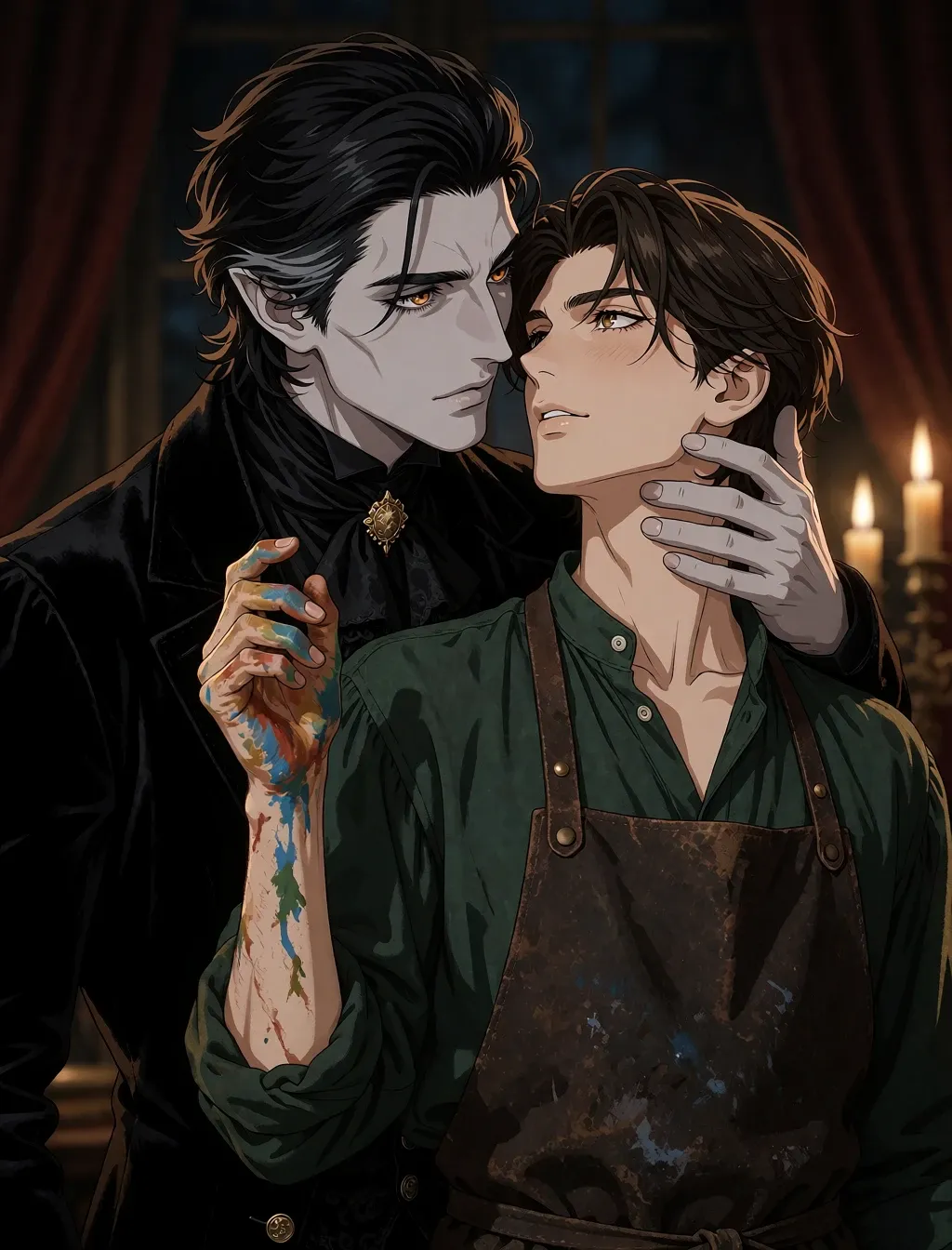
The castle had no doorbell. It had a gate that opened before Matthias's knuckles found it, a courtyard that smelled of wet stone and woodsmoke, and a steward with auburn hair and a ring of silver keys who looked at his paint case the way a customs officer looks at a suspicious trunk.
"Mr Kerr." Elara Vasse, twenty-eight, did not offer her hand. "You're early."
"The coach was late, actually." He shifted the case to his other shoulder. "I find the two tend to cancel out."
She looked at him for a moment longer than was polite — a woman taking inventory — and then turned, keys ringing against her hip, and led him up a stair that had been worn into shallow bowls by three centuries of feet. The castle breathed around them. Somewhere above, a shutter knocked softly against its frame, though the night outside was still.
"The gallery is on the fourth floor," she said. "You'll have it to yourself. The Count receives at midnight."
"And before midnight?"
"Before midnight the Count is not receiving." She stopped on the landing and turned, and her green eyes had something in them that a painter would have called umber, the deep warm brown of a shadow with light behind it. "Mr Kerr. The men who have come before you were paid handsomely and asked a great many questions. They did not finish the commission. I would take it as a kindness if you would finish it."
"I've never left a portrait unfinished."
"The portrait isn't what I'm worried about."
She left him at the gallery door with a candle in a brass holder and the sort of look that said the candle was not a courtesy but an examination.
The gallery was long and cold and full of light that should not have been there.
Candles. Dozens of them — in sconces, on stands, in clusters along the walls like a congregation — and every flame standing perfectly upright in air that had no draught, no breath, no reason to be still. Matthias set his case down and stood in the doorway and did what he always did when he walked into a room: he read it. *Cold stone, warm light. A gallery built to hold something enormous. And they've hung the walls with cloth.*
The cloth was grey silk, gathered and pinned. Under it, the shape of frames. Mirrors — he counted eleven of them along the east wall before he stopped counting, because counting them was beginning to feel like a bad idea. Every mirror in the room was veiled. Not one showed a face. Not even his own.
He crossed to the nearest one and stood in front of it a moment, his reflection a grey suggestion in the silk, and then he went back to his case and unpacked his easel with more noise than the job required, because the silence of the room had teeth.
Charcoal. Canvas primed and stretched, carried all the way from Edinburgh in a wooden crate. Brushes rolled in oiled cloth. The smell of turpentine and linseed came up off his hands as he worked, and it was the only familiar thing in that whole grey and gold and candlelit space, and he clung to it the way a man clings to a rope.
He was thirty-five years old and he had painted dukes and merchants' wives and one very patient archbishop, and none of them had ever made his palms sweat before he'd so much as mixed a colour.
The candles leaned.
All of them. At once. Every flame in the gallery bent toward the far end of the room like grass under wind, and there was no wind, and then the door at the far end opened and Count Aurelien Vasse came in.
He looked forty. That was the first thing, and it was the thing that would not leave Matthias alone all night — the man looked forty, silver at the temples, the lines of his face set like a man in his prime who had simply stopped. His hair was black and slicked back, his skin alabaster under the candlelight, and his eyes were the colour of whisky held up to a lamp. He wore a high-collared shirt, open at the throat, and a black velvet coat that moved like water when he walked. He did not hurry. He had not hurried in a very long time.
"Mr Kerr." The voice was a baritone with velvet laid over it. "You brought real candles."
"I brought my own light, my lord Count. Gallery light lies."
A pause. The Count's mouth did something that was not quite a smile. "Yes," he said. "It does."
He crossed the room and the candles leaned after him as he passed, every flame turning its head, and Matthias watched him sit in the high-backed chair at the end of the gallery — watched him settle, watched his hands come to rest on the chair's arms, perfectly still, and thought: *nothing living is that still. Not even a man at rest. A man at rest still breathes.*
The Count did not appear to breathe at all.
"Where would you have me?" Aurelien asked.
"As you are. Turn your face a little toward the candles — no, toward me, my lord, that's it." Matthias took up his charcoal and stepped to the canvas, and his hand was steady, because his hands were always steady, that was the one thing he could count on. "I'll rough you in first. It won't look like much."
"It will look like something." The Count's eyes had not left him. "That is the difficulty."
The charcoal touched the canvas. The sound of it — that dry, scratching sound — filled the gallery, and Matthias began to work, and the work did what it always did: it took the fear out of his hands and put it somewhere he could use it.
He roughed the line of the jaw, the shelf of the brow. He found the hollow beneath the cheekbone and the way the candlelight pooled there, and he thought, *alabaster, but not cold — there's warmth under it, a warmth that's been banked a long time.* He found the silver at the temples and the way it caught the light like frost on dark water. He found the mouth, which was a hard mouth, a mouth that had learned to keep its own counsel.
And then he stopped, because he had roughed in the eyes, and the eyes were wrong.
"My lord Count."
"Yes."
"I've drawn your eyes twice now and both times they've come out older than the rest of you." He turned the canvas a fraction, though the Count could not see it from where he sat. "I don't know how to paint a face that's forty and eyes that are — not."
The Count was quiet for a moment. A candle beside him guttered, though no air had moved, and then settled.
"You are the first to notice," he said. "In three hundred years, Mr Kerr, you are the first to notice and say so."
Matthias's charcoal hovered. "Three hundred —"
"Years. Yes." The whisky-coloured eyes did not blink. "I am told I do not age. I am told this by my steward, who is my great-granddaughter, and who has been told it by her mother before her. I have no way to verify it. I have never seen my own face."
Matthias looked at the veiled mirrors along the wall. Eleven of them. Twelve. The silk moved very slightly, as if the room were breathing, and then he understood, and the understanding went down his spine like cold water.
"You can't see yourself," he said. "In any of them."
"I cannot. Nor in glass, nor in water, nor in the polished silver of a spoon." The Count's hands had not moved from the chair's arms. "So you see my difficulty, Mr Kerr. You are asking me to sit for a portrait of a face I have never seen, and I am asking you to paint it true. I have no way to tell you if you have succeeded. I will have to trust you."
"That's a strange thing to trust a stranger with."
"You are not a stranger." The Count's voice had dropped, just slightly, into something lower and older. "You are the man I have hired to see me. That makes you the only person in the world who can."
The candle flames leaned toward him again, all of them, as if the words themselves had weight.
Matthias set the charcoal down and picked up a brush, because he needed to do something with his hands that was not standing there being looked at.
"Then I'll need more sittings," he said. "I can't do it in one night. The light's wrong after a few hours and I'll want to see you by daylight —"
"There is no daylight for me, Mr Kerr."
"Then by candlelight, and more of it, and I'll want to see you move. Faces aren't still things. A face at rest is a mask. I need to know what yours does when you're not holding it."
For the first time, the Count's stillness broke. It was a small thing — a tilt of the head, a shift of the shoulders under the velvet — but it was a break, and Matthias saw it the way he saw everything, as a change in the light.
"No one has ever asked that of me," Aurelien said.
"Then no one's ever painted you properly."
They worked. The candles burned down an inch, and then two, and Matthias forgot to be afraid somewhere around the second hour, which was always the way of it — the work took him and the world narrowed to the canvas and the light and the line of a jaw, and the Count sat in his chair like a man carved out of patience and let himself be studied.
But the Count talked, too, and that was the thing Matthias had not expected. He asked about Edinburgh, and about the archbishop, and laughed — a low, dry sound, like a door opening onto a warm room — at the story of the merchant's wife who had insisted her portrait show her holding a parrot that did not exist. He asked what turpentine did to the skin of a painter's hands, and Matthias held up his own, ochre and umber in the creases, and said, "It takes the oils out. Leaves them dry. I've been meaning to buy a cream."
"You should," said the Count. "Your hands are the instrument. You should take better care of them."
And then, later, when the talk had thinned and the gallery had gone quiet except for the small wet sound of the brush: "What do you see, Mr Kerr? When you look at me. Not the face. The thing under it."
Matthias did not answer at once. He looked at the man in the chair — the open collar, the silver at the temples, the hands that did not move — and he thought about how the candles leaned toward him, and how the shadows in the corners of the gallery seemed to lean too, and how a man who had lived three hundred years might be very tired and very hungry and very alone all at once and never say a word about any of it.
"I see a man who's been looked at a great deal and seen very little," he said. "And I see —" He stopped.
"Go on."
"I see a man who's holding still. All the time. Even now. Like if he lets go of himself something will happen that he can't take back." Matthias set the brush down. "That's what I'd paint, if I could. The holding still. It's the truest thing in the room."
The Count's eyes had gone very dark. The whisky colour had deepened to something older, and the candle flames had all bent toward him and stayed bent, and the shadows in the corners of the gallery had drawn in a little, as if the room itself were listening.
"You are a dangerous man, Mr Kerr," Aurelien said softly.
"I'm a painter."
"Yes." The Count rose from the chair — one movement, no effort, no sound — and crossed the gallery toward him, and the candles leaned after him the whole way. "That is what I said."
He stopped close. Closer than a patron should stand to his painter. Matthias could smell him now — cold stone and something sweeter underneath, wax and wine and the faint iron smell of old blood — and he could see, this close, that the Count's eyes were not quite still either. There was something moving in them. Something hungry and very carefully held.
Matthias had spent his whole life learning to read faces. He knew what he was looking at. He had just never had it look back at him before.
"My lord Count," he said, and his voice came out lower than he meant it to.
"Mr Kerr."
He should have stepped back. He should have picked up the brush and said the light was going and they would continue tomorrow. Instead he reached out — his paint-stained hand, ochre in the creases — and touched the Count's jaw, just under the bone, the way he touched a canvas when he was checking it was dry.
The skin under his fingers was cool and smooth and alive, and Aurelien's eyes closed.
"I'm going to kiss you," Matthias said. "Unless you'd rather I didn't."
"You may." The Count's voice had gone rough at the edges. "You may, Mr Kerr."
Matthias kissed him.
It started careful — a painter's kiss, testing the surface — and then the Count's mouth opened under his and it was not careful at all. Aurelien tasted of wine and cold stone and something underneath that was neither, something that made Matthias's blood move faster in his veins. His hands came up and found the velvet of the Count's coat and gripped it, and the Count made a sound low in his throat, a sound like a door opening onto a warm room, and pressed closer.
When they broke apart, Matthias was breathing hard. The Count was not breathing at all.
"You should know," Aurelien said, "that I have not done this in a very long time. And that I am — hungry, Mr Kerr. In more ways than one."
"I know." Matthias's hand was still on his jaw. "I've been watching you all night. You've been holding still."
"Yes."
"Then stop."
The Count went down onto his knees on the cold stone floor, and the candles all leaned toward him, and Matthias's breath caught in his chest and stayed caught.
Aurelien's hands found the fall of Matthias's trousers and undid it with the unhurried precision of a man who had done this before the invention of buttons, and Matthias's cock came free into the cool air of the gallery, already hard, already leaking, and the Count looked at it the way a man looks at something he has been denied for a very long time.
"Tell me," Aurelien said, "if I do anything you do not want."
"I'll tell you."
And then the Count's mouth was on him.
Matthias's head went back. The first touch of it — cool lips, a cool tongue, the wet heat of a mouth that was not quite the temperature of a living man — made his knees loosen. He put a hand out to the easel and gripped the wood and held on. Aurelien took him deep, unhurried, all the way to the root, and Matthias felt his throat work around him and made a sound he did not recognise as his own.
"God," he said. "God, my lord —"
The Count pulled off him, slowly, his lips dragging, and looked up. His mouth was wet. His eyes were black now, the whisky gone out of them entirely, and there was something in his face that was not a man's face at all.
"Say my name," he said. "Not the title. Not tonight."
"Aurelien."
"Again."
"Aurelien." Matthias's hand came down and found the Count's hair, black and slicked back and cool under his fingers, and he gripped it, and the Count's eyes closed and he made that sound again, that low sound, and took him back into his mouth.
It went on. That was the thing Matthias would remember after — how long it went on, how the Count did not hurry, how he worked him with his tongue and his throat and the slow drag of his lips, pulling off to breathe a wet breath against the head of his cock and then taking him down again, deeper, until Matthias's hips were moving of their own accord and his fist was tight in the black hair and the candles were guttering all around them, every flame bending toward the two of them on the cold stone floor.
"I'm close," he said, and his voice was wrecked. "Aurelien — I'm going to —"
The Count did not pull off. He looked up, his mouth full, his eyes black and fixed on Matthias's face. He stayed exactly where he was, and Matthias came with a sound torn out of him, spilling down the Count's throat, and Aurelien swallowed it all, unhurried, every drop, his hand coming up to grip Matthias's hip and hold him steady while he shook.
When it was over, Matthias slid down the easel and sat on the floor, his back against the wood, his trousers open, his chest heaving. The Count sat back on his heels and wiped his mouth with the back of his wrist, and his eyes had some of the whisky back in them now, and he was watching Matthias with an expression that was almost — almost — tender.
"You are shaking," he said.
"I'm aware."
Aurelien's hand came to rest on Matthias's knee, and then slid up, slowly, over the wool of his trousers, to the inside of his thigh. He looked at Matthias a long moment. The candles had gone still again, all of them upright, waiting.
"Mr Kerr," he said, and his voice had gone formal, the old formal words, the words of a man who had been a count before he had been anything else. "Will you grant me your blood?"
Matthias looked at him. The silver at his temples. The wet mouth. The hand on his thigh, cool through the wool.
"Yes," he said.
Aurelien bent his head and pushed the trouser leg up, baring the pale inside of Matthias's thigh, and Matthias felt the cool air and then the cool lips, and then the needle-prick of teeth, and then the pull — slow, deep, a drawing at the root of him that was not pain, that was something older than pain, something that made his spent cock twitch and his hand come down to grip the Count's shoulder and hold on.
The Count drank. The candles leaned. And Matthias, his head back against the easel, watched the ceiling of the gallery go soft and gold and far away, and thought, with the last clear thought he had for a while: *he's the colour of old varnish. Three hundred years of varnish. And I'm going to have to mix it from scratch.*
The Count's mouth was still on his thigh.