
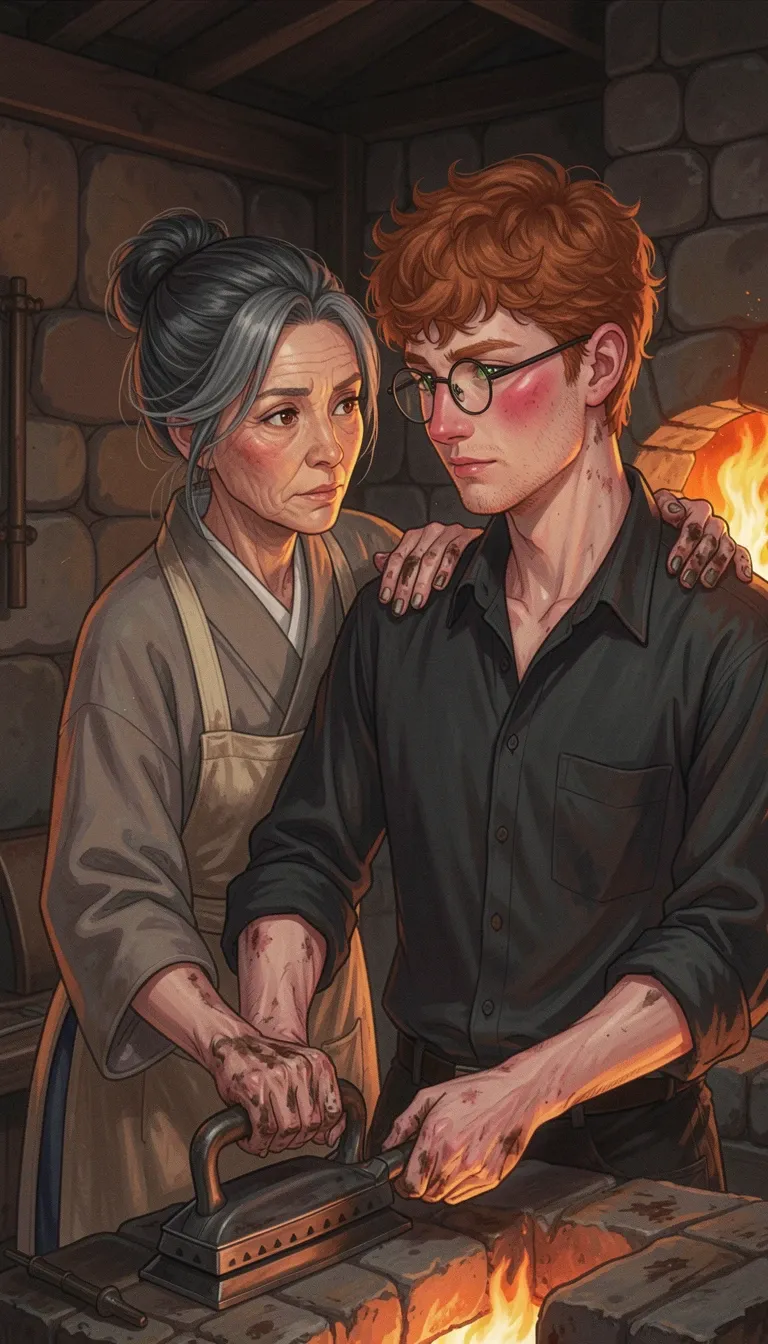
The kiln had been cooling for four days, and still it ticked.
Keiko heard it from the studio before she saw it — that slow metallic conversation of brick and iron shedding heat, a sound like something settling its bones. She had been up since five. She had not slept well. Liam had gone back to the guest room at some gray hour and she had lain in the empty futon listening to the rain stop, and then to the birds start, and then to the kiln ticking, and she had thought: today I open it.
Now the studio smelled of plaster dust and cold ash and the green tea she had poured and forgotten. The wedging table stood in the middle of the room, its plaster top still dusted with dried clay from the last batch — she had not cleaned it, had not had a reason to. She wiped it with her palm. A pale smear. She wiped it again and left it.
Liam came in through the side door with his camera bag on his shoulder and his hair still wet from the wash basin, the copper of it dark at the edges. He was thirty-one and looked younger when he was nervous, which was most of the time. He set the bag down on the shelf by the window, unsnapped the flap, and left the lens cap off the way he always did, as if the camera might need to see something without warning.
"The door's still too hot to touch," he said. "Barely. I put my hand near it and it's like standing next to a kettle."
"Then we wait," Keiko said. "It has waited five days. It can wait an hour more."
She had laid the first pots out on the long shelf beneath the window, where the late-morning light came in flat and white through the paper. She had pulled them from the anagama's front chamber at dawn with the long iron tongs, one at a time, and set each on the shelf to cool, and she had not let herself look at them properly. Not yet. A pot is not finished until it has cooled, and a potter who looks too soon is a potter who cannot sleep.
"Come here," she said. "Look at this."
He came. She lifted a chawan — a tea bowl, wide and low, the lip uneven by a thumb's width — and held it up into the window light. The glaze had run in the fire the way she had hoped and never quite trusted: a deep green-black breaking to rust at the rim, the ash having settled on one shoulder and melted there into something like frost, something like the skin of a plum. The light went through the thinner wall of it and came out amber.
Liam did not say anything for a moment. Then he said, very quietly, "Keiko."
"I know."
"No, I mean —" He took his glasses off and polished them on his shirt and put them back on, as if the first look had been faulty. "I've been photographing your work for six days and I've never seen one do that. The green. It's like — there's a color inside the black. Like it's lit from behind."
"The ash fell on that side," she said, turning it so he could see. "The fire came from the left all night. It does what it wants. I only make the room for it." She set the bowl down. "That is the best bowl I have ever fired."
She said it plainly, without pride, the way she would say the kiln was hot. It was simply true. She had been firing this kiln for twenty-six years and she had never had a chamber come out like this one — the whole front row, every piece, the glaze behaving as if it had been listening to her.
Liam crouched and began to photograph them, and she stood back and let him work. He was good at this. She had known he was good at this before she had known anything else about him — she had seen his portfolio, the way he found the one angle in a thing that made it confess. Now he moved along the shelf, crouching, rising, tilting the camera, his breath going quiet the way it did when he was inside the work. The shutter clicked. He shifted a pot a half-inch and clicked again.
"The light's going to move off this in twenty minutes," he said, not looking at her. "I want to get the whole row before it does."
"Then get it."
He worked. She watched him work, and she was aware, in a way she did not entirely like, of the calendar on the wall behind him — the plain paper calendar with the red circle she had drawn around the twenty-eighth, which was the day his visa expired, which was six days from now, which was a week. She had drawn that circle herself, months ago, when he had first written to her about the project. She had not known then that she would be standing in this room watching him crouch over her best bowl with his hair drying in the light.
He finished the row and stood up and looked at the camera's little screen, thumbing through the frames. Then he lowered it.
"That's the lot," he said. "I'll do the rest when they're all out." He set the camera down on the shelf, lens cap still off, and did not pick it up again. "Keiko. The twenty-eighth."
"I know what the twenty-eighth is."
"I've got a flight I can change, but it's — the ticket's already —" He stopped. Started again. "I've been trying to figure out how to say this for about three days and every version sounds like I'm asking you for something."
She waited. She had learned, over these five days, that waiting was the kindest thing she could do for him.
"I don't want to go back," he said. "That's the whole of it. I don't want to go back to Dublin and develop these rolls and put them in a book and have that be the thing that happened. I want —" His hands did something in the air, a helpless shaping, as if he were trying to throw a pot without clay. "I want to know what the spring firing looks like. I want to be here for it. I want to photograph the next one and the one after that until you're sick of me standing in your light."
"The spring firing is in April," she said.
"I know when the spring firing is. I've known since the first night. You told me and I wrote it down in the back of my notebook like a schoolboy."
She looked at him. He had gone red — the flush that started at his throat and climbed, the one she had watched climb for five days and had never once tired of. His fingers were stained with developer and there was clay dust on the knees of his trousers from crouching and he was standing in her studio asking, in his roundabout way, whether there was a place for him in the next firing. In the next year. In whatever this was.
"You are asking me," she said slowly, "whether you may come back."
"I'm asking whether you want me to."
The kiln ticked. Out in the yard a bird said the same three notes it had been saying all morning. Keiko put her hand flat on the wedging table, on the cool plaster, and felt the dried clay under her palm, and she thought about how she had woken at five and lain in the empty futon and known, with a certainty that had nothing to do with reason, that she was not finished. That the first time was its own thing, as she had told him, and that this — this standing in the studio with the best pots she had ever made and a man asking to come back — was the thing after the first thing.
"Come here," she said.
He came around the table. She took his face in both her hands — her palms still damp with the water she had used to wipe the plaster, and they left prints on his cheeks, two pale smudges — and she looked at him for a moment, at the green eyes behind the round glasses, at the mouth that was already parting, and then she kissed him.
He made a sound against her mouth, small and surprised, as if some part of him had not quite believed she would. His hands came up to her waist and then her back, gathering the linen of her apron, and she felt the nervous tremor in them and pressed closer to still it. He tasted of tea. His mouth was warm and uncertain and then, as she held him there, it stopped being uncertain.
"The door," she said against his lips. "The side door. Bolt it."
He went. She heard the bolt go across, and then he was back and his hands were on her again, and she was untying the apron and letting it fall, and his fingers found the sash of her kimono and fumbled it, and she covered his hands with hers and showed him — one pull, the knot giving — and the silk loosened and he pushed it off her shoulders and it pooled at her feet.
"God," he said, looking at her. Just that. His hands hovered, not quite touching, the way he did with a pot he was afraid to break.
"You have seen me before," she said.
"Not in the daylight."
"Then look." She took his wrist and put his hand on her breast. He cupped it, his thumb finding the nipple already hard, and she let her head fall back and breathed out. "And then put your mouth where it will do some good."
He understood. He went down onto his knees in front of her — she guided him back against the wedging table, hitching herself up onto its edge, the plaster cold through the thin cotton of her underrobe — and he pushed the cotton up her thighs and looked at her, and then he put his mouth on her.
She had taught him this on the woodpile on the second night, and he had learned. He licked her slowly, the flat of his tongue up the length of her, and she felt the wet heat of it and her hand went into his hair. He found her clit with his tongue and worked it, soft, then firmer. She heard herself make a sound she had not meant to make and did not stop. His hands were on her thighs, holding her open, and his glasses were fogging and he did not care. He pushed his tongue into her and then back up, and again, and the rhythm of it was slow and thorough and patient in a way that undid her.
"There," she said. "Stay there. Don't — don't go faster, just —" Her hips tilted. Her heel found the leg of the table. "Yes. Like that. Like that, Liam."
He moaned against her, the vibration of it going through her cunt. She gripped his hair harder and rocked against his mouth, and the wet sound of it filled the studio, and the light came in white through the paper and lay across them both. She was close. She could feel it gathering, low and heavy. She held it back a moment, watching the top of his head between her thighs, the copper hair, the pale hands splayed on her, and then she let it come.
It rolled through her in a long clench, her thighs closing on his ears, her back arching off the table, a sound coming out of her that was almost a word. He stayed with her through it, his tongue gentling, until she pushed at his head and he came up, gasping, his mouth wet, his glasses crooked.
"Come here," she said, and pulled him up, and kissed him with her own taste on his mouth, and reached down between them and found his cock through his trousers — hard, straining, the fabric damp at the tip. She freed it. It came into her hand hot and heavy. She stroked it once, root to tip, and he shuddered against her.
"I want you inside me," she said. "Slow. On the table. I want to feel you think about it."
He pushed into her slowly — the head of his cock parting her, the stretch of it, and she felt every inch of the way, her cunt slick and open from his mouth. He went still when he was all the way in, his forehead against hers, his breath ragged. "Keiko. God. You're so — I can't —"
"You can. Move."
He moved. Slow, the way she had asked, drawing out until she felt the drag of it and then pushing back in, deep, his hips meeting the backs of her thighs. The table creaked. Her hands went back to brace on the plaster and left prints, and he watched her face, and she watched his — the flush high on his cheeks, the way his mouth stayed open, the way his eyes kept closing and opening as if he could not decide which was better.
"Harder now," she said. "But not fast. Hard and slow."
He gave her that. Each thrust drove her back against the table and she took it, her cunt clenching around him, the wet sound of it loud in the quiet room. His hand came down over hers on the plaster and his fingers laced through hers, and that — more than the rest of it — made her breath catch. She looked at their hands, his pale fingers between her clay-stained ones, and something in her chest turned over.
"I'm close," he said. "Keiko, I'm — I can't hold it much —"
"Then come," she said. "Come with me. Now."
She pulled him down by the back of the neck and kissed him, and the second crest took her — tighter than the first, wrung out of her by the angle of him, her cunt gripping his cock in waves. She felt him go rigid and then break, felt him spend inside her, hot, in pulses, his mouth open against her throat and her name coming out of him broken in two. She held him there, her legs locked around his hips, until the last of it had passed through him and he sagged against her, heavy and shaking.
For a while neither of them moved. The kiln ticked. The bird outside had stopped.
Then Liam lifted his head and looked at her — his glasses gone completely fogged, his hair in disarray, a smear of clay on his jaw where her hand had been — and he laughed, shakily, the way a man laughs when he has been frightened and is not frightened anymore.
"I'll book the ticket," he said. "For April."
Keiko reached behind her for the calendar on the wall, not letting go of him, and turned it to April, and looked at the empty square, and then at him.
"Yes," she said. "You will."
He was still inside her, still hard, and when she said it he made a low sound in his throat and his hips moved — one slow push, involuntary, the slick of it loud between them.
"You're still —" His breath caught. "Keiko, I'm still —"
"I know." She set the calendar face-down on the table beside her hip. Her legs were still locked around him; she tightened them, and his eyes went wide behind the fogged glasses. "You came and you're still hard. That happens at your age. It will not happen forever. Do not waste it."
"I'm not —" He laughed, breathless. "I'm not wasting anything, I just — I don't want to hurt you."
"Liam." She took his glasses off, folded them, set them on the plaster. "Look at me without them. Can you see me?"
"Not clearly."
"Then listen. I am fifty years old and I have wanted a man to take his time with me for a very long while, and no one has." She slid her hand up the damp back of his neck into his hair and closed her fist there, gently. "You have been inside me for one minute and you are already worried about my comfort. Stop worrying. Take me off this table and put me on the blanket."
He pulled out of her — she felt the drag of it, the sudden emptiness, the wet running down the inside of her thigh — and then his hands were under her arms. He was lifting her, staggering a little under her weight, and she laughed against his shoulder and let herself be carried. The blanket was in the corner where she kept it for the cold mornings. He got her down onto it badly, both of them going to their knees. She pulled him over her and kissed him and reached between them and found his cock and guided it back in.
He went deep. She arched under him and let out a sound that came from the bottom of her.
"That's it," she said. "That's where I wanted you. Now — you have five days of watching that fire to draw on. You know how to keep something alive all night. Do that to me."
He fucked her slow. The way the fire was slow — steady, fed, never let to die. Each thrust went all the way in and stayed a beat and came almost all the way out. She felt every inch of the way, her cunt wet and swollen and gripping him. The blanket rucked up under her back. His hands were on either side of her head and his elbows were shaking and his breath came out of him in a rhythm she could have counted.
"Harder," she said. "You won't break me. Harder."
He gave it to her. The slap of his hips against her thighs, the wet sound of her under him, the little grunt he made at the bottom of every push. She got her heels onto the backs of his thighs and pulled him in deeper. He groaned and his rhythm stuttered and recovered.
"Keiko —"
"Not yet." She put her palm flat on his chest and pushed. "Stop. Get up."
He came out of her, confused, glistening. "Did I —"
"You did nothing wrong. Come here." She got up onto her knees and turned him with a hand on his hip, and pushed him down onto his back on the blanket. "You have been on your back foot since the first night. It is my turn to be looked at, and it is your turn to lie there."
She swung her leg over him and took his cock in her hand and held it upright and sank down onto it in one long movement, and watched his face while she did it. His mouth came open. His hands flew up and then stopped, hovering. She took both his wrists and put them on her hips.
"There. Hold on. And do not move them unless I tell you."
She rode him. Slow at first, circling her hips at the bottom of each stroke to feel the head of him drag along the front wall of her, and she watched him watch her — her breasts moving, the sweat on her throat, the way her mouth fell open when she found the angle. The light through the paper had gone warmer; it was later than she had thought. She did not care.
"You're beautiful," he said. "I know I shouldn't say that, it's a stupid thing to — but you are, you're — oh God —"
"Say it again."
"Beautiful. Keiko. You're so —" His hips came up off the blanket, driving into her, and she let him, and then she pressed him back down with a hand on his sternum. "I want to touch you. Please. Let me touch you."
"Then touch me." She took his right hand off her hip and put it between her legs, his fingers on her clit, and showed him the pressure and the rhythm with her own hand over his. "There. Do not stop when I come. That is the one thing. Do not stop."
He did not stop. She rode him. He worked her with his fingers, clumsy and then not clumsy, and the second crest came up on her faster than she had expected. She took it — took it with her head back and her hands braced on his chest and her cunt clenching hard around his cock, a long pull that seemed to go on and on. He kept his fingers moving through all of it until she had to slap his hand away and gasp.
She opened her eyes. He was staring up at her, his hair flattened to his forehead with sweat, his mouth working.
"I'm close," he said. "Keiko, I can't — the way you —"
"Then come." She leaned down over him, her hair falling loose around both their faces, and drove herself down onto him. "Come inside me. I want to feel it. I want to feel you finish in me."
He broke. She felt it — the whole length of him going rigid inside her, then the first hot pulse against the wall of her cunt, and then the next. He cried out her name and it turned into a sob halfway and he was gripping her hips hard enough to bruise. She stayed down on him, grinding slow, drawing it out of him until he was shaking and oversensitive and begging her to stop. Then she stopped and lay down on his chest and let him hold her there.
His heart was going like a bird in her ear. She counted it down. The kiln ticked. Somewhere out in the yard a car went past on the road and the sound of it faded.
"I have never," he said at last, hoarse, "in my whole life, felt anything like that."
"You have never done anything like that in your whole life," she said into his collarbone. "That is not the same thing. But it is not nothing."
He laughed, and the laugh went through his chest into her cheek. His hand came up and smoothed her hair back off her face, and it was such a careful gesture, so much the gesture of a man tidying a shelf, that she had to close her eyes.
They lay there until the sweat cooled on them and the room got cold. Then she got up, and he got up, and they dressed without speaking — her in the underrobe and the kimono, him in his trousers and shirt, and he had to hunt for his glasses on the table and put them on with two clay-smudged fingers.
"I'll make tea," he said.
"There is tea in the pot already. It will be cold."
"I'll make new."
She let him. She sat on the bench by the window with the blanket around her shoulders and watched him move around her kitchen — find the kettle, find the gas, find the tin of leaves by opening three wrong cupboards first — and she thought about the fact that in six days he would get on a plane and fly west, and in April he would get off one and come back, and that in between there would be months of a thing she had not done in a very long time.
He set the cup down in front of her and sat on the bench at the other end, not close, and wrapped his hands around his own cup.
"Can I ask you something," he said, "and you can tell me to mind my own business."
"Ask."
"What do you want this to be?" He looked into the tea. "Because I've been trying to be — I don't want to presume. You said the first time was its own thing, and now it's not the first time, and I don't know what the rules are. If there are rules. I'd like to know the rules."
Keiko turned her cup a quarter turn on the bench. The tea was too hot to drink. It smelled of the good leaves, the ones she kept for visitors.
"The rules are these," she said. "You come back in April. You stay in the guest room, because I am fifty years old and I have a life that does not rearrange itself for a man in a week, and I will not pretend otherwise. You photograph the firing. And when the firing is done, you ask me again whether you should go home, and I will answer you honestly, and it may not be the answer you want."
He nodded slowly. "And in between? The months in between?"
"In between you will send me photographs of Dublin and I will send you photographs of pots and we will discover whether we like each other when there is no fire to look at." She took a sip of the tea and it burned her tongue and she did not mind. "That is the honest arrangement. I am too old to promise you more than I can see."
He was quiet for a moment. Then he set his cup down and turned toward her on the bench, and his face had the look it got when he was about to say something he had been carrying a while.
"The thing I told you," he said. "The first night. The — you called it a gift."
"I remember."
"I've been thinking about it all week and I want to say the rest of it, because I said it badly and I've been —" He stopped. Started again. "I told you I'd never. That I was thirty-one and I'd never, and I said it like a confession, like something shameful, and you didn't laugh at me. You've never laughed at me. So I want to say the other half, which is that I don't think it was an accident. I think I was waiting. I didn't know what for. And then I got off a train in Mashiko in the rain and there was a woman in an apron with clay to her elbows and I thought, oh. There it is." He picked up his cup again and held it. "That's all. That's the rest of it."
Keiko looked at him for a long moment. Then she reached over and put her hand on his knee, over the clay dust, and left it there.
"Drink your tea," she said. "Then help me carry the rest of the pots in from the kiln. The light is good now and I want them photographed properly before it goes."
"Yes, ma'am," he said, and grinned at her over the rim of the cup, and she felt the grin go through her like the warmth off an opened kiln door.
Outside, the anagama ticked in the cold, shedding the last of its heat into the afternoon, and the shelf under the window waited with one row of bowls on it and three empty rows beside them, and the calendar on the wall had April turned up and a square on the twenty-eighth with nothing written in it yet.