
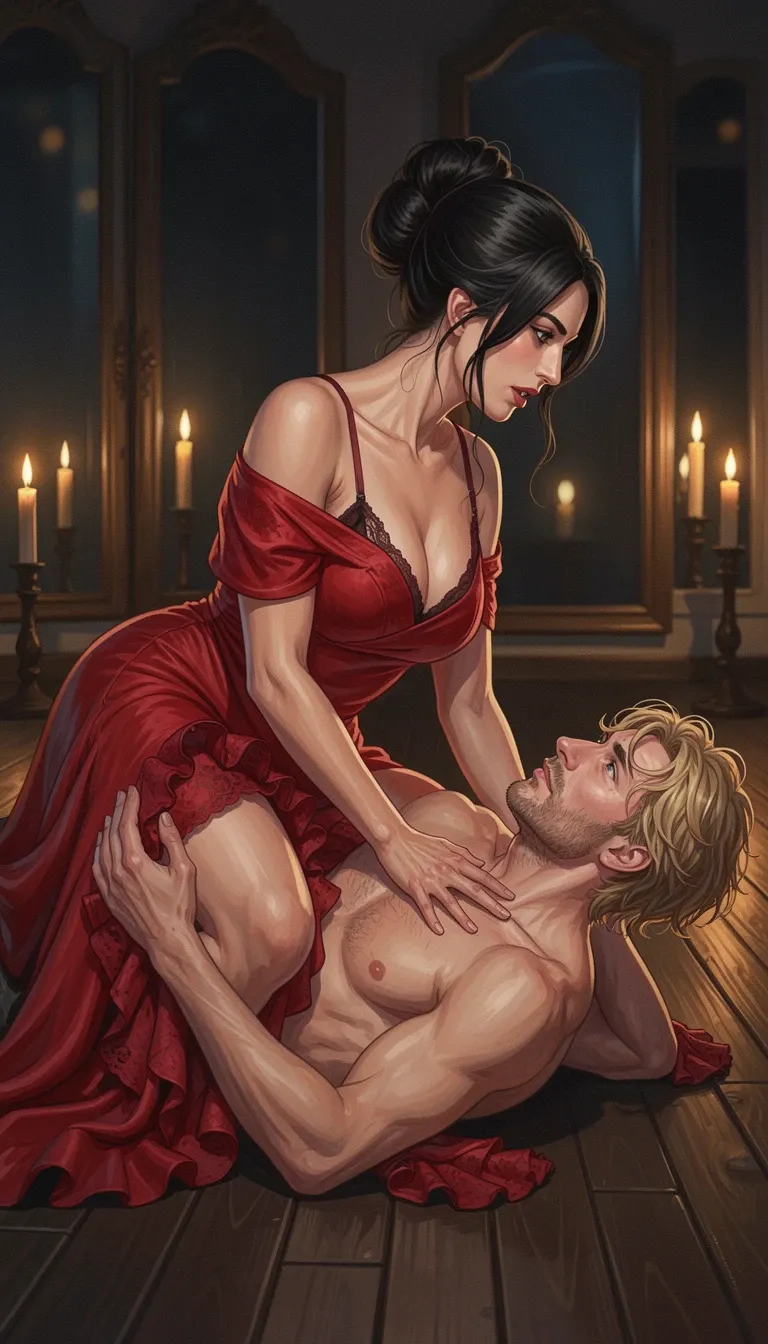
The laptop was shut on the chair, the little green light gone dark, and the article — four thousand words on the white towns and the light that fell on them — was already somewhere over the Atlantic, filed at eight and acknowledged at eight-oh-three by an editor who had not written back since. Nathaniel Brooks, thirty-nine years old, lay on his back on the bed and watched the ceiling fan turn and felt the whole month gathered in his chest like a held note.
Lucía came out of the bathroom with her hair down. He had seen it down twice in twenty-nine days. It fell past her shoulders, still damp at the ends, and she had put on a thin cotton robe the color of old wine and nothing else that he could see, and she crossed the room and sat on the edge of the bed with her back to him and reached for the bottle on the nightstand.
"You're quiet," she said. "The article is done. You should be insufferable."
"I'm working up to it." He watched her pour oil into her palm. The smell came to him — almond, faintly bitter, the same as the studio floor. "Lucía."
"Mm."
"My flight is Thursday."
Her hand stopped. Not long. A beat, the oil pooled in her palm, and then she turned and set the bottle down and looked at him over her shoulder with her dark eyes flat and patient, the way she looked at a student who had come into class with the wrong shoes. "I know when your flight is. You told me the first night and again at the feria and a third time when you were drunk on tinto." She turned further. "Say the thing you are actually saying."
He sat up. The sheet slid off him and he did not pull it back, and he was aware of his own body in a way he had stopped being aware of it in this room — the wiry arms, the stubble, the softness around the middle he had earned in hotel bars across four continents. "I've got nothing to go back to. That's not — I don't mean it as a sad thing. There's an apartment in Queens with a chair in it. There's a woman who gives me assignments and doesn't like me." He rubbed his jaw. "I want to ask for the season. Autumn. I'd find a room. I wouldn't — " He stopped. "I'm not asking to move in here. I know what this is."
"Do you." She said it without heat, which was worse.
"I think I do."
Lucía looked at him for a long time. The street below the window was still going — a scooter, someone calling up from a doorway, the far-off clatter of a shutter coming down — and she let all of it happen around the silence she was keeping. Then she shifted on the bed and put her oily palm flat on his chest and pushed, and he went back against the pillows because that was what the hand said to do.
"You are going to lie there," she said, "and I am going to answer that. But not with words first." Her hand slid down his stomach, deliberate, and closed around his cock, which had been half-hard since she came out of the bathroom and was not half-hard now. She stroked him once, root to tip, the oil making it easy, and his hips lifted off the sheet. "You remember the third night. What I said to you."
"We go slowly." His voice came out thin. "You're in charge."
"And I have not once been in a hurry with you." She let go of him and reached over to the drawer. He heard the wood and the small click of it. She brought out the harness and laid it on the bed beside his hip, and then the amber cock, and set it down too, and his mouth went dry. "Sit up. On your knees. Facing the headboard."
He did it. The sheet bunched under his knees and he put his hands on the headboard and heard her behind him — the leather, the straps pulled through the buckles, the small sounds of a woman dressing herself in a tool. The oil again, the bottle knocked against the wood. Then her hand on the back of his neck, warm and wet, and her thumb pressing the knuckle at the top of his spine.
"This is the answer," she said, close to his ear. "It is not the whole answer. But it is the beginning of it, and you will listen with your body, because that is the only part of you that ever tells me the truth."
"Lucía —"
"Giralda, if you need it. Not before." Her hand moved down his back, slow, and her fingers found him and he felt the oil, cool, then warm, and then the pad of her thumb circling. "Breathe out. You always hold it at the top of your chest. Let it go down."
He breathed out. It took him three tries to do it properly and she waited through all three, her thumb moving in a slow ring, and by the fourth breath something in his shoulders let go and his forehead came down against his own wrist on the headboard.
One finger. He had known her finger before, on the studio floor, and it was not the same — this was slower, the oil making it a long smooth slide rather than a push, and she went in to the second knuckle and stopped and did not move at all. "Tell me," she said.
"It's — good. It's all right."
"That is not what I asked." Her finger curled, just slightly, and his whole body jerked and a sound came out of him that was not a word. "There. That is what I asked."
She worked him that way for a long time. Two fingers, then, and the stretch of it made him grip the headboard and breathe through his teeth, and she talked to him the whole while in a low steady voice, in Spanish and then in English, telling him to let it happen, telling him she had him, that nothing was going to be done to him that she had not decided on, and the words did something to him that the fingers could not — they made the fear in his chest turn over and lie down.
"I'm ready," he said. "Please. I'm ready."
"You are not the one who decides that." But she withdrew her fingers. He heard her move behind him, and the blunt warm head of the amber cock found him and rested there, not pushing, just resting, and her hands came around his hips and held him still. "Slowly. If it is too much, you say the word and I stop and we do not discuss it tonight. Do you understand?"
"Yes."
"Say it in Spanish."
"Sí. Entiendo."
She pushed. Not hard — a slow steady pressure that did not stop and did not hurry. He felt himself open around it in a way that had no words in his own language, a burn that was not pain, a fullness that went up through his belly and into his throat. His breath broke on her name. "Lucía — Lucía —" and she said, "I know. I have you," and kept going, and then she was all the way in and her hips were flush against him and neither of them moved.
The room was very quiet. The street had gone quiet too, or he had stopped hearing it. He was aware of the fan turning above them and of her breath at the back of his neck and of the amber cock filling him so completely that he could not tell where his body ended and it began.
"Good," she said. Her voice had gone rough at the edges. "God. Look at you."
She drew back, slow, and pushed in again, and the second time was easier and the third time was something else entirely, and by the fifth she had found a rhythm — unhurried, deep, each stroke ending in a pause where she was buried in him to the root. He could feel her heartbeat through the leather. Her right hand came around his hip and found his cock, slick with the oil still on her palm, and closed around it.
"No," he gasped. "I can't — if you do that —"
"You can." Her hand began to move in time with her hips, and the two rhythms together were more than he could hold. "You will. But not yet. Not until I say."
She took him to the edge and held him there. Her hips would slow to almost nothing, a slow grind, and her hand would go loose and easy, and then when his breathing had come back down she would drive in deep and stroke him hard and fast and take him up again. He made sounds against his own wrist that he had never made in his life, and once he said her name so many times in a row that she laughed — a low breathless laugh against his shoulder blade — and said, "You are going to wear it out."
"I'm close. Lucía, I'm — please."
"Please what."
"Please let me."
"Say the whole thing."
"Please let me come." His voice cracked open on it. "Please — I can't hold it, please —"
"Now," she said. "Now, Nate."
He came with her buried in him and her hand tight around his cock. It went through him in long pulling waves that started where she was and rolled out to his fingers and his teeth. He heard himself making a sound that was too loud for the room and did not care, and his come hit the headboard and his own wrist and her fingers, and behind him Lucía said something low and fierce in Spanish that he did not catch and drove in one last time and held. He felt the shudder go through her where her thighs pressed against his.
She stayed in him until he stopped shaking. Then she drew out slowly, carefully, and he heard the harness come off and drop, and her hands were on his back, easing him down off his knees onto the sheet, and she was saying something to him in a murmur he could not follow — not commands now, just words, the sound of a woman talking to someone she had decided to keep.
He lay on his side and she lay behind him and put her arm over him, and her hand found his and held it, and for a while neither of them said anything at all. The fan turned. Somewhere below, a door closed.
"Thursday," she said at last, into the back of his neck. "You will change the flight."
He turned his head. "That's the answer?"
"That is part of it." She pushed herself up on one elbow and looked down at him, and her hair had come loose entirely and there was a mark on her shoulder where the strap had been, and her eyes were steady. "You stay the season. You find your room, you do not move in here, I am not your mother and I am not your wife." She let that sit. "And every morning, six o'clock, you are in my studio in your shoes. Not the evening class. The morning class, before the light, when it is only me and the women who are serious and you. You will be terrible. You will be the worst dancer in the room for a long time, and you will not be funny about it, and you will not make that face you make when you want to be liked."
"Six in the morning."
"You wanted to stay." She smiled then, the wicked one, and bent and kissed him hard on the mouth. "You did not think it would be free."
He laughed. It hurt somewhere in his ribs and he laughed anyway, and he pulled her down against him and she came, and he looked past her at the lamp and the shut laptop and the window going pale at the edges, and he thought that he had come to Seville to write four thousand words about the light and would be leaving with a pair of dance shoes and a woman who had told him, in front of no one, exactly what he was going to do with the rest of his autumn.
"Six o'clock," he said. "I'll be there at five-forty-five."
"You will be there at six," she said, and turned off the lamp.
The dark was not complete. The streetlamp on the corner came up through the shutters in thin orange bars, and after a moment he could see her again — the shape of her shoulder, the mark where the strap had been, the hair spread on the pillow. She had not moved away from him. Her hand was still on his chest, flat, weighing him.
"You are still awake," she said.
"So are you."
"I am thinking." Her thumb moved once, slow, over his sternum. "It is a bad habit of mine. I think when I should be asleep."
He turned onto his side to face her and the sheet went with him and he did not bother to bring it back. The air on his skin was cool and he could still feel the oil drying on his belly, the tack of it, the place where her hand had been. His ass ached in a low, wide way that had nothing to do with pain and everything to do with being open, and every time he shifted, the ache spoke.
"Say it," she said. "Whatever it is. You have the face."
"I don't have a face."
"You have a face. It is the one you make when you are deciding whether to be funny." She reached up and put two fingers against his mouth, not hard, just there. "Do not be funny. Not now."
He kissed her fingers because they were there and because he did not have a better answer. Then he said, "I don't know what I'm doing. That's the whole of it. I've spent twenty years being the man who arrives and leaves and writes it down, and now I've asked a woman for a season and she's given me six in the morning and I don't know what I'm doing."
"You are learning to dance badly," Lucía said. "It is not complicated."
"It's not the dancing."
"No." She took her hand back and folded it under her cheek. "It is that you have asked for something and I have said yes, and now you are waiting for the catch. There is no catch, Nathaniel. There is only the work." She yawned, unexpectedly, hugely, and did not cover it. "And the work begins at six."
He laughed, and the laugh turned into something else in his chest, and he lay there in the orange bars of light and felt the whole of it settle — the season, the room he had not found, the shoes he had not bought. Then he reached for her, and she came without being asked, and he kissed her properly, mouth open, his hand in her hair, and she made a low sound against his tongue that he had not heard before and would spend the rest of the autumn trying to hear again.
"You should sleep," she said, when they broke apart. Her voice had gone rough. "You have a class."
"I have an hour." He kissed the corner of her jaw. "Maybe two."
"You are bargaining." But her hand had found his hip and was pulling him over her, and her legs were opening under the sheet, and the bargaining was over before it began. "Slowly," she said, against his mouth. "You have had a long night. Do not be a hero about it."
He put his hand between her thighs and found her wet — properly wet, the slick of it on his fingers, and she lifted her hips into his palm with a small sharp breath. He had wanted this since the terrace, since before the terrace, since the first night she had stood over him in the violet light and told him what he was going to do. He slid two fingers into her and she clenched around them and said something in Spanish into his shoulder. He worked her that way, slow, his thumb finding her clit, until her breathing changed and her hand came up and gripped his wrist hard.
"Enough," she said. "Inside me. Now."
He shifted over her and she reached down and guided him. He pushed into her in one long slow stroke and stopped when he was all the way in. They both made a sound at the same time — hers low and satisfied, his something closer to a groan. She was hot and tight and wet. It was nothing like the strap, nothing like anything, and for a moment he could not move at all for the sheer fact of her.
"There you are," she said. Her heels came up against the back of his thighs. "Move."
He moved. Slow at first, long strokes, pulling almost all the way out and pushing back in to the root. She watched his face the whole time with her dark eyes half-lidded and her lips parted and her hand flat on his chest, feeling his heart go. The ache in his ass flared every time he drove in, and the flare went up his spine and made his strokes ragged. She felt it and smiled.
"You feel that," she said. It was not a question.
"Yes."
"Good. Feel it." Her hips rolled up to meet him. "That is me still in you. Do not forget it."
He did not forget it. He could not have. Every thrust reminded him — a deep interior soreness that was somehow the hottest thing he had ever felt, and it made him harder. She felt that too, and her smile widened into the wicked one. She got her hand between them and found her own clit and began to work it, and her eyes went unfocused and her breath came short.
"Faster," she said. "Not — like that. Yes. Like that. Do not stop, do not you dare stop —"
He did not stop. The bed knocked against the wall. He did not care and neither did she, and her legs locked around his hips and pulled him deeper. He felt her start to come before he heard it — the long clench of her cunt around his cock, the way her whole body went rigid and then broke, her heels digging into his back, her hand leaving her clit to grab his shoulder hard enough to hurt. She came with her teeth in his shoulder and a sound in her throat that was almost a growl, and the sound of it, the feel of her, took him over the edge with her.
"Lucía —"
He came inside her. It went through him in long pulling waves and he drove in deep and stayed. He felt himself spend into her, pulse after pulse. She held him there with her legs and her hands and her teeth. He heard his own voice break on her name and did not care who heard it in the street below. The last of it left him shaking, his forehead down against hers, his breath coming in rags.
Neither of them moved for a long moment. Then she let her legs fall open. He eased out of her, slowly, and felt the wet of it on his cock and her thighs. She made a small satisfied sound and stretched like a cat under him.
"Well," she said. "That was not slow at all."
"You said not to be a hero."
"I said not to be a hero. I did not say to be a racehorse." But she was smiling, and she reached up and pushed the hair off his forehead with a hand that was not quite steady. "Lie down. You are heavy and I am old."
"You're not old."
"I am forty-two. Lie down."
He lay down. She turned onto her side and he fitted himself behind her, his arm over her waist, his face in her hair, and the fan turned above them and the orange bars of light lay across the wall and neither of them said anything for a while. He could feel her heartbeat slowing under his palm. He could feel his own slowing to meet it.
"Nathaniel," she said at last.
"Mm."
"The room. There is one on Calle Mateos Gago, above the pottery. A widow lets it. It is small and it is loud and the stairs will kill you, and it is four minutes from the studio." She said it into the dark, not turning. "I will give you her name in the morning. You will go and see it and you will not tell her you know me, because she will double the rent."
He laughed into her hair. "That's the rest of the answer."
"It is not an answer. It is a room." She pulled his arm tighter around her. "The answer is the season. The room is only where you will sleep in it."
He lay there and thought about the apartment in Queens with the chair in it, and the woman who gave him assignments and did not like him, and the four thousand words about the light that were already somewhere over the Atlantic. He thought about how he would write to the woman and ask for the season, and how she would say no and then say yes, and how he would buy the shoes, and how he would be the worst dancer in a room full of serious women at six in the morning, and how Lucía would watch him be terrible and not let him be funny about it.
"Lucía," he said.
"Sleep."
"Thank you."
She was quiet for a moment. Then she turned her head just enough that her lips found the inside of his wrist, and she said, "Do not thank me yet. You have not danced for me in the morning."
He smiled into her hair and closed his eyes, and the fan turned, and the street was quiet, and somewhere below a shutter came down and did not come up again.
In the morning he woke before the alarm, before the light, to the sound of her moving in the bathroom and the smell of coffee coming up the stairs, and he lay in the warm hollow of the bed with his body aching in three places and thought that he had come to Seville to write about the light and had found, instead, a woman who had told him exactly what he was going to do with the rest of his autumn.
He got up. He found his shoes.
The shoes were the wrong shoes. He knew it before he got to the bottom of the stairs — leather soles, city shoes, made for pavements and not for the strike of a floor — but he had nothing else, and so he carried them and went barefoot down the last cool steps into the studio with the coffee cup warm in his other hand.
Lucía was already there. She stood at the far mirror with her back to him, her hair down for once, and she was not in the red dress. Grey leggings, a black vest, a scarf knotted at her throat against the morning cold that came up off the tiles. She was doing something with her wrists, small circles, and in the mirror he could see her face doing nothing at all — no performance in it, no audience. Just a woman getting her joints awake.
She saw him in the glass and did not turn around.
"You are barefoot," she said.
"You said shoes. I have shoes." He lifted them. "They're just the wrong ones."
"Put them on. You will dance in them until the shop opens at ten and then you will go to the shop on Calle Feria and you will buy what I tell you to buy." She turned then, and looked him up and down with the flat evaluating look she gave the women in her class, and he felt it land on his bare feet and his city trousers and the coffee cup he was holding like a shield. "And you will not drink that in here. Not before. After."
He set the cup down on the bench by the door. The studio was cold and smelled of rosin and the ghost of last night's oil, and the mirrors made it bigger than it was, and in them he could see himself from three angles at once — a lanky American in his forties, sockless, holding a pair of shoes, in a room built for women who knew what their bodies were for.
"I don't know the steps," he said.
"I know you do not know the steps. That is why you are here at six in the morning and not at eight with the others." She came off the mirror and crossed the floor and stopped a metre from him. "The others come to learn a dance. You are learning something else. So we will do it differently."
"What am I learning?"
"The compás." She clapped once, sharp, and the sound went off the walls. "Twelve. One two three, four five six, seven eight nine, ten eleven twelve. The accents are not where you think. You are a writer. You will want to make it a sentence. It is not a sentence. It is a clock with a limp in it." She clapped again, in a rhythm he could not hold in his head. "Now. Stand there. Do nothing. Only the feet. Tap the twelve and do not move the rest of you."
He tapped. He got it wrong. He got it wrong eleven times and on the twelfth he got the accent right and she said nothing at all, which he was beginning to understand was her highest praise.
By half past six his calves were burning and the cold had gone out of the room and his shirt was stuck to his back. She had him walk the compás across the floor and back, and then with his arms, and then — "No. Not like a man swimming. Like a man who has decided something" — and he laughed and she did not, and he stopped laughing and did it again, and the thing that came out of him that time was not a dance but it was not a joke either.
She watched him from the bench with her coffee, her ankles crossed, her face unreadable.
"Better," she said. "You are still terrible. But you are terrible with the feet now and not with the face."
"Is that the lesson?"
"The lesson is that you came in here this morning and did not make a joke about it. Not once. Do you know how rare that is?" She set the cup down and stood. "Every man who comes through that door makes a joke before the first hour is out. It is how they ask to be let off. You did not ask to be let off."
He wiped his forehead with the back of his wrist. "I didn't have the breath for it."
"Good. Then you have learned the only thing I can teach before ten." She walked to the door and pulled it open onto the street, and the morning came in cold and blue and smelling of bread from somewhere. "Go and buy the shoes. Calle Feria, the man with the bad eye. Tell him Lucía sent you and he will not cheat you more than a little." She paused with her hand on the doorframe. "And Nathaniel. The room. Go and see it before the shoes. The widow is awake at eight and asleep by noon, and if you go at noon you will stand in the street for nothing."
He put his shoes on. His feet had swollen and they complained.
"Lucía," he said, at the door.
"Mm."
"What is this? I mean — I know what it is. The season. The room. But what do I call it, when I'm writing to a woman in New York and she asks me why I'm not coming back?"
She considered him. The street light was behind her and her face was in shadow and he could not read it, and then she stepped forward into the light and he could.
"You tell her you have taken a room," she said, "and you are learning to dance, and the woman who is teaching you does not give refunds. You do not tell her the rest. The rest is not for a woman in New York. The rest is for this room."
"And for you."
"And for me." She reached out and straightened his collar, which did not need straightening, and her hand stayed there a moment at his throat. "Now go. You are wasting the morning and the morning is the only thing I cannot give you back."
He went out into the street. The sky over the roofs was the colour of the inside of a shell and the Giralda stood up out of the city with the light coming up its side, and he stood there a moment with his wrong shoes and his aching body and watched a woman in an apron pull the shutters up off a fruit stall, and he thought that he had never in his life been given a morning, not like this — not a morning that was a thing to be spent and not endured.
He found the widow's door above the pottery. He climbed the stairs and they did try to kill him, and the room was small and loud and the window looked out on a wall, and he took it before he had finished looking at it.
Then he went to Calle Feria and bought the shoes, and the man with the bad eye took his money and told him he would ruin them in a month and he said yes, I know, and carried them home in a paper bag.
He was back in the studio at half past nine, and Lucía was alone in it, and she looked up from her phone and saw the bag and the shoes in it and the fact that he had not gone home to sleep, and something crossed her face that she put away quickly.
"You took the room," she said.
"I took the room."
"And the shoes."
She came and took the bag from him and looked inside at them, the black leather, the nailed heel, and she nodded once, slowly, the way she had nodded at the twelfth tap.
"Then we begin," she said. "Again. Tonight. In the violet light, with the door locked, and this time you will not be funny and I will not be gentle, and when it is over you will sleep in your own room and I will sleep in mine, because that is what this is. Do you understand what I am telling you?"
He understood. It was not a promise and it was not a refusal. It was a season, and a room, and a woman who did not give refunds, and the whole of his autumn laid out in front of him like a floor he had not yet learned to walk on.
"Yes," he said. "I understand."
"Good." She handed him back the shoes. "Then go and eat something. You are no use to me hungry."
He went. At the door he turned to say something — he did not know what, something about the light, something about the morning, something that would have been a joke if he had let it — and she was already back at the mirror with her wrists and her small circles, watching him leave in the glass, and she did not look away.
So he did not say it. He went out into the Seville morning with his shoes in a bag and his body aching in three places and a room of his own waiting up four flights of stairs, and behind him, faint through the door, he heard her clap once — sharp, twelve, the clock with the limp in it — and begin again.