
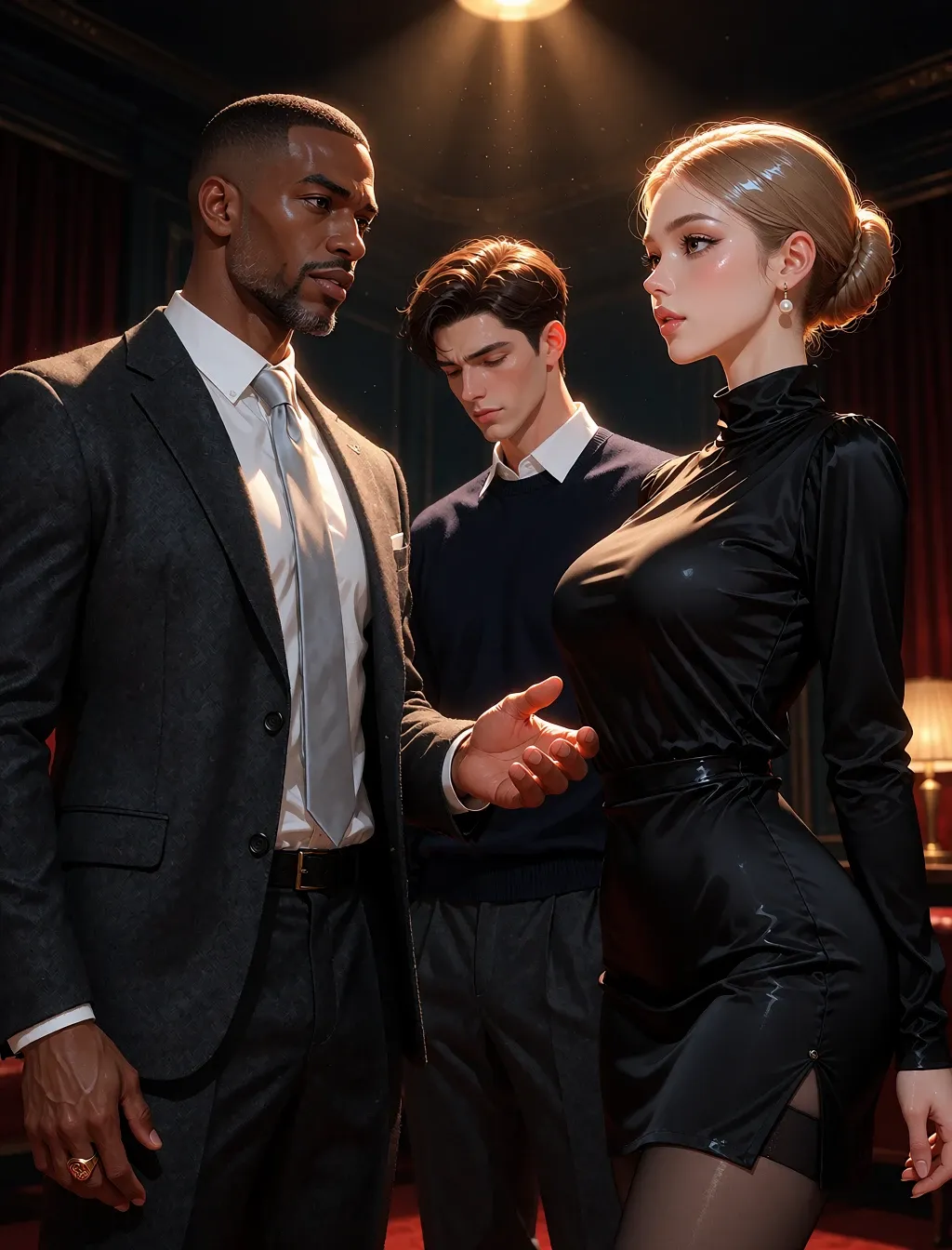
The bass came up through the marble into his knees before it reached his ears, a low throb that rearranged his heartbeat to its own tempo, and Willow knelt in it with his bound arms locked behind him and his forehead not quite resting against Lydia's thigh. The dance floor was a field of moving bodies, dark shapes cut by amber light that swung slow and low from somewhere overhead, and every few seconds one of those shapes would turn and find him and not look away fast enough.
A woman in silver passed with a drink held high, and her eyes went down, and her mouth did something that was not a smile. A man at the bar had been watching for a full minute and had stopped pretending otherwise. Willow kept his chin down and felt the latex sealing his skin and the steel cap cold and exact around him, and the two sensations had stopped being separate things somewhere in the last hour.
Lydia's hand rested on the crown of his wig, light, almost absent, the way a woman rests her hand on a dog she has already decided to keep. Her thumb moved once, twice, along the platinum strands.
Then the room changed.
He felt it before he understood it — a thinning of the crowd near the far side of the floor, bodies drifting aside the way water gives way to the keel of a boat. The bass went on thudding, but the noise of the room dropped a register, conversations folding down into something quieter and more careful, and Willow lifted his head because he could not help it.
Kofi Amari came through the parted crowd at a walk that had nothing hurried in it, and the amber light caught the dome of his shaved head and laid a wet-looking shine across it. He was broader than the room had made him in the foyer, or the foyer had made him smaller by comparison; either way, in his own house, moving between his own dancers, he took up more space than his body strictly occupied. The charcoal suit moved with him without a wrinkle. The gray beard was trimmed to a hard line along his jaw, and his eyes were already on Lydia's table, already on the leash, already on Willow.
His hand came down on the back of Lydia's chair, and the gold signet ring on his little finger threw a small hard star of light across the table's edge.
"Mrs. Bakker." His voice was a rumble that found the gaps between the bass notes and filled them, low enough that Willow felt it in his chest more than heard it. "I trust your gift has been properly prepared."
Lydia did not stand. She tilted her face up to him, and Willow watched the two of them from below, the angle making them both strange and tall.
"She has been," Lydia said. "Celeste saw to the first rule."
Something moved in Kofi's face at that, small and satisfied. "Celeste is thorough." His gaze came down then, unhurried, and settled on Willow the way a hand settles on a table. "Look at me, girl."
Willow's chin came up because his neck had already learned what his mind was still arguing about. Kofi looked at him — really looked, the way a man looks at a thing he is considering buying and has not yet decided the price of. The platinum wig. The painted eyes, the painted mouth. The latex stretched over his chest and belly, and the place beneath it where the steel cap sat hidden and heavy and made him feel hollowed out and sealed at once.
The smile that came onto Kofi's face was slow and patient and did not hurry to finish.
"Well," he said. "She's a pretty little thing. Prettier than the photograph."
Willow's stomach dropped. The photograph. He felt his bound hands try to move and find no room, the cuffs biting at his wrists.
"You sent him a photograph," he said, and his voice came out thin and wrong, a breathy little rasp that was neither Warren's voice nor quite the whisper he used for Willow. "Lydia. You sent him—"
"Hush." Lydia's hand closed on the crown of the wig, not hard, just enough. "Girls don't interrupt."
Kofi pulled the empty chair out from the table and turned it and sat down, unhurried, one ankle crossed over the other knee, and the chair took his weight without a sound. Up close his stillness was the loudest thing about him. He did not fidget. He did not glance at the room. He watched Willow the way a fire watches a room it is warming.
"Your wife," he said, "has been very generous with her information."
"Lydia." Willow turned his face up to her, and the leash pulled a little and he leaned into it without meaning to. "What did you tell him?"
Lydia looked down at him, and her dark eyes were calm and unhurried and gave nothing away, and it occurred to Willow — not for the first time tonight, but sharper now, with a blade's edge — that he had never once seen his wife surprised. Not in three years. Not by anything he had ever done.
"I told him the truth," she said. "All of it."
"There isn't—" His breath came short. "There isn't all of it. I don't know what you think you—"
"The shoe box," Lydia said, and her voice was almost gentle, and that was the worst of it. "The camisole. The wig. The lipstick. That was the first thing, Warren. That was only the first thing."
The music went on. Someone laughed somewhere out on the floor, high and bright, and it seemed to come from very far away.
"The accounts you keep under a different name," Lydia went on, and she reached down and tucked a strand of platinum behind his ear, and her fingertip brushed the black glass drop and made it swing. "The little camera above your desk at the office that you turn on when the door is locked. The men you've shown yourself to. The hours you've spent at that desk with the door locked and your hand down your trousers and a voice in your ear telling you what you are." She paused. "You keep a history, darling. Browsers keep histories. So do I."
Willow could not speak. His face was burning under the paint, and his throat had closed, and the steel cap was suddenly the only solid thing in the world.
"The hypnosis files," Kofi said, and he said it without any particular emphasis, the way a man might name a wine. "The ones you listen to with the headphones on. The ones that tell you to go under and be a good girl and forget that you ever wanted anything else." He tilted his head. "How many times, Willow?"
The sound of his own name in that voice — the girl's name, said plainly, by a man who had never met him — went through him like a hand.
"I don't—"
"He doesn't have to answer," Lydia said, and she said it pleasantly. "He's shown us. That's rather the point of a history."
Kofi's smile deepened, and he looked at Lydia with something that might almost have been respect. "You've done your work, Mrs. Bakker. Most wives come to me with a suspicion and a shoebox. You come with a file."
"I've had two years," Lydia said.
"Two years." Kofi turned the signet ring on his finger, once, slow. "And in two years you never once said a word to him."
"Why would I?" Lydia's hand found the leash again and drew it up through her fingers, loop after loop, until the slack was gone. "If I'd told him I knew, he'd have burned the box and been very sorry and very careful and gone on being exactly what he is in the dark, and I'd have had to watch him pretend." She looked down at Willow. "This way, he doesn't have to pretend anymore. Does he?"
Willow's eyes stung. The paint at the corners of them would run if he let it, and he did not let it, and he did not know whether the tightness in his chest was shame or something worse that wore shame's clothes.
"No," he whispered. "I don't."
"Good girl," Lydia said, and the two words went through him and left him light-headed.
Kofi leaned forward and set his forearms on his knees, and the movement brought his face close, and Willow saw the fine lines at the corners of his eyes and the steady brown of them and the patience in them, and understood that this man had sat across tables from a great many people who had come to him wanting something and pretending not to.
"Let me tell you what your wife has arranged," Kofi said, "so there's no confusion between us. You are a sissy. You have been one in a closet and behind a locked door and under a different name, and you have wanted, all that time, for someone to find you out and take the choice away from you. That is what your wife has done. She has taken it away." He let that sit. "The question that remains is not whether you want this. We both know you want this. The question is what kind of thing you become now, and who owns it."
Willow's bound hands had gone still behind his back. The bass went on. Somewhere a glass broke and someone cheered.
"My office is upstairs," Kofi said, and he straightened and stood, and the chair did not scrape. "We should discuss the terms of her stay."
Lydia rose. The leash came taut in her fist, a straight dark line from her hand to the collar at Willow's throat, and the pull lifted his chin and made him rise with it, awkward on the six-inch heels, his bound arms making him clumsy, his knees stiff from the marble. He got his feet under him and stood, and the room tilted and settled.
The shift was in the air before anyone said anything more. The display was over. What came next was negotiation — the weighing, the terms, the price — and Willow stood at the center of it with his painted face and his caged cock and understood, with a clarity that was almost peaceful, that he had stopped being the gift and become the thing the gift was about.
"The terms," Lydia said, and she gathered the leash once more, and her voice was flat and final and did not invite an answer. "We'll discuss them upstairs."
Kofi did not move toward the back of the room. He moved toward the bar, and the girl behind it had a bottle out and a glass filled before he had finished lifting two fingers, and he set the glass down in front of Lydia without a word and did not pour one for himself. The whiskey sat there amber and patient. Lydia looked at it and did not pick it up, and Willow understood that this was not courtesy — it was a clock starting, the first small test of the negotiation, and his wife had already decided not to drink from a glass a man had poured for her.
"You'll want to hear the rest of it before we go up," Kofi said, and it was not a question. "There's a thing I do with the ones who come to me with a file. I read it first. Out loud. To them. So there's no confusion about what's known and what's only guessed." He turned the signet ring again, and the gold caught the amber and threw it back. "Two years is a long time to keep a thing to yourself, Mrs. Bakker. Longer than most people can manage without slipping. I'd like to hear how you managed it."
Lydia's fingers were still wound in the leash, and the loops of it lay across her knuckles like rings. "He's careful," she said. "He's been careful his whole life. That's the thing about a man who's spent thirty-two years being careful — he thinks careful is the same as invisible." She let her eyes come down to Willow, and there was no heat in them, and no cruelty either, only the flat attention of a woman reading a page she had already read. "He wipes his browser history. He clears the camera roll. He keeps the files on a drive in his desk drawer and he takes the drive out and puts it in the safe when he leaves the office. He thinks he's thorough." A pause. "He forgot the router logs. He forgot that the little camera above his desk uploads to a cloud account he set up when he was twenty-eight and never thought about again. He forgot that a man who listens to the same voice in his ear for two years starts to use that voice's words in his sleep."
Willow's face had gone cold under the paint. He had not known about the router logs. He had not known about the cloud account. He had not known, and the not-knowing sat in him like a swallowed stone, because it meant that every careful thing he had ever done had been a door left open, and she had been walking through it for two years while he stood on the other side of it thinking himself alone.
"There's more," Lydia said, and she said it to Kofi and not to him, and that was the part that stung — that she had stopped addressing him at all, as though he had already passed out of the category of people who were spoken to. "The photographs. The ones he took of himself in the mirror with the timer on. He kept them in a folder called taxes." Her mouth did something at the corner that was not quite a smile. "There are two hundred and eleven of them. I counted. In some of them he's wearing the camisole. In some of them he's wearing nothing but the wig and the lipstick and a pair of my earrings." She looked at Willow then, and her eyes were steady. "You took my earrings, Warren. The pearls. You put them on and you took a picture and you put them back in the box and you thought I wouldn't notice that the clasp was warm."
Willow made a sound. It was not a word. It came up out of him and broke against the back of his teeth, and his bound hands pulled against the cuffs behind him, and the steel cap was suddenly the only thing holding him together.
"And the men," Kofi said, and his voice was low and unhurried and did not judge. "The ones on the camera. The ones who watched." He picked up the whiskey Lydia had not touched and turned the glass once, watching the light move in it, and set it down again untouched. "How many, Willow?"
"I don't—"
"He doesn't have to count," Lydia said. "I did. Forty-one. Over two years. Some of them came back more than once. One of them he talked to for six months and never once showed his face, and that one he called sir." She said the word without any particular weight, and that was worse than if she had spat it. "He would sit at his desk with the door locked and the camera on and the headphones in and let a stranger in another country tell him what to do, and he would do it, and he would say thank you afterward."
The bass had changed. Something slower had come on, something with a pulse in it like a slow hand on a drum, and the dancers out on the floor had drawn closer together, and the amber light swung lower, and none of it reached the three of them at the bar. Willow stood with his chin lifted by the leash and his eyes on the mirror behind the bar, and in the mirror he could see himself — the platinum wig, the painted mouth, the collar, the dark drops in his ears — and he could see Lydia beside him, and Kofi beyond her, and the three of them made a shape in the glass that he did not recognize and could not look away from.
"The hypnosis," Lydia said, and she said it quietly, and for the first time all night her voice had something in it that was not flat. "That's the part I couldn't watch. The files. The ones that tell him to go under and be a good girl. He listens to them with the headphones on and his eyes closed and his hands flat on the desk, and he goes somewhere, and when he comes back he's crying and he doesn't know why." She let the leash out a little, and it slid through her fingers and lay slack on the marble, and Willow felt the small freedom of it and did not move. "He's been doing that for two years. Every week. Sometimes more. And every time he comes back he's a little further from the man I married and a little closer to the thing he's been trying to become."
Kofi was quiet for a moment. The bass went on. Somewhere out on the floor a woman laughed and the laugh went up and broke apart against the ceiling and came down in pieces.
"So you didn't find a shoebox," he said at last. "You found a whole life. And you sat with it for two years and said nothing."
"I sat with it," Lydia said, "and I learned it. Every file. Every folder. Every name he used and every man he showed himself to. I learned him better than he knows himself, because he only ever sees the pieces one at a time, and I saw all of them at once." She turned her face up to Kofi, and her chin was level and her eyes were dark and she did not blink. "That's what I'm bringing you. Not a shoebox. A whole girl, already made, already trained by her own hand. All she needs is someone to own her."
Willow's knees went weak under him, and the leash caught him, and he stood. The steel cap was cold and exact, and his cock was a small hard ache behind it, and he understood — with a clarity that came up through the floor and into his chest — that every private thing he had ever done in the dark had been a rehearsal, and that his wife had been sitting in the audience the whole time, taking notes.
"Upstairs," Kofi said, and he set his glass down and stood, and the chair did not scrape. "There's a file on my desk with your name on it, Mrs. Bakker. I'd like to open it with you in the room."
Lydia gathered the leash once more, and the slack came up through her fingers and the collar lifted Willow's chin, and she looked down at him and her mouth was calm and her eyes were calm and there was nothing in her face that he could read at all.
"The terms," she said, and her voice was flat and final and did not invite an answer. "We'll discuss them upstairs."
The stairs were narrow and uncarpeted, and every step up them drove the heel of the boot down onto wood that rang like a struck pipe. Willow climbed with his arms bound behind him and the leash pulling him upward, and he had to take each stair sideways, and the latex made a sound against itself with every stride, and behind him Kofi's voice said, "Steady," once, without heat, the way a man speaks to a horse on a ramp.
The office was at the top and the door was already open.
He had expected something else. He did not know what — a dungeon, he supposed, some theatrical dark. Instead the room was warm and low-ceilinged and smelled of paper and coffee gone cold. A green banker's lamp stood on a desk of dark wood, and the desk was clean except for a single manila folder squared to the blotter and a fountain pen laid across it at an angle. Bookshelves ran the length of one wall, spines worn soft. A window at the far end looked out over the canal and the black water held the streetlights in long broken columns. There was a rug. There was an armchair with the seat worn hollow. It was, Willow thought with a lurch, an office — a real one, a working one, the room of a man who did business here most nights and had done it for years.
"Kneel," Lydia said, and let the leash fall slack.
He went down on the rug. His knees found it gratefully after the marble. The cuffs behind his back forced his chest forward, and the steel cap pressed against his thigh, and he set his eyes on the folder and did not lift them.
Kofi came around the desk and sat down behind it, and the chair took him and he leaned back and folded his hands over his stomach and looked at Willow across the lamp. Lydia did not sit. She stood at the corner of the desk with the leash looped loose around her wrist, and the amber light came up under her chin and made a shadow of her cheekbones.
"Before we talk about money," Kofi said, "we talk about what's in here." He laid one finger on the folder. "Your wife gave me a drive. Forty-one men, two hundred and eleven photographs, a router log that goes back nineteen months. I've had my girl read it. It's thorough. It's the sort of file I'd expect a bank to keep on a client it doesn't trust." His finger stayed where it was. "But a file tells me what a man did. It doesn't tell me what's underneath. That's what the room downstairs is for. That's what tonight is for."
"You're going to test him," Lydia said.
"I'm going to find out what's already been put there." Kofi opened the folder. The pages inside were dense with Willow's own small handwriting — his own hand, from his own desk, and the sight of it made his stomach turn over. "Two years of files, Mrs. Bakker. The voice in his ear. The words it used. If I'm going to own a girl, I want to know what her own hand has already taught her, so I'm not fighting it." He turned a page. "The files have titles. Did you know they had titles?"
"I know what they're called," Lydia said.
"Then you know what I'm going to ask him." Kofi looked up. "Willow. Look at me."
He lifted his head. The lamp was between them and it made Kofi's face a mask of light and shadow, the beard a hard gray line, the brown eyes steady and giving away nothing at all.
"I'm going to say some words," Kofi said. "You're not going to fight them. You've heard them before, in your headphones, with your eyes closed and your hands flat on the desk. You know what happens when you hear them. You know how far down they take you." He set his forearms on the desk. "I want to see how far. Nothing more than that. Tonight. Understand?"
Willow's mouth was dry. "Yes."
"Say it properly."
"Yes—" His breath caught. "Yes, sir."
Something crossed Kofi's face and was gone. "Good girl. Now. Eyes on the lamp."
Willow looked at the lamp. The green glass, the brass arm, the small hot filament inside. The room narrowed to it. The canal outside the window went quiet. The clock on the shelf behind Kofi had a tick to it that he had not heard before and heard now.
"Good girl," Kofi said, and his voice had dropped, had found a register below the one he used for business, a low patient rumble with the accent softening the vowels. "Good girl, Willow. You've heard that before. You've heard it in your ear with the door locked, and you know what it means. It means you can put it down. All of it. The man and the suit and the careful life. Put it down."
Willow's shoulders went loose before he knew they were going. The cuffs held his arms, but the muscles along his back let go one by one, and his chin dropped, and he caught it and lifted it again.
"There," Kofi said. "You feel that. That's not me. That's what's already in you, waiting for the word. Your wife's file says the voice taught you a place to go. A quiet place. Do you remember what it's called?"
"The—" Willow's voice came out thin. "The garden."
"The garden." Kofi said it slowly, tasting it. "And what happens in the garden?"
"I—" His eyes were still on the lamp, and the lamp had gone soft at the edges, and the room had gone soft behind it. "I don't have to be anything. In the garden. I don't have to be a man. I don't have to be a husband. I just—" His throat worked. "I just have to be good. And someone tells me I'm good. And I don't have to think."
Lydia had not moved. Willow could see her from the corner of his eye, the black dress, the pearl at her ear, the leash still looped around her wrist, and her face was turned toward him and it was not cold. It was not anything he had a name for.
"The garden has a gate," Kofi said. "What's on the gate?"
Willow's lips moved before he had decided to let them. "A lock."
"And who holds the key?"
"The voice."
"And now?"
Willow's eyes stung. The paint at the corners of them was going to run and he did not care and he did not stop it. "You do," he whispered. "You and her."
The room was quiet. The clock ticked. Kofi sat back and looked at Lydia, and something passed between them that Willow was not part of.
"Two years of files," Kofi said, "and in two years he never once went all the way down for a man in the room. That's the thing about the recordings. They take you to the gate and they leave you there. They can't put a hand on your shoulder. They can't look at you." He turned his signet ring once. "That's what I'd be buying. A girl who's been to the gate a thousand times and never once been taken through it."
"And what's that worth?" Lydia said.
"More than a girl who's never been to the gate at all. Less than a girl who's been through it and come back." Kofi closed the folder and squared it to the blotter with two fingers. "There's another word in the file. Two, actually. The voice uses them as a pair. I want to test them and I want you to watch what happens when I do."
Lydia's chin came up a fraction. "Which words?"
"The first one is 'pretty.'" Kofi's eyes came back to Willow. "Pretty girl. Pretty thing. Pretty little sissy. The voice says it and the girl goes soft. I've seen it in the file. I want to see it in the room." He leaned forward. "Willow. Look at me. You're a pretty girl."
It hit him in the chest like a hand. His breath went out of him and did not come back at once, and heat climbed his throat and flooded his face under the paint, and his bound hands pulled against the cuffs behind him without his telling them to. The steel cap was suddenly unbearable, a small hard pressure with nowhere to go, and his cock ached behind it and he made a sound — a small humiliating sound, a whimper that came up out of his chest and broke in his throat.
"There it is," Kofi said, and his voice was almost kind. "That's not obedience. That's hunger. A girl who's been told she's pretty a thousand times in the dark and never once by a man who could see her face." He let it settle. "The second word is harder. The voice uses it to take the choice away. It says it and the girl stops arguing with herself. The word is 'mine.'"
Willow's whole body went still.
"Willow," Kofi said, and the rumble of his voice had gone low and certain. "You're mine now."
The room tilted. Willow's eyes closed without his permission and the garden was there behind them, the quiet place, and the gate in it was open, and there was a hand on his shoulder that had never been there before and it was warm and heavy and it did not let go. His bound arms had stopped pulling. His breathing had gone slow and deep and even, and something in his chest that had been clenched for as long as he could remember had come unclenched, and it hurt, and he did not want it to stop.
He heard himself say it. "Yes." His voice was a whisper and it was not Warren's voice and it was not quite Willow's either. "Yes. Yours."
Lydia made a small sound. Willow's eyes came open and found her, and she had one hand pressed flat to the desk and her knuckles were white, and her face — her face had cracked, just at the corner of the mouth, just for a moment, and then it was calm again.
"Well," she said, and her voice was not quite steady. "That's what I brought you."
Kofi sat back. He looked at her for a long moment, and the lamp lit one side of his face and left the other in shadow, and he did not smile.
"Now we talk about what happens to her," he said. "Because a girl like this doesn't go in a cage in a back room. A girl like this has been made for a purpose, and the purpose is to be seen. That's what the files were for. That's what the photographs were for. She wanted to be found out. She wanted someone to look." He turned the signet ring again, once, slow. "So the question I'd put to you, Mrs. Bakker, is whether you want her kept, or whether you want her shown."
"Both," Lydia said.
Kofi's mouth did something at the corner. "That's the expensive answer."
"I'm not asking for cheap."
"No." He looked at her steadily. "You're not." He pulled a second sheet from the folder and turned it around and pushed it across the desk toward her, and it was covered in his own small precise writing, columns and figures and dates. "Then hear the terms. She stays here. Not in a back room — in the house, where the members see her, where she's got a name and a place and a purpose. She serves. She's shown. She's used as a sissy is used, and she's kept as a sissy is kept, and she doesn't leave except when I take her out on a leash. That's the first year. At the end of the first year, we talk about the second."
Lydia looked down at the sheet. "And me?"
"You go home." Kofi said it plainly. "You go home and you're a widow or you're a wife whose husband has gone away, and you choose which, and you choose it before you leave this room. That's the part I won't decide for you. The club keeps its business to itself. But the world outside this door is yours to manage, and I want to know how you mean to manage it before I take her on."
Willow knelt on the rug with the garden still soft at the edges of his mind and heard his wife say, "A divorce. Quiet. He'll have signed the papers before I leave."
"And if he hasn't?"
Lydia's eyes came down to Willow, and they were calm, and they were dark, and there was nothing in them he could read at all.
"He will have," she said.