
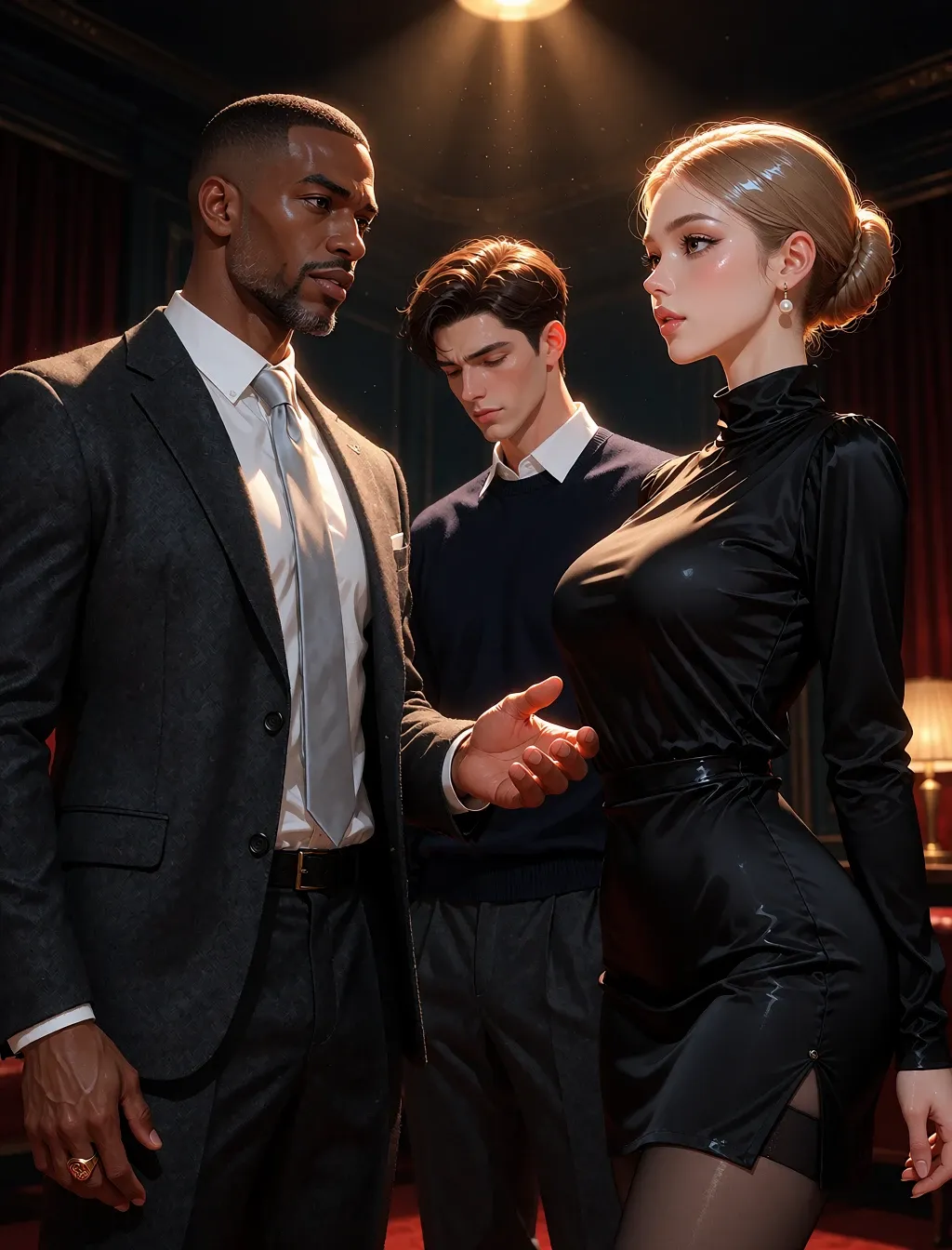
Warren woke first, and Lydia knew it without opening her eyes. The mattress had that particular stillness to it, the held-breath stillness of a man lying very carefully so as not to disturb anything, least of all the question of where the camisole had gone. She kept her eyes shut and let him have his silence. Somewhere beyond the window, a canal boat groaned against its mooring. The room smelled of the champagne from last night and, beneath it, faintly, of him.
When she finally opened her eyes the clock said eleven. Late. Good. Let the day start soft.
He was on his back, the sheet pulled to his chin like a boy hiding from a thunderstorm, his hair flat on one side and standing on the other. His eyes were open and fixed on the ceiling. He did not turn to look at her.
"Morning," she said.
"Morning." His voice had gravel in it. He cleared it. "I didn't— you were sleeping. I didn't want to wake you."
She sat up, and the sheet fell away from her, and she watched him decide not to look at her breasts, the way he always decided not to look, the way that had stopped being gallant sometime in the second year and become a kind of apology he kept making that neither of them could cash. "There's a terrace," she said. "They serve breakfast until noon. Get dressed."
He was up before she finished the sentence. She heard the bathroom door, the shower, the water running longer than a man's shower should run — long enough to wash something off, long enough to stand under the hot water and rehearse being Warren again. She stayed in bed and listened to it and looked at the small pile of things on the armchair: the camisole, folded now, and the black lace panties, folded too, laid on top of it like a note.
He'd folded them. Of course he had. Even his shame was tidy.
The rooftop terrace was four floors up and open to the sky, and the morning had turned hot enough that the white canvas umbrellas were all deployed, and the humid air came up off the canal carrying the smell of damp stone and, from the direction of the street, a stale-beer sourness left over from the night before. Lydia took the table at the railing. Below, a heron stood in the green water on one leg, entirely still, and did not care about anything.
Warren came out in the navy blazer and a fresh white shirt, the collar smoothed flat, his hair combed and parted and already, she noted, with one strand making its escape at the temple. He pulled out his chair and sat and immediately adjusted the cutlery, turning the knife a quarter turn so it lay parallel to the edge of the table.
"Sleep well?" she asked.
"Yes. Very. The bed's— it's a good bed." He laughed at nothing. "Big. It's a big bed."
She picked up the menu and did not help him out of it, and after a moment he picked up his own menu and they read in silence, and the silence had a shape to it, a thing sitting at the table between the bread basket and the salt, and neither of them touched it.
She ordered the eggs and the strong coffee and a glass of the fresh orange. He ordered the same, then changed it to the pancakes, then apologized to the waiter for changing it, then, when the waiter had gone, said, "I should have just had the eggs."
"You can have the pancakes. It's your birthday."
His face did something complicated at the word. It had been his birthday since the plane, since the red-light district, since the shop with the silk bow, and it was still his birthday today, and tomorrow it would not be, and she wondered if he had thought about what that meant yet. Probably not. He was not a man who looked at dates.
The coffee came. She wrapped both hands around the cup and let the heat climb into her palms and looked at him over the rim. His eyes skated off hers and went to the heron, then to the canal, then to the sky, and came back. "The light here is strange," he said. "It's so— it's flat. The sky's so low."
"It's the water. It reflects."
"Right. Yes." He turned his cup a quarter turn. "You said tomorrow. Last night. You said you're taking me somewhere today."
"I did."
"Is it—" He stopped. Started again. "Do I need to wear anything particular?"
She set the cup down. It made a small click on the saucer, and his eyes went to it and stayed there. "You'll wear what I put out for you," she said. "But this morning we're doing the museums. The Rijksmuseum. The Dutch Masters — you said once you wanted to see the Night Watch."
"I did say that." He sounded surprised that she remembered. She remembered everything. That was the whole difficulty of being married to her, though he had never quite worked that out. "The Night Watch. Yes. That would be— I'd like that."
She watched him decide to be pleased. It was a real pleasure, she could see that, the genuine article surfacing through the nerves like a fish coming up through ice. He loved paintings. He had dragged her through the Met on their honeymoon and stood in front of the Vermeers for forty minutes without speaking, and she had stood beside him and watched him watch them and thought, at the time, that this was what love was, a man's silence in a room full of old light. She had been wrong about what the silence meant. But the paintings were still real.
"Good," she said. "We'll go after breakfast. The Rijksmuseum first, then the Van Gogh if we have time."
The eggs came. The pancakes came. He ate with his shoulders slightly hunched, cutting everything into small pieces before he started, and she ate her eggs and watched the heron and let the quiet do its work.
It was Warren who broke it. Of course it was. He could not leave a quiet alone.
"About last night," he said.
She looked up. He had put his fork down and was looking at her now, actually looking, his brown eyes very wide and very young in his boyish face, and there was a flush climbing his neck that had nothing to do with the heat. "I— I don't know what that was," he said. "I don't. I've never— you must think I'm—"
"Eat your pancakes," she said.
He picked the fork back up. He ate his pancakes. He did not finish the sentence, and she did not let him, and she could feel him deciding, over the plate, that she had not meant it unkindly, that she had meant it as a kindness, that she was sparing him. He was so eager to be spared. He had been eager to be spared his whole life, she thought, and it had never once worked.
"The light's getting better," she said, nodding at the sky. "We should go before the queue."
He nodded. He drank his coffee. And then, because he could not help himself, because the question had been sitting in him since the plane and had grown too big to hold: "Last night you said— you said you were taking me somewhere. And you bought me those things. The— the things from the shop." His voice had gone careful and low. "Is that— is that what today is? Is that the surprise?"
"No," she said. "That was the warm-up."
His fork stopped. He looked at her, and the flush on his neck went up into his cheeks, and he opened his mouth and closed it and opened it again and said, "The warm-up."
"Eat." She reached over and pushed his plate an inch closer to him with one finger. "You'll want your strength."
They went to the Rijksmuseum at half past one and stood in front of the Night Watch for a long time. Warren forgot himself in front of it — she watched him forget, watched the nervy smoothing of his collar stop, watched his long fingers go still at his sides. He tilted his head back and looked up at the great dark canvas and the light coming out of it, and his mouth came open a little, and she thought: there you are. There was the man she had married, the one who could stand in front of a painting and be entirely present, the one who did not apologize to Rembrandt for looking at him.
He said, quietly, "It's bigger than I thought."
"Everything's bigger than you think until you're standing in front of it."
He glanced at her and smiled — a real smile, the rare one, the one that made his whole face go soft and boyish and made her understand, for a moment, how she had ever said yes. "Thank you," he said. "For this. For bringing me."
She let him thank her. She let him stand there and be grateful and not know what he was grateful for. The museum crowd moved around them, the humid breath of four hundred strangers, and beyond the windows the afternoon was going gold, and she felt the day turning over in her hands like a coin, and on the other side of it, waiting, were the cosmetics counters and the shops in the narrow street, and the black door, and the man with the gold ring.
She checked her watch. "Two forty-five. Come on."
"Where are we—"
"You'll see."
She took his hand. His palm was damp and warm and he held hers too tightly, the way he always held it, as though she might pull away, and she did not pull away, and she walked him out through the great echoing hall and down the stone steps into the gold afternoon, and she felt him come along beside her, five foot six and narrow-waisted and entirely hers, and she did not tell him where they were going.
Not yet.
The street outside the museum was crowded with the late-afternoon press of tourists, and Lydia turned them north without a word, her hand still closed around his. He came along with that half-step stumble he always had when he didn't know the destination, his shoes catching on the cobbles, his free hand lifting once to smooth his collar and then dropping. She counted the turns. Two lefts, a right past a cheese shop breathing warm gouda into the street, and then the narrow way where the buildings leaned close enough to touch at the top and the light fell in a green shade that smelled of wet brick.
"This isn't the way back to the hotel," he said.
"No."
"Lydia—"
"You said you wanted your strength." She stopped at a corner where a bicycle leaned chained to a railing, and turned to face him. "I'm going to tell you the shape of the day now, and you're going to listen and not ask the questions you're already lining up in your head. Can you do that?"
He nodded. His throat moved. The strand of hair had come loose again at his temple and he did not fix it, which meant he was frightened, because a frightened Warren forgot his own grooming before he forgot anything else.
"Museums were the morning. This afternoon is the gift." She let go of his hand. "We're going to a department store. The cosmetics floor. And then the shops on the narrow street, the ones with the windows you walk past a little too fast."
His face went through several things in quick succession and settled on nothing. "Cosmetics," he said.
"Foundation. Blush. Mascara, primer, lashes. Nails. The whole palette." She watched him absorb each word like a man being handed stones one at a time to put in his pockets. "You'll need a proper face before tonight. You can't walk in there bare."
"Walk in where?"
"That's the part you don't ask about yet." She turned and resumed walking, and he fell in beside her, and for a dozen steps neither of them spoke and the green shade moved over them in patches and the canal water slapped at the stone below the street. "The shops after the cosmetics," she said, "are for the rest of you. Lingerie. Boots. A bodysuit, I think, in latex, something that holds you. And a piece for your chest so you're not flat as a board, and a wig — platinum, I've decided, it'll suit the pale skin. Bangles for the wrists and ankles. Rings for the fingers. Something for the ears."
He stopped walking. She went three steps more before she turned back to him.
"You've measured me," he said. His voice had gone thin. "You know my— you know I'm an extra small. You know my waist."
"I've been married to you for three years, Warren. I know your waist to the centimeter. I know your collar and your inseam and the fact that you turn your left cuff twice before you sit down." She came back to him, close enough that a passerby had to step around them both. "I know what you are. I've known a while. The only question left is whether you'll walk through the afternoon like a man being given a gift, or like a man being walked to a scaffold. Which is it?"
He looked at her. The boyish face was doing something she had not seen it do before — not the nervous flutter, not the eager apology, but a stillness underneath, the stillness of a man standing at the edge of water and deciding. "A gift," he said. "It's a gift."
"Good." She took his hand again, and this time he held it loose, and she walked him on. "The department store's two streets over. I've already spoken to the girl at the counter. She'll have the shades pulled and a chair ready, and she'll not say a word about who's sitting in it. You'll sit and let her work and you'll not apologize to her once. Not once, Warren. Do you hear me?"
"I hear you."
"Say it back."
"I won't apologize to her." His voice cracked on the last word and he cleared it and said it again, firmer. "I won't apologize."
She let the corner of her mouth move. The tailor's shop on the narrow street had a brass scale in the window and a mirror behind it, and she caught their reflection as they passed — her black dress and her chignon and her pearl earrings, and beside her this narrow-shouldered man in the navy blazer holding his wife's hand as though it were the only thing keeping him on the pavement. He was looking at his own reflection and then away from it, and then back, and she thought: he is practicing. He is practicing being seen.
"Lydia," he said, quiet, "the things from last night. The camisole. The— the panties. Are those coming with us? Or are they—" He could not finish it.
"Those were the warm-up. They stay folded in the room. Tonight you'll have new things." She said it without turning. "Tonight you'll have the whole set, and you'll wear it, and you'll wear it for longer than four minutes."
The flush went up his neck and into his cheeks and he did not look at her. "That was— I don't usually—"
"I know what you usually do. I've known what you usually do since before I married you." She let that sit. "You'll learn to last tonight. Or you'll learn that lasting isn't what's wanted of you. Either way, it's not your decision anymore."
He walked beside her with his jaw tight and his eyes forward, and the green shade gave way to a wider street where the light came down white and hard off the paving stones, and the crowd thickened, and the department store's great glass doors stood open a few hundred meters on, breathing cold air out onto the warm street. He saw them. She felt his hand tighten in hers, one quick squeeze, involuntary, and then release.
"One more thing," she said, stopping short of the doors. "When we're inside, you're not Warren. You're a client who's come in for a full face. You don't explain yourself, you don't apologize, you don't tell the girl your name. You sit where you're put and you look at yourself in the mirror and you decide, while she's working, whether you're going to spend the rest of your life apologizing for a face you were born wanting. That's the whole afternoon. That's all it is."
He looked at the glass doors and then at her. "And after the shops?"
"After the shops we go back to the hotel and you put it all on. Every piece. And then we go out."
"Out where?"
She stepped through the doors and the cold air took them and she did not answer him, and after a moment she heard his shoes on the marble behind her, coming along, coming along, entirely hers.
The cosmetics floor smelled like powder and cold air and, underneath it, the clean chemical bite of a hundred open bottles. Lydia walked the marble aisle with her chin level and her heels making their small precise clicks, and Warren came behind her with his hands loose at his sides, and every counter they passed had a face behind it that lifted and smiled and then, seeing Lydia's expression, thought better of the greeting and went back to its work.
She had chosen the counter at the end, the one with the black marble and the single tall chair, and the girl there was young and pale and had her hair pinned up with a pencil through it. She looked at Lydia, then at Warren, and something passed across her face and was filed away.
"You're the appointment," the girl said.
"I am." Lydia set her handbag on the counter. "And this is the client. He's here for a full face. The works."
Warren stood with his blazer still buttoned and his collar smoothed and his eyes going everywhere but the mirror, and he said, "Hello," in a voice that had gone up half an octave, and Lydia heard him about to say sorry and she put one finger against the back of his hand and he stopped.
"Sit," she said.
He sat. The chair was high and he had to climb into it a little, and the girl turned it to face the mirror, and there he was — his own face looking back at him, boyish and pale and frightened, the strand of hair escaped at the temple, the collar of the new white shirt still immaculate. His long fingers found the armrests and held them.
The girl pulled a trolley round. It was loaded, and Lydia watched Warren's eyes go along it — the bottles and the brushes and the little pots, the paper masks, the cotton pads stacked like coins.
"We'll start with the primer," the girl said. "Something to hold it all day. It's going to feel cold."
She pumped it onto the back of her hand and dabbed it onto his face with a sponge, and Warren flinched at the first touch and then held still, and Lydia stood a half-step back with her arms crossed and watched his eyes in the mirror. The eyes were the only part of him moving. Everything else had gone rigid, the way a man goes rigid when he is being handled and does not trust himself to be handled.
"Foundation next," the girl said. "You're fair. We'll want something with a little warmth in it or you'll go grey under the lights." She held bottles up against his jaw, one after another, and Warren sat and let her, and Lydia saw his throat work.
"Not too warm," Lydia said. "He's going somewhere with low light. I want him pale. I want him to look like something that came out of the dark."
The girl nodded and chose a shade and went to work with the sponge, and the face in the mirror began to change. The blotchy pink at his cheeks went out. The shine on his nose went matte. His skin became one flat even color, smooth as the inside of a shell, and the boyishness of him sharpened into something else — something with a little more edge, a little less apology.
"Contour," Lydia said.
The girl took up a darker stick and drew under his cheekbones and along his jaw, and Warren's hands tightened on the armrests and released. The hollows came in. His face narrowed and lifted and his cheekbones came out of hiding, and in the mirror he looked older and finer and, Lydia thought, not quite like a man at all.
"Blush."
The girl swept it high and hard, and the color bloomed on the flat foundation like blood coming up through ice. "Eyes now," she said. "Do you want a natural eye or—"
"Dark," Lydia said. "Heavy. Smoke it out to the corners and take it down under the lash. And the liner — a proper wing. And lashes. The false ones, the long ones. He's got good eyes. Give him something to do with them."
Warren's mouth opened and closed. "Lashes," he said, to nobody.
"Eyeliner first," the girl said, and tipped his chin up with two fingers. "Don't blink. Look at the ceiling."
He looked at the ceiling. She drew the liner along the lash line in one even stroke, and then the wing, and then the other eye, and the whole time Warren did not breathe and his hands did not move and his eyes stayed fixed on the ceiling tiles as though the answer to something were written up there. Then the shadow, the brush going in circles and out, and the smoke coming up dark around his eyes, and the false lashes laid on and pressed and held, and when the girl sat back and turned the chair a little to the light, the face in the mirror had become somebody else's.
Warren looked at it. He looked for a long time and said nothing, and his hands came up off the armrests and hovered near his own face and then went back down without touching it.
"Brows," Lydia said. "Darken them. And the lips — a plumper first, then a gloss. I want them full and I want them wet."
The girl found a little tube with a wand and painted it on and Warren's lips began to sting and swell, and he made a small sound and pressed them together and the girl said, "That's the plumper, it goes away in a minute," and then she took up the gloss and laid it on thick and shining, and his mouth came up full and dark and wet as a split plum.
"Lip pencil," Lydia said. "Line it first. Over the natural line, take it out a little, he's got a small mouth and I want it wide."
And the pencil went around his lips and the gloss went over again, and now the mouth in the mirror was a dark wet thing and the eyes above it were smoked and the face was pale and hollowed, and Warren sat in the tall chair with his hands back on the armrests and looked at what had been done to him, and Lydia watched his reflection look at itself and saw the flush come up under the foundation and vanish into it.
"Nails," she said. "French. Long. Squared off at the tip."
The girl brought out a file and a pot and a little lamp, and she took Warren's long pale hand and laid it on the cloth and worked the false tips on one finger at a time, and Warren watched his own hand being made into something else, and his fingers lay still under the girl's hands the way they lay still under Lydia's when she had him, and the nails came out white-tipped and long and clean.
"The other hand," Lydia said.
When it was done the girl held both his hands up and the nails caught the light. Warren turned his hands over and back. He spread the fingers. He looked at them as though they belonged to a man he was meeting for the first time.
Lydia paid. She paid without looking at the total, and while the girl was wrapping the extra bottles in tissue she said, quietly, "You did well. He'll be back another time and you'll remember him, and you'll not say a word to anyone about who sat in your chair."
"I don't say anything," the girl said. "It's the job."
"Good girl." Lydia took Warren by the elbow. "Up. We're not done."
He came down off the chair and stood in the marble aisle with a woman's face and a man's navy blazer and his own hands held out a little from his body like a man carrying something he was afraid to drop, and the shoppers went past and one of them looked and then looked away, and Warren did not apologize to any of them, and Lydia counted that as the first thing he had done right all day.
They went out through the great glass doors and the gold afternoon hit the new face and Warren blinked and lifted one long-nailed hand against the light.
"It's bright," he said.
"That's the price of a face." She walked him north. "Keep up. The shops close at six."
The narrow street was the same green shade, the buildings leaning close, the cheese shop breathing its warm gouda, and Lydia turned into it without slowing and Warren came beside her with his shoes catching on the cobbles and his long nails flashing as he steadied himself on the railings. The first window had a mannequin in a harness of black leather and a mask with no mouth. Warren's step faltered and she took his arm and kept him moving.
The shop she wanted was three doors down and had no name over the door, only a brass plate and a bell, and inside it was warm and close and smelled of rubber and leather and something like baby powder. A woman behind the counter looked up from a magazine and did not blink at the face or the blazer. She looked at Lydia and nodded, once, and went back to her magazine.
"Lingerie first," Lydia said, and took Warren by the hand and walked him to the wall of it. "You're an extra small. I know it. Take your jacket off."
He took his jacket off. He folded it over his arm and then, seeing there was nowhere to put it, folded it again and held it against his chest like a shield. His narrow waist in the white shirt was small enough that the shirt hung loose at the sides, and his flat stomach made a smooth line down to the belt.
Lydia went along the racks with her fingers. She pulled a black lace set — a bralette with no cup to speak of and a thong cut high at the hip — and held it up against him and considered and put it back. She pulled a wine-red thing in satin and held it up and put it back. Then she found the one she wanted: black lace over a mesh that went sheer at the belly, and a thong with a wide band that would sit low, and straps at the shoulders thin as spaghetti.
"This," she said. "Try it. The fitting room's there, and you'll show me, and you'll not apologize for how you look in it."
He went into the fitting room. The curtain rings rattled. Lydia stood with her arms folded and listened to the small sounds of him undressing and the hanger being worked and the rustle of lace, and it took a long time.
"Warren," she said.
The curtain opened a hand's width. He stood in the black lace and the sheer mesh and the thong sat low on his narrow hips and the bralette held nothing but the shape of him, and his flat stomach went smooth to the waistband and his long-nailed hands hung at his sides, and he did not look at her. He looked at the floor.
"Look at me," she said.
He looked at her. The smoked eyes and the wet dark mouth and the pale face and the black lace, and the flush under the foundation going all the way down his throat and into his chest.
"Good," she said. "That's the one. Now the bodysuit."
She found it on the far wall — black latex, sleeveless, cut high at the leg and low at the chest, and it would come in at the waist like a second skin and hold everything it held. She held it up against him through the curtain gap and nodded. "This over the lace. And then the plate."
"The plate," he said.
She found it in a drawer behind the counter — a seamless silicone chest plate, a B cup, the color matched to pale skin, with a high neck and a soft weight to it. She turned it in her hands and then held it up against his chest through the gap and it sat there and made him into something with a shape.
"This," she said, "is the rest of you. Put it on under the bodysuit. You'll want it warm against the skin."
He took it. His hands were shaking and the long nails made a small click against the silicone, and he went back into the fitting room and drew the curtain and the rings rattled and then stopped.
Lydia turned to the boots. The rack had them in every height and every heel, and she went along it and found a pair of black thigh-highs with a six-inch heel and a platform sole, and she took one down and looked at it and then at the fitting room curtain. "Warren. How long are your legs from the knee down?"
"I don't— I've never measured—"
"I have. You're five foot six and your inseam is thirty. These will come to the top of your thigh and they'll make you six foot. Put them on."
She passed the boots through the gap. The curtain rattled. There was a long silence and then a thump and then a small, "Oh."
"Well?"
The curtain opened. Warren stood on the six-inch heels and he was taller than her now, a head taller, and the latex bodysuit held him in at the waist so his narrow middle was narrower still, and the chest plate gave him a soft B cup under the latex, and the black thigh-highs went up and up and stopped at the top of his leg and the platform made him sway. He put one hand out to the wall and found it.
"I can't walk," he said.
"You'll learn. You'll learn tonight." She walked around him once, slowly, and the latex made a small sound as he breathed. "The wig."
She found it on the stand by the mirror — platinum, long, a blunt cut at the shoulder blades, with a soft fringe. She took it down and came back and stood behind him and set it on his head and worked the fringe straight and tucked the loose strand of his own dark hair up underneath, and then she took him by the shoulders and turned him to the mirror.
Warren looked at himself. Lydia watched him look. The platinum fell around the pale face and the smoked eyes and the wet dark mouth, and the latex held the narrow waist and the plate made the chest, and the boots made him tall, and the long nails lay against the black latex, and for a moment his mouth came open and nothing came out of it.
"That's the gift," Lydia said. "That's the warm-up done."
He swallowed. "The coat," he said, and his voice was very small. "I'll need a coat. To— to go out in."
Lydia smiled at him in the mirror. She went to the rack by the door and found it — a shiny PVC coat, black, belted hard at the waist and flaring out below, nipped and narrow, and the hem cut to fall one inch below the crotch and below the ass. She brought it back and held it up and it caught the shop light and shone.
"This," she said. "Put it on over everything. And then we'll find you something for your wrists."
He put the coat on. The PVC was cold and it made a sound like something being unwrapped, and when he pulled the belt tight at his waist the whole thing cinched in and flared out over his hips and stopped, as promised, one inch below the bottom of his ass. He stood in the shop mirror with his platinum hair and his smoked eyes and his long white nails and the coat shining like wet paint, and he put one hand on the counter to steady himself on the six-inch heels.
"Turn," Lydia said.
He turned. The coat swung with him and the hem lifted and he caught it with one hand, too late.
"Don't," she said. "Let it swing. That's what it's for."
The woman behind the counter had put down her magazine. She watched Warren turn with the flat patience of someone who had seen every variety of man come through her door and had stopped being surprised somewhere around 1998. "Wrists," she said. "You said wrists."
"And ankles. And ears." Lydia went to the case by the register. It was glass-fronted and lit from beneath, and the light came up through rows of metal — steel and blackened silver and something paler that might have been white gold — and she drew her fingertip along the glass while she looked.
The bangles were on the second shelf, stacked in pairs. She picked up a cuff of blackened silver, wide and flat, with a hinge and a small keyhole at the clasp, and weighed it in her palm. Heavy. Good. She set it down and found its pair and then a second pair, narrower, for the ankles, and then a third set in cold steel that were not hinged at all but solid rings, and she held those up to the light and turned them and watched the light go round the inside of them.
"These," she said. "The solid ones for the wrists. The hinged for the ankles — I want to be able to take them off him at the end of the night, or not, depending."
The woman nodded and reached under the counter for a cloth and began to wipe them down. "You'll want the key on a chain," she said. "Or you'll lose it."
"I won't lose it."
"Everyone loses it." The woman threaded a small key onto a fine chain and laid it on the cloth beside the cuffs. "There. Wear it round your neck and you'll not have to think about it."
Lydia put the chain round her neck and dropped the key down inside the black dress, and it lay against her sternum, cold, and she felt it settle there and did not touch it again.
The earrings were in the next case, on a card. Long drops — black glass, faceted, the length of a finger joint, on thin silver hooks. She took the card and held it up against Warren's face where he stood swaying in the coat, and the black glass caught the shop light and threw a small dark spark onto his cheek.
"These. And the studs to go with them, for the upper holes. He's got two in each ear, don't you, Warren."
He put a hand up to his ear, and the long nail of his index finger found the small silver stud he wore there, the one he'd had since before she met him, the one he'd told her was a whim in his twenties. "Yes," he said. "Two."
"I know. I counted them the first time I undressed you." She handed the card to the woman. "The drops and four studs. Black. Nothing that shines too bright — I don't want him looking like a Christmas tree. I want him looking like something that came out of the dark and might go back into it."
Then she went to the back wall, where the collars hung.
There were more of them than there were of anything else in the shop, and they were arranged by width, from the thin chokers at the left to the broad posture collars at the right, and Lydia walked along them with her hands behind her back and her chin up and read them the way she read a menu in a restaurant she intended to enjoy. Leather. Latex. Steel. One in red patent that she passed without slowing. One with a bell on it that she did not even look at.
The one she wanted was in the middle, and it was black leather, two fingers wide, lined with something soft, with a D-ring set at the throat and a buckle at the back and a small padlock hanging from the buckle by a loop of steel. She took it down and turned it over and read the maker's stamp on the inside and nodded to herself.
"This one. And the leash."
The leash was on a hook below, coiled — a thin black strap, four feet, with a clip at one end and a loop at the other, and the loop was wide enough to go over a wrist. Lydia took it down and clipped it to the D-ring of the collar and let it hang, and the collar dangled from the leash and turned slowly in the shop light, and the padlock caught the light and threw it back.
"That's a good set," the woman said. "The lock's a real one. Not a toy."
"I know what it is." Lydia looked at Warren. He had gone very still in the coat, one hand on the counter, and his eyes were on the collar and the leash and he was not blinking. "Warren. Come here."
He came. On the six-inch heels it took him four careful steps and he put his hand out to the wall once and found it and came on, and when he stood in front of her she had to look up at him now, which she did not care for, and she would deal with that presently.
She held the collar up. "This goes on tonight. Not now. Tonight, before we go out, I'll put it on you myself and I'll lock it and the key stays on this chain and the chain stays round my neck and you'll not touch it, not once, not to loosen it, not to check it's still there. Do you understand?"
"Yes."
"Say the rest of it."
He swallowed. The gloss on his mouth had gone a little tacky at the corner. "I won't touch it," he said. "I won't— I won't ask you to take it off."
"Good." She did not put it on him. She coiled the leash and laid the collar on top of it and rolled the whole thing into a neat black bundle, and then she opened her handbag — the black calfskin one, the good one — and put the collar and the leash down inside it, and the cuffs and the key-chain were already there, and the earrings went into the small zipped pocket where she kept her rings when she washed her hands. The bag was heavier now. She closed it and felt the weight of it settle against her hip.
"The coat," she said. "You'll wear it out. And the boots. And nothing else of yours."
He looked down at himself. "My— you mean the blazer. My clothes."
"I mean the blazer and the shirt and the trousers and the shoes and the socks and the underpants you put on this morning, which I know you put on, because I watched you do it and I said nothing. All of it goes in a bag and the bag goes in the bin by the door. You're going back to the hotel in what you're wearing and nothing else, and you'll walk the whole way in it, and you'll not put your hands in your pockets because the coat hasn't got any."
"Lydia—"
"The bin's by the door." She said it without heat. "You've got three minutes. I'll be at the register."
He went into the fitting room. The curtain rings rattled and then there was a long silence and then the sounds of a man undressing in a hurry — the zip, the belt, the small thud of shoes being kicked off, the rustle of a shirt, and then the click of the bin lid by the door and the sound of everything he had been that morning going into it.
Lydia paid. The woman wrote the total on a slip and Lydia counted out the notes and did not ask for a bag, and the woman said, "The key," and Lydia touched her chest through the black dress and said, "I've got it," and the woman said, "You'll want to oil the lock. Once a month. They stiffen."
"I'll oil it."
The curtain opened. Warren came out in the coat and the boots and the platinum hair and the painted face, and under the coat, she knew, the black lace and the latex and the silicone plate, and nothing else at all, and the coat was belted hard and flaring and he held the leash-end of nothing in his hands because there was nothing in his hands, and he stood in the middle of the shop with his long white nails and his dark wet mouth and looked at her.
"The bag," he said. "My wallet—"
"In the bin. You won't need it. I've got money." She held out her hand. "Come on."
He came. The bell over the door rang as they went out and the gold afternoon took them and the narrow street was still green and still smelled of wet brick and gouda, and Warren walked beside her on the six-inch heels with his hand gripping hers hard and his other hand out a little from his body for balance, and the PVC coat made its wet sound with every step, and the people in the street looked, and looked again, and one man in a flat cap stopped dead in the middle of the pavement and watched them go by and said nothing at all.
"Slow down," Warren said. "Please. I can't— the cobbles—"
"You're doing fine."
"There's a— there's a man—"
"There's always a man. Keep walking."
They came out of the narrow street onto the wider way and the light went from green to white and the canal opened up on their left with its flat brown water and its houseboats and its heron standing on one leg on a mooring post, entirely still, entirely uninterested. Warren walked and the heels clicked and caught and clicked again, and Lydia walked beside him with her handbag heavy on her hip and the key cold against her sternum, and she did not hurry him and she did not slow for him and she set a pace that was just slightly too fast for him and held it.
At the bridge a group of English boys in football shirts came the other way, loud and sunburned, and they saw Warren and one of them said something to another and they all laughed, and Warren's hand tightened on hers and his step faltered and she felt him begin to turn his face away.
"Don't," she said, quiet, not looking at him. "Look at them. Look at them and keep walking and don't say a word."
He looked at them. He kept walking. The boys went past and the laughing went with them and died out behind, and Warren's breath came out of him in a long shake and he did not apologize to anyone.
The hotel was two streets on, and the doorman saw them coming and had the glass door open before they reached it, and his face did the thing that a good doorman's face does, which is nothing at all. Warren went through the lobby on the six-inch heels with his platinum hair and his painted mouth and the PVC coat shining under the chandeliers, and the woman at reception looked up and then down at her screen, and a man in a grey suit waiting by the lifts looked at Warren for three full seconds and then at Lydia for one, and then at the floor.
The lift came. They went up in it alone, and Warren stood with his back to the mirrored wall and his hands at his sides and his eyes on the numbers going up, and the lift hummed, and Lydia watched him in the mirror and did not say anything, and the doors opened on the sixth floor.
The suite was as they had left it. The bed unmade. The armchair with the folded camisole and the folded panties still on it. The window with the canal ring going gold and going pink at the edges, and the long evening light coming in flat across the carpet and up the wall.
Warren stood in the middle of the room in his coat and his heels and did not sit down and did not take anything off, because she had not told him to.
Lydia set her handbag on the desk. She unzipped it and took out the collar and the leash and laid them on the desk beside the bag, and the cuffs and the chain with the key, and the small box with the earrings in it, and she lined them up in a row with the care of a woman laying out instruments. Then she went to the wardrobe and opened it and looked at what hung there — her own things, the black dress she had worn on the plane, the cream silk, the grey, and the one long garment bag she had not opened since they arrived.
She unzipped the bag.
"Now," she said, without turning round. "You'll sit on the end of the bed and you'll wait, and you'll not touch the collar and you'll not take off the coat, and I'm going to get ready. It's going to take me an hour. You'll sit there for the whole hour and you'll think about what's in my handbag, and you'll not say a word unless I ask you a question. Is that clear?"
"Yes."
"Sit."
He sat. The coat creaked and the bed gave under him and he put his long-nailed hands on his knees and looked at the wall.
Lydia turned back to the wardrobe and drew out the garment bag's contents and laid it across the bed beside him — black, long, with a sheen to it that was not quite leather and not quite silk — and she went into the bathroom and closed the door, and through it, after a moment, came the sound of the shower running and, under that, the small click of a compact being opened.
She came out with her hair wrapped in a towel and her face still damp, and she did not look at him. She went to the bed and picked up the black garment and shook it out and let it hang from her fist, and it was a corset — long, boned, the sheen of it going from black to near-black as it moved — and she laid it flat and pulled the laces loose and stepped into it with her back to him.
"Zip me," she said.
He got up off the bed too fast and the heels made him lurch and catch the bedpost. He crossed to her in the coat and the boots with his long nails held out like a man walking on ice, and found the zip at the small of her back and pulled it up, and the corset closed on her and took her waist in and she felt him do the thing he always did, the small hitch of breath when her body surprised him.
"The laces," she said. "From the bottom. Pull them tight and don't stop when it gets hard."
He pulled. She set her hands on the desk and let him work, and the boning bit in at her ribs and the air came out of her in a slow hiss, and he pulled and pulled and the corset closed and her waist went narrow and narrower, and he said, "That's — Lydia, that's as far as it goes," and she said, "It's not," and he pulled once more and the last of the slack came out and she put her head back and breathed through her teeth.
"Tie it," she said. "A double knot. I don't want it coming loose at the wrong moment."
He tied it. She turned and took the towel off her hair and shook it out and the honey-blond came down around her shoulders, and she stood in front of him in the corset and her black stockings and nothing else and watched him try to look at the wall and fail.
"Sit down," she said. "I'm not finished."
She did her face at the desk with the mirror propped against the lamp, and she did it slowly, because she wanted him to watch her do it. Primer, foundation, the same sequence she'd watched the girl do to him an hour ago, and she caught his eyes in the mirror and held them and put on the blush with two fingers, high and hard on the cheekbone, and did not look away while she did it. The lipstick went on last — a dark red, nearly brown, the color of dried blood — and she pressed her lips together and blotted them on a tissue and dropped the tissue in the bin.
"Earrings," she said, and put on her pearls, and the black dress came off the hanger and she stepped into it and pulled it up over the corset and it fit her like a poured thing, the waist taken in, the hips flaring, the neckline cut low and level across the top of her chest.
She turned to him. He was sitting on the edge of the bed in the PVC coat with his hands on his knees and his painted face tilted up at her, and she saw his throat move.
"Well?" she said.
"You look—" He stopped. Started again. "You look like you're going to eat me."
"I might." She went to the desk and picked up the small box and opened it. "Ears. Come here."
He came and stood in front of her and she took the little silver studs out of his lobes first, one and then the other, and set them on the desk. His hands had gone still at his sides. She opened the drawer and took out the thing she'd bought that afternoon and had not shown him — a sealed packet, a small steel needle in a plastic sleeve, a pair of latex gloves, a bottle of antiseptic, a wad of cotton wool.
"Lydia," he said. "What is that."
"You've got two holes in each ear. Old ones. They've closed up at the top, or nearly." She pulled on the gloves and the latex snapped at her wrists. "The drops are heavy. They need a proper hole to hang from, not a scar."
"You're going to—"
"I'm going to open them again. Sit on the bed and keep your hands in your lap and don't move your head, and it'll be quick, and it'll hurt less than the way you're imagining it."
He sat. She swabbed the lobe with the cold antiseptic and he flinched and then held still, and she took the needle out of its sleeve and set the tip against the old scar at the top of his left ear and looked at him. His eyes were wide and his mouth had come open and he was breathing through it.
"Look at me," she said. "Not at the needle."
He looked at her. She pushed.
He made a sound — not a word, a sound, high and startled, and his hands came up off his knees and then went back down and gripped the coat, and the needle went through the old scar and out the back and she had the stud in and the back on it before he'd finished the sound.
"One," she said. "Three to go."
The second one he was ready for and it was worse, because he was ready for it and it still hurt, and he said, "Oh," very quietly, and she swabbed the blood away with the cotton wool and it came away red.
"Other ear. Turn."
He turned his head. The right lobe was paler, the scar fainter, and she found it with her thumb and pressed and the needle went through and he said her name — just her name, once — and she said, "Almost," and did the fourth, and then she took the cotton wool and held it to each hole in turn until the bleeding stopped, and then she took the long black drops out of the box and hung them.
They swung when he moved his head. Black glass, the length of a finger joint, throwing a small dark spark onto his jaw every time he turned.
"Look at yourself," she said.
He got up and went to the mirror over the desk and looked. The drops hung and swung and settled, and the platinum fringe moved against them, and he put one long-nailed hand up to his ear and stopped himself before he touched.
"They're heavy," he said.
"They're supposed to be. You'll feel them all night. Every time you turn your head, you'll feel them, and you'll remember whose they are." She stripped the gloves off and dropped them in the bin. "Now. Stand by the window. The light's going."
He turned from the mirror. "The window?"
"I want photographs." She had her phone out of her handbag already, and she thumbed it awake and held it up. "Six of them. And then two videos. Stand where the light comes in flat and don't pose, because you can't pose, you'll look like a man in a costume. Just stand there and be looked at."
He went to the window. The canal ring was going orange and the long light came in and lay across the carpet and up the wall, and he stood in it with the PVC coat shining and the platinum hair going gold at the edges and the black glass drops hanging still.
"Chin down," she said. "Look at me."
He looked at her. The shutter went.
"Turn. Profile. Left."
He turned. The drops swung and caught the light and she took the second one with the whole of the canal behind him and the third with his hand lifted to push the hair back off his face, and the nails came out white against the platinum.
"Both hands on the belt of the coat. Like you're holding it closed."
He put his hands on the belt. The fourth.
"Now open it. One button. Just the one."
His fingers found the top of the coat and worked it and the PVC made its wet sound and the coat came open at the chest and the black latex and the soft shape of the plate showed through, and the flush came up his throat and into the painted face and he looked at her with his mouth open and she took the fifth.
"Last one. Sit on the bed and put your hands behind you and lean back on them and look at the camera."
He sat. He leaned back on his hands and the coat fell open down the middle and the black lace and the latex and the long line of his legs in the thigh-high boots all came into the frame at once, and the drops hung forward off his jaw, and his mouth was wet and dark and open, and the shutter went and she looked at the screen and it was the best of the six.
"Videos," she said. "Stand up and walk to the window and turn and walk back. Slowly. I want to see the heels."
He stood. She started the video and he walked, and the heels clicked on the floor and the coat swung and the hem lifted and he caught it and then remembered and let it swing, and he turned at the window and the canal light came around him and he walked back, and the whole way his eyes were on the phone and not on his feet, which was the thing she'd wanted.
She stopped it. "One more. Stand still and turn your head slowly from one side to the other and let me see the earrings."
He did it. The drops swung and settled and swung again, and the video ran for eleven seconds, and she stopped it and put the phone down on the desk and looked at the time on it.
"Nine thirty," she said. "We're late."
He was still standing by the window. "Late for what?"
She went to the handbag and took out the collar and the leash and the cuffs and laid them on the bed in a row, and then she picked up the collar and held it open in both hands and looked at him across the room.
"Come here," she said. "And kneel."
He came. The heels made him come carefully, one hand out to the desk edge, and then he was in front of her and folding down, the PVC whispering against itself, his knees finding the carpet. The coat splayed open around him. The drops hung level with his jaw and did not swing now that he was still.
She looked down at the top of the platinum head for a moment before she did anything with it. The part was too straight. The fringe too even. She'd fix it in a minute.
"Chin up."
He lifted his face. The collar went around his throat — black leather, two fingers wide, the buckle at the back — and she drew it snug and then tighter than snug, and heard his breath go shallow and stay shallow. She put the little padlock through the hasp and clicked it shut and dropped the key down the front of her dress, and it slid cold between her breasts and settled against the boning.
"You feel that?"
"Yes."
"Where's the key?"
His eyes went to her chest and stayed there, and the flush came up under the paint again. "You—"
"Say it."
"Down your dress."
"That's right." She took the leash off the bed and clipped it to the ring at the front of the collar and let the strap fall. "Now you know exactly how far you can go tonight, and it's the length of this. Nothing more."
She picked up the cuffs. They were the good ones, lined, the buckles small and mean, and she took his wrists one at a time and closed them and set them two holes tighter than comfortable, and when she let go his hands hung at his sides with the weight of the steel pulling them down.
"Hands behind your back."
He put them behind his back. She clipped the cuffs to each other and then, after a moment's thought, to the back of the collar too, so his shoulders drew back and his chest came forward and the black latex over the plate pushed out and the whole line of him from throat to knee was one long arched thing.
"Stand up."
He stood up. The leash swung from the collar and the drops swung from his ears and he stood there in the coat with his arms bound behind him and his chin up because the collar made it so.
"You can't touch your face now," she said. "You can't fix your hair. You can't wipe your mouth. Whatever happens tonight, it happens to that face and you can't do one thing about it." She came around him and took the leash up in her fist and gave it one small testing pull, and his whole body came forward half a step before he caught it. "Good."
"Lydia."
"Mm."
"Where are we going?"
"Out." She wound the leash once around her hand. "The museums are shut. But there's a door in the Jordaan that opens after ten, and I've an appointment."
He was quiet. She watched him work through it — the coat, the plate, the paint, the ears, the leash — and she watched him arrive, somewhere behind the eyes, at the fact that she did not intend to take any of it off him first.
"Like this," he said.
"Like that."
"Lydia, I can't—"
"You can. You've been doing it in a shoebox in a closet for two years. The only difference tonight is the door's on the outside." She pulled the leash and he came, and the heels struck the floor in a rhythm that was not quite steady. "Down the service stairs. There's a car in the alley. You'll keep your eyes down and you won't speak to anyone, and if anyone speaks to you, you look at me and I'll answer."
At the door he stopped, and the leash went taut, and she turned.
His face had gone the color of the paint and no further. "What if someone sees me."
"Someone's going to see you." She said it flat, without heat, the way she'd have said the time. "That's rather the point of the coat."
He swallowed, and the collar moved against his throat, and she watched him decide — she could see the exact moment of it, the way his shoulders came down and his chin lifted again into the collar's hold — and then he nodded, once, small.
"Good girl," she said, and watched what that did to him, and opened the door.