
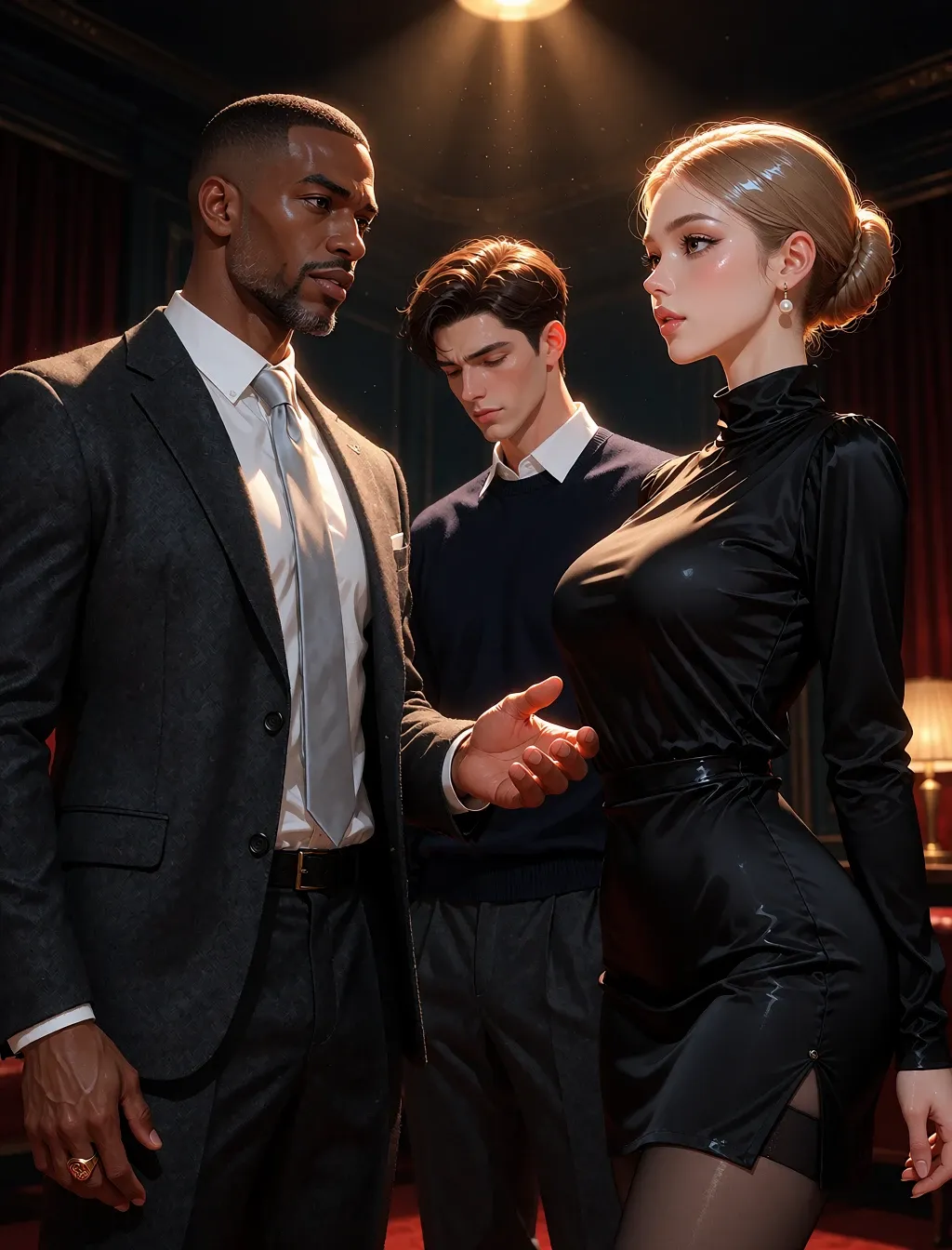
The seat was cool at first. Supple, yes, the leather breathing against the back of her thighs, but cool — first class always overcooled the cabin before boarding and let the bodies do the work of warming it. Lydia let her spine settle, felt the give of the seat accept her weight, and only then permitted herself to look at her husband.
Warren was already fidgeting. Not visibly, not in a way the flight attendant would notice as she floated past with her tray of boarding-pass champagne — but Lydia had spent three years learning the small print of him. His left thumb was working the edge of the armrest, a slow circular rub that would leave a faint shine on the leather by landing. His right hand was on his knee, then off it, then smoothing the front of his navy blazer as though the fabric had somehow offended him. The collar of his shirt — she'd watched him adjust it twice at the gate, once in the security line, once at the bottom of the jet bridge. A third time now, two fingers hooking under the starched edge and tugging.
The flight attendant stopped at their row. Champagne flutes on a silver tray, cold and beading, the stems thin enough to snap.
"Sir? Madam?"
"Thank you," Lydia said. She took one — the stem cold against her fingertips, a single bead of condensation already sliding toward the base — and held it without drinking. Warren took his with both hands, the way a man handles something he's afraid of breaking, and the flight attendant smiled at him and moved on.
They were three rows from the front. The cabin was a hushed, sterile little world of ozone and expensive perfume and the low mechanical breath of the air system, and beyond the half-drawn shade the ocean was going dark, the last smear of daylight a thin orange line beneath the wing. Somewhere behind them a man was already on his second scotch and talking too loudly about a merger. Ahead, a woman in cashmere had put on her eye mask before takeoff, which Lydia respected.
Warren hadn't touched his champagne.
"You're allowed," she said.
He looked at her, startled, as though she'd read his mind. "What?"
"To drink it. It's a flight, not a deposition." She let her mouth curve — the smile she'd perfected, the one that reached her eyes just enough to be convincing. "We're on holiday, remember."
"Right. No — yes. Holiday." He laughed, too quickly, and lifted the glass. "To holiday, then."
"To your birthday," she said. "Three days early."
Their glasses touched. The sound was small and clean, and Warren's unguarded smile came up to meet it — that boyish, eager, faintly apologetic smile that had once made her stomach turn over. He drank. She watched his throat move as he swallowed, watched the glass come away from his lips with a faint smear of his mouth on the rim, and she did not drink from hers.
"This is — I still can't quite believe it," he said. "First class. Amsterdam. You didn't have to do all this."
"It's a birthday."
"It's a lot of birthday."
"You're worth a lot of birthday." The words came out smooth as the champagne she wasn't drinking. She turned her glass a quarter turn on the tray table, watching the liquid catch the cabin light. "Besides. I've been working too much. We both have. I wanted to do something that felt like — a reset."
Warren nodded, and the nod was too vigorous, the way he agreed with everything when he was nervous. "A reset. God, yes. Work's been — I mean, you know how it's been."
"I know how it's been."
He didn't catch it. He never did. He took another sip of champagne and settled back into his seat, and the tension in his shoulders eased by a degree, and Lydia watched him do it — watched her husband relax into the exact posture of a man who believed his wife had just given him a gift.
The plane pushed back. The safety demonstration played. Warren watched it with the attentive courtesy of a man who genuinely believed the instructions might matter, and Lydia watched him watch it, and the wheels left the ground, and New York fell away beneath them in a smear of lights.
She set her champagne down, still full, and let her head rest against the seat back.
Somewhere over the Atlantic, the cabin lights dimmed to a blue approximation of night, and the man with the merger gave up and went to sleep. Warren had his shoes off — he'd asked first, quietly, whether she minded, and she'd said of course not — and his feet were tucked up under him in the seat, and he was reading a novel with his glasses on. The glasses were new. He'd bought them two months ago and hadn't mentioned it, and she'd found the receipt in the pocket of his coat and said nothing, and now they sat on the bridge of his nose and made him look like a man in a photograph of himself.
His wedding band caught the reading light. It was loose on his finger — he'd lost weight this year, in the way that men do when they're carrying something they don't talk about — and she watched him turn a page and the band slide a quarter inch toward his knuckle and slide back.
She had met him at a fundraiser. Six years ago. He'd been standing by the bar in a suit that didn't quite fit and he'd spilled a glass of red wine on the sleeve of a woman with a great deal of money and he'd apologized so profusely, so completely, that the woman had ended up comforting him. Lydia had watched the whole thing from across the room and thought: there's a man who has spent his entire life apologizing for something he hasn't done yet.
She'd been right about that. She'd been right about a great many things.
Warren turned another page. He was a slow reader, careful, the way he was careful about everything — and the care was the tell, wasn't it. The care was always the tell. A man who was not hiding anything did not fold his clothes the way Warren folded his clothes. A man who was not hiding anything did not close the bathroom door to shave.
She reached over and touched his knee. He looked up, glasses sliding, and smiled at her over the top of the book.
"You're not reading," he said.
"I'm watching you read. It's restful."
"It's boring, is what it is." He closed the book on his finger. "You should sleep. It's a long flight."
"I'm not tired."
"You're never tired." He said it with a fondness that she let land, that she let warm the space between them, and she took her hand back and put it in her lap.
He went back to his book. She looked out the window. The ocean was black now, absolute, and the wing light blinked its slow red pulse into the dark, and she thought about the club in the Jordaan with its black door and its brass plaque and the man who'd opened it for her at eleven in the morning, when no one else was there.
She had done her research. That was the thing about Lydia Chen-Bakker — she had done her research. The club had no website. It had a reputation that lived in the gaps between other reputations, the kind you only found if you already knew what you were looking for, and she had known what she was looking for because she had been looking for two years. Not in a hurry. Not in anger. The way a woman looks for a house she intends to live in.
Kofi Amari had received her in his office with the curtains drawn and a pot of tea she hadn't drunk, and he had listened to her for eleven minutes without interrupting, and at the end of it he had said, in his low, deliberate voice, and you understand what you are asking me to do, and she had said yes, and he had said, and you understand that once it is done, it is done, and she had said yes.
She had not said yes quickly. She had said it the way she said everything — after the long, careful consideration that Warren mistook for coldness, and that she had stopped correcting him about years ago.
She looked at him now. His head had tipped against the seat back. The book had slid down onto his chest and his glasses had come askew and his mouth was slightly open, and he was asleep, and in his sleep his face lost its apologetic set and went soft and young and — she would be honest with herself, because there was no one else to be honest with — beautiful. He had always been beautiful. She had married him partly for that, and partly for the way he'd held her hand at the fundraiser after the wine incident, and partly because she had looked at him and seen a puzzle with one piece deliberately mislaid, and she had wanted to find it.
She had found it. Two years ago. A shoebox at the back of the closet he thought she never opened, and inside it, folded with a care that made her chest go tight, a silk camisole the color of a bruise. And under it, a wig. And under that, a pair of panties with lace at the hips, and a lipstick in a shade she would never have chosen for herself, and a photograph of a woman who was not a woman, who was Warren, who was smiling in a way Warren had never once smiled at her.
She had put it all back. She had closed the box. She had closed the closet door. And she had gone downstairs and made a cup of tea and sat at the kitchen table and looked at the garden for a long time, and she had not cried, and she had not confronted him, and she had not — this was the part she was proudest of — she had not let her face change at all when he came home that evening and kissed her cheek and asked how her day had been.
She'd said it had been fine.
She had spent the next two years finding out everything else. The accounts. The apps. The names he used when he thought he was being clever. The way he'd look at himself in the mirror when he thought the bathroom door was shut — the long, unguarded, hungry look, the look of a man who wanted something he'd been told he couldn't have, and who had been told it so many times that he'd started telling himself.
He had never told her. That was the thing. In three years of marriage he had never once told her, and she had decided — slowly, deliberately, the way she decided everything — that she was not going to be the wife who found out. She was going to be the wife who knew. There was a difference, and the difference was the whole of her life.
Warren shifted in his sleep. His hand slid off the armrest and hung loose, and his wedding band caught the reading light, and Lydia looked at it for a long moment and then reached out and — very gently, so as not to wake him — turned his glasses right on his face.
She woke to the chime of the seatbelt sign and the cabin lights coming up, and the flight attendant's voice making its descent announcements, and Warren blinking at her from the next seat with his book on the floor and his hair pushed up on one side.
"We're here," he said. "I slept the whole way. I'm sorry."
"Don't be sorry. You needed it."
"I wanted to talk to you." He was already fixing his collar, two fingers under the edge, and she watched him do it and did not look away. "I wanted to — you know. Have a proper conversation. It's our trip."
"There'll be time."
"There's always time," he said, and smiled, and it was such a small, hopeful, frightened smile that she felt something turn over in her chest — not guilt, not quite, but the cousin of it. "What's the plan? When we land."
She picked up her glass. The champagne had gone flat and warm, and she looked at it and then set it down again, and she turned to him, and she let the silence sit for a moment before she spoke.
"The plan," she said, evenly, "is that I've arranged a surprise for your birthday."
He lit up. It was almost painful, how easily he lit up — the boyish face going bright, the shoulders coming down off their guard, the whole anxious architecture of him relaxing into something like joy. "A surprise? What kind of surprise?"
"The kind you don't get to ask about." She let her mouth curve. "Not yet."
"Lydia—"
"You'll find out." She turned her glass a quarter turn on the tray. "On the night. Not before."
"That's — that's not fair."
"It's your birthday. Fair doesn't enter into it."
He laughed. The real laugh, the one that came up from his chest and made his eyes crinkle, and he shook his head at her and said, "You're terrifying, you know that?" and she said, "I know," and he reached over and took her hand and squeezed it, and his palm was warm and slightly damp and she let him hold it.
Below them, through the window, the lights of Amsterdam were coming up out of the dark — a low bright grid, canals glinting like seams of silver, the whole city laid out and waiting. The plane banked. Warren leaned across her to look, his shoulder pressing into hers, and she felt the weight of him and the warmth of him and the easy, trusting, oblivious affection of him, and she looked at the city and thought about the black door in the Jordaan and the man behind it.
"It's beautiful," Warren said.
"It is," she said. "You're going to love it."
She did not let go of his hand.