
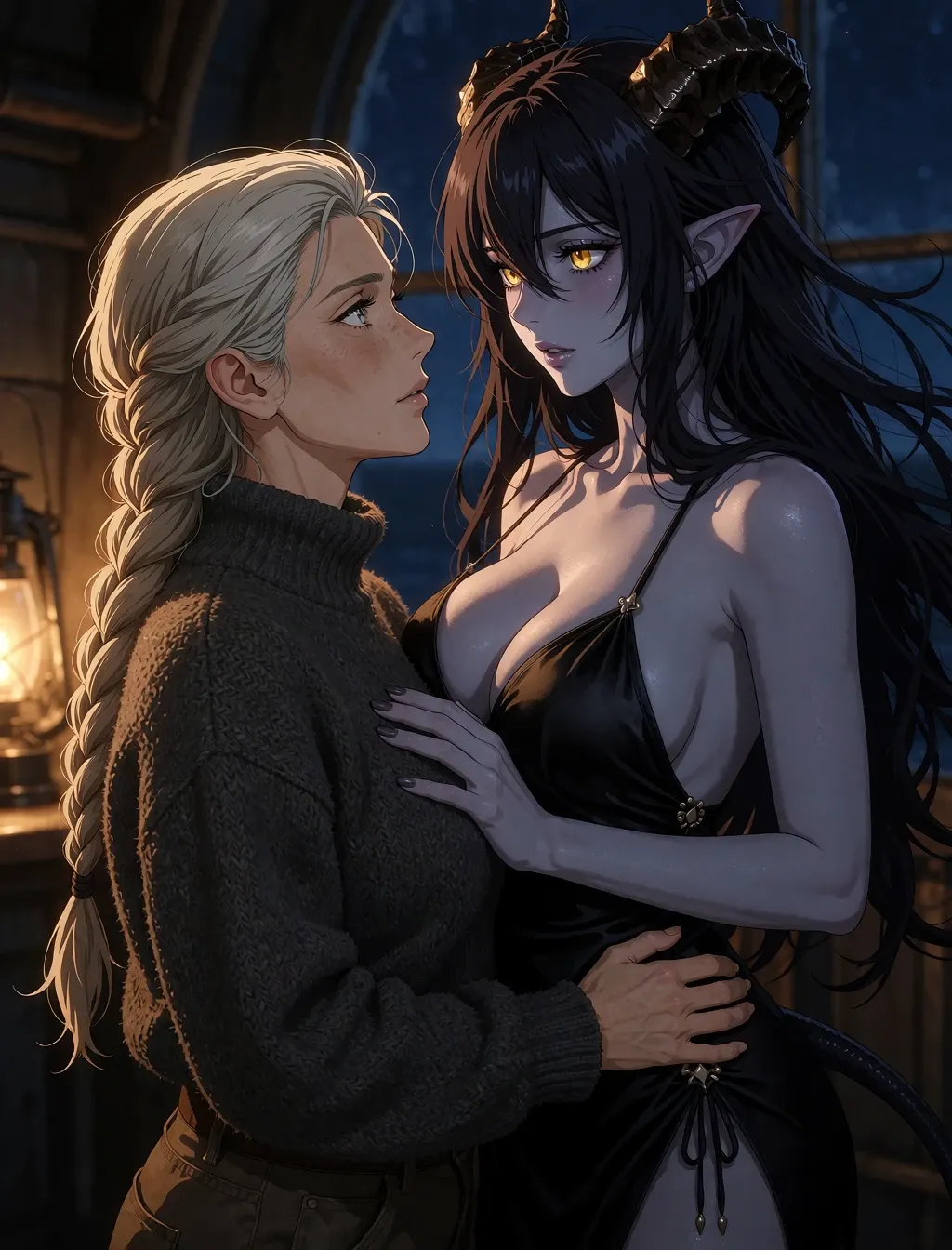
The storm had been trying the lamp room windows for three hours, and Ragnhild had stopped hearing it somewhere around the second bottle.
Not the second bottle of the night. The second bottle of the winter. Keep count of something, or the rock keeps count of you. She'd hauled herself up the hundred and forty steps with the thing under her arm — a book that had no business being in a lighthouse, leather gone soft and grey as a drowned man's hand, pages stitched with something that wasn't thread — and she had set it on the lamp table and had a long conversation with it that amounted to: you're not real.
The book had declined to argue. That was the trouble with books.
Then she'd opened it. Then the room had gone warm in a way the stove had never managed, warm from the middle of her chest outward, and the lamp overhead had dimmed and flared and dimmed again like a heart deciding whether to bother. And now there was a woman standing on the other side of the lamp table who had not come up the stairs.
Ragnhild took her time looking. It was the only weapon she had left in the room.
Tall. That was the first thing, and it annoyed her, because Ragnhild was not a small woman and she did not like looking up. The horns were the second thing — obsidian, curving back from the temples like something grown rather than worn, and the lamplight ran along them in a wet black line. The tail was the third. It hung behind the woman's hip, spade-tipped, and it moved with a slow, idle curiosity, curling and uncurling against the leg of the table as though testing whether the wood was worth its attention.
"You're not dressed for the weather," Ragnhild said.
The woman's mouth curved. Low-cut black, the dress, and nothing over it, and the storm screaming at the glass behind her as though personally offended. "I am not dressed for weather at all, Keeper." Her voice came out slow and warm, poured rather than spoken. "I am dressed for an appointment."
"I didn't make one."
"You signed." A clawed hand turned the grimoire's cover toward the lamp. "That is generally considered making one."
Ragnhild's hand found the bottle before her mind decided to. The glass was cool and honest and she poured two fingers into the tin cup and drank them and set the bottle down with a thump that made the flame in the lamp gutter. "Read it to me, then. If I'm going to be swindled I want to hear the swindling."
"How very sensible." The succubus drew the book to herself and let one claw trace down the first line of the page, and Ragnhild watched that claw the way a sailor watches a reef. "Clause the First. The party of the second part—" a glance up, molten gold, unhurried "—that is I—shall draw sustenance from the pleasure of the party of the first part, that is you, until the new moon next following. Not before. Not after."
"Sustenance." Ragnhild turned the word over and found it slippery. "Say it plain. You eat me."
"I eat what you feel, Keeper. The pleasure. Not the meat." The tail gave a single satisfied flick. "The meat I leave you. It is a courtesy of the house."
Ragnhild snorted into her cup. "Generous."
"Clause the Second. The signatory shall not be compelled. What is given must be given." The claw moved down. "Clause the Third. No mark shall be left upon the signatory's skin that the signatory does not choose to keep."
"Stop." Ragnhild set the cup down. "Say that one again."
"No mark shall be left—"
"I heard it. I want to know why it's there." She leaned her knuckles on the table, and the wood took her weight and complained about it. "Every contract I've ever signed had a clause in it that was there because someone before me got cheated. That's a strange clause to put in a demon's book. Sounds like it was written for somebody who got marked."
For the length of one turn of the lamp, the succubus said nothing. The beam swept the glass, swept the black beyond it, swept back, and in its light the woman's face had gone still in a way that had nothing to do with patience. Then the smile returned, fitted back into place like a lid. "You are observant. That is going to be inconvenient."
"Twenty winters on a rock with nobody to talk to. You notice things or you go mad."
"Clause the Fourth," Vesperine said, and her voice had a new edge in it, a fine one, like the first crack in ice. "The bond endures no longer than the moon allows. At the dark of it, the debt is settled and the signatory is released, whether or no."
"And if I want out before the moon?"
"Then you will have to write it. There is a clause for that. There is always a clause for that." The claw tapped the bottom of the page, where the lines ran out and the parchment went blank and waiting. "Every signatory writes the last clause herself. It is the oldest courtesy of the trade. The book will take whatever you put to it, Keeper, and it will hold you to it exactly as you word it."
"And it'll hold you to it."
"It will hold me to it." The gold eyes did not blink. "I am not permitted to lie about the terms. I am permitted a great many other things."
Ragnhild took the bottle by the neck and drank from it directly, which was a thing she did not usually do in company, and the whisky went down and sat in her chest like a coal. The lamp turned. The storm put a shoulder to the glass and shoved. Outside there was nothing but the sea and the dark and the long grey back of the swell running at the rocks, and inside there was a demon in a black dress with her tail curled around the table leg, waiting with the patience of something that had waited out empires and found them a trifle overrated.
"Read me the rest," Ragnhild said.
"Clause the Fifth. The signatory's word, once given, is the whole of the law between us."
"Good. I like that one."
"Clause the Sixth. The signatory shall not be taken in public, nor before witnesses, nor in any manner that would put her to shame before her own kind." A pause, and the smile sharpened. "Unless she asks prettily."
"I don't ask prettily."
"You will."
"Clause the Seventh. The demon shall not enter the signatory's dwelling unbidden, nor remain past the signatory's word to go." The claw paused, and the gold eyes came up. "That one is mine. I put it in myself, a very long time ago. I have found it improves the quality of the company."
Ragnhild looked at her a long moment. "You don't like being feared."
"I like being wanted." The tail uncurled and lay still. "Fear is a poor substitute and it tastes of tin. Read on."
"Clause the Eighth. Should the signatory die before the moon is dark, the debt is void and the demon goes hungry." Ragnhild's mouth pulled sideways. "That's the one that'd get me. Isn't it. That's the clause somebody wrote after a keeper went off the gallery in a gale."
"Keepers are a melancholy breed," Vesperine said, and for a moment she sounded almost gentle, and Ragnhild did not trust it, and did not entirely disbelieve it either.
The page ended. Below the eighth clause the parchment ran on, pale and empty and faintly warm, and the flame in the lamp leaned toward it as though it wanted to read too.
"Well." Ragnhild set the bottle down between them. "Give me the pen."
The succubus did not move. "You have not asked what I take."
"You told me. Pleasure. Till the new moon."
"You have not asked what it costs you."
Ragnhild looked at her hands on the table. Callused, the knuckles gone knotted with twenty years of rope and cold iron and the slow arithmetic of getting old on a rock by herself. There was a scar across the back of the left one from a lamp that had bitten her when she was thirty-one. There was a wedding ring's pale ghost on the third finger, though the ring itself had gone into the sea the year the boat went down with everything else in it, and she had not spoken that husband's name aloud in nine years, and she was not going to start now in front of a demon.
"Everything costs," she said. "I've been paying rent on this rock since I was twenty-six. I know what a bill looks like."
Vesperine's tail curled once, slowly, around the table leg and held. "Then write your clause, Keeper."
Ragnhild took up the pen. It was heavier than it had any right to be, and the nib was warm, and when she put it to the parchment the ink came up out of the page to meet it rather than the other way about, a dark bead swelling at the tip like blood from a small clean wound.
She wrote slowly. She was a woman who had never been hurried by anything with less patience than the sea.
Clause the Ninth. The signatory may end this contract at any hour of any day, and the demon shall go and not return, and no debt shall stand, upon the signatory speaking one word. That word is—
She stopped. The pen hovered. Behind her the lamp turned and her shadow swung around the room and the storm leaned on the glass.
"Well?" Vesperine said.
"I'm thinking."
"Take your time. I have had centuries of it and I have never once found it boring."
Ragnhild thought about the word. It had to be a word she would not say by accident, in her sleep, in her cups, in the middle of a gale with her mouth full of salt. It had to be a word that meant something and nothing, a word she could hold in her pocket like a knife and forget she was carrying. She thought about the boat, and the name she had not said in nine years, and she thought: no. Not that. I'm not putting that in a demon's book.
She wrote: Enough.
The ink sank into the parchment and did not come back up. For a breath nothing happened at all — and then the ninth clause lit, a slow amber glow running the length of her own handwriting like fire finding a fuse, and the lamp overhead flared white and the whole room went bright and hard-edged and Ragnhild's shadow was thrown up the wall enormous and horned and not entirely her own.
Vesperine made a sound. It was not a word. It was low and it came from somewhere under the dress, and her tail had gone rigid and her horns caught the light and her eyes — her eyes had gone the deep flat gold of a struck match.
"Enough," she said, tasting it. "You gave yourself a door, Keeper. A door with one word on it and no lock." She drew the book to herself and set her claw to the page beneath Ragnhild's line, and began to write, and her writing was small and exact and older than the language it was in. "Then I shall give you mine, and the bargain is whole."
"Sign it," Ragnhild said.
"You will want to be sitting."
"I'm sitting."
"Sit better."
Ragnhild sat back in the chair and put her boots flat on the floor and her hands on her knees and looked the demon in the eye, and she said, in the flat hard voice she used on the sea when it asked her a question: "Sign it."
The claw came down. The book took the mark. And then the heat arrived.
It came up through the chair, through the wool of her trousers, into the bone of her right hip — not a burn, not quite, something hotter and more patient than a burn, a slow press from the inside out as though a small coal had been set under her skin and told to take its time. Ragnhild's breath went out of her in a grunt and her hand went to her hip and found the wool already warm, warmer, hot, and the light of it came up through the fabric, pink and steady, a shape she could not see but could feel the edges of, curling, intricate, alive.
"Breathe, Keeper." Vesperine had come around the table. She had not seemed to cross the space; she was simply there, close enough that the smell of her arrived before her — smoke, and night-blooming flowers, and something darkly sweet underneath that made the back of Ragnhild's throat ache. "It is only the sigil. It will fade to a scar by morning and it will glow every time I feed. That is how you will know me. That is how you will know yourself."
Ragnhild's braid had fallen forward over her shoulder. She looked down at it, at the grey-gold rope of it against the pink glow coming through her own clothes, and she heard herself say, from somewhere a long way off: "That's going to be inconvenient."
"Yes," Vesperine said, and her voice had gone soft and terrible. "It is."
The sigil finished its work. The glow sank down through the wool and into the skin and settled, banked, a coal under ash, and the lamp overhead came back to itself and the room was only a room again, storm and oil and cold. Vesperine closed the grimoire and set it down on the lamp table with a care that was almost tender, and her hand stayed on the cover a moment, and her tail lay quiet.
Then she looked up, and her eyes flared pink — a deep rose light, bright as a coal breathed on, spilling out of the gold and drowning it — and the sigil under Ragnhild's wool answered, pulsing once, warm.
"The debt is mine to collect now, my signatory," Vesperine said. "And I find I am very hungry."