
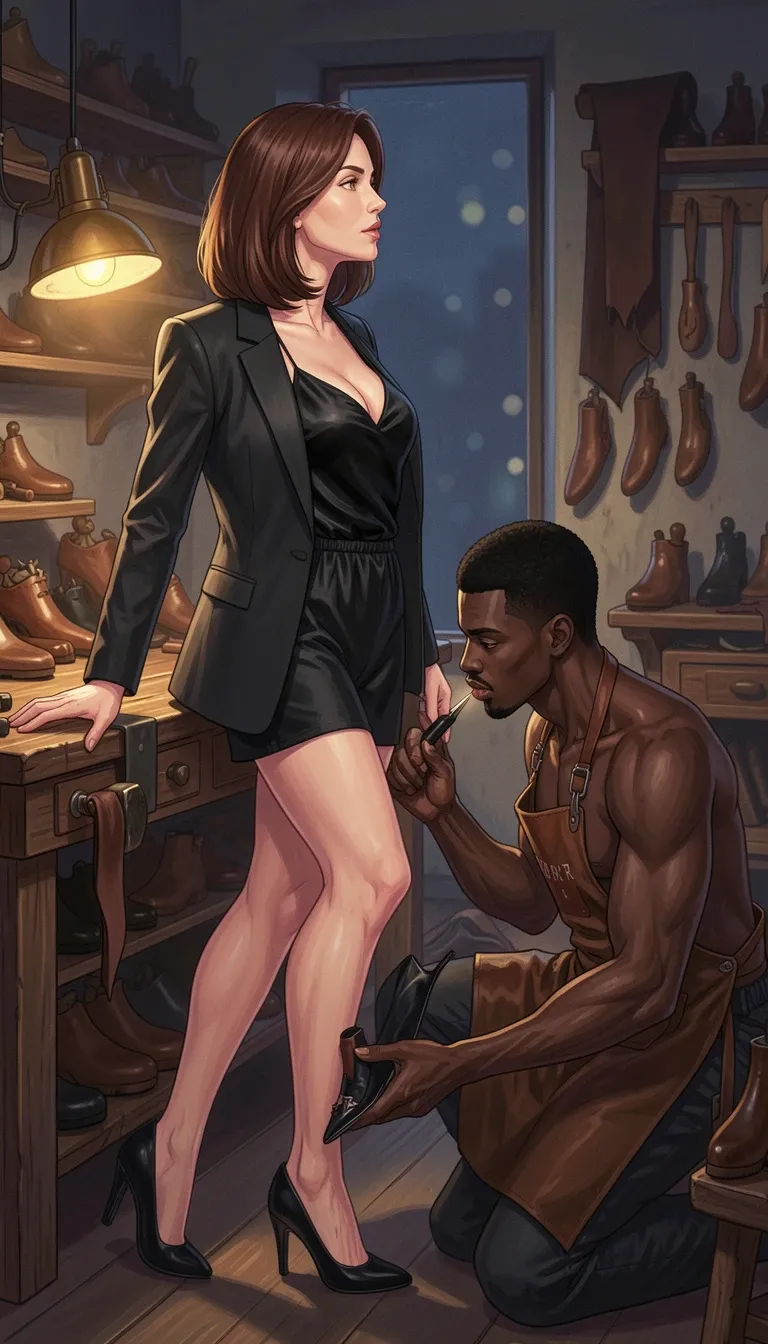
The last of them left at four — the junior pattern-cutter with her coat over her arm, the buyer from Osaka with his samples boxed and his bow double-knotted, the photographer who had spent the morning shooting the line and the afternoon shooting the empty rails. Ginevra stood at the top of the atelier stairs and watched them go down into the courtyard, and she did not move until the big door shut and the bolt dropped and the street below went quiet.
Then she turned around and looked at what was left.
Twelve pieces on the rails, the launch line, the one she had built in nine days out of a workshop that had never made more than bespoke. And on every tag, under the size and the colorway and the little embossed heel, a name in her own hand, because she had cut the stamp herself and refused to let anyone else do it: DIALLO.
Amadou was at the far end of the room with his back to her, sleeving a last pair in tissue. His leather apron was on him the way it always was, worn soft at the shoulder where the strap crossed, and his forearms were dusted pale with the bloom that comes off new suede. He had been up since five. She knew because she had heard him in the workshop at five, and she had lain in the dark above it listening to the tap of his hammer and not gone down.
She was wearing the stilettos. She had worn them all day, under the long black trousers, and no one had noticed anything except that she stood differently — that was the whole of it, that was the entire trick. The shoes did not make her tall in the room. They made her certain. And certainty, she had learned in nine days, was the actual mechanism; the height was only what happened when you stopped apologizing for taking up space.
"Leave that," she said.
He set the shoe down anyway, carefully, toe to the rail. "It will crease if it sits in the box overnight."
"Then it creases." She crossed the floor. The heels made their small hard music on the boards and she watched him hear it — the way his shoulders came up a quarter inch and stayed there. "Amadou. Put it down and come here."
He turned. Thirty-six years old, a broad serious man with close-cropped hair and a shoemaker's hands, and his face when he looked at her had the same expression it had worn at the gate two nights ago and on the runway before that and, she suspected, in some quieter form for six years: a man doing arithmetic he has already lost.
"You have not eaten," he said.
"Neither have you."
"I had a coffee at eleven."
"That is not eating." She stopped in front of him. She was not nine feet tall now — she had learned that too, in nine days, that the growing was a door she could open and close and that the trick was not to be afraid of the handle — but she was tall enough, and in the shoes she had four inches on him, and she let herself have them. "Sit down."
He looked past her at the room. "Where?"
"The cutting table. Clear it."
He did not ask why. That was the thing about Amadou Diallo, the thing that had undone her slowly across six years: he never asked why, he simply did the thing well, and the not-asking was its own kind of answer. He went to the long oak table at the center of the atelier and moved the samples to the rail one by one, the way he moved everything, and then he swept the offcuts into the bin and wiped the surface down with the flat of his hand and stood at the end of it with his arms at his sides.
"Sit," she said. "On the edge. Hands on your knees."
He sat. The table took his weight without a sound. His hands went to his knees.
Ginevra took her time. She walked the length of the room and back — past the rails, past the sewing machine with its spool still wound, past the window where the late light came in low and orange across the boards — and she let him watch her do it, because the watching was part of it, because six years of watching from across a workshop had earned him at least this: to be looked at while he looked.
"Do you know what I did this morning," she said, "before the buyers came?"
"You were in the workshop at six."
"I was in the workshop at six." She stopped in front of him. "I put the shoes on and I grew until my head touched the ceiling and then I stood there in the dark for twenty minutes with my eyes shut, and I thought about you coming up those stairs, and I made myself small again before you did. Every morning for nine days. That is what I did."
His throat moved. "Ginevra."
"You say my name like it costs you something."
"It does."
"Good." She lifted her right foot and set it down on the edge of the table beside his hip, and the heel came down with a small clean knock, and she watched his hands on his knees curl until the knuckles went pale. "Then pay."
He looked at the shoe. The black calf, the needle-thin heel, the strap she had cut and stitched herself in a workshop in her twenties before she had a name to put on a tag. Then he looked at her face, and whatever he found there made him let out a breath he had been holding since the door closed.
"May I touch it," he said.
"You may."
His hands came off his knees. He took her ankle first — the way he always took it, the way he had taken it a thousand times to measure an instep — thumb behind the bone, fingers wrapping the front, and then he stopped. Did not measure. Did not adjust the strap. Just held it, and his thumb moved once, slow, along the tendon, and Ginevra felt it go up the back of her leg and settle somewhere low in her belly and stay there.
"Six years," he said, to her ankle. "Six years I have put my hands here and thought about nothing but the fit."
"And now?"
"Now I am thinking about the fit," he said, "and also that I would like to put my mouth on the arch and not stop until you told me to."
"Then do that," she said. "But you keep your cock where it is. You don't touch it. You don't come until I say. You wanted to worship these feet for six years, Amadou — so worship them, and find out what it costs."
He slid off the table onto his knees on the boards, and he bent his head and put his mouth to the arch of her foot through the leather, and Ginevra let her head fall back.
It was not the same as the runway. On the runway she had been enormous and the whole thing had been a kind of storm, her foot on his cock and the lights and the floor of her own stage. This was small and slow and exact. He worked the arch with his lips and then his tongue, and where the leather ended at the strap he licked the bare skin above it. Then he took the heel of her foot in both hands and pressed his mouth to the hollow under her ankle and stayed there, breathing her in, his shoulders shaking once.
"The shoe," she said. "Take it off. Slowly."
He undid the strap with two fingers and no fumbling at all — of course not, he had undone this strap a hundred times — and drew the shoe off her heel, and the cool air of the workshop came up the sole of her foot and she felt every board and every grain of the table through it. He set the stiletto down on the oak beside him, toe to the ceiling, and then he took her bare foot in his hands and put his mouth on the sole.
Ginevra made a sound she had not authorized.
He looked up. His mouth was wet. "Too much?"
"Don't stop."
He didn't. He dragged his tongue from her heel to the ball of her foot in one long wet stroke and then did it again, and again, and the callus he had built on his hands over twenty years of cutting leather was nothing to the callus on the tongue of a man who had wanted something for six years. He sucked her toes one at a time, slow, the way he had sucked them clean two nights ago, but this was not cleaning, this was not penance — this was a man taking his time at a table he had set himself. His other hand came up and closed around her ankle and pulled her foot deeper into his mouth, and Ginevra put her hand flat on the table to keep herself upright.
"Your cock," she said. Her voice had gone low and flat. "Is it hard."
"Yes."
"Are you touching it?"
"No."
"Good." She drew her foot back out of his hands and set it down on the floor, and then she picked up the stiletto and turned it over in her fingers and looked at him kneeling there with his mouth wet and his apron twisted and his trousers tenting the wool, and she felt the thing she had felt in the dark at six in the morning, the door with the handle. She opened it. Just a little. Just enough.
The room got smaller around her — no. She got bigger. Her knee rose past his shoulder and her head went up past the hanging lamp and the ceiling came down to meet her, and she stopped there, at nine feet, because nine feet was enough for what she had in mind, and she looked down at him from a height that made the whole workshop look like a model of itself.
"Lie back on the table," she said.
He got up and lay back on the oak, and his head was at the far end and his boots hung off the near edge, and his cock was a hard line under the wool of his trousers that twitched when she came to stand over him. She put the stiletto back on her foot — the one that still fit, the one that had always fit, the shoe that had started all of this — and she set that foot down on the table between his thighs, and the point of the heel came to rest a half inch from the seam of his trousers.
"You fitted this shoe," she said. "You fitted all of them. Every sample, six years, on your knees. Did you ever once think about what you were fitting them for?"
"No." His voice came out wrecked. "I thought about the fit. And then I thought about your foot. And then I made myself think about the fit again."
"And now?"
"Now I am thinking about your foot."
She pressed the sole of the shoe against his cock through the wool — not the heel, the flat of the sole, the whole length of it. He arched off the table and his hands came up and then stopped in the air, because she had not said he could touch her. "Hands on the table," she said. "Flat. You leave them there."
His hands went flat on the oak.
She began to move the shoe. Slow, at first — the sole rolling up the length of him and back down, feeling the shape of him through the wool, learning it the way he had learned her arch. He was big. She had known that, had felt it against her ankle on the runway, but this was different, this was the whole weight of him under the flat of her foot and the point of the heel tracking up the seam and the sound he made when she found the head of him with her toe, a low broken thing out of the back of his throat.
"You're leaking through your trousers," she said.
"I know."
"Say it."
"I am leaking through my trousers," he said, and his voice cracked in the middle of the word, "because you are standing on my cock in your shoe and I have wanted you to do that for six years."
"Six years." She pressed harder. His hips came up off the table and his hands stayed flat and his whole body was a bowstring. "Six years of kneeling and measuring and saying yes, signorina, and never once asking for this. What were you afraid of?"
"That you would send me away."
She stopped. The shoe went still on him and he made a noise like a man who has been walking a long time and has been told to stop a mile short of the town.
"I would not have sent you away," Ginevra said. "That is the part I am angry about. Six years, Amadou. I would have kept you."
"I know that now." His eyes were wet again. "I am a slow man."
"You are a shoemaker," she said. "You take your time. It is the one thing I have never once wanted to change about you." She began to move the shoe again, and this time she did not stop, and she did not go slow. The sole ground up and down the length of him and the heel caught the seam and he started to breathe in short ragged pulls and his hands on the oak went white at the knuckles and stayed flat.
"Ginevra—"
"Not yet."
"Please—"
"Not yet." She leaned on the shoe, the whole weight of nine feet of her through the sole of it, and he made a sound like a door coming off its hinges and his hips bucked once and his hands came up a half inch off the table and she said, "Hands," and they went back down. "You wanted to worship these feet. You are going to worship them until I am finished with you, and you are going to come when I say, and not before. Do you understand?"
"Yes."
"Yes what."
"Yes, signorina."
She nearly lost her own footing on that word. She had heard it ten thousand times across six years, from the door of the workshop, from the floor of the runway, and it had never once sounded like this — not deference, not distance, but a man handing her the whole of himself and saying, here, it is yours, I have been carrying it around for six years.
"Then come," she said.
The sole of the stiletto pressed down and dragged up. He came with his eyes open and his hands flat on the oak and her name in his mouth — not signorina, her name, Ginevra, broken in half — and the wet heat of it soaked through the wool and into the sole of the shoe. She felt it against her foot through the leather, the pulse of it, one and two and three, and his hips went up and stayed up and then came down slow.
The sewing machine was off. The street below was muffled. Somewhere in the building a pipe knocked twice and was quiet.
Ginevra lifted the shoe off him and set her foot down on the floor, and the height went out of her the way it always did when she let it, a slow settling, until she was her own size again and the ceiling was a ceiling and the room was just a room with two people in it. She looked at the sole of the stiletto. It was wet and shining and it smelled of him.
Amadou lay on the table with his arm over his eyes and his chest going up and down.
"I have ruined a pair of trousers," he said, from under his arm, "and a pair of shoes that are not even mine."
"The shoes are mine," she said. "You fitted them."
He took his arm off his eyes and looked at her, and there it was again, that rare smile, the one that changed his whole solemn face. "I will clean them," he said. "It is my mess."
"Later."
"Later," he agreed, and did not move.
She watched him not move for a while — the arm back over his eyes, the boot-heels still hooked off the edge of the oak, the wet dark bloom spreading through the wool at his crotch — and the wanting that had been riding her all day turned over into something with an edge on it.
"Amadou."
"Mm."
"Sit up. Get your trousers off. All of it."
He came up onto his elbows. His face was still loose, the way a man's face goes after, but his eyes found hers and held. "You said later."
"It is later." She turned the stiletto over in her hand, put it back on the floor. "And I have not finished with you. I came down those stairs this morning and made myself small so you would not have to look at me, and I have decided I am not doing that again. So. Trousers. Off."
He got them off. The wool was a lost cause and he knew it; he peeled it down his legs, worked the shoes off his feet with the heel of one against the other, and stepped out of everything. Then he stood in the middle of her atelier with his leather apron still on and the rest of him bare, his cock still half hard and shining at the tip. He did not cover himself. That was the thing about him. He never covered himself. He simply stood and let her look, the way he had let her look at him for six years without once asking for anything back.
"The apron," she said. "Leave it."
Something crossed his face — not surprise, something quieter. "You want the apron."
"I want the apron." She walked to the cutting table and put her hand flat on the oak where his hands had been. "Come here. And get up on it. On your back. I want you under me and I want to see your face when I do it."
He climbed onto the table and lay back, and the oak creaked once under his weight and then held. His cock lay thick and dark against his belly, still wet from before, and the apron strap crossed his chest and his hands lay open at his sides, palms up, as though he had put them there for her to use.
Ginevra kicked her other shoe off. The boards were cool and familiar under her soles. She climbed up over him — knees on the oak either side of his hips, hands planted on the table past his shoulders — and she was her own size now, five foot seven of her, and she looked down into his face and he looked up, and there was nowhere for either of them to put it.
"Tell me what you want," she said.
"You."
"That is not telling me anything. I have been in your mouth twice tonight. Tell me what you want."
His throat moved. "I want to be inside you. I have wanted to be inside you since the first week, when you put your foot up on the stool and told me you had a high instep and I went home and could not sleep." His hand came up and stopped, the way it always stopped, a half inch from her hip. "May I."
"You may."
His hands closed on her hips and pulled her down and she felt the head of him slide along her and stop, and she was so wet it should have been embarrassing, it was not, it was the whole point. She reached down between them and took him in her hand and put him where she wanted him and sank onto him in one slow move.
Both of them made a sound. His was the worse one.
She sat down on him to the root and stayed there, and the stretch of it went up through her and made her put her hands flat on the apron strap to hold herself steady. He was big and he was hot. She could feel his pulse inside her, one and two and three, the same pulse she had felt through the sole of a shoe a quarter hour ago, and the fact of that — that she had felt him come through leather and now she had him in her — made her clench around him without meaning to.
His hands went white on her hips. "Ginevra."
"Don't."
"I am not going to last."
"Then don't last." She lifted herself off him, slow, all the way to the head, and sank back down, and the wet sound of it filled the room. "You have six years to make up for and I have all night, and the first one does not have to count."
He laughed — a wrecked, breathless thing — and then he stopped laughing because she did it again, and again, and set a rhythm that was hers, her knees on the oak, her hands on his chest through the apron, taking him at the angle she wanted and not the angle he would have chosen. He tried to help, his hips coming up to meet her, and she put her hand flat on his sternum and pressed him down into the table.
"No," she said. "Lie still. You are a shoemaker. I am the last."
He lay still. His hands slid from her hips to her thighs and held there, thumbs in the crease of her. She rode him with the whole of her weight and let herself make whatever noise came, because the atelier was empty and the street was empty and there was no one left in the building to hear Ginevra Rossi fuck her shoemaker on her own cutting table.
"Look at me," she said.
He had his eyes shut. He opened them.
"That's it. Don't look away. I want to watch you come."
"I am close."
"I know you are. I can feel you." She leaned down over him and her hair came loose from its pin and hung down around his face. "Come inside me, Amadou. Now. Do it now."
He came with his hands hard on her thighs and his mouth open and her name. She felt it — the jerks of him, the heat of it spilling into her, the way he swelled and emptied and swelled again, and the sound he made was not a word at all by the end of it. His hips came up off the oak and she rode him through it, down onto him, grinding, and it was that — the feeling of him coming inside her, the whole of it, the pulse of him against her — that tipped her over.
She came with her head thrown back and her hand fisted in the apron strap and her thighs locked around his hips. It went through her in long waves, her cunt clenching down on him, and she heard herself say something that was not a word either. Then she folded forward onto his chest and lay there with her forehead against his collarbone and her breath going in and out of her like she had run up the stairs.
Under her ear, his heart was going like a bird's.
Neither of them said anything for a long time. The lamp above the table ticked as it cooled. Somewhere down in the courtyard a gate swung and did not quite latch.
Then Amadou's hand came up and settled, careful, on the back of her head, and his fingers moved once through her hair, and Ginevra shut her eyes.
"I have to get up," she said, into his chest.
"You do not."
"I do. You are a bony man and this table is oak."
"I am not bony."
"You are bony and you are lying on my cutting table and I am going to be sore tomorrow." She pushed herself up, and he slid out of her. She felt the loss of him and then the slow seep of him down the inside of her thigh, and did not do anything about it. Let it. It was hers. He watched her climb down off the table and go to the rail for a length of tissue. She cleaned herself with the same matter-of-factness she used on a spill of contact cement, and he laughed at her from the table.
"What."
"Nothing. You are just — you are very practical."
"I am a businesswoman." She threw the tissue in the bin. "Get dressed. We are going to eat something and then we are going to talk, and I warn you, I am not good at talking."
He got down off the table and found his trousers and looked at them and put them on anyway, and the wet bloom was a fact neither of them pretended not to see. He tied the apron back around his waist and got his shoes on and stood there in the middle of her atelier, and he looked like a man in a photograph from a hundred years ago, a craftsman in a room full of his own work, except that his neck was flushed and his mouth was still red from her.
Ginevra put her shoes back on. Both of them. The black stilettos, the ones that had started all of this, and she stood in them and felt the floor come up to meet her and felt her own certainty settle back around her shoulders like a coat.
"There is a trattoria on the corner," she said. "It stays open for the kitchen staff. They will feed us at ten o'clock at night and they will not ask us any questions."
"I know it. I have eaten there."
"You have eaten there alone for six years and never once asked me to come."
He looked at her. "No."
"Ask me now."
"Ginevra." He said it slowly, the way he said everything, as though he were cutting it from a hide and wanted no waste. "Will you come and eat with me."
"Yes." She picked up her keys from the cutting table and turned off the lamp island, and the room went dark except for the streetlight coming in the high window. "But understand what you are asking. This is not a thing that stays in the workshop. Tomorrow there is a launch and there is a line with your name on every tag and there is a woman who is not always going to be five foot seven, and if you are going to be at my side you are going to be at my side in all of it. I am too old to have a secret."
He thought about it. She watched him think about it, which was its own kind of pleasure, the way his eyes went to the rails and the tags and then came back to her.
"I did not fall in love with the five foot seven," he said.
Ginevra stood very still in the dark atelier with her keys in her hand.
"That is the first time you have said that," she said.
"I know." He picked up his jacket from the back of the stool and held it over his arm and did not put it on. "I am a slow man."
She went down the stairs ahead of him. The heels made their small hard music on the boards, and behind her she heard his boots come down after, unhurried, and out in the courtyard the air was cool and smelled of rain that had not fallen yet, and the two of them walked out through the big door together into the empty street with the shutters down and the lamps just coming on.
At the corner the trattoria had its chairs up on two of the tables and one still down, and the old man behind the counter looked up and saw them and did not ask any questions at all.
The old man wiped his hands on his apron and jerked his chin at the one table with its chairs still down. "Sit. I have a pot of something on the fire that my wife would not approve of at this hour, but she is not here."
They sat. Ginevra took the chair against the wall, her back to the plaster, and Amadou took the one across from her and set his jacket over the back of it and rolled his sleeves to the elbow. Under the counter the old man was already doing something with a ladle, and the smell of it came across the room — tomato and wine and something charred underneath.
"You are Rossi," the old man said, not turning. "The shoes."
"I am."
"My wife has four pairs. She will not throw out the ones that are worn through. She says they fit like she was born in them."
"That is the highest compliment there is."
"It is not a compliment, it is a complaint. She will not buy new ones." He set two bowls down in front of them and a heel of bread between. "Eat. It is not good but it is hot."
It was good. Ginevra ate with the flat, methodical attention she gave everything, and Amadou ate slower, watching her over the rim of his bowl, and the two of them did not say anything at all for a while, and the old man went back to the counter and put the radio on low.
She set her spoon down first. "You said you loved me."
"I did."
"You did not say it because I had you on the table."
He put his own spoon down. "No." He thought about it, and she let him think, the way she had let him think in the dark atelier, because a man who had to reach for a thing would hold onto it once he had it. "I have known it for a long time. I did not say it because you were my employer and because I did not think a woman like you would want a man who fit shoes for a living."
"I am a shoemaker too."
"You are the name on the door."
"And you are the hands." She turned her bowl a quarter turn on the table, an old habit, settling it. "I am going to tell you something and I want you to hear all of it before you answer. The shoes made me grow. I felt it happen. But I took them off and I am still — I am not the same as I was this morning. I do not know if it goes back. I do not know if I want it to go back." She looked at him. "That is the woman you would be standing next to. Tomorrow, and the day after, and I do not know how tall."
Amadou picked up his bread and tore it and did not eat it. "You think I am afraid of a tall woman."
"I think you are a man who has spent six years not saying a word, and I am asking you to say one now that will be hard to take back."
He set the bread down. "When I was a boy in Dakar my grandmother was the tallest woman in our quarter. She carried a bucket of water on her head and the children ran behind her. Nobody was afraid of her. Everybody did what she said." He looked across the table at Ginevra, and his eyes were steady and warm and not a bit of fear in them. "I am not afraid of you. I am afraid of the years I spent not saying anything, and I am not going to spend any more."
Ginevra looked down at her bowl. The radio was playing something old and slow, and the old man was drying glasses with his back to them, and she thought about the note the witch had written, and the six years, and the way Amadou's hands had gone white on her thighs and not once let go.
"Then this is what it is," she said. "You are not my assistant. Not after tonight. You are my partner — in the workshop and out of it — and tomorrow at the launch you stand beside me and you let people see you standing there, and if the woman on the tag is not the woman they remember, then they can look at the shoes and mind their own business."
"And the shoes?"
"The shoes stay." She reached down and touched the black stiletto at her heel, felt the leather warm under her fingers, the same leather that had started all of this. "I am not going to be the woman who was afraid of her own feet anymore."
Amadou reached across the table and put his hand over hers, and she let him, and the old man came over and set a small glass of something amber in front of each of them without being asked and went back to his glasses.
"On the house," he said. "For the shoes."
Ginevra drank hers in one swallow and it burned all the way down and she did not cough, and Amadou watched her do it and shook his head slowly and drank his own.
They walked out into the street together and the rain had finally started, soft and fine, and the lamps on the corner made halos of it. Amadou put his jacket over her shoulders without asking and she let him, and they walked up the street toward the workshop with the rain coming down and her heels making their small hard music on the wet stone, and she was still five foot seven and she did not care, and she did not know what the morning would bring.
At the workshop door she turned and looked at him standing in the rain with his collar up and his hands in his pockets and his sleeves still rolled.
"Come inside," she said. "We have a launch tomorrow and I am not going to do it alone."