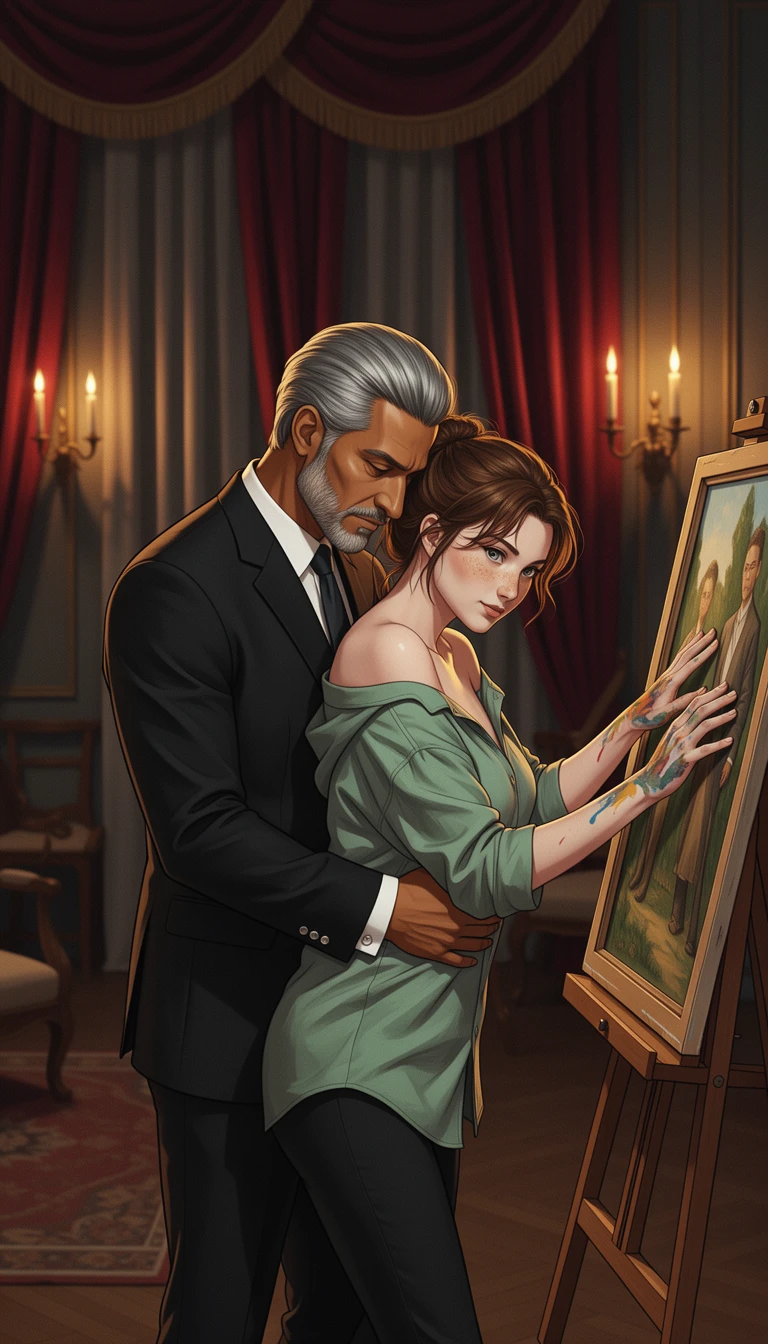
The pressure at her nape deepens—not touch, not weight, but a recognition, as if the air has memorized the exact curve where her neck meets her shoulder and is holding that knowledge against her skin. She does not flinch. Her scarred palm stays flat against the glass, the warmth spreading through her wrist in slow pulses that match the second heartbeat in her chest.
The lamp hums lower, the light contracting into a tight amber circle at the center of the worktable. The edges of the room retreat into shadow. She watches the fog bloom beneath her hand, a small circle of opacity where her reflection had been, and realizes she is no longer looking at her own face through the glass—she is looking at the fog, at the absence her palm has created.
"I'm still here," she says, and her voice sounds strange in the dim room, too solid for the space the light has left. "You haven't left."
The pressure at her neck shifts. A fraction of a degree, as if the darkness is tilting its head. She feels it in her spine before she understands it—a question, unvoiced, waiting for her to name what she already knows.
She doesn't turn. She keeps her palm pressed to the glass, the fog spreading wider now, the warmth of her body claiming more of the window than her reflection ever did. "You could have touched me," she says. "When I turned around. When I spoke. You didn't."
The lamp flickers once. The pressure at her nape does not withdraw, but it does not advance either. She feels it holding, suspended, as if the shape is learning the rhythm of her breathing and adjusting itself to match.
She lets the silence stretch, counts her own heartbeats until they blur with the second pulse beneath her sternum. The scar against the glass has stopped throbbing—settled into a steady warmth that feels less like pain and more like recognition, like a muscle remembering how to flex after years of disuse.
"I don't know what you want," she says, and her voice is steadier than she expects. "I don't know if you even remember wanting anything." The fog on the glass has spread past her palm now, a handprint of breath where her reflection should be. She watches it grow, watches the edges curl and thin. "But you're still here. That means something."
The pressure at her neck deepens—not touch, still not touch, but the air itself seems to thicken, to press against her skin like a held breath. She feels it along the column of her throat, at the hollow where her pulse jumps, at the tender spot behind her ear where Vincent's thumb had rested that first night. The shape has learned her body. It knows where to find her.
She does not flinch. She does not pull away. She lets the pressure hold her, lets it settle into the curve of her spine, and waits.
The lamp hums lower. The light contracts, pulling inward until the studio is mostly shadow, mostly the gray of late afternoon through high windows. The shape behind her does not move, but the pressure shifts again—drops from her nape to her shoulder blade, tracing a slow line down her back without ever breaking the boundary of touch. Proximity. Intention. A question made of heat and nearness.
Her breath catches. She feels it in her chest, in the second heartbeat that stutters then steadies. "You're learning," she whispers. "Aren't you."
The pressure withdraws. A single degree of distance, a retreat that is also an answer.
She presses her palm harder against the glass, feels the cold through the fog, feels the scar pull tight against the surface. The second heartbeat in her chest slows to match her own, and for a moment—just a moment—they beat together, one rhythm, one body learning to share its silence.
"Stay," she says. Not a command. Not a plea. An offering, held out like an open hand. "Until you remember your name. Until you don't need mine anymore."
The lamp flickers once. The pressure at her neck returns—lighter now, almost tentative, as if the shape is asking permission. She does not turn. She does not speak. She simply stands, palm to glass, scar to cold, waiting for the dark to decide what it wants to become.
The pressure at her neck shifts again, but differently this time — not withdrawal, not advance, but a subtle rotation, as if the darkness is tilting its head to study her from a new angle. She feels the air move against her skin, a slight current where the shape has rearranged itself, and understands in her bones that it has heard her question and is considering how to answer without words.
The lamp dips lower, the amber circle contracting to a coin of light on the worktable, and the pressure at her nape begins to trace — not the line it followed before, but a new path, slower, as if the shape is reading her spine like a text it has just learned to decipher. The warmth follows where the pressure leads, bleeding through her linen shirt, claiming each vertebra one by one down to the small of her back.
Her breath catches and holds. She does not move her palm from the glass. The pressure reaches the hem of her shirt, stops, hovers — a question made of heat and hesitation, waiting at the boundary of fabric and skin. The second heartbeat in her chest quickens, and she feels the shape register it, feels the pressure pulse in response, a slow echo that matches the rhythm beneath her sternum.
"You've learned where to find me," she says, and her voice is barely a thread, thin as the light left in the room. "Now you're learning how to ask." She feels the pressure waver at her words, as if the shape is startled by being named. "I gave you permission to stay," she continues, her palm still flat against the cold glass. "I didn't say you couldn't touch."
The pressure pushes against the hem of her shirt. A single point of warmth, small and deliberate, pressing into the bare skin above her hip. She feels it like a brand, like the first note of a song she hasn't heard in years. The scar against the glass flares once, hot and sharp, then settles into a thrum that matches the shape's pressure.
She lets out the breath she was holding. "That's it, isn't it," she says, not a question. "You didn't just learn my body. You learned that I let Vincent touch me here." Her free hand lifts, hovers near her throat where Vincent's thumb had pressed. "You learned where he found me first."
The pressure at her hip deepens. Not harder — deeper, as if the shape is pressing through skin to find the bone beneath, to memorize the architecture of her pelvis the way it memorized the curve of her neck. She feels it in her knees, a slight tremor that travels up her thighs. The fog on the glass has spread to the full span of her palm now, a ghost of her hand suspended in the window's cold.
"I don't know if you're jealous or grateful," she whispers, "that someone else found me first." The pressure at her hip moves — a slow, dragging path across her lower back, trailing warmth like a finger through water. It reaches the opposite hip, pauses, then retreats back to center, settling at the base of her spine like a hand placed in prayer.
The lamp gutters, nearly out. The studio sinks into deep gray, and in the glass, the fog from her palm begins to reshape itself — not dispersing, but gathering into a form that echoes her own height, her own posture, standing behind her reflection's empty space. She watches it take shape, this dark twin born of her breath and the cold, and feels no fear. Only a strange, aching recognition, as if she has been preparing for this moment since she first touched the canvas where Vincent's thumb had pressed.
"You want to be seen," she says, "but you don't know how to let yourself be seen." The shape in the fog holds still, waiting. She presses her palm harder against the glass, feels the scar pull taut, feels the warmth of her own blood moving beneath the surface. "I can't see you until you're ready to show yourself. But I can keep standing here. I can keep my hand on the glass. I can stay."
The shape in the fog shifts. A suggestion of a shoulder. The curve of a jaw. Then nothing — the fog thins, the reflection returns, and the pressure at her spine withdraws, leaving only a lingering warmth that fades slowly, like an ember dying. She is alone at the window, palm to glass, the lamp a dim ember in the dark.
But beneath her hand, where the fog has cleared, there is an imprint — a handprint that does not match her own, slightly larger, the fingers longer, pressed into the cold glass from the other side. She stares at it, her breath held, and feels the second heartbeat in her chest slow to match the rhythm of her own. The shape has answered her. It wants to be seen, but only when it is ready to be known completely. And until then, it will leave her traces, small proofs that this was real, that she was not speaking to an empty room. She lets her breath out slowly, and the handprint on the glass does not fade. It waits, patient as she is patient, two bodies learning to share a silence that is no longer empty.