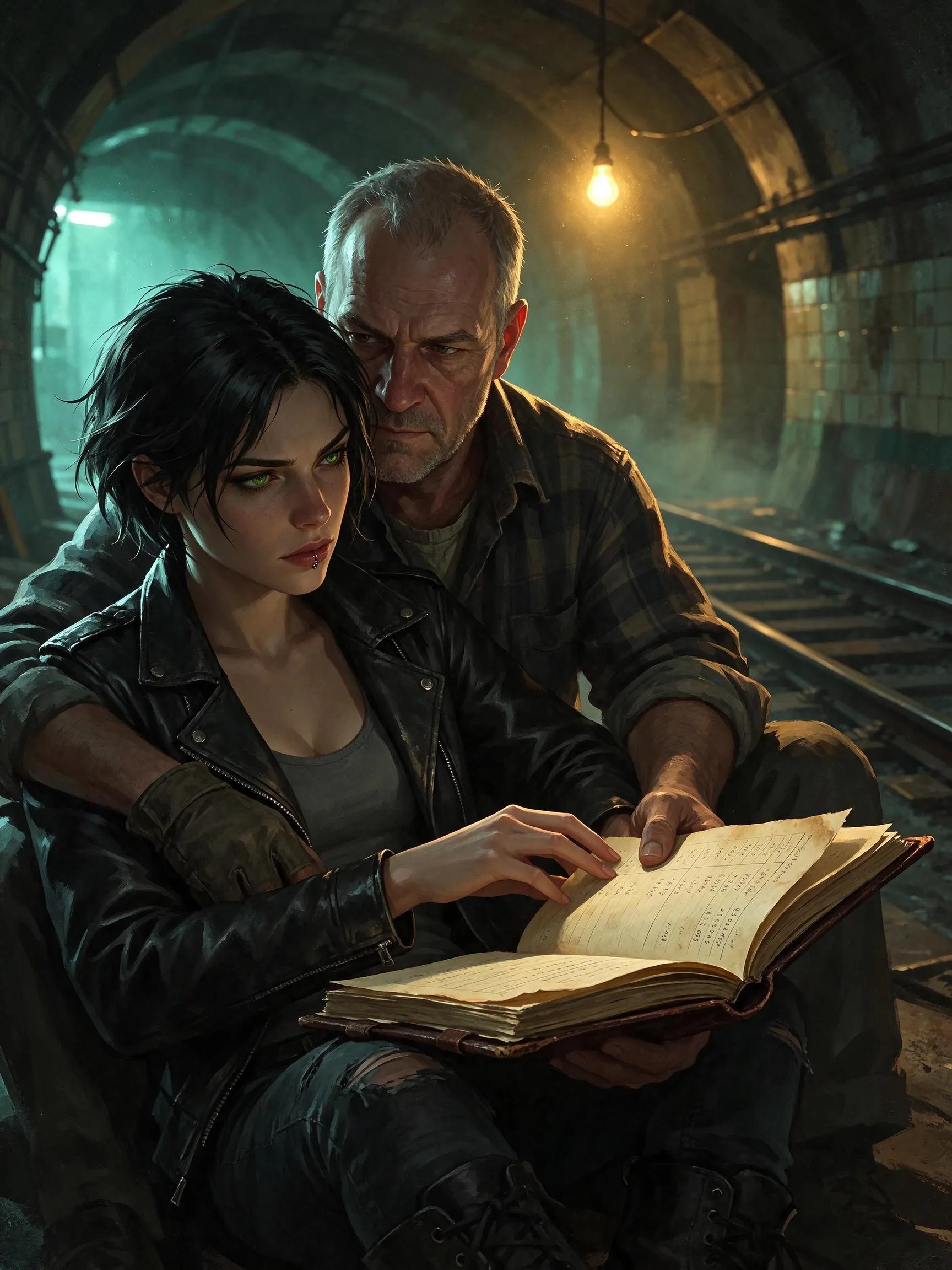

Her fingers found the wallet's worn leather before her brain even finished the calculation—the brush of his jacket, the slight give of the inner pocket, the weight of a man who carried his money close but not close enough. She let her shoulder catch his as she passed, muttering a quick "sorry" that he'd already forgotten by the time she was three steps clear. The wallet slid into her jacket's inner pocket with the practiced ease of a motion she'd performed a thousand times. She didn't look back. Looking back was how you got caught.
The businessman's cologne hung in the air behind her—something expensive, something that probably cost more than she'd eat in a week. She let the crowd swallow her, a small figure in a leather jacket moving against the tide of lunch-hour foot traffic. Her hand found the wallet again, testing its weight. Thick. Maybe a cardholder, maybe a money clip. The good ones always felt like this, promising more than they delivered.
She turned down 14th Street, past the shuttered bodega with its faded advertisements, past the newsstand where the old man never looked up from his racing forms. The grate of the old station waited at the end of the block, rusted and padlocked, the kind of entrance that said *condemned* to anyone with eyes. But Veya had learned years ago that *condemned* was just a word the city used to mean *nobody's watching*.
She slipped down the side alley first, checking the street behind her with the quick, casual glance of someone who'd forgotten something. Nobody. The padlock on the grate was new—the city replaced it every few months, and every few months someone in the camp cut it again. She pulled the bolt cutters from her bag, the ones with the taped handles that Ralf had given her on her sixteenth birthday, and made short work of it. The grate swung open with a groan that echoed down into the dark.
She stepped through and pulled it shut behind her, the padlock hanging loose and useless. The stairs descended into a blackness that smelled of rust, damp concrete, and the particular mustiness of places the sun had forgotten. She knew these steps by heart—twenty-three of them, then a landing, then another seventeen that curved slightly to the left. She'd counted them enough times in the dark.
Her boots echoed on the concrete as she moved deeper. The station below was a skeleton of its former self: tiled walls cracked and stained, benches ripped from their moorings, a clock frozen at 4:47 that had been frozen for at least a decade. She passed through the turnstiles without breaking stride—they'd been jammed open so long that spiders had built empires in the mechanisms.
She pulled the wallet out as she walked, thumbing it open. Credit cards, three of them, all embossed with a name that wasn’t worth remembering. They'd be cancelled before she could use them, and using them would leave a trail straight back to her anyway. The banks were fast these days. Stolen cards didn't stay useful for long unless someone had the right equipment to keep them alive. She flipped past the cards, past a photo of a woman and two kids that she deliberately avoided looking at, and found the cash. A single fifty. Not the thick roll she'd hoped for, but much better than nothing.
The fifty went into her boot, flat against the sole where she'd sewn a pocket for exactly this purpose. The wallet and its useless plastic went into her bag—Ralf could find something for them, even if it was just a couple bucks for the leather. She'd learned never to throw anything away. One person's trash was another person's two dollars.
The tunnel branched ahead, and she took the left fork, the one that led deeper into the forgotten parts of the system. The lights here were few and far between, bare bulbs strung on wires that someone had tapped into a live line decades ago. They buzzed and flickered, casting pools of sickly yellow light that barely dented the darkness between them.
The camp materialized slowly out of the gloom—first a mattress propped against a wall, then a shopping cart overflowing with bundled possessions, then a row of tents made from tarps and scavenged lumber. This was the thieves' camp, and it had its own geography, its own rules, its own economy. The newcomers slept near the entrance, the ones who'd been here a while moved deeper, and the ones who'd earned their place—or just survived long enough—had their own corners, their own alcoves, their own piece of the dark.
Veya moved through the rows with confidence. A few heads turned as she passed, faces she recognized, faces that recognized her. She gave a short nod to Old Mickey, who was playing solitaire by the light of a camping lantern, and ignored the leer from a man she knew only as Teeth, who'd offered her a "business proposition" once that had involved a lot more intimacy than business.
Ralf's alcove was at the far end, tucked behind a support pillar where the tunnel curved. A bare bulb buzzed overhead, casting its sickly cone of light over a pallet of stained blankets and a dented metal footlocker. Ralf himself sat on an overturned crate, hunched over a table made of plywood and cinder blocks, sorting through a pile of phones.
He didn't look up when she approached. He never did. It was part of the ritual.
"Got some things for you," she said, dropping the wallet onto the table.
Ralf's hands kept moving, his fingers quick and sure as they pried a SIM card from a cracked phone. "That all?"
"Got some other bits." She swung her bag onto the table and started pulling items out—a watch she'd lifted from a stall in the market, a pair of sunglasses that had fallen out of an open purse, a phone charger she'd found in a coffee shop. "The charger's good, tested it. The watch keeps time, but the band's loose."
Ralf finally looked up, his gray eyes sharp and appraising beneath the receding hairline. He picked up the wallet, turned it over in his calloused hands, and grunted. "Fifty in it?"
"You know I don't skim."
"I know you say that." He opened the wallet, checked the cards, checked the empty cash compartment. "These cards will be dead. Bank's already flagged them."
"Doesn't mean they're worthless. Jammer users still buy them."
"They're worth the leather." He tossed the wallet onto a pile of similar wallets, the detritus of a hundred petty thefts. "Ten for the wallet. Five for the watch. Two for the sunglasses. Charger's worth nothing, but I'll give you a dollar for the copper."
Veya stared at him. "Eighteen dollars? The watch alone is worth forty!"
"The watch is worth forty in a shop. It's worth five to me because I have to find someone who'll buy a watch with a loose band and no box. You want to try your luck on the street, be my guest." He slid a stack of bills across the table, his expression flat, unmoved. "Eighteen's what I can give you."
She looked at the money. Eighteen dollars. It would buy her food for a few days if she was careful, maybe a hot meal and a bus pass. It wouldn't buy her a place to sleep that wasn't a drafty corner of a tunnel. It wouldn't buy her anything close to a way out.
"Twenty," she said, because she had to try.
Ralf's laugh was dry and humorless, a sound like gravel shifting. "Eighteen. You take it or you don't, but the offer doesn't get better."
She reached for the bills, her fingers brushing the worn wood of the table. "You're a bastard, Ralf."
"I'm a businessman, Vex."
She pocketed the money without counting it—she trusted him that much, at least—and turned to go. The transaction was done, and there was nothing left to say. That was the rhythm of it: come in, drop off, take the lowball, leave. She'd been doing it since she was fifteen, and she'd never once gotten the better end of a deal with him.
"Wait."
She turned back. Ralf had set down the phone and was looking at her with an expression she couldn't quite read—something between calculation and consideration.
"I heard something today," he said. "Something that might interest you."
"I'm not interested in anything that requires me to get shot at."
"This one doesn't require getting shot at. It requires getting in and getting out fast." He leaned forward, his voice dropping. “There's a buyer. Someone with money. Real money. They came through a middleman, so I don't know much about them. They’re looking for a specific item. A brass seal."
"A brass seal?"
"From a business. An accounting firm, something like that." He gestured vaguely toward the world above. "The seal is stored in some kind of special lockbox, A Rekon 254."
Veya crossed her arms. "And this buyer wants it badly enough to—"
"Pay out for good." Ralf's eyes were flat, serious. "I'm not talking a few hundred. I'm talking enough to get anyone out of this tunnel and set them up with a new life. Could get you out of this tunnel."
She didn't let her face change. She'd learned that too—never show interest, never show need. But something in her chest had tightened at his words. Get out of this tunnel. She'd been in this tunnel for three years. She'd been in tunnels and doorways and shelters and the backs of cars for as long as she could remember, and she always dreamed of getting out.
"What's the catch?" she asked.
“The catch is, the offer's open to anyone, and another crew is already after it. Word is they've already been sniffing around the same building, asking questions, trying to find a way in. You'd be racing them, and they're not the kind of people who play nice."
"So the catch is I might get my head kicked in by a gang."
"The catch is you might." Ralf shrugged. "But you're fast, and you're smart, and you've got something they don't."
"What's that?"
"You know how to move through the dark. I haven't seen anyone else navigate a pitch-black subway tunnel like you can.”
She looked at him for a long moment. He wasn't wrong. She'd always had a knack for navigating Carroway's underground. The bare bulb buzzed overhead, and somewhere in the tunnel a drip of water hit concrete with a steady, patient rhythm. She thought about the fifty in her boot, about the eighteen dollars in her pocket, about the cold concrete floor she'd sleep on tonight and the hunger she'd wake up with tomorrow.
"Where's the building?" she asked.
Ralf's mouth twitched—not quite a smile, but close. He reached into his pocket and pulled out a folded piece of paper, creased and worn, and slid it across the table. "The address. The floor. The office where the seal is supposed to be. Just bring it to me, when you have it."
She picked up the paper but didn't unfold it. "How do you know this buyer's legit?"
“I don't. But they paid upfront. People don't hand over that kind of money unless they want something badly.” He leaned back on his crate. "You want it, it's yours. You don't, I'll find someone else."
She tucked the paper into her jacket pocket, next to the wallet she'd lifted an hour ago. "I'll think about it."
"Don't think too long. The other crew's already moving."
She turned and walked out of the alcove, back into the dim light of the tunnel. The camp was quiet around her, the thieves settling into their evening routines—cooking over small flames, trading stories, counting the day's take. She passed Teeth without looking at him, passed Old Mickey, who was still playing solitaire, and made her way toward the mouth of the tunnel where the grate let in a sliver of gray light.
At the bottom of the stairs, she stopped. The paper was still in her pocket, a small rectangle of possibility. She pulled it out and unfolded it in the dim light, reading the address, the floor number, the office number. A building in the financial district, fifteen floors up, a door that would need a keycard and a code and probably a prayer.
She folded the paper and put it back in her pocket.
Then she started up the stairs, toward the gray light and the city above, the brass seal's address burning against her chest like a promise she hadn't decided whether to keep.
She broke the surface of the stairwell like a swimmer gasping for air, the gray light of the city hitting her eyes hard after the tunnel's perpetual dusk. The grate groaned behind her as she pulled it shut, the loose padlock swinging against the rusted metal with a hollow clank that seemed louder than it should have been. She stood there for a moment, letting her eyes adjust, feeling the weight of the paper against her ribs like a second heartbeat.
The street had changed while she was underground. The lunch crowd had thinned, replaced by the slower, more deliberate pace of early afternoon—mothers with strollers, delivery men on bikes, the occasional office worker sneaking a cigarette outside a building that didn't allow smoking. She checked her reflection in a darkened storefront window: short black hair mussed from the tunnel, green eyes sharp and watchful, the lower lip piercing glinting in the weak sun. She looked like a kid who'd been in too much trouble—but she also looked like a hundred other kids in this neighborhood, and that was the point she tried to stick with.
She'd turned eighteen five months ago, though most people still guessed she was no older than seventeen, and people still treated her like a kid. She didn't mind. Looking young helped her avoid trouble and, more importantly, helped her avoid getting caught.
She walked east, away from the station, letting her feet carry her through streets she knew by heart. The financial district rose ahead of her, glass towers catching the afternoon light, their polished surfaces reflecting a sky that was doing its best to pretend it wasn't gray.
She stopped at a corner deli and spent two of her eighteen dollars on a cheap coffee. Then she took a place outside, where she could watch the building Ralf had written down without looking like she was watching it.
Fifteen floors of glass and steel. A revolving front entrance. Security desk just inside.
She took a slow sip.
The guard was big, but bored. He watched the front doors more out of habit than interest, barely glancing at employees as they swiped their badges. The side entrance was more interesting. Deliveries came through every few minutes, and whoever was working the door had propped it open with a rubber wedge.
Veya filed that away.
She walked on.
The loading dock sat around the back, below street level, with a ramp disappearing into shadow. Two cameras covered the entrance, but neither had a clean view of the far corner. She circled the block once, then again, changing her pace the second time so it looked less like surveillance and more like she was killing time.
Four cameras on the front.
Two on the side.
The loading dock cameras were older.
The front guard could see anyone entering from the street, but not the side entrance.
More importantly, nobody seemed to be watching the cameras very closely.
Good.
She found a bench in a small plaza across from the building and sat down. Only then did she pull Ralf's paper from her pocket.
Fifteenth floor.
Office 1504.
A phone number for the buyer.
She studied the building again.
The front entrance would be difficult without a badge. The side entrance might be easier, but getting from there to the fifteenth floor would be the problem. She'd picked locks before, but she'd never worked a keycard system. She'd talked her way past guards, but this wasn't some corner store with a bored teenager behind the counter.
She'd need another way in.
Her phone buzzed. It was a cheap burner with a cracked screen and a battery that she was sure would die if she looked at it wrong. But it was reliable enough to communicate short messages.
>Ralf: You interested or not? Buyer's getting impatient.
Veya stared at the message. Twenty-four hours wasn't enough time. It would have to be.
She typed back. I'm interested. Give me two days.
The response came almost immediately. You'll be lucky to have one.
Veya's thumb hovered over the screen for a moment before she locked the phone and slipped it back into her pocket.
One day. — Twenty-four hours to get inside a building she'd never entered, reach the fifteenth floor, find a locked office, take a brass seal she knew almost nothing about, and get back out before someone else beat her to it.
She looked across the street. The building glittered in the afternoon light, all glass and steel and expensive security. A place built to keep people like her out.
Veya smiled faintly. That had never stopped her before.