
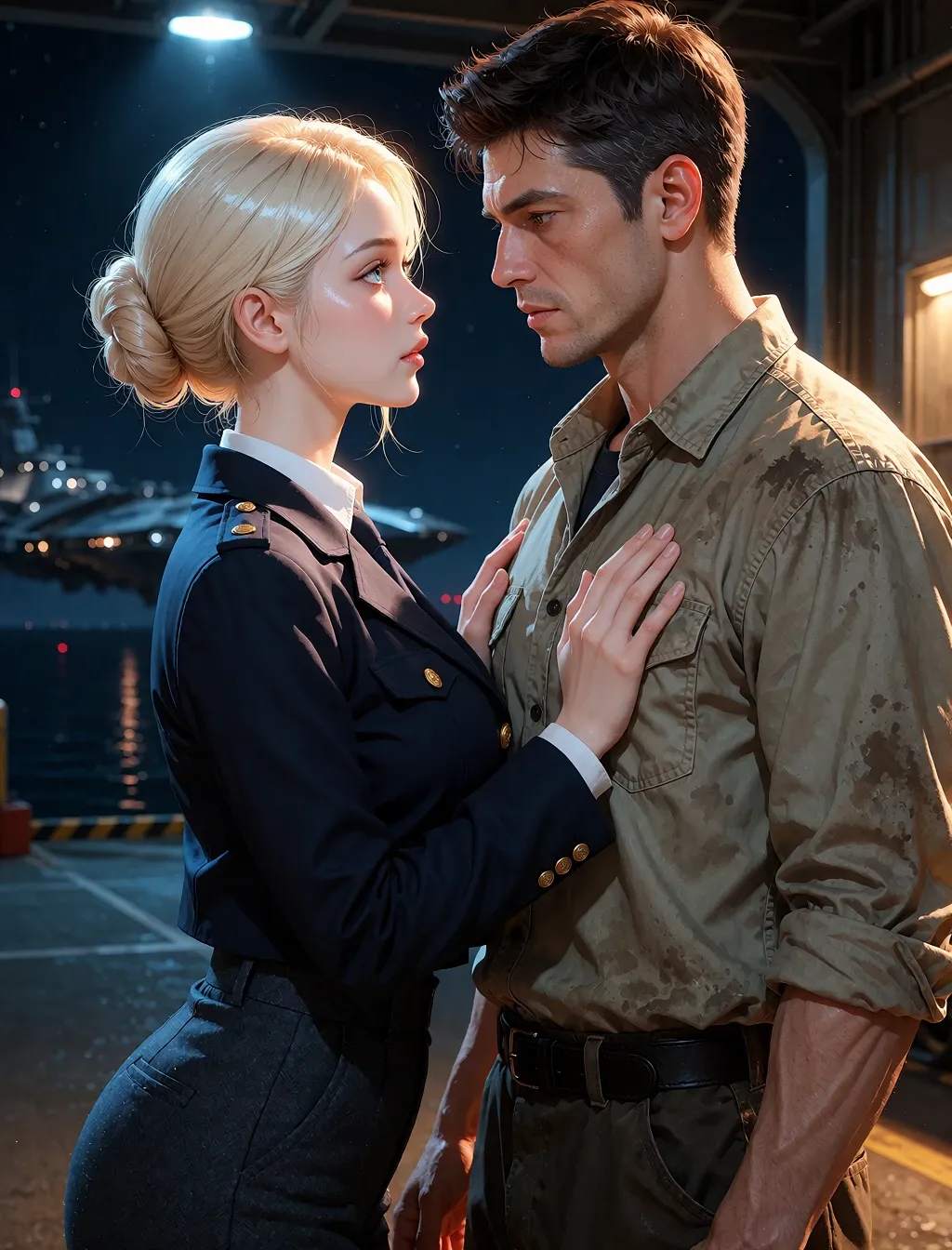
The corridor lights came up to ship's morning at 0540, a slow amber bleed along the ceiling strips that Jay had learned to read like a clock. She'd been awake for an hour already, lying on her bunk with her hands folded on her stomach, watching the light crawl down the bulkhead. She'd been awake, but she hadn't moved. There was a difference.
Her duffel sat open on the deck, still mostly empty. A toothbrush. Two changes of underwear from the ship's stores. The gray coveralls she'd been issued on intake, folded at the foot of the bunk. She'd been on this ship forty-one days. That was all she had to show for it — a bag that weighed less than the wrench she used to keep in her back pocket.
She sat up. Reached for the coveralls. Dressed.
The mess hall was two decks up and the coffee was a dark, bitter sludge that the Warspite's galley crew brewed strong enough to strip paint. She took a cup to a table by the viewport and sat with her back to the room, watching the stars smear past at cruising velocity. Nobody sat down across from her. Nobody looked twice. That had been one of the strange mercies of this ship — forty-one days of being looked at exactly as much as a person wanted to be looked at, and not one degree more.
She drank half the cup. Set it down.
Counselor's office was on deck four, port side, at the end of a corridor that smelled like nothing at all. Jay had noticed that on her first visit — how the Warspite scrubbed every smell down to a thin, neutral hum. Cold metal. Recycled air. Ozone from the life-support scrubbers. She'd spent a year breathing air that smelled like men and fear and antiseptic and the sweet rot of the Vixen's carpets, and now she was on a ship that smelled like a hospital that had never once been used.
She knocked twice.
"Come in."
Commander Ruth Okafor was at her desk with a mug of tea and a stack of hardcopy files — actual paper, which Jay had learned was Okafor's small rebellion against a fleet that had digitized everything but the coffee. She looked up, and something in her face shifted when she saw who it was. Not surprise. Jay had seen the shift before. It was the look of a woman who kept a running ledger of her patients and had just noticed a line item that didn't add up.
"Jay. You're early."
"I know." Jay closed the door behind her. Stood with her back to it. "This isn't a session. I just — I wanted to tell you in person."
Okafor set her pen down. Didn't say anything. That was the thing about her. She could hold a silence longer than anyone Jay had ever met, and she never once used it as a weapon. She just — waited. Gave you the room.
"Thursday's appointment," Jay said. "It's not going to happen. I'm leaving the ship when we reach Starbase Twelve."
Okafor's face didn't move. Her eyes did — a slow, deliberate blink, like she was filing the sentence somewhere and wanted to make sure it went in straight.
"Sit down," she said.
"Ruth—"
"Sit down, Jay."
Jay sat. The chair was the same one she'd sat in for every session — low, soft, angled away from the desk so you didn't have to look the counselor in the eye unless you wanted to. She'd hated that chair for the first two weeks. She'd come to tolerate it.
Okafor picked up her tea, took a sip, and put it down. Then she folded her hands on the desk and looked at Jay the way she looked at a patient who had just said something that mattered more than they knew.
"When did you decide?"
"Last night."
"Before or after you spoke to Captain Reyes?"
Jay's jaw tightened. Of course Okafor knew. Of course she did. Jay had spent forty-one days learning that this woman kept her ear to the whole ship, and that nothing happened on the Warspite that she didn't eventually hear about — not because she gossiped, but because she listened, and people told her things, and she never forgot a single one.
"Before," Jay said.
"So the decision wasn’t made in her quarters."
"The decision was made a long time ago," Jay said. "I went there to tell Reyes my decision."
Okafor nodded slowly. She didn't write anything down. She never did, in the sessions Jay had been in. She kept it all in her head, and Jay had the strange sense that her head was a very large room and Jay was only renting a small corner of it.
"Tell me why," Okafor said.
"You know why."
"I know what you told me last week. I know you said the wanting was yours and not a disease. I know you said you wanted to go back to the stars." Okafor tilted her head. "What I don't know is why you're leaving a ship that has kept you safe for forty-one days to go find a berth on a freighter that hasn't made you any promises at all."
Jay looked at the viewport. The stars were still smearing past, patient and indifferent, the same stars she'd watched from the mess hall an hour ago. She'd spent so much of the last year looking out viewports. She'd stopped counting somewhere around the third month on the Vixen, when the viewport in the rest room had been the only window she was allowed to stand at, and even then only between clients.
"Because this ship isn't mine," she said.
"It's a Star Service vessel," Okafor said. "It's not anybody's."
"It's yours." Jay turned back from the viewport. "It's Reyes's. It's Pell's. It's yours. It's a place where people do their jobs and follow the rules and go home at the end of a tour. And I'm — I'm a guest. I'm a patient. I'm the thing that happened to them on a rescue op. Every time I walk into the mess hall I can feel it. Not from most of them. Most of them are fine. That is fine for you, but to me it feels… chaste… I feel like I am in a beige dream. This ship has given me a chance to think, to breath, to come to terms with what I am…but it can’t give me what I need."
Okafor was quiet for a moment. Then she said, "You know the rules about Star Service and — what you are now."
"I know."
"You will never have a berth on a Star Service vessel again. Not because of what you are. Because of the regs. Nobody's going to override them for you, and even if they did, you'd be spending every day of a six-month tour in a fishbowl." Okafor's voice was even. Not cruel. Not kind. Just true. "Do you understand what you're giving up?"
"I'm giving up a clean bunk and three meals a day and a captain who'd break a man's jaw for looking at me wrong," Jay said. "I know exactly what I'm giving up."
"And what you're trading it for."
"Hopefully a place on a ship without those regulations. A ship where I can be myself. A place where I can experience the high of being touched, used, shared. A place where I know I am desired. Somewhere I can experience the thrill of sumission."
Okafor reached for her tea again, but didn't drink. Just held it. "There is a Captain that sometimes visits Starbase 12. Halvorsen runs a civilian freighter, short a hand, doesn't ask questions. That's the pitch. Do you know what she doesn't ask questions about, Jay? She doesn't ask questions about where her crew came from. She doesn't ask questions about what they do in their off-hours. She doesn't ask questions about who's using who as long as the manifest gets delivered and nobody gets hurt who didn't sign up for it. She will say it’s too much paperwork when people are hurt."
"I know."
"And you're all right with that."
Jay thought about it. She made herself think about it, the way Okafor had taught her — not the reflex answer, not the easy one. She sat with the question long enough that the hum of the ship's air handlers filled the silence between them.
"I'm all right with it," she said finally. "I'm not looking for a husband. I'm not looking for a rescue. I'm looking for a crew that'll have me and work that I can do and — " she stopped. Started again. "And a place where the thing I am isn't a problem to be managed."
Okafor set the tea down. "The thing you are."
"Yeah."
"Say it."
Jay met her eyes. She'd been practicing this, in her own head, in her bunk, in the dark. She'd said it to Okafor once before, and it had cost her something then. It cost less now. That was either progress or surrender and she'd stopped caring which.
"A whore," she said. "That's what I am. That's what Cassiday and Vance and Michelle made me. And it's not — " she held up a hand before Okafor could speak — "it's not a wound anymore. You told me that. You told me the wanting was mine. I've had a month to sit with it and I think you were right. I think it was always mine, under everything. I think Vance and the others just — cut away the parts of me that were in the way."
Okafor's face was very still. "That's a big thing to say."
"It's the truth."
"It's a truth." Okafor leaned back in her chair. "Let me give you my honest read, Jay. Not the discharge summary. Not the paperwork version. The one I'd give you if you were my sister."
"Okay."
"You were taken apart. Not just physically. Systematically. Vance sold you. Graadar broke you in. Michelle branded you and put you on a stage. Cassiday rewired your nervous system so that the breaking-in felt like pleasure, and then he trained you to thank him for it. That's not a metaphor. That's what happened. Your body was rewritten at a level that Doctor Pell can't undo and I can't counsel away."
Jay nodded. She'd heard the diagnosis before. It didn't land the same way now.
"What I can tell you," Okafor said, "is that most people who go through what you went through come out the other side with one of two things. They come out hollow — no wanting left, no direction, just a body that keeps moving because it hasn't been told to stop. Or they come out with a wound that never closes, and they spend the rest of their lives picking at it. You didn't do either."
"What did I do?"
"You came out with an addiction." Okafor said it plainly. "A specific one. An addiction to servitude. A need to be used. A want to be — " she paused, choosing the word — "kept. And you've stopped apologizing for it. You said it yourself. You need the “high of being used”. You've stopped trying to fix it. You've started trying to build a life around it. That's not a cure. But it's a prognosis, and it's the best one I can give you."
Jay's throat was tight. She hadn't expected this. She'd expected a warning. She'd expected Okafor to tell her she was making a mistake, that she needed more time, that forty-one days wasn't enough to make a decision like this.
"You're not going to try to stop me," she said.
"No."
"Why not?"
"Because you're not a child and I'm not your mother." Okafor said it without heat. "And because the version of you that stays on this ship out of fear isn't a version of you I'd want to treat. And frankly I’m not convinced that in your case that wouldn’t do you even more harm. You'd rot here. You'd be safe and you'd rot. I've seen it happen. I've watched people choose the safe berth and then spend ten years staring at the same bulkhead. Too afraid to live, just waiting to die."
Jay laughed — a short, wet sound she hadn't planned on. "That's the nicest thing anyone's said to me in a year."
"It's not a compliment. It's a clinical observation." But Okafor's mouth had turned up at one corner. Just slightly. Just for a second. Then it was gone. "One more thing, and then I'll let you go."
"Okay."
"The primer doesn't make you safe." Okafor leaned forward. "It makes you eager. It makes you easy. It makes you a body that says yes before your mouth does and long before your brain has processed the question. On the right crew, that's a life. On the wrong crew, that's a trap with a door that closes behind you and doesn't open again. You know the difference. You've lived on both sides of it. So when you walk onto that freighter and you meet Halvorsen's crew, or any other ship and crew, and you decide whether to offer yourself — I want you to ask one question before you do. Not whether they'll have you. Whether they'll keep you."
Jay sat with that. The hum of the ship filled the room. Somewhere down the corridor, a door opened and closed.
"I'll ask," she said.
"Good." Okafor stood. "Then I think we're done with the last session."
Jay stood too. She looked at the chair she'd just left — the low, soft chair she'd hated for two weeks — and felt something in her chest go tight and warm, the way a muscle does when you finally stop using it.
"Thank you," she said. "For all of it. For the — for everything you didn't have to do."
"I did have to do it," Okafor said. "It's my job."
"It's not your job to be the only person on this ship who looked at me like a person."
Okafor didn't answer that. She just walked Jay to the door, and when Jay stepped into the corridor, Okafor put a hand on her shoulder — the first time she'd ever touched her — and held it there for one full second before letting go.
The ship's internal comm crackled overhead, the voice of the bridge watch soft and even. All hands, all hands. We are two hours out from Starbase Twelve. Docking at 1300 hours. Shore leave rotations to follow. That is all.
Jay stopped in the middle of the corridor. Two hours. She'd known it was coming — the schedule had been on her cabin's display for a week — but hearing it out loud in the ship's own voice made it real in a way the display hadn't. Two hours and the Warspite would be behind her. Two hours and she'd be standing on a civilian concourse with a duffel bag and a referral and a body that wasn't the body she'd started with.
"Jay."
She turned. Okafor was still in her doorway, one hand on the frame.
"Yeah?"
"If it doesn't work out — if Halvorsen says no, or if she says yes and it's wrong — you can come back here. Not for a berth, as my guest. For a week or two. A shower. A meal. Somewhere to think." Okafor's voice was steady. "That offer doesn't expire."
Jay's eyes stung. She blinked it away.
"Okay," she said.
"Okay." Okafor nodded once. Then she went back inside and closed the door, and Jay was alone in the corridor with the two-hour clock running under her skin.
She went to sickbay.
The Warspite's medical bay was two decks down and lit too bright, the way all sickbays were, and Doctor Pell was at her desk with a tablet and a cup of something that had gone cold. She looked up when Jay came in, and Jay saw the same shift she'd seen in Okafor's face — the small recalibration of a woman who kept a ledger.
"Miller." Pell set the tablet down. "You're not on my schedule."
"I know. I'm not here for a checkup."
"Then what are you here for?"
"To say goodbye." Jay walked up to the desk. "I'm leaving at the station. I wanted to — I don't know. I wanted to say it to your face."
Pell looked at her for a long moment. She was a woman in her late fifties with short gray hair and a face that had never once been described as warm, and she had been the one to tell Jay the truth about her body in the first week — the truth Jay had needed to hear, delivered without a single soft word. Jay had hated her for it at the time. She'd come to respect her for it since.
"You don't owe me a goodbye," Pell said.
"No. But I owe you a thank you."
Pell's eyebrows went up a fraction. "For what?"
"For not lying to me." Jay put her hands on the edge of the desk. "You told me the primer couldn't be undone. You told me the body I have now is the body I keep. You didn't dress it up. You didn't tell me it would get better. You just — told me the truth, and then you let me decide what to do with it."
Pell was quiet for a moment. Then she said, "It's not a kindness. It's the job."
"Okafor said the same thing."
"Because it's true." Pell stood. She was shorter than Jay had remembered — Jay had been flat on her back for most of their interactions, and standing, the doctor came up to her chin. "You're leaving. Where?"
"I’m not sure, maybe a freighter. The Kestrel's Weight. Captain Halvorsen. Ruth and the Captain had good things to say about it."
"Halvorsen." Pell's mouth thinned. "I know the name. She runs a tight ship. Doesn't tolerate her crew being hurt without her say-so. That's a better berth than most."
"Reyes said the same."
"Reyes knows what she's doing." Pell reached into a drawer and pulled out a small sealed packet. Held it out. "Take this."
Jay took it. Turned it over. It was a medical packet — the fleet's standard issue, with her name printed on the label in small block letters. Inside, she could feel the shape of a small vial and a folded sheet of instructions.
"What is it?"
"Broad-spectrum prophylactic. And a course of antivirals." Pell didn't soften it. "You're going to be working. Civilians don't screen the way we do. Take the packet. Use it. Don't skip a dose because you're embarrassed to ask for a refill at a port pharmacy — you can get the same formula at any licensed clinic, and I've written the name of it on the sheet in plain Standard so you don't have to explain yourself."
Jay's face went hot. She looked at the packet in her hand. Then she looked back up at Pell.
"You've been planning this," she said.
"Covering my bases, I suspected that sooner or later this might be in your future. And I like to have a plan for everything." Pell's voice was dry. "It's a character flaw."
"It's not a flaw." Jay tucked the packet into the pocket of her coveralls. "Thank you."
"Don't thank me. Use it." Pell sat back down. Picked up her tablet. Then, without looking up, she said, "One more thing, Miller."
"Yeah?"
"The primer doesn't come with a pain response." Pell's eyes were on the tablet, but her voice had gone very precise. "You're going to be in situations where a normal body would tell you to stop. Yours won't. Not the way it used to. So you're going to have to do it in your head. Set a limit before you walk into a room and don't let the room move it. That's the only thing I can give you that'll keep you alive out there."
Jay stood in the doorway for a moment. The packet was warm in her pocket from her own hand.
"I'll remember," she said.
Pell didn't answer. She was already back to her tablet, and Jay left her there.
Her quarters were small and bare and smelled like her now — the ship's soap, and the faint, sweet undertone of the primer that she'd learned to stop being afraid of. She stood in the middle of the room and looked at what she had.
The duffel. The toothbrush. The two changes of underwear. The gray coveralls. And on the small shelf above the bunk, three things she'd accumulated in forty-one days without meaning to.
A smooth gray stone from the Warspite's arboretum — she'd picked it up on a walk with Okafor in the second week, when she still couldn't sleep and Okafor had started scheduling her walks instead of her sessions, and she'd kept it because it was the first thing she'd touched in a year that didn't want anything from her.
A folded slip of paper with Birdie's mother's address on Sarif IV, written in Birdie's own hand. She'd kept it in case — in case of what, she still didn't know. But she kept it.
And the third thing. The thing she'd been avoiding looking at for a week.
A small, plain bottle of lube from the ship's stores. Standard issue, unscented. She'd bought it from the quartermaster in the second week, along with the toothbrush and the underwear, and the quartermaster hadn't looked at her once while he rang it up, and she'd carried it back to her cabin and put it on the shelf and it had been there ever since.
She picked it up. Weighed it in her hand. It was a small thing. It was a nothing thing. It was the one of first things she'd ever bought for herself since her transission, with her own money, for her own body, and it hadn't been for a client and it hadn't been for a captor and it hadn't been for a rescuer. It had been for her.
She put it in the duffel. The stone went in after it. The address went into the pocket of her coveralls, folded twice, next to the medical packet.
She zipped the bag. Looked around the room once. There was nothing else in it. There had never been anything else in it. But it had been hers for forty-one days, and that was more than she'd had for a year.
She shouldered the duffel and left.
The gangway corridor was a long, bright throat of a passage that ran from the Warspite's port airlock out toward the station's docking collar, and it was empty except for three people standing at the ship's end of it. Jay saw them from the far end of the corridor — a small cluster of uniforms against the gray bulkhead, and her stomach did something complicated.
Okafor was in the middle. Pell was on her left. And on her right, in full dress uniform with her hair up and her collar straight, was Captain Reyes.
Jay stopped walking. For a second she thought about turning around. Then she thought about what Okafor had said — you're not a child and I'm not your mother — and she made herself keep walking. Her boots were loud on the deck plates. The three of them watched her come.
"Captain," Jay said when she was close enough. "I didn't expect — you didn't have to."
"I know." Reyes's voice was the same as it had been in her quarters — level, dry, and carrying an authority that didn't need to raise its volume. "That's why I'm here."
Okafor stepped forward first. She was holding a small, flat box wrapped in plain brown paper, and she held it out to Jay with both hands, the way you'd hand someone a citation.
"This is from all three of us," she said. "But mostly it's from me."
Jay took the box. It was light. She turned it over. The paper was folded at the corners, precise, and there was no card.
"Open it," Okafor said.
Jay peeled the paper back. Inside was a small hardcover book — a real book, not a data slate, with a spine that had been broken in and pages that had been turned. The cover was plain gray cloth with no title printed on it. She opened it to the first page.
It was a journal. Blank. The first twenty or so pages were filled in Okafor's small, even handwriting — dates, notes, short entries in a shorthand Jay couldn't fully read — and then the rest of the book was empty. Waiting.
"That's my session log," Okafor said. "The first twenty pages. The rest is blank. It's for you."
Jay looked up. "I don't understand."
"You spent a year with no record of your own life. Everything that happened to you was recorded by other people — Cassiday's count, Michelle's manifest, Verhoeven's inventory. You didn't get to write any of it." Okafor's voice was steady. "So I'm giving you the log I kept of you. The clinical version. So you can see what I saw. And then the rest of the book is yours. You write it. Whatever you want. Nothing in it has to be true. Nothing in it has to be — anything. It's just yours."
Jay's eyes were stinging. She looked down at the book in her hands. Twenty pages of Okafor's handwriting, and then — nothing. Waiting.
"Ruth," she said. Her voice cracked on the name.
"Don't." Okafor held up a hand. "Don't thank me yet. Pell has one too."
Pell stepped forward. She was holding a small, hard case — dark green, matte, the kind of thing you'd keep in a field kit. She held it out without ceremony.
"Standard field medical kit," she said. "Sutures, coagulant, broad-spectrum antibiotics, a pressure bandage, a small mirror. Everything you'd need to handle yourself if you got hurt and there wasn't a doctor on hand."
Jay took it. It was heavier than the book. She turned it over. The latch was good — solid, well-machined. Someone had put thought into this.
"Pell," she said. "This is — this is a lot."
"It's a kit." Pell's voice was flat. "Open it."
Jay opened it. Inside, snugged into foam cutouts, was everything Pell had described — and one thing more. Tucked into the top lid, in a small slot, was a folded piece of paper with a name and an address on it. “A clinic on Starbase Twelve. Dr. Amara Singh, MD, in Pell's handwriting. Tell her I sent you. She won't charge you for the first visit. Nothing she see’s or hear’s will shock her and since I sent you she will probably have an idea of your history.”
Jay closed the kit. Her hands were not entirely steady.
"Thank you," she said. "I mean it."
"I know you do." Pell stepped back. "That's why I wrote the name."
Then Reyes stepped forward. She had a small, flat package in her hand — smaller than the book, wrapped in the same plain brown paper. She held it out, and Jay took it, and for a second their hands were close enough that Jay could feel the heat off Reyes's palm.
"From me," Reyes said. "Not from the fleet. From me."
Jay opened it. Inside was a small, flat leather case, worn at the edges, with a brass snap. She pressed the snap. It opened.
Inside was a pair of red silk panties. The same pair Jay had left behind in Reyes's quarters — the same red, the same cut, the same faint scent of Reyes's soap and Reyes herself. They had been washed and folded and laid into the case like something precious, and underneath them, tucked into the lining, was a small folded card.
Jay's face went hot. She looked up. Reyes was watching her with an expression that was not quite a smile and not quite anything else.
"You didn’t take them," Reyes said. "I had them cleaned. I thought you might want them."
Jay couldn't speak for a second. The corridor was very quiet. Okafor was looking at the bulkhead. Pell was looking at her boots. Neither of them was going to rescue her.
"Captain," Jay said finally. "This is — "
"It's embarrassing," Reyes said. "I know. That's the point." She tilted her head. "You're going to a ship where nobody knows what you are. Where nobody knows what you've done. Where you'll have to decide, every day, whether to tell them or not. And I want you to have one thing in your bag that says — " she paused, and for the first time since Jay had met her, she seemed to be choosing her words carefully — "that says somebody knew. And somebody kept them. And somebody thought they were worth entrusting to you."
Jay's eyes were stinging again. She snapped the case shut. Held it against her chest.
"I don't know what to say," she said.
"You don't have to say anything." Reyes stepped back into line with the other two. "You just have to walk through that airlock. That's the whole job right now."
Jay looked at the three of them — the counselor, the doctor, the captain — standing in a row at the end of the corridor with their hands at their sides and their faces carefully neutral, and something in her chest that had been tight for a year finally came loose. It wasn't a sob. It was quieter than that. It was the feeling of a door opening somewhere she hadn't known there was a door.
She set the duffel down. Set the book and the kit and the case on top of it. Then she stepped forward and hugged Okafor first — hard, both arms, the way she hadn't hugged anyone since she was a kid, and Okafor held her for a second and then a second longer, and Jay felt the older woman's hand press flat against her back, once, before letting go.
Then Pell. Pell was stiff and small and smelled like antiseptic, and she patted Jay's shoulder twice with the same clinical precision she used for everything, and Jay laughed into her hair and said thank you one more time, and Pell said use the kit, and that was that.
Then Reyes. Reyes didn't hug like the others. Reyes hugged like a captain — one arm, firm, brief, her chin at Jay's temple for exactly as long as it took Jay to breathe in once and breathe out once. And in that one breath, Reyes said, quietly, against Jay's hair, don't let anybody move your limit, and then she let go and stepped back and her face was a captain's face again.
Jay picked up her duffel. Slung it over her shoulder. The book and the kit and the case went into the bag, packed in the order she'd been given them, and she zipped it and squared her shoulders and turned toward the airlock.
"Miller," Reyes said behind her.
Jay stopped. Didn't turn around.
"The Kestrel's Weight is a good ship," Reyes said. "Halvorsen is a good captain. But if she's not — if the berth is wrong, or the crew is wrong, or you decide you want a different life than the one you're walking toward right now — you send a message to the Warspite. Any port. Any time. It comes to me."
Jay nodded. Her throat was too tight for words.
"Go on," Reyes said.
Jay walked through the airlock. The docking collar was a short metal tube, cold on both sides, with a soft hiss of equalizing pressure at the seam. And then she was through, and the deck under her boots was different — station plating, not ship plating, a slightly different ring to it, a slightly different smell. Recycled air and old coffee and the faint chemical tang of a thousand strangers passing through the same corridor.