
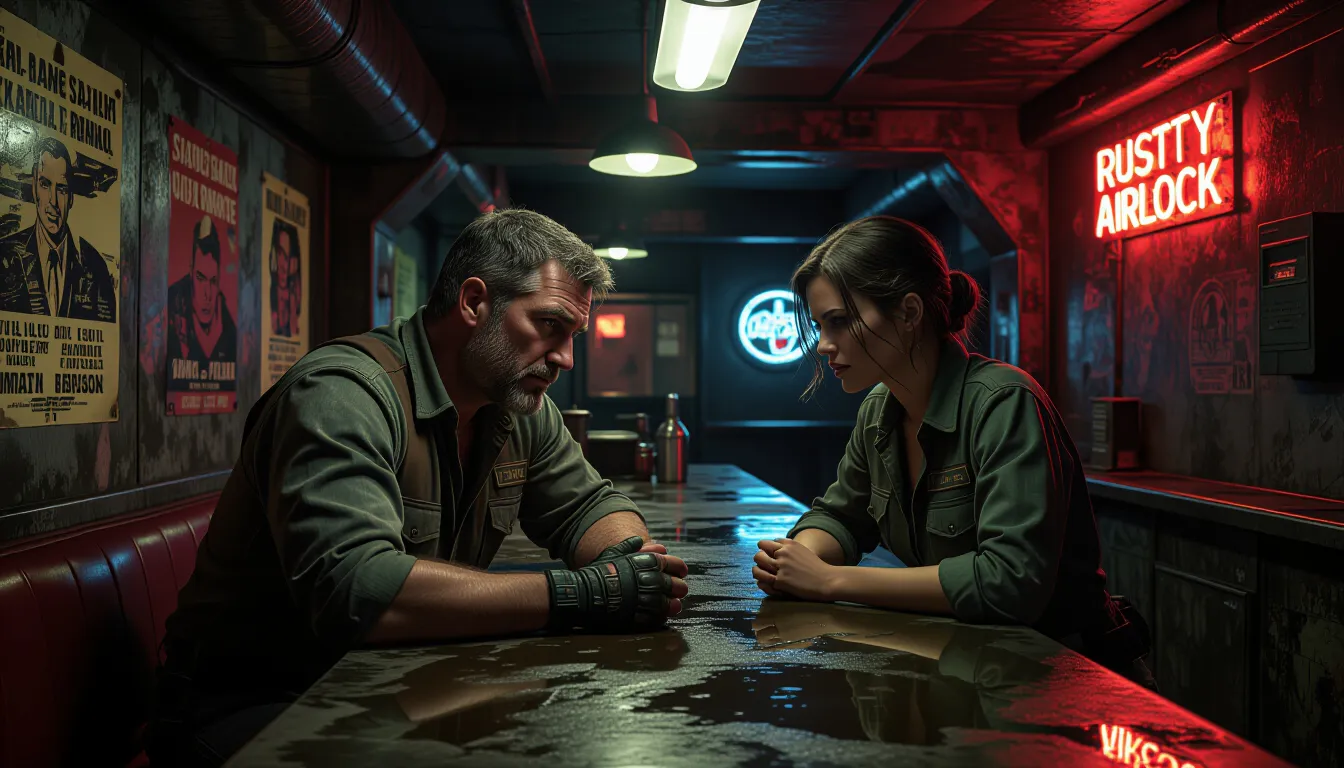
The Rusty Airlock Bar stank of synth-ale and desperation. The scent was a physical layer, a greasy film of recycled air, spilled liquor, and the ozone-tinged damp that wept from the cold metal hull. Jamie ‘Jay’ Miller sat with his back to a corroded bulkhead, his broad shoulders hunched over a glass of something amber and cheap. The flickering neon from a broken sign outside cast long, trembling shadows across the dented floor grates, painting everyone in shades of failure.
He felt the gaze before he saw its source. A weight, assessing and cool, moving over the back of his neck, the breadth of his shoulders, down to the grease-stained knuckles wrapped around his glass. He knew that look. It was the look a foreman gave a piece of machinery, evaluating torque and tensile strength. Slowly, he turned.
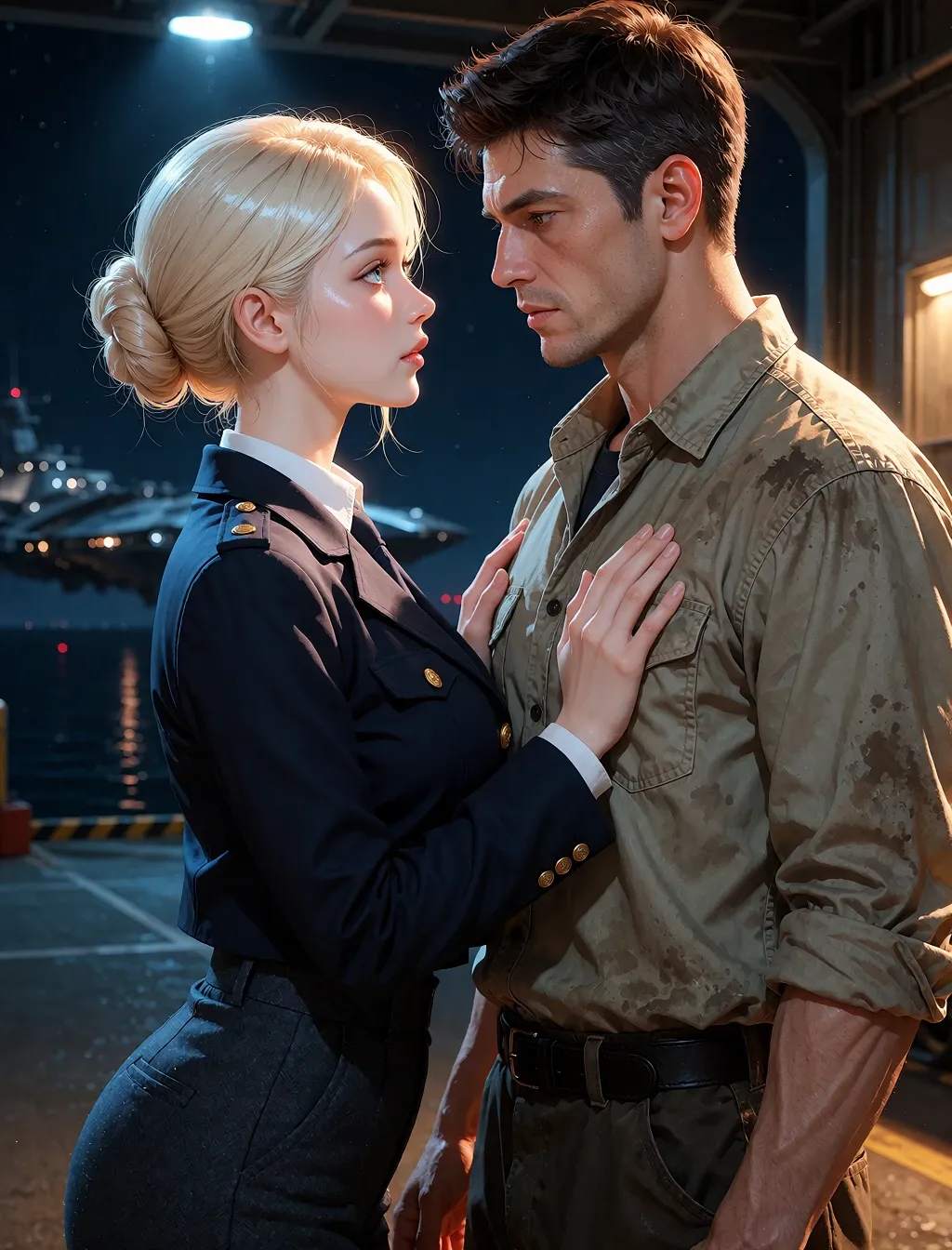
Captain Emma Vance stood three meters away, a stark anomaly in the gloom. Her ice-blonde hair was pulled into a severe knot at the nape of her neck. Her fitted captain’s jacket was a deep navy, pristine, but her boots were scuffed from docking bay grime. Her eyes, the color of a neutron star, absorbed the dim light and gave nothing back. She was looking directly at him.
She moved then, not toward the bar, but toward his table. Her walk was efficient, predatory in its lack of waste. She didn’t ask permission. She pulled out the opposing chair, its legs scraping against the grate with a shriek that made Jamie’s jaw tighten, and sat. She placed her palms flat on the sticky tabletop. Her hands were clean, nails trimmed short and practical.
“Jamie Miller,” she said. Her voice was a calibrated instrument, warm but with a metallic undertone. “Former chief reactor mechanic, Kepler Yards. Ten-year service pin. Laid off eight months ago.”
Jay’s heart did a slow, heavy roll in his chest. He took a slow sip of his synth-ale, the cheap bitterness coating his tongue. “You’ve done your homework.”
“Due diligence.” Captain Vance’s head tilted, just a fraction. “I have a berth. Deep-space hauler, the *Venture’s Star*. We leave in twelve hours. My mechanic took a better offer at the last port. I need a replacement.”
The words hung in the damp air between them. A berth. A ship. The vibration of a star-drive under his feet, the scent of hot metal and ionized coolant, the purpose of a system that needed his hands. The relief that flooded him was so profound, so violent, it felt like a physical blow. Heat rushed to his face, a stupid, hot gratitude that tightened his throat. He had to swallow before he could speak.
“What’s the run?” His own voice sounded rough, too eager. He tried to temper it with a mechanic’s skepticism. “What’s the pay?”
“Six-month loop. Mineral surveys in the Kyril Belt. Pay is standard guild rate, plus a two percent share of non-contraband mineral bonuses.” She recited it like a manifest. Her eyes never left his face, studying his reaction. “The work is hard. The ship is old. You’ll earn your share.”
Jay nodded, a slow, thoughtful gesture born of a lifetime assessing problems. An old ship. He could work with that. Any system could be fixed with the right parts and enough sweat. The loneliness of the past eight months—the silent apartment, the dwindling credits, the way people stopped meeting his eye—rose up like a wave behind him, pushing him toward this lifeline.
“Why me?” he asked, the last vestige of caution. “Plenty of mechanics on the docks.”
Captain Vance’s lips curved, not quite a smile. It was a transaction concluding. “Your service record. No brawls, no debts to the syndicates. You’re reliable. And you’re here.” Her gaze swept the decrepit bar, the flickering shadows, the empty glass in his hand. The meaning was clear: *And you have no other options.*
She was right. The truth of it was a dull ache in his ribs. He was here. He was useful. He wanted to be part of a crew again, to have a function, to hear the hum of a living ship around him. The cold calculation in her eyes was invisible to him, obscured by the blinding light of escape.
“Twelve hours,” he said, more statement than question.
“Dock Seventy-Two, gantry four. Be there, sober and packed. Standard personal gear only. Ship provides the tools.” She stood, the movement fluid and final. She extended a hand across the table.
Jay looked at her hand, then at his own. He wiped his palm on his thigh, a quick, self-conscious motion, before reaching out. Her grip was firm, cool, and brief. A deal sealed.
“Thank you, Captain,” he said, the words thick with that unseemly gratitude.
Captain Vance gave that slight tilt of her head again, a barely perceptible angle. “Don’t thank me yet, Miller. You’ll earn it.” She released his hand and turned, her boots clicking a steady rhythm against the floor grates as she walked out of the bar and into the perpetual twilight of the space docks.
Jay sat there, the ghost of her cool grip still on his skin. The ambient noise of the bar—the low murmur of other lost causes, the drip of a leaking condensation line—flooded back in. He looked down at his hands. The calluses, the faint traceries of old burns, the grease embedded in the cracks of his knuckles. They were a mechanic’s hands. They would be useful again.
He lifted his glass and finished the synth-ale in one long swallow. The bitterness was still there, but now it tasted like promise. Like a beginning. He set the glass down with a definitive *click*. The weight that had been sitting on his chest for eight months was gone, replaced by a nervous, buzzing energy. In twelve hours, he would be aboard a ship. In twelve hours, he would be gone.
He stood, his movements quicker now, purposeful. He left a few chits on the table—a larger tip than he could afford, a silent offering to the gods of fortune—and strode out of The Rusty Airlock. He didn’t look back. The damp, stale air of the docks outside was sweet with the scent of freedom.
Back in his partitioned hab-unit, the silence felt different. It was no longer a prison, but a brief interlude. He hauled his duffel from under his cot, the same one he’d carried from Kepler Yards. He packed his few belongings: spare coveralls, a thermal shirt, a data-slate with his technical manuals, a photograph of a yard crew he hadn’t seen in years. The ritual was familiar, comforting.
He lay on his cot in the dark, listening to the distant thrum of dock machinery through the thin walls. His mind raced with possibilities. The *Venture’s Star*. He wondered about the engine configuration, the age of the plasma conduits, the temperament of the gravity stabilizers. Problems to be solved. Systems to be maintained. A crew to belong to.
He didn’t wonder about Captain Vance’s true cargo. He didn’t question the ease of the deal. He saw only the escape hatch that had slammed open in front of him, and the profound, aching need in him to crawl through it. The gratitude was a warm, stupid animal curled in his gut, and it purred him into a deep, dreamless sleep long before dawn.
The alarm in Jamie’s hab-unit buzzed, a harsh, metallic sound that shattered his deep sleep. He was awake instantly, the old mechanic’s reflex of rising before a shift change. For a glorious, disoriented second, he thought he was back in the crew quarters of the Kepler yardship. Then the silence of his tiny room settled back in, but today, it was a different silence. It was full of potential.
He dressed quickly in his cleanest coveralls, shouldered his duffel, and did one last sweep of the empty hab. The photograph of his old crew was already packed. He locked the door behind him, a meaningless gesture for a room he’d already stopped paying for, and stepped into the corridor.
The walk to the orbital tram was brisk, the dockside air still clinging with the artificial chill of night cycle. His boots echoed on the polished deck plating. Other early-shift workers moved around him, their faces drawn with routine. For the first time in months, Jamie didn’t feel like one of them. He had a destination. A purpose. The *Venture’s Star*.
“Hey. Miller.”
The voice, gravelly and familiar, came from a shadowed maintenance alcove. Jamie slowed. Old Man Hensch, a retired cargo supervisor who spent his days watching the docks like a sour, sedentary bird, peered out at him.
“Heard you caught a berth,” Hensch said, not bothering with a greeting. His eyes, clouded but sharp, scanned Jamie from duffel to boots.
“That’s right,” Jamie said, a thread of pride weaving into his voice. “Deep-space hauler. Mechanic’s berth.”
Hensch grunted, a wet, unpleasant sound. “Which ship?”
“The *Venture’s Star*. Captain Vance.”
For a long moment, Hensch said nothing. He just stared, his wrinkled face impassive. Then he spat a wad of synth-tobacco juice onto the deck plating. It sizzled faintly against the cold metal. “Vance. Ice-bitch with a clean jacket and dirty boots.”
Jamie’s shoulders tightened. “She seemed straight enough.”
“They all seem straight enough,” Hensch countered, his gaze drifting past Jamie, out toward the cavernous mouth of the docking bay. “Till you’re out past the beacon lights and the rules get… flexible.” He looked back at Jamie, his expression unreadable. “What’s the cargo?”
“Mineral surveys. Kyril Belt.”
Another grunt. “Long way out. Quiet sector. Not much traffic, not much law.” Hensch shifted his weight, the servos in his old exo-brace whining. “You see any other crew? Big lads? Security types?”
Jamie blinked. “Didn’t ask. Just needed a mechanic.”
“Just needed a mechanic,” Hensch repeated, his voice flat. He gave Jamie another long, assessing look, the same look Captain Vance had given him in the bar, but stripped of all transaction and filled with something like pity. “Well. Good luck to you, son.”
He turned and shuffled back into the darkness of his alcove, the conversation clearly over.
Jamie stood there for a second, the brisk energy of the morning leaching away into the cold deck. Hensch was a crank, a professional pessimist. He saw conspiracies in cargo manifests and betrayal in every docking clearance. Jamie shook his head, physically dispelling the old man’s words, and resumed his walk to the tram.
But the unease had taken root, a tiny, cold seed in his gut. *Ice-bitch. Dirty boots. Quiet sector.* The words cycled in his head, syncing with the rhythm of his footsteps.
The orbital tram was half-empty. He took a seat by a window, his duffel on his lap. As the tram accelerated along the magnetic rail, the sprawling, grimy expanse of the docks streaked past. Gantries like skeletal fingers clawed at the void. Ships of every class and condition hung in their berths, some gleaming under repair arcs, others dark and silent.
He found himself searching for the *Venture’s Star*. What would an old deep-space hauler look like? He realized, with a slight jolt, that Captain Vance hadn’t described the ship at all. Not a word about its make, its tonnage, its drive class. She’d only said it was old. He, the mechanic, hadn’t asked.
“Stupid,” he muttered to himself, his breath fogging the cold viewport. He’d been so hungry for the berth, so grateful for the lifeline, he’d forgotten to check its structural integrity. A basic mistake.
The tram announced Dock Seventy-Two in a bland, automated female voice. Jamie stood, the duffel feeling heavier on his shoulder. He stepped out onto the gantry access platform. The air here was thinner, colder, smelling of raw vacuum and metallic sharpness. The distant, constant hum of the station’s life support was fainter, replaced by the occasional clang of machinery and the hiss of pressurization valves.
Gantry Four was at the far end, a narrow, poorly-lit corridor of grated walkway extending into the docking bay’s shadows. As he walked, the sounds of the main docks faded behind him. His own footsteps were the loudest thing, ringing too brightly in the enclosed space.
Halfway down the gantry, he stopped. A service panel was open on the bulkhead, wires spooling out like intestines. It wasn’t the disarray that caught his eye; docks were messy. It was the tool left behind. A hydro-spanner, its grip worn smooth, lay on the grate. It was a mechanic’s tool, a good one, not a cheap dock-issue model. Abandoned.
Mechanics didn’t leave good tools behind. Not unless they were in a very great hurry. Or unless they weren’t coming back.
He stared at the spanner, the cold seed of unease in his gut beginning to sprout, sending tendrils up into his chest. *My mechanic took a better offer at the last port*, Vance had said. The words now felt slick, rehearsed.
“You lost?”
The voice made him jump. A dockworker in a stained enviro-suit was watching him from an intersecting catwalk, his face obscured by a tinted visor.
“Looking for the *Venture’s Star*,” Jamie said, his voice steadier than he felt.
The dockworker didn’t move for a moment. Then he pointed a thick glove down the length of Gantry Four. “Berth at the end. Dark one. They’ve been running quiet.”
“Thanks.”
The worker didn’t acknowledge him, just turned and disappeared down his own catwalk, his footsteps soon swallowed by the ambient noise.
Jamie forced himself to move, his legs feeling less sure. *Dark one. Running quiet.* Haulers on a tight schedule didn’t run quiet. They lit up like festival lights, loading and prepping. His mechanic’s mind, finally kicking into its proper gear, started compiling the discrepancies: the lack of details, the abandoned tool, the quiet berth, Hensch’s warning, Vance’s calculating eyes.
He reached the end of the gantry. The airlock door before him was standard issue, but the ship ID plate beside it was dull, unlit. He had to step closer to read the faded script: VENTURE’S STAR. REGISTRY: BARIUM SECTOR. The viewport next to the airlock was dark, showing only the reflection of his own worried face.
As he stood there, the decision looming, the airlock door hissed and slid open with a sudden, violent rush of equalizing pressure.
Captain Emma Vance stood in the doorway, backlit by the low, red emergency lighting of the ship’s interior. She was already in her captain’s jacket, her expression one of mild impatience.
“You’re late, Miller,” she said, though he knew he wasn’t. Her voice was the same calibrated instrument, but in the hollow silence of the gantry, it sounded sharper. “Stop gawking and get aboard. We’re on a clock.”
She stepped back, a clear command to enter.
Jamie looked from her impassive face to the dark maw of the ship’s airlock. The warmth of his gratitude had completely evaporated, leaving only the cold metal scent of the dock and the acidic taste of doubt. This was the threshold. The escape hatch.
He took a deep breath, tightened his grip on his duffel, and crossed it.
The airlock sealed behind him with a final, pressurized hiss, cutting off the cold, metallic scent of the dock and replacing it with the canned, sterile smell of a ship on internal life support. The red emergency lighting painted everything in long, bloody shadows.
“Welcome aboard,” Vance said, her voice echoing slightly in the cramped airlock vestibule. She didn’t offer to take his bag.
Jamie’s eyes adjusted, taking in the narrow corridor ahead. Conduits ran exposed along the ceiling, and the deck plating was worn thin in the center. It looked less like a hauler’s working spine and more like a carcass picked clean. “Quiet,” he said, the word out before he could stop it.
“Crew’s at their stations, prepping for undock. Follow me.” She turned and walked, her boots silent on the grating. He had no choice but to follow.
The corridor led to a central lift. Vance punched a code into the panel. “You’ll bunk in engineering crew quarters. Drop your gear, then I’ll show you your workspace.”
“Workspace,” Jamie repeated, the mechanic in him latching onto the term. “You have a spec sheet for the main drive? I’d like to see what I’m working with before we spin up.”
The lift doors slid open. She stepped in, waiting for him. “All in good time.”
The lift descended, a low hum vibrating through the deck. Jamie watched the level indicators blink past. They passed the main deck, the mess hall level. They kept going down. “Engineering’s pretty deep.”
“Old ship design. Structural reinforcement around the drive core.”
He nodded, but the explanation felt too smooth, like a rehearsed line from a docking permit. The lift settled with a soft thud. The doors opened onto another dim corridor, this one colder, the air smelling faintly of ozone and something chemical, like cheap solvent.
He felt the ship lurch slightly as the docking clamps were released before a dull vibration reverberated up through his boots as the engines started propelling the ship away from the dock into the void of space.
“This way.” She led him to a hatch marked ‘C-12’. It was unpowered; she manually spun the wheel lock and shoved it open.
The room beyond was a cube. Four bunks, two stacked on each wall, bare mattresses. A single locker. No personal effects. No viewport. One dim glow-strip flickered on the ceiling.
“Home sweet home,” Vance said, without irony. “Your locker. Stow your kit. Quickly.”
Jamie hefted his duffel inside, dropping it on the lower bunk nearest the door. The silence was oppressive. “Where’s the rest of the engineering crew?”
“On shift. You’ll meet them.” She was already turning back to the corridor. “Workspace.”
He followed her again, the tendrils of cold in his chest tightening. She took him not to a main engineering bay, but to a secondary access corridor, stopping at a heavy, insulated door. A faded label read ‘Auxiliary Fluid Reclamation’.
“In here.” She palmed the lock. The door slid open with a whisper of compressed air.
The room inside was small, crowded not with drive components or plasma conduits, but with cleaning rigs. A sonic floor-scrubber was docked in a charging cradle. Shelves held bins of sealant, lubricant, and biodegradable solvent. In the corner hung an old fashioned french maids outfit featuring an impossibly short skirt and stockings that was clearly at least one size too small for Jamie’s frame.
He stared. “This is a janitorial closet.”
“It’s your workspace,” Vance said, her voice shifting, the calibrated warmth gone, replaced by flat finality. “Your primary duty is environmental and crew maintenance. Keeping the crew spaces habitable and the crew happy. It’s vital work on a long haul.”
“You hired me as a mechanic.” His own voice sounded dull in the small space.
“I hired you as crew. The ship’s needs are fluid. My last mechanic handled both. You’ll adapt.” She leaned against the doorframe, blocking his exit. “The suit is mandatory. Change. Now.”
“Captain,” he started, the protest forming, but she cut him off.
“The terms were ‘room, board, and standard wage for the duration.’ You accepted. The duration has begun. Your wage is contingent on performance. Is there a problem with your ability to perform, Miller?”
Her eyes held his. Neutron stars, absorbing all light, giving nothing back. The cold calculation he’d missed in the bar was the only thing visible now. “If there is you are welcome to leave… now”
“No,” he said, the word ash in his mouth.
“Good.” She pushed off the frame. “Put on the suit. Report to the main mess deck in ten minutes for orientation. The crew is eager to meet our new… maintenance specialist.”
She left, the door sliding shut behind her. A soft, definitive click echoed in the silence, the sound of a lock engaging.
Jamie stood alone in the janitorial closet, surrounded by the smell of solvent. He looked at the rack of shipsuits. They were cut for a slimmer build, with a high, tight collar. He reached out, his callused fingers brushing the coarse fabric.
It wasn’t a mechanic’s coverall. It was a uniform.
Outside the locked door, deep in the ship’s belly, a low thrum began to build through the deck plates. The drives were spinning up. They had left dock and were already accellerating into deep space.
He was already in the void.
Jamie stared at the locked door for a full minute, listening to the ship’s drives build to a cruising hum. He turned back to the uniform. The fabric was a cheap, synthetic blend, the color of engine coolant. He didn’t move.
The door slid open again without warning. Vance stood there, one eyebrow arched. “The clock is ticking, Miller. The crew expects you.”
“I’m not putting that on.” His voice was low, a rumble in the small room.
“Yes. You are.”
“You said mechanic.”
“I said crew. The definition is mine to set.” She took a single step inside, reclaiming the space. “You accepted the terms. You are on my ship, in my space, under my command. The outfit is part of the uniform. Refusal is insubordination.”
“Insubordination,” he repeated, a dry laugh escaping him. “You lied.”
“I presented an opportunity. You seized it. The details are merely… operational.” She leaned against the shelving unit, crossing her arms. “What’s the real objection? The cut? The fabric? Or the fact that it isn’t coveralls?”
He said nothing, his jaw tight.
“It’s the last one,” she said, nodding as if he’d spoken. “Pride. You were a mechanic. You defined yourself by grease and torque. Now you’re just crew. My crew. And my crew wears what I assign.”
“I didn’t sign up for this.”
“You did. The moment you stepped aboard. The moment you felt that relief in the bar. You’d have signed anything.” Her voice was clinical, dissecting. “This is the anything.”
He looked from her to the uniform, his mind racing through useless options. Ramming the door. Talking his way out. There was only the hum of the ship, endless and deep.
“What are the consequences?” he asked, finally.
“For refusal?” A faint, cold smile touched her lips. “No wage. Confinement to quarters—this closet, specifically. Reduced rations. And when we make port, you’ll be handed over to station authorities as a stowaway, with a bill for your passage attached. Your choice.”
“That’s not a choice.”
“It’s the only one you have.” She pushed off the shelf. “The uniform. Now. Or I seal this door and you can contemplate the void in the dark. I’ll collect you for the brig at the next port. Six months from now.”
The finality in her voice was absolute. He believed her.
His hands went to the fastenings of his own worn jacket, fingers clumsy. He shrugged it off, the familiar weight gone. Then the thermal shirt beneath, stained at the cuffs from old work. The air in the closet was cool against his skin.
Vance didn’t look away. Her gaze was an appraisal, noting the breadth of his chest, the scars from old burns and tool slips, the softness settling around his waist after months without steady work.
He reached for the french maids dress, the fabric felt light but slightly coarse. He pulled it over his head. It was tight across the shoulders, the seams straining. The high lacy collar tickled against his throat.
“The stockings,” she said.
He unbuckled his belt, the leather worn soft. He toed off his boots, stepped out of his heavy work pants. He stood in his shorts, feeling exposed under the flickering light and her unblinking stare.
“And those.” she said indicating his boxer shorts. Slowly, reluctantly he hooked his thumbs into the waistband and lowered them to the floor, exposing his flaccid cock and heavy balls to her cold but amused gaze. The hem of the dress teased his thighs making him acutely aware of how short it was, at it just barely covered his arse.
The stockings slid up his calves with a sensual ease as they whispered against the hair on his legs. A whisper that sent a thrill through him inspite of the situation and he felt his cock twitch in reaction. He had to force his thighs into them the fabric pulled taut. The fastenings on the straps of the dress were fiddly and awkward for him to attach to the stocking tops. The material was thin, leaving nothing to the imagination. He pulled on a garter belt that helped secure the stocking tops in place.
“So pretty.” Vance said, her eyes flicking over the maid’s outfits. He felt embarrassment rising within him causing first his throat and then his cheeks to flush crimson. “Finally the panties.
Jamie walked to the corner, his movements stiff. The skirt was a scrap of black almost sheer pleated fabric. The stockings were sheer, attached to a lacy garter belt. He lifted the the panties, absurdly light in his hand. Made of a sheer white fabric did little to mask his cock and balls although they were contained by it. The thin stringslipped between his buttocks and teased his anus causing his cock to give another twitch.
“This is a joke.”
“It is not.”
He felt the cool air on his thighs where the stockings ended and the skirt didn’t cover. He was trembling, a fine shake he couldn’t control.
“The apron,” Vance said. She hadn’t moved.
A frilled white apron hung with the outfit. He tied it around his waist, the bow sitting at the small of his back. The final piece was a small, ridiculous lace cap. He held it, looking at her.
“Put it on.”
He settled it on his head. The lace brushed his forehead.
“Now you’re uniformed.” She stepped closer, her eyes scanning him from head to toe. Her expression showed no amusement, no cruelty. Just satisfaction. “A perfect fit. Turn around.”
He turned, facing the shelves of solvent, his reflection a distorted blur in a polished valve housing. He saw a stranger: a large, broad-shouldered man squeezed into a parody of servitude.
“Your duties are simple,” she said, her voice close behind him. “You keep the crew spaces spotless. You attend to any mess. You are available, and agreeable, to the crew for their comfort. You make the long haul… shorter.”
“You’re sharing me?” The realization was cold and clear.
“I’m utilizing an asset. Your gratitude has a shape now. It has a uniform.” She placed a hand on his shoulder, her touch firm through the thin fabric. “The crew is waiting. Let’s not keep them.”
She turned and walked out, leaving the door open. An invitation. A command.
Jamie looked at the blurry reflection. The man in the maid’s outfit. He took a slow, deep breath, the collar tight against his throat. Then he followed her out into the corridor, the stockings whispering with every step, the skirt brushing his thighs, walking toward the sound of distant voices.
The corridor stretched before him, the metal decking cold even through the thin soles of the maid shoes. The whisper of his stockings was the only sound, a maddening, intimate rhythm against his own skin. Vance walked ahead, her boots firm and silent. The door to the crew lounge stood at the end of the passage, a solid slab of polished steel.
Jamie’s steps slowed. His breathing hitched, the tight collar suddenly a vise. He could feel the air moving over his exposed thighs, the absurd flutter of the pleated skirt.
“Captain.” His voice was rough, a stranger’s.
She stopped, turned halfway. Her neutron-star eyes absorbed the light from the corridor strips. “Problem, Specialist?”
“This… you can’t do this.”
“I am doing it.” She didn’t move. “The door is there. The crew is there. Your employment is there. Move your feet.”
“I’m a mechanic.” It sounded pathetic, even to him. A plea from a ghost.
“You were.” She took two steps back toward him, closing the distance. Her voice dropped, not to a whisper, but to a blade’s edge. “Look at yourself. You’re a middle-aged man with stale credit and no prospects. I gave you a purpose. A function. It just isn’t the one you were expecting.”
“It’s slavery.”
“It’s contract fulfillment.” She reached out and adjusted the bow of his apron, her fingers brisk and impersonal. “You agreed to serve the crew’s needs. Their needs are varied. You will be fed. You will have a bunk. You will have purpose. That was the bargain in the bar. The specifics are just… logistics.”
He stared at the door. A laugh, muffled by the metal, leaked through. His hands, stained with permanent grease around the nails, clenched at his sides. The lace cuffs of the uniform sleeves were a joke.
“What’s the first thing they’ll do?” he asked, not looking at her.
“Assess the new equipment.” She said it like discussing a vacuum bot. “They’ll look. They’ll ask questions. You will answer politely. You will smile. You are grateful, remember? This is your gratitude, made flesh.”
She placed a hand on the small of his back. The touch was firm, propelling. He took a step, then another. The door seemed to swell in his vision.
“Remember the alternative,” she murmured, her breath near his ear. “The dark. The void. The bill you can’t pay. This is warmth. This is company. This is a job.”
Her hand fell away. She reached for the door control. The mechanism gave a soft hydraulic hiss.
The door slid open.