
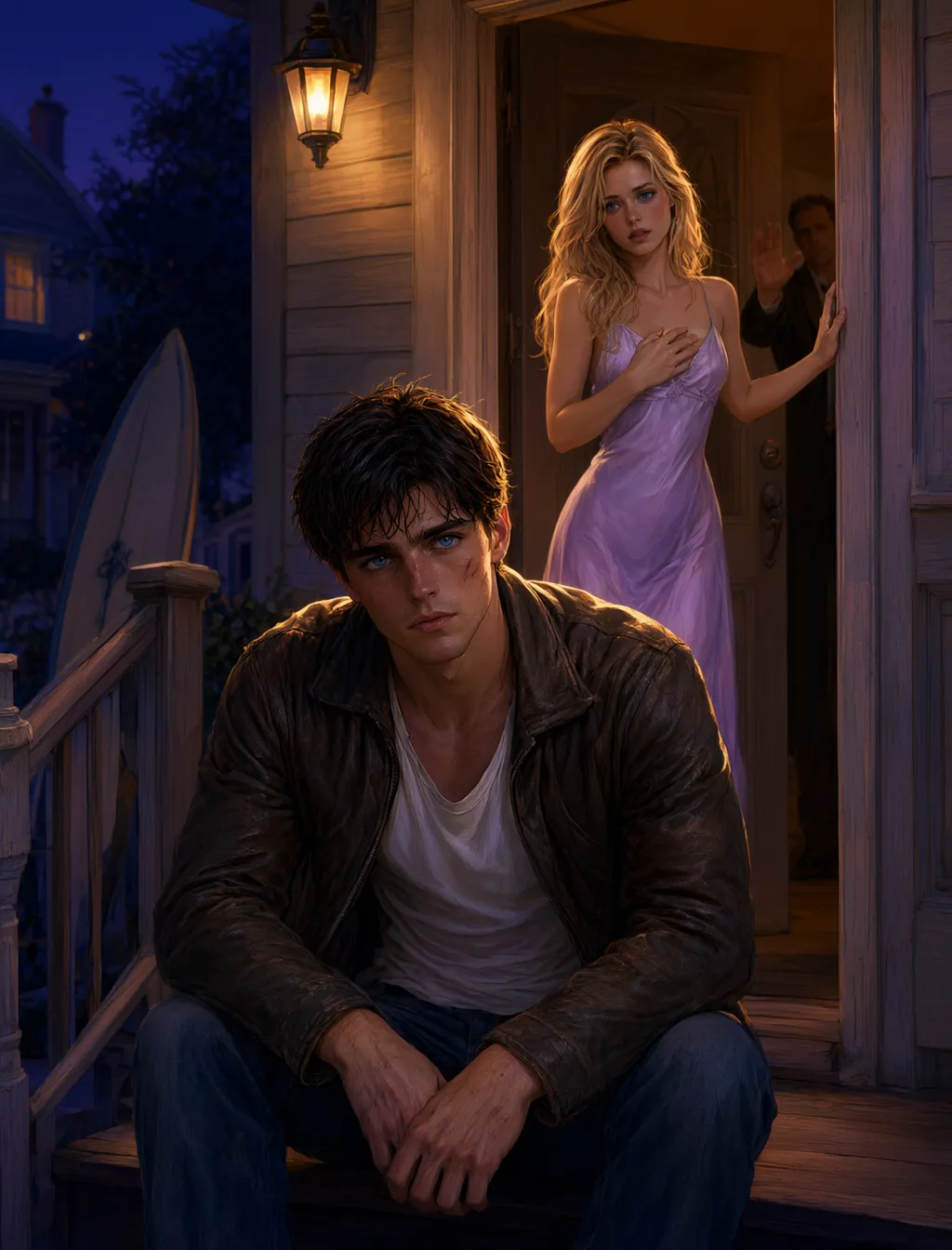
The Harbor's lawn was a patchwork of shadows and yellow light, the string bulbs overhead humming a low electric note that never quite rose above the crowd's laughter. Ryan stood at the edge where the grass gave way to gravel and wet sand, the brine thick in his nostrils, the folded note in his chest pocket worn soft at the edges from the times his fingers had found it today. Thursday had been the longest day of his life, and Friday had somehow been longer. He'd told himself he wasn't going to come. He'd told Sandy he was going to hang out, and Seth had raised an eyebrow but hadn't pushed, and now he was here, watching the harbor's boats rock against their moorings like they were breathing.
The note was warm against his heart. He'd unfolded it so many times that the creases had gone pale, the ink starting to soften. An address, a time, a name in handwriting that looped and dipped like it was trying to be prettier than it was. Marissa. He'd memorized it by now — the pressure of the pen, the way the 'M' leaned left like it was about to fall over.
He found her near the bar, and the relief hit him in the chest before he could stop it. She was laughing at something a guy in a linen shirt was saying, her head tilted back, her sun-streaked hair catching the light. But her smile didn't reach her eyes. It stopped at her mouth and stayed there, a fixed thing, a mask she'd learned to wear. He watched her laugh a beat too late, watched her hand come up to touch her collarbone like she was checking something was still there.
She was wearing a silk dress the color of the sea at dusk, and the straps were thin, and her shoulders were tight. He could see it from across the lawn — the way she held herself like she was bracing for a blow.
Someone bumped his elbow. "You're Ryan, right? From the Cohen house?"
He turned. A girl with honey-blonde hair and a gold pendant was looking at him with open curiosity, a red cup in her hand.
"Yeah."
"I'm Summer. I'm friends with Marissa." She said it like it was a credential, like it mattered. "She said you might come."
Ryan didn't answer. His eyes went back to Marissa, who was still at the bar, still laughing that too-late laugh. The guy in the linen shirt was leaning in closer now, his hand on the bar beside hers, a move Ryan recognized from a hundred parking lots in Chino — the slow encroach, the casual claim.
"She's had a rough year," Summer said, and her voice had gone quieter. "Just so you know. If you're here to—"
"I'm not here to do anything."
"Good." She took a sip from her cup. "Because she doesn't need another guy trying to fix her."
Ryan's jaw tightened. He watched Marissa's smile flicker, watched her glance over the guy's shoulder like she was looking for an exit. And then he saw Julie Cooper.
She came out of the crowd like a shark moving through water — all sharp angles and expensive fabric, her blonde bob catching the light, her green eyes scanning the party like she was taking inventory. She was wearing a white pantsuit that probably cost more than Ryan's entire wardrobe, and diamond earrings caught the string lights and threw sparks.
She made a beeline for Marissa.
Ryan saw the change before anyone else could. Marissa's shoulders went up, just a fraction. Her laugh cut off mid-breath. The guy in the linen shirt stepped back like he'd been dismissed, and Julie's hand closed around Marissa's wrist.
The grip was fast. Practiced. A manicured hand with nails the color of blood, fingers circling Marissa's thin wrist like a bracelet that tightened.
Ryan's feet moved before he decided. He was cutting through the crowd, past bare shoulders and clinking glasses, past a girl who said "hey" and a guy who stepped into his path and then stepped aside at whatever he saw on Ryan's face. The string lights blurred overhead. The slap of boat hulls on water pulsed under the murmur of voices, and all of it went distant, background, nothing — because Marissa's eyes were wet.
Julie had pulled her aside, just past the bar, in the shadow of a potted palm. Her voice was low and sharp, a whisper that cut.
"—do not embarrass me tonight. Your father is already making calls, and I will not have you—"
"Mom." Marissa's voice cracked. "Please."
"Please what? Please let you ruin this for everyone? I have spent twenty years building this family's reputation, and you will not—"
Ryan stepped between them.
It wasn't a decision. It was a body moving into a gap, a shoulder sliding into a space that shouldn't exist. He was taller than Julie, and he used it, stepping into her line of sight so she had to look up at him. Her eyes went wide for a second — surprise, maybe, or the first flicker of something she didn't control — and then they narrowed.
"She's with me."
The words came out flat. No heat. No threat. Just a fact, laid down like a boundary.
Julie's lips parted. The silence stretched — one heartbeat, two. Behind him, Ryan heard Marissa's breath catch.
"Excuse me?" Julie's voice was silk over ice.
"You heard me."
"I don't believe I did." She smiled, and it was a beautiful smile, and it didn't touch her eyes. "You must be Sandy's project. The one from Chino." She said 'Chino' like it was a disease. "I saw you at the school gate."
Ryan didn't blink. "Yeah. I'm from Chino." He let that sit. "And she's with me."
Julie's grip on Marissa's wrist tightened — he saw it, the way her fingers dug in, the way Marissa's hand trembled in her mother's hold. The red mark from the school gate was fading, but there was a new pressure now, a fresh bloom of white around Julie's nails.
"Marissa," Julie said, and her voice was sweet, terrible, "do you know this boy?"
Silence. Ryan could feel Marissa behind him, could hear the shaky rhythm of her breathing. He didn't turn around. He kept his eyes on Julie, on the green eyes that were calculating, weighing, measuring him like she was pricing a piece of furniture.
"I asked you a question, sweetheart."
Marissa's voice came from behind him, small and raw. "He's my friend."
Julie's smile didn't waver. "Your friend." She repeated the word like it was a joke. "From where? The pool house?"
"Mom." Marissa's voice cracked again. "Please. Just—"
"Just what? Just let you disappear into the night with a boy from the wrong side of town?" Julie's eyes flicked to Ryan, dismissive, cruel. "I don't think so."
Ryan felt the old heat rise in his chest — the familiar fury, the instinct to swing, to make someone hurt the way they were hurting her. His knuckles ached with it, the scars on his hands remembering every fight they'd won and lost. But he didn't swing. He stood there, between Marissa and her mother, and he made his voice flat.
"She's not disappearing. She's staying here. With me." He paused. "You can go back to your party."
Julie's eyes narrowed further. For a second, he thought she was going to slap him. He'd been slapped before, by women who thought they could put him in his place, and he knew the tell — the slight shift of weight, the hand drawing back. But Julie Cooper-Nichol was not that kind of woman. She was the kind who smiled while she ruined you.
"Marissa," she said, and her voice was honey, "we'll talk about this at home."
She released Marissa's wrist. The grip loosened slowly, deliberately, her fingers lingering like a warning. And then she turned, her white pantsuit catching the light, and she was gone, swallowed by the crowd like she'd never been there at all.
Ryan stood still for a long moment, his heart hammering against his ribs. The string lights hummed overhead. The boat hulls slapped the water. And behind him, Marissa let out a breath that sounded like it had been held for years.
"Ryan."
Her voice was barely a whisper. He turned.
She was standing in the shadow of the potted palm, her silk dress a dark sea-green, her sun-streaked hair falling over her shoulders. Her eyes were wet, and the red mark on her wrist was blooming where her mother's fingers had been. She looked at him like she didn't know what to do with him.
"You came," she said.
"You asked."
She nodded, a small, jerky motion. Her hand came up to her wrist, rubbing the mark like she could erase it. "I didn't think you would."
"Why not?"
"Because." She looked away, at the party, at the laughing crowd, at the boats rocking in the harbor. "Because nobody comes."
Ryan didn't have an answer for that. He stood there, in the shadow of the palm, and he watched her. The way her shoulders were still tight, the way her smile was gone now, replaced by something raw and unguarded. The way her fingers kept circling her wrist, over and over, like a ritual.
"You want to get out of here?" he asked.
Her eyes snapped to his. "What?"
"The party. You don't want to be here." He said it like a fact, because it was. "There's a dock down there. Past the gravel." He nodded toward the edge of the lawn, where the grass gave way to wet sand and the boats bobbed in the dark water. "We could sit. Not talk. Just—" He shrugged. "Not be here."
Marissa looked at him for a long moment. Her eyes were still wet, but the tears weren't falling. She was holding them back, the way she held back everything — her laugh, her smile, her fear. She was a girl who had learned to keep everything inside.
"Okay," she said.
Ryan led the way across the lawn, past the edge of the party, past the string lights and the laughter and the clinking glasses. The gravel crunched under his shoes, and the wet sand squelched, and the harbor's brine was thick and cool against his skin. He found a spot at the end of the dock, where the wood was worn and splintered, and he sat down, his legs hanging over the edge.
Marissa sat beside him. Close, but not touching. The water slapped against the pilings below them, a steady rhythm, and the boats creaked in their moorings.
For a long time, neither of them spoke.
The party was a distant murmur behind them, the string lights a warm glow that didn't quite reach the end of the dock. The moon was out, a thin crescent, and it painted a silver path across the water. Ryan could feel the note in his chest pocket, the edges worn soft, and he didn't reach for it. He just sat there, breathing the brine, feeling the dock shift under him, aware of Marissa beside him — the warmth of her, the silence of her.
"She's not always like that," Marissa said finally.
Ryan didn't look at her. "She grabbed your arm."
"She's stressed. My dad—" She stopped. "It's complicated."
"Complicated." He let the word sit. "That's what you call it?"
Marissa was quiet for a moment. Then she laughed, a low, bitter sound. "What would you call it?"
Ryan thought about it. He thought about his mother, about the men she'd brought home, about the nights he'd spent with his back against a door, listening to things he shouldn't have heard. He thought about the way he'd learned to read a room, to see a fight coming before it started.
"I'd call it a lot of things," he said. "None of them 'complicated.'"
Marissa turned to look at him. Her eyes were dry now, but they held something that wasn't quite sadness — something rawer, more honest. "You're not like them."
"Who?"
"The guys at that party. The guys at school. The guys who look at me like I'm a—" She stopped, searching for the word. "Like I'm a prize. Or a problem."
"I don't know what you are," Ryan said. "I just know you asked me to come."
Marissa's breath caught. She looked away, out at the water, and her hand came up to her wrist again, circling the mark. "I didn't think you'd actually show up."
"You wrote me a note."
"I write notes to a lot of people." Her voice was quiet. "Nobody reads them."
Ryan reached into his pocket. He pulled out the note, the creases pale, the edges soft, and he held it out to her. "I read it."
Marissa stared at the note like she'd never seen it before. Her fingers brushed the paper, and then she took it, unfolding it slowly, reading her own handwriting like it was a letter from someone else.
"You kept it," she said.
"Yeah."
"Why?"
Ryan didn't answer. He didn't know how to say it — that the note had felt like a hand reaching out in the dark, that he'd carried it against his chest for two days like it was something precious, that he'd unfolded it so many times the ink was starting to fade. He didn't have the words for that. So he just sat there, on the edge of the dock, and let the silence hold.
Marissa folded the note back up, neat and precise, and held it out to him. "Here."
Ryan took it. His fingers brushed hers, and she flinched — a small, quick movement, like she'd been burned. He saw her hand go to her wrist again, covering the mark, and something in his chest tightened.
"Does she do that a lot?" he asked.
Marissa's jaw worked. "It's not—" She stopped. Started again. "She's not always like that."
"That's not what I asked."
Marissa looked at him, and for a second, her mask slipped. He saw it — the exhaustion, the fear, the girl underneath who was tired of holding everything together. And then she looked away, out at the water, and the mask was back.
"I don't want to talk about my mom," she said.
"Okay."
"I just—" She took a shaky breath. "I just wanted to be somewhere else. For one night."
Ryan nodded. He understood that better than she knew. He sat there, on the edge of the dock, and he let the silence come back. The water slapped the pilings. The boats creaked. The party was a distant murmur, a world away.
"You want to stay here?" he asked. "Or you want to go back?"
Marissa was quiet for a long moment. Then she said, "I want to stay."
Ryan nodded. He leaned back on his hands, the note still warm in his pocket, and he looked up at the thin crescent moon. Beside him, Marissa did the same. Their shoulders were almost touching — a breath of space between them, a gap neither of them closed.
It was enough.
For now.