
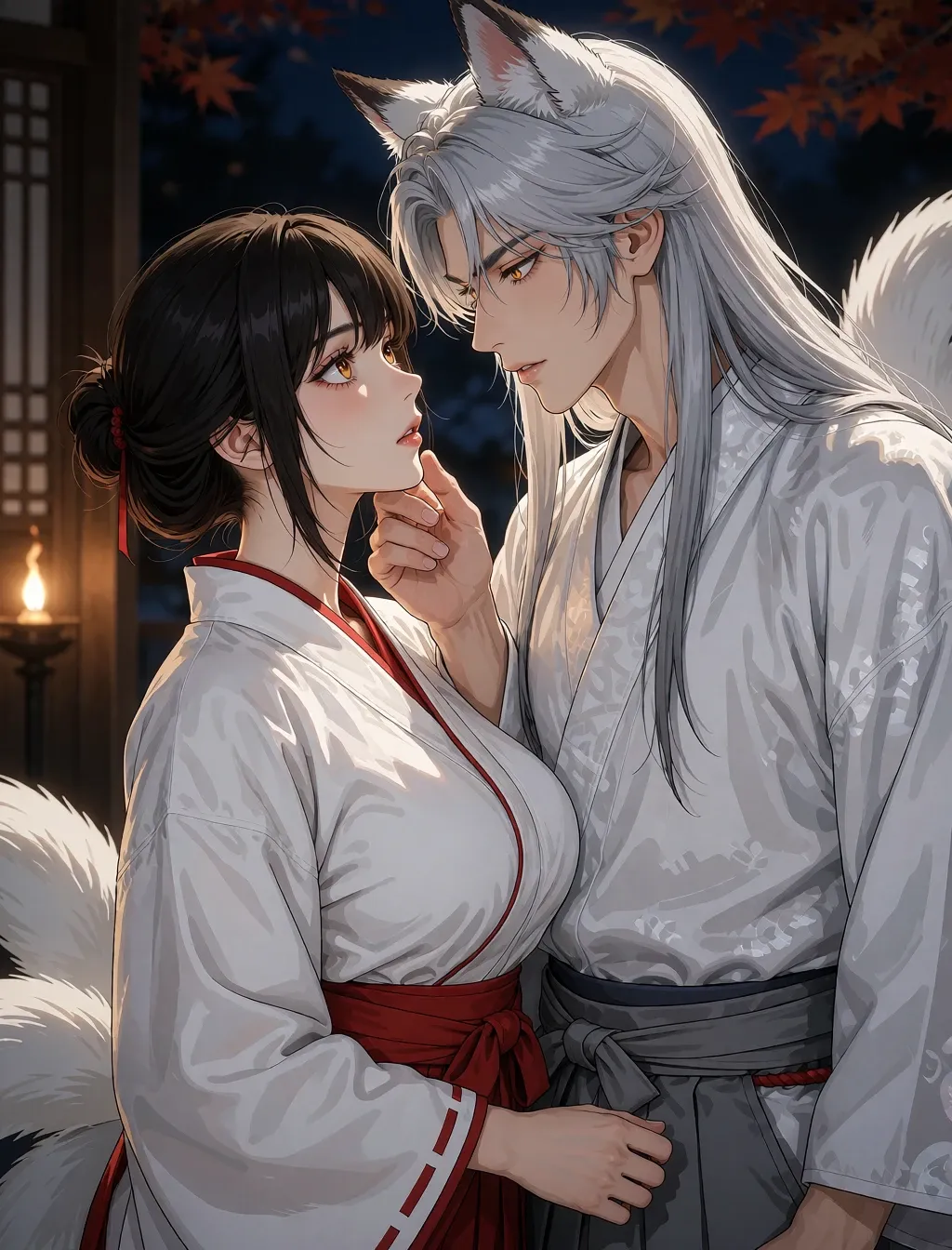
The snow came early that year. Sayo Kujo, thirty-seven, knelt on the cold flags before the main altar with her white haori still smelling of the morning's cedar smoke, and watched the first flakes drift in past the open pillars and settle on the stone step without melting — small, deliberate, as though the sky were counting something out.
Behind her, the elders had arranged themselves in the order they always arranged themselves: Elder Matsuda nearest the brazier because his knees were bad, Elder Ishii by the pillar because she liked to be seen against the vermilion, and the eldest of them all, Elder Ōnishi, eighty-one and dry as a winter reed, at the center where the light from the offering lamps could find him.
Sayo had known them since she was seventeen. She knew the sound of Ōnishi clearing his throat the way a farmer knows the sound of a roof about to give.
"The sake was poured," Ōnishi said.
"It was poured."
"And answered." He let the word sit. "There are those in the valley who say the mountain has taken an interest in its priestess that is not the interest of a guardian in his shrine."
Sayo's thumb found the red sacred cord coiled on the altar beside the sake vessel — the fiber rough, familiar, the same cord that had bound the offering box for twenty autumns. She did not look up from it. "The mountain has never once spoken to the valley about me. Whatever the valley is saying, it is saying to itself."
Elder Ishii made a small sound that was nearly a laugh and then thought better of it.
"Devotion," Ōnishi said, and he said it the way a physician says the name of a disease. "That is what I am asking after, Kujo-san. Not your conduct. Your devotion. A priestess gives her life to the shrine. We have watched you give twenty years. We have not watched you give — " he turned one hand over, as though weighing something in it, " — the rest of it."
The snow came down past the pillars. One flake landed on the back of Sayo's hand and stayed there, a cold white point against the skin, and she felt it melt and run into the crease of her wrist and did not wipe it away.
He is asking whether I am still his. Not the shrine's — his. Whether a woman who has been courted by a fox can still be trusted to sweep the hall in the morning.
"Elder," she said, and her voice came out in the measured cadence of ceremony, the one she used for funerals and first frost, "I have poured that sake for twenty years. Every autumn, before the first snow, I have carried it up the mountain and set it at the stone fox and come down again in the dark. This year the stone fox came down to me." She lifted her eyes then, and let them rest on Ōnishi's. "If the mountain wished to object to its own guardian, it has had nine hundred years to say so. It has chosen, instead, to send the snow early."
Ōnishi's mouth worked. It was not a smile. It was the expression of a man who has been given an answer he cannot fault and does not like.
"The snow," he said, "is not a blessing. The snow is the season."
"Then the season has come early to a shrine that is in order," Sayo said, "and I have swept it. I will sweep it again in the morning."
Elder Matsuda shifted his bad knees and said, more gently than Ōnishi, "No one doubts the sweeping, Kujo-san."
"No," she said. "Only the rest of it."
That was the end of the questioning, though no one said so. Ōnishi rose first, and the others rose after him in the order of their rank, and their sandals made a soft deliberate noise down the outer stair — tok, tok, tok — until the sound thinned into the snow's hush and the hall was empty except for the offering lamps and the cold coming in and the woman still kneeling on the flags with her hem gone dark where the wet had crept up through the cloth.
She stayed on her knees a moment longer than she needed to. Twenty years of kneeling had taught her that the hall did not empty all at once; it emptied in layers, and the last layer was always the silence.
And the silence had a shape in it.
She had felt him before she saw him — the way the air by the inner shrine grew warm and still and faintly of dry leaves, the way the lamps leaned their flames toward a corner that had no draft. When she turned, Hakuro stood in the shadow behind the great shimenawa rope, tall and silver-haired and still as a pillar himself, his white kimono dusted with snow that had not melted on the shoulders, his nine tails held low and motionless the way they always were while the elders spoke.
"You heard," she said.
"I heard." His voice was the old courtly one, unhurried, but there was something banked underneath it. "The old one speaks of your devotion as though it were a coin he is owed. I have watched that man climb this stair for forty years and never once bring a thing but his opinion."
"Hakuro-sama."
"It is not for me to answer him." His fox ears had gone flat, the way they did when he was holding something back, and one tail — only one — lifted a hand's width from the floor and then subsided. "But I will say this before the altar, since he said his piece before it. I have guarded this shrine nine hundred years. In that time I have accepted one offering. I accepted it because the hands that poured it were steady, and because the woman they belonged to came up the mountain alone in the dark and did not ask the stone fox for anything."
Sayo's throat had gone tight. She did not trust it with a word.
"I did not come down to you because the mountain sent me," he said. "The mountain has never sent me anywhere. I came down because I could not watch you pour another autumn and go home alone."
The snow fell past the pillars. Somewhere below the torii a bell knocked once in the wind and was still.
Sayo stood. Her knees ached from the cold flags and she let them ache; she was tired of being careful, tired of the measured cadence, tired of a hall full of old men's opinions and a woman's devotion weighed like rice in a measure. All afternoon she had held herself still under Ōnishi's questions, and now the hall was empty and the holding was done, and what was left in her was not grief and not gratitude but a hot, level, unrepentant wanting.
She looked at Hakuro — nine hundred years of him, standing in her shrine with snow on his shoulders — and she thought: He has waited eleven years to say that. I have waited twenty to hear it. I am done waiting for the permission of old men.
"Come here," she said.
His ears came up. "Sayo-dono — "
"I said come here."
He came. He crossed the hall with that unhurried grace that never quite matched the hurry in him, and he stopped an arm's length from her, and his tails had begun to move now — not the slow sway of an idle spirit but the restless, curling motion of something that wants to reach and has not been told it may.
Sayo took the red cord from the altar. It was the cord that had bound the offering box, coarse hemp dyed the deep vermilion of the torii, and it lay across her two palms heavy and cold and familiar. She had tied it and untied it a thousand times. She had never once thought of it as a thing that could be used.
"Hakuro-sama," she said, and her voice was very quiet, "may I ask something of you that is not the asking of a priestess?"
His amber eyes had gone still. "You may ask me anything. You know that."
"I want to lead tonight." She held up the cord. "I want to tie your hands with this and have you under me, and I want you to let me, and I want you to tell me if that is not a thing you want."
The silence that followed was not the hall's silence. It was his — the long, deep, considering silence of a creature that has had nine hundred years to learn what it wants and has just been offered it.
Then his ears went back — not flat with shame this time, but laid down the way a fox lays them when it is being handled gently — and a low sound came out of him that was not quite a word.
"Yes," he said. "Sayo-dono. Yes."
"Both wrists," she said. "If I tie them, you don't pull free. Not even if you want to. You say the word and I stop, and that is the only word that stops me."
"I understand."
"Say it properly."
A breath of a laugh escaped him, and his tails curled. "I understand, Sayo-dono. I will not pull free. I will say the word if I need it, and no other thing."
She took his right wrist in her left hand and drew the cord around it, once, and pulled it snug. The hemp bit into the pale skin above the bone. His pulse was there under her thumb, quick, and she felt it jump as she drew the cord tight — the pulse of a nine-hundred-year-old spirit, running like a hare's.
His free hand hung at his side, open, palm turned slightly up, and he did not offer it. He waited, the way he had waited eleven years, and the whole of the empty hall and the falling snow and the two of them in it came down to that one waiting hand.
Sayo looked at that open palm for a long moment. The lines of it were old in a way his face was not — the creases deep and certain, a callus at the base of each finger from centuries of holding a broom he did not need to hold, of sweeping a hall he could have let go to dust. She had watched those hands close around the sake cup every autumn, careful, as though the cup were the offering and not the wine.
"You are not going to make this easy," she said.
"I am making it exactly as easy as you asked, Sayo-dono." His voice had gone low, roughened at the edges, and his ears were still laid back, but his eyes had not left her face. "You said both wrists. I am not going to lift the second one for you. If you want it bound, you will have to come and take it."
The snow whispered past the pillars. Somewhere in the rafters a beam contracted in the cold and let out a single soft tick, like a knuckle cracking.
She came and took it. She stepped in close enough that the hem of her hakama brushed his shin, close enough to smell the dry-leaf warmth of him under the snow, and she reached down and closed her hand around his wrist and lifted it — and he let her lift it, let his arm come up loose and unresisting, the way a branch lets the wind move it. His free hand was heavier than the bound one, the muscle of the forearm warm under her palm, and when she drew it across to meet the other wrist behind his back she felt him shift his weight to keep his balance, felt the whole tall length of him adjust to being arranged.
"Behind you," she said. "Both of them. Together."
"As you wish."
The cord went around the second wrist, and she drew it through the loop she had made of the first, and pulled. The hemp slid and caught and slid again, and she felt the two wrists come together, felt the bones of them meet under her fingers, and she wound the cord between them twice — once, twice — so that they could not slide apart, so that the binding had a shape to it and not just a tightness. His tails had gone completely still. All nine of them, hanging in the air behind him like a fan of white fur that had forgotten how to move.
"Too tight?" she asked.
"No." The word came out of him differently than the others had — not courtly, not considered, just the plain answer of a body to a question about its body. "It is — I have not been held by anything in a very long time, Sayo-dono. Not by a hand, not by a rope. The mountain holds me the way it holds a stone. That is not the same."
She finished the knot — not the sacred knot, not the careful ceremonial tie she had made a thousand times over the offering box, but a plain hard knot pulled down flat against the small of his back, the ends of the cord left hanging. Then she stepped around him to look at what she had done.
It was not the picture she had carried up the mountain in her head. She had imagined something ceremonial about it, something with the gravity of ritual. What she had instead was a tall silver-haired spirit in a snow-dusted white kimono with his wrists bound at the base of his spine and his ears laid flat and his chest rising faster than it had any right to, standing in the middle of her empty hall like a thing that had been caught and had decided, deliberately, not to struggle.
He could break that cord with a thought. He is nine hundred years old. He has stood in this hall through fires and earthquakes and the whole of the Meiji and not one stone of this shrine has fallen. And he is standing here with his hands tied behind his back because I asked him to, and his pulse is running like a hare's.
"Hakuro-sama," she said. "Look at me."
He lifted his head. His amber eyes had a shine in them she had never seen there — not foxfire, not the banked blue glow that came when he was moved past speaking, but something wetter and more human, the shine of a creature who has been given a thing he did not know he was allowed to want.
"You have not moved," she said. "Not once, since I took the cord. You have not stepped back, you have not lifted a hand to stop me, you have not even shifted your feet."
"You told me not to pull free."
"I told you not to pull free of the cord. I did not tell you to stand still while I decided what to do with you." She walked a slow half-circle around him, and his head turned to follow her, and his tails turned with him, a slow white tide. "You are not standing still because I told you to. You are standing still because you want to know what I will do next. Aren't you."
A breath of a laugh came out of him, but it was not quite steady. "Sayo-dono. I have spent nine hundred years being the one who knows what happens next. I have not — " He stopped. His ears flicked, once, and settled. "I have not been on this side of it since I was a young fox with one tail and no sense. It is not a comfortable thing. It is a very good thing."
The snow had begun to gather on the stone step in a thin white skin, and the offering lamps had burned down to the length of a finger, and the cold coming in past the pillars had found the back of Sayo's neck and made her shiver — and the shiver ran down her and did not stop at the cold. She reached up and pulled the tie from her hair. The bun came loose and the black of it fell down her back with the grey streak in it, and she shook it out and let it hang, and she saw his eyes follow the grey streak the way they always did, the way they had for years, as though it were the one thing in the shrine he could not explain.
"Kneel," she said.