
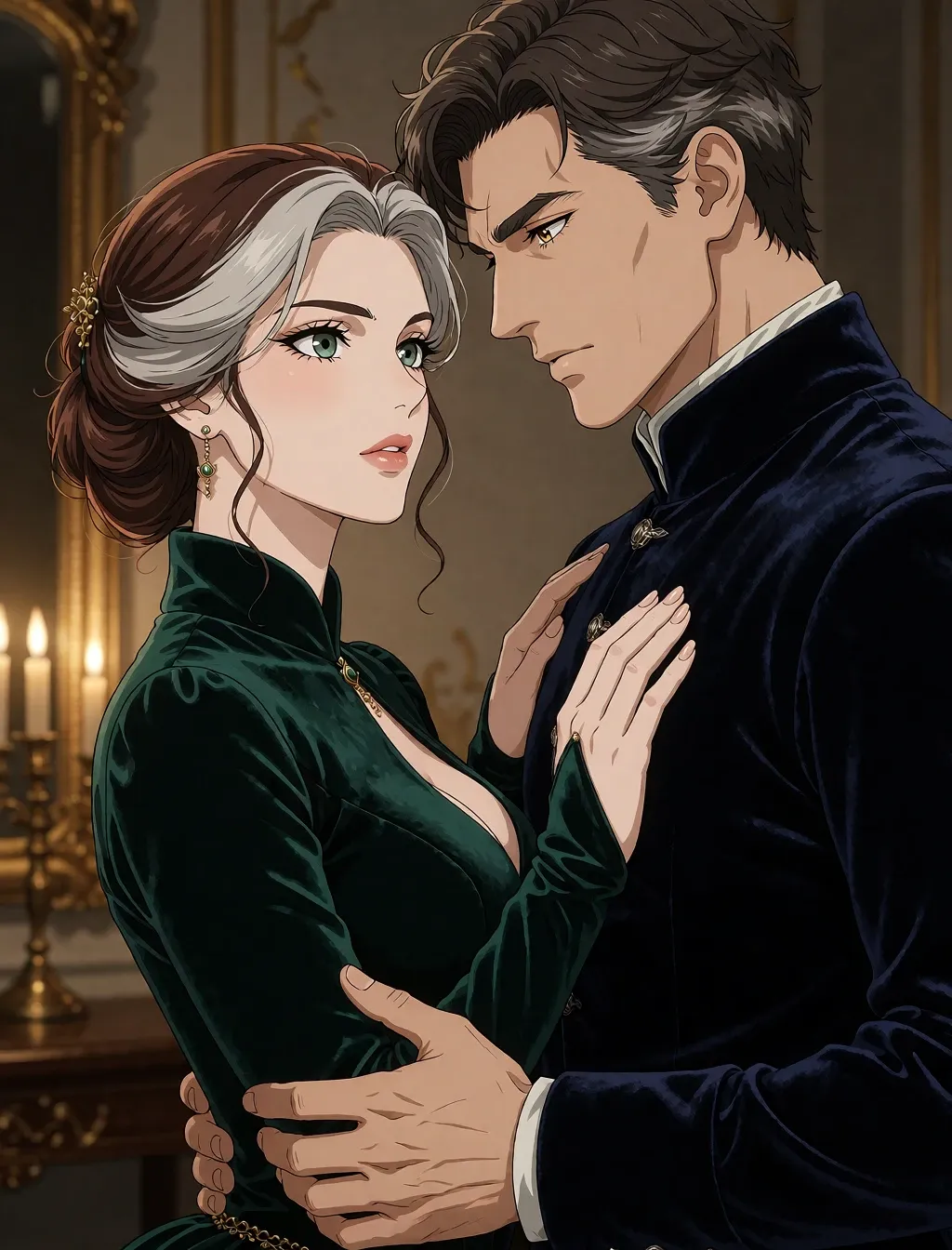
The knock came at the half hour past the palace's last bell. Three raps, unhurried, spaced the way a man knocks when he has already decided to wait as long as it takes.
Liriel did not move from the window. Below, the courtyard lay empty, the tourney pennants hanging slack on their poles in the wet night air. She had been standing there an hour, watching the last of the servants cross to the kitchens, and she had not yet decided what she was going to do about the thing between her legs.
"I know you're in there, Ashgrove. Your lamp's wasting oil."
Dorian. Of course. She closed her eyes. The knock came again, softer this time, and then his voice, pitched lower, almost gentle. "I brought something. It's not what you think."
She crossed the workroom, stepping around the smoking circle still burned into the floorboards, and opened the door exactly the width of her own shoulder. He stood in the corridor with his collar undone and his sleeves rolled past the elbow, a glass vial held between two fingers like a man carrying a lit candle. Forty-one years old, and the lamplight still found the same silver at his temples, the same patient hunger behind the amber.
"It's late," she said.
"It is." His eyes went past her before he answered, finding the mirror on the far wall — still turned to the angle she'd set it at — and staying there a beat too long. "May I come in, or shall we conduct this in the hallway where the whole east wing can hear?"
She stepped back. Not wide. Enough.
He came in and shut the door behind himself, and the latch clicked, and the room got smaller by exactly one alchemist. He did not look around the way a man looks around a room he has never seen. He looked at the components scattered across her table — the split crucible, the scorched sprig of vervain, the strengthening sigil she'd drawn and drawn again until the chalk was a gray smear — and his mouth did something that was not quite a smile.
"A strengthening spell," he said. "For the tourney. The king's champions, I'd wager." He set the vial down on the edge of the table, carefully, clear of the chalk. "You were going to make them stronger. Faster. Harder to put down."
"You're very clever at reading chalk."
"I'm very clever at reading you." He turned. "Your hair's come down. You only let it down when a working's gone wrong enough to frighten you."
Her hand went to her pins before she could stop it. Two of them, still sparking faintly where the residual magic hadn't bled out. She'd forgotten she hadn't repinned it.
"What's in the vial, Hale."
"Nothing that will fix anything." He held it up to her lamp, and the contents caught the flame — a thin amber fluid, clear, with a slow drift of something finer suspended in it. "A tincture of my own making. It won't undo a botched working. What it does is take the edge off the residue. Keeps a spell from turning on its caster while it settles." He set it down again. "You've been sitting with your own magic crawling under your skin for six hours. I can see it from the door. Your hands are shaking."
They were. She put them behind her back.
"Why," she said.
He was quiet a moment. The fire in the small hearth popped, and neither of them looked at it. "Because I've spent eleven years watching you win every argument in that council chamber and never once ask anyone for help, and I've wondered what it would take." His voice dropped out of its dry courtroom cadence into something quieter, more careful. "I'm not here to gloat, Liriel. I want that understood before anything else happens in this room. I did not come up here to watch you squirm."
"And yet."
"And yet I'm here." He let that sit. "You didn't have to open the door."
No. She hadn't. She had known exactly who it was from the first knock, and she had opened it anyway, and now he was standing in her workroom with the firelight on his throat and the vial between them like a flag of truce neither of them believed in.
"The residue," she said, at last. "What does it feel like, when it's not treated?"
"Like a second heartbeat in a place that shouldn't have one. Like your own magic doesn't recognize the shape of you anymore and keeps trying to correct it." He picked the vial up again and turned it slowly between his fingers. "You've been fighting it. That's why you're shaking. The more you fight it, the worse it gets."
She looked at the mirror. She did not mean to. His eyes followed hers, and this time he did not pretend not to see, and the silence stretched out long enough that she could hear the wet night wind against the tower glass.
"The spell didn't work the way it was meant to," Dorian said. It wasn't a question. "The champions will fight tomorrow without your help, and you'll be sitting in the royal box with something the king's physicians can't be allowed to look at." He set the vial down a third time, and this time he did not pick it back up. "I'm not asking what it is. I'm asking whether you've looked at it properly. Whether you've taken the time to understand what you're dealing with, instead of just being frightened of it."
"I've looked at it."
"And?"
Her jaw tightened. "And I'm not undoing it."
The words came out flatter than she'd meant them to, and she heard them land in the room and stay there, and she did not take them back. Dorian's expression did not change, but something behind his eyes shifted — a door opening somewhere, quietly, that she had not known was closed.
"No," he said, slowly. "I didn't think you would."
"You think you know what I've got under my skirts."
"I think I know a strengthening spell gone sideways when I see the residue on the components, and I think I know you well enough to guess that whatever it made, you've already decided it's the most interesting thing that's happened to you in years." He took a step closer. The firelight moved on his face. "I came up here to ask you a question. I'm going to ask it now, and you can throw the vial at my head if you like."
She didn't move. The gap between them had shrunk to a few feet of floorboard, and she was aware of every one of them, and of the way her body had gone still and alert the way it did before a duel.
"Ask it."
"Let me help you explore it." His voice was quiet, and steady, and did not waver. "Not cure it. Not study it in a jar like a curiosity. Explore it. With you. Properly, and slowly, and as many times as it takes for you to understand what you've been given."
The hearth popped again. Somewhere below, a door banged in the wind.
"You've wanted to ask me something like that for eleven years," she said.
"Yes."
"And you're asking now because I've grown a cock and you think it's given you an opening."
"I'm asking now," he said, "because for eleven years you've been the only person in that palace who could put me on my back foot, and I've wanted you since the first time you did it, and I've never once had a reason to believe you'd say yes." He let out a breath. "Now I have a reason to ask. That's all this is. You can still say no."
She stood there with her hands behind her back and her hair down and her own magic still crawling under her skin like something looking for a door, and she looked at him — the reagent stains on his fingers, the patient set of his shoulders, the way he had not once looked at her body, only at her face — and she felt the thing between her legs stir, heavy and warm and entirely, ruinously interested.
"The tincture," she said. "Does it work?"
"It works."
"Then stop talking and give it to me."
He crossed the last of the floor between them and put the vial in her hand, and his fingers brushed hers, and they were warm and callused and did not linger, and somehow that was worse than if they had. She unstoppered it and drank. It tasted of anise and something bitter underneath, and the crawling under her skin went quiet all at once, like a room when the wind drops.
She set the empty vial down on the table beside the ruined crucible. The mirror caught her in its corner — hair down, cheeks flushed, eyes too bright — and beyond her own reflection, Dorian's, standing close behind.
"I did not come here to gloat," he said again, quietly, to the back of her head. "I came here to ask. I'm asking now."
Liriel did not answer. She turned from the mirror to face him, and the workroom was very small, and the firelight was very warm, and the silence between them had a shape now, and she let it hold.
He did not fill the silence. That was the thing she had forgotten about him, in eleven years of council-chamber sparring — that Dorian Hale could out-wait a locked vault. He stood with his hands loose at his sides and let her look at him, and the fire ticked, and somewhere in the wall a pipe knocked twice and went still.
"You're not going to make this easy," she said.
"I've never made anything easy for you. It's the one thing I've been consistent about." He tilted his head, and the lamplight slid off his temple. "You want me to beg. I'll beg. But I'd rather you told me what you're actually afraid of, because I don't think it's me."
She turned away from him and walked the length of the table, her bare feet cold on the boards, and stopped at the scatter of her own failure. The split crucible. The vervain gone to ash. The sigil she'd drawn so many times the chalk had worn a groove in the wood. Her hand hovered over it, and the residue answered — a faint greasy shimmer on the chalk line, the color of a bruise three days old.
Dorian came up beside her without sound and looked down at the same smear. "There," he said. "That's the tell. You drew it counter-clockwise on the third pass. Look — the tail of the sigil curls back on itself. A strengthening spell has to close outward or it turns the force inward on the caster." He reached past her, not quite touching, one stained finger tracing the air above the chalk. "Whatever it made, it made it out of you. That's why the residue clings. It's not foreign. It's yours, wearing a new shape."
"I know what I drew."
"I know you do. I'm not telling you to be clever." He straightened. "I'm telling you that I can see it, and that seeing it doesn't cost you anything. You've been alone in this room for six hours convincing yourself no one could look at the evidence without guessing. I've guessed. The room hasn't fallen down."
She laughed — one short breath of it, unwilling, out of the side of her mouth. It surprised her more than it surprised him. "You're insufferable when you're being kind."
"I've been told." He stepped back to give her room, and the small courtesy of it — the way he kept giving her the floor, the door, the choice — loosened something behind her ribs that she had not known was knotted. She had spent eleven years braced against his sharpness. She had no defense at all against this.
The fire settled, and the room went briefly dark at the edges before the flame caught again, and in that half-second of dimness she felt the weight between her legs shift with her weight, warm against her thigh, and her whole body registered it at once — not the crawling panic of the residue, but something lower and slower, a heavy interest that had nothing to do with fear.
"Say something," Dorian said, quietly. "Anything. Even if it's no."
She looked at the door. The latch was shut. Beyond it the corridor was empty and cold and the whole east wing was asleep, and no one in Valdmar would know if the court sorceress and the court alchemist spent the small hours of the tourney's eve behind a locked door. She looked at him. The reagent stains. The patient set of his jaw. The way he had not once let his gaze drop below her collarbone.
"It's not no," she said.