
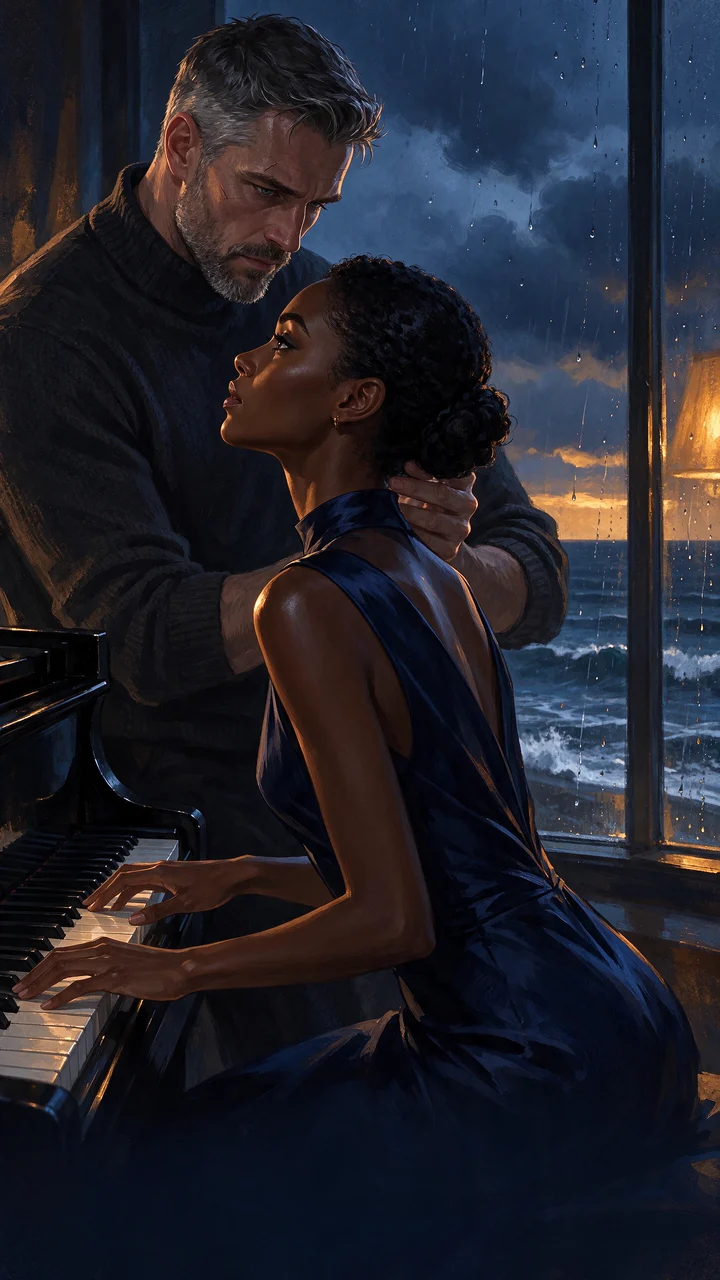
“From the top,” Henrik said. “And this time, all of it.”
Then he opened the doors.
The terrace room took the gale full in the face. Both glass panels folded back on their tracks and the storm came in at once, salt and noise and a roar from the sea that she felt in the soles of her feet. The music on the stand lifted and slapped. Her hair, already escaping its bun, whipped across her mouth. Out over the water the dusk had gone pewter, and the waves threw silver spray as high as the terrace rail.
“You’re insane,” she shouted.
“It’s loud on a stage.” He had to raise his voice, which she had never heard him do. “Coughing. Programmes. Someone’s phone. A door at the back. You’ll never have quiet. Play anyway.”
Five weeks. Five weeks of four hours a day in two sittings, the stairs at dawn with Halvard pretending not to watch from the garage. Five weeks of Henrik at the keyboard every evening after dinner, picking out the Satie with two fingers and then three, the left hand lumbering, the right hand learning to wait. He played it badly and without apology. She had started looking forward to it more than she should.
She set her hands on the keys.
The Schubert opened under her, wide and calm, the long theme walking out over the low notes. The wind tore at it. She let it. The trill in the bass came up growling out of the dark and she leaned into it, and for a moment the storm and the trill were the same sound, and she thought, I can.
Then the music turned toward F-sharp minor.
The bar came at her across fourteen months. The same bar. The same chord, half-formed under her right hand.
Her hands locked.
They hovered. Wind howled through the open doors. Spray spattered the floorboards, and she sat with her joints set hard as iron and her heart slamming.
“Sorry,” she said. “Sorry. I’m sorry.”
She heard it. She went very still.
Behind her, he had not moved.
“Imani.”
“I know.”
“Say it.”
“I apologised.” She stared at her hands. “Three times.”
“Four, last Tuesday, to a pencil.” His voice was even, not unkind, pitched under the storm so it came to her and nowhere else. “We wrote down what happens. You remember.”
She remembered. She had written it herself on the second page, in her small careful hand, and he had read it and asked, Are you sure, and she had said yes.
“I remember.”
“You can say fermata. Now, or halfway through, or at any point. Do you want it?”
Her pulse was everywhere. “No.”
“Then close your eyes.”
She closed them. She heard him come round behind the bench, the floor creaking under his weight. Then his hand settled at the nape of her neck, beneath the loosened coils of her hair, warm and dry and entirely still. Not pressing. Simply there. The whole of her narrowed to that square of skin.
“From the start of the passage,” he said. “I count. You play. Every time you apologise, we go back.”
“And if I don’t?”
“Then we’re done.” His thumb did not move. “One. Two. Three. Four.”
She played. She froze at the bar. “Sor...” She caught it, too late. His hand stayed.
“Again.”
The second time she got a chord further and then said, “Sorry, sorry, I...”
“Again.”
The third time she stopped dead and her throat closed on the word and she swallowed it, and he said, “Name it.”
“C sharp. Wrong voicing.”
“Go on.”
She couldn’t. “Again,” he said, level as a ship’s horizon, his palm a fixed point at the back of her skull, and the fourth time she played into the bar and stumbled and said through her teeth, “F sharp,” and went on two notes before she stopped.
“Good,” he said quietly, and the word went straight down her back and lodged somewhere warm. “Again.”
The fifth time, she did not think about the bar.
She thought about his hand. She thought about the count, low and unbroken just above her head, one, two, three, four, and the storm pouring in, and the spray on her ankles, and she played straight through F-sharp minor as if it had never been anything but a key.
She kept going. Into the development, the music darkening, climbing. He kept counting. She did not stop at the end of the passage. She did not stop for anything. Twelve minutes, fifteen, the room going violet and then grey, and his hand never left her. The last chord of the movement sounded under her fingers and spread into the wind and was gone.
She opened her eyes. Her face was wet, and it wasn’t the spray.
She turned on the bench.
He was there. Inches. He had bent to keep his hand where it was, and his face was close enough that she could see the scar through his eyebrow was older than the silver in his hair, and that his eyes, always so steady, were not steady now.
Neither of them moved.
She needed to know if it was real. If the folded paper in the music rack was real. She looked at his mouth and said, very low, “Fermata.”
His hand left her at once. Cleanly, completely, and he began to straighten.
She caught his wrist. The stopped steel watch was cold under her fingers. She drew his hand back and laid it where it had been, at the nape of her neck, and held it there.
“I was checking,” she said.
“I know.”
“Kiss me.”
He did not pull away. He leaned closer, until his breath was on her lips and she could feel the shape of the words before he spoke them.
“Ask me again,” Henrik said, “when you’ve played it in front of someone else.”
Her phone lit up on the music stand.
It buzzed against the wood, and again, and again. Saskia. She nearly let it ring. Then she saw the first line on the screen, and the second, and picked it up with her free hand.
“Sas.”
“Somebody leaked it.” Saskia’s voice was raw. “Delacroix’s people, I’d bet my flat on it. ‘Asante hiding in billionaire’s cliff house, can’t play a note.’ It’s everywhere. Marchetti panicked. He’s moved the recital.”
“To when?”
“Three weeks. And it’s livestreamed. He wants the whole world watching, either way.” A pause. “Imani, I can still pull it. Say the word.”
Imani looked up. Henrik’s hand was still on her neck. He had heard every word. The wind came through the open doors and moved his hair, and behind him the sea went on breaking against the rock two hundred and twelve steps down, where he had not set foot in six years.
“Three weeks,” she said.
His thumb moved once against her skin.
“Then I’m coming,” Henrik said quietly.
He said it to her. But he was looking past her, at the open doors, and his hand had gone cold.