
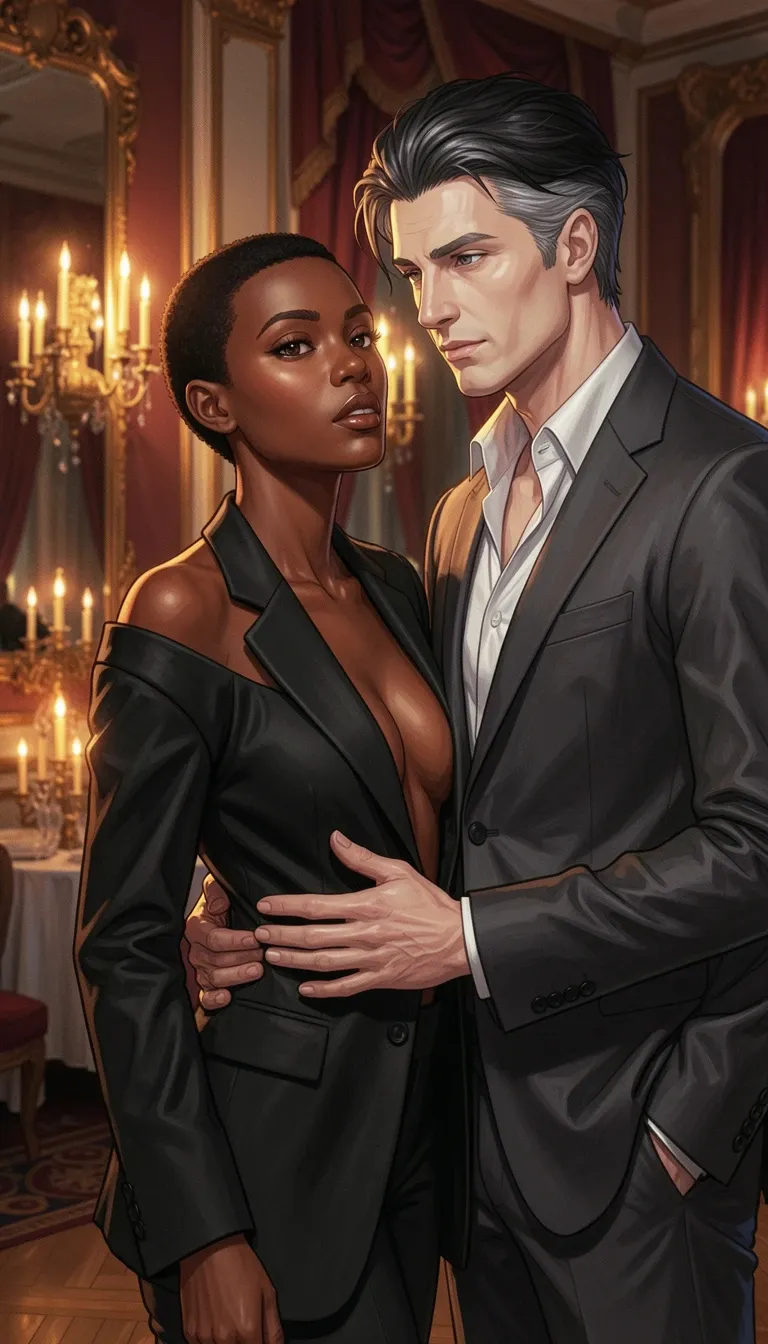
The committee room smelled of cold ash and beeswax. Celeste sat in the low leather chair with her knees together and her hands folded, and she could feel the sweat cooling at her hairline, the wet of her still drying on her thighs under the green silk, and none of it mattered to the three faces across the table, who had been waiting for her the way furniture waits.
Hugo sat at the head. He had put his mask down on the mahogany in front of him, face-up, like a dish he had finished with. To his left a woman of about sixty with white hair scraped back and a man of thirty with an expression of permanent mild disappointment, and neither of them had said a word since Celeste came in.
The book lay open in front of Hugo. It was old, the leather gone soft and dark at the corners, and the page he had opened it to had rows and rows of names in different inks, and halfway down the page, in a hand that was not Hugo's and not hers, someone had already written Celeste Amara Okafor.
She looked at it for a long time.
"You wrote my name," she said.
"The secretary wrote it," Hugo said. "An hour ago. He was confident."
"He shouldn't have been."
"No," Hugo agreed, and his pale grey eyes came up to her, and there was nothing in them she could read. "But he was."
Anouk's chair was drawn so close to Celeste's that when Anouk leaned, her shoulder pressed warm against Celeste's arm through the black silk jumpsuit. She had not spoken either. She had one hand loose on the arm of her chair and her pale blonde hair was still coming down from where Tariq had had his fist in it, and she watched the committee the way she watched a gallery — for what was not on the wall.
Tariq would not sit. He stood with his back to the table, facing the double doors, and the doors were open, and beyond them the ballroom lay bare under its chandelier. The floor had been cleared. The chaises were gone. The parquet shone where the light fell through the doorway and thinned into the dark at the edges, and there was no one in it, and the emptiness of it was louder than the room had been full.
Somewhere far off in the building a door closed. A trolley went past on a stone floor, one wheel ticking. Then nothing, and the last voices from the balcony were gone, and the club was empty except for the five of them and whatever the club kept in its walls.
"Membership," Hugo said, "is not what you think it is."
"I haven't thought about it at all," Celeste said.
"That's wise." His hand lay flat on the open book, the fingers spread, the page with her name under his palm. "It is not a card. It is not a key. It is a place in a room. You come here, and the room knows what you are, and you don't have to explain it to anyone at the door."
"And the dais?"
The woman with white hair shifted in her chair. It was the first movement she had made.
"The dais," Hugo said, "is not a reward." He lifted his hand from the book and set it down again, flat, deliberate, a man laying a card. "It's a place. Places are taken or they're left. They don't wait."
"That's a very pretty way of telling me to get on it."
"It's a plain way," he said. "You're the one who keeps hearing it prettier than it is."
Anouk laughed, low, the smoke in it, and did not move her shoulder away. "He's been practising that all evening," she said. "He said it to me in the corridor twice."
"Anouk."
"What? She should know what she's buying." Anouk turned her head, and her blue eyes came round to Celeste, clear and assessing and entirely without mercy. "It's not a stage, Celeste. It's a slab of oak under the chandelier, and the room stands round it, and everyone in that room has already had you in their mouth tonight, one way or another. You want to know what it is? It's the same floor you were on an hour ago, only raised, so they don't have to look down."
"That's not selling it," Tariq said, from the doors. He had not turned round.
"I'm not selling it. She's not a painting."
Celeste put her hands on the arms of the chair and looked at the book again. Her name, in that other hand, with the ink gone dry. The secretary had written it an hour ago, before she had come up from the floor, before she had stood in the committee room with her thighs still wet, before she had decided anything. The name sat there as if it had always been there and she had only now caught up to it.
"What are the terms?" she said.
The man with the disappointed face spoke at last. "The usual. A year's subscription, paid quarterly. Two guineas on the book. The rules as they've been read to you." He paused. "And the dais, if you accept it, is for tonight only. It isn't a standing invitation. It's a place in an evening."
"For tonight only," Celeste repeated.
"Unless you're asked again."
"By whom?"
"By the room," Hugo said. "The room asks. That's how it works. You don't get to be the centre of it twice by wanting to be. You get it by being worth the asking."
Anouk's shoulder was warm and steady against her arm. Beyond the doors, the chandelier hung in the empty ballroom, and the light off it fell through onto the bare parquet in a long pale shape, and Celeste found she was looking at that shape the way she looked at a canvas — for the thing underneath the surface, the thing the painter had not meant to leave.
"Tariq," she said. "Come here."
He turned from the doors and came, and stood at the end of the table with his hands at his sides, and his dark eyes were steady on her and had been steady on her all night, and she thought of his hand gone still round his glass on the balcony in the first week, and of the way he had kept his word to her on the chaise without being asked twice.
"You heard all of it," she said.
"I heard it."
"And?"
"And I'm not going to tell you what to do with your own name in a book." He said it quietly. "I'll tell you what I'll do. If you take it, I'll be on that floor. If you leave, I'll walk you to the door and no one will say a word about it, and I'll still be standing there in the morning."
The white-haired woman made a small sound — not quite disapproval, something older, something that had seen this before and had stopped being moved by it.
Hugo had not looked away from Celeste. His fingers were still spread on the page, on her name, and the light from the desk lamp lay along the silver in his hair, and she thought, with a clarity that felt like cold water, that he had known what she would do before she had come into the room, and that the knowing was the worst thing about him and the thing she could not stop looking at.
"The dais," she said. "What happens on it."
"You know what happens on it."
"I want to hear you say it."
Hugo sat back. He looked at her for a moment, and then he said it, plainly, in the voice he used for the plain things. "You'll be taken up onto it and laid back on it, and the room will stand round, and I'll have you, and Tariq will have you, and Anouk will have your mouth, and the room will join us when it's ready and not before. And you'll come with every eye in this club on you, and then you'll take the book and sign it, and that will be the end of it."
"The end of it," she said.
"The end of the evening," he said. "Not of you."
Anouk turned her head and put her mouth close to Celeste's ear, and her breath was warm and smelled faintly of the wine from dinner. "Say yes," she said, very softly, "or say no, but say it. Don't sit here letting him think he's won you by waiting."
Celeste looked at the book. Her name, dry, certain, written before she had agreed. She thought of the balcony in the first week, the turned faces, the cold stone under her knees, the sound of her own voice going out across the ballroom and coming back changed. She thought of the Corot hanging in the empty room beyond the doors, waiting for an appraisal that had never happened.
"Yes," she said.
The room did not move. The white-haired woman inclined her head a fraction, as if a small procedural matter had been settled. The man with the disappointed face made a note on a pad with a silver pencil.
Hugo closed the book. He did not close it on her name — he closed it with the page marked, her name still open to the air, and he stood, and the chair went back from the table, and he said, "Then we'll go down."
The club had filled again while they sat. Celeste heard it before she saw it — the low surf of voices beyond the doors, the shuffle and rustle of a room settling, the particular hush that comes over a crowd when it has been waiting and hears the thing it waited for begin. The double doors stood open onto the ballroom, and the light through them was no longer the thin pale shape of an empty floor. It was a wall of warm gold, and the chandelier hung in it, and beneath the chandelier the dais had been raised — a low square platform of dark oak, waist-high, with a lip of worn brass at its edge, and the parquet all around it packed with masked faces turned toward the doors.
Anouk went first, and the crowd parted for her without being asked, and she walked to the foot of the dais and turned and waited with her hand out. Tariq came at Celeste's shoulder, not touching her, close enough that she could feel the heat of him along her arm. Hugo walked at her other side with his hand at the small of her back, and the hand was not pushing and not guiding, it was simply there, and the room watched her come the way it had watched her come down the stairwell in the first week, only now it was not a stairwell and she was not arriving to watch.
The steps to the dais were three, shallow, and she took them with her hand in Anouk's, and then she was up, and the room dropped away below her. The faces were all lifted. The chandelier was directly overhead, and its light came down through the crystal and broke into a thousand moving flecks across the oak and across the pale shoulders of the woman beside her and across the backs of her own hands.
"Lie back," Hugo said.
She lay back. The oak was warm under her, warmed by the chandelier, and it smelled of beeswax and old wood, and the green silk slid against it as she settled, and Anouk was already kneeling at her head, her pale blonde hair falling loose around her face, her blue eyes looking down into Celeste's with something that was not quite tenderness and was not quite anything Celeste had a word for.
"Hello," Anouk said.
"Hello."
"Keep your eyes open as long as you can," Anouk said, and bent and kissed her.
It was a slow kiss, unhurried, the way Anouk did everything, and Celeste felt her own mouth open under it and Anouk's tongue come in, and the room was a warm roar somewhere below the edge of the dais. She could feel it through the oak under her back, the crowd's attention like a weight laid on her, and she did not close her eyes. Anouk's hand came down and found the neckline of the green silk and drew it aside, and the cool air of the ballroom crossed her breast a moment before Anouk's mouth did.
Hugo's hands were at her knees. He opened them, and the silk went back over her thighs, and the light came down on her, and she heard a low sound go round the room — not applause, something softer, something that had been held in and let out.
"Look at her," Hugo said, to the room, and the room looked. "This is what you came for. Don't pretend otherwise."
His fingers found her, and she was already wet — had been wet since the committee room, since the book, since her name in that dry ink. He slid two fingers into her and curled them. She arched off the oak, and Anouk's mouth was at her breast and Anouk's hand was in her cropped hair, holding her head steady, and the chandelier broke into a thousand flecks above her.
"There she is," Anouk murmured against her skin. "There. Let them see it."
Hugo withdrew his fingers and she heard the wet of it, and then he was over her. She felt the blunt head of his cock press against her cunt, and he pushed in, slow, all the way. She felt the stretch of him and the heat of him and the weight of him settling into her, and above her Anouk kissed her again and swallowed the sound she made.
He fucked her slowly at first, deep, deliberate, the way he did everything, and the oak took the rhythm of it and the room took the rhythm of it, and Celeste opened her eyes past Anouk's shoulder and saw the faces below the dais — a hundred of them, masked and bare and lifted, watching her take him — and the sight of it went through her like a hand closing.
"Tariq," Hugo said. "Come up."
Tariq came up the steps. He had taken off his jacket and his collar was open and his dark hair was disordered and his eyes found hers across the dais and held, and he came round to where Hugo stood and Hugo drew out of her and stepped aside, and Tariq took his place between her thighs.
"You said yes," Tariq said, low, for her only.
"I said yes."
"Then look at me," he said, and pushed into her.
He was broader than Hugo and he filled her differently. She felt the difference of it in her whole body, and Anouk's mouth had come down to her throat and Anouk's hand was between her own thighs now, working herself, and the room below had begun to move — she could hear it, the shuffle and the parting, the small sounds of a crowd deciding to become something else.
Hugo's hand came down on her hip and turned her. "Onto your side," he said. "Both of you. Anouk, her mouth."
They moved together, the three of them, and it was clumsy for a moment. Then it was not, and Celeste was on her side on the warm oak with Tariq behind her and his cock still in her cunt, and Anouk had swung round and lay on her other side with her head at Celeste's mouth, and Celeste took her — the taste of her, salt and musk, Anouk's cunt wet under her tongue — and Anouk's hand came into her hair and held her there.
And then Hugo was behind Tariq, and his hand came down and Celeste felt it — the shift, the pressure, Tariq's body going still against her back, a sound from Tariq's throat that she had never heard him make.
"Breathe," Hugo said, quietly, to Tariq. "Breathe and hold still."
Tariq breathed. His hand came round and found Celeste's hip and gripped it, hard. She felt him steady himself, and then Hugo pushed, and Tariq pushed with him, and Celeste felt the two of them move in her at once — Hugo's thrust driving Tariq deeper into her cunt, the rhythm of it doubled and uneven and then finding its own pace. She moaned into Anouk's cunt and Anouk's thighs closed round her ears.
The room had joined them. She could hear it now past Anouk's thighs — the slap and the wet and the low animal sound of a hundred people on the floor below the dais, the shuffle of bodies finding bodies, a woman's cry going up and breaking, the brass lip of the dais taking the weight of someone's hand. The chandelier above her was a thousand points of light and every one of them was moving.
Anouk came first, with her thighs clamped round Celeste's head and her hand fisted in Celeste's cropped hair, a long shuddering sound that went down into the room and was taken up by it. Then Tariq, with his hand white on Celeste's hip and his forehead against her shoulder blade, spending himself in her with a groan that Hugo's next thrust pushed out of him in pieces.
"Don't stop," Celeste said, into Anouk's thigh. "Don't you dare stop."
Hugo did not stop. He drove on, and Tariq, shaking, held himself in her, and the two of them together worked her the way a hand works a rope, and Celeste felt the thing building in her low and deep and unstoppable, and she lifted her face from Anouk's thigh and looked out over the dais at the room.
Every face was turned up to her. Every body below the dais was coupled or touching or watching, and the light from the chandelier lay over all of it, and she was the centre of it, the raised place, the thing the room had been built around, and she thought of the cold stone under her knees in the first week and of the balcony and of her name in the book in dry ink, and she came.
It went through her in long waves that she could not count, her cunt clenching round Tariq's cock and Tariq's hand in hers now, both their hands gripped white on the oak. She heard her own voice go up over the room and the room take it and give it back to her, and Hugo's thrusts went ragged and then stopped. He held, and she felt the hot pulse of him spend itself in Tariq and through Tariq into her, and the three of them came down together onto the warm oak.
For a moment there was only the chandelier and the sound of the room breathing.
Then Hugo withdrew, carefully, and Tariq after him, and Celeste lay on her side on the dais with her cheek against the wood and the wet of all of them cooling on her thighs, and Anouk's hand came down and pushed the hair back from her forehead, and the room below the dais was quieting, a hundred people coming down out of it, the shuffle and the small laughter and the low talk of an evening finishing.
Hugo came round the dais with the book in his hands. He had put his mask on again, and it did not hide his eyes, and his eyes were not unreadable now. He knelt at the edge of the dais and set the book down on the oak and opened it to the page with her name, and the silver pencil was in his hand.
"Sign it," he said.
Celeste pushed herself up on one elbow. The room had gathered at the foot of the dais, a ring of lifted faces, and Anouk was watching her with her flat blue eyes and something in them that had not been there before, and Tariq stood at the edge with his collar still open and his hand loose at his side, and the chandelier laid its thousand flecks of light across the open page.
She took the pencil. Her hand was not steady and she did not care. She wrote her name under the name the secretary had written, and the two of them sat there together on the page, one in dry ink and one in silver, and she closed the book.
"Welcome," Hugo said, and the room below the dais began, softly, to clap.
The clapping went on longer than she expected. It came up off the parquet in waves, a hundred gloved palms, and the sound of it was not the bright theatre applause of the balcony but something lower and more private, the way a congregation marks an amen. Celeste sat up on the oak with the green silk pooled at her waist and her thighs still slick and let it come over her. She did not bow her head. She looked at them looking at her.
Hugo closed his hand around hers — the one still holding the pencil — and lifted it, and the room took that as its cue and stopped.
"Down," he said, quietly, at her ear. "Before your legs decide for you."
Anouk was already on the steps with her hand out. Celeste took it and came down the three shallow treads, and the parquet was cool under her bare feet after the warm oak, and the crowd parted for her the way it had parted for Anouk, only slower, and with a different quality — not deference, something hungrier. A man in a black domino put his fingers to his mouth and then thought better of it. A woman with grey at her temples looked at Celeste's wet thighs and then at her face, and her expression was the one Celeste had seen on collectors in the seconds before they named a price.
"This way," Anouk said, and steered her by the elbow toward the side door, the one that led to the corridor with the small rooms, and Tariq came up on her other side with his collar still open and his jacket over his arm, and behind them Hugo spoke once to the white-haired woman and gave her the book.
The corridor was dim and papered in a green that had gone brown at the seams, and the sounds of the ballroom fell away behind the closing door like water going down a drain. Celeste's legs were trembling now that she was not being watched, and she let them. Anouk stopped at the second door and opened it onto a small sitting room — a fire laid but not lit, two deep chairs, a chaise, a decanter on a tray, and a tall window with the curtain half drawn and the London night beyond it gone the colour of wet slate.
"Sit," Anouk said. "Before you fall down, which you are about to do."
Celeste sat on the chaise. The silk was cold and then it was warm. She was aware of her own body in a way she had not been on the dais — the ache low in her, the drying wet, the tenderness at her breasts where Anouk's mouth had been, and under all of it a great humming quiet, as though someone had rung a bell in her and it was still going.
Tariq poured brandy into three glasses and brought one to her and put it in her hand. His fingers were warm and steady. He had a mark on his shoulder where Hugo's teeth had been, she saw, and he had not put his collar to rights, and there was something in the set of his jaw she had not seen before — not shame, not quite, a man taking the measure of a thing he had done.
"Drink," he said.
She drank. The brandy went down and made a line of heat from her throat to her stomach, and the trembling eased.
Anouk had not sat. She stood by the window with her glass and her back half to them, and the black silk of her jumpsuit was creased across the shoulders and her pale hair was a mess and she did not seem to care, which for Anouk was saying something. She turned her head.
"Well," she said. "That's done."
Celeste laughed — it came out of her before she could stop it, a raw scrape of a laugh. "That's your assessment. 'That's done.'"
"You want the full review? I can give you the full review. You came with the whole room on you and you did not once close your eyes. I was watching." Anouk's mouth curved. "You looked at me the whole time I was on your mouth, and you looked at Tariq, and you looked at him, and you never once looked away from any of it. That is not a woman who was done to. That is a woman who did."
"It felt like being done to."
"Yes," Anouk said. "That's the trick of it."
The door opened and Hugo came in. He had taken off his mask and set it somewhere, and he had his jacket on again, buttoned, and he closed the door behind him and stood with his back to it and looked at the three of them — at Celeste on the chaise with her glass and her bare feet and the green silk, at Tariq standing over her, at Anouk by the window — and there was a long moment in which he said nothing at all.
Then he crossed the room and sat down in one of the deep chairs, and he leaned back and let his head go against the chair's back, and for the first time all night he looked his age. The silver in his hair showed under the lamp. There were lines at the corners of his eyes that the club's low light had kept hidden, and his hands lay loose on the arms of the chair, and the man who had said She's mine to a hundred people was not in the room anymore. Only Hugo was.
"The dais is struck by now," he said. "They'll have it down and the floor swept and by morning you would not know it had been there. That's the club. It puts itself away."
"And me?" Celeste said. "Do I put myself away?"
He turned his head against the chair and looked at her. "That's what we're here to settle."
"I thought it was settled. I signed the book."
"You signed for the evening. The evening is over." He reached for the decanter and poured himself a glass without sitting up, and his wrist was steady, and she watched it and thought of the same wrist under her own hand on the oak. "What you are in the morning is a separate matter, and it's yours to decide, and I'm not going to decide it for you by standing over you in a corridor."
"That's very generous."
"It's not generous. It's the rule." He drank. "You may leave at any time and no one will follow you out or speak of it. That was true when you came in the door the first night and it's true now. I'd have you back. I'd have you back in a week or a month or not at all, and I'd not think less of you for any of it. But I'll not have you thinking you owe me your name in a book because I put my hand on the back of your neck."
Anouk made a small sound into her glass. "Careful, Hugo. You're about to say something true."
"I've said several true things tonight. You've been in the room for all of them."
Celeste set her glass down on the floor by her foot. The chaise was deep and the fire was not lit and the window showed the wet slate of the sky. She was aware that she was sitting in a room with three people who had, an hour ago, been inside her body in one way or another, and that of the three of them only one was looking at her now as though she were a problem to be solved, and it was not the one she would have guessed at the start of the night.
"Tariq," she said. "You've not said anything."
He turned from the window. The mark on his shoulder showed above his open collar, and he had not covered it, and she understood that he would not.
"I said what I had to say on the dais," he said. "I said yes, and you said yes, and I meant it and you meant it, and I'm not going to sit here and take it back now to make myself easier in the morning. But I'll say this." He came and crouched by the chaise so that his face was level with hers, and his dark eyes were steady and unhurried. "I told you I'd walk you to the door if you wanted it. That stands. It stands at four in the morning and it stands in a month. You don't have to decide anything tonight. You don't have to be the woman on the dais or the woman who signs the book or the woman who goes home in a taxi. You can just be tired."
"I am tired," she said, and her voice caught on it, and she did not care that it caught.
"Then be tired."
Anouk came away from the window and set her glass down and sat on the arm of the chaise at Celeste's shoulder, and her hand came into Celeste's cropped hair and stayed there, warm and heavy, the way it had been on the dais. "I'll tell you what I think," she said, "since no one else will. I think you're going to go home and sleep and wake up and lie in your bed and go over every minute of it and be ashamed of some of it and want all of it again. That's what happens. It happened to me. It's not a crisis. It's just Tuesday."
"It's Friday."
"It's Friday," Anouk agreed. "Better."
Hugo set his glass down and stood. He crossed to Celeste and stood over her, and she looked up at him, and his face was open now in a way she had not seen it — not the mask, not the stillness on the balcony, just a man of forty-six with silver in his hair looking down at a woman of twenty-nine who had done a brave thing in his club and was now very tired.
"The car's at the door," he said. "It'll take you wherever you want to go. Anouk's flat, your own, Timbuktu. It doesn't come back to me and it doesn't report to me and the driver is paid to forget." He paused. "And the Corot's still in the secretary's office, and it's still not been appraised, and if you want the commission it's yours and if you don't it goes to someone in Bond Street who'll overcharge me for it. That's a separate thing. That's business."
Celeste looked at him for a long moment. Then she stood — her legs held, which surprised her — and she smoothed the green silk down over her thighs, and she picked up her glass and drank the last of the brandy, and she set it down on the tray.
"I'll appraise the Corot," she said. "Monday. Ten o'clock. I'll want the provenance file and the 1930s invoice and I'll want the room empty and the door shut, and I'll want it to be a painting and not a pretext, and you'll not put your hand on my back while I'm working."
Hugo's mouth moved. "And the rest of it?"
"The rest of it," she said, "I'll tell you on Monday. After the painting."
Anouk laughed — the low smoky one — and got up off the arm of the chaise. "There she is," she said. "I was wondering where she'd gone."
Tariq rose and put his jacket on and did up his collar over the mark on his shoulder, and he went to the door and held it open, and the corridor beyond was dim and quiet and smelled of the beeswax they used on the parquet.
Celeste went out first. At the threshold she stopped and looked back — at the small room, the unlit fire, the decanter, the two of them standing there, Anouk with her pale hair loose and Hugo with his jacket buttoned and his mask nowhere to be seen — and she thought that she would remember this room better than the ballroom, and that she would not be able to say why.
"Monday," Hugo said.
"Monday," she said, and went down the corridor in her bare feet with the green silk whispering round her legs, and the car was at the door with its engine running and the night air coming in cold and clean off the street, and she got in and pulled the door shut and did not look back at the club at all.