
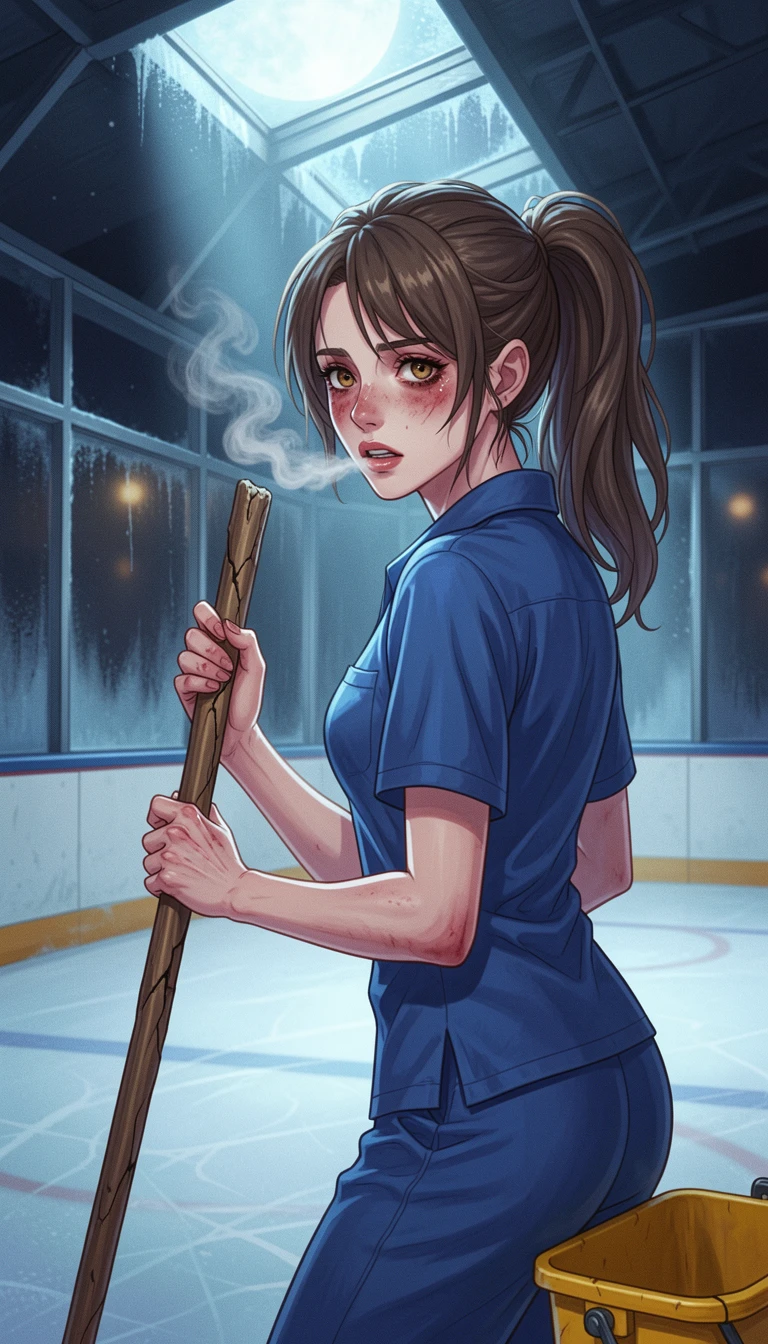
The first crack hits like a gunshot in a cathedral.
Her fingers spasm open before her brain catches up—the mop handle clattering against the rubber matting, bouncing once, rolling to a stop against the fiberglass wall. The sound echoes, ricocheting off the rafters, deadening in the empty stands. She doesn't breathe. Her lungs have locked, her entire body wired to the reverberation still trembling through the soles of her shoes.
It came from the ice. Not the boards. Not the glass. Something hit the ice—something that wasn't a puck. Pucks crack. This was a thud. Dense. Wet. Wrong.
She counts the seconds. One. Two. Three. The refrigeration unit hums. The ice settles with a low groan. Nothing follows.
Her hand hovers above the fallen mop. Don't pick it up. Don't move. Invisible means silent, and silent means safe. The rule beats through her chest like a second heart.
Another crack. Closer now. From somewhere near the blue line, where the moonlight pools brightest across the frozen surface. She turns her head—slow, millimeter by millimeter, the tendons in her neck screaming—and scans the rink through the penalty box glass.
Nothing. Just the ice, pale and gleaming, scarred by a thousand blade marks. A faint fog rising from its surface.
But the crack came from on the ice. Not under it. Something landed. Something that shouldn't be there.
Her eyes trace the moonlight's path. A dark smudge near the faceoff circle. Too small to be a body. Too still to be alive.
The air has gone cold in a new way—not the arena's cold, but a cold that breathes. She feels it on the back of her neck, raising the fine hairs there. Her chapped fingers curl against her palms, nails digging crescents into the skin.
Don't look. Don't move. Don't make a sound.
Her hand never lowers to the mop.
Her eyes find the smudge again. Dark against the white. And then it moves—a shudder, a limb dragging across the ice. A hand. Fingers splayed, scraping, leaving a smear that isn't water.
The cold on her neck becomes a hand. She feels his breath before she hears it—warm, measured, close enough to stir the loose hairs at her temple. He's standing behind the penalty box glass. Not inside it. Outside, on the rubber matting she just cleaned, close enough that if she turned her head he'd be inches away.
"Don't." His voice is low, almost conversational. A blade dressed in silk. "Don't turn around."
Her body locks. Her hand, still hovering above the mop, goes still. She can smell him now—ice, expensive cologne, something metallic underneath. Blood, maybe. His or someone else's. Her fingers curl into her palm, nails biting crescents into the chapped skin, the small pain grounding her in her own body.
"You watched," he says. "Didn't you." Not a question. A verdict.
She doesn't speak. Her throat has closed, the air in her lungs going solid. The ice groans beneath the weight of whatever—whoever—is still sprawled near the faceoff circle. The fingers stop scraping.
"I didn't—" The words scrape out of her, thin and cracked.
"You did." His voice doesn't rise. That's what makes it worse. The calm in it. The ownership. "I felt you watching. From the moment you dropped your mop. You've been standing here, counting your heartbeats, pretending you're invisible." A pause. The refrigeration unit clicks, hums, settles. "You're not."
Her knees threaten to buckle. She locks them, forces herself upright, the rubber matting rough and cold through the thin soles of her worn sneakers. The bleach smell rises from the mop on the floor. Her nose stings.
"I know who you are," he says. "Elara Vance. Academic scholarship. Chemistry major. Night janitor, three months now, never missed a shift." A beat. "Never looked up either. Until tonight."
He knows her name. Of course he does. Men like him know everything about the people they own before they even speak to them. Her scholarship. Her schedule. Her silence. All of it on a file somewhere, a piece of paper he could shred with a phone call.
"One call to Dean Morrison," he says, and his voice drops, intimate now, the silk drawn tighter. "Your scholarship's gone by morning. You're back in whatever hole you crawled out of before the ice melts."
Her breath catches. Her chest tightens around the ache—the ramen budget, the sleepless nights, the single thin blanket she'd saved for months to buy. All of it balanced on the edge of a blade he's holding.
"But I'm not cruel," he says, and she hears the smile in his voice. It doesn't touch the cold. "I'm offering you a trade. Your silence for your future." A pause. "And your attention. Whenever I want it. You are now mine."
She doesn't answer. Can't. Her hand is still frozen above the mop, her eyes still fixed on the dark smear near the faceoff circle, where the moonlight catches something wet and spreading. Behind her, he breathes. Waiting. The cold on her neck deepens, and she knows—without turning, without speaking, without anything but the hair rising on her arms—that she's just become visible. And visibility, for a ghost, is the same as dying.
The silence stretches, a blade pulled thin. I don't answer him. I can't.