
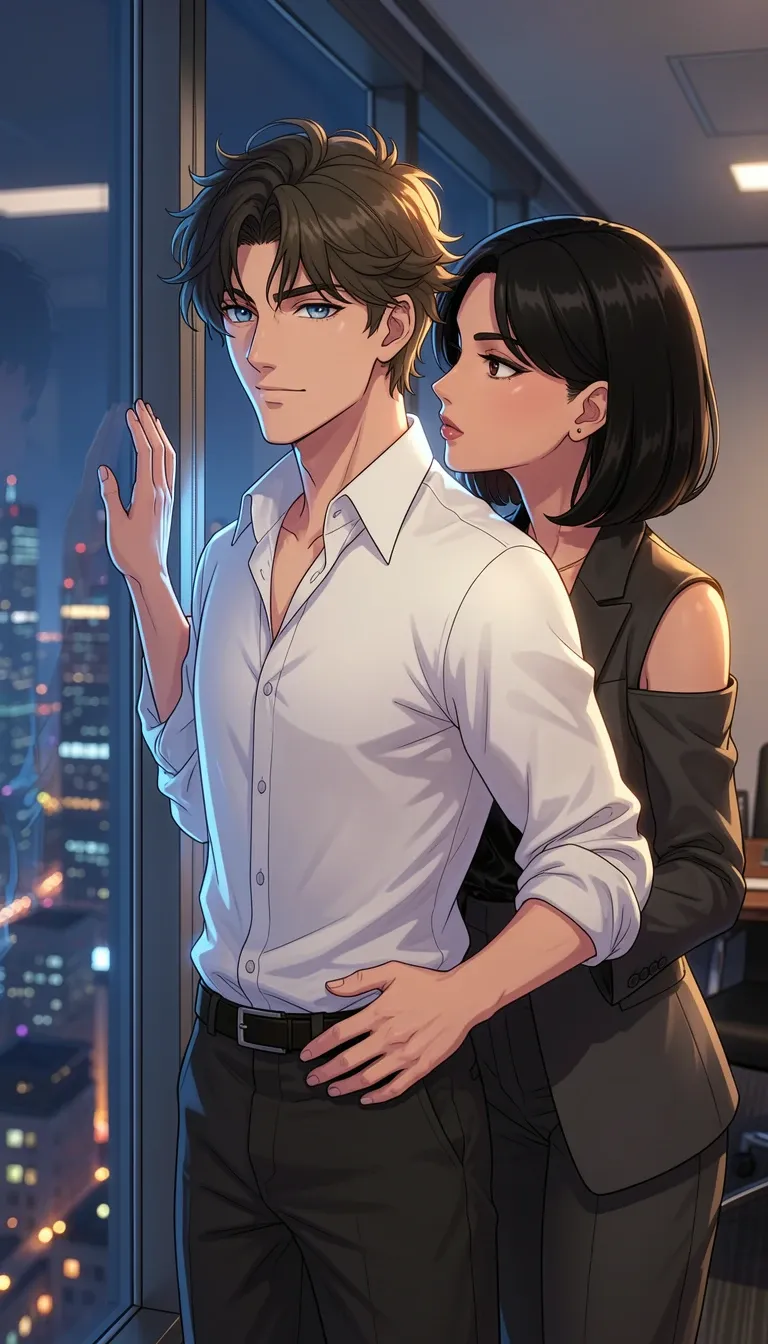
The forty-first floor at seven on a Friday was a held breath. The strip light above Valentina's door was the only light left on in the open plan, and it laid a long yellow rectangle down the carpet that Owen had to walk through to get to her. The rest of the floor sat in the blue of the city coming up through the glass — the towers across the street already lit, the lake somewhere out there black and flat, the CN Tower's antenna blinking its slow red pulse at the top of everything.
He had carried the letter in his jacket pocket for six days. The fold had gone soft, the crease worn through in one spot so the paper felt like cloth when he touched it. He had rehearsed the words on the subway, in the shower, at three in the morning with the ceiling above his bed doing its blank impression of an answer. None of the rehearsals had survived contact with the actual corridor. The corridor was just a corridor. The carpet was the same carpet. Somewhere behind him a printer coughed and died.
Her coat was over the back of her chair. That was the first thing that didn't fit — the camel wool draped there, one sleeve hanging, the way it hangs when someone has stood up intending to leave and then sat back down. Her monitor was on. Her reading glasses were pushed up into her hair, the black bob parted around them, and she was reading something on the screen with her chin propped on two fingers, and she did not look up when his shadow crossed the threshold.
"You're late," she said.
"It's seven-oh-four."
"For a Friday, that's late." She turned her head then, and the glasses came down out of her hair in one motion, folded, set on the desk. Her eyes went over him once — jacket, jaw, the hand he had not yet taken out of his pocket — and whatever she read there made her sit back in the chair. "You've got a face on. Sit down or say it standing, but do one of them."
He stood. He took the letter out of his pocket and set it down on the glass desktop, flat, with two fingers, the way you'd lay down a card you weren't sure you wanted to have played. The paper made almost no sound. That was the thing he hadn't expected — months of turning it over in his head, and the actual moment was a whisper of paper on glass and then nothing.
Valentina looked at it. She did not pick it up. "That's your resignation."
"It's my two weeks. Effective the end of the month." He heard his own voice do the thing it did when he was nervous — go flat and careful, like he was reading a script he didn't trust. "I took a job. Senior copywriter at Fielding in the Distillery. They came to me."
She picked it up now. The glasses went back on, and she read it the way she read everything, all the way through, her mouth doing nothing. The strip light above the door hummed. Down on the street a streetcar went by with its bell ringing, faint through the glass, and Owen counted the seconds by the pulse in his own throat. Six days he'd rehearsed. Six days and the woman was reading his letter like it was a deck someone had handed her on the way into a meeting.
"Fielding," she said, to the page. "That's a demotion with better stationery."
"It's not a demotion."
"It's across town and it's smaller and they'll have you writing mattress ads by spring." She set the letter down and took the glasses off and looked at him, and her face was doing that thing it did when she was deciding whether to be difficult on purpose or to be honest, which were two gears in her that sat closer together than anyone else on this floor ever got to see. "You're leaving me."
"I'm leaving the agency." He put his hand on the back of the visitor's chair and did not sit in it. "There's a difference, and you know the difference, and I'm not going to say it for you."
The corner of her mouth moved. Not a smile. The beginning of one, held back, filed. "Say it anyway."
Owen breathed out through his nose. The window behind her held the city upside down and small, and he could see the two of them in it, her seated and him standing with his hand on the chair, two figures in a lit box forty-one floors up, and the whole thing — the months of staring, the Friday she'd kept him late, the word lighthouse folded in his wallet — came down to this one sentence he had to say out loud in a room that smelled of her coffee and the cold coming off the glass.
"I don't want you to be my boss anymore," he said. "I want to be able to walk into a room with you and not have to pretend there's nothing happening. I want to be your partner and not your report. That's what the letter is. It's not me walking away from you. It's me clearing the ground." He heard how it sounded — earnest, a little raw — and made himself stop. "You said I had to decide. I decided."
Valentina was quiet for a moment. She turned her chair a few degrees so she was facing him square, and she folded her hands on the desk, and the gesture was so much the opposite of the woman who had bent him over the boardroom table that it took him a second to understand she was nervous. That was what it was. The folded hands. The straight back. The woman who never fidgeted, fidgeting very slightly by sitting too still.
"Sit down," she said. "Not that chair. The desk."
He sat on the edge of the glass desktop, half-turned toward her, one foot on the floor. She rolled her chair in close so that her knees came either side of his leg, and she put her hand flat on his chest, over the shirt, over his heart, and held it there. He could feel his own pulse under her palm. She could feel it too — he watched her feel it, watched her thumb move once against the fabric like she was confirming something.
"I've had a letter like this on my desk before," she said. "From a man who thought it bought him something. It didn't." She looked up at him. "You understand what I'm telling you. The letter doesn't buy you anything. The Fridays don't stop being mine because you change buildings."
"I'm not trying to buy anything."
"Good." Her hand slid up to his collar and pulled him down, and she kissed him. It was not the kiss from the boardroom, not the verdict. It was slower than that, and it tasted of her coffee, and her other hand came up to the back of his neck and held him there, and when she broke it she kept her forehead against his for a second and breathed. "Get your coat," she said. "We're not doing this in the office. I've spent enough of you in this building."
The elevator chimed at the end of the corridor, faint and polite, and neither of them moved. Then she stood, took her coat off the chair, and walked past him to the door, and he followed her down the long yellow corridor and into the lift with his letter still lying on her desk behind them, the crease soft, the ink dry.
The penthouse was on the thirty-eighth floor of a building on Harbourfront, and the elevator opened directly into it, and the first thing Owen saw was the city through the far wall of glass — the whole harbour, the islands black against the water, the planes coming in low and slow with their lights on. Valentina dropped her keys in a bowl and her coat on a chair and walked out to the window without turning on a light, and he stood in her hallway in his socks and watched her silhouette against all that dark and all those lights.
"Come here," she said.
He came. She turned him by the shoulder and unbuttoned his shirt herself, top to bottom, unhurried, and pushed it off his shoulders. Her hands were warm from her coat. She got his belt, his trousers. She went down onto her knees on the rug in front of the window with the city behind her and took his cock into her mouth, and Owen put both hands flat against the cold glass and made a sound he had not intended to make.
She took him deep. Slow, and then deeper, her tongue flat along the underside, her hand working the base of him where her mouth couldn't reach. He felt his cock hit the back of her throat and she held it there, breathing through her nose, and the wet sound of it filled the dark room. "Fuck," he said, to the glass, to the harbour. "Valentina—" She pulled off him with a wet sound and looked up, her lips swollen, her chin wet, and she said, "You don't come in my mouth tonight. You save it. You understand me?"
"Yes."
"Say it properly."
"I won't come in your mouth. I'll save it."
"Good boy." She stood, and took his hand, and led him through the dark apartment to her bedroom, where the bed was wide and low and the window ran the length of one wall, and she turned on one lamp and the room came up warm around them.
She undressed herself. He watched her do it — the blouse, the skirt, the black underwear she stepped out of, and then she stood there in front of him with her cock already half hard and her pussy dark between her thighs. She was thirty-eight years old and looked at him like she had all the time in the world. "On the bed," she said. "On your front. Pillow under your hips."
He did it. The pillow lifted his ass, and he lay with his cheek on the sheet and his heart going. He heard her open the drawer and the click of the bottle, and then her knee came down on the mattress behind him and her hand was on the small of his back, warm, steadying. "Slow tonight," she said. "I'm going to take my time with you. Tell me if it's too much."
"It won't be."
"You don't know that yet." Her fingers, slick, found him and worked him open — one, then two, slow and thorough. He felt himself open around her and the lube going warm and the ache of being stretched. "There," she said, when her fingers curled and he jerked against the pillow. "There it is."
Then the head of her cock against him, and the slow push, and the stretch of it, and Owen gripped the sheet and breathed out long and let her in. She went slow. Inch by inch, her hand flat between his shoulder blades, and when she was all the way in she stopped and lay down over his back, her breasts against him, her mouth at his ear. "Breathe," she said. "You're doing so well."
"Move," he said. "Please."
She moved. Slow, deep strokes, her hips rolling into him, and the bed took the rhythm and the window held the city and Owen felt every inch of her drag out of him and push back in. "Turn over," she said after a while, and pulled out, and he turned onto his back. She came down over him and pushed back in face to face, her hair falling forward, her eyes on his the whole time.
This was different. Face to face, her weight on her elbows either side of his head, her cock filling him slow and deep, and he could see her — the flush on her throat, the way her mouth came open on each push, the way she watched his face like she was reading a page she'd written. "You feel that," she said. "That's me. That's all of me in you."
"I feel it."
"Tell me what it feels like."
"Full," he said, and his voice cracked. "It feels — you're so deep, I can feel you all the way up. Don't stop."
She didn't stop. She took him slow and long until his thighs were shaking and his cock was leaking onto his own belly, untouched. She said, "Now you. On top. I want to feel you fuck me."
She pulled out and lay back against the pillows and opened her legs, and Owen came up over her. She reached down and guided him — not her cock, her pussy, hot and slick under his fingers. He pushed into her and they both made a sound. She was so wet. He sank into her to the root. She wrapped her legs around his back and pulled him down onto her, and her cock pressed up between them, trapped against his belly, sliding in the wet he'd left on her.
"Fuck me," she said. "And don't you dare come until I say."
He fucked her. Slow at first, then harder, and every thrust pushed her cock against his belly and every thrust made her gasp. She reached up and gripped the back of his neck and pulled his mouth down to hers and bit his lip. "Harder," she said against his mouth. "I'm not made of glass." He gave her harder. The bed knocked the wall. Her heels dug into his back and her pussy clenched around him and she said, "That's it, that's my boy, right there—"
"I can't—" His hips stuttered. "Valentina, I can't hold it—"
"Not yet." She gripped his ass and held him deep and her voice came out low and wrecked. "Not yet. Wait for me. Wait—" and then her back arched and her cunt clamped down on him and she came with a sound that started in her chest and broke in her throat, and her cock jerked between them and spilled hot across his belly, and she said, "Now. Now, Owen, come—"
He came. He drove into her and emptied himself with his face buried in her neck and her name in his mouth. She held him there with both arms and both legs while it went through him. It went through him a long time, and when it was done he was shaking. She was stroking his back and the room smelled of them both.
Neither of them said anything for a while. The city turned outside the glass. His come was cooling on her belly and hers on his, and she reached over eventually and pulled the sheet up over their hips with one hand, and Owen lay with his cheek on her shoulder and her fingers in his hair.
"Fielding," she said, to the ceiling.
"Fielding."
"You'll hate their coffee."
"I'll survive."
She was quiet a moment. Then, "Every Friday. Whatever building you're in, whatever you're writing. Friday night is mine." Her fingers kept moving in his hair. "That's the deal. Take it or leave it."
Owen lifted his head and looked at her — the flush still on her chest, the hair stuck to her temple, the woman who had spent all evening being a boss and was now, unmistakably, something else. "I'll take it," he said.
She nodded once, and pulled his head back down to her shoulder, and outside the window the last plane of the night came in low over the harbour with its lights on, and neither of them watched it land.
Her fingers stopped in his hair. Then her hand slid down the back of his neck, took a fistful of his shirt collar, and pulled him up off her shoulder.
"Not finished with you."
"I thought—"
"You thought I was done because I came." She sat up against the headboard, the sheet pooling at her waist, and her cock was still hard, still slick from where it had been pressed between them. "Lie back. I want to look at you while I do it."
He lay back. The pillow was damp where his face had been. She came over him on her hands and knees, and her hair hung down and swung with her breathing, and she looked at him the way she read a page she was about to change.
"You've been hard since the harbour," she said. "Through all of it. That's a long time to wait."
"It was your rule."
"It was." Her hand closed around his cock and he jerked. "And now it's my rule that you come. Not before I say, not after. When I say." She stroked him once, root to tip, her thumb dragging over the head. He made a sound that came out of the back of his throat. "Tell me what you need."
"Your hand. Just — keep doing that."
"That's not what you need." She bent and put her mouth on his throat, and her hand kept going, and her cock lay hot along his hip. "Say it. You're allowed to say it. You're not allowed to be shy about it."
He turned his head against the pillow and said it into her hair. "Inside. I want you inside me again."
"There it is." She sat back on her heels and reached for the bottle on the nightstand — it had been knocked over at some point. She righted it and poured into her palm, and the sound of it was loud in the quiet room. She worked the lube down her cock with her fist, unhurried, watching him watch her. "On your side. Knee up."
He turned. She came in behind him, her chest against his back, and her hand found his hip and pulled him into the angle she wanted. The head of her cock pressed at his ass and she held it there, not pushing, just letting him feel it.
"Breathe out," she said, and he did, and she pushed in.
The stretch took him all the way up his spine. He got a hand into the sheet and twisted it. She went slow — slower than the first time that night, her hips barely moving, letting him open around her a quarter inch at a time until her hips were flat against his ass and she was all the way in and her breath was hot on the back of his neck.
"There," she said. "You've got all of me now."
"I know." His voice came out thin. "I can feel it."
"Tell me where."
"Everywhere. It's — you're in my stomach, Val. I can feel you in my fucking stomach."
She made a low sound behind him, and her hand came around and took his cock. She started to move. Slow at first, long drags out and a long push back in, and her hand on him matched it stroke for stroke, so that he was being filled and emptied on the same rhythm and there was nowhere to put it.
The window ran the length of the wall and the city lay out there in its lit grid, and he could see them in the dark glass — her behind him, her arm around his waist, her hair falling over his shoulder, the two of them moving in the reflection like something happening to other people.
"Faster," he said.
"You don't give the orders." But she gave it to him anyway, her hips picking up, the bed taking the knock of it, her fingers tight around his cock. "You want faster, you take faster. Push back on me."
He pushed back. She met him. The sound of it — skin and wet and the slap of her hips against his ass — filled the room and the glass threw it back at them. Her hand was a hard ring around him now, working him fast, and her mouth was at his ear saying things he would only half remember after. That's it. Take it. You were made for this, you know that? Look at you.
"I'm close," he said. "Val — I'm close, I can't—"
"Not yet." She pulled her hand off him and he groaned. "Not yet. You wait for me. You waited all night, you can wait a minute more."
She fucked him harder. There was nothing careful in it now — her hips snapping into him, her hand flat on his hip to hold him, her breath coming rough and broken against his shoulder. He felt her cock swell inside him, felt the exact moment her rhythm went ragged, and then she said his name — "Owen—" — and her whole body locked against his back. She came, deep, her hips jerking, and he felt it happen in her, the pulse of it, the way her hand dug into his hip hard enough to leave marks.
"Now," she said, wrecked, her mouth against his neck. "Now. Come for me."
Her hand found his cock again and stroked him rough and fast. He came so hard his vision went white at the edges. It went across the sheet in front of him, hot and in pulses that kept coming. She kept her hand moving through all of it, working him until he was twitching and oversensitive and putting his hand over hers to make her stop.
She pulled out of him slowly. He felt the empty ache of it, the lube and the wet sliding down the inside of his thigh, and he lay there breathing with his cheek on the mattress and his heart going like a bird in a jar.
Valentina got up. He heard her in the bathroom — water running, the tap, a cupboard — and she came back with a warm cloth and cleaned him herself, her hand gentle now, unhurried, wiping the inside of his thigh and his stomach and then his chest where she'd come on him. She dropped the cloth on the floor and got into the bed and pulled the sheet up over both of them and put her arm across his chest.
For a while there was only the room. The lamp still on. The city out the window. Her heartbeat slowing down under his ear.
"Fielding will want you to start before the end of the month," she said. "They'll push for two weeks."
"They already did."
"And you said?"
"I said I'd confirm."
"Confirm it." Her voice was quiet and flat, the way it got when she was being practical and not liking it. "Give them the two weeks. I'll have your files transferred by the fifteenth." She shifted, and her chin came down onto the top of his head. "You'll keep the Meridian account off your desk. It's a conflict of interest the moment you're across town. I'll tell them you're being reassigned to — something. I'll think of something."
"And after the fifteenth?"
"After the fifteenth you're not my employee." She said it slowly, as though she were checking each word against something. "Which means the Fridays are not a thing I'm doing to someone who works for me. They're a thing I'm choosing. You understand the difference."
"I understand it."
"Good. Because I'm not going to be careful with you and then have you decide later that I took advantage." She said took advantage like it was a phrase she had heard in a meeting and disliked. "You're going to be a grown man in a different building who comes here on Fridays because he wants to. That's the whole of it. If you ever don't want to, you say so and that's the end of it and there's no scene."
Owen turned his head so he could see her. "Is that why you gave me the word?"
"Lighthouse." She said it without inflection. "That's for the other thing. That's for when I'm inside you and it's too much. That's not for this. This doesn't need a word. This just needs you to be honest with me, which you've been doing badly for six months and better for six days."
"I'm being honest now."
"I know." Her hand moved on his chest, once, and stilled. "It's the first thing about you I've actually liked."
He laughed — it surprised him, coming out of him like that, and she made a sound against his hair that was almost a laugh too. "You're a terrible boss," he said.
"I'm an excellent boss. You're a difficult employee."
"I'm resigning."
"You've resigned. It's the most sensible thing you've done since February." She reached over him and turned off the lamp, and the room went to the blue of the city and the window. "Sleep. You've got a slide to fix in the morning and I'm not doing it for you."
"The ninth slide."
"The ninth slide." Her voice had gone soft and slow with the dark. "It's still wrong."
He lay there with her arm across him and the harbour lights coming through the glass, and after a while her breathing evened out and her hand slid off his chest onto the mattress, and he was the only one awake in the room.
He thought about the letter on her desk. The crease worn soft. The ink dry. He thought about the fifteenth, and the Fridays after it, and how a thing could be a transaction for six months and then one night turn into something with terms — and how the terms, when you looked at them, were just two people agreeing to show up.
He turned his head on the pillow. The city was still out there, the towers lit, the lake black and flat beyond the islands, and the last plane was long gone. He watched the red pulse at the top of the CN Tower go around once, and then again, and then he closed his eyes.
In the morning the bed beside him was empty and the shower was running, and the folded paper with Lighthouse on it was standing upright against the lamp on the nightstand, where she had put it, where he would find it, the crease soft and the ink dry and her handwriting on it in black, and on the desk in the other room the letter lay open with her initials at the bottom of it in the same hand.
He woke to the smell of hotel coffee and the sound of her typing.
Valentina sat at the desk in the other room with her back to him, the sheer curtain pulled half across the window, the lake behind her a flat grey that hadn't decided yet what kind of day it was going to be. She had her glasses on. She was wearing his shirt — the one he'd dropped on the floor the night before — and nothing else, and the sleeves were rolled twice at the wrists and the hem sat high on her thigh, and she was reading the letter with one hand and holding the coffee away from it with the other.
He got up. His legs had an opinion about that. He found his boxers and pulled them on and came around the end of the bed, and the carpet was cold and the air was cold and the whole room smelled of the two of them.
"You're up," she said, without turning.
"You're in my shirt."
"It was on the floor. It's mine now." She took a sip of the coffee and set it down and kept reading. "There's one for you. In the bathroom."
He found it on the counter by the sink, a paper cup with a lid, still hot. He stood there a moment looking at his own face in the mirror above it — the mark on his neck, the one on his hip that he could see through the gap in his boxers, the state of his hair — and then he took the coffee back out into the room and sat on the end of the bed facing her.
The letter lay open on the desk under her hand. He could see the top of it from here. A letterhead he didn't recognize. A date from a year ago.
"You read it often," he said.
"Once a month, maybe. More, lately." She turned it over, facedown, and looked at him. "You want to know what's in it."
"Only if you want to tell me."
"That's a very diplomatic answer."
"I've been told I'm a difficult employee."
She almost smiled. She picked the letter up and held it a moment, weighing it, and then she put it back down and squared it with the edge of the desk. "It's from a woman named Ruth Alderman. She ran this floor before me. She hired me at twenty-six when nobody else in this city would take a creative director who looked like me, and she taught me how to do the job, and she died in September of the year before last, and she wrote this to me before she did." She lifted the coffee. "It's not a sad letter. That's the thing about it. Everyone expects it to be a sad letter."
"Is it?"
"It's a list of things she thought I should stop doing." Valentina drank. "She was right about most of them. One of them I've been ignoring for a year."
"Which one?"
"That I should stop working like the building's on fire and find something to do with my Fridays that isn't this." She gestured at the desk, the laptop, the forty-first floor implied in all of it. "Her word. She said I'd burn out by forty and nobody would come to the funeral because I'd have scheduled it during a pitch."
Owen turned the cup in his hands. "And now?"
"And now I've got a Friday." She said it plainly, no weight on it, and then she took her glasses off and folded them and set them down, and the look she gave him across the room was the first one that morning that wasn't a verdict. "Which brings us to terms. You're going to Fielding. That's decided, it's good for you, and I'm not going to be the reason you don't go. But I want to be plain about what the two weeks are. They're not a countdown to something. They're just two weeks."
"I know what they are."
"Do you." She leaned back in the chair and the shirt pulled across her chest. "Because the last six days you've had a look on your face like a man waiting for a train that might not come. I've been watching it. It's a very readable face, Owen. It's one of the reasons I hired you and one of the reasons I should have fired you."
He set the coffee down on the nightstand. "I'm not waiting for a train."
"Then what are you doing?"
"I'm sitting on a hotel bed at seven in the morning drinking coffee your assistant probably ordered, watching you wear my shirt, and I'm not in any hurry." He met her eyes. "That's what I'm doing."
She looked at him for a while. The city went on doing whatever it did at seven in the morning on a Saturday — a streetcar somewhere far below, a gull on the windowsill of the next tower over, the lake flat and pale and endless.
"All right," she said. "Then here's what this is. On Fridays, after the fifteenth, you come to my building at seven. You take the elevator to the forty-first. You knock on my door and I decide what happens after that, and you decide whether to knock in the first place. Nothing in between. No texts during the week about anything but work. No showing up on a Tuesday because you had a bad day. If you have a bad day, you call your brother."
"I don't have a brother."
"Then call a friend. You've got friends. You've got that whole floor of writers who think you're funny." She stood, and the shirt hung on her, and she came and stood in front of him with her hands on her hips. "The point is, this doesn't run the rest of your life. It's one night a week and it's a door you knock on. That's all it is."
"And if I don't knock?"
"Then I go home and read a letter and think about what Ruth would have told me to do." She said it without self-pity, the way she said everything. "I'm not going to chase you. I've never chased anyone. It's a character flaw and I've decided to keep it."
He reached up and took the hem of the shirt in his fingers and tugged it, just enough to bring her a step closer. "I'm going to knock," he said.
"I know you are." She looked down at him. "I'm just making sure you know you don't have to."
He stood up. The shirt was warm from her and the buttons were half open and he put his hands flat on her waist and kissed her, and she let him, and her hands came up and settled at the back of his neck, and for a moment the room was just the two of them and the coffee going cold and the grey light coming through the curtain.
Then she stepped back. "Eight o'clock," she said. "The ninth slide. Go and fix it. I'll be in the room next door not helping."
"Cruel."
"Practical." She was already turning to the desk, already reaching for the glasses. "And Owen — take the shirt. It doesn't fit me and I'm not sentimental about it."
He found his own shirt folded on the armchair, clean, pressed, the collar crisp. She must have sent it down. He put it on and did up the buttons and looked at her — the bob, the glasses, the letter under her hand, the whole of her in the grey morning — and then he took his bag and went out through the adjoining door and shut it softly behind him.
In his own room the laptop was open on the desk where he'd left it, the ninth slide glowing on the screen, the wrongness of it obvious now in a way it hadn't been at midnight. He sat down. He put his hands on the keyboard. Out the window the lake was turning from grey to a thin, bright silver, and the city was waking up, and somewhere across town a man named Fielding was going to get an email before the end of the day.
He fixed the slide in forty minutes. It was the headline. It had always been the headline.
At ten to eight he closed the laptop and put it in his bag and took the folded paper out of his pocket and looked at it — the crease soft, the ink dry, her handwriting in black — and then he put it back and went down the hall and knocked on her door.
"It's open," she said.