
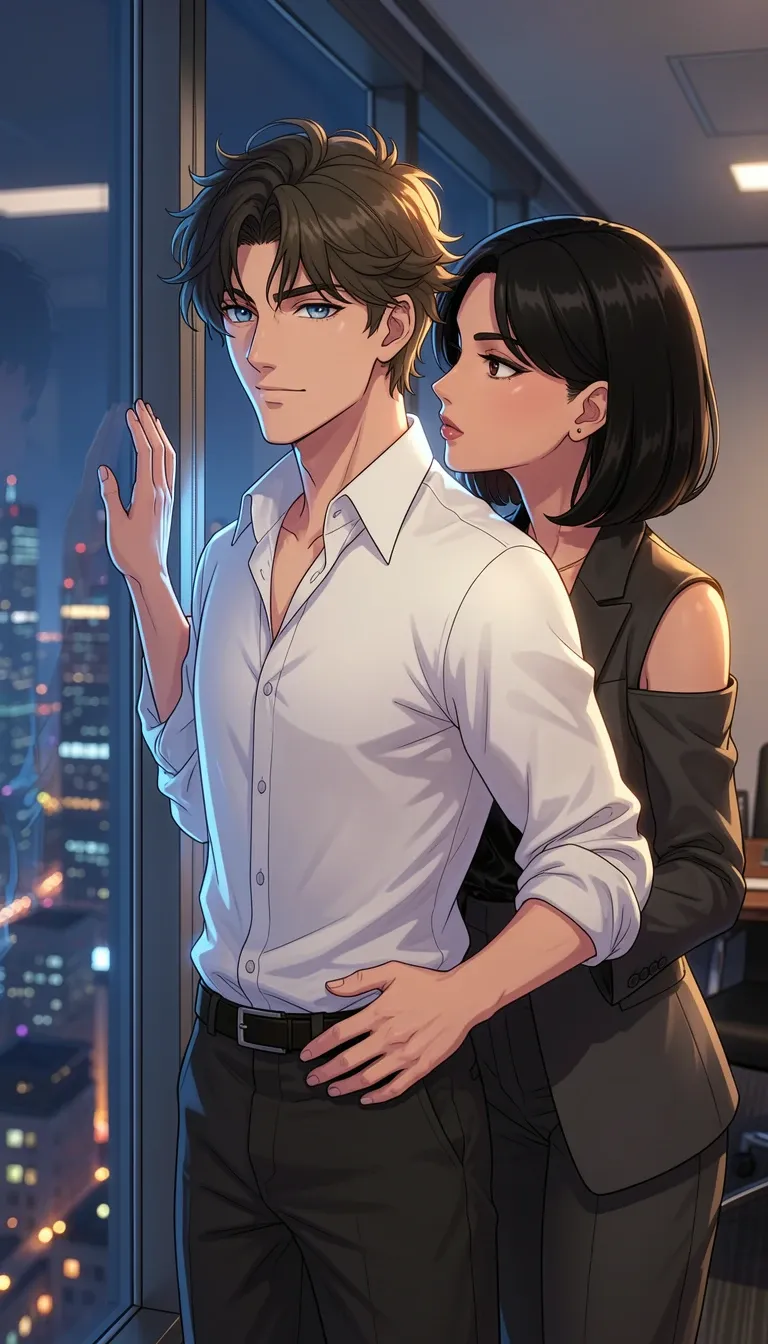
The forty-first floor at eight on a Friday was a mausoleum. Owen Fairbanks stepped off the elevator into the corridor's blue half-light, the motion sensors clicking awake one bank at a time as he walked, the whole empty agency coming on for him alone like a theater lighting cue. Ninety percent of the desks were dark. The monitors wore their little orange standby eyes. Somewhere a printer cleared its throat and thought better of it.
He was twenty-nine years old and his palms were already damp, and he'd had a week to plan for this and had planned nothing, because every time he tried to imagine the evening his brain handed him a different, worse, better movie. He'd rehearsed a joke. He'd lost the joke. He'd rehearsed not needing the joke.
The boardroom door stood open at the end of the hall, and she was in it.
Valentina Ruiz — thirty-eight, black bob sharp as a level line, dark eyes that found him before he'd crossed the threshold — sat at the head of the long table with her jacket off and her sleeves rolled to the elbow, a glass of water at her right hand, the city strung out behind her in strings of amber and white. Below the glass wall, Lake Ontario was a black plate with light smeared across it. She didn't stand. She watched him walk the length of the table, and she let the walk be long.
"Close it," she said. "And hit the lights. The far switch, not the one by the door."
He did. The fluorescents over the far end died, and the room dropped into the city's own light — the flat orange wash off the towers, the moving white of headlights forty floors down. It made the table a long black mirror. It made her face half shadow and half streetlight.
"Sit," she said.
He sat. Not the chair across from her — she pointed with two fingers at the chair at her right hand, and he moved down and sat there, close enough to smell her, which was cedar and something clean and cold like the inside of a good hotel.
She reached under the table and lifted her briefcase onto it — good leather, worn pale at the handle — and clicked both latches with her thumbs. The lid came up. Inside: a laptop, a folder, a pen case. And, laid on top of the folder like a set of instruments, a small clear bottle and a folded square of paper.
She set the bottle down on the polished table. She set the paper beside it and smoothed it flat with two fingers. Then she folded her hands and looked at him.
"You've been thinking about last Friday," she said.
"Every day."
"Good. So have I." She tapped the paper once. "Before anything else happens in this room, you're going to read this. Out loud. And then you're going to say the word back to me, and you're going to tell me what it means."
He picked the paper up. It was folded once, the crease pressed hard, and it opened under his thumb into a square no bigger than his palm. In her handwriting — black ink, small and exact, the loops clipped — one word. He read it out.
"Lighthouse."
"And what does it mean."
"It means stop. Everything stops, no questions, no explaining myself."
"Say the rest of it."
He looked up from the paper. Her face gave him nothing to lean on, and that was the point of it. "It means I don't have to earn it. I don't have to be reasonable about it. I say it and you let go of me and we're still — " he turned the paper over, though there was nothing on the back — "we're still okay. Whatever that is."
"We're still okay," she repeated, slow, like she was setting it into the table between them. "That's the whole contract, Owen. Everything else in this room is mine to decide. That one word is yours. Do you want it?"
"Yes."
"Then say it again. Not because you're scared. Because you're not, yet."
"Lighthouse."
She nodded once, and something in her shoulders let go a quarter inch, and only because he'd been watching her for months did he see it. She folded the paper back along its crease and slid it to the edge of the table where he could reach it.
"Put it in your pocket. You keep it. That's not a loan."
He did. The paper was warm from the table and it sat against his thigh like a coin. She picked up the bottle, turned it so the label faced him — a plain pump bottle, nothing coy about it — and set it down again with a small click.
"Now," she said. "Stand up. Take everything off from the waist down, fold it, put it on the chair. Then clear the head of the table — all of it, the folders, the water, my briefcase — onto the credenza behind you. Then you put your hands flat on the table where I can see them and you wait for me."
His hands went to his belt and then stopped, and she watched the stop happen.
"Say the thing you're about to say," she said.
"The windows."
"Forty-one floors up. The next building over tops out at thirty-three and it's a hotel with its blinds shut. The glass is mirrored after dark — from outside, in this light, we're a smudge." She tilted her head. "And I checked. Which you should find either reassuring or deeply unhinged."
"Reassuring," he said, and his voice came out lower than he meant it to.
"Then get undressed."
He got undressed. The belt made a sound in the quiet room like a drawer closing, and he stepped out of his jeans and folded them — she watched him fold them. He was absurdly glad he did it well — and set them on the chair, and his boxers on top. Then he stood in his shirt and socks with the cold of the room arriving on the backs of his thighs. He cleared the head of the table in two trips. He set his palms flat on the black surface, and the polish was cool and slightly tacky under his fingers, and the city burned orange in it just past his knuckles.
She came around the table. He heard her chair, her footsteps, and then she was behind him and not touching him, and he could feel exactly where she was in the room without turning around, the way you can feel a heater.
"Bend over," she said. "Chest down. Cheek on the table. That's it — further. Good."
He went down. His cheek found the cold black glass and the whole city swung sideways in it, and his own breath came back at him off the surface, warm, fast. His hands slid a little and he spread them wider and the table took his weight. He was aware of his ass being the highest thing about him, of the room's air on it, of her standing back there looking.
"You're shaking," she said.
"A little."
"That's fine. It'll stop." A pause. "Or it won't. Either way I've got you."
The pump bottle clicked. The sound of gel into a palm was small and wet in the empty room, and then her hand was on him, the flat of it, warm and slick, sliding down the crack of his ass and back up, unhurried, once, twice, and his forehead came down against the table.
"Talk to me," she said. "Or don't. But I'm going to be here a while, and I'd rather hear you."
"I don't — " His voice cracked and he let it. "I don't know what I'm supposed to say."
"Whatever's true. Start there."
Her thumb found his hole and pressed, no more than that, just pressed, and held. He made a sound into the table that he hadn't authorized. The polish was cold against his cheek and the pressure was warm and patient and it did not move, and he heard himself say, "It's a lot," and she said, "It's one finger's worth of a lot. Breathe out."
He breathed out. She pushed in, slow, one finger to the second knuckle, and the burn of it was bright and specific and he felt his whole body try to close around it and then, because she waited and said nothing and did not push, let it go.
"There," she said. "That's the whole trick. Nobody's ever told you that."
"Nobody's ever — " he said, and then she moved, and the rest of the sentence got away from him.
She worked him open the way she did everything, which was thoroughly and without any visible hurry. One finger, curling, finding the spot and pressing it until his hips flinched and a sound came out of him he'd never made before, and then doing it again, and again, until he was pressing back into her hand without deciding to. Then two. The stretch of it pulled a low noise out of his chest. She stopped and let him get used to it and started talking again, level, easy, in the same voice she used in reviews.
"You know what I like about this," she said. "You can't fake it. Every other thing a person does in bed, they can perform. This one, your body either lets it happen or it doesn't, and there's nothing to do but be honest and wait."
"I'm — " His fingers curled against the table and slid. "I'm not being very — composed."
"I know. It's my favorite thing that's happened to me all week."
Two fingers became a slow, deep rhythm, and the wet sound of it filled the boardroom. He stopped being able to hold his own weight properly and put his cheek flat and let the table have him. Then he felt her shift, felt her hair brush the back of his thigh, and he said, "Wait — " and her hand went still.
"Wait like slow down," she said. "Or wait like lighthouse."
He breathed. The question sat there, and the fact that she'd asked it — that she'd made the difference plain and waited — did something to his chest that was not fear. "Slow down," he said.
"Good." Her fingers eased out, and she rested her palm flat on his lower back, warm and still. "That's the other thing nobody tells you. Asking for the smaller thing isn't failing the bigger one."
"You're going to give me a whole education tonight."
"I intend to give you a whole education generally," she said, and he laughed, one startled breath of it against the table, and then her mouth was on him and the laugh turned into something else.
Her tongue was flat and hot and it dragged up through the slick she'd left and his whole body jolted, hips driving into the edge of the table. Her hands caught his hips and held them still, thumbs pressed into the meat of him, and she did it again, slower, and the wet heat of it and the press of her tongue and the fact that it was her down there, her mouth, her breath across the wet skin, undid something in his chest that had been knotted for months. He said her name. He said it into the black glass and heard it come back at him.
She hummed against him, which was not a word but was clearly an answer, and her tongue found the spot her fingers had been and worked it, and his hands scrabbled and slid on the polish and found nothing to hold. She had to pin him harder. One hand flat between his shoulder blades, pressing him down into the table, and the pressure of that — being held down and open and taken apart by a mouth — pulled a sound out of him that was close to a sob and had nothing sad in it at all.
"Please," he said, when he could say anything.
She lifted her mouth, and the cool air on the wet skin made him shudder. "Please what. Be specific. You're a writer."
"Please — I want — " He turned his face, and the city was still out there going about its night, cars moving on the expressway, a whole city that had no idea. "I want you in me. I want to know what it's like."
"Yeah," she said, and her voice had gone rough at the bottom. "You do."
He heard her stand. Heard the zip. He turned his head far enough to see her in the black glass, her reflection and his, her hands at her waist. Then she stepped out of her trousers and folded them over the back of the chair with the same economy she did everything, and when she came back to him she was wearing the shirt and nothing else, and what hung between her thighs was already hard and slick at the tip.
"Look at me," she said. He lifted his head and turned and looked at her, and she held his eyes while she pumped gel into her palm and slicked herself with three long pulls, and his mouth went dry. "You still want this."
"Yes."
"Say the word first."
"Lighthouse."
"Good man."
Her hand came down on the small of his back and pressed him flat, and the head of her cock found him and pushed, and the stretch was nothing like fingers. He opened his mouth and the table took the sound. She didn't drive. She leaned, and held, and let it happen an inch at a time, and her other hand was on his hip and her thumb moved in a slow circle while she waited him out. The burn crested and broke and crested again. He heard her say, low and even, "Breathe out, Owen. Let me all the way in," and he did, and she did.
She was all the way in. Her hips were against him and her hands were on him and she was breathing hard through her nose, and she stayed there, and the fullness of it was so much that his eyes watered and he had to put his forehead down and just be full.
"Okay," she said. "Now listen to me. You don't come until I tell you. Not because I'm being cruel to you. Because I want to watch you decide." Her hips drew back, slow, and the drag of it made his hands skid on the table, and then she pushed back in, deep, a single long stroke, and the sound of it was wet and final in the empty room. "And you're going to decide," she said, closed and quiet, her hand flat between his shoulder blades. "Because I'm not going to let you do anything else."