
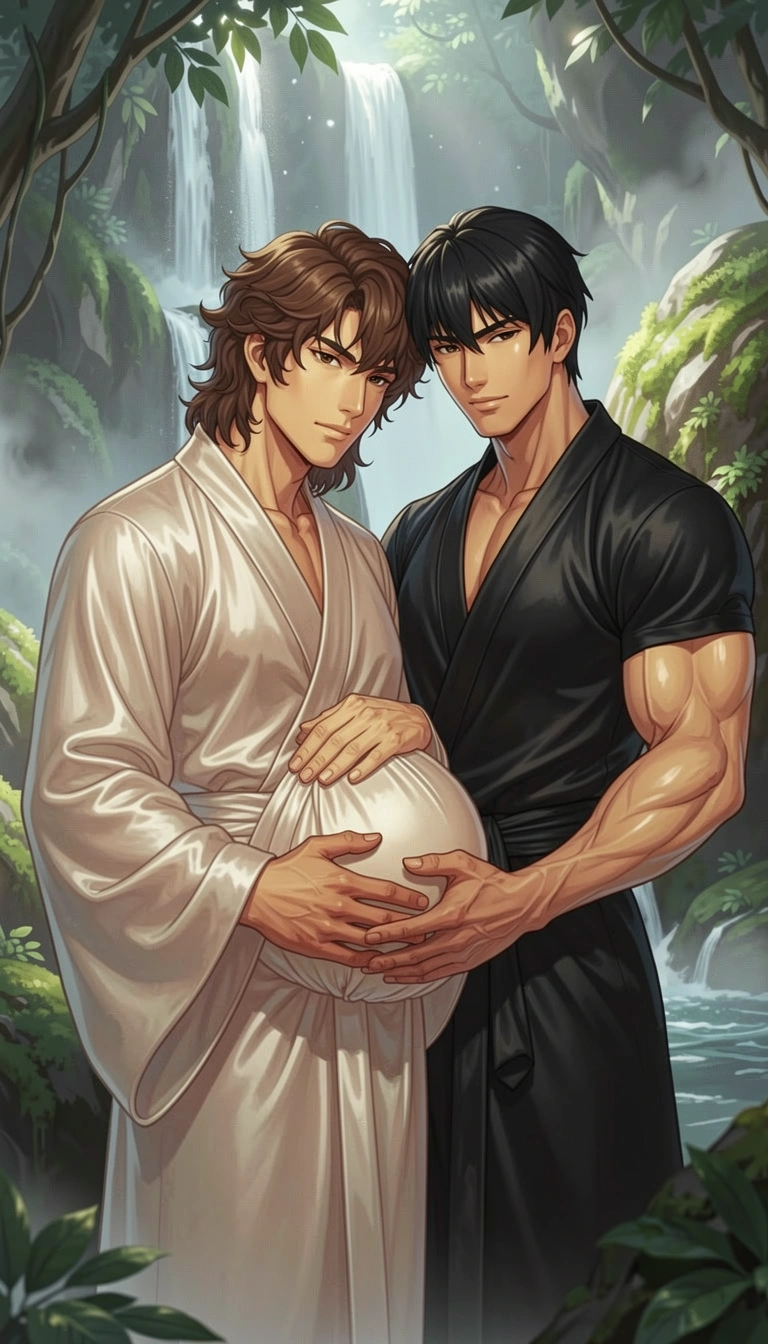
The corridor stretched before him, dark and cold, the torches guttering in their sconces as if the palace itself was too exhausted to keep them burning. Phuwin's bare feet met the stone with a shock that traveled up through his ankles, his knees, settling in the hollow of his chest where his heart beat too fast and too loud. The leather bag hung from his shoulder, heavy with everything he could carry and nothing that mattered.
He walked. One step. Another. The stone bit into his soles, rough and cold, and he welcomed the pain—it gave him something to focus on besides the weight pressing down on his ribs, the baby shifting inside him, the image of Pond's open hand on the empty sheet burned into the back of his eyelids.
The corridor turned. He followed it. The eastern hall, where Imaria used to practice her sword forms in the mornings, the tapestries catching the light from the windows. Empty now. The shadows pooled in the corners like water, thick and waiting, and he moved through them as if he had become a shadow himself.
Halfway down the stairs that led to the main floor, the pain hit him.
It came from nowhere and everywhere at once—a sharp, slicing cramp that seized his belly and twisted, hard enough to knock the breath from his lungs. His hand shot out, gripping the bannister, the wood rough and familiar under his palm. He bit down on his lip, hard, tasting copper, refusing to let the cry escape.
The baby pressed against his ribs, insistent, a living pressure that made his eyes sting. He stood frozen on the stair, one hand on the rail, the other pressed flat against the swell of his stomach, waiting for the wave to recede.
It didn't. Not quickly. The cramp held him, pulsing, a deep ache that radiated through his lower back and settled in his hips. He breathed through it, the way he had learned to breathe through so many things—through pain, through grief, through the long silences between him and Pond. In through the nose. Out through the mouth. The baby kicked, a sharp jab against his palm, and he pressed back, a silent apology for dragging them both through this.
The contraction loosened. Slowly, like a fist unclenching, the pressure ebbed, leaving him shaking and cold. He straightened, his hand still gripping the bannister, and looked down at the stairs stretching below him. How many more? How many more steps before he reached the gate? How many more before he left this place behind?
He didn't know. He only knew he had to keep moving.
One step. The stone cold under his foot. Another. The baby settling lower, the weight shifting, making his hips ache with a dull, persistent throb. He reached the bottom of the stairs and paused, leaning against the wall, pressing his forehead to the cool stone. The nightgown clung to his skin, damp with sweat, the fabric sticking to the curve of his belly, the mud on the hem crusted and stiff from where he had collapsed at the waterfall.
He could still smell the waterfall. The damp earth, the moss, the clean bite of the water. He could still feel the grass under his cheek, the cold seeping into his skin, the scream that had torn out of him like something alive. He had screamed Pond's name. He had cursed him. He had begged the sky to take him instead of Ovoale, and the sky had not answered.
He pushed off from the wall and kept walking.
The corridor opened into the main hall, vast and empty, the high ceilings swallowing the sound of his footsteps. The chandeliers were dark, the candles burned down to stubs, and the shadows pressed in from every side. He crossed the marble floor, his bare feet making soft, wet sounds against the polished stone, and he did not look at the east corridor. He did not look at the place where Tarven had forced him to his knees. He did not look at the stain on the floor that might have been blood, or shadow, or memory.
He looked straight ahead. At the doors. At the dark rectangle of the courtyard beyond the glass. At the gate.
The doors were heavy, iron-bound oak that creaked when he pushed them open, the sound too loud in the silence. Cold air hit him, sharp and biting, carrying the scent of wet earth and night-blooming flowers from the garden. He stepped through, and the night wrapped around him like a shroud.
The courtyard stretched before him, cobblestones slick with dew, the fountain at its center dark and still. The grass was wet under his feet, cold and soft, and the mud squelched between his toes. He looked down. The hem of his nightgown was caked with it, brown and stiff, clinging to the fabric in clumps. He had worn this gown to the waterfall. He had worn it when he collapsed at the pool's edge, when the grief had swallowed him whole, when he had screamed until his voice gave out. The mud was still there. A reminder. A record.
He started across the courtyard, and his body protested every step. His ribs ached where Tarven's knee had pressed, a deep, throbbing pain that flared with every breath. His hand throbbed where the glass had cut him, the bandage damp and warm. His belly was heavy, the baby settled low, pressing against his pelvis with a pressure that made him want to stop and curl into himself. But he didn't stop. He couldn't stop. The gate was ahead, black iron against the gray sky, and beyond it was Clove. Beyond it was somewhere else. Somewhere that was not here.
Halfway across the courtyard, the second contraction hit him.
It came faster than he expected, harder than the first, a twisting, tearing pain that doubled him over. He stumbled, catching himself on the edge of the fountain, the stone cold and wet under his hands. He gasped, the sound sharp and ragged, and the baby pressed down, hard, a weight that made his knees buckle.
He clung to the fountain, his fingers finding the grooves in the stone, the places where the carvings had worn smooth with age. He had sat on this fountain with his daughters. He had watched them splash each other, laughing, their long hair flying, their voices bright and careless. Ovoale had sat right here, right where his hand was now, her feet dangling in the water, her round face split in a grin. She had said something—what had she said? He couldn't remember. The memory was there, just out of reach, a shape in the dark, and he groped for it, desperate, as if holding onto it could hold her here.
The contraction passed. He was left shaking, gasping, the cold stone pressing into his palms. He pushed himself upright, his legs unsteady, and looked toward the gate. It was closer now. He could see the iron latch, the dark bars against the sky, the empty road beyond.
He limped forward, his steps uneven, his body screaming with every movement. The baby shifted, pressing against his ribs, and he pressed back, his hand flat against his belly, feeling the flutter of movement under his palm. Still alive. Still moving. Still fighting.
The nightgown clung to his skin, damp and cold, the fabric dragging across the cobblestones where the hem had come loose from the mud. He felt the wetness seep through, felt the chill settle into his bones, and he did not care. He did not care about any of it. He only wanted to reach the gate.
He passed the fountain. Passed the garden path where the roses had gone to seed, their petals brown and curling. Passed the bench where he had sat with Star, the morning after Aric was born, when she had brought him tea and told him the children were sleeping and that he should rest. He had not rested. He had not slept. He had not done anything except wait for the next blow to fall.
The gate loomed ahead, black iron against the dark sky, the latch cold and solid, waiting for his hand. He reached for it, his fingers trembling, the metal biting into his palm with a shock of cold that traveled up his arm. He held it, the weight of it, the reality of it, and he did not turn back.
He pulled. The gate swung open, the hinges groaning, the sound carrying into the night. The road stretched before him, empty and dark, the trees lining it like sentinels, their branches black against the stars. He stepped through, his bare feet finding the packed earth of the road, cold and rough, and he stood there, alone, the palace at his back and the unknown ahead.
The baby kicked. A sharp, insistent movement, as if asking where they were going. He put his hand on his belly, feeling the flutter, and he whispered, "Somewhere safe. Somewhere away."
The night was silent. The stars were cold. And then, in the distance, he heard it—the creak of wheels, the soft thud of hooves on packed earth, a sound that grew louder, closer, until a shape emerged from the dark.
A cart. Gold and blue, the colors catching the starlight, the horse moving at a steady trot, its breath misting in the cold air. Clove sat at the front, her hands on the reins, her face set and focused. She saw him—he saw her see him, the way her shoulders tightened, the way she pulled the reins, slowing the cart to a stop in front of him.
The gate was open behind him. The palace was dark. And Clove was there, stepping down from the cart without a word, her boots hitting the ground, her hands reaching for him as his knees finally gave way.
The horse stamped, once, the sound sharp in the stillness. Its breath curled in the air between them, pale and dissolving, and Phuwin watched it as if it were the only thing in the world that made sense—warmth leaving a living body, vanishing into the dark.
Clove's boots hit the packed earth. She did not run. She moved with the same deliberate steadiness she had shown in the house with gold and red decorations, the same measured grace that had washed his hair and clipped flowers into it and told him he would live. She crossed the distance in three steps, her hands finding his arms, her grip firm and sure, and the contact was enough to break something loose inside him.
His knees buckled. The leather bag slid from his shoulder, hitting the ground with a dull thud, and he was falling, the night tilting around him, the stars spinning in their cold, indifferent arcs. But Clove caught him. Her arms closed around his back, her palms flat against his shoulder blades, and she held him upright, her body solid and warm against his shaking frame.
"I've got you," she said. Her voice was low, rough at the edges, as if she had been crying or screaming or both. "I've got you, Phuwin."
He buried his face in her shoulder. The fabric of her coat was rough against his cheek, smelling of horse and road and the faint, clean scent of soap. He breathed it in, desperate for something that was not the palace, not the memory of blood on marble, not the image of Pond's hand open on an empty sheet. He breathed her in, and the sob tore out of him before he could stop it.
It was not a quiet sob. It was not the kind of crying he did in the dark, with his hand pressed over his mouth to keep the sound from carrying. It was raw and ugly and broken, a sound that came from somewhere deep, somewhere he had been keeping locked since the moment he had seen Ovoale's body on the stretcher. He clutched at Clove's coat, his fingers curling into the fabric, and he shook against her, the tears hot on his face, the cold air biting at his wet cheeks.
Clove did not shush him. She did not tell him it would be all right. She held him, one hand moving to the back of his head, her fingers threading through his hair, and she let him fall apart. The horse shifted, the harness creaking, and the gate swung slightly on its hinges, a soft, metallic groan that sounded like the palace letting out a breath.
"The baby," Phuwin gasped, the words torn out of him. "The baby—I can feel—there was a contraction, on the stairs, and I thought—I thought—"
"You're still standing," Clove said, her voice steady, her hand still in his hair. "You're still here. The baby is still with you. That's what matters."
He pulled back, just enough to look at her face. The starlight caught the lines of her jaw, the shadows under her eyes, the tight set of her mouth. She looked older than he remembered, tired in a way that sleep could not fix, but her eyes were clear and focused, locked on his.
"I left him," he whispered. "I left him sleeping. I kissed his forehead and I walked out and I did not look back."
Clove's jaw tightened. Something flickered in her eyes—anger, grief, understanding, all of them tangled together. "You did what you had to do."
"Did I?" His voice cracked. "He is going to wake up and I will be gone and he will not know where I am. He will think—" He stopped, the words catching in his throat. "He will think I stopped fighting."
"No." Clove's hand moved from his hair to his cheek, her palm warm against his cold skin. "He will wake up and he will know exactly what he lost. And maybe—" She paused, her thumb brushing across his cheekbone, wiping away a tear. "Maybe that is what he needs to finally understand."
The baby shifted, a slow, rolling movement against his ribs, and Phuwin gasped, his hand flying to his belly. The contraction was there, lurking, the echo of the one that had seized him on the stairs, and he pressed his palm flat, feeling the tightness, the hard curve of the baby's back pressing against his hand.
"You need to get in the cart," Clove said, her voice firm. "You need to sit down and drink water and let me get you somewhere warm."
He nodded, a jerky, uncontrolled motion, and Clove's arm slid around his waist, taking his weight. She guided him toward the cart, her steps slow and steady, matching his limping, uneven pace. The horse nickered, a soft, questioning sound, and Clove murmured something to it, a low, soothing word that Phuwin did not catch.
The cart was close now. He could see the wooden side, painted blue and gold, the same colors as the house where Clove had saved his life. He could see the blanket folded on the seat, the shape of a water skin tucked beside it, the small lantern hanging from a hook, its flame low and steady. She had prepared for him. She had thought of everything.
His legs gave out again as they reached the cart. Clove caught him, her grip tightening, and she half-lifted him onto the seat, her strength surprising for someone who looked so slight. He landed heavily, the wood hard beneath him, and he sagged forward, his hands finding his knees, his breath coming in short, ragged gasps.
Clove was beside him a moment later, the cart dipping under her weight. She reached for the blanket and wrapped it around his shoulders, the wool rough and warm, smelling of cedar and hay. She pressed the water skin into his hands, and he took it without thinking, his fingers cold and clumsy, the leather slick against his palms.
"Drink," she said. Not a suggestion. An order.
He lifted the water skin to his lips. The water was cold, almost painfully cold, and he swallowed, feeling it travel down his throat, settling in his empty stomach. He drank until he could not drink anymore, and then he lowered the water skin, his hands shaking, and he looked back at the palace.
It rose against the sky, dark and silent, the windows black, the towers cutting into the stars. He had lived there for ten years. He had given birth to seven children there. He had loved and fought and bled and broken inside those walls. And now he was leaving them behind, carrying nothing but a leather bag and a child who had not yet been born.
Clove picked up the reins. The horse stamped again, ready to move. She did not ask if he was sure. She did not ask him to look back one more time and change his mind. She just sat beside him, the reins loose in her hands, and waited.
Phuwin kept his eyes on the palace. On the gate that still hung open. On the dark rectangle of the courtyard beyond. Somewhere inside, Pond was still sleeping, his hand on the empty sheet, dreaming of a son or a daughter or a world where he had not had to choose between his empire and his family. Somewhere inside, Ovoale lay silent, her chest rising and falling with the help of machines, her brain caught in the space between waking and nothing. Somewhere inside, Xiana was healing, her broken ankle wrapped, her small body fighting to mend. Somewhere inside, Imaria was moving through the shadows, carrying secrets and a plan that she had not shared with anyone.
He was leaving them all behind. He was choosing himself, for the first time in years, and it felt like tearing off his own skin.
"I am ready," he said. His voice was hoarse, barely above a whisper. "I am ready to go."
Clove clicked her tongue. The horse leaned into the harness, and the cart lurched forward, the wheels grinding against the packed earth. The palace began to shrink, the details blurring, the dark mass of it receding into the night. Phuwin watched it go, his hand pressed to his belly, the baby moving inside him, and he did not look away until the gate was no larger than his thumb, and then nothing at all.