
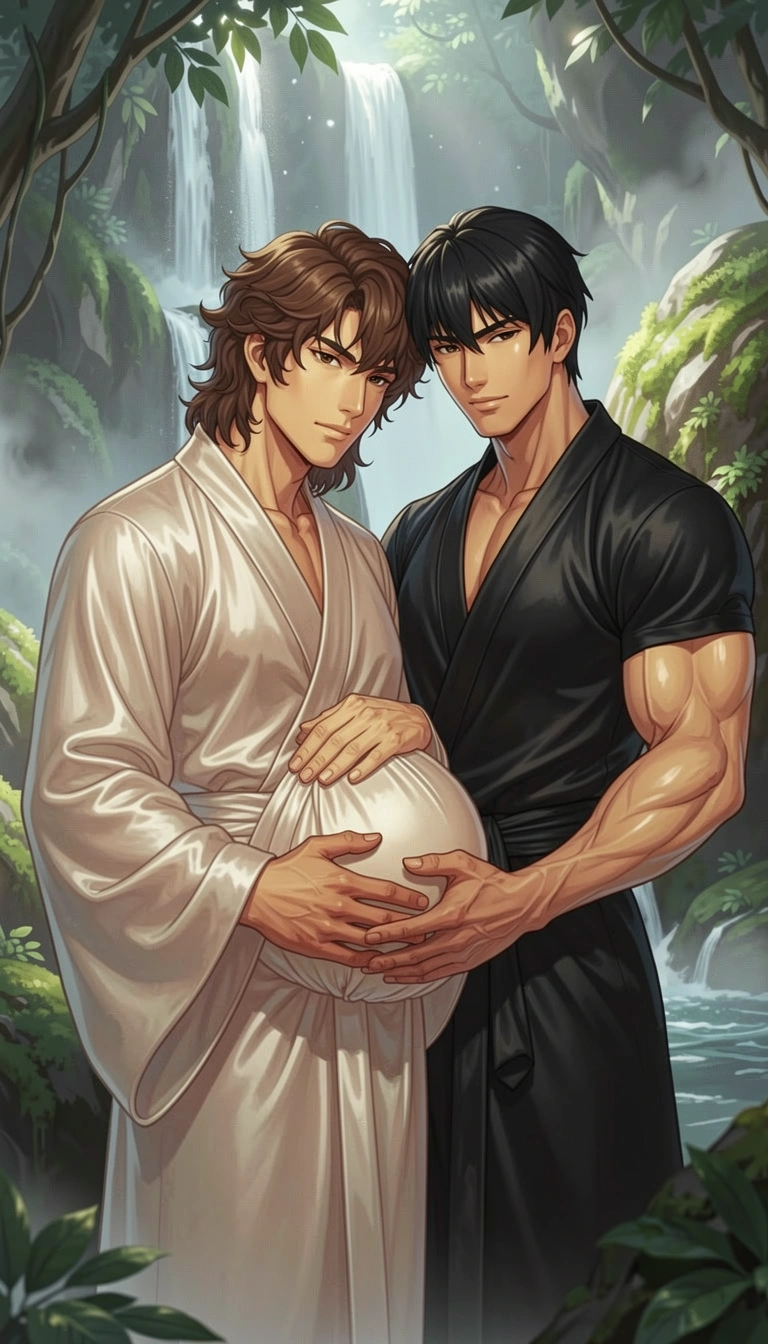
He woke to warmth.
Not the warmth of the sun through silk curtains, not the warmth of the waterfall's spray on his skin. A different warmth. Heavy. Anchoring. The weight of a hand on his hip, fingers curled just above the jut of bone, palm pressed flat through the sheet. Familiar. Impossible to mistake.
Phuwin's eyelids were lead. He forced them open anyway, the dim light of the bedchamber seeping in like water through a crack. Candles had burned low, their flames small and desperate, casting long shadows across the ceiling. The curtains were drawn. The fire in the hearth had crumbled to embers, orange and sullen.
And beside the bed, slumped in the carved wooden chair he must have dragged from the desk, sat Pond.
His husband's head was tilted at an angle that would ache in the morning, cheek pressed against the high back of the chair, one arm stretched across the bed to rest on Phuwin's hip. The other arm hung limp over the armrest, fingers loose and open. His chest rose and fell in the deep, heavy rhythm of a man who had not slept in days and finally had no choice but to surrender.
Phuwin lay still. He watched the candlelight move across Pond's face—the strong jaw relaxed into something softer, the brow unknitted, the mouth slightly parted. He looked younger like this. Not the emperor who commanded armies and councils. Just a man. A man who had carried his wife up from a waterfall, who had washed blood from his hands, who had held him through the night and refused to let go.
The baby moved. A slow roll, a pressure against his ribs. Phuwin's hand drifted to his belly, pressing lightly, feeling the shift of a foot or an elbow beneath his palm.
He thought of Ovoale.
He thought of the blade sinking into her side, the sound she had made—a wet, surprised gasp, like she had not understood what was happening, like her body had not yet caught up to the fact that it was being killed.
He thought of Star's hand, cold and still in his.
He thought of the healer's voice, calm and clinical, saying the words that had split his world in two: alive but silent, alive but gone, a narrow chance.
And he thought of the million gold. The northern cliffs. The men who had died reaching for a root that might not even work.
His hand tightened on his belly. The baby kicked once, sharp, as if in protest.
Phuwin turned his head slowly, his neck stiff, his body aching in places he did not want to name. The bedchamber was quiet. The distant tick of a clock in the corridor outside, marking time. The soft crackle of dying embers. The rhythm of Pond's breathing, deep and even and oblivious.
The phone sat on the bedside table. A small, black receiver. Silent. Waiting.
Phuwin stared at it for a long moment. The clock ticked. The embers crackled. The baby moved inside him, restless, alive.
He reached for the phone.
His hand trembled. He wrapped his fingers around the cold metal, pulled it toward him, careful not to let the screen catch the light, careful not to make a sound. Pond's hand did not shift from his hip. His breathing did not change.
Phuwin pressed the button. The screen glowed to life, pale and blue in the dim room, casting shadows across his face. He tilted it away from Pond, angling the light toward his own chest, and scrolled through the contacts with a thumb that would not stop shaking.
Clove.
Her name was there, saved with a small crescent moon beside it—a detail he had never noticed before, or had forgotten. He pressed it. The phone began to ring in his ear, a low, insistent pulse against his silence.
One ring. Two. Three.
His heart hammered. His throat closed. He had not thought about what he would say, had not rehearsed the words, had only known that he could not stay here, could not lie in this bed while the ceiling pressed down on him like a stone, could not watch Pond sleep the sleep of a man who thought he could still fix this.
Four rings. Five.
A click. A rustle. And then Clove's voice, rough with sleep and sharp with concern, cutting through the static like a blade.
"Phuwin?"
The sound of her voice nearly broke him. His jaw clenched. His eyes burned. He pressed a hand over his mouth, holding in the sob that wanted to tear out of his chest, and breathed through his nose, slow and careful, until he could speak.
"Clove." His voice was a whisper, barely audible, a thread of sound that seemed to vanish into the dark. "I need—" He stopped. Swallowed. Tried again. "Can I stay with you?"
Silence on the other end. The rustle of fabric, Clove shifting, sitting up. When she spoke again, her voice was clearer, the sleep burned out of it.
"Does Pond know?"
Phuwin's gaze slid to his husband's face. The candlelight traced the line of his jaw, the curve of his shoulder, the hand that still rested on Phuwin's hip like a claim, like a promise, like an anchor he was about to cut.
"No." The word was barely a breath. "He's tired, Clove. He's so tired. And I'm tired. And I just—" His voice cracked. He pressed his hand harder against his mouth, squeezed his eyes shut, fought for control. "I just want to keep my family safe. I don't know how to do that here. Not anymore."
Another silence. Longer this time. Phuwin could hear Clove breathing, could hear the faint creak of a bed frame, could imagine her sitting in the dark of her own room, her sharp mind turning, weighing, deciding.
"Please," he said. And the word cost him everything. He was an empress. He was a ruler. He did not beg. But he begged now, his voice stripped of all dignity, all pretense, all pride. "Please, Clove. I don't know where else to go."
The breath she let out was long. Slow. A surrender of her own.
"Okay."
The word hung in the air between them, a door opening, a path appearing in the dark. Phuwin's hand trembled against the phone, and he pressed it closer to his ear, as if he could hold onto the sound of her voice, as if she were a rope lowered into a pit.
"Thank you," he whispered. "Thank you."
"Don't thank me yet." Clove's voice was low, practical, the sharp edge of a woman who had spent her life navigating emergencies. "I'll ride to the palace with my cart. Gold and blue, you'll recognize it. I'll be there when the clock strikes midnight."
Phuwin's gaze drifted to the window. The curtains were drawn, but the moonlight bled through the edges, a pale silver line against the dark. Midnight. That was—he calculated quickly, his heart hammering—twenty minutes. Maybe less.
"Twenty minutes," he said, his voice barely a breath.
"Can you be ready?"
He looked at Pond. The candlelight traced the curve of his husband's shoulder, the line of his throat, the hand that still rested on Phuwin's hip like a seal, like a sentence, like a question he was about to answer with his silence.
"Yes," he said. "I'll be ready."
A pause. Clove's breath, slow and steady, on the other end. Then: "Phuwin."
"Yes?"
"You're doing the right thing."
He wanted to believe her. He wanted to let the words settle into his chest like balm, like permission, like absolution. But the word right felt foreign in his mouth, a language he had forgotten how to speak. All he knew was that he could not stay. That the walls of this bedchamber were closing in. That every breath he took felt like it belonged to someone else.
"I'll see you at midnight," he said.
"I'll be there."
The line went dead.
Phuwin lowered the phone. The screen flickered once, then went dark, leaving him in the dim glow of the dying candles. He held the device in his lap for a long moment, staring at his own reflection in the black glass—a ghost, a shadow, a woman who was already gone.
The clock ticked in the corridor. Seventeen minutes, maybe eighteen. He did not have time to think, did not have time to doubt. He had to move.
He turned, slowly, and looked at Pond's hand on his hip. The fingers were loose, relaxed, the palm warm against the silk of the sheet. He could feel the weight of it, the heat of it, the shape of it pressed against his body like a memory he was about to leave behind.
His hand moved before his mind caught up. He reached out, slowly, and touched Pond's fingers. They were warm, calloused, the hands of a man who had held swords and plows and babies. He traced the line of his husband's knuckles, the curve of his thumb, the small scar on his index finger from a training accident years ago, before the empire, before the weight of the crown had pressed them both into shapes they had not chosen.
His eyes burned. He blinked, and a tear fell, landing on Pond's knuckle, glistening in the candlelight.
He wiped it away with his thumb. Gently. Carefully. Pond did not stir.
"I'm sorry," Phuwin breathed, the words so quiet they were barely a vibration in his throat. "I'm so sorry."
He lifted Pond's hand from his hip, slow and deliberate, and set it on the empty space beside him on the mattress. The hand lay there, palm up, fingers curled slightly, as if still reaching for something that had slipped away.
Phuwin swung his legs over the edge of the bed. The cold air hit his bare skin, raising goosebumps along his arms. His body ached—his ribs, his back, the deep, dull throb of the wound beneath his bandages. The baby shifted, a roll and a kick, and he pressed a hand to his belly, steadying himself.
He stood.
The room spun for a moment, the candlelight swimming, the shadows tilting. He gripped the bedpost, his knuckles white, and breathed through it. In. Out. The dizziness passed.
He crossed the room on bare feet, the stone floor cold against his soles. His wardrobe stood against the far wall, dark wood carved with flowers and vines, a gift from Pond's mother on their wedding day. He opened it slowly, wincing at the creak of the hinges, and pulled out a leather bag from the bottom shelf.
He packed quickly, silently. Dresses first—the soft blue one, the green one with the gold embroidery, the plain white one he wore when he wanted to disappear. A nightgown, thin and worn soft from washing. A pair of shoes, plain leather, easy to walk in. He folded each piece with care, pressing the creases flat, as if the ritual of it could hold him together.
The baby kicked again, harder this time, a sharp pressure against his ribs. He paused, one hand on the bag, the other pressed to his belly, and closed his eyes.
"I know," he whispered. "I know."
He opened a small drawer beside the wardrobe and pulled out his jewelry box. A tarnished silver thing, its hinges loose, its velvet lining worn. Inside, a tangle of chains and earrings, a few rings, a brooch in the shape of a lotus flower. He picked up the brush—ivory handle, soft bristles, a strand of his own hair still caught between them—and set it on top of the folded clothes.
Then he reached for the wedding ring.
It sat in a small velvet pouch at the bottom of the box, separate from the others. He had taken it off during the blood and the screaming and the desperate race to Clove's house, and he had not put it back on. He did not know why. Perhaps because it had felt like a lie, wearing it while everything fell apart. Perhaps because he had been afraid of losing it, of watching it slip from his finger into some dark corner where he would never find it again.
He pulled it out now. The diamond caught the candlelight, scattering it into a thousand tiny sparks. The rose gold band gleamed warm against his palm. The rhinestones around the setting—small, brilliant, flawless—winked up at him like stars.
He slid it onto his finger.
It fit perfectly. It always had.
He stared at it for a long moment, the ring glinting on his hand, the weight of it familiar and foreign all at once. A laugh escaped him—a broken, wet sound, half sob, half wonder. He pressed his hand to his mouth, his shoulders shaking, and let the tears fall.
When he looked up, his reflection stared back at him from the dark glass of the window. A woman with hollow eyes and a swollen belly, a wedding ring on her finger, a leather bag at her feet. An empress who was about to run.
He wiped his face with the back of his hand, took a breath, and closed the jewelry box.
The bag hung heavy on his shoulder as he crossed the room. He paused at the bedside, looking down at Pond. The emperor had not moved. His hand still lay on the empty mattress, palm open, fingers curled. His chest rose and fell in the slow, steady rhythm of deep sleep.
Phuwin leaned down. He pressed his lips to Pond's forehead—soft, warm, a kiss that tasted like goodbye. He lingered there, breathing in the scent of his husband's skin, the familiar mix of sandalwood and sweat and something that was just Pond, something he had memorized over a decade of shared nights.
"I love you," he whispered against his skin. "I have always loved you. I will always love you."
He pulled back. Pond's face was slack, peaceful, untouched by the weight of the words that had just passed between them.
Phuwin turned away. He walked to the door, his hand finding the handle, the cold metal biting into his palm. He pulled it open, slow and careful, wincing at the faint creak of the hinges, and slipped through into the corridor beyond.
The clock ticked. The candles guttered. And behind him, in the bedchamber, the emperor slept on, his hand still open on the empty sheet, waiting for a warmth that had already gone.