
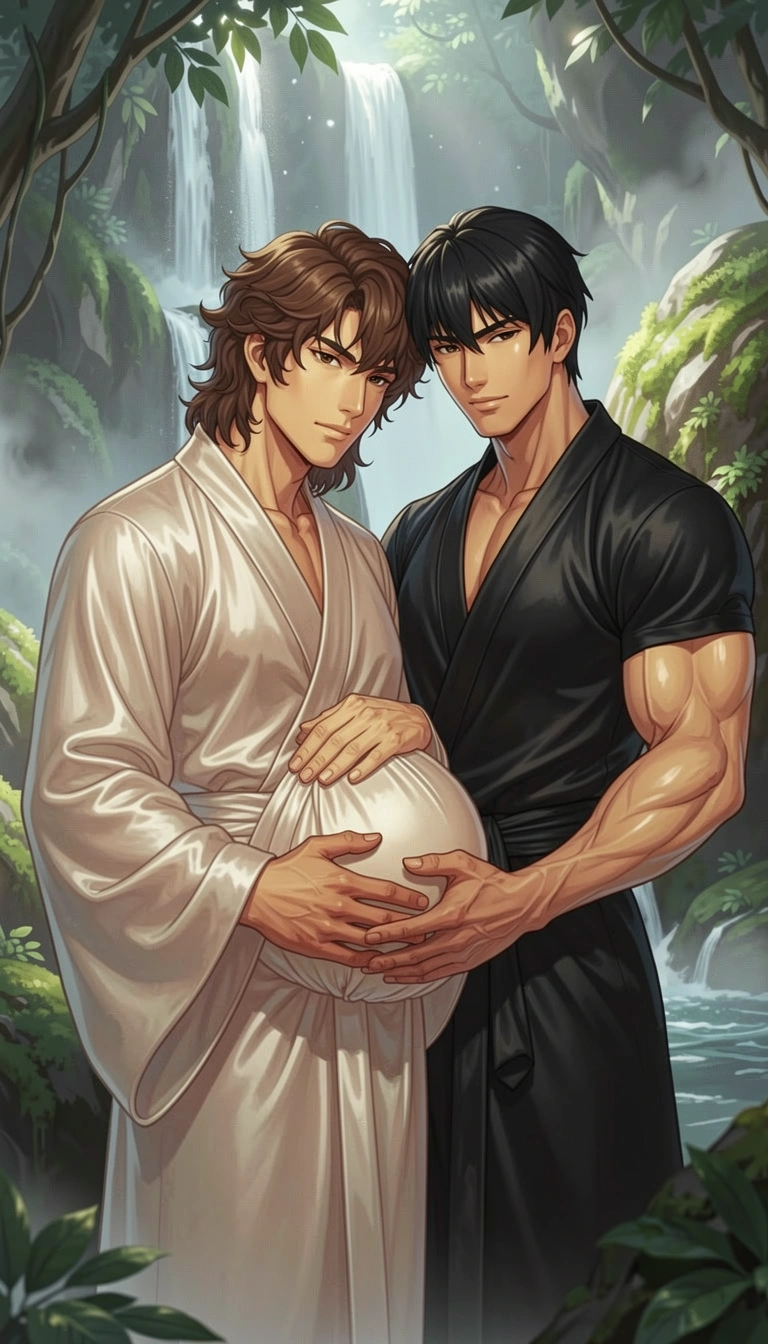
The torn robe slipped further as he stood, the fabric gaping at his shoulder, falling in folds around his waist. His body shook. His legs trembled beneath him, the muscles screaming after days of lying still, of bleeding, of healing, and he gripped the edge of the bed frame with one hand, his knuckles white against the carved wood, feeling the baby shift inside him, a roll of movement that pressed against his ribs.
Pond took a step toward him, his hand reaching out. "Phuwin—"
"Do not." Phuwin did not look at him. His gaze stayed fixed on the garden door, on the rectangle of darkness beyond, where the jasmine scent poured in and the waterfall thrummed its endless pulse. "Do not touch me. Do not follow me. Do not—" His voice cracked, and he swallowed, and his hand tightened on the bed frame until the wood creaked under his grip. "I need to go. I need to—" He did not finish. He did not know what he needed. He only knew that he could not stay in this room, in this bed, in this body that had been taken apart and put back together so many times he no longer recognized the seams.
He let go of the bed frame. His legs held, barely, and he took a step toward the garden door, the stone cold beneath his bare feet, the torn robe slipping again, sliding off his shoulder and pooling at his elbow, and he did not stop to fix it. He did not look back. He walked toward the darkness, toward the jasmine, toward the sound of water falling, and his body shook with every step, and the baby kicked, and he did not wipe the tears from his face.
He reached the doorway of the bedchamber and paused, one hand gripping the carved frame. The moonlight caught his profile—the sharp line of his jaw, the hollow of his throat, the bruise still dark on his cheekbone from Tarven's hand. Behind him, the room held its breath: the tangled silk sheets, the overturned chair where he had sat while the healer delivered her impossible numbers, the empty basin still stained pink from the cloths they had used to clean his hands.
Phuwin did not turn around.
His hand trembled on the doorframe. The wood was warm beneath his fingers—warm from the years of his palm, from the weight of this chamber, this marriage, this life he had built inside these walls, room by room, daughter by daughter. He had walked through this doorway a thousand times. He had carried each of his children through it, swaddled and sleeping. He had been carried through it himself, bleeding, after Ovoale's body was brought in. He had lain in that bed while Pond held him through the night, and he had believed—foolishly, desperately—that holding was enough.
His fingers curled against the frame. His nails scraped the carved wood.
Behind him, Pond said his name again. Soft. Like a wound being touched.
"Phuwin."
He heard the weight of it. The fear. The man who had held his hand in the carriage while blood pooled under his thighs. The man who had knelt beside him in the East corridor, promising vengeance over Ovoale's cooling body. The man who had, three hours ago, calculated the cost of their daughter's life against the cost of a lantern festival.
Phuwin's breath came out in a shudder. He did not speak.
He stepped into the hall.
The stone was cold under his bare feet. The corridor stretched before him, dark and silent, lit only by the sconces at either end—dim, wavering, insufficient. He had walked this corridor a hundred times in the dark. He knew every loose stone, every creaking board, every shadow that a certain angle of moonlight cast against the wall like a reaching hand. He had walked it barefoot before, in the early months of each pregnancy, when sleep abandoned him and the palace was the only place that felt quiet enough to breathe.
It did not feel quiet now.
The silence behind him was louder than any sound Pond could have made. Pond did not follow. Pond did not call out again. Only the sound of Phuwin's own breathing, ragged and wet, and the soft slap of his bare feet on the stone, and the distant pulse of the waterfall, growing closer with every step.
He passed the first doorway. The second. The hall where Imaria's training tunic hung on a hook, still damp from her morning drills. He saw it out of the corner of his eye—the worn leather, the frayed stitching—and his step faltered, just for a moment. Imaria. His firstborn. Where was she? He did not know. He had not asked. He had been lying in that bed, hollow and numb, while his eldest daughter moved through the palace alone, and he had not asked.
His hand found the wall. He leaned against it, his palm flat against the cold stone, his forehead dropping forward until it touched as well. The baby kicked again—harder this time, a sharp jab against his ribs—and he pressed his other hand to his belly, feeling the movement, the life inside him that refused to stop growing, refused to stop demanding, even now, even when everything else had fallen silent.
He pushed off the wall. Kept walking.
The staircase appeared at the end of the corridor, spiraling down into darkness. He took the first step, then the second, his hand sliding along the banister, the wood smooth and worn from generations of palms. His legs ached. His palm throbbed where the glass had cut him. His ribs were still tender from Tarven's knee, and every breath came shallow, careful, as if his body were a thing he had to negotiate with to keep moving forward.
Down. Step after step. The torchlight flickered, casting his shadow long and distorted against the curved wall. He passed the landing where Ovoale had once sat, legs dangling through the balusters, waiting for him to come up from the kitchens with honey cakes. She had been seven. Her hair had been escaping its braids, as always, and she had grinned at him with a missing front tooth, and she had said, Mama, you walk so slow. I've been waiting forever.
He reached the bottom of the stairs. His hand found the door frame. He pushed open the heavy oak door that led to the garden wing, and the night air hit him full in the face—cool and damp, carrying the green smell of wet grass and the sharp sweetness of night-blooming jasmine. The garden stretched before him, silver and black under the moon, the hedges casting long shadows across the gravel paths, the fountain at its center a dark shape against the lighter stone of the terrace.
He stepped onto the gravel. The stones bit into his bare feet, sharp and cold, and he welcomed the pain. It was something real. Something he could feel that was not grief, not rage, not the endless turning of his own thoughts in the dark.
He walked. Past the rose bushes, their thorns catching at the torn silk of his robe, tugging like small, insistent fingers. Past the bench where he had sat with Xiana two days ago, reading her a story about a princess who tamed a dragon. The book was still there, spine-up, the pages damp with dew. He did not stop.
The garden path curved toward the eastern gate—the gate that should have been guarded, the gate that Tarven had planned to use. Phuwin's steps slowed as he approached it. The iron was dark, the lock intact. No guards stood at its posts. The palace had not yet found its feet again. The attack had come and gone, and the people who were meant to protect this place were still counting their dead, still searching the corridors for the wounded, still trying to understand what had happened.
Phuwin kept walking. He passed the gate without touching it. He passed the wall where the jasmine grew thickest, where the scent was so heavy it sat on his tongue like something almost edible. He passed the small wooden door that led to the kitchen garden, where Ovoale had once hidden from her tutors for an entire afternoon, curled between the tomato plants, reading a book by the light of a single candle.
The tree line rose ahead of him. The forest.
He did not hesitate. He stepped off the gravel and onto the soft earth of the path that led through the woods, and the trees closed around him, swallowing the moonlight, muting the sound of the palace behind him. The air changed—cooler, damper, thick with the smell of moss and decay and living things. The path was narrow, barely visible in the dark, but he knew it. He had walked it a thousand times. It led to the waterfall.
His breath came faster now, not from exertion but from something else—something building in his chest like a pressure that needed release. His hands shook at his sides. His teeth were clenched so hard his jaw ached. The baby moved inside him, restless, as if it felt the storm gathering in its mother's body, and he pressed his palm against his belly, not to soothe the child but to hold himself together.
The path opened suddenly, and he was there.
The waterfall pool lay before him, black and silver under the moon, the water cascading from the cliff above in a continuous sheet that caught the light and shattered it into a thousand fragments. The sound filled the clearing—deep, constant, older than any grief. The spray rose in a fine mist, cool against his face, and the rocks at the edge of the pool were dark and slick, worn smooth by centuries of water.
Phuwin stopped at the edge. His chest heaved. His legs gave out beneath him.
He dropped to his knees on the damp grass at the edge of the pool, and the impact jarred through his body, and the sound that came out of him was not a sob—it was a scream. Raw. Ugly. Tearing out of his throat like something that had been clawing its way up for days, for weeks, for years, and had finally found the surface.
He screamed until his voice broke. He screamed until the sound dissolved into the waterfall's thunder, swallowed whole, as if it had never been. He screamed until his throat was raw and his chest was heaving and his vision blurred with tears that would not stop falling, streaming down his face, dripping from his chin onto the grass where they disappeared without a trace.
"Fuck you," he said. His voice was hoarse, barely a whisper. Then louder: "Fuck you, Pond."
The words came out broken, jagged. He pressed his hands against the grass, his fingers curling into the wet earth. "I don't understand. I don't understand why you have become this man." His breath hitched. A sob caught in his throat. "I'm tired. I'm so fucking tired of you choosing this empire over our family. Over and over and over again."
He hit the ground with his fist. The impact sent a shock up his arm, and the pain was sharp and clean, and he hit it again, and again, until his knuckles split against the stones hidden in the grass, until his skin broke open and blood smeared across his fingers, dark and warm in the moonlight.
"Fuck you," he breathed. His hands were shaking. His whole body was shaking. He pressed his forehead against the grass, the wet blades sticking to his skin, and he felt the baby shift again, a slow roll, a kick against his hip. "Fuck you and this empire. Fuck everything you have built. Fuck—"
His voice cracked. He stopped. He stayed there, on his knees, his forehead in the grass, his hands bloody, his robe soaked through at the knees, and the waterfall thundered on, indifferent, eternal.
And then the images came.
He was holding Ovoale. She was in his arms, and she was heavy, and she was cold, and her hair was tangled and matted with blood, and he was holding her against his chest, her cheek pressed to his collarbone, her eyes closed, her lips slightly parted, and he was screaming. He was screaming her name. He was screaming for someone to help, for someone to wake her, for someone to tell him this was a nightmare he would wake from, that she would open her eyes and grin at him with her missing tooth and say, Mama, you're being dramatic.
But she did not open her eyes. She did not move. And he was holding her, and the guards were trying to take her from him, their hands on her arms, her legs, her small body that had been whole and warm and laughing just hours ago, and he was screaming at them to let go, to get away, to leave his baby alone.
"No—no, don't touch her—don't—"
He was shoving them. He was kicking. He was holding Ovoale so tightly his arms ached, his hands tangled in her hair, the blood soaking through his robe, warm and wet against his chest. "This is my child. This is my beautiful baby. My baby—"
Someone grabbed him. Pond. Pond's arms around his waist, pulling him, lifting him, trying to separate him from Ovoale's body. And he screamed. He screamed and he thrashed, his feet kicking against Pond's shins, his hands still gripping Ovoale's shoulders, her hair, her cold fingers. "Don't take her—Pond, don't let them take her—she's my baby—"
Pond was saying something. He could hear the words, but they did not reach him— it's okay, it's okay, let her go, let them take her —and he twisted in Pond's grip, his fist connecting with Pond's chest, his body thrashing, his voice raw and ragged. "It is not okay! It is not okay! This is my baby, Pond, this is our baby—"
His arms gave out. His grip loosened. Imaria stepped forward, pale-faced, her amber eyes dry and burning, and she took Ovoale from him. She lifted her sister's body with a strength that should not have existed in a thirteen-year-old girl, and she carried her to the stretcher, and she laid her down, and she straightened her dress, and she tucked a strand of hair behind her ear, and she did not cry.
Phuwin's body collapsed. Pond caught him. Pond's arms closed around him, pulling him against his chest, and Phuwin kicked and screamed and beat his fists against Pond's shoulders, against his ribs, against his face—and then he stopped. His fists opened. His fingers curled into Pond's tunic, and he pressed his face into the hollow of Pond's neck, and he sobbed.
"Pond." His voice was small, broken, barely a sound. "Pond. Pond. Pond."
He said it over and over, as if the name were the only thing holding him to the earth. And Pond held him, and he watched over Pond's shoulder as the stretchers were carried away—Ovoale's body, Star's body—and the world went dark around the edges, and he kept saying the name, kept holding on, even as the darkness pulled him under.
Pond. Pond. Pond.
Phuwin's eyes snapped open. He was on his knees at the edge of the waterfall pool, his hands bloody, his face wet with tears, his chest heaving with breath that would not come fast enough. The images receded, leaving only the afterimage of Ovoale's face, her closed eyes, her blood in his hands.
He gasped. A strangled sound. His hands scrambled at the grass, at the stones, looking for something to hold onto, something solid, something real. His breath came in short, sharp bursts—hyperventilating, his chest tight, his vision swimming at the edges. The baby kicked, hard, and he doubled over, one hand pressed to his belly, the other braced against the wet earth.
He coughed. He choked. He tried to breathe, but the air would not come, would not fill his lungs, and he was drowning on dry land, drowning in the memory of his daughter's body in his arms, drowning in the sound of his own screaming, drowning in the knowledge that she was alive—alive but silent, alive but gone, alive but unreachable in a way that might as well be death.
He gasped again. His body shook. The waterfall thundered on, indifferent, eternal.
And then the world went dark.
His body slumped forward, his shoulder hitting the grass, his cheek pressing into the cold wet earth. The baby moved one last time, a gentle roll, a soft pressure against his ribs. And then the waterfall filled the silence, and the forest breathed around him, and the moonlight fell across his still form, the torn robe spread around him like broken wings, his bloody fingers curled loosely in the grass, his lips slightly open, his face wet with tears that continued to fall even after he had stopped moving.