
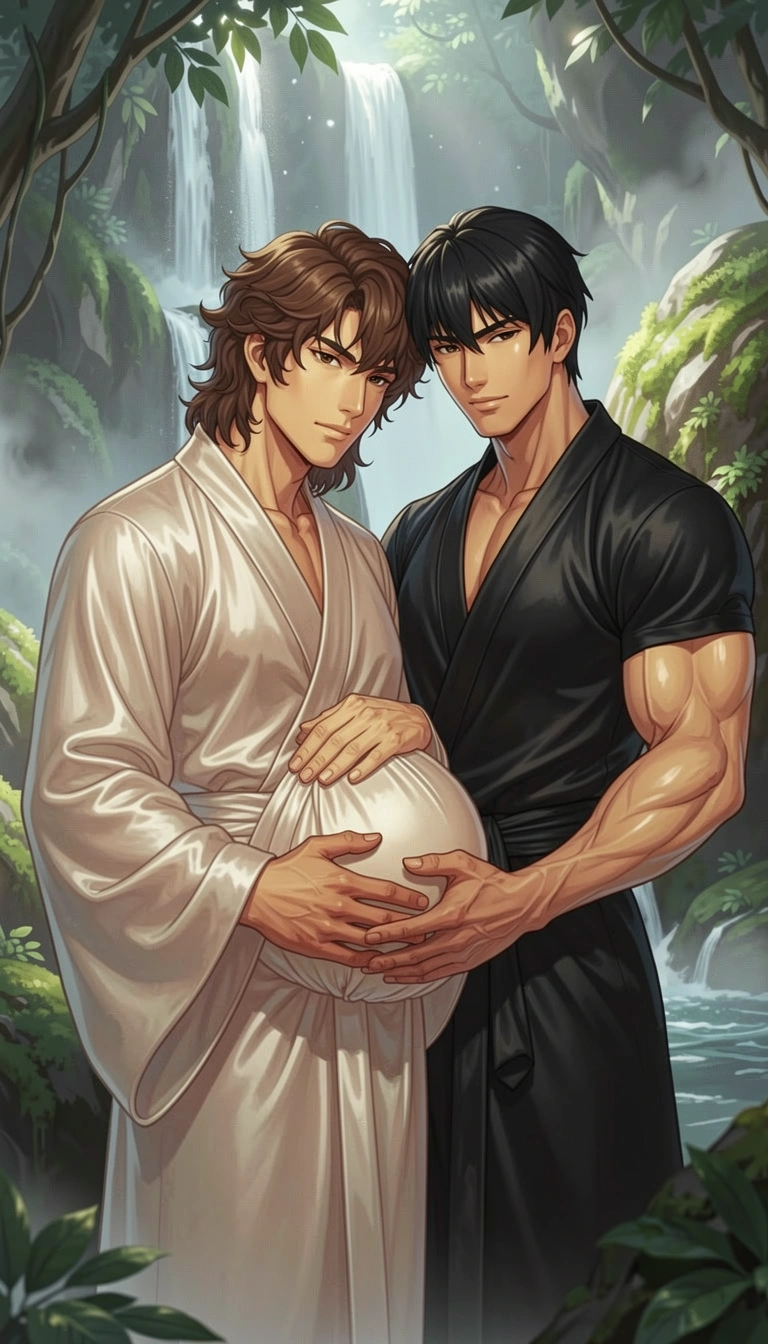
The wood creaked under Pond's grip. A small sound, almost lost beneath the waterfall's distant thunder and the rustle of jasmine leaves through the open garden door. His knuckles had gone white, the tendons standing out against his skin like roots beneath soil, and he was staring at a point on the far wall where the tapestry showed a hunting scene—horses, hounds, a stag at bay—as if the answer to everything might be woven into the threads.
Phuwin's hand slid from his belly. The movement was slow, deliberate, as if he had to remind his fingers that they belonged to him. They found the torn edge of his robe where the silk had ripped during the corridor, where Tarven's hands had pulled and twisted until the fabric gave way, and he gathered the edges together, pressing them flat against his chest, covering the bruise that was already purpling beneath his collarbone.
The healer cleared his throat. A soft, careful sound, the kind a man makes when he does not know if he is allowed to speak. Neither Pond nor Phuwin acknowledged it. The ledger in his hands was still open, the ink still wet on the page where he had written the sum—one million, three hundred thousand gold pieces, a number that sat on the paper like a wound that had not yet begun to bleed.
Phuwin's bare foot moved against the stone floor. A small motion, barely visible beneath the hem of his robe—his toes finding a crack in the mortar, tracing its jagged line as if it were a map, as if the answer to everything might be written in the flaws of the palace he had called home for thirteen years.
The silence stretched. It filled the room like water, rising past their ankles, their knees, their chests. The healer's ledger trembled in his hands, the pages whispering against each other. The jasmine scent drifted through the open door, sweet and unbearable, the smell of a world that was still turning, still blooming, still utterly indifferent to the fact that Ovoale's hair was matted with blood and Star's hands had been cold when they lifted her onto the stretcher.
Pond's jaw worked. He had not turned yet. His shoulders were a hard line beneath his robes, the muscles of his back tight enough that Phuwin could see the tension through the fabric, could count each vertebra where the cloth pulled taut. His hand was still on the bedpost, and the wood had begun to groan under the pressure, a low complaint that seemed to come from somewhere deep in the grain.
"Your Majesty." The healer's voice was barely above a whisper. "I understand this is difficult. But time is not on our side. The root must be harvested while the moon is still in its dark phase, and that is—" He glanced at the window, at the pale light filtering through the curtains. "That is three days from now."
Three days. The number settled in the room like a stone dropped into still water. Three days to find a million gold. Three days to send men to cliffs that had already swallowed every soul sent to them. Three days to decide if a festival was worth more than the life of a child who had hidden his father's shoes in the garden and laughed with her whole body when she was found out.
Phuwin's toe stopped moving. It pressed into the crack in the mortar, hard enough that the edge of the stone bit into his skin, and he felt it, the small sharp pain, the proof that he was still in his body, still alive, still here.
He looked down at his hands. They were wrapped in the torn silk of his robe, the fabric bunched and wrinkled where he had pulled it closed. There was blood under his nails. He did not know whose. His own, probably, from the shattered glass case in the tower. Or maybe Ovoale's, from when he had held her, from when he had pressed his palm against her wound and felt her blood pulse between his fingers, warm and then cooling, warm and then cooling, warm and—
He closed his eyes. The waterfall filled his ears. The jasmine filled his nose. The baby kicked, a sharp movement against his bladder, and he felt it, the small insistent demand of a life that did not know it had almost been lost, that did not know its sister was lying in a room somewhere with a brain that had forgotten how to wake up.
"The festival," Pond said. His voice was low, flat, the voice he used when he was reading trade agreements or signing execution orders. The voice of a man who had learned to separate his feelings from his words because feelings had no place on paper. "The harvest festival funds the eastern granaries for the winter. It pays for the roads that let grain reach the northern provinces. It keeps the capital's poor from starving when the snow comes."
He was still facing the wall. Still gripping the bedpost. Still speaking to the tapestry of the stag at bay as if it could hear him, as if it mattered whether the stag understood.
"The eastern granaries," Phuwin repeated. The words came out soft, almost curious, as if he were tasting them, turning them over in his mouth to see what they were made of. "The roads. The northern provinces."
"Yes." Pond's voice did not waver. "The people depend on that money. The merchants, the farmers, the families who line the streets when the lanterns are lit. Ovoale herself—" He stopped. His throat moved, a swallow that seemed to cost him something. "Ovoale herself begged to see the lanterns this year. She told me she wanted to release a sky-lantern with her sisters, that she had saved three copper pieces for it, that she had hidden them in a pouch under her mattress so no one would find them."
The healer's ledger trembled again. A single drop of ink fell from the nib of his pen, landing on the page, blooming into a dark flower that spread across the neat columns of numbers.
Phuwin's hand pressed flat against his belly. The baby had stopped kicking. He could feel the weight of it, the curve of its spine pressed against his palm, the small flutter of its heartbeat beneath the layers of skin and muscle and amniotic fluid. Alive. Still alive. Still demanding to be felt.
"You were speaking to her," he said, his voice still soft, still curious. "Before the guards came. You were speaking to her about the lanterns."
Pond's silence was the only answer he needed.
"She was in my office," Pond said, after a long moment. "She wanted to know if I would join them. She said she had saved a lantern just for me, that she would write my name on it, that I could wish for whatever I wanted and the sky would carry it to the gods." His voice cracked, just slightly, on the last word. "I told her I would think about it."
Phuwin's toe found the crack again. He pressed into it, harder this time, feeling the stone bite into his skin, feeling the small bright pain that kept him tethered to this moment, to this room, to this body that had been used and broken and was still, impossibly, still standing.
"And what did you decide?" he asked. "Did you think about it?"
The question hung in the air. The healer had stopped breathing. The ledger was still trembling, the ink still blooming, the dark flower still spreading across the page as if it were trying to consume the numbers, to erase the sum that sat between them like a wall that could not be climbed.
Pond turned. It was a slow movement, the turn of a man who was carrying something heavy and did not want to drop it. His face was pale beneath his tan, the lines around his mouth deeper than they had been this morning, the shadows under his eyes dark enough to look like bruises. He looked at Phuwin, and for a moment, just a moment, his composure cracked, and Phuwin saw what was underneath—the same grief, the same rage, the same desperate clawing at a world that had taken everything and was still asking for more.
"I told her I would join them," he said. "I told her I would write my wish on her lantern, and that she could write hers on mine, and that we would release them together, and that whatever we wished for would come true because the sky would not dare refuse an emperor's daughter."
Phuwin's hand stilled on his belly. His gaze lifted from the crack in the floor, traveled up the length of Pond's robes, across the broad chest, the tight jaw, the eyes that were holding his with an expression that looked almost like begging.
"You cannot be talking about a fucking festival right now."
The words cut through the room like a blade through silk—clean, sharp, leaving a silence that seemed to widen at the edges. Phuwin's voice was not loud. It was barely above a whisper, the kind of whisper that carried more weight than any shout, the kind of whisper that made the healer's ledger stop trembling and the jasmine scent seem to curdle in the air.
Pond's mouth was still open, the words he had been about to speak dying on his tongue. He stared at Phuwin, at the pale face, the torn robe, the bare feet on the cold stone, and something in his expression shifted—a flicker of surprise, as if he had forgotten, for a moment, that his husband could sound like that, could wield his voice like a weapon he had never bothered to sharpen.
"The harvest festival," Pond said, and his voice was careful now, the voice of a man trying to find solid ground in a room that had suddenly become unstable. "Phuwin, I understand—"
"Do not." Phuwin's hand pressed flat against his belly, hard enough that the fabric of his robe stretched over the curve. "Do not tell me you understand. Do not stand there and tell me you understand when you are talking about lanterns and granaries and roads while our daughter lies in a room with a wound in her chest and a brain that has forgotten how to wake up."
The healer took a step back. A small, instinctive movement, the retreat of a man who knew he was standing in a room where a storm was about to break and did not want to be caught in the rain. His ledger was still open in his hands, the ink still wet on the page, and he looked down at it as if he were reading words he had never seen before.
"The eastern granaries," Phuwin said, and the words were bitter now, sharp-edged and splintering. "The roads. The northern provinces. The poor who will starve when the snow comes. I have heard this before, Pond. I have heard it in every council meeting, every dinner, every night when you came to bed with numbers in your mouth and told me that the kingdom needed something I could not give it." He took a step forward, his bare foot leaving the crack in the mortar, and the movement was unsteady, his leg shaking beneath the weight of his body. "You told me the kingdom needed a son. You told me the kingdom needed an heir. You told me the kingdom needed—"
He stopped. His breath caught in his throat, a sound that was almost a sob but not quite, and his hand slid from his belly to his chest, pressing against the torn silk, pressing against the bruise that was spreading beneath his collarbone like a dark flower blooming under his skin.
"The kingdom," he said again, and his voice had gone quiet, so quiet that the healer had to lean forward to hear it. "The kingdom took everything. It took my son. It took my daughters' childhood. It took Star's life. It took Ovoale's—" His voice broke. He swallowed, his throat moving, and when he spoke again, the words came out raw, scraped clean of anything except the truth. "It took Ovoale's laughter. It took her voice. It took the way she used to run through the halls, the way she used to hide my shoes, the way she used to climb into my lap and tell me about the clouds."
Pond's hand left the bedpost. He took a step toward Phuwin, his arm reaching out, his fingers brushing the torn silk of Phuwin's sleeve. "Phuwin—"
"Do not touch me." Phuwin's voice was flat, empty, the voice of a man who had used up all his feeling and was running on something else now, something that felt like ice in his veins. "Do not touch me and tell me about the festival. Do not touch me and tell me about the people who depend on that money. Do not touch me and tell me that Ovoale wanted to see the lanterns because I know she did, I know she saved her copper pieces, I know she hid them under her mattress, I know because she told me, she told me every night for a week, she could not stop talking about it, she was so excited, she was so—"
His voice cracked again. He pressed his hand against his mouth, hard, as if he could push the sound back in, as if he could swallow it and keep it inside where no one would have to see it.
The healer cleared his throat again. "Your Majesties—" he began, and his voice was trembling, the ledger trembling, the ink still wet on the page where the dark flower was still spreading. "I understand this is difficult, but the root—"
"Leave." Phuwin's voice was soft. His hand was still pressed against his mouth, and the word came out muffled, but it carried. "Leave this room."
The healer's eyes went wide. He looked at Pond, searching for direction, for permission, for anything that would tell him what to do. But Pond was not looking at him. Pond was looking at Phuwin, at the hand pressed against his mouth, at the bare feet on the cold stone, at the torn robe that was slipping off his shoulder, revealing the edge of the bruise that was spreading beneath his collarbone like a dark flower that had been planted in his skin and was growing, growing, growing.
"I said leave." Phuwin's hand dropped from his mouth. His voice was louder now, sharp enough to cut, and his eyes were fixed on the healer with an intensity that made the man take another step back, then another, until he was at the door, his ledger clutched against his chest like a shield.
"I will be in the—in the eastern hall," the healer said, his voice stumbling over the words. "I will be there when you are ready to discuss—"
"Go."
The healer went. The door clicked shut behind him, and the room was suddenly smaller, the silence thicker, the jasmine scent pressing in through the open garden door like a presence that had been waiting for the right moment to enter.
Phuwin stood in the middle of the room, his bare feet on the cold stone, his torn robe slipping off his shoulder, his hand pressed against his belly, and he did not look at Pond. He looked at the open garden door, at the patch of sky visible through the frame, at the pale blue that was already darkening toward evening, and he thought about Ovoale's voice saying she had saved a lantern for him, that she would write his name on it, that he could wish for whatever he wanted and the sky would carry it to the gods.
"I do not give a fuck about a damn festival," he said, and his voice was quiet again, the ice back in his veins, the words coming out cold and precise. "Our daughter will not be there to witness it. Our other daughter lies with a broken ankle in a room somewhere, and I do not even know if anyone has checked on her today, if anyone has brought her water, if anyone has told her that her sister is alive but not awake, that her mother was raped by the men her father swore to protect her from."
The words hung in the air. Phuwin's hand slid from his belly to his side, and he felt the torn silk of his robe shift, felt the cool air against his skin, felt the bruise throbbing beneath his collarbone as if it had a heartbeat of its own.
"You swore," he said, and his voice was trembling now, the ice cracking, something raw and bleeding pushing through the cracks. "You swore to protect me. You swore that the palace was safe. You swore that no one would ever touch me again, that no one would ever hurt me, that you would burn the world down before you let anyone lay a hand on me or our children." He turned, finally, and looked at Pond, and his eyes were wet, the tears spilling over, tracing lines down his cheeks that caught the fading light from the garden door. "And I believed you. I believed you, Pond. I believed you when you said you would protect us, and I let my daughters walk through those halls without guards, and I let myself believe that the walls were enough, that the gates were enough, that you were enough."
He wiped his face with the back of his hand, a rough, angry motion, as if he were trying to erase the tears, as if he were trying to erase the weakness they represented. "But you were not enough. You were not there. You were at a council meeting, reading grain reports, and they came through the gate, and they took our daughters, and they—" His voice broke. He pressed his lips together, hard, and when he spoke again, the words came out in a rush, as if he were trying to get them out before they could choke him. "Tarven put his hands on me, Pond. In the corridor where our daughters have walked a thousand times. Where Ovoale has run and laughed and hidden from her tutors. Where Xiana has drawn pictures on the walls with chalk that the maids have to scrub off. He put his hands on me, and our daughters saw it, and Star died trying to stop it, and you were reading grain reports."
Pond's face had gone pale. His hands were at his sides, his fingers curling and uncurling as if he were trying to find something to hold onto, something to anchor himself in the storm of Phuwin's words. "I know," he said, and his voice was hoarse, the words scraping against his throat. "I know, Phuwin. I know I failed you. I know I failed our daughters. I know that Star is dead because I was not there, because I did not see, because I was too busy looking at numbers on a page to see what was happening in my own palace."
He took a step forward, then another, and this time Phuwin did not tell him to stop. "But I am here now. I am here, and I am telling you that I will find a way. I will find the gold. I will send men to the northern cliffs. I will bring back the root, and I will watch Ovoale wake up, and I will hold her when she opens her eyes, and I will tell her that her mother never gave up, that her mother fought for her, that her mother—"
"You will send men." Phuwin's voice was flat again, the ice returning. "You will send men to the northern cliffs. Men who will die, like the ones before them. Men whose families will mourn them, whose children will grow up without fathers, whose wives will receive letters telling them that their husbands fell in service to the emperor." He looked at Pond, and his eyes were dry now, the tears spent, leaving behind a hollow emptiness that was worse than the crying had been. "And for what? For a root that might not even work? For a chance that is not even large?"
"For Ovoale." Pond's voice was barely a whisper. "For our daughter. For the chance to hear her laugh again, to see her run through the halls, to watch her hide my shoes in the garden and pretend she has no idea where they are."
Phuwin's hand moved to his belly. The baby was kicking again, small insistent movements against his palm, and he pressed down, feeling the curve of its spine, the flutter of its heartbeat, the impossible fact of its existence in a world that had taken so much already.
"I still blame myself," he said, and his voice was quiet, so quiet that Pond had to lean forward to hear it. "I still blame myself for everything. For my beauty, for the way men look at me, for every hit and every tear and every moment of pain that has touched our family since the day I walked into this palace." He looked down at his hands, at the torn silk wrapped around his fingers, at the blood still crusted under his nails. "I blame myself for what Tarven did. For what he wanted. For the way he looked at me, like I was something to be taken, something to be used, something that existed only for his pleasure."
His breath caught. He pressed his hand against his mouth again, hard, and when he spoke, the words came out muffled, broken, falling from his lips like stones dropped into deep water. "I should have been stronger. I should have fought harder. I should have—"
"Do not." Pond's voice was sharp, cutting through Phuwin's words like a blade. "Do not do this. Do not blame yourself for the evil of men who chose to do what they did. You did not ask for this. You did not invite this. You were walking through your own palace, in your own home, and they took you, and they hurt you, and none of that is your fault."
He crossed the room in three long strides and stopped in front of Phuwin, close enough that Phuwin could feel the heat of his body, could smell the familiar scent of him—sandalwood and ink and the faint trace of sweat from a day spent holding vigil. "Look at me," he said, and his voice was soft now, the voice he used when they were alone, when the doors were closed, when the world was somewhere else and it was just the two of them. "Look at me, Phuwin."
Phuwin did not look up. His gaze was fixed on the floor, on the crack in the mortar, on the place where his toe had pressed until the stone bit into his skin. He could feel Pond's hand reaching for him, could feel the brush of fingers against his wrist, and he flinched, a small involuntary movement that made Pond's hand freeze in mid-air.
"Do not," Phuwin said, and his voice was barely a whisper. "Do not touch me. Not yet. I cannot—" He swallowed, his throat working, and when he spoke again, the words came out in a rush. "I cannot be touched right now. I cannot be held. I cannot be comforted. I need to—"
He stopped. His hand pressed against his belly, hard, and he felt the baby kick, felt the small insistent demand of a life that did not know it had almost been lost, that did not know its sister was lying in a room somewhere with a brain that had forgotten how to wake up.
"I need to go," he said, and his voice was steadier now, the ice back in place, the cracks sealed over. "I need to go to the waterfall. I need to—" He did not finish the sentence. He turned, his bare feet finding the cold stone, his torn robe slipping further off his shoulder, and he walked toward the open garden door, his steps unsteady but determined, his hand still pressed against his belly as if he were holding onto the last thing in the world that was still his.
"Phuwin." Pond's voice was behind him, desperate, reaching. "Phuwin, please. Do not walk away. Do not leave me here. I cannot—I cannot do this alone."
Phuwin stopped at the threshold. The garden was before him, the flowers bending in the evening breeze, the path leading toward the forest, the waterfall's distant roar a steady pulse beneath the rustle of leaves. He stood there, his bare feet on the edge of the stone, his torn robe catching the last light of the dying day, and he did not turn around.
"You are not alone," he said, and his voice was quiet, almost lost in the sound of the waterfall. "You have the kingdom. You have the festival. You have the eastern granaries and the roads and the northern provinces." He took a step forward, into the garden, the grass cool against his bare feet. "I have nothing left but this baby and the hope that Ovoale will wake up. And I will not let you take that hope from me by telling me about lanterns and grain reports and the cost of a root that might not even work."
He walked into the garden, and the flowers swallowed him, the jasmine scent wrapping around him like a shroud, the evening light painting his torn robe in shades of gold and shadow. Behind him, Pond stood at the threshold, his hand reaching out, his mouth open, his eyes wet with tears that he did not bother to wipe away.
And then Phuwin was gone, swallowed by the trees, the sound of his footsteps fading into the steady pulse of the waterfall, leaving Pond alone at the edge of the garden, his hand still reaching, his mouth still open, his heart still beating in a chest that felt like it had been hollowed out and left to dry in the sun.