
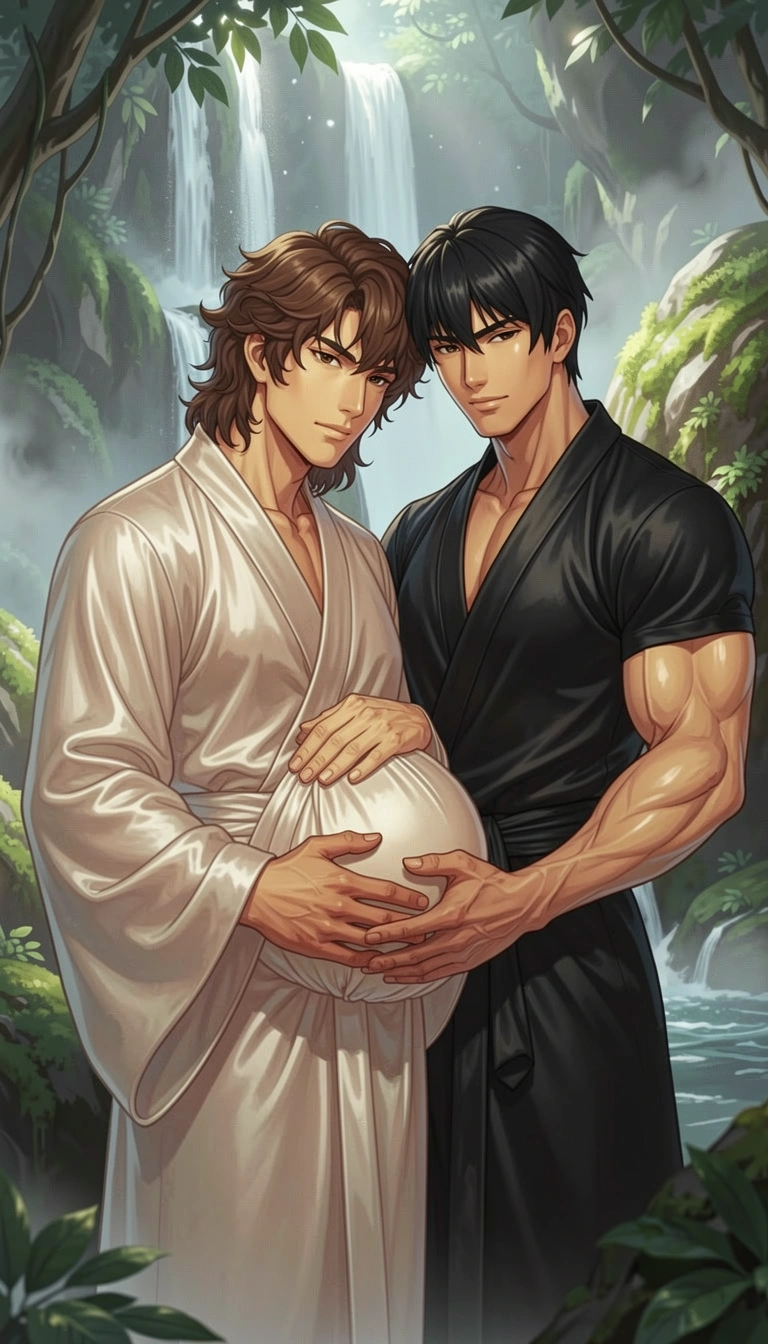
It had been one day since then, exactly that.
Phuwin lay curled in the center of the wide bed, his knees drawn toward his chest, his hand pressed flat over the mound of his belly. The crimson silk sheets were tangled around his legs, cool against his skin where the fabric had pulled away, and the single oil lamp on the bedside table cast long shadows across the stone floor—shadows that stretched and swayed as the flame trembled in a draft he could not feel.
Beneath his palm, the baby kicked.
A small roll, a press of a foot or a hand against the inside of his belly, the way all his children had moved before they were born—insistent, alive, demanding space. He had felt it a dozen times before. Each kick had once pulled a smile from him, a hand pressed back, a whispered promise. Now he did not react. He did not smile. He did not even blink. His eyes were open, fixed on the pattern of shadows on the far wall, but they saw nothing. He was still seeing Ovoale's face—the stillness of it, the way her dark hair had fanned across the stretcher, the bandage on her chest already soaked through. He was still hearing Star's last breath, the wet rattle of it in the courtyard, the way the fountain had kept running as if nothing had happened.
He was still running through every word he had said and not said. Every moment he could have moved faster, screamed louder, done something other than kneel and break.
Behind him, Pond's arm tightened around his waist. The warmth of his palm pressed against Phuwin's stomach, just beside Phuwin's own hand, their fingers overlapping in the hollow between his ribs and the swell of the baby. Pond's chest was solid against his back, his breath steady and slow, but Phuwin felt none of it. The weight of his husband's body, the heat of his skin, the familiar rhythm of his breathing—all of it passed through him like wind through a broken window, leaving nothing behind.
The silence stretched.
The candle flame dipped and rose. Shadows crept across the ceiling. Somewhere in the palace, a door closed, the sound muffled by distance and stone, and Phuwin did not flinch. He did not turn his head. He did not ask who it was, or whether they had found the nursery, or whether Aric was safe, or Kael, or Lirien—he could not ask, because asking meant hoping, and hoping meant he had room for anything other than this hollow numbness, and he had no room at all.
The baby kicked again. Harder this time. A sharp press that pushed against his hand, against the wall of his belly, as if demanding to be acknowledged. Phuwin's fingers did not move. He did not press back. He simply lay there, his hand flat and still, and watched the shadows.
Pond's palm was warm against his skin. The baby rolled beneath the touch—perhaps recognizing the weight of his father's hand, or perhaps just moving because that was what babies did, alive and unaware that the world outside had shattered. Phuwin felt the movement as a distant fact, like rain on a roof he no longer lived under.
Then—a knock.
Three soft strikes against the wooden door, hesitant but deliberate. A servant's knock. Or a maid's. Or a messenger's. Phuwin did not move. He did not turn. He did not even breathe differently. But beside him, Pond stirred.
The arm around Phuwin's waist loosened slowly, reluctantly, as if Pond was pulling himself away from something he was not ready to release. The bed shifted beneath his weight as he sat up, the silk sheets sliding across his skin, and Phuwin felt the absence of his body like a change in temperature—a cold that crept in where warmth had been.
"I'll get it," Pond said, his voice low and rough, the voice of a man who had not slept in two days and would not sleep for many more.
Phuwin did not answer. He did not nod. He did not even blink. But Pond must have seen something in his stillness—or heard nothing, which was answer enough—because he rose without waiting for a reply, his bare feet pressing into the cold stone floor as he crossed the room.
The robe lay across the foot of the bed. Pond pulled it on, the fabric sliding over his shoulders, and Phuwin watched him from the corner of his eye without turning his head. The oil lamp caught the line of his back, the breadth of his shoulders, the way his hands moved as he tied the sash—strong hands that had held him through the night, that had signed treaties and commanded armies, that had knelt beside him in a corridor full of blood and grief and had not let go.
Pond opened the door.
The hallway beyond was dark. A figure stood silhouetted against the torchlight—a woman in simple robes, a leather satchel slung over one shoulder. The healer. Phuwin recognized her by the shape of her, by the way she stood with her weight on one foot, her hands clasped in front of her. He had seen her in the aftermath of the surgery, in the carriage, in the room where Clove had saved his life. He did not know her name. He did not care to learn it.
"Your Majesty," she said, her voice quiet, careful, the voice of someone who had delivered bad news before and knew that loudness only made it worse.
Pond stepped aside. "Come in."
She entered, her feet making no sound on the stone, and closed the door behind her with a soft click. The satchel rustled as she set it down beside the chair near the bed—the chair that had held Clove, the chair that had held Pond, the chair that had held nothing but silence for hours on end. She lowered herself into it slowly, as if her bones ached, and folded her hands in her lap.
Phuwin still did not move. But his eyes shifted. Just slightly. Just enough to see her face.
The healer's face was unreadable. Not cold—not cruel—but blank in the way that came from having held too much news, too many truths, too many hearts that had broken in her hands. She looked at Pond, then at Phuwin, then back at her folded hands.
"I have news," she said. "About the princess. And the handmaiden."
Phuwin's throat closed. He had not asked. He had not let himself ask. But now she was here, and her hands were folded, and her face was blank, and the baby was still kicking against his palm, and he could not breathe.
"They are alive."
The words fell into the room like stones into still water. Phuwin heard them. He felt them land. But they did not make sense. They could not make sense. He had seen Ovoale's body carried in. He had seen the blood, the stillness, the bandage soaked through. He had felt her weight in his arms, the way she had not moved, the way her skin had already begun to cool. He had seen Star lying in the grass, her eyes open, the fountain still running beside her.
"What," he said, and his voice cracked on the single word, scraped raw from a throat he had not used in hours. "What do you mean?"
The healer's hands tightened slightly, the fingers interlacing. "They are alive," she repeated, and this time the words came slower, measured, as if she were choosing each one with care. "But they are not... whole. Their bodies took severe damage. Princess Ovoale's chest wound was deep. The handmaiden's stomach wound was worse. Both lost a great deal of blood before they were found."
Pond had crossed the room and stood at the foot of the bed, his hand gripping the carved wooden post, his knuckles white. "Alive how?" he said, and his voice was not gentle now—it was the voice of a man who had been told lies before, who had been given hope only to have it ripped away.
The healer looked up at him, then back at Phuwin, and for the first time, something flickered in her face—not hope, not sorrow, but something in between. "Their hearts still beat. Their lungs still draw breath. But their brains... are mostly silent. The damage from blood loss, from the time they lay without care—it has left them in a place between waking and sleep. They cannot speak. They cannot move. They cannot open their eyes."
The baby kicked again. Phuwin felt it as a distant pulse, a thing happening to someone else's body.
"They are alive," the healer said again, as if saying it enough times would make it true. "Their hearts still pump. Thin as thread, slow as winter, but still pumping. And with a specific medicine, a root that grows only in the northern mountains—there is a narrow chance they may wake."
Phuwin's breath caught. A sound escaped him—not a sob, not a gasp, but something in between, a small broken noise that he had not meant to make. He turned his head on the pillow, slowly, as if his neck was made of glass, and looked at the healer with eyes that had seen too much to be anything but hollow.
"What do you mean, wake?" His voice cracked again, higher this time, a child's voice in a man's broken throat. "They'll open their eyes? They'll talk? They'll—"
He could not finish the sentence. He did not know what he wanted to finish it with. He wanted them to sit up. He wanted Ovoale to laugh, to run, to steal his shoes and hide them in the garden. He wanted Star to bring him tea and pretend she had not seen him crying. He wanted the world to undo itself and start again from the moment before the guards had come through the gate.
The healer did not answer immediately. She looked down at her hands, and then she said, very quietly, "There is a chance. Not a large one. But a chance."
Phuwin's gaze dropped to his belly. To the mound of his belly where the baby was still moving, still alive, still demanding to be felt. His hand was still pressed flat against it, and he watched it now as if seeing it for the first time—the pale skin, the fingers splayed, the faint tremor in his wrist that he could not still.
A single tear slid from the corner of his eye, tracing a slow path down his temple, disappearing into his hair. He did not wipe it away. He did not close his eyes. He just lay there, his hand on his belly, the baby kicking beneath his palm, and for the first time in a day, his lips parted into something that was not quite a smile but was no longer a scream.