
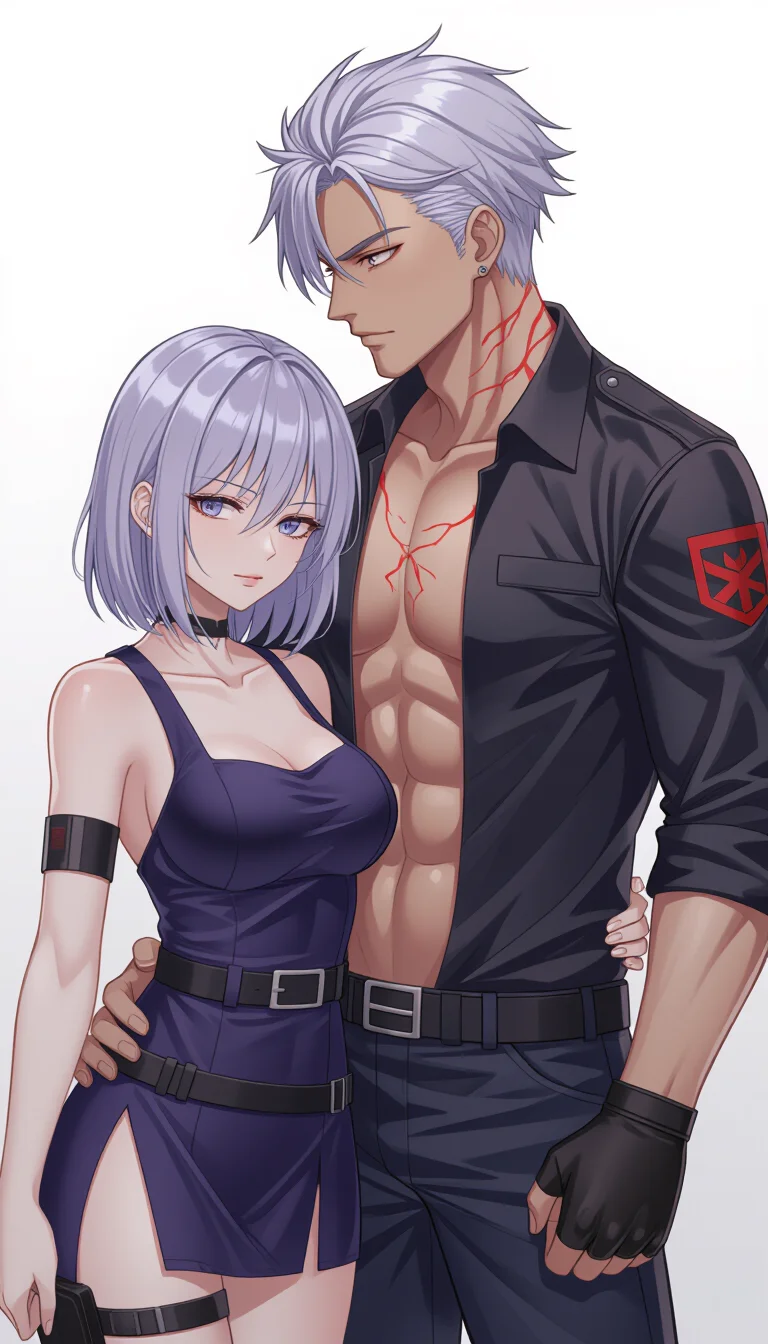
Charlie watched Nox’s hands—the same hands that had traced her spine with a lover’s reverence—now methodically disassembling a sidearm on their kitchen table. The motion was sterile, efficient, a ritual of becoming. Her breath felt thin. She didn’t need to fight him to leave; she just needed to stop pretending this version of him was a phase. ‘I can’t watch you erase yourself,’ she said, her voice quiet as a verdict. He didn’t look up, but his hands went still—the only confession she’d get.
The silence that followed was a solid thing. It filled the apartment, pushing against the smell of stale coffee and old grease from the cardboard containers by the sink. The streetlamp outside cut a sharp, yellow line across the floorboards, bisecting the space between them. She stood just outside its reach, in the shadow of the hallway. He sat within it, illuminated, a man at a workbench.
His stillness was more telling than any reaction. Nox didn’t startle, didn’t argue, didn’t flinch. He just stopped. The pieces of the gun lay before him on a microfiber cloth, oiled and gleaming. A spring. A slide. A barrel. Components of a system, laid bare. He was looking at them, but she knew he wasn’t seeing them. He was waiting for her to continue, to give him a problem he could solve. She wasn’t a problem. She was a conclusion.
“It’s not the work,” she said, her voice still low, but it carried in the quiet. “It was never the work. It’s the silence you bring home with you. It’s in your clothes. It’s in the way you look at the door like it’s a breach point. It’s the way you look at me.”
Finally, his eyes lifted. They found her in the shadows. In the bad light, they were flat, dark pools. The man who used to smile when she came into a room was gone. This version assessed. Calculated. “How do I look at you, Charlie?”
“Like I’m a variable.”
He didn’t deny it. He just watched her, his expression giving away nothing. It was the face he wore for strangers, for assets, for threats. It was the face of the thing he was becoming. A tool. A weapon. Something that had pared away everything unnecessary, and he was starting to include her in that category.
She took a step into the light. Her socked feet were silent on the wood. She stopped at the edge of the table, her gaze dropping to his hands. They were resting now, palms down on either side of the cloth. Strong. Capable. Scarred. She knew every callus, every old break. She knew how they felt tangled in her hair, skimming her ribs, holding her hips. The memory was a physical ache, a hollow pull deep in her stomach.
“Do you remember the night on the roof?” she asked. “In Mirror Park?”
His jaw tightened. A micro-expression. The only sign he was still in there. “Yes.”
“You talked for three hours. About the stars you could name. About the shitty coffee from that bodega on Vinewood. About the sound the river makes at 3 a.m. You were… present. You were here.” She gestured vaguely at the room, at him. “You haven’t been here in months. You’re just… preparing. For what, Nox? What’s coming that requires you to disappear now?”
“Survival isn’t a mood, Charlie. It’s a state of being.” His voice was even, devoid of defensiveness. It was a statement of fact. “The world doesn’t care if I’m present. It only cares if I’m ready.”
“And what about me?” The question slipped out, raw and quiet. “Do I care?”
He looked at her then, really looked, and for a fractured second, she saw it—the crack. A flicker of something like pain, swiftly buried under a layer of ice so thick it might as well have been stone. “You shouldn’t,” he said, the words final.
That was it. The verdict, from his own mouth. She felt the truth of it settle in her bones, cold and heavy. He was choosing the silence. He was choosing the cold. He was erasing the man she loved because that man was a vulnerability, and Nox was systematically eliminating vulnerabilities.
Her own control was a tight wire in her chest. She didn’t cry. She didn’t raise her voice. She observed the scene, as she’d been trained to do: the subject, the environment, the threat. The threat was the future. The threat was watching the last good thing in her life calcify into something efficient and dead.
She turned and walked to the bedroom. Not fleeing. Executing. Her movements were just as efficient as his had been. She pulled her go-bag from the back of the closet—not a suitcase, a weathered, olive-drab duffel she could run with. She’d packed it a week ago, a silent admission to herself that this was the horizon.
From the top drawer of her dresser, she took her service pistol—the one she’d turned in when she left the force, and he’d quietly retrieved for her—and a box of 9mm. From the bathroom, her toothbrush, her hair tie from the edge of the sink. She didn’t take the framed photo from the nightstand. She didn’t take the sweater of his she slept in. She took only what she needed to survive.
When she returned to the living area, he was standing. He had not reassembled the gun. The pieces still lay scattered, a puzzle abandoned. He was facing the window, his back to her, a broad silhouette against the city’s faint glow. His shoulders were rigid.
“The lease is paid through the quarter,” she said, her voice clinical. “My key is on the counter.”
He didn’t turn. “Where will you go?”
“Away from here.”
“Charlie.” Her name, from him, was a command and a plea fused into one syllable. It stopped her hand on the doorknob.
She looked back. He had turned halfway, his profile etched in the yellow light. The tension in him was visible now, a live wire humming under his skin. Every muscle was coiled. His hands were clenched at his sides.
“If you ask me to stay,” she said, each word precise, “you have to mean it. You have to choose it. Not the mission. Not survival. Me.”
The silence stretched. She could see the war in him. The brutal calculus. The part of him that was still her Theo, screaming behind his eyes. And the colder, newer thing, the survivor, smothering it. The survivor knew love was a liability. The survivor knew attachment was a flaw. The survivor won.
He said nothing.
Charlie nodded, once. Acknowledgment. Acceptance. She opened the door. The hallway air was cooler, smelling of disinfectant and dust.
“Don’t let them make you into a ghost,” she said, not looking back.
She closed the door behind her. The click of the latch was softer than a heartbeat.
The door clicked shut. Nox stood in the silence, the echo of her final words a cold stone in his gut. He turned back to the kitchen table. The disassembled pieces of the sidearm lay scattered across the scarred wood, gleaming dully in the streetlamp’s glow. His hands, which had trembled when her back was turned, were steady now. He began to reassemble the gun.
It was a ritual. Each component had a place, a sequence, a correct pressure. Spring. Slide. Barrel. Pin. His fingers moved with sterile, practiced efficiency. There was no reverence here, no connection to the tool. It was mathematics. It was order. The soft, metallic clicks of parts seating into place were the only sounds in the apartment. He did not think of her hands. He did not think of the way she’d traced the line of his jaw last week, her thumb catching on his stubble. He thought of torque. Of tolerance. Of a clean, predictable function.
The apartment felt different. It wasn’t just her absence. It was the collapse of a field. The coffee mug she’d used that morning sat in the sink, a faint ring of brown at the bottom. The throw blanket was crumpled on her side of the couch. These were not memories. They were artifacts. Data points in a space that had been neutralized. The air itself was thinner, colder, as if her warmth had been a physical pressure he hadn’t noticed until it was gone.
He seated the magazine with a solid, final click. The weapon was whole. He lifted it, checked the action. Smooth. Perfect. He set it down, aligned parallel to the table’s edge. His path was sealed. Not with a bang, but with the quiet, definitive sound of a slide locking home.
His body was a traitor. The coiled tension she’d seen hadn’t left. It had migrated, settled low in his abdomen, a hot, tight knot. His heart beat a slow, heavy rhythm against his ribs. He was aware of every breath, the expansion of his lungs feeling too sharp, too conscious. This was the cost of the silence he’d chosen. The survivor had won the argument, but the man was left to pay the physical toll. A faint tremor threatened in his right hand. He flattened it on the table, pressing down until the wood grain bit into his skin.
His gaze drifted to the key she’d left on the counter. A simple brass key. It looked absurdly small. It was the only thing out of place in the entire room. He should pocket it. Or discard it. Instead, he left it there. A test. A reminder.
He pushed away from the table and walked to the window. The street below was empty. No taillights pulling away. She was already gone, absorbed into the city’s grid. Charlie. The name was a fracture in his chest. He hadn’t meant to say it like that, fused from command and plea. It had escaped. A vulnerability, witnessed. He could still feel the shape of it in his mouth.
He cranked the window open. The night air rushed in, carrying the smell of wet pavement and distant traffic. It was bracing. It cleared the scent of her from the room—the faint, clean smell of her shampoo, the warmth of her skin. He breathed in the cold until his lungs ached.
The buzz of his encrypted phone was a violence in the quiet. He didn’t startle. He turned, plucking it from the table. The screen glowed. A single code: CAYO. Transfer confirmed. Report for assignment briefing. 0800.
He felt nothing. That was the point. The mission was a vacuum, and it was filling the space she’d left. He typed a one-character acknowledgment: R. Received.
He looked around the apartment. He would not sleep here tonight. The bed would smell like her. The silence would have texture. He collected the gun from the table, holstered it at his hip. He took his go-bag, always packed, from the closet. He did not look at the empty space where hers had been.
At the door, he paused. One last glance. The key on the counter. The mug in the sink. The shadows stretching across the floor where they had danced once, drunk on cheap wine and each other. A museum of a life he was choosing to leave.
Her words echoed, not in his ears, but in his bones. *Don’t let them make you into a ghost.*
He turned off the light. He stepped into the hallway, pulling the door shut behind him. The latch engaged with the same soft, final click. He did not lock it.
He walked away, his boots soundless on the worn carpet. The ghost, he thought, was already made. It was standing in a hallway, walking toward an elevator, feeling the cold weight of a gun against its hip. It was carrying the echo of a warmth it had voluntarily extinguished.
The elevator arrived. He stepped inside. The descent was smooth, silent. He watched the floor numbers blink downward. His reflection in the polished metal doors was a stranger—all sharp angles and hollows, eyes that gave back nothing.
The lobby was empty. The night security guard nodded, used to his odd hours. Nox pushed through the glass doors into the night. The air was a slap. He stood on the sidewalk, the city humming around him.
He had made his choice. It was the correct one. The strategic one. The survivor’s choice. So why did his chest feel like it had been excavated? Why did every breath seem to scrape against a raw, internal edge?
He brought a hand to his sternum, pressing hard, as if he could physically push the feeling down. It didn’t work. The ache was a lodestone. It had weight. It had gravity.
He started walking. No destination. Just movement. The rhythmic impact of his steps on concrete was a mantra. Left, right, left. The city lights blurred into streaks of color. He walked until the feeling wasn’t pain, but a dull, constant pressure. A companion. The only one he had left.
He stopped on a bridge overlooking the black water of the river. He gripped the cold railing. Below, the water moved, endless and indifferent. He could throw the key in. He could throw the phone in. He could follow them down.
He did not. That was not an option. Survival was a state of being. It was forward motion. It was the next mission, the next order, the next breath.