
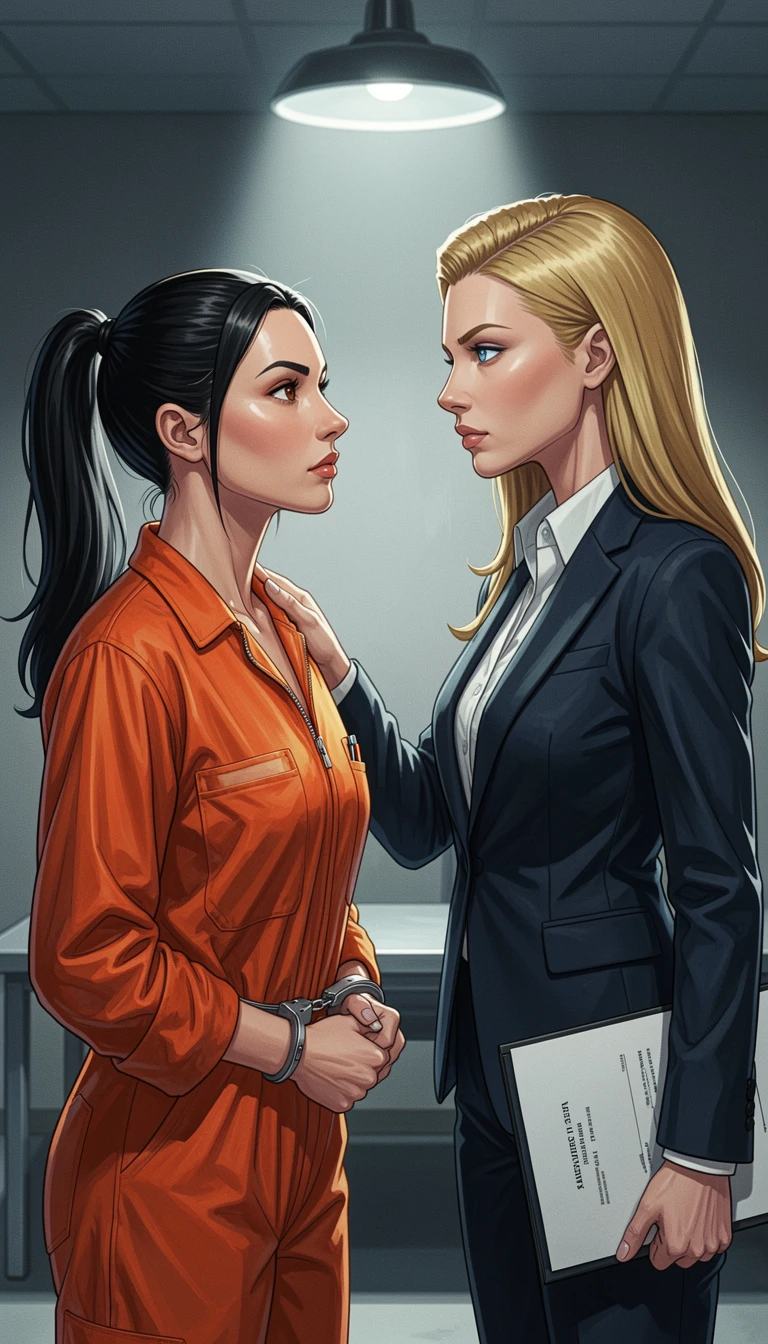
The door opened without a knock, and Kate Sheridan came in with her phone already lit, held up like a warrant. She did not sit. She stood at the edge of the table, in the fall of the single lamp, and the blue glow of the screen threw her cheekbones into a hard relief that the room's one bulb had never managed.
Mara looked up from her hands. She had been counting the seams in the steel table — eleven, if you counted the one the light didn't reach — and she had gotten as far as the fourth before the door moved. A week in this chair had taught her the sound of every hinge in the building. This one had a catch in it. She heard the catch.
"You're supposed to knock," she said.
"I'm supposed to do a lot of things." Kate turned the phone toward her. "Watch."
The screen held a face Mara knew without needing the chyron. Elena Voss, mid-thirties, dark bob blown sleek, pearl studs catching the studio lights, sitting in the anchor chair she usually occupied at six and ten. Tonight she was not reading the news. She was being the news — a guest on someone else's set, hands folded on the desk in front of her, mouth moving with the particular composure of a woman who had rehearsed her grief until it looked like calm.
The banner underneath ran in a crawl, and Kate let it run, and Mara read it twice before the words stopped rearranging themselves into something survivable. EXCLUSIVE: SLAIN MAID'S FINAL MOMENTS — SISTER OF MISSING PRESENTER BREAKS SILENCE ON WATTS CASE.
"She gave an interview," Kate said.
"I can see that."
"She gave it today." Kate thumbed the volume up. The room's ozone-and-leather smell seemed to sharpen, the way it did when the air handler kicked on, and Mara felt the cold of the table come up through her forearms and settle somewhere behind her sternum.
Elena Voss's voice came out of the little speaker, compressed and tinny, and somehow that made it worse — a woman's voice reduced to a phone, describing a body. "…and I want to be clear that I am not here to attack Detective Watts. I am here because my sister is still missing, and because I believe the woman who took her is being protected by people who should be asking her questions."
The host leaned in. "You've seen the filing."
"I've seen it. And I've seen the statement from Ms. Shelby, who was there." Elena's jaw worked once. "Ms. Shelby described the detective to me in detail. She described a scar. On the upper right thigh — four lines, like a rake. She said the detective told her, while she was holding her, that she'd gotten it in a fight and won."
Kate stopped the playback with her thumb and read the line off the screen, flat, the way she'd read a deposition back to a witness she was about to take apart. "'Four lines like a rake.' That's the quote. It's in the crawl, it's in the lede, it's going to be in every aggregator by midnight."
Mara did not move. She was aware, distantly, of her own hands on the table, of the orange sleeve of the jumpsuit, of the fact that she had not blinked in some seconds and that her eyes had begun to sting. She made herself blink. The scar was on her upper right thigh. It had been there since Kyle had firebranded her, and no one in this building knew about it, and no one in this building had ever seen her with her clothes off, and yet a woman she had never met had just described it to a city of viewers with the exactness of a coroner's report.
"That's a lie," she said.
Kate's eyes came up off the phone.
"The scar's real. The story isn't. I got that mark tied up at the Sterling house, and the story I told — the one about winning some fight — that was the lie." Her own voice came out level, almost bored, the voice she used on the stand, but beneath it her skin remembered the weight of Kyle's knee on her chest, the smell of her own flesh curling. The ember had been a chunk of the hearth log, still glowing at the edges, and Kyle had held it to her thigh while two of his men kept her arms pinned to the wet concrete floor. She'd counted the seconds — four of them, one for each point of the brand, before the nerve-endings gave up and went numb. She'd never met Elena Voss. She had never in her life said the words "I won."
Kate set the phone face-down on the steel. It landed with a small flat clap, and she left her hand on top of it, and her fingers drummed once — one beat, thumb to index, the tell Mara had learned in the first week, the thing Kate did when she was deciding whether to say the next sentence.
"Then how does she know about it."
"Someone told her."
"Someone told her the truth, Mara. That's the problem. If she'd made it up, it would be wrong. It's not wrong. You just said it's not wrong."
Mara's mouth opened and closed. She looked at the phone under Kate's hand, at the thin seam of blue light leaking around its edges onto the steel, and she made herself follow the thread the way she would have followed it a week ago, from the other side of the glass. Who knew. The scar existed in exactly two places: her own skin, and — she stopped. She stopped because the second place had just surfaced, and it surfaced with the particular coldness of a thing that had been waiting for her.
The Sterling brothers had her friend. The one she left behind with them. The one she didn’t want to abandon, but had to, to escape.
"Elle," she said.
Kate's fingers stopped drumming.
"Elle's the lawyer, she is representing them, she'd say everything on the friend that left her behind. And she's the one who signed the statement." Mara's voice picked up speed, and she let it, because the speed was the only thing keeping the floor under her. "She's the one who told Elena Voss where to put the knife. She fed her the scar. She fed her the whole thing. That's not a witness, Kate, that's a handler —"
"Stop.”
Mara stopped.
Kate pulled the phone back into her palm and turned it over, and the screen lit her face again, and for a moment she looked older than the woman who had walked in — the same tailored black blazer, the same silver watch, the same no-nonsense posture, but the posture had gone slightly wrong, like a coat hung on a hook that was coming out of the wall. She looked at the screen, then at Mara, then at the door, and then back at Mara, and Mara understood, with a clarity that arrived the way a diagnosis arrives, that whatever Kate was about to say had been decided before she walked in.
"I can't represent you anymore," Kate said.
The words landed in the room and the room did not take them back. The lamp hummed. Somewhere beyond the concrete, a door closed and a set of keys swung against a belt, and a man laughed at something on the other side of a wall, and none of it had anything to do with the two women at the table.
Mara heard herself say, "Say that again."
"I can't represent you anymore." Kate did not look away. She was not the kind of lawyer who looked away; that was the worst of it. She set the phone down again, face-up this time, and the crawl was still running under Elena Voss's frozen face, and Kate's voice stayed level, which somehow made it worse than if she'd shouted. "It's everywhere. It's on the wire. It's going to be on the morning shows, and by the time we pick a jury every one of them will have seen a woman describe your body on television. The scar is real. That's the part I can't get around. I can argue the story is manufactured — I can argue it all day — but I can't put you on the stand and have you say 'I got it as I was held' when a notarized statement from the Sterling brothers' counsel says you told her you got it in a fight, and the only person who can contradict that statement is the same woman who signed it."
"Then get her on the stand."
"She's their lawyer, Mara. She's not going to testify against her own client. And even if she did —" Kate's jaw worked, once, and she let the sentence die where it was.
"Even if she did what."
"Even if she did, a jury would look at a woman who signed a statement three days before it was filed, and they'd ask the same question I asked you in week one. Why would a woman who was chained to a cross sign a document that set her captors free." Kate's thumb found the edge of the phone and pressed it flat against the steel, as if she wanted to feel the cold through it. "I can't sell it. I've been selling it for a week and I can't sell it. And a lawyer who can't sell her client's story is a lawyer who's already lost."
Mara sat with that. The chair had a rivet in the back that pressed into her spine no matter how she sat, and she had stopped noticing it four days ago, and she noticed it now. She noticed the exact temperature of the air on the back of her neck, the exact weight of her own hands, the exact distance from her elbow to the edge of the table — three inches, maybe four — and she noticed that all of it felt like a room she was being asked to leave.
"You think I did it," she said.
"I think it doesn't matter what I think." Kate stood up. The chair behind her scraped the concrete, and the sound went through Mara's teeth. "I think you killed a woman with a needle to stop her from screaming, and I think you did it to keep a house full of people from waking up, and I think you've been telling me the truth about everything except the part where you're the victim. That's what I think. And I also think that if you take the plea, you walk out in three years, and if you don't, you die in a cell in a state facility with a woman named Elle Shelby's signature on the paperwork that put you there. Those are the two doors, Mara. I've been holding one open for you for more than a week. I can't hold it anymore."
"Kate."
"Don't." Kate picked up the phone and slid it into the inside pocket of the blazer, and the blue light went out, and the room went back to being one lamp and one table and two women, and one of them was leaving. She got as far as the door. She put her hand on the catch — the one with the catch in it — and she did not turn around. "The DA files in six days. If you want to take the deal, you call the number on the card and you say you accept, and I'll make sure it's still on the table. If you don't call, I'll assume you've decided to fight it alone, and I'll wish you luck, and I'll mean it, but I will not be in the room when it happens."
The catch clicked. The door swung. The corridor light came in, white and flat, and Kate Sheridan stepped out of it and pulled the door shut behind her, and the latch did not catch on the first try, and she had to pull it again, and the second pull was the sound of the chapter closing.
Mara sat alone with the lamp.
The phone was gone. The broadcast was gone. The crawl was gone. What was left was the steel table, cool under her forearms, and the eleven seams in it, and the fourth one she had never gotten to, and a number on a card she had not been given because she had not been given anything in this room but a week of her own voice coming back at her off the walls.
She put her hand flat on the table, palm down, and spread her fingers, and looked at the back of her own hand — the knuckles, the veins, the small pale line where a hinge plate had gone in when she was twenty-six and a door had come off a burning house and she had dragged a man out by his collar and never once in her life said she won. She turned the hand over. She looked at the palm. She thought about the fact that somewhere in a house on a hill, a woman with ice-blue eyes and a gold band on her right ring finger had sat down at a desk had twisted the facts into a story, and had handed the story to a grieving sister, and the sister had put it on television, and now the story was in every house in the city, and it was true enough to kill her.
The lamp hummed. The concrete held its cold. Beyond the door, in the corridor, a phone rang at a desk and someone answered it, and the sound of a normal night in a police station went on the way it always did, indifferent, unbothered, and Mara Watts sat in the middle of it with her hand open on the table and no lawyer, no witness, no proof, and six days left on a clock she could not see but could hear, faint and steady, the way you hear a leak in a wall before you find the water.
The parking garage off Fifth had three levels and only one working camera, and Kate Sheridan had noted that on her way in, the way she noted everything — the kind of woman who clocked a dead lens the way other people clocked a parking space. She was thinking about it now, thumbing the fob, because the fob wasn't answering and the overheads on level two were out, and the only light came from the stairwell door behind her, a slab of yellow that didn't reach the car.
She heard the footsteps and did not turn around. That was the first mistake, and she knew it was a mistake even as she made it — the trained part of her brain already cataloguing the stride, the weight, the fact that whoever it was wasn't carrying keys and wasn't headed for a car. She turned at the last second. The arm came around her throat from behind, a forearm like a length of pipe, and the hand that clamped over her mouth smelled of gasoline and something sweeter underneath, something medicinal.
She bit down. Hard. Got a mouthful of palm and the taste of copper, and the man grunted, and for one second she thought she had it — she was already driving her heel back at his knee, already twisting her weight the way she'd been taught in a self-defense seminar she'd paid for herself because no one else was going to pay for it. Then the cloth came down over her face and the sweet smell went into her lungs like water into a flooded engine, and the garage tilted, and the yellow slab of stairwell light slid sideways and got small, and Kate Sheridan went down into the dark with her fingers still hooked in the collar of a man she never saw.
———
Cold woke her. Cold, and the taste of the cloth still in her sinuses, and the fact that her cheek was against concrete and her arms were somewhere behind her, and neither of those things should have been true.
She tried to move and the chain told her no. It was a short chain — she learned its length in the first four seconds, the way you learn the size of a cage — bolted to the wall behind her, running up to a collar buckled snug at the base of her throat, loose enough to breathe through and not one link looser than that. Her wrists were bound behind her back with something that had no give to it, tape or cord, and her ankles were bound too, and she was naked. Not half-dressed. Not stripped to her underwear. Naked, all the way down, her skin against the raw concrete, and the concrete had a grit to it that she could feel in her hip and her shoulder and the side of her face where she'd been lying.
She kept her eyes closed and did what she had done for eighteen years of practice: she breathed, and she listened.
The room was dark. Not black — there was a seam of light somewhere off to her left, low, the width of a door and the color of a bulb that had been left on in another room. It showed her almost nothing: a floor of poured concrete, a wall a few feet from her face, the chain rising from her collar to a ring set in the wall above her head. The air smelled of damp and kerosene and something older underneath, something like a barn.
And there was a sound. A rhythm. A body moving against another body, and the specific wet slap of skin on skin, and a voice — a man's voice, low, talking the way men talk when they think no one can hear them.
Kate's stomach dropped through the floor. She knew that sound. She'd heard it on a hundred calls, through a hundred thin apartment walls, and she'd heard it once through a motel door when she was twenty-four and too green to knock, and she had never once heard it in a place like this, a place with a chain in the wall.
Then came the whimper.
It was small. It was regular. It came every few seconds, on the beat of the movement, and it was not a cry for help — it was past that. It was the sound a woman makes when she has stopped fighting, when the fight has been taken out of her and what's left is the body doing what it does. A soft, involuntary, ruined little sound, over and over, and Kate lay on the concrete with her cheek in the grit and understood, with a clarity that made her want to be sick, that the woman on the other side of that wall had been here long enough to stop screaming.
She tested the chain. Quietly. She drew her bound hands up behind her back until her shoulders burned, found the collar with her fingertips, found the buckle — a small brass buckle, a tongue, a hole. She could not reach it with her hands behind her. She tried anyway, twice, and the chain clinked against the wall, and she went still.
The rhythm on the other side of the wall did not change. Whoever was doing it had not heard. Or did not care.
The noises sped up. The whimpers sped up with them — faster now, higher, and then the whimpers broke open into something else, into moans, and the moans had a shape Kate recognized and did not want to recognize, because they were the sound of a body being brought somewhere against the will of the woman inside it. Unwanted pleasure. Kate had never heard it described, had never had a word for it, and she had a word for it now, lying on the floor of a shed in the dark: a woman's body betraying her in front of a man who had already taken everything else.
"That's it," the man's voice said, from beyond the wall. Slow. Wet. The voice of someone who liked the sound of his own mouth. "There she is. There's my girl."
The moans climbed. The chain above Kate's head rattled once, from the vibration in the wall, and she flinched at her own wall the way you flinch at a hand that isn't aimed at you.
Then the man groaned. It was long and it came up from somewhere deep in an old chest, a sound with a rasp in it, and it went on longer than it should have, and Kate lay in the dark with her jaw clenched and her eyes open and listened to a stranger finish inside a woman who had stopped fighting, and there was nothing she could do, and the nothing was the worst part. She was a lawyer. She had spent her whole career in rooms where words were the weapon. There were no words for this room.
When the groan ended, there was a silence. And then the crying. Small, discreet, the crying of someone who had learned to do it quietly — a hitch of breath, a wet sound, a hiccup swallowed before it could become a sob. The woman was crying the way you cry when you know that crying out loud gets you hurt, and Kate, who had never in her life prayed, found herself doing something close to it: a formless, furious wish that whoever was on the other side of that wall could feel her there, could know she was not alone.
She heard the man get up. Bare feet on concrete. A grunt of effort, the sound of an old body rising. Something metallic was set down — a bucket, a tin, she couldn't tell — and then the footsteps started, and they were coming toward her.
Toward the seam of light. Toward the door.
Kate rolled onto her side and got her back against the wall, which was as far as the chain would let her go, and she did it fast, because whatever was about to happen was going to happen to her while she was lying on the floor like something that had fallen off a truck, and she was not going to meet it on her back. The collar bit into her throat. She ignored it. She got her knees under her, then her feet, and stood with her shoulders against the concrete and her bound hands behind her and her chin up, and she was shaking — she could feel it in her thighs, a fine tremor she could not stop — but she was standing, and that was the only thing she had left to decide.
The footsteps stopped on the other side of the door.
There was a pause. A long one. The kind of pause a man takes when he knows the person on the other side of the door can hear him and wants her to hear him, wants her to have time to imagine it. Kate stared at the seam of light and refused to imagine it.
Then the latch turned — a rough, old-fashioned latch, the sound of iron on iron — and the door swung open, and the light came in.
It was a bulb on a cord, hanging from a rafter, and it was not bright, but it was enough. Enough to show her the shed: the plank walls, the dirt floor at the edges, the chains set into the wall where she stood and where the woman behind her hung. Enough to show her the woman — a shape on the far side, blond hair matted to a face she couldn't see, arms above her head, and Kate's throat closed, because the woman was looking at her, and the woman's eyes were open and empty and unsurprised, as if a new woman chained to the wall was just the weather.
And it was enough to show her the man.
He stood in the doorway with the light behind him and then he stepped in, and he was naked, all of him, an old body gone soft and pale and wrong, the skin loose over the ribs, the belly hanging, the hair thin and white on his chest and gone entirely from his legs. His eyes were yellowed and they did not blink. He had a silver pocket watch on a chain around his neck, and nothing else. He looked at Kate the way a man looks at a cut of meat he has been saving.
"There she is," he said. The same slow, wet voice from beyond the wall. He smiled, and his teeth were the color of old piano keys, and he came closer, one bare foot and then the other, until he was standing close enough that Kate could smell him — sweat and kerosene and the sweet medicinal reek that had put her on this floor. He reached out, unhurried, and took a lock of her hair between two fingers and rubbed it, the way you'd rub a coin you were thinking of spending.
"You're the lawyer," he said. "I've been looking forward to the lawyer."
Kate did not pull away. There was nowhere to pull away to. She looked him in his yellowed eyes and said nothing, because everything she could think of to say was a thing that would make him smile, and she had already decided she would not give him one more of those tonight.
He let the hair go. He stepped back and spread his arms, the watch swinging against his bare chest, and he looked around the shed — at the chains, at the woman, at the new woman — with the satisfaction of a man showing off a house he'd built himself.
"Welcome," Thaddeus Croft said, "to your new life."
Behind him, in the dark at the far end of the shed, the woman on the chain made a small, wet sound, and went quiet again.