
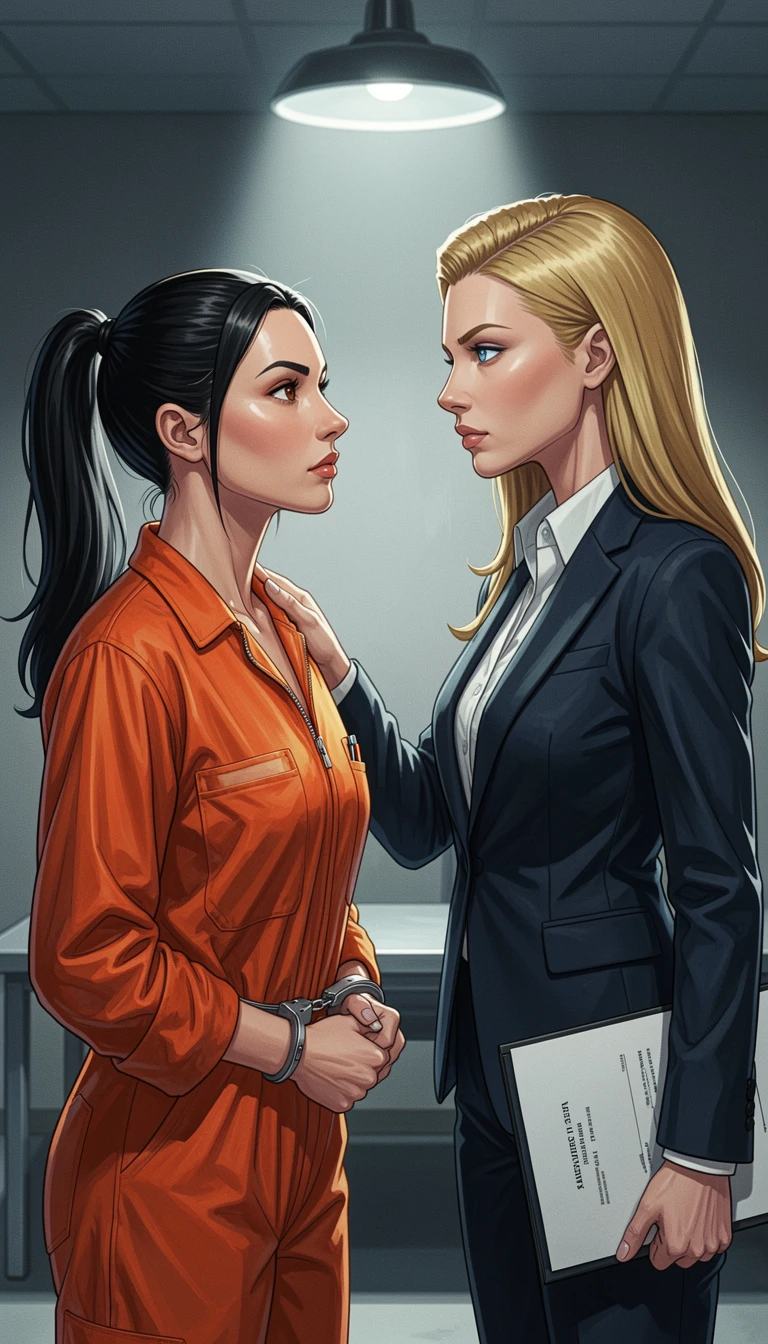
The car came up the drive at four-forty, a black sedan with the Sterling crest on the door, and Elle watched it from the study window with her hands folded at her waist and her face arranged into something that would pass for welcome. The gravel popped under the tires. The south gate stood open behind the car — it had stood open for a week now, nobody had closed it, and she had stopped asking why. Beyond it the service road ran pale and straight toward the pines, and beyond the pines, if you kept going, the county highway, and beyond that the city, and beyond that everything she had once been.
She did not look at the gate. She had trained herself out of it. The trick was to keep her eyes on the car, on the door, on the woman stepping out — tall, dark-haired, a leather satchel over one shoulder and a small recorder already in her right hand, thumb on the button, red light blinking before her heel touched the gravel. A journalist's habit. Elle respected it. She had done the same thing once, walking into depositions, the recorder running before anyone had offered her a chair.
"Ms. Voss," she said, and came down the portico steps with her hand out. "Eleanor Shelby. Thank you for coming all this way."
Elena took the hand and shook it — a firm grip, brief, the grip of someone who had decided in advance to be professional and was holding herself to it. Up close she looked like Mila the way a photograph looks like a person: the same bones, the same dark hair, but the warmth sanded down, the smile held behind the teeth. She was wearing a blazer the color of oatmeal and no jewelry except a thin watch. She had come alone, as instructed. She had driven two hours on a Saturday to interview a lawyer, because her sister had called her and said the words exclusive and interview and come alone, and because she had been calling the sheriff's office every day for a week and getting nothing back.
"My sister said on the phone you had information about the Sterling case," Elena said. "And about my sister."
"I do." Elle smiled, and it cost her nothing, which was the point. "Come inside. It's cooler. We'll talk properly."
She turned and walked Elena up the steps and through the front door, and the whole time her spine felt the open gate at her back like a hand between her shoulder blades. She did not turn around. She had learned that too.
The hall was cool and dim after the glare outside, and it took a moment for the eye to adjust — long enough for Elle to see Mila before Elena did. Mila stood at the foot of the staircase with a silver tray in her hands, a teapot and two cups on it, and she was wearing the uniform: the short black dress, the white apron, the velvet collar with the little silver bell at her throat. She had been told to wait there. She had been told to be seen. Elle had not told her why, and Mila had not asked, because Mila had stopped asking questions around the time she had stopped being able to look at her own reflection.
Elena stopped mid-step.
The recognition went through her face in stages — the eyes first, widening, then the mouth opening on a word that didn't come, then the whole body turning toward the staircase as if pulled by a rope. "Camila?"
Mila's wrists trembled. The bell at her throat gave one thin, involuntary chime, and Elle watched her grip the tray harder to still it. For one second — one — Mila's eyes came up and met her sister's, and there was relief in them, raw and naked, the relief of a person who has been drowning and has just seen a hand. And then something else came in behind the relief, something colder, and Mila looked away. Down. At the tray. At the floor. Anywhere but at the woman standing ten feet from her with her mouth still open.
"Camila," Elena said again, and took a step toward her.
"Ms. Voss." Elle's voice cut across the hall, smooth and warm, and she moved — not fast, not obviously, just enough to put herself between Elena and the staircase without appearing to. "Your sister works here now. She's been very well. I'll explain everything, but not in the hall. Please."
Elena's face was doing arithmetic. Elle watched her do it — the sister in a maid's uniform, the bell, the looking-away, the lawyer with the practiced smile — and watched her decide, for now, to file it and keep walking. Journalists did that. They collected, they did not react, they got to the room where the story was and then they opened the notebook. Elena's thumb pressed the recorder again, a small click, and the red light steadied.
"All right," she said. "The study."
Elle led her down the corridor, past the closed doors and the bad light, and behind them Mila stood frozen at the foot of the stairs with the tray in her hands and did not follow. Elle did not look back at her. She had stopped looking back at Mila the day she had driven her through the gate and back into this house, and the not-looking had become a kind of muscle, and muscles only got stronger.
The study door clicked shut behind them, and the sound was small and final, and Elle felt it in her teeth.
The room smelled of aged leather and expensive whiskey. The fire had been lit — Kyle had had it lit an hour before, because he liked the room to have a temperature, a mood, a set — and the conditioned air raised goosebumps along Elle's bare forearms as she crossed to the sideboard. The window behind the desk faced south. She did not look at it. She had learned that too.
"Sit anywhere," she said. "Tea? Or something stronger. I'm having tea."
"Tea's fine." Elena chose the leather chair facing the desk, the one with its back to the door, and set her satchel on the floor beside it and laid the recorder on the arm of the chair, red light up, facing Elle. "You said you'd explain about Camila."
Elle poured. Her hand was steady on the pot — she watched it be steady, the way you watch a thing you no longer trust — and the tea came out in a thin amber line and filled the first cup and then the second. Steam. The fire cracked. Somewhere down the corridor, a door opened and closed, and Elle knew the sound of that particular door, and knew who was on the other side of it, and did not turn her head.
"Your sister came to work for the family about a month ago," she said, and handed Elena the cup. "Through a hiring agency. She's been well cared for. I understand she hasn't been in touch with you, and I understand how that must have felt."
"She called me yesterday," Elena said. "From this number. She told me to come alone and not tell anyone." She took the cup but did not drink. "That's not Camila. Camila tells everyone everything. She called me every day for a year when she got her first job, just to describe the vending machine."
"People change when they find work that suits them."
"She called me from your house and told me to come alone." Elena set the cup down on the side table, untouched, and looked at Elle the way she must have looked at press secretaries and PR men and every polished person who had ever tried to hand her a version of events. "Ms. Shelby. I've been calling the sheriff's office every day for a week asking about a missing person. I've been told nothing. Now I get a call from my sister, who I've been trying to find, inviting me to an exclusive interview at the estate of the family the whole state is talking about. I'm not here for tea. I'm here because I want to see my sister, and because I want to know what happened to her, and because I think you know. I’m not here for the tea."
Elle sat down across from her, in the chair behind the desk, and folded her hands on the blotter, and let the pause do its work. The recorder blinked. The fire ate a log and settled. Elena's eyes were steady, but her thumb had found the edge of the chair arm and was pressing, pressing, the way you press a bruise to see if it still hurts.
"Your sister is fine," Elle said. "She's here of her own accord. She has a room, a wage, and the protection of this family. What she doesn't have is a way to explain it to you that you'll accept, because you've already decided what this place is."
"And what is it?"
"That's what the interview is for." Elle smiled again, and this time she let a little of the real thing through — the thing that had once won her a courtroom, the thing that made people lean in and trust her before they knew they were doing it. "You came here for a story, Ms. Voss. I'm going to give you one. But first I want to ask you something, and I want you to answer honestly, because you're a journalist and I'm a lawyer and we both know what happens when two people start lying to each other in a room with a recorder running."
Elena waited.
"How much do you already believe?"
The question sat there. Elle watched it land — watched Elena's jaw tighten, watched her decide whether to be honest or clever, watched the journalist in her win. "I believe my sister disappeared," Elena said. "I believe the sheriff's office is stonewalling me. I believe this family has more money than the county and more friends than the sheriff. And I believe you called me here for a reason that has nothing to do with an interview."
"Good," Elle said. "Then we can skip the part where you pretend to be surprised."
She leaned back. The leather creaked. Behind her the window held the south gate in its frame — she could feel it there without looking, the way you feel a door you left open in a house you know too well — and beyond the gate the road, and beyond the road the pines, and beyond the pines the highway that ran east toward everything she had given up. She had given it up. She had chosen this room, this fire, this man, this life, and the choosing had been the last free thing she had ever done, and she was not going to unchoose it now for a woman with a recorder and a missing sister and the same stubborn jaw as the girl standing in the hall with a bell at her throat.
"Let's start with the detective," Elle said. "Mara Watts. I understand you've been asking about her too."
"I've been asking about everyone."
"Then you'll want to hear this first." Elle reached for her own cup, lifted it, and did not drink — just held it, the warmth coming through the porcelain into her palms, grounding her. "Everything you've been told about this house is a lie told by a woman who killed a maid on her way out the door. I was here. I saw it. And I'm going to tell you exactly what I saw, on the record, and then you're going to go home and write it, and then you're going to understand why your sister called you."
Elena's thumb came off the chair arm and found the recorder. She did not press anything. She just rested her finger on the button, ready.
"Why did she call me?"
"Because she wanted to see you," Elle said, and the lie came out of her mouth smooth and warm as the tea, and she felt nothing at all, and that was the part that would have frightened the woman she used to be. "And because I asked her to."
In the hall, on the other side of the study door, Mila stood with her ear an inch from the wood and the tray still in her hands and the bell at her throat gone silent because she had stopped breathing. She had not been told to listen. She had been told to wait. But the door was thin, and the hall was empty, and her sister's voice was on the other side of it, and Mila had spent a week learning exactly how much she could afford to do that she had not been told to do, and the answer was: a little. A little more each day.
"What do you want me to say on the record?" Elena asked, and her voice had changed — lower, slower, the voice of a person who has stopped performing professionalism and started doing the actual work.
Elle set her cup down. The fire cracked. The recorder's red light blinked on the arm of the chair, patient and small, and Elle looked at it and thought of the gate, still open, and the road beyond it, and the woman she had been who would have walked out of this room and down that road and never looked back. That woman was dead. She had died the day her friends left her chained to a frame and drove away, and Elle had stood at the window and watched them go, and after that there had been nothing left to be except this.
"Start with the night of the eleventh," Elle said. "And I'll tell you everything."
The study went quiet except for the fire. In the hall, Mila pressed her ear to the door and did not breathe.
Elle took her time. She lifted the cup again, let the steam touch her lip, set it back down in the exact center of its saucer. The recorder waited. Elena waited. The fire gave a small collapse of ash and Elle let that be the only sound in the room for a count of four, because a story told fast is a story that sounds rehearsed, and she had rehearsed this one enough to know it had to sound like it was being remembered, not recited.
"The night of the eleventh," she said, "I was in this house. I was working late — I'm counsel for the family, you understand, there's always something. Around eleven I heard the front door. Not a knock. The door. Someone had come in through the gate and up the drive and through a door that should have been locked, and I remember thinking that was strange, and I remember going out into the hall to see who it was."
"Was the door locked?"
"It was. That's the part I want you to hold onto." Elle tilted her head, and her voice stayed level, almost gentle, the voice she used when she was walking a hostile witness into a corner they'd built themselves. "A locked door, Ms. Voss. And a woman standing on the other side of it who had no business being inside. I didn't know her. I'd never seen her before that night. She told me her name was Detective Mara Watts and that she was investigating the family, and she had no warrant, no backup, no uniform. She'd come in the dark, alone, through a locked door."
Elena's pen had come out of the satchel. She hadn't asked permission. She was writing now, quick shorthand, her head down, and Elle watched the top of her head and felt the small clean satisfaction of a hook setting.
"I offered her hospitality," Elle said. "That's the part that matters. I could have called the police. I didn't. I brought her into the kitchen and I put the kettle on, because she looked exhausted, and I thought — I actually thought — that whatever she wanted, she could have it in the morning, with a lawyer present and a cup of tea in her hand. That's who I was then." She let a beat pass. "She sat where you're sitting. She drank my tea. She told me she'd been following the family for months and that she was close to something and that she needed help, and I told her I couldn't help her without a warrant, and she smiled at me and said that was fine, that she understood."
"And then?"
"And then Rosa came in."
Elle said the name and watched it land. Elena's pen stopped. The fire cracked. Elle let the silence sit long enough that Elena looked up, and when she looked up Elle was already looking at her, steady, and that steadiness was the whole trick — a liar looks away, and a witness looks at you.
"Rosa was our kitchen maid. Six years with the family. She had two children. She came in through the back because she'd forgotten her bag, and she saw a stranger at the table with a cup of my tea, and she did what any decent person would do. She asked who the woman was. She asked if everything was all right. She put herself between me and the stranger, because that was Rosa — she was always putting herself in front of things. She was the kind of woman who'd step in front of a car for you and then apologize for the inconvenience."
Elle's hand went to her own throat, to the place where the collar had once sat, and she caught herself doing it and stopped. She had not worn a collar in weeks. The gesture was a habit, and habits were dangerous, and she filed it away to deal with later, the way she filed everything.
"Detective Watts stood up. She said something to Rosa — I don't remember the words, I remember the tone, it was the tone of a person who has decided something. And she took Rosa by the wrist and pulled her close, like a lover, like she was going to whisper something, and Rosa didn't fight her because Rosa didn't understand yet, and then there was a needle in her hand."
Elena's pen came down hard enough to dent the paper. "A needle."
"A syringe. Small. She had it in her sleeve or her pocket, I don't know, I didn't see it until it was in Rosa's throat." Elle closed her eyes for a moment — not for effect, though it served the effect, but because she had learned that the truth and the lie had to be told with the same body, or the body would give you away. "She put it into the side of Rosa's neck and pushed the plunger, and Rosa made a sound, a small sound, like a question, and then she went down. She went down against the counter and then to the floor, and she was still holding onto the edge of the counter when she stopped, and I remember her hand. I remember her hand on the counter. I remember it slid off."
"You saw this."
"I was three feet away. I saw all of it."
"And you didn't—"
"I didn't do anything, Ms. Voss, because I was frozen, because a woman I had just poured tea for had just killed a maid in my kitchen and I was standing there in my bare feet with a cup in my hand." Elle set the cup down, deliberately, and the porcelain clicked. "And then she looked at me. And she said — and I want you to write this down exactly — she said, 'You didn't see anything.' And then she walked out through the back, and she went through the gate, and she was gone."
Elena wrote. Her hand was shaking slightly and she was writing anyway, and Elle watched the shaking and felt nothing, and that was the part that would have frightened the woman she used to be, and she had stopped being frightened of it a long time ago.
"Why didn't you call the police?"
"I did. In the morning. I called and I gave a statement, and I've given it again since, and it's on file, and it says exactly what I've just told you." Elle leaned back. "You can check that. That's the part I want you to check, Ms. Voss. Not my word — the record. There's a statement, notarized, dated, filed. It exists. It's not something I'm telling you in a room with a fire going. It's a document, and you can hold it in your hand."
Elena looked at her for a long moment. Then she said, quietly, "There's something you're not telling me."
"There's a great deal I'm not telling you. You're a journalist; you know that. What I'm telling you is the part that's on the record, and the part that's on the record is the part that will hold up."
"You said you'd explain about Camila."
"I will. But first there's one more thing about that night, and it's the thing that makes the rest of it make sense." Elle reached for the pot and refilled her own cup, unhurried, the tea going in thin and amber, and she did not offer Elena more because Elena's cup was still full and cold. "When Detective Watts pulled Rosa against her, Rosa fought. Not much — she didn't have time to fight much — but she got one hand loose and she grabbed at the detective's leg. Her thigh. She was trying to push her away, or hold on, or both. And her nails went in."
"Her nails."
"She scratched her. Hard. Through the fabric of the trousers, hard enough to break the skin, and I saw it happen, and I've thought about it a hundred times since." Elle set the pot down. "A scratch like that doesn't heal clean. It scars. It leaves a mark. And I've been sitting in this house for more than a week listening to a woman on the news tell the world that she was the victim, that she was held here, that she never touched anyone — and I keep thinking about that mark on her thigh that she has never once mentioned, not to the police, not to her lawyer, not to anyone. Because if you were innocent, Ms. Voss, you'd have told them about the scratch. You'd have said, look, the maid fought me, here's the proof I was there. Unless you were trying to hide that you were there at all."
The room was very quiet. Elena had stopped writing. Her pen was resting on the page and her eyes had gone somewhere behind Elle's shoulder, doing arithmetic.
"How do you know she still has it?"
"Because a scratch that deep doesn't vanish in a week. And because I know where it is — upper right thigh, about a hand's width below the hip, running at an angle. Four lines. Like a rake." Elle said it flatly, the way she would have read a medical report into a record, and then she let her voice come down a register, warm again, the lawyer becoming a woman confiding. "You can verify it. That's what I'm giving you. Not my word — a fact you can check. If you ever get within ten feet of that woman with a camera, or if her lawyer ever lets a doctor look at her, or if anyone ever asks her to account for every mark on her body, you'll find it. And when you do, you'll know which of us was telling the truth."
Elena picked up her pen again. She didn't write. She turned it over in her fingers, once, twice, and Elle watched her decide to believe it, and watched her hate that she was deciding to believe it, and filed both away.
"Why are you telling me this?" Elena said. "Why me? You could have given this to any reporter in the state."
"Because your sister called you," Elle said, "and because I think you deserve to hear it from someone who was there, and because—" she paused, and let the pause do its work, and then she said the thing she had been building toward since the car came up the drive "—because I think you already know something is wrong with this house, and I think you came here half-expecting to find your sister in trouble, and I want you to understand that the trouble in this house is not us. It's the woman who came through that door. It's the woman who killed Rosa. And when you write this, and when people read it, that's what they'll understand too."
Elena sat back in the leather chair. The recorder blinked between them, patient and small, and Elle could hear her own heartbeat now, slow and even, and she thought about the gate standing open behind the house and the road beyond it and the fact that she had just told a journalist a story she could never take back, and she felt nothing, and the nothing felt like clean water.
"I want to see my sister," Elena said. "Before I leave. Alone."
Elle smiled. It was the smile that had won her courtrooms, and it was real, and that was the worst of it.
"Of course," she said. "She's just outside. I'll go get her."
She stood, and crossed the study, and opened the door, and Mila was standing in the hall three feet away with the tray in her hands and her face wiped blank, and the bell at her throat gave one small betraying chime as Elle stepped out, and Elle looked at her and did not blink, and said, quietly, "Your sister wants to see you. Alone. Be careful what you say."
And then she walked past her down the corridor, toward the window that faced the south gate, and she did not look at the gate, and she did not look back at Mila, and behind her the study door stood open and the recorder was still running.
The corridor was long and dim, and Elle walked it the way she walked everything now — measured, unhurried, her heels ticking against the wood in a rhythm she could count on. Behind her, muffled by the study door, she heard the low murmur of two voices, one careful and one breaking, and she did not stop walking to listen. Whatever Mila said to her sister in that room, whatever version of the truth she found the spine to tell or the cowardice to swallow, it was no longer Elle's business. She had opened the door. The rest belonged to them.
Kyle's office was at the end of the corridor, past the closed doors and the bad light, and the door was ajar, which meant he was waiting for her, which meant he had heard the car come up the drive and the footsteps on the gravel and the click of the study door, and had known she would come to him the moment she could. She pushed the door open and stepped inside and closed it behind her, and the latch clicked, and the sound was the same small final thing it always was.
He was standing at the window with his back to her, one hand in his pocket, the other holding a glass of something amber that caught the last of the afternoon light. The window faced south. The gate stood open in the frame, pale and distant, and beyond it the road ran straight toward the pines, and Elle looked at the back of his head and did not look at the gate, because she had trained herself out of it, and the training held even when he was the one standing between her and it.
"She's here," Elle said. "She's in the study with Mila. I've given her the story."
He turned. The glass came up to his mouth and he drank, and his eyes over the rim were the color of a stormy sea, patient and watchful, the eyes of a man who had all the time in the world and knew it. "And?"
"And she believed it. Or she wanted to believe it, which is the same thing for a journalist." Elle crossed the room and stopped a few feet from him, close enough to smell the whiskey on his breath and the cedar of his cologne, close enough to feel the heat coming off his body in the cool of the room. "She took it all down. The needle, Rosa, the locked door. She wrote it in shorthand and she believed it with her pen."
Kyle set the glass down on the sill and turned to face her fully, and there was something in his face she couldn't quite read — not approval, not quite, something sharper and more inward, like a man who has just seen the first move of a game he didn't know he was playing. "Tell me what you said. Exactly."
Elle told him. She went through it the way she had gone through it for Elena — the locked door, the kettle, the smile, Rosa coming in through the back with her forgotten bag, the needle in the throat, the hand sliding off the counter. She kept her voice level and her hands still, and she watched his face as she spoke, and she saw the moment she said the word scar — saw his eyes go somewhere else, saw the stillness come over him the way it came over him before he did something he had already decided to do.
"The scratch," he said. "You told her about the scratch."
"I told her it scarred. Upper right thigh, four lines, like a rake. I told her she could verify it, that it was the proof that held the story together." Elle stopped. "Was that wrong? Should I not have mentioned it?"
He didn't answer for a long moment. He just looked at her, and the look on his face was the look of a man doing arithmetic, and Elle felt the small cold thing in her chest that she had learned to call nothing — because it was nothing, because she had told him everything, because there was nothing left to hide — and she waited.
"No," he said finally, and his voice had gone soft, almost gentle, the voice he used when he was about to tell her something she would have to sit with. "You did more than good, painslut. You did exactly right."
He crossed to her and took her face in his hand, his thumb along her jaw, tilting her head up, and he kissed her on the mouth — a slow, deliberate kiss, the kind that had nothing to do with hunger and everything to do with ownership, the kind that said you are mine and you did well. She felt it in her knees, the small give of her body toward him, and she let herself have it, let herself be held in his hand like a thing he was pleased with.
"The scar," he said against her mouth. "The scar on her thigh. You're sure that's what you told her."
"I'm sure. I told her where it was and what it looked like and that she could check it. I told her it was the proof."
He let her go and stepped back, and the look on his face had changed again — the arithmetic had come out to a number he liked, and he was smiling, a real smile, the one that reached his eyes and made him look almost human. "Good," he said. "Then we're changing the plan."
Elle felt the words land in her chest and sit there, heavy and unfamiliar. "Changing it how?"
"We're letting her go." He picked up his glass and drank, and the smile stayed. "We're letting her write her story. We're letting her print it in every paper in the state, if she wants. We're giving her the scar and the needle and the locked door, and we're letting her take it all home with her."
Elle's mouth opened. The words came out before she could stop them. "What about the plan? What about the debt? My debt — I promised Croft a woman by Tuesday. I promised him, Kyle. I told him I would bring him someone."
He looked at her, and the smile softened into something almost tender, and he said, "We'll find someone else."
The room went quiet. The fire had burned low and the light was going amber through the window, and Elle stood in the middle of it with her hands at her sides and felt the floor go strange under her feet, like the ground had shifted and she hadn't felt it move.
"Someone else," she repeated.
"Someone else." He set the glass down and came back to her, and this time he took her by the shoulders, his hands warm and sure, and he looked down at her with that patient, watchful patience that made her feel like the only thing in the room he cared about. "You did your part, painslut. You gave her the story. You gave her the proof. And now the story does the work for us — she'll print it, the whole state will read it, and the detective's case dies in the court of public opinion before it ever reaches a jury. That's worth more than one woman delivered to an old man's shed."
"But the debt—"
"I said we'll find someone else." His voice didn't rise. It didn't need to. It was the voice of a man who was used to being obeyed, and Elle heard it, and her mouth closed, and she nodded.
"Who?" she said.
He smiled, and the smile was the worst thing she had seen on his face all day — not cruel, not cold, just knowing, the smile of a man who had already seen the end of a game she was still standing in the middle of. "I have an idea," he said. "I'll tell you when it's time. For now, you go back to the study, you walk your journalist to her car, you smile at her and you shake her hand and you tell her to drive safe. You let her leave with her recorder and her notebook and her sister's phone number in her pocket. And you let her think she won."
Elle stood there a moment longer, in the warmth of his hands on her shoulders, and she felt the nothing rise up in her like clean water, and she let it hold her. "Yes, Master," she said.
He kissed her again, quick and hard, and let her go. "Go on. She'll be done with her sister soon, and you need to be there when she comes out."
She left him there. That was the only way to do it — one step, then another, her heels finding the rhythm again on the wood, the latch clicking behind her with the same small final sound. The corridor stretched long and dim in both directions, and she walked it the way she walked everything now, measured, unhurried, and she did not look back at the door, because there was nothing back there she needed to see. He had told her what to do. She would do it. The arithmetic was done.
But the word followed her down the corridor anyway, ticking along with her heels like a second set of footsteps. Someone else. She had said it back to him like a student repeating a lesson, and he had smiled that knowing smile, and she had nodded, and now the words were loose in her head, rattling around with the rest of the things she did not let herself think about. Someone else meant a woman. Someone else meant a body to trade for her debt, a life to hand over to an old man's shed. She had done it before — she had handed over Cruz, had watched the light go out of a cop's eyes as she drove away, and she had felt nothing, because there was nothing left in her to feel it with. That was the trick of it. That was how you survived.
She stopped at the study door. The murmur had gone quiet on the other side, and she stood in the corridor with her hand on the brass and listened to the silence the way she had trained herself to listen to silences — for what was underneath them, for what was about to break. Two voices, one careful and one breaking. The careful one had won, or the breaking one had given up, and Elle could not tell which, and it did not matter. She pushed the door open.
Elena Voss stood at the window with her back to the room, a strand of dark hair tucked behind her ear, her recorder held loose in one hand like she had forgotten she was holding it. Mila sat in the chair behind the desk, small in her maid's uniform, the velvet collar at her throat, and her face was the face of a woman who had just done something she could not take back. She did not look up when Elle came in. She looked at her hands, folded in her lap, and Elle saw the fine tremor in them and filed it away and did not let it touch her.
"Elena." Elle's voice came out warm and practiced, the voice she had used in a hundred courtrooms, the voice that made people believe her. "I'm sorry to interrupt. I wanted to make sure you had everything you needed before you head back."
Elena turned. She was beautiful in the way her sister was beautiful, the same dark hair and hazel eyes, but there was a stillness in her that Mila did not have, a professional calm that had probably taken years to build. "I have more than enough," she said. "Your statement is thorough. I'll have the piece ready for the evening broadcast."
Elle crossed the room and stopped beside her, close enough to see the faint mascara smudge at the corner of her eye — she had been crying, or nearly, and Elle felt the small cold thing in her chest and did not let it move. "I know this has been hard. For both of you. I want you to know that I meant every word I said. The truth needs to come out, and you're the one who can tell it."
Elena's mouth tightened. "It's a good story. A terrible one, but a good one. The public needs to know what that detective did."
Elle nodded. Behind her, she heard the creak of the desk chair and knew Mila had stood, and she did not turn around. "I'll walk you to your car."
They went out through the front hall together, Elena's heels and Elle's heels making a two-part rhythm on the marble, and the afternoon light came in through the tall windows and laid itself down across the floor in long amber bars. The door was heavy and the air outside was cool, and Elle stood on the portico and watched Elena Voss walk down the gravel drive toward her car, a small sedan the color of rain, and she did not look at the south gate, because she had trained herself out of it, and the training held even now, even with the open road running past the pines just beyond the fence.
Elena stopped at the driver's door and turned. "Elle."
"Yes?"
"Thank you. For telling me the truth." Elena looked at her a moment longer, and there was something in her face that Elle could not quite read — gratitude, or doubt, or the beginning of a question she had not found the words for yet. "I know it couldn't have been easy."
Elle smiled. It was a good smile, practiced, the smile she had used to win juries and close deals and convince a hundred people that she was exactly what they needed her to be. "Drive safe," she said. "And Elena — tell the truth. All of it. That's all I ask."
Elena nodded and got into the car, and the engine turned over, and the gravel crunched under the tires as she pulled away down the drive. Elle stood on the portico and watched the car shrink toward the gate, watched it pass through the open frame and turn onto the road and disappear into the pines, and she felt the nothing rise up in her like clean water, and she let it hold her.
Behind her, the front door opened, and she did not turn around. She heard the soft tick of the bell at Mila's throat, and then the smaller, quieter sound of Mila's voice, hoarse and careful, like she had been crying and was trying to hide it. "Did she believe it?"
Elle watched the empty road a moment longer. The gate still stood open in the distance, pale and patient, and she did not look at it. She looked at the road, at the place where the car had been, and she felt the weight of everything she had just done settle onto her shoulders like a coat that fit too well.
"She believed it," Elle said. "She believed all of it."
She turned and walked back into the house, past Mila standing small in the doorway with the bell trembling at her throat, past the study door left open and the recorder still running on the desk, down the long dim corridor toward the office at the end of it, where Kyle would be waiting, where the next move was already being planned, where the name of the next woman was already forming behind his patient, watchful eyes. She did not look back at the gate. She had trained herself out of it.
The door to the office was ajar, and she pushed it open and stepped inside, and the latch clicked behind her, and the sound was the same small final thing it always was.