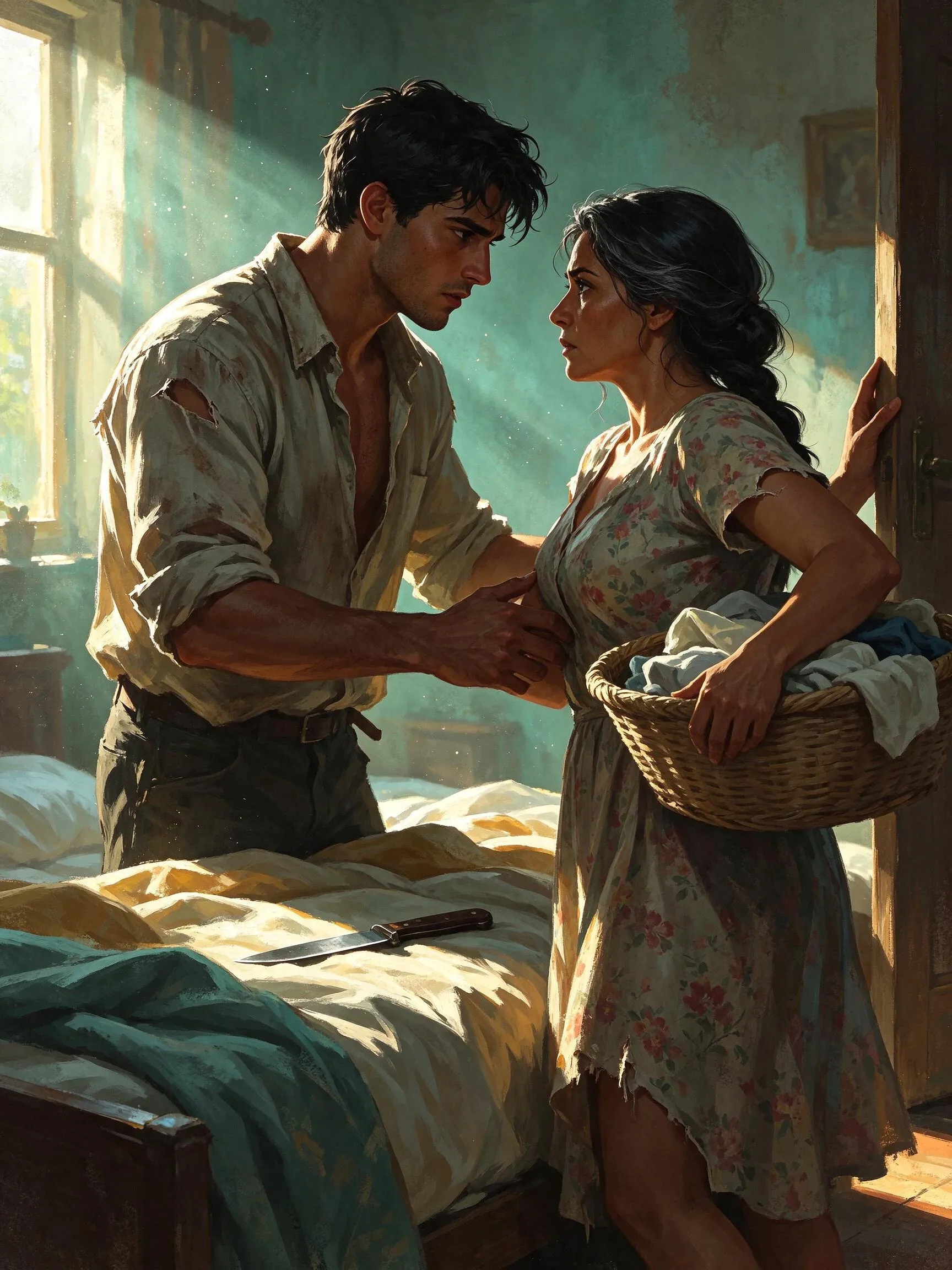

Mateo's knees had gone numb against the floorboards an hour ago, and he hadn't moved. He'd been looking for the tin of buttons his mother kept somewhere in this room — a small thing, a thing to mend a shirt with, a thing to do with his hands while the afternoon burned outside — and instead his fingers had found the edge of the mattress stuffing, and under the stuffing, something hard and flat that did not belong to a bed.
His hand closed around it before his mind caught up.
Cold. The cold was the first thing. Not the cold of a thing left in a shaded room, but the deeper cold of metal that had been waiting a long time in the dark, and would still be cold when everything around it had rotted away. His fingers mapped the shape without his permission — a handle, worn smooth in one place where a palm had gripped it again and again, and a blade the length of his hand, tapering to a point that had been ground thin and fine.
He drew it out. The quilt slid off the mattress corner and pooled on the floor, and he didn't pick it up.
The blade caught what little light came through the rattling window. Along one edge, where steel met the flat of the metal, ran a stain. Rust, he told himself. It was rust. The orange-brown crust of it, flaking at the edges, dark in the grooves where the steel had pitted. He'd seen rust a thousand times — on the plow blade, on the hinges of the barn door, on the bucket that sat out in the rain. Rust was nothing. Rust was time.
But this stain had a shape. It started at the base of the blade and thinned as it climbed, and where it thinned, it spread in small irregular fingers, as if whatever had wet the metal had been smeared along it, wiped, and then left to dry. He turned the knife over. The other side carried the same stain, mirrored, and in the fuller — that shallow channel running down the center of the blade — the rust had gathered into a darker line, almost black.
He pressed his thumb against it. The crust gave slightly, like something that had once been soft.
Beside his knee, half under the fallen quilt, lay a dress.
He hadn't noticed it when he'd first reached under the mattress. Now it seemed like the only thing in the room. Faded floral print, the colors gone pale as old skin, the fabric thin enough to see the light through where it stretched across his thigh when he lifted it. His mother's dress. He knew it the way he knew her hands — the small tear at the shoulder seam that she'd never bothered to mend, the way the hem had been let down once and then again, the faint line of stitching still visible where the last letting-down had been done in a hurry.
The hem was torn. Not worn. Torn — a clean diagonal rip through two layers of cloth, as if someone had caught it on something and pulled, hard, and the fabric had given. He touched the ragged edge. It was stiff, the threads frayed and darkened.
He looked at the knife in his right hand. He looked at the dress in his left. The window rattled in its frame — a loose pane his father had promised to fix the summer before he died, and never had — and the sound went through him like a finger drawn down his spine.
He should put it back.
The thought arrived clearly, in his own voice, and he ignored it. He turned the knife again, watching the light crawl along the edge. Someone had sharpened this. Recently. The bevel was even, patient, done with a steady hand and a whetstone — not the hacked, hasty edge of a tool kept for cutting rope. This was a blade that had been cared for. Kept. Hidden.
His mother's mattress. His mother's dress. His mother's knife.
The floorboards in the hallway creaked.
He didn't move. His body had gone very still, the way it did in the fields when he heard a snake in the grass — not frozen, but gathered, every muscle holding its breath. The creak came again, closer, and then a third time at the threshold, and then the door — which had been standing ajar, and which he had not thought to close — swung inward on its old hinges.
Elena stopped in the doorway.
She had a basket of laundry balanced against her hip, and her braid had come loose at the temple, a gray-streaked strand hanging down across her cheek. Her face was still flushed from the walk back from the river, and for one full second it held nothing but the ordinary tiredness of a woman coming in from her work. Then her eyes found the knife in his hand, and everything in her face went out like a lamp.
The basket slipped. She caught it against her thigh, but a shirt spilled over the rim and hung there, and she didn't fix it.
Neither of them spoke.
The silence was not empty. It had weight, and texture, and it pressed against Mateo's ears until he could hear his own pulse in them. His mother's dark brown eyes — his eyes, everyone said so, the same shape, the same heavy lids — moved from the blade to the rusted stain to the dress on the floor and then, slowly, up to his face. He watched her take in the whole of it. The open mattress. The fallen quilt. The torn hem. Her son kneeling on her floor with a knife that did not belong to him.
Her jaw tightened. That was all. She did not gasp, did not step back, did not ask him what he thought he was doing. She stood in the doorway and looked at him the way she looked at the sky when it turned the wrong color over the fields, and Mateo understood, in a way he could not have explained, that she had been waiting for this. Not for him. For someone. For the moment the thing under her mattress would be found.
"Put it back," she said.
Her voice was low. It always was — she had never been a woman who raised it, not even when the men from the village came drunk to the door, not even the night his father died. But there was something under it now that he had not heard before. Not fear. Something older than fear, and colder.
He didn't move.
"Mateo." She set the basket down on the floor beside the door, deliberate, the way she did everything, and the shirt that had been hanging over the rim slid the rest of the way out and lay in the dust. She didn't look at it. "Put it back where you found it."
"Where you found it," he said. His own voice came out strange to him — flat, and too quiet, the way it went when he was holding something in. "You mean under your bed. Where you keep it."
"Put it back."
"How long has it been there?"
She took a step into the room. Just one. Her bare feet were gray with dust from the road, and he noticed that, noticed the small cracked heel of her left foot, and hated himself for noticing, because it made her his mother again, just for a second, and he needed her to be something else right now. He needed her to be someone who could answer him.
"That is not for your hands," she said.
"It's a knife, Mamá. It's a knife under your mattress. Whose hands is it for?"
Her face did not change. That was the worst of it. He had expected — he didn't know what he had expected. Tears. Anger. Some crack in the surface he could push his fingers into. Instead she stood there with her hands at her sides and her eyes on the blade, and she looked like a woman who had already had this conversation a hundred times in her own head and had decided, long ago, exactly what she would say.
"Give it to me."
"No."
The word came out before he'd decided to say it. He felt his grip tighten on the handle — the smooth worn place where a palm fit, and his palm fit it too, and that fact went through him like a splinter. His hand was the right size for this knife. His hand had always been the right size for it. He had just never known.
Elena's eyes came up to his, and for the first time since she'd walked in, something moved behind them. Something that might have been fear, after all, or might have been grief, or might have been the two braided so tightly together that no one could tell them apart anymore.
"Mateo."
"Who's it for?"
The window rattled. Outside, somewhere down the lane, a dog was barking at nothing, the way the village dogs did in the long yellow afternoons. The room smelled of stale sweat and damp linen and, faintly, of the river — river water and soap, his mother's smell, the smell of every shirt she'd ever washed against the flat rocks at the water's edge. He wanted to put the knife down. He wanted, more than he had wanted anything in a long time, to lay it on the mattress and stand up and let her fold him into the ordinary afternoon, the way she had when he was small, when his father was alive and the world had not yet learned what it could do to them.
He didn't put it down.
He looked at the rusted stain along the blade, and then at the torn hem of the dress on the floor, and then at his mother standing barefoot in the doorway of a room that had held this secret for longer than he'd been old enough to understand secrets, and he asked her again, slower, the words coming up out of something in his chest that he had spent nineteen years learning to swallow.
"Who have you been saving it for?"
Elena's hand moved. Not to the knife, not to him — to the doorframe, her fingers curling around the old wood the way they curled around the edge of the table when the pain in her back got bad, or around the rope of the well when the bucket came up heavy. She held on. She looked at her son, kneeling on her floor with a blade that had waited years for a hand, and she did not answer.
The silence stretched, and in it, Mateo heard the floorboard creak again under her weight as she shifted, one small movement, as if she meant to come closer and had thought better of it. The light through the window had gone the color of late afternoon, orange and low, and it lay across the floor between them like something spilled.
"Some things," she said at last, and her voice had dropped so low he had to lean forward to hear it, "are not for a son to carry."
"I'm not a child."
"No." She said it quietly, and her eyes moved over him — his shoulders, his hands, the knife — and something in her face softened and hardened at once, like wax cooling. "No, you're not."
He waited.
She didn't finish the thought. She just stood there in the doorway with her hand on the frame and her eyes on the knife, and the dress lay on the floor between them with its hem torn, and the rust on the blade caught the last of the light and held it.