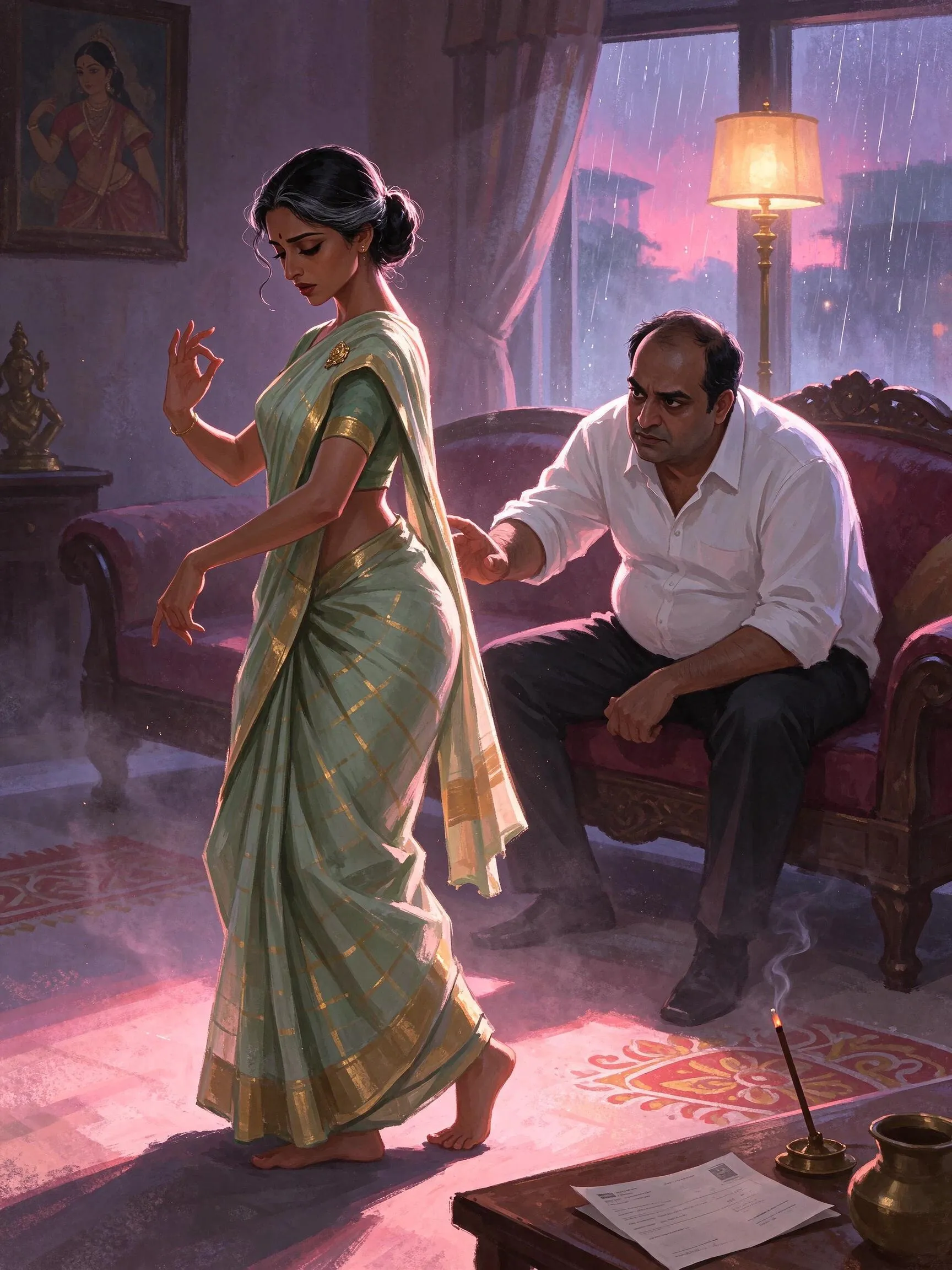

The rain had been falling for an hour, and Banumathi had stopped hearing it. What she heard instead was the sound of Ashok Menon shifting his weight on her sofa — the leather creak, the little sigh of the cushions — and the way his breath came slow and even, as if he had all the time in the world.
He did have all the time in the world. That was the problem.
She stood near the window, her back to him, watching the water streak the glass and smear the coconut palms beyond into green smears. The pallu of her saree lay over her left shoulder the way she had worn it for thirty years, pinned at the pleat with a gold brooch her mother-in-law had given her on her wedding day. She could feel the brooch's weight against her collarbone like a small stone.
"You said three hours," she said.
"I did."
"It's been forty minutes."
"You've been standing at the window for forty minutes, yes." A pause. The cushions creaked again. "I've been waiting."
She turned. He was exactly where she had left him — sprawled into the corner of the sofa, one arm along the backrest, his white shirt sleeves rolled to the elbow as if he had come here to fix a pipe. His thinning hair lay flat against his scalp, dark with the damp of the ride over. He had driven through the rain to get here, and she hated him a little for that, for the trouble he had taken, for the fact that he had taken it at all.
"What is it you want?" she asked. "Exactly."
"I told you on the phone."
"Tell me again."
He smiled. It was not a cruel smile. That was the worst part. It was a patient one, the smile of a man who had waited months for a thing and had now arrived at the moment of receiving it, and saw no reason to hurry.
"Dance for me," he said.
She had known. She had known since the phone call, since the way his voice had gone soft and slow on the word come, since the way he had said at your house, when your family is out — she had known, and she had still hoped, in the small animal way that hope works, that he meant something else.
"I haven't danced in two years," she said.
"You danced at the temple festival in September. I saw the photographs in the paper."
"That was one item. For the deity."
"Then dance one item for me." He lifted his hand from the backrest and gestured at the open floor between the sofa and the television cabinet — the space where, on ordinary evenings, her husband's slippers sat and Lakshmi's textbooks were stacked. "There's room."
She looked at the floor. The tiles were swept — she had swept them herself that morning, before he came, because she could not bear to have him see her house untidy. She had washed her hair. She had worn the saree Rajan had bought her for their twentieth anniversary, the pale green one with the small gold checks, the one she saved for weddings and temple visits. She had done these things and she did not want to know why.
"The music—" she began.
"You don't need music. You're a dancer. You've been dancing since you were six."
She had told him that. Months ago, in his office, when the loan papers were spread on his desk and she was trying to explain why the family could not sell the house, why the house was the only thing they had, why the dance school she ran out of the front room was the only income that could save them. She had told him she had been dancing since she was six, as if it were a qualification, as if it proved something about her worth. He had listened with his pen capped and his eyes on her mouth.
Now he uncapped nothing, and his eyes were still on her mouth.
"Please," she said. She had not meant to say it. It came out of her like water from a cracked pot, unplanned, undignified.
"That's not the word I want to hear from you," he said. "Later, maybe. Not now." He settled deeper into the sofa. "Now I want to see you dance."
She stood for a moment longer. The incense she had lit for the evening puja still curled from the brass holder on the windowsill, sandalwood smoke rising in a thin thread and folding into the damp air. His cologne — something sharp and woody, cheap — cut through it. The rain hissed against the glass.
She thought of the notice from the bank, folded into the back of her jewelry box. She thought of Arjun's hostel fees, due in a fortnight. She thought of Rajan's spectacles, mended at the hinge with a thread because they could not afford new ones, and of the way he had looked at her last week when she had said the loan would be extended, and of how he had believed her.
She lifted her right hand. Palm out.
The opening posture of the Padams — the old Padams of her guru's lineage, the ones about longing, about waiting, about a woman who stands at the door and watches for a lover who may not come. She had chosen it without deciding to. Her body had chosen it, the way her body knew things her mind did not want to know.
Her heel found the floor. Her knee bent. She began.
The first movement was slow — a lift of the wrist, a turn of the head, the eyes following the hand as if following a bird. Her hips swayed once, left, right, the weight shifting from foot to foot with the small precise control that had taken her thirty-nine years to learn. The gold checks on her saree caught the grey light from the window and flashed, once, and were still.
She did not look at him. She looked past him, at the wall behind his head where the framed photograph of her guru hung, the old woman's face severe and patient, watching her student perform the one thing she had never performed for a stranger.
Second movement. The palm turned. The fingers curled inward, then opened — the gesture for come, or for wait, or for I am here; in the Padams it meant all three at once. Her arm drew a slow arc through the air, and her wrist led, and her elbow followed, and her shoulder finished it, the whole arm one continuous line of meaning.
She heard him exhale.
Third movement. She turned — a half-turn, the pallu swinging free of her shoulder and settling again as she came back around, and she saw him now, briefly, in the corner of her eye: leaning forward, elbows on his knees, hands clasped, his chin resting on his knuckles. His eyes moved with her hand. His mouth was slightly open.
She closed her eyes.
She danced the next minute with her eyes closed, the way she used to dance in the practice hall before dawn, when the only audience was the deity and the dust. Her feet knew the floor. Her hips found the rhythm of the rain. Her hands told the story — the woman waiting, the woman watching the road, the woman who has been waiting so long that waiting has become a kind of dancing, a kind of prayer. Her breath came short at the top of the arc and long at the bottom, and her belly drew in and released with each sway, and the muscles of her thighs burned the way they had burned when she was twenty and thought she would dance forever.
She heard him shift his weight again. The leather creaked.
She did not open her eyes.
The fourth movement was the descent — the slow sink, the knees bending, the torso folding forward, the hands coming together at the chest as if in prayer. In the Padams it was the moment the woman gives up waiting, accepts that the lover is not coming, and turns back into the house. Banumathi sank until her fingertips touched her sternum, and her chin touched her fingertips, and she held there, breathing, her saree pooled around her knees on the swept floor.
The rain kept falling. The incense smoke had thinned to nothing.
"Stop," he said.
She opened her eyes. He was standing. She had not heard him rise. He was standing very close — closer than she had realized a man could cross a room without her noticing — and his shadow fell across her folded hands.
"That was beautiful," he said. His voice was different now. Lower. It had lost the clipped bank-manager quality and found something else underneath, something that had been waiting there all along. "You have no idea what you looked like."
"I know what I looked like."
"Do you?"
She rose. Her knees ached. She was forty-five years old and she had just danced a full Padam in her living room for a man who held her house in his hand, and her knees ached, and she was ashamed of the ache.
He reached out. His fingers found the knot of her pallu — the place where the fabric was tucked into the waist of her saree, the small tight fold that held the whole drape together — and he rested his fingertips there without pulling.
"Now the rest of the agreement," he said.
She did not pull away.
His fingers worked the knot loose, slowly, the way a man unwraps something he intends to keep. The pallu slid from her shoulder and hung at her elbow, and the cool air of the room touched the skin above her blouse, and she felt the small hairs on her forearm rise. Her blouse was the plain one, the cream one, the one with the hooks down the front that she had bought at the Co-op Super Bazaar three years ago for ninety rupees. She was aware of it in a way she had never been aware of a blouse before — the way the cotton lay against her breasts, the way the hooks pressed into her sternum, the way the fabric had gone slightly thin at the left shoulder from too many washings.
He put his hand on her waist.
His palm was cool and dry. It covered the whole span of her waist above her hip, and his thumb settled into the hollow just below her ribcage, and he held her there for a moment without moving, as if measuring her. She looked at his face. His eyes had gone dark and steady and very awake, and there was a small muscle jumping in his jaw, and she understood, with a clarity that surprised her, that he was nervous too.
That helped, somehow. That he was nervous too.
"Sit," he said.
She sat.
He guided her — not roughly, but with a certain impatience now, a certain hurry that had not been there before — down onto the sofa, and she went, and the leather was cool and slick against the backs of her thighs where the saree had ridden up. She had not realized how much of her legs were bare. She had not realized how the saree had loosened around her hips during the dance, the pleats opening, the fabric sliding.
He knelt in front of her.
For a moment she thought he meant to do something with his mouth — the thought arrived and she did not know where it had come from, and she felt her face go hot — but he did not. He put both hands on her knees instead, and pushed them apart, and the saree fell open between them like a curtain drawn back from a window.
She was wearing her ordinary cotton petticoat underneath. The drawstring had come loose during the dance, and the cotton had slipped low on her hips, and she could feel the waistband resting just below her navel. She could feel the air of the room on the insides of her thighs. She could feel the small wet place at the center of her, the place that had made itself known without her permission, sometime during the fourth movement of the Padam, when her knees had bent and her body had remembered what a body is for.
"Lie back," he said.
She lay back. The sofa was too short for her; her head rested on the arm, and the arm was hard, and the position was not comfortable, and she did not care. He was standing over her now, unbuttoning his shirt — not all the way, just the top three buttons, enough to expose the pale soft hollow of his chest — and then he was unbuttoning his trousers, and his hands were shaking slightly, and she watched his hands shake and felt something turn over in her chest that was not quite pity and not quite contempt and not quite anything she had a word for.
He pushed his trousers down to his knees. His thighs were pale and soft. His cock stood out from a nest of dark hair, thick and flushed and already wet at the tip, and she looked at it the way she had looked at the floor tiles that morning — carefully, without expression, because to have an expression would be to give him something she had not agreed to give.
He climbed onto the sofa between her legs. The leather creaked. His knee pressed into the cushion beside her hip, and his other knee found the floor, and the position was awkward and he knew it was awkward and he did not care. He put one hand on her stomach — flat, warm, the fingers spread — and with the other he pushed the petticoat up over her hips, and then he was looking down at her, at the place between her legs, and she closed her eyes.
"Open your eyes," he said.
She opened them.
He was watching her face. Not her body — her face. He wanted to see her while he did it. He wanted to watch her watch him.
She felt the head of his cock against her. It was hot and blunt and slick with his own wetness, and it slid along the length of her slit once, twice, gathering her wetness onto itself, and she heard the small wet sound of it and felt her face go hot again. Her hips lifted, just slightly — an involuntary thing, a thing her body did without asking her — and he made a low sound in his throat, almost a laugh, almost a groan.
"There," he said. "That's it."
He pushed into her.
She was wet enough that it did not hurt, but she was tight — it had been a long time, longer than she liked to think, and her body had forgotten the shape of being entered. He went in slowly, an inch at a time, and she felt each inch as a separate event: the stretch at the entrance, the slide along the front wall, the strange deep pressure at the end, the place where she had not been touched in years. Her hands found the sofa cushion and gripped it. Her breath came out of her in a long shudder that she could not stop.
"Look at me," he said again.
She looked at him. His face was flushed, the pale skin gone pink across the cheeks and the throat, and his eyes were half-closed and fixed on her, and his lower lip was caught between his teeth. He was fully inside her now, all the way, his hips pressed against the backs of her thighs, and he held there, not moving, just breathing.
The rain drummed on the glass. The room smelled of sandalwood and sweat and the sharp animal smell of her own arousal, which she could smell now, rising between them, and which she knew he could smell too.
He put his hand on her belly. Flat. Possessive. His palm covered the place below her navel, and his thumb found the small rise of her hipbone, and he traced a slow circle there, once, twice, as if he were claiming the territory he had just entered.
"I'm going to take my time with you," he said. "You understand that? I have three hours. I'm not going to waste them."
She said nothing.
His thumb kept circling her hipbone. His cock lay still inside her, thick and hot, pulsing with the beat of his heart, and she could feel that pulse against her deepest wall, a small insistent rhythm that was not hers. Her own body answered it — a clench, a flutter, a slow gathering of heat that she did not want and could not stop.
He had not moved yet. He was waiting. He wanted her to feel the stillness, to understand that the stillness was a promise, that everything that had happened so far had been only the doorway.
Outside, the rain kept falling.
Inside, his hand lay on her belly like a brand, and his cock lay inside her like a claim, and Banumathi Raghavan — dancer, wife, mother, woman who had held her family together for twenty years — closed her eyes and waited for the storm he had promised her.
She kept her eyes closed. She had promised herself she would keep them closed, that whatever happened in the next three hours would happen to a body and not to her, that the woman on this sofa was only the shell of Banumathi Raghavan and the woman inside the shell could go somewhere else until it was over.
He made that impossible within a minute.
He did not move the way she had braced for. She had prepared herself for the bank manager — the quick, grunting, transactional thing she had imagined on the drive home from his office the day she agreed. Instead his hand left her belly and travelled up, slow, the flat of his palm dragging over her ribs, over the thin cotton of her blouse, until his fingers found the hook at her throat. He undid it. One hook. Then the next. He did them one at a time, and between each one he bent his head and put his mouth on the skin he had just uncovered — the hollow of her throat, the top of her sternum, the small warm dip between her collarbones — and his lips were soft and wet and unhurried, and she felt each kiss land somewhere below her stomach like a swallowed stone.
"You're shaking," he said against her skin.
"I'm cold."
"You're not cold." He kissed the swell of her breast above the blouse, the place where the cotton had gone thin. "You're wet and you're shaking and you're lying to me. I don't mind. I like the lying. It means you're still in there."
He worked the blouse open the rest of the way. Her breasts spilled free of the cotton, and the cool air of the room crossed them, and her nipples tightened before he had even touched them. He looked at her then — not at her face this time, at her breasts, at the loose soft weight of them, the dark nipples, the fine silver stretch-marks low on the underside from two children and twenty years — and he looked at them the way a man looks at something in a shop window he has decided to buy.
"Beautiful," he said.
"They're not."
"They are." He cupped one in his palm, weighed it, thumbed the nipple once, slow. "Everything about you is. You have no idea how many months I've sat across that desk from you."
She did not want to hear that. She turned her face into the hard arm of the sofa and he let her, and his mouth came down over her nipple instead, and the wet heat of it pulled a sound out of her that she had not authorized — a small low noise, almost a sigh, that came from the back of her throat and hung in the room, and she felt her own face burn with it.
He sucked. Not gently. His tongue flattened the nipple against the roof of his mouth, and he drew on her in long pulls, and the pull went down through her chest and into her belly and settled somewhere between her hips, and she felt her cunt clench around his cock — still buried in her, still thick and hot and still, and the clench was involuntary and unmistakable and he felt it, because he groaned against her breast and his hips shifted, just slightly, just enough.
"There," he said, mouthing the word into her skin. "There she is."
He lifted his head. He found her mouth.
The kiss was not what she expected either. She had expected force — a claim, a taking. What she got was slow. He kissed her like a man with nowhere to be. His lips parted hers without hurry and his tongue came in soft and warm and tasted her — the inside of her lower lip, the ridge of her teeth, the roof of her mouth — and he did it over and over, patient, thorough, as if the three hours had been a lie and he had all night and all the next day.
And she answered him.
She did not decide to. Her mouth opened wider under his and her tongue came up to meet his, and her head tilted back into the hard arm of the sofa to give him more room. Her hands, which had been gripping the cushion like a woman on a raft, came up and found his shoulders and held them. He was soft there, soft and pale and damp with the heat of the room, and her fingers dug into them, and he made a sound into her mouth that was almost surprise.
"Oh," he said, pulling back an inch, his lips wet. "You're going to give me the real thing after all."
"Shut up."
He laughed, low. "Make me."
She pulled his mouth back down.
It went on longer than a kiss should. Their mouths worked against each other, wet and open. Saliva gathered between their lips and slid; he licked it off her chin. She caught his lower lip between her teeth and bit — not hard, but enough that he breathed in sharply through his nose — then licked the place she had bitten. He shuddered, his hips moved, and the cock inside her dragged back an inch and pushed home again. She felt the whole length of it slide against her front wall, and her back arched off the sofa of its own accord.
He broke the kiss to watch that happen.
"Do it again," he said.
She did not want to. She did it again. Her hips rolled up into him, slow, the way her hips moved in the fourth movement of a Padam — the same control, the same articulation, the same telling of a story with the pelvis — and his face went slack and his mouth opened and a strand of spit still connected their two mouths, silver, thinning, and she watched it break and fall onto her own bare breast and she did not wipe it off.
"Fuck," he said. It was the first time she had heard him swear. It came out of him like the truth.
He began to move.
Not fast. He pulled out nearly all the way — she felt the ridge of his head drag at her entrance, that tight ring of muscle that had not been used in years, and it stung, and the sting was good, and she hated that it was good — and then he pushed back in, slow, all the way, until his pelvis met the backs of her thighs with a soft wet slap of skin. Out. In. Out. In. Each stroke a separate sentence. Each stroke she felt the shape of him, the slight upward curve of him, the way he filled her to a depth she had forgotten she had.
Her breathing went ragged. Her hands slid from his shoulders down his back, under his open shirt, over the soft damp skin of his sides, and she felt the muscles there flinch and work with each thrust. She found the waistband of his trousers, still pushed down around his knees, and pushed them lower. He kicked them off the rest of the way without stopping. Then his legs were bare against hers, his thighs warm and heavy, and she wrapped one of her own legs around his hip to pull him deeper.
He sank in to the hilt and stopped, panting, his forehead on hers.
"Look at you," he said. "Look at what you turn into."
"Don't."
"You're holding me inside you like you're afraid I'll leave."
She was. She let go of his hip with her leg and lay back and looked at him — really looked, at his flushed face and his wet mouth and the strand of her own hair stuck to his cheek — and she saw the same thing she had seen before: the small muscle jumping in his jaw, the fine tremor in the hand he had braced on the sofa cushion beside her head. He was nervous. He was nervous and he was trying to hide it under all this patience, and she understood, suddenly, that he had wanted this for months and had never quite believed it would happen, and that he was as afraid of wasting it as she was of surviving it.
Something in her chest let go.
"Then don't leave," she said.
He stared at her.
"What?"
"You heard me." She reached up and pushed the damp hair off his forehead with two fingers, a gesture so tender it startled them both. "You said three hours. Stop talking and use them."
He pulled out and slammed back in.
The sound she made was not a sigh. It was a cry — short, sharp, torn out of her — and she clamped her hand over her own mouth and he took her wrist and pulled it away and pinned it above her head against the arm of the sofa.
"No," he said. "I want to hear it. This is my house for three hours."
"It's my house."
"Not today." He thrust again, hard, and she arched and did not cover her mouth this time. "Today it's mine. Say it."
"No."
He thrust harder. The sofa creaked under them, a rhythmic protest, and the rain on the window kept its own time, and she could hear the wet sound of him moving in her — that unmistakable slick noise, obscene and specific, the noise of a woman who is wet past argument — and she could hear her own breath coming in short huffs and her own voice making small sounds at the top of each thrust that she could not stop.
"Say it," he said again, driving into her. "Say whose house it is."
"Yours," she gasped. "It's yours."
"And whose cunt is this?"
She turned her face away. He caught her chin and turned it back.
"Whose?"
"Yours," she said, and the word came out of her in a voice she did not recognize, low and broken and wet, and the moment it left her mouth her cunt clenched around him so hard that his rhythm broke and he had to stop, buried to the root, breathing hard through his nose, his eyes squeezed shut.
"God," he said. "God, you liked that."
She had. She had liked it. She lay there in the wreck of her own saree with a stranger's cock inside her and a stranger's hand pinning her wrist to the arm of her own sofa, and the truth was that her whole body was one long ache of wanting, and the shame of it was not separate from the wanting — the shame was part of it, the shame was the fuel, the shame was what made her hips lift to meet him now without being asked.
He felt her lift. He opened his eyes and looked down at her and grinned, breathless, and began to move again — no patience left in it now, no measuring, just the long hard strokes of a man who has stopped pretending he is in control and started taking what he came for.
She wrapped both legs around him. Her heels locked at the small of his back, and her hands — both of them now, he had let her wrist go — found his ass and pulled him in, and she met every thrust with a roll of her own hips, and the wet slap of their bodies filled the room, and her breasts moved with each stroke, and he bent his head and caught one nipple in his mouth as he fucked her and she cried out and dug her nails into the soft pale meat of his backside and he yelped and laughed and did it again.
They were not strangers anymore. That was the thing she could not account for. Somewhere in the last ten minutes they had stopped being a bank manager and a debtor and become two people doing the thing two people do, greedy and graceless and soaked in each other, and his mouth kept coming back to hers between thrusts, messy, open, saliva smeared across both their chins, and she kept taking it, kept giving it back, kept licking the salt of his upper lip, and her whole body was climbing toward something she had not felt in longer than she could remember.
"I'm close," he said. His voice was wrecked. "I'm close, I'm — where do you want it."
She thought of her husband's spectacles mended with thread. She thought of the notice in her jewelry box. She thought of the children who would never know, and she looked up at the pale sweating face of the man above her and said the filthiest thing she had ever said out loud in her life.
"Inside me."
He made a sound like he had been struck. His hips hammered — three, four, five hard strokes, the sofa slamming the wall behind it — and then he drove in deep and stopped and she felt him come: the hot pulse of it, the twitch and throb of his cock against her deepest wall, the sudden spill of wet heat where there had only been pressure. She felt every pulse. She counted them without meaning to. And on the fourth one her own body crested and broke, and her cunt wrung around him in long clenching waves, and she heard herself make a noise that was half sob and half laugh and she could not have said which.
He collapsed onto her. His full weight, soft and hot and heavy, and she took it, and his face went into the side of her neck, and his breath came in ragged huffs against her collarbone, and for a long moment neither of them moved.
The rain had thinned to a drizzle. The room smelled of sandalwood and sex and the wet cotton of her ruined blouse.
He lifted his head. His hair was plastered flat to his forehead and his face was slack and young-looking, all the bank manager smoothed out of it, and he looked at her for a long moment and then he kissed her once more — soft this time, almost chaste, a small closed-mouth kiss at the corner of her mouth — and pulled out of her.
She felt the wet follow him out. She felt it pool, warm, between her thighs, on the leather. She did not move to stop it.
He sat back on his heels on the floor between her open knees and looked at her — at the whole of her, spread and spilled and glistening — and his face was doing something she could not read.
"That was not the first hour," he said. "We still have two."
"I know."
He got up. He crossed the room barefoot, his trousers still pooled on the floor by the sofa, and she watched his pale soft backside walk to the window and stand there looking out at the wet palms, and she lay on her own sofa with her saree open and her blouse in ruins and his seed cooling between her legs, and she waited to feel the shame arrive.
It did not arrive. Not yet. What arrived instead was the sound of her own phone buzzing on the kitchen counter — once, twice — and she knew without looking that it was Lakshmi, texting something silly about her day, and she knew that in a moment she would have to stand up and cross the room and answer it, and that her hands would be steady when she typed back, and that she would never be able to explain to anyone, least of all herself, why that steadiness frightened her more than anything Ashok Menon had done to her.
"Come here," he said from the window, without turning around. "Bring the saree. I want to see it on the floor this time."
She stood. The saree had come loose everywhere — the pallu hanging off one elbow, the pleats unravelled around her hips, the blouse open and hanging off both shoulders. She gathered it in her arms without fixing it. The gold checks dragged across the floor as she crossed the room.
He had turned from the window. He stood with his back to the grey light, and the drizzle behind him made a soft halo of the glass, and she could not read his face at all.
"On the floor," he said. "All of it."
She let it fall. The saree went down in a heap of pale green and gold, and the petticoat after it, and she stood in the ruins of her blouse with the drawstring of nothing left to hold and her hair coming down out of its bun, strand by strand, against her neck.
He looked at her for a long time. Then he knelt — not gracefully, his knees cracking on the tiles — and he put his hand flat on the saree where it lay, and smoothed it, once, as if he were laying a bed.
"Lie down."
She lay down on her own saree on her own floor. The cotton was cool and the tiles underneath were cooler, and the ceiling above her was the ceiling she had looked at every night for twenty years, and the fan was still. He came down over her on his hands and knees, and his cock hung heavy between his thighs, still wet from her, and she looked at it and felt her stomach turn over with something that was not revulsion.
"Your turn," he said.
"My turn for what."
"You know what." He lowered himself onto his elbows, one on either side of her head, and his face was very close. "Put your mouth on me."
She had never done it. Not once, not in twenty-two years of marriage. Rajan had never asked, and she had never offered, and the act had existed for her only as something other women mentioned in lowered voices at weddings. She looked at Ashok Menon's face above her — the flush, the wet lower lip, the small jump in his jaw — and she understood that he knew. That he had known the whole time. That this was the thing he had come for.
"I don't know how," she said.
"Then learn."
She pushed at his chest. He let her, sitting back on his heels, and she rose onto her knees in front of him on the heap of her own saree, and the two of them were level now, both kneeling, her bare breasts an arm's length from his open shirt.
She put her hand around him.
He was hotter than she expected. The skin was thin and silky, stretched tight, and underneath it the shaft was hard as a knuckle, and at the tip there was a bead of wet already forming again. She closed her fingers around the middle and felt him pulse against her palm, a small insistent beat, and above her his breath went out of him in a rush.
"Tighter," he said.
She tightened her grip. She moved her hand up, slow, and the skin slid over the shaft, and down, and the head disappeared into her fist and came back out wet and shining. He groaned through his teeth. His hips twitched forward, once, an involuntary thing, and she felt a small mean satisfaction at that — that his body had moved without his permission, the way hers had moved during the Padam.
She bent her head and licked him.
Just the tip. One flat stroke of her tongue across the head, tasting salt and her own cunt and something else underneath, something male and musky that she had no word for. He made a sound like he had been punched. His hand came down onto the back of her head and then lifted off again immediately, hovering, not pushing.
"Again," he said. "Please. Again."
She licked him again. Longer this time. She dragged her tongue from the base of the head all the way up the underside, following the ridge of a vein she could feel with her tongue but not with her fingers, and at the top she found the small slit and pressed the point of her tongue against it and tasted the wet that came out.
His hand settled on the back of her head. Not pushing. Just there. His fingers worked into her hair where it had come loose, and he gathered it, and held it, and his thumb moved against her scalp in a slow circle while she worked.
She took him into her mouth.
Not far — the first inch, and the stretch at the corners of her lips was already more than she had bargained for. She closed her lips around the head and sucked, gently, and the taste flooded her mouth, and his whole body shuddered above her. His hips jerked. His hand tightened in her hair.
"Oh god," he said. "Oh god, Banumathi."
Her name in his mouth like that. She had never heard it said that way. She took him deeper — two inches, three — and her tongue flattened along the underside and she began to move her head, slow, up and down, her lips dragging, her hand working the part of him her mouth could not reach. Saliva gathered and ran down the shaft and over her knuckles. The sound was wet and rhythmic and obscene, and she heard it and did not stop.
"That's it," he said. His voice had gone thin. "That's — just like that. Don't stop."
She did not stop. She found a rhythm — down, suck, up, tongue — and kept it. His breathing went ragged and fast above her. His hips began to rock in small shallow strokes that pushed him a little deeper each time, and she took it, until on the deepest one he touched the back of her throat and she gagged and pulled off, coughing, a string of spit still connecting her lower lip to his cock.
"Sorry," he said. "Sorry, I—"
"Don't." She wiped her mouth with the back of her hand and looked up at him. "Don't apologize to me."
He laughed — a real laugh, short and surprised — and she put her mouth back on him and he stopped laughing.
She worked him for a long time. Longer than she had intended. Her jaw ached and her knees ached on the hard floor through the thin cotton of her saree, and she did not stop, because there was a power in it she had not expected — the way his breath caught, the way his hand shook in her hair, the way his whole body had narrowed to the small wet circle of her mouth. He was not the bank manager anymore. He was a man on his knees on the floor of her house, and she was doing that to him.
"Stop," he said. "Stop, or I'll — I'm close."
She pulled off him with a wet sound and sat back on her heels, breathing hard, her lips swollen, her chin slick.
"Not yet," he said. "Lie back."
She lay back on her saree. He moved down her body, and this time when he reached the place between her legs he did not stop to look. He put his mouth on her.
The first stroke of his tongue took her by surprise. She had not expected the heat of it, or the wetness, or the way he would not go gently — his tongue went straight up the length of her slit, flat and firm, from the place just above her ass all the way up to her clit, and she arched off the floor and cried out before she could stop herself.
"There," he said into her, and did it again.
Her hands went into his thinning hair and held on. He worked her with his tongue the way she had worked him — no hurry, thorough, learning her — and when he found the place she liked best, the small hard nub at the top, he stayed there, and he sucked it, and he put two fingers inside her at the same time and curled them up against the front wall, and she heard the wet sound of his mouth and his fingers together and she could not have cared less.
"Ashok—" she said, and his name in her mouth was a surprise to both of them, and he groaned against her and sucked harder and his fingers moved faster, in and out, and the heel of his hand pressed down on her clit with each stroke, and she was climbing again, fast, faster than the first time, the floor hard under her back and her thighs shaking on either side of his head.
"Again," he said, pulling his mouth off her just long enough to speak. "Say it again."
"Ashok."
"Again."
"Ashok, don't stop, don't—"
She came on his mouth. It rolled through her in long waves, her cunt clenching around his fingers, her heels drumming the floor, and he kept his mouth on her through all of it, drinking her, his tongue gentling only when she pushed at his head because it was too much. When he lifted his face his chin and mouth were shining and wet, and he was grinning like a boy.
He crawled up her body and kissed her.
She tasted herself on him. Her own cunt on his tongue and lips, salt and musk, and underneath it the taste of his cock from her own mouth, the two of them mixed together in the kiss until she could not tell where she ended and he began. He kissed her like he was starving. His tongue pushed into her mouth and she took it and gave it back. He pulled away an inch and she followed him up off the floor. He laughed and she caught his lower lip in her teeth and bit down and he groaned and came back for more.
They kissed for a long time. Longer than the sex. Their mouths were open and wet and messy and neither of them cared — spit gathered at the corners of their lips and slid down both their chins, and he licked it off her jaw, and she licked it off his. He put his tongue into her mouth again and she sucked on it like it was his cock, and his hips ground down against her thigh, his cock dragging a wet line across her hip. She reached down and took him in her hand and stroked him while they kissed, slow, feeling him pulse and jump in her fist.
"This is worse than the fucking," he said against her mouth.
"What?"
"This." He kissed her again, deep, then pulled back just enough to speak. "I could do this all afternoon. I could do nothing but this. You kiss like—" He stopped. He looked at her mouth, wet and swollen, at the smear of saliva on her chin. "You kiss like you've been waiting for somebody to ask."
She had no answer to that. She pulled his mouth back down and he came willingly, and they went on kissing until her lips were numb and his were red, and the rain outside had stopped entirely and the room had gone dim with the early evening. Somewhere in the middle of it she rolled him onto his back.
He let her. That was the thing. He let her push his shoulders down against the saree and he went, and his eyes came open and he watched her rise up over him.
"What are you doing," he said.
"You said three hours." She swung one leg over his hips. "You've had your turn."
She sank down onto him.
He was still hard — he had stayed hard through all of it, through the kissing and her hand and everything — and he went into her in one slow slide, all the way, until her ass rested on his thighs. She took a breath and held it and felt every inch of him inside her, the stretch, the pressure, the way he filled her right up to the place that ached. He grabbed her hips with both hands and his head went back on the floor and his throat worked.
"God," he said. "God, you're—"
She began to move.
Slow at first. A long roll of her hips forward and back, the way her pelvis moved when she danced — the same articulation, the same control, the same telling of a story — and she watched his face as she did it, watched his mouth fall open and his eyes go unfocused and his hands tighten on her hips hard enough to bruise. She rose up until only the head of him was inside her and then sank back down, slow, and his whole body arched off the floor under her.
"Faster," he said.
"No."
She kept it slow. She leaned forward, hands on his chest, and rode him in long deep strokes. Her breasts hung down over his face; he lifted his head to catch one nipple in his mouth, and she let him suck while she moved. The pull of his mouth went down through her chest into her belly and made her cunt clench around him each time he drew on her. She could feel how wet she was — how wet they both were, the slide of him in and out of her making a sound that filled the room, the slap of skin each time she came down hard on his thighs.
He let go of her nipple and his head fell back. "I can't—" he said. "You have to — I'm going to—"
"Not yet."
"Banumathi—"
She put her hand flat on his sternum and held him down. "You said you'd take your time. Take it."
He made a strangled sound and grabbed her ass with both hands and held on while she rode him, and she found a rhythm now that was not slow anymore — long hard strokes, her hips slamming down on his, her knees burning on the hard floor, her hair fallen all the way out of its bun and swinging against her back with every stroke. He reached between them and found her clit with his thumb and rubbed it in fast rough circles, and that was the end of her control — she lost the rhythm and just ground down on him, grinding, her whole body chasing the thumb, and he thrust up into her from below, hard, three, four, five times, and she felt him swell and throb inside her and she knew he was about to come and she wanted it, she wanted to feel it happen inside her while she was on top of him.
"Now," she said. "Now, Ashok, now—"
He came with a sound she felt in his chest under her hand. His hips bucked up off the floor and his cock pulsed inside her, hot, again and again, and the feel of it — the twitch and spill of him deep in her cunt — tipped her over after him. She clenched around him in long waves and her thighs shook and her head fell back, and she heard herself make a low broken sound that came from somewhere below her ribs, and she kept moving on him through all of it, riding it out, until he grabbed her hips and held her still because it was too much.
She stayed there. Sitting on him, his cock softening slowly inside her, both of them slick with sweat and spit and each other, and the room had gone almost dark around them. His hands moved up her sides, over her ribs, and came to rest on her waist, and he looked up at her from the floor of her own house with an expression she could not read and did not try to.
"The third hour," he said, "is going to kill me."
She did not answer. She lifted herself off him — the wet sound of it, the sudden cool emptiness — and sat back on her heels on the heap of her saree, and looked down at the pale soft body of the man who held her house in his hand, lying spent on her floor with his seed sliding down her thigh.
From the kitchen counter, her phone buzzed again.
The phone stopped buzzing. She looked at it where it lay face-down on the counter, and then she stood up off the floor of her own drawing room with her saree crushed under her knees and her hair down her back, and she did not pick it up.
"Bathroom," she said.
He raised his head from the floor. "What?"
"You said three hours. You have two left and you are lying in my drawing room sweating onto my good cotton." She held out her hand. "Get up. The bathroom has a door that locks."
He took her hand. His palm was damp and soft, and he got up off the floor with a grunt. She saw the smear of her own wetness drying on his stomach, and she turned and walked ahead of him down the short corridor with her saree gathered in one fist at her waist, not looking back, listening to his bare feet on the tiles behind her.
The bathroom was small and tiled in that old pale green that had been in the house since her mother-in-law's time. She reached in and turned the shower on, and the pipes knocked twice before the water came, cold first and then warm. Steam began to gather along the mirror. She did not look into the mirror.
He came in behind her and closed the door and turned the bolt, and the sound of it going home was the loudest thing in the room.
Then he put his hands on her shoulders and turned her around and kissed her under the water.
It was different in here. The rain had stopped outside but the shower kept its own weather, water coming down over both their heads and running into their mouths, and it should have made the kiss clumsy and it did not. He held her face in both hands and kissed her slowly, the way he had on the floor, but slower still, and she let him. She put her palms flat on his chest and felt his heart going under her hands, quick and stupid and eager, and she kissed him back with her eyes closed and the water running down between their faces.
This part she had not bargained for. The fucking she had bargained for. The fucking she could put in a box and carry out of this house and bury. But he kissed her like he was trying to learn her by mouth, and his thumbs moved along her jaw, and once he pulled back just far enough to look at her with water dripping off his eyelashes, and she pulled him back in before he could say anything.
She did not want him to say anything.
They stayed like that a long time. Long enough that the steam filled the room and the mirror went blind and the water began to run cool at the edges. His hands moved down her back, over the dip of her waist, down onto her ass, and he pulled her in against him and she felt him hard against her belly, and the slow kiss went hungry all at once.
He turned her and put her against the wall.
Her cheek met the cool tile and her palms went flat on either side of her head and he was behind her with his hands on her hips before she had time to decide anything about it. The water beat down on her back. He kicked her feet apart with his own and she let him, and then he was inside her in one hard push, and she cried out against the tile and the sound came back at her off the wet walls.
"Like this?" he said into her ear.
"Yes—"
He fucked her against the wall of her own bathroom with the water running over both of them. It was not slow. It was not the careful thing it had been on the floor. He held her hips and drove into her; her breasts slapped against the tile, her whole body moved forward and back with each thrust, her toes slipping on the wet floor, and she braced her hands and took it. The water ran into her open mouth. She could taste it, warm and flat and faintly metal, and under that the taste of him from the kiss, and she stopped thinking and just held on to the wall.
His hand came up and gathered her wet hair and pulled her head back, not hard, just enough to arch her spine, and the change of angle put him against something that made her knees go soft.
"There," she said. "There, there—"
"Say please."
She said nothing.
He thrust harder and held her hair, and the slap of their bodies echoed off the tile and mixed with the water, and still she said nothing, and he laughed low against the back of her neck and let her hair go and put both hands back on her hips and gave it to her at the angle she had asked for, and she came with her forehead pressed to the tile and her mouth open and no sound at all.
He did not stop. He kept going through it, and her cunt clenched around him in long pulls, and he groaned and slowed, and she reached back blind with one hand and pushed at his hip.
"Stop. Stop, wait."
He pulled out. She turned around in the steam, and her legs were shaking, and she slid down the wall until she was sitting on the floor of the shower with the water coming down on her head.
"Lie down," she said.
He stared at her. "On the floor?"
"You asked me to dance for you. You asked me to be your slut. You did not ask to be comfortable." She reached up and took his hand and pulled. "Lie down."
He lay down on the wet tiles. The water hit his chest and ran off his sides, and his cock stood up off his belly, wet and red and hard, and he looked up at her with his thinning hair plastered flat to his skull and a grin that was half nerves and half want.
She got up on her knees over him, straddled his hips, took him in her hand and held him upright, then sank down onto him in one long slow drop. His head went back on the tile, his mouth opened, and nothing came out of it.
She rode him on the floor of the shower.
It was the same as before and it was not. Before, on the floor of the drawing room, she had been proving something. Now she was not proving anything. She planted her hands on his chest and rolled her hips, the old articulation, the dancer's roll, and she watched his face come apart under her and she felt the water running down her spine and between her shoulder blades and over the place where they were joined, and she took her time. She went slow and deep and then slow and shallow, and then she leaned all the way forward with her breasts in his face and rode him in short fast strokes, and he turned his head and caught a nipple in his mouth and sucked, hard, and she felt it go straight down into her cunt and grip him.
"Banumathi," he said against her breast. "Banumathi, I'm going to—"
"Not yet."
"I can't—"
"You can." She sat up and put her hand flat on his sternum, the same as before, and she held him down and rode him harder, and her thighs burned and her knees slid on the wet tile and she did not care. "You said three hours, Ashok. We are not even at two."
He made a sound that was almost a laugh and almost a sob. He grabbed her ass and held on and let her use him, and she used him, and the water poured over both of them and went cold and neither of them noticed.
She came again. It surprised her — she had thought she was done — and it came up through her from nowhere and folded her forward onto his chest with her forehead on his collarbone, and he held her hips and thrust up into her from below while she shook and the wet sound of it filled the room.
When it passed she lifted her head. His face was right there. Close enough to see the water in his eyebrows, the small red mark on his lip where she had bitten him, the way his eyes were not smug anymore, not hungry, not anything she had a word for.
She got off him.
"Turn over," she said. "On your hands and knees."
He did not move for a second. Then he rolled onto his front and pushed himself up onto his hands and knees on the wet floor, and she knelt up behind him and put her hand on his back, between his shoulder blades, and felt him breathing.
"Is this—" he started.
"You wanted a slut," she said. "This is what a slut does."
She moved up behind him and put her hand on his hip and guided him into her from behind — the angle wrong for it, the floor slippery, both of them clumsy and wet — and then it was right and he was in her again, and she rocked back onto him and took him all the way.
He fucked her like that on the floor of the shower, from behind, both of them on hands and knees in the running water, and it was animal and graceless and her knees kept slipping and his hands kept grabbing at her hips and sliding off. The water was cold now. Neither of them stopped.
He got a fist in her wet hair again and pulled her head up and she let him. He drove into her in long hard strokes and she pushed back to meet every one of them, and the sound of their bodies was flat and loud off the tile, and under it she heard him talking — not words, just her name and a string of broken things that were not sentences.
"Harder," she said.
He gave her harder.
"Like that. Don't stop. Don't—"
He stopped talking altogether. He was just breathing now, fast and rough, and his rhythm went jagged, and she felt him swell inside her and she knew, and she pushed back onto him and bore down and said his name once, and he came.
He came with a long shuddering groan that seemed to come up out of the floor through him, and his hips slammed into her and stayed, and she felt him pulse inside her, hot and deep, and she held herself there impaled on him and let it happen and ground back against him once more, twice, and then her own body answered and she came with him, clenching down, her arms giving out so that her cheek went down onto the wet tile and she stayed there with her ass up and him still inside her.
For a while neither of them moved. The shower ran over both of them, cold now, and their breathing slowed, and his hand came off her hip and rested flat on the small of her back, and she felt the weight of it there, the whole soft warm weight of his hand, and she did not shake it off.
Then he pulled out, slowly, and she felt the sudden emptiness and the wet slide of him leaving her, and she heard him sit back down on the floor with a splash.
She got up. Her legs were not entirely reliable. She stood under the shower and turned it off and stood dripping in the sudden ringing silence, and then she reached for the soap and washed herself, methodically, under the arms and between the legs and down the backs of her thighs, the way she had washed herself a thousand times in this bathroom after a hundred ordinary days.
He watched her from the floor. Then he got up and took the soap from her hand without asking and washed himself, and she stepped out and pulled a towel off the hook and wrapped it around herself and stood looking at the wall.
"There's another towel," she said. "On the door."
He used it. He dried his thinning hair with it and wrapped it around his soft waist and stood there looking at himself in the fogged mirror, wiping a stripe clear with the heel of his hand, and she watched him look at his own reflection and adjust his hair and not find anything wrong with what he saw.
"Well," he said.
She went out into the corridor. She left him in the bathroom with the towel and the fog and the wet floor, and she walked to the bedroom and took a fresh cotton saree out of the almirah and put it on, blouse, petticoat, pallu, pin, the whole ordinary ritual, standing in her own room with her hair still wet and her body still humming and her hands doing what they had done every morning of her life.
When she came back out he was dressed. White shirt, sleeves rolled down now, tucked in; trousers; his feet back in his shoes by the door. He had folded the towel and hung it on the hook, which she had not expected. He looked like a bank manager again. He looked like a man who had come to discuss a loan.
"The extension," she said.
"One year. I'll have the papers drawn up. Come to the branch on Monday, sign them, and the account goes into restructuring." He picked his bag up off the floor. "It will look entirely routine on paper."
"It will look routine," she said.
He stopped with his hand on the door. He looked back at her across the dark drawing room — the sofa, the crushed saree still lying on the floor, her, standing straight in a fresh saree with a towel around her wet hair.
"Banumathi."
"Yes."
"That was not what I thought it would be."
"No," she said. "Nor me."
He waited a moment, as though there was something else he had come in with and could not now find. Then he opened the door and went out into the wet evening, and she heard his shoes on the steps, and the gate, and then nothing.
She bolted the door. She stood in the middle of her own drawing room in the dark and listened to the house, and the house was exactly as it had been — the clock, the hum of the fridge, the last of the rain dripping off the gutter into the yard. She bent and picked up the saree off the floor and shook it out and folded it, edge to edge, and put it away in the almirah with the others.
On the kitchen counter the phone lit up again. Lakshmi, three messages: amma did you eat, amma you didn't reply, amma are you okay.
She picked it up and typed back with wet hair and steady hands: I'm okay, kanna. Just tired. I ate. Tell me about your day.
Then she sat down at the kitchen table to wait for the reply, and her hand went, without any instruction from her, to the small of her own back — to the place where his hand had rested — and stayed there.
Six months, and the house still stood.
That was the thing Banumathi noticed every morning when she opened the front door to sweep the steps — the same house, the same cracked step, the same mango tree dropping leaves across the path. Nothing had fallen. Nothing had been taken. The notice from the bank had come out of her jewelry box and gone into the fire in the backyard; she had watched the paper curl and blacken and turn to ash, and she had not cried.
The first month, she had taught the dance school with her old energy and her new silence. Twelve students, then fourteen. The temple committee had called her back for the Navaratri program, and the local paper had printed her photograph in the cultural page — Banumathi Raghavan returns to the stage — and Rajan had cut it out and taped it to the fridge door, and she had looked at it every night while she cooked and said nothing.
The second month, a dance academy in Kochi invited her to teach a three-day workshop. The third month, a wedding. The fourth month, the district arts council. The money came in — not much, but steady, in small envelopes and UPI transfers, and she kept a ledger in the back of her old notebook, and by the end of the fifth month she had repaid a little over half of what they owed. She wrote the figure down and underlined it twice and did not tell Rajan.
He never called.
She had expected it, in the first weeks — expected the phone to light up with his number, expected some follow-up, some small reminder that the transaction had a tail. There was nothing. The branch letters came typed and formal, on bank letterhead, signed by a subordinate. The restructuring papers had been exactly as he'd promised, entirely routine, and she had signed them in a clerk's cubicle without ever seeing Ashok Menon's face.
By the fourth month she had started to wonder.
By the fifth month she had started to notice that she was wondering. She would be standing at the stove, stirring sambar, and the thought would arrive whole and unwelcome: he has not called. She would be teaching a mudra to a ten-year-old and her hand would pause mid-gesture, and she would have to ask the child to repeat the question. She would lie in bed beside Rajan's steady breathing and stare at the ceiling and think about the weight of a hand on the small of her back, and she would turn her face into the pillow and tell herself it was the loan she was thinking about.
It was not the loan.
She knew it was not the loan the afternoon of the sixth month, standing in the doorway of her own kitchen with the phone in her hand, the number already dialled and her thumb hovering over the green call button. The bank's number. The branch number. She could ask for the manager's extension. She could say she had a query about the restructuring. She could say anything at all.
She pressed call before she could decide not to.
It rang four times. A clerk answered. She heard herself ask, in the measured voice of a woman who had spent her life on stages, whether the manager was available. A pause. A click.
"Menon."
His voice was exactly as she remembered it. Clipped. Bank-manager voice. It went through her like cold water down the back of her neck.
"It's Banumathi Raghavan."
A pause on the line. She heard him shift in his chair — the small creak of it, the same leather sound she had heard on her own sofa six months ago, and her stomach turned over at the familiarity of it.
"Mrs. Raghavan." Nothing in his voice gave anything away. "Is there a problem with the account?"
"No. The account is fine. I've repaid more than half."
"I know."
Of course he knew. He would have watched the ledger every month. She closed her eyes and leaned her shoulder against the doorframe and said it before she could lose her nerve.
"I'd like to buy you a coffee. Outside the bank. Somewhere neutral."
The pause this time was longer. She heard him breathe — once, slowly, the way a man breathes when he is deciding something.
"There's a place on Round South Road," he said. "The one with the blue awning. Four o'clock?"
"Four o'clock."
He hung up without saying goodbye. She stood in the kitchen doorway with the phone against her ear for a long moment after the line went dead, listening to nothing, and then she put the phone down on the counter and went to take her bath.
She wore the pale green saree. She told herself it was because it was the coolest one, because the afternoon was warm, because she had a class at six and it was the only one ironed. She pinned the pallu with the gold brooch and stood in front of the mirror in the bedroom and looked at herself — forty-five, silver at the temples, the fine lines at the corners of her eyes — and she did not know what she was doing, and she went anyway.
The café had four tables on the pavement under the blue awning and a ceiling fan that turned too slowly to move any air. He was already there when she arrived, sitting with his back to the wall, a steel tumbler of filter coffee in front of him, his white shirt sleeves rolled to the elbow exactly as they had been that afternoon in her drawing room. He stood when he saw her. She had not expected that — the small courtesy, the half-rise from the chair — and it unsettled her more than the sight of him.
"Mrs. Raghavan."
"Banumathi." She sat down across from him. "You can use my name. You've used it before."
He sat back down. A waiter came and she ordered a coffee she did not want, and then there was nothing between them but the small table and the six months and the sound of traffic on Round South Road.
"I came to thank you," she said.
"For what."
"For the extension. For honouring the agreement." She turned the tumbler in her hands, watching the steam curl. "You could have changed the terms. You could have called. You could have asked for more. You didn't."
"I said one night. It was one night."
"Yes." She looked up at him. "That's what I'm thanking you for."
He nodded slowly. He had a small crease between his eyebrows that she had not noticed before — the same face, the same thinning hair, the same pale skin, and yet not the same man at all. He looked tired. He looked, she thought with a small shock, like a man who had not slept well in some time.
"I'm dancing again," she said.
"I saw. The paper. The Navaratri program."
"You read the cultural page."
"I read the paper." A pause. "You were very good in the photograph."
She laughed — a short, surprised sound, out of her before she could stop it — and he looked at her mouth when she did, and then away, quickly, out at the traffic, the way a man looks away when he has been caught.
"It's more than the photograph," she said. "The programs. The workshops. There's a festival in Thrissur next month. They've asked me to do the main item." She set the tumbler down. "I hadn't danced properly in two years. Not since my knee. I'd told myself I was finished. I'd told myself it didn't matter."
"And then?"
"And then I danced for you." She held his eyes. "In my drawing room. With no music. And something in me came back."
He was very still.
"I don't know how to say this without it sounding like something it isn't," she said. "So I'll say it plainly. When I danced that day, I was ashamed. I was ashamed of my body and ashamed of the floor and ashamed of you watching me. And then I stopped being ashamed, somewhere in the fourth movement, and I have not been ashamed since. Not of the dancing. Not of anything." She turned the tumbler again. "You gave me that. I don't know what you meant to give me. But that's what I took."
He was quiet for a long time. The fan turned. A scooter went past. The waiter brought her coffee and she did not touch it.
"I didn't do it for you," he said at last. "I want to be honest about that. I did it for me. I'd been watching you for months. Every time you came to the branch with your papers and your straight back and your — that voice you use, the stage voice — I wanted to see what was underneath it. That's all I wanted. I'm not a good man, Banumathi. I'm a man who saw a woman in trouble and made her an offer."
"I know what you are."
"Do you."
"I know you were nervous." She said it flatly, watching his face. "That afternoon. Your hands were shaking when you unbuttoned your trousers. You tried to hide it. I saw it."
His jaw worked. He picked up his tumbler and put it down again without drinking.
"Yes," he said. "I was nervous."
"Why?"
"Because I'd wanted it for a year and I couldn't believe it was happening." He met her eyes. "And because I knew, the whole time, that you were doing it for your house and not for me. And somewhere in the middle of it I stopped caring which it was. That's the truth."
She took a breath. The traffic went on. The fan went on. She looked at the man across the small table — the soft paunch, the pale forearms, the small scar on his thumb she had never noticed before, the tired eyes — and she felt the whole six months of not-calling settle into a shape she could finally read.
"I want to ask you something," she said.
"Ask."
"Do you want me again?"
He did not flinch. He did not look away. He looked at her for a long moment, and the tiredness in his face went somewhere else, and when he answered his voice was lower than it had been.
"More than once."
She smiled. It came up out of her without permission — a real smile, the kind that reached her eyes, the kind she had not used on a man in years — and she saw it land on him, saw him sit back slightly as if it had weight.
"Good," she said.
"That's all? Good?"
"Yes." She stood, and left the coffee untouched on the table, and picked up her bag. "My class is at six. I have an hour."
He stood too. He paid at the counter without asking her, and she let him. They walked out from under the blue awning into the late afternoon heat. His car was parked at the end of the road — the same car, she thought, the same one he had driven through the rain to her house. He unlocked it and opened the passenger door for her. She got in. He went around and got in beside her. Neither of them said anything.
He drove. Not far. Two streets, three, into a lane behind the vegetable market where the trees were thick and the light came down in patches and nobody walked in the afternoon heat. He pulled to the side and switched off the engine. The silence came down around them with the ticking of the cooling motor, and the smell of his cologne filled the small space, and she turned in her seat and looked at him.
He reached for her at the same moment she reached for him.
The kiss was not the kiss of six months ago. There was no bank manager in it and no debtor. She got her hand into his thinning hair and pulled his mouth down onto hers, and his hand found the back of her neck and held her there, and the gear lever dug into her hip and she did not care. His mouth opened under hers and his tongue came in and she met it with her own, and the coffee on his breath and the faint salt of his skin and the whole long six months of not-calling went into it, and she made a sound against her mouth that she had not made in her own house in years.
He broke away. "The back seat—"
"Yes."
They climbed over the gear lever, clumsy, her saree catching on the handbrake, his elbow knocking the rear-view mirror, both of them laughing under their breath like two people doing something they should not be doing in a car on a public road in the middle of the afternoon. She got into the back and he followed. The doors were locked, the windows up, the fan off, and the heat inside the car was thick as a blanket.
He pulled the pin from her pallu. The gold brooch came loose in his fingers and he set it carefully on the seat beside them, and she noticed that — the care of it, the small deliberate gesture — and something in her chest turned over.
"You kept the brooch," he said.
"I always wear it."
"I remember it." He kissed her throat. "That day. You kept touching it while you danced."
She pulled his mouth back to hers and stopped him talking.
His hands went under her blouse, up her ribs, over the soft weight of her breasts, and she arched into him and let him. He unhooked her blouse the way he had before — one hook at a time, his mouth following his fingers down her sternum — and she got her hands on the buckle of his belt and worked it open, then the button of his trousers. She felt him hard against her palm through the cotton, closed her hand around him, and he groaned into her shoulder.
"Here," she said. "Now."
He pushed her saree up over her hips. The petticoat was thin cotton and he got it down and off one leg, and she was already wet — had been wet, she realised with a flush of shame that was not shame at all, since the moment she had seen him standing at the café table — and he felt it when his fingers found her, and he stopped and looked at her.
"Banumathi."
"Don't say anything."
He did not. He shifted over her on the narrow seat, one knee on the floor of the car, one braced against the door, and she reached down and guided him in, and he entered her in one slow push and stopped, buried, both of them breathing hard in the hot closed air of the car.
She wrapped her arms around his neck and held on. He began to move — slow, deep, careful of the cramped space, his forehead against hers — and the car rocked gently on its springs, and outside the trees were still and the market was quiet and nobody knew where she was. She closed her eyes and felt him move inside her and felt the wet slide of him and the weight of his body on hers, and she did not think about the loan or the house or the children or her husband or the six months of waiting. She thought about nothing. She held onto his neck and let him take her, and when she came she bit down on his shoulder through his shirt to keep quiet, and he followed her a moment later with his face buried in her hair and his hand flat on the small of her back.
They lay there afterwards, twisted on the back seat of his car, her saree bunched around her waist and his trousers around his knees, and the heat of the afternoon pressed down on the roof above them. He was stroking her hip with his thumb, slow circles, the same place he had touched her six months ago on the floor of her drawing room, and she let him.
"I have a class at six," she said.
"I know."
"You should drive me back."
"In a minute." He kissed her shoulder, just above the strap of her blouse. "I'll drive you back in a minute."
She looked up at the grey cloth roof of the car and listened to him breathe, and her hand found the small of her own back, over his hand, and stayed there.
The class ended at nine. She had taught the varnam badly — her mind elsewhere, her adavus landing half a beat late, the two senior students exchanging looks behind her back — and she knew it, and she did not care. She had told them all she would be performing at the town hall in Kochi on Saturday, and they had clapped, and she had smiled the smile she used for stages, and gone home to make dinner for a husband who would eat it alone.
Saturday came.
She left the house at four in the afternoon with her costume bag over her shoulder and told Raghavan the programme would run late and she would stay the night with her old guru in Ernakulam rather than take the last bus. He kissed her forehead and told her to be careful and went back to his newspaper. She stood in the doorway a moment longer than she needed to, looking at the back of his greying head, and then she went out and closed the door.
The programme was a charity show for a cancer trust. She danced a padam and a thillana and the audience was good, warm, full of the kind of people who come to classical dance to be seen coming to it, and she gave them everything she had left and they gave her back their hands. It ended at half past eleven, later than the printed time, and by the time the last of the well-wishers had been thanked and the garlands were wilting on the green room table it was past midnight.
Her phone had three messages from him. The first at ten: Where are you sitting. The second at eleven: I am parked on the north side. Black car. Don't come out the front. The third at half past eleven, just: Banumathi.
She changed out of the costume top and into a blouse, but she kept the rest — the red and gold dance saree, the pleats still pinned, the waistband tight, the anklets, the flowers still in her hair, the whole apparatus of the stage — and she pulled her shawl over her shoulders and went out the side door into the alley where the vans were parked.
The car was there. Black, idling, lights off. She opened the door and got in and the smell of him came up around her — the same cologne, the same faint cigarette underneath it — and he looked at her for a long moment without saying anything, taking in the flowers and the pleats and the anklets and the kumkum still on her forehead, then put the car in gear and pulled out into the empty midnight street.
"You kept the costume on," he said.
"You asked me to."
"I know." He turned onto the highway, toward the city. "I didn't think you would."
She looked out the window at the sodium lights going by. "I don't have anything to prove to you anymore," she said. "That's the difference. Six months ago I would have taken it off in the car to show you I wasn't that kind of woman. Now I don't care what kind of woman you think I am."
He was quiet for a kilometre. Then he said, "I think you're the kind who keeps her word."
She did not answer.
His flat was on the fourth floor of a new building off the bypass, the kind with a lift and a security desk and no neighbours who would know her face. The guard looked up, saw the bank manager, nodded, and went back to his phone. They rode the lift in silence. He unlocked the door, let her in, and turned on one lamp and not the overhead, so the room came up around them in pieces — a sofa, a coffee table with a laptop and a stack of files, a kitchen counter with a single mug and a single plate drying on a rack, a window with the city laid out beyond it.
No photographs. No plants. Nothing on the walls.
"You live here alone," she said.
"Since my mother died. Three years."
She walked the length of the room slowly, the anklets ringing on the tile with every step, and she felt him watching her the whole way. She stopped at the window and looked out at the lights and then she turned around.
"Put on some music," she said.
"What kind?"
"Anything with a beat."
He found something on his phone and set it on the table and the room filled with a slow thavil-and-flute piece, an old one, one she had danced to in her twenties. He sat down on the sofa. He was still in his shirt from the day, sleeves rolled, and he had loosened the top button, and he sat with his hands on his knees like a man at an auditorium.
She stood in the middle of the room and closed her eyes and found the beat.
She began with her hands. Just her hands — the mudras coming up one after another, the old alphabet, the language she had spoken her whole life with her wrists and fingers. Alapadma. Hamsasya. Then the shoulders, one rolling and then the other, and the head following, the chin tracing its slow half-circle. Her feet found the tala on the tile and the anklets did the rest. She opened her eyes and looked at him and started to move in earnest — the hips going into the first of it, the pleats of the dance saree swinging out and back, the flowers in her hair coming loose one by one and falling.
She watched his face.
He was not a man who knew dance. She could see that. He did not follow the mudras or the tala. What he followed was her body — the rise of her arms, the turn of her waist, the way the red and gold silk moved against her skin — and his hands on his knees had gone still, his mouth slightly open, the whole professional bank manager of him drained out of his face and something simpler and hungrier left behind.
She turned her back to him and undid the brooch at her shoulder.
The pallu came loose and she let it fall and kept dancing, the saree now only the pleated lower half, her back bare above the blouse and the blouse itself cut low and the muscles of her back moving under the skin as she worked. She heard him shift on the sofa. She heard his breath.
She unhooked the blouse at the back, one hook at a time, without stopping the dance, and then she turned to face him and let it come off her shoulders and drop.
She wore nothing under it.
He made a sound. Not a word. She kept moving — the hips, the arms, the slow deliberate turn — and her breasts moved with the dance and his eyes followed them and his hand went to the front of his trousers and pressed, once, and stopped, and she saw it and something in her belly pulled tight and low.
"Don't touch yourself," she said.
His hand came away.
She danced for him another five minutes in nothing but the saree and the anklets and the flowers. She undid the waistband and let the pleats fall and stepped out of the whole thing, and then she stood in front of him in the lamplight with her hair down and the flowers fallen and the kumkum still on her forehead. She was forty-five years old and her body had borne two children and there was a softness at her waist that had not been there at twenty, and she did not cover any of it.
"Now," she said. "Take me to the bed."
He stood up so fast the sofa scraped the floor.
He got her through the door of the bedroom and onto the mattress and his mouth was on her throat before she had finished landing, and his hands went everywhere at once — her breasts, her hips, the inside of her thigh — as if he had been holding them back all evening and could not decide where to put them now that he was allowed.
"Slow," she said.
"I can't—"
"You can." She got her hand into his hair and held his head still and made him look at her. "You waited six months. You can wait ten more minutes."
He laughed, breathless, and did as he was told.
He undressed her with his mouth — no, she was already undressed; he undressed himself, fumbling the buttons, and she lay back on the pillow and watched him strip, the pale soft body coming out of the white shirt and the dark trousers, the paunch, the thin legs, the cock standing up from him already wet at the tip, and she felt her own wetness gather and slide and she did not pretend otherwise. When he came down onto her she opened her legs and let him settle between them and he pushed into her in one long stroke and she took all of him and locked her ankles behind his back.
"Oh god," he said. "Oh god, Banumathi."
"Don't come yet."
"I won't—"
"You will if you keep doing that." She shifted her hips and took him deeper and watched his face break open. "Stop. Stay in me. Don't move."
He stayed. Buried to the root, his arms shaking, his forehead on hers, breathing in short hard pulls through his nose. She could feel him throbbing inside her, the pulse of him against her walls, and she clenched around him deliberately and watched what it did to his face.
"You're cruel," he said.
"You wanted a slut." She said it flatly, watching him. "This is what one looks like. Now move."
He moved.
He fucked her slow first, long strokes, pulling almost all the way out and pushing back in, and she lay under him and took it and let the sound of it fill the room — the wet slap of their bodies, the creak of the bed, the anklets she had forgotten to take off ringing faintly with every thrust. She got her hands on his back and felt the sweat come up under her palms. She got her mouth on his shoulder and bit.
"Harder," she said.
He went harder.
The bed knocked the wall. He fucked her through the first one — her first — and she came with her hand over her own mouth, her heels digging into his back, her whole body locking around him. He felt it and groaned and kept going. She rode it out under him, eyes shut, teeth in her own palm.
When she opened her eyes he was watching her.
"Again," he said.
"You first."
She pushed him off her and onto his back and climbed over him and took him inside her from above, sinking down onto his cock in one slow motion, and his hands came up to her hips and gripped hard enough to leave marks. She rode him — the same hips that had danced for him ten minutes earlier, doing the same work now — and she watched him watch her breasts move and her belly move and her face, and she leaned down and put her mouth beside his ear.
"Is this what you wanted," she said. "In your office. On your chair. While I sat across from you with my loan file."
"Yes—"
"Say it."
"Yes. Every day. For a year."
"Then take it." She sat up and rode him harder and he came with a sound like something tearing, his hands slamming down on the mattress, his hips jerking up into her, and she felt him spill inside her in long pulses and kept moving on him until he was done and then a little past it, until he grabbed her hips and begged her to stop.
She climbed off him and lay down beside him and looked at the ceiling.
They did not speak for a while. His hand found hers on the sheet and held it, and she let it stay there, and outside the window the city hummed on the way a city does at one in the morning.
"I have to tell you something," he said.
"Not now."
"Now." He turned his head on the pillow to look at her. "The loan. I moved it to a different desk last month. It's not mine anymore."
She lay very still.
"So I'm not doing this for the loan," he said. "I want you to know that. Whatever it was at the start — that's not what this is now."
She looked at him for a long time. Then she turned onto her side and put her hand flat on his chest, over the soft drum of his heart, and said, "Then do it again."
He did.
He did, and it took longer the second time, and she was glad of it.
The first one had been a collision — six months of waiting meeting six months of holding back, over almost before either of them understood it had begun. This one she could feel happening from the inside. He came up onto his knees between her legs and pulled her hips onto his thighs and went into her slow, watching himself do it, and she lay back with her arms above her head and let him look.
The ceiling fan turned. The anklets were still on her ankles. Every time he pushed in, the little bells gave one thin sound, and every time he pulled back, it stopped, and the room was full of the two of them and a question neither had asked.
"You're quieter now," he said.
"I said what I had to say."
"Say something else."
She thought about it. "You're going to leave a mark on my hips."
"Good."
"It isn't good. My husband—"
She stopped. The word sat in the room like a chair nobody had been offered.
Ashok leaned down over her, still moving, and put his mouth against her ear. "Say his name again," he said.
"No."
"Say it."
"No." She got a hand into his thinning hair and pulled his head back and made him look at her. "You don't get to have that. You get the rest of me. Not that."
His face did something complicated — irritation, and under it, a flicker of something that looked almost like respect. He kept moving. He did not ask again.
She came the second time with her hand on his chest and her eyes open, because she wanted to see the room while it happened — the pale walls, the framed photograph of somebody's parents on the far shelf, the folded towel on the chair by the door. She wanted to know exactly where she was. The wave went through her from the inside of her thighs outward and she made a low sound in her throat that she did not try to swallow, and Ashok said there you are, and she did not answer him.
He finished a minute later, pulled out at the last second and spent himself across her stomach and the lower edge of her ribs, and then lay down heavily beside her with one arm across his eyes.
For a while there was only the fan and the city.
She got up. She walked to the bathroom at the end of the hall with the saree held loosely against her front, and she stood in front of the small mirror over the sink and looked at herself for a long time. Kumkum still on. Hair down past her shoulders, damp at the roots where she had sweated. A red mark on her left hip beginning to purple. The line of her own collarbone, which she had not looked at in years.
She washed. She wet a cloth and cleaned her stomach and her thighs. She used his soap, which smelled of sandalwood and something chemical underneath, and she rinsed her mouth and spat, and she put the saree back on properly — pleats, pallu, the whole architecture of it — and pinned it at the shoulder, and looked at herself again.
Same woman. That was the strange part. Same woman in the mirror, and the house still standing behind her, and the loan still on the desk. Nothing had been paid yet.
When she came back into the bedroom he was sitting up against the headboard with the sheet across his lap, and he had put his spectacles back on, which he had not been wearing all evening, and the effect was jarring — the man from the bank was back, the one who had sat across from her with a pen and a file and said your collateral is insufficient, madam.
"You should eat something," he said. "You didn't eat."
"I ate."
"You had one idli and moved it around the plate."
She stopped in the middle of the room.
"You were watching what I ate," she said.
"I was watching you." He took the spectacles off again and rubbed the bridge of his nose. "I've been watching you for a year. That's the part I didn't tell you."
She came and sat on the edge of the bed with her back to him, because it was easier to hear it that way.
"The first time you came in," he said, "you had a green cotton saree and a plastic folder and you stood at my desk for eleven minutes because I didn't offer you a chair. I still remember the eleven minutes. I remember thinking you were the most composed person who had ever been in that room, and that if I could make you lose it even once I would die happy."
"That's not a compliment."
"No." He laughed a little. "It isn't."
She looked at the curtain, which was thin and let in the orange of the streetlight, and at the small dark shape of a gecko on the wall above the window, motionless, waiting for something to fly into its mouth.
"So this was never about the loan," she said.
"The loan was real. The extension is real. I can still do it — I told you, it moved desks, but the man who has it now owes me two favors and a bottle of Scotch." He paused. "But no. It was never only about the loan."
She turned and looked at him.
"Then I want you to say the number," she said.
"What number?"
"The number of months. On paper. In writing. Before I leave this house."
He blinked at her. "Now?"
"Now."
"Banumathi—"
"You told me three hours." She stood up and went to the chair where her handbag was hanging and brought it back and sat down on the bed with it in her lap and did not open it. "You said three hours, and I gave you three hours, and now it's two-forty in the morning and I have to be home before six because my husband leaves for the office at seven and I have to have made breakfast. So. The number, in writing, before I go."
He stared at her. Then he laughed — a real laugh, surprised out of him, and he swung his legs off the bed and went to the desk in the corner and pulled a pad of paper toward him.
"You're something else," he said.
"I'm a woman with a house."
He wrote. She watched his hand move across the page, the small careful bank-manager letters, and she did not look at his back or his neck or the soft fold of skin above his waistband, because if she looked at any of it she would start feeling something about it and she did not have room for that tonight.
He tore the sheet off and held it out.
She read it twice. Twelve months extension on loan account number— payable in monthly installments of— first installment due— signed— The date. His signature at the bottom, with his full name spelled out, and under it, in smaller letters, his employee number.
"This is a personal letter," she said. "Not on bank paper."
"If I put it on bank paper I have to justify it to three people and it becomes a file, and a file is a thing that can be found." He looked at her steadily. "This is a thing I can deny. But it's also a thing you can take to my wife."
She folded it once and put it in the inner pocket of her handbag, and closed the bag, and set it on the floor beside her feet.
"You have a wife," she said.
"I have a wife."
"Does she know where you are tonight?"
"She thinks I'm at the district review in Ernakulam. I do this twice a month." He said it without apology, which was somehow worse than if he had apologized. "She doesn't ask anymore."
Banumathi stood up. She walked to the window and looked down through the curtain at the street — a dog asleep under a parked scooter, a man on a bicycle carrying a stack of milk packets on his head, the sodium lights doing their orange work on the wet road. Somewhere in the building a baby was crying and being walked.
"My husband," she said, still facing the window, "has never once asked me where I am. Not because he doesn't care. Because he trusts me so completely that the question has never occurred to him. In twenty-three years." She turned around. "That's the thing you don't understand about what you bought tonight. You didn't buy a body. Bodies are cheap. You bought the only hour in twenty-three years that he was wrong about me."
Ashok was quiet.
"And I sold it," she said, "for a piece of paper in a handbag."
She picked up the bag. She picked up her sandals from beside the door and carried them rather than put them on, because the anklets had to come off first and she did not want to do that in front of him.
"You can sit down," she said. "You don't have to walk me out."
"I want to."
"I know. Don't."
He sat back down on the edge of the bed and watched her undo the anklets — the small brass clasps, the leather strap, the bells going silent one by one — and put them in her bag, then her sandals, and then she stood in the doorway with her hair loose and the saree pinned and the kumkum still on her forehead, and looked at him one last time.
"Next month," she said, "I'll bring the first installment to the bank. I'll stand at the counter like everybody else. And if the man at the new desk asks me any questions, you'll be somewhere in that building and you'll make sure the answers are the right ones."
"I will."
"Then we're done."
"Banumathi—"
"We're done."
She went out through the living room, past the sofa where the whole thing had started, past the lamp he had asked her to dance under, and she did not look at the sofa or the lamp or the small square of floor where her feet had been. She opened the front door and stepped out into the corridor and pulled it shut behind her, quietly, the way you close a door you have no right to be closing.
The corridor smelled of cooking from other flats, and somewhere below, a lift was coming up. She walked to the stairs instead, because the lift had a mirror in it.
Outside, the air was cool and wet and the road was still shining. She walked to the corner and stood under the awning of a closed shop and took out her phone. Two-forty-nine. Three missed calls from Lakshmi between eleven and midnight — amma are you awake, amma call me, amma I got the highest in the class test — and one message from Raghavan: sleeping. don't wait up. take your medicine.
She read the message twice.
Then she called an auto, and while she waited for it, she stood under the awning with her handbag against her chest and her anklets silent inside it, and she thought, without meaning to, about the piece of paper folded in the inner pocket.
Twelve months.
The auto came. She gave the address, and got in, and the driver pulled out into the empty road, and she watched the lights of the city slide past the open side of the auto and did not cry, because there was no point in crying in an auto at three in the morning, and because she had promised herself — some time between the sofa and the bed, she could not remember exactly when — that she would not give him that too.
At home she paid the driver, let herself in with her own key, and stood in the dark hallway of her own house and listened: the fridge humming, the clock on the wall, her husband's breathing through the half-open door of the bedroom, slow and even and entirely unbothered.
She went to the kitchen and drank a glass of water standing up.
Then she went into the bathroom and washed her face and took the kumkum off with the heel of her hand, and looked at herself one more time in the mirror over the sink — the same mirror she had stood in front of that afternoon, brushing her hair, deciding what to wear to a meeting with the bank.
Same woman.
Three years.
She counts them differently now — not in months of installments but in the slow arithmetic of a life rebuilt. The loan closed in the second year, the last installment paid at the counter by her own hand, and the clerk who took it had no idea that the woman in the plain cotton saree was paying off something that had never appeared on any ledger. She had walked out of that bank into the afternoon light and stood on the pavement for a full minute, and then she had gone to the tailor and ordered two new blouses, because she could.
The sponsor came after that — a Chennai foundation that had seen her perform at a festival in Thrissur and wanted her name on a European tour. Six cities. Workshops in Berlin, a lecture-demonstration in Paris, a full margam in London where the hall was full and the applause went on long enough that she had to stand still and let it wash over her. She had not known she was still capable of being that woman. The one who takes the stage. The one the lights find.
And then Kalamandalam. A permanent post, a teacher's post, the kind of appointment that comes once in a career and usually to someone younger and better connected. The pay was more than Raghavan's and hers combined had ever been. The letter was still folded in the steel almirah in the bedroom, behind the wedding photographs, because she had read it so many times the creases had gone soft.
Raghavan had cried when she told him. Not much. Just his eyes going wet behind the spectacles and his hand finding hers across the dining table, and he had said, I always knew. I always knew you would. And she had let him believe that, because the truth was too heavy to set down in front of him.
Arjun was in Bangalore now, an engineer with a company that made software for hospitals. Lakshmi was in her final year, engaged to a boy from a good family in Palakkad, and she called every evening to narrate the wedding plans in exhausting detail — the colours, the caterer, the cousin who had invited herself. The house was full of the sound of a wedding being planned. It was the sound of everything being fine.
She had not seen Ashok Menon in two years and four months.
He had been transferred. That was all she knew. One day the bank had a new manager at the desk, a young woman with a severe haircut, and when Banumathi had asked — casually, at the counter, while signing a slip — where the previous manager had gone, the woman had said, Posting. Somewhere north, I think. And that was the whole of it. No forwarding address. No number that still worked. She had tried the mobile once, in the first month, and it had rung and rung and then gone to a recorded voice that told her the number was no longer in service.
She had told herself it was relief.
She tells herself that most nights.
Tonight the house is quiet in a way it rarely is — Raghavan gone to his sister's in Guruvayur for a temple function, not back until tomorrow evening, Lakshmi at a friend's for the weekend, Arjun in Bangalore — and so the whole house belongs to her, and she has locked the front door and drawn the curtains and put the phone on the bedside table face-down.
She has taken her bath early. She has oiled her hair and braided it loose, the way she used to before a performance, and she is wearing the old cotton nightgown that she would never wear in front of anyone, the one with the frayed hem, and she has eaten her dinner standing at the counter because there was no one to sit with.
And now she is lying on her back on the bed in the dark, on top of the covers, with the ceiling fan turning slow above her and the window open a crack so the night air comes in smelling of rain that hasn't fallen yet.
She has a banana in her hand.
She has had it for ten minutes now, holding it, not doing anything with it, and she is aware of how absurd this is — a forty-eight-year-old woman, a teacher at Kalamandalam, a woman whose daughter is getting married in four months, lying in her own bed with a piece of fruit, working up the nerve. She almost laughs. She doesn't.
She peels it slowly, the way she peels everything, and the smell comes up sweet and a little green. She sets the peel on the bedside table, lies back, closes her eyes, and lets her hand travel down over her stomach, under the hem of the nightgown. She is already wet.
She has been wet since she got into the bed. She knew she would be. That is the thing she has stopped pretending about — that the thought of him still does this to her, that it has done this to her every night for two years and four months, that she has lain here in this bed with her husband breathing beside her and touched herself thinking about a man whose surname she is not even sure she remembers correctly.
She spreads her legs and bends her knees and sets her feet flat on the mattress, and she brings the banana down between her thighs, and she presses the tip of it against herself, against the slick heat of her, and she stops breathing for a second.
Then she pushes it in.
It is not the same. It is nothing like the same — it is cool and smooth and wrong-shaped, too tapered at the tip, too firm in the middle, no pulse in it, no weight, no man attached to the other end. And that is exactly why she is doing it. Because it is a body that is not his, and she wants to feel the difference, and she wants to want him anyway.
She slides it in slow, all the way to where her fingers are, and her hips lift off the mattress on their own and a sound comes out of her that she would never in her life make in front of another person.
Ashok.
She says it out loud. Into the empty room. Into the fan-turned air. She says his name out loud because there is no one to hear it and because she has not been allowed to say it in two years and four months, and the saying of it is almost better than the thing she is doing with her hand.
She works the banana in and out, slow at first, and she can hear it — the wet sound of it, obscene in the quiet room, and she turns her face into the pillow and grins at the ceiling like a girl. The bed creaks. She doesn't care. There is no one to hear the bed creak.
She thinks about his hands. Not the rest of him — his hands, the soft bank-manager hands, the ones that had never done a day of labour, the ones that had written that letter in small careful letters. She thinks about the way he had looked at her in the car, that first time, six months after the room, when she had called him out of the blue and met him at the café and got into his car like she had a right to. She thinks about the way his thumb had found her pulse at her wrist and the way he had said her name — Banumathi — with all three syllables, like he was tasting it.
She thinks about being on her knees on the floor of that hotel room, the one with the sofa and the lamp, and the way he had stood over her and told her to open her mouth, and the way she had done it without a single word of protest, and how that had been the moment — she knows it now, she has known it for two years — that she had stopped being a woman paying a debt and started being a woman who wanted to be on her knees for this man.
Her hand moves faster. The banana is slick now, coated, and she can feel her own wetness on her fingers and the inside of her thighs. She pushes it deeper and angles it up the way she has learned she likes, and her other hand comes up to her breast and finds the nipple hard through the cotton and pinches it, and she gasps.
Ashok.
She thinks about the way he had fucked her in the car with the windows fogged and the seat pushed back and her saree rucked up around her waist, and the way he had said, Look at me, and the way she had looked at him, and the way he had come inside her with his mouth open and no sound at all, just his eyes on hers and his hand fisted in the front of her blouse.
She thinks about the letter. That piece of paper in her handbag. Twelve months. The thing he had given her without being asked, at three in the morning, when she had stood up and demanded it. She thinks about the fact that he had written it. That he had not cheated her. That he had done exactly what he said he would do, and nothing more, and had never once called her after, and had let her go.
That is the part that undoes her. Every time. The letting go.
Her hips are moving now, working against her own hand, and she is making the sound she makes, the low one that starts in her chest, and she is so close, and she is thinking about his face — the thinning hair and the dark eyes and the soft paunchy body and the way he had looked at her like she was the only thing in the world he had ever wanted and could not have.
You didn't buy a body, she had told him. You bought the only hour in twenty-three years that he was wrong about me.
And he had said nothing. He had just looked at her. And then he had let her walk out the door.
She comes with her hand between her legs and his name in her mouth and her heels dug into the mattress, and it rolls through her in waves, one after another, and she has to bite down on the pillow to keep the sound in, and the banana slides out of her and lands wet on the sheet beside her hip and she doesn't care, she doesn't care, she is lying there with her nightgown up around her waist and her thighs slick and her chest heaving and the fan turning slow above her and the whole empty house around her like a held breath.
When it is over she lies still for a long time.
Then she reaches over and picks up the banana and looks at it — ruined, useless, ridiculous — and she starts to laugh. A real laugh, the kind that comes up out of nowhere and hurts, the kind she has not laughed in a long time. She laughs until her eyes water, and then she is not laughing anymore, and she is crying instead, and she does not stop that either, because there is no one to hear it.
She gets up. She goes to the bathroom and washes her hands and the banana down the sink, and she rinses the peel off and puts it in the bin, and she stands at the mirror over the sink and looks at herself — the loose braid, the flushed face, the nightgown, the woman who teaches at Kalamandalam.
She does not know where he is.
Somewhere north, the woman at the counter had said. Somewhere north, in a town she has never been to, in a house with a wife who doesn't ask anymore, living a life she has no part in and never will.
She goes back to the bedroom and strips the sheet off the bed and puts a fresh one on, the way she does every night now, and she gets under the covers and turns off the lamp.
And before she sleeps, she reaches over to the bedside table and turns her phone face-up, and looks at it, and thinks about the number that no longer works.
The phone is still dark in her hand when she opens her eyes again.
She doesn't remember falling asleep. She remembers the ceiling, and the fan, and the number that no longer works, and then nothing. Now the room is grey at the edges and her mouth tastes of the night, and the phone is in her hand the way it always is, and she is forty-eight years old and lying in her own bed at — she tilts the screen up, squints — four minutes past eleven.
She should sleep. She has a class at seven. The senior students are working on a varnam they have been fumbling for weeks and she will need her patience, and her patience is not something she keeps in a drawer.
She turns the phone over and unlocks it.
She does not decide to. Her thumb does it. The way her thumb has done it every night for two years and four months, opening the same three apps in the same order like a prayer she doesn't believe in — the bank app, the news, and then the one with the little camera on it, the one she made an account for the year Lakshmi went to college and then never used, because what would she post, and who would she post it for.
She types his name into the search bar.
She has done this before. She knows what comes back — a doctor in Kochi, a civil engineer in Doha, a young man with a bike and a beard who is not him. She scrolls past all of them the way she always does, thumb moving, eyes flat, and she is already telling herself to put the phone down when the screen stops.
Ashok Menon. Small square photo. Grey background. No face in it at all — just a desk, a corner of a desk, a mug, the edge of a chair. Private.
She sits up.
The sheet falls off her shoulder and the night air comes in from the window and finds her back, and she doesn't feel it. She is looking at the little word under his name. Private. The same word she has scrolled past a hundred times without knowing it, because she never knew where to look.
She presses the little blue button.
The screen tells her: Requested.
She stares at it. Then she laughs — out loud, in the dark, one short ugly sound with no joy in it at all — because what in God's name is she doing. A woman whose daughter is getting married in four months, sending a request at midnight to a man she has not seen since — she checks the clock — since two years and four months ago. A man whose surname she wasn't even sure she remembered correctly. And now here it is, spelled out under a photograph of a mug and a desk, and she was right, she had it right all along, and she doesn't know what to do with that either.
She puts the phone face-down on her thigh and looks at the wall.
The wall says nothing.
She picks it up again to delete the request — she will delete it, she will delete it and put the phone on the charger and sleep, and in the morning this will be a thing that did not quite happen — and the little symbol in the corner of the screen is gone, and there is a message.
One word.
Banumathi.
She looks at it for a long time. Longer than the word deserves. It is a name. It is her name, spelled correctly, all four syllables, with the th in the right place, and he has typed it the way he said it — the way he said it in the car, the way he said it in that room, and she can hear it. She can hear it in her own bedroom at eleven at night with the fan turning over her head.
Her thumbs are shaking. She types back: How did you know it was me.
Three dots. Immediate. So immediate that she understands he was sitting with the phone in his hand when the request came in, that he was waiting for it, that he has probably been waiting for it for a while.
I know your name, he writes. There's only one of you.
She bites the inside of her cheek. She is smiling. She can feel it, the stupid stretched feeling in her face, and there is no one in the room to see it and she is smiling anyway, like a girl, like Lakshmi texting the boy from Palakkad, and she hates it and she lets it happen.
You changed your number, she types.
I know. I'm sorry.
Two years.
I know that too.
She gets out of bed. She cannot do this lying down, apparently. She walks to the window with the phone and pulls the curtain back an inch and stands there looking out at the compound wall and the dark of the neighbour's coconut tree, and the phone lights her face from below, and she types with one thumb.
Where are you.
Chennai.
She reads it twice. Chennai. Three hundred and fifty kilometres. A night's train. A town she has been to eleven times in her life, always for a performance, always in a hall with a green room and a schedule and a bus waiting outside.
Since when, she types.
Since the transfer. They moved me in the winter. I've been here two years.
And you never —
She stops. Deletes it. Types: You could have called.
There is a pause this time. A real one. She watches the dots come and go and come again, and something in her chest goes tight and cold, and she thinks: he is going to say something sensible. He is going to say you're married or it was one night or what would we have done, and it will be true, all of it, and she will put the phone on the charger and go to sleep and teach the varnam in the morning and this will be over.
Because I didn't trust myself to stop at calling, he writes.
She stands at the window with her hand over her mouth.
The message that comes after it is longer. She has to scroll.
I wrote you six letters. I never sent a single one, they're in a drawer in this flat, you can have them if you want, they're mostly the same letter. I put the transfer request in myself. I asked for the north posting because I could feel what was happening to me and I thought if I got far enough away it would stop. It didn't stop. I'm not telling you this so you'll feel something. I'm telling you because you asked why I never called, and the honest answer is I was afraid of what I'd be if I did.
She reads it three times. The third time she has to sit down on the edge of the bed.
The next morning, over tea, the message she sends is this:
I have a program in Chennai next week. Kalakshetra, the festival. Three days, the 14th to the 16th. I perform on the 15th.
She sends it before she can think about it. Then she puts the phone in her lap and stares at the pale strip of light under the kitchen door and thinks, calmly, in the voice she uses for the accounts: You are a fool. You have just told a man your dates.
The reply comes in eleven seconds.
What a coincidence, he writes.
And then, before she can answer: I'll be there. Tell me the hall and I'll be in the third row, and after the performance you don't have to come to me, I'll come to you. But I want to watch you dance first. I never got to see you dance.
She laughs out loud at the empty kitchen.
She has to put the tea down because she is laughing and the cup is full, and she is blushing — actually blushing, at six in the morning, in her own kitchen, in the nightgown with the frayed hem — and she has not blushed since she was seventeen and the boy from the neighbouring house walked past her gate, and she puts both hands over her face like a child and sits there in the chair with her heart going like a drum.
Third row is for sponsors, she types, when she can. You'll have to buy a ticket like everyone else.
I'll buy four.
Why four.
To make sure I get the third row.
She sets the phone down and drinks her tea and it has gone cold already and she drinks it anyway. Outside the window the sky is going the colour of a wet slate, and the first auto is grinding its way down the lane, and somewhere a dog is arguing with another dog about nothing at all, and this is an ordinary Thursday morning in Thrissur and she is sitting in it with her knees pressed together under the table.
She is going to see him in nine days.
She is going to sleep with him in nine days.
She knows it the way she knows the tala of a piece before she plays it — not a thought, a certainty that lives in the body, in the hips and the wrists and the soles of the feet. There is no decision in it. There has not been a decision in it since the request went through at midnight, and that is a relief so enormous that she has to close her eyes against it.
All that day she is useless.
She teaches the varnam and her hands keep going to her hair, checking the bun, and one of the senior girls asks her twice whether she is feeling well, and she says she slept badly, which is true. She buys vegetables she does not need. She stands in the queue at the bank — the new bank, the one with the young manager — and looks at the counter and thinks about the little grey square with the mug in it, and has to look at the floor so her face doesn't do anything.
That night she locks the door and draws the curtains and takes her bath early again, and she does not bother with dinner.
She gets into the bed and she has her phone and she reads the whole conversation from the top — every line, in order, the way she used to read the letter in the steel almirah — and she can hear his voice in it. The clipped bank-manager voice. I'll buy four. Smug. Pleased with himself. Sitting in some flat in Chennai with his letters in a drawer and his phone in his hand at midnight, and she has never been so certain of anything in her life as she is that he was sitting there waiting for exactly this.
She puts the phone on the bedside table, screen-up, and reaches down and finds herself already slick, and this time there is nothing in her hand but her own fingers.
She uses three of them. She knows her body the way she knows the stage — where the weight goes, where the turn begins — and she works herself slow and deep, and she doesn't need the banana or anything else, because this time she has a date. She has a hall and a row and a train ticket she will buy tomorrow. She has I'll come to you in writing on a screen beside her head.
She comes with her palm flat and hard against herself and her heels dug into the mattress, and she does not say his name into the pillow this time. She says it out loud, into the room, at the ceiling, at the fan — Ashok — because there is no one to hear it, and in nine days there will be no need to say it into a pillow ever again.
Afterwards she lies there with her hand on her stomach, breathing, and the phone lights up by itself on the table.
She rolls over and looks.
I'm not going to pretend I'm not counting the days, he has written. Nine.
She looks at the little number for a long time. Then she types back, one thumb, and sends it before she can take it back:
Eight and a half.
The festival office gives her a room in the hostel block behind the Kalakshetra campus — a cot, a steel cupboard, a window that opens onto the backs of the coconut trees. She performs on the fifteenth to a hall three-quarters full and she knows, before she lifts her eyes past the first row of sponsors, exactly where he is sitting. Third row, centre-left, aisle seat. A white shirt with the sleeves rolled up. He has bought four tickets and given three of them away, she can see the empty seats beside him, and when she takes the first pose of the varnam — the wrist lifted, the chin turned, everything in her body gathered and still — he does not clap like the others. He just watches her. He watches her the way a man watches a thing he has already decided to have, and she dances the whole piece with that gaze on her like a hand.
Afterwards, in the green room, the other dancers crowd around her with water and praise. She nods and smiles and takes the towel and does not change out of her costume. She sits with the mirror lights on her face and the bells still strapped to her ankles, and she waits.
He comes in when the room has emptied. He stands in the doorway with his hands in his pockets and the corridor light behind him.
"You didn't tell me," he says.
"Tell you what."
"That you were — " He stops. Starts again, and his voice has gone strange, lower than the bank voice. "I've seen you on a stage eleven times. I've never seen you like that. That wasn't the same woman."
"It's the same woman." She reaches down and unbuckles the first anklet, and the bells fall quiet. "It's the only thing I've ever been good at."
"No," he says. "It isn't."
She looks up at him in the mirror. He is standing closer than she heard him come. His face in the glass is doing something she has not seen it do — the smugness gone off it entirely, and under the smugness something hungry and frightened and about nineteen years old, and she thinks, with a calm that surprises her, that this is a man who has been waiting in a drawer of unsent letters for two years and has just now understood what he was waiting for.
"Come out with me," he says. "Just — the city. An hour. I'm not taking you back to that hostel yet."
She unpins the last flower from her hair and sets it on the dressing table.
"Give me ten minutes," she says.
She washes the stage paint off in the little sink and changes into the cotton saree she wore on the train — a plain green one, the blouse a little faded at the collar, nothing that was chosen for anybody. She coils her hair into its bun without looking at the mirror. When she comes out he is leaning on the corridor wall with his arms crossed, and he looks at her the way he looked at the fourth ticket, and she walks past him toward the gate without a word and hears him come after her.
Chennai at nine at night is a different animal from Thrissur. The traffic is a solid roar, the air is diesel and jasmine and something frying, and the auto drivers on the corner all call out to them at once. He waves them off and they walk.
They walk without a plan. Past a temple wall with the lamps just lit and a queue of women in wet hair. Past a row of shops selling silk at prices she can price to the rupee in her head, and she catches herself doing it and stops. Past a man selling flowers from a basket on his head, and Ashok buys a string of jasmine without asking and holds it out, and she takes it and does not put it in her hair, just holds it in her fist, the cool wet stems against her palm.
"You're quiet," he says.
"I'm looking at things."
"At what?"
"Everything. I've been to this city eleven times and I've seen the inside of eleven green rooms."
He laughs. It is a real laugh, unguarded, and it changes his face — takes ten years off it and puts the paunch and the thinning hair out of the picture entirely, and for a second she sees the man who wrote six letters and did not send them, and her chest does something she does not permit it to do. She looks away, at the traffic, at the lights, and keeps walking.
They turn down a side street where the noise drops off and the buildings go dark. She walks with her hands at her sides because she does not know what to do with them, and then his hand finds hers and laces into it, and she lets it. Nobody has held her hand in a street in twenty years. Raghavan holds her hand in the temple, at the wedding of a cousin, for the length of a photograph. This is different. This is a man's palm sweating against hers in the dark of a strange city, thumb moving slow across her knuckles, and she walks the whole length of the street with her eyes on the pavement because if she looks at him she will not be able to keep her face still.
At the end of the street there is a wall — the back of some big old building, a school or an office, gone to seed, its gate chained and the compound dark. He stops. He pulls her into the shadow of the gatepost, and his mouth is on hers before she has finished the step.
It is the first kiss of the night and it is not gentle. He kisses her like a man who has been holding his breath since the third row, and she drops the jasmine on the ground and puts both hands in his hair and kisses him back with everything the stage took out of her. His mouth tastes of the coffee he must have had before the hall. His hands are on her waist, then her back, then splayed across her hips through the cotton, and she can feel him hard against her thigh through his trousers and she pushes into it deliberately, once, and hears him make a sound into her mouth that she has never heard a man make.
"Not here," he says, against her jaw. "Not — Banumathi, there's a watchman somewhere, I saw a light."
"Then find somewhere better."
He takes her hand and pulls her along the wall, past the chained gate, to a place where the compound wall has fallen in on itself — a gap, a heap of broken brick, a black rectangle of a building behind it with no lights in any window and the ground floor gone to rubble and weeds. He stops at the gap and looks at her.
"It's a ruin," he says.
"I can see that."
"There could be — I don't know. Rats. People."
"Ashok." She steps past him through the gap, and the broken brick shifts under her slippers, and the dark of the compound closes around her like a room. "You told me in the car you wanted me more than once. I've been on a stage for two hours with you watching me. Come in or don't."
He comes in.
The building has a verandah — pillars, a broken floor, the roof still holding over one corner of it. She can see it by the light coming over the wall from the street, that orange city light that never goes off, and it is enough to see his face and the shape of his shoulders and the white of his shirt. The floor is concrete, gritty, with sand drifted into the corners. Above them, through the ruined roof, there is one square of night sky with a single star in it, and somewhere behind the wall a generator is running, and a dog is barking two streets away, and every one of these sounds is a reason somebody could come.
She hears the traffic on the main road and knows that behind a wall and thirty feet of rubble, there are a hundred people walking past this building without looking at it. She unties the pallu of her saree and lets it fall.
"Here," she says.
He is on her before she has finished the word. He pushes her back against the pillar, his mouth on her throat, his hands at her blouse, and she hears the hooks give, one, two. The cotton comes loose, the night air cool on her skin, and then his mouth is on her breast and she arches off the stone with a sound she has to bite down on, because the street is right there, twenty feet away, and a woman's voice would carry over that wall the way a bell carries.
"Quiet," he says, into her skin, and she can hear that he is grinning. "You have to be quiet."
"Then stop — " His tongue drags across her nipple and her sentence comes apart. " — stop doing that."
He does not stop. He takes the whole of her breast into his mouth and sucks, hard. She presses the back of her own hand against her mouth and looks up at the square of sky and the single star and lets it happen, her hips moving against his thigh without her permission, the gritty pillar cold on her shoulder blades and his body hot all down her front. His hand goes under the waist of her saree. His fingers find her through her petticoat and she is already soaked through two layers of cotton — she has been wet since the third row, since the first pose, since she looked up and found him looking at her — and when he feels it he groans against her breast like a man who has been given something he did not expect to deserve.
"You're — " he says.
"I know."
"Since when?"
"Since the varnam." She gets her hand between them and finds the front of his trousers and cups him through the cloth, and he is thick and hard and straining and he jerks into her palm with a sound that is almost a whimper. "Since the third row. Since you bought four tickets like a fool."
He pulls her off the pillar and turns her and bends her forward over a low broken wall at the edge of the verandah — the parapet, waist-high, the street on the other side of it — and she puts both hands flat on the concrete and looks out over the top of the wall at the road. There is a man walking past with a sack on his head. There is an auto idling at the corner. There is a woman on a scooter with her dupatta flying, and none of them look up, none of them see, and she is bent over this wall with her saree around her hips and her blouse open and a bank manager's hand on the back of her neck.
"If somebody looks up," he says, close to her ear, "they'll see you."
"I know."
"You don't care?"
"I care." She turns her head and looks back at him along her own shoulder. "Do it anyway."
He pushes her petticoat down over her hips. The night air on her bare cunt makes her gasp, and then his hand is there, two fingers sliding through the wet of her, spreading it, and she drops her head and watches her own knuckles go white on the concrete. He takes his cock out and she feels the head of it, blunt and hot and slick with his own leaking, drag down through her folds, once, twice, finding the place, and she widens her stance on the grit of the floor and pushes back against it.
He pushes into her.
Slow — the first inch, the second, and she is tight and slick and stretched around him and it has been six months and her body has forgotten nothing, and she hears herself make a long low sound that she smothers into her own shoulder. His hands grip her hips and pull her back onto him until he is all the way in, flush, his balls against the wet of her, and for a second neither of them moves. The generator runs. The dog barks. A bus goes by on the road with its horn.
"Banumathi," he says, and it is not the bank voice, it is not the smug voice, it is a man saying a name like a prayer he is not sure he is allowed.
"Move."
He moves.
He fucks her bent over the parapet of a ruin with the city twenty feet away, and it is not tender and it is not slow. Each thrust drives her onto the concrete and she has to brace to keep her forehead off the wall, and the wet sound of it is loud in the little stone corner and she can hear it and cannot stop it, and every time a vehicle passes on the road she clenches around him hard, involuntarily, and he groans and fucks her harder for it. His hand comes around her front and finds her clit and works it with two wet fingers in time with his hips, and her legs begin to shake at the knees.
"Quiet," he says again, and this time it is not a grin, it is ragged. "Banumathi — there's someone — "
Footsteps on the road. Slow. An old man's cough. She goes rigid, and Ashok goes still inside her, both of them bent over the wall in the dark with her cunt full of him and her heart going like a drum, and the footsteps come level with the gap in the wall and stop.
The old man clears his throat and spits and walks on.
They stay frozen until the footsteps fade. Then Ashok lets out a breath that is half a laugh and pulls back and drives into her again, hard, and she has to bite her own wrist to keep from crying out, and the risk goes through her like a current — this is the thing, this was always the thing, not the bed and the door and the three hours, but this, the wall, the street, the old man's cough, the certainty that at any second they could be seen and everything she has could come down around her — and she comes with her teeth in her own wrist and her cunt clenching around his cock in waves, and he feels it and loses it and drives into her three more times and empties into her with a sound he does not manage to keep quiet, a long broken moan against her back.
He stays inside her. His forehead is on her shoulder blade. Both of them are breathing like dancers after a full padam, and the sweat is cooling on her back, and down the road the auto is still idling at the corner and the city has not noticed them at all.
She lifts her head and looks out over the wall.
A scooter goes past with a whole family on it — a man, a woman, a child standing on the footboard — and none of them look up, and she watches them until the taillight is gone.
"We should go," he says. He is still inside her. He does not move.
"In a minute."
He kisses the back of her neck, once, and she closes her eyes.