
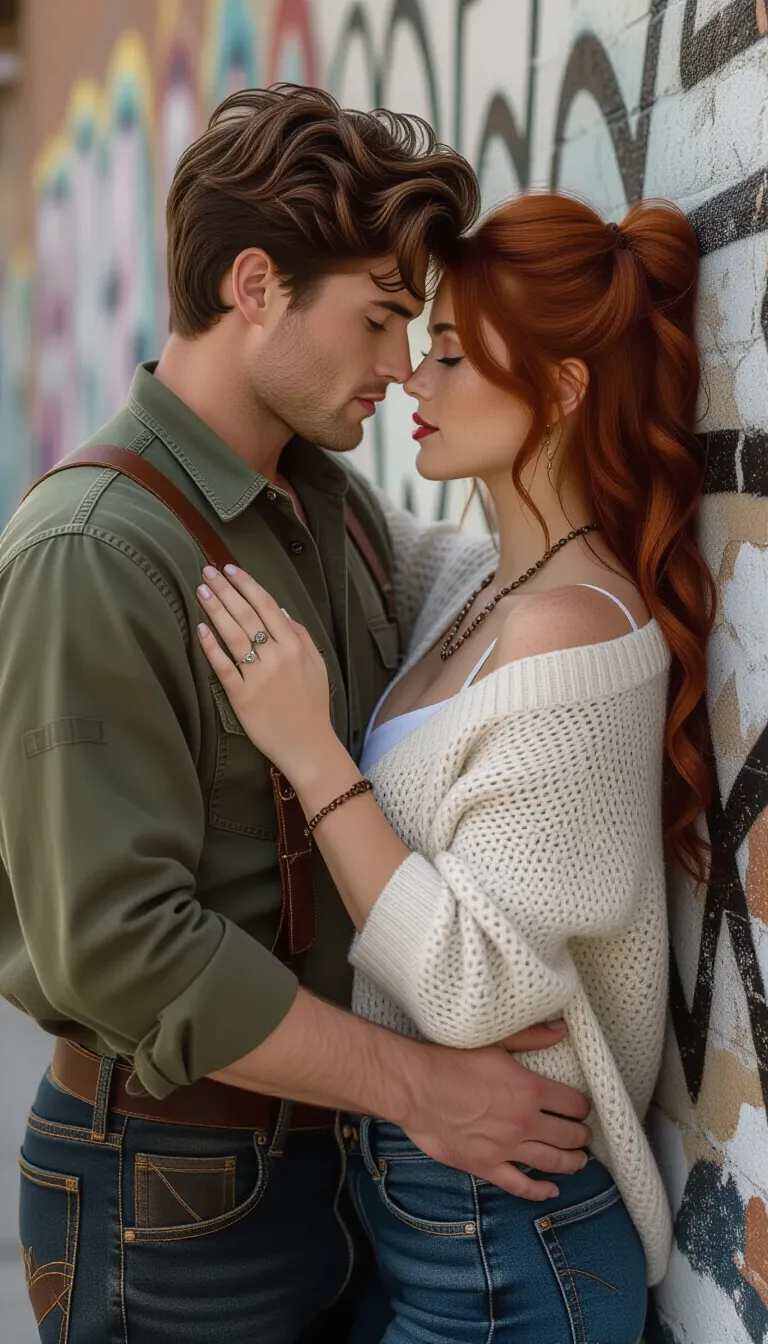
The cold seeped through her wool cardigan, through the thin cotton of her blouse, into the marrow of her bones. Declan pulled her closer, his back against the iron shelving, frost riming the metal inches from his shoulder. Her face was pressed into his neck, and he felt it—the wet heat of her tears, silent, soaking into his collar one after another.
"Shh." He said it soft, his hand finding the back of her head, fingers threading through her pinned-up hair. "Shh, love. I'm here."
She didn't stop. Her shoulders shook, barely, the kind of trembling you could miss if you weren't holding her. He was holding her. He felt every one.
"I prayed for him," she whispered into his skin. "Your father. I lit a candle at St. Mary's and I prayed for his soul."
Declan's throat tightened. He said nothing. His hand kept moving through her hair.
"I prayed for your mother. For her to survive the grief." She pulled back just enough to look at him, her green eyes wet, the freckles on her nose standing out in the dim light. "I prayed for the city to burn down if that's what it takes."
His breath caught.
"If it means we can walk through the ashes together," she said, her voice cracking, "let it all burn. I don't care anymore."
"Siobhan."
"I don't." She shook her head, a small violent motion. "I knelt in that church and I asked God to forgive me for meaning every word."
He watched her. The frost on the shelves. The drip of meltwater hitting stone, slow and regular as a heartbeat. Her hands came up between them, trembling, and found the top button of his shirt.
She undid it. Slow. Her fingers fumbling.
Second button.
He didn't stop her. He couldn't. She wasn't undressing him—she was prying him open, layer by layer, the way you'd open a door you weren't sure you were allowed through.
Third button. The cold air hit his chest. She pressed her palm flat against his sternum, over his heart.
"I don't know how to save you," she said. "I don't know how to save us."
Fourth button. The shirt fell open. She looked at him—the scar on his ribs from a fight he'd never explained, the hollow at the base of his throat where his pulse beat visible.
"Then let them come."
He said it quiet. Not a challenge. Not a defiance. A statement, flat and final as a door closing behind him.
She looked up.
"Let who come?"
"Anyone." He took her face in his hands. His thumbs found her cheekbones, wet from tears. "Your priest. My brother. The whole bloody city."
He kissed her forehead. Her skin was cold, salt on his lips.
"Your mother," he said, and kissed her left eyelid.
"My mother," she whispered.
He kissed her right eyelid. "Mine."
He kissed the bridge of her nose, the tip, the corner of her mouth where a tear had tracked down.
"The men who broke Thomas's hands," he said, his voice low. "The men who'll come for me. Let them."
She was crying again, silent, her breath hitching in small gasps he felt against his mouth.
"Let them come," he repeated, "because I'm not leaving you. Not for any of them."
She closed her eyes. A tear escaped, ran down her cheek, caught in the corner of her mouth. He kissed it away.
"I'm not worth dying for," she said.
"That's not your choice to make."
She opened her eyes. The green of them, moss after rain, wet and dark and holding everything she couldn't say.
"Declan."
"I know."
"I'm so tired of being afraid."
He pulled her close again, her face against his bare chest, his shirt hanging open around them. The cold bit at his back. The hooks above them swayed—a draft from somewhere, the old building breathing around them. His hand found the back of her head again, and he held her there, feeling her tears on his skin, her breath warm then cold as she inhaled.
"I know," he said again.
They stood like that. Long enough that the drip of meltwater changed rhythm, slowed. Long enough that the cold seeped through to his bones and he stopped feeling it.
She pulled back first. Her hand was still on his chest, over his heart. She traced the edge of his collarbone with her thumb, light, barely there.
"I brought you something."
He waited.
She reached into the pocket of her cardigan and pulled out a photograph. Frayed edges, creased down the middle. The image was faded—a man and a woman, young, standing in front of a stone wall. The woman had red hair, pinned up, a smile that didn't reach her eyes. The man was tall, thin, his hand on her shoulder like he was afraid she'd run.
"My mother," Siobhan said. "And Thomas."
Declan looked at the photograph. The man's hands were fine in the picture. Whole.
"She gave it to me," Siobhan said. "The night she told me about him. She said she kept it because she needed to remember that she'd been loved, once, before she learned to be afraid."
Declan's jaw tightened.
"She said there's no version of this story where I don't get hurt." Siobhan's voice was flat. Quoting. "She said the only question is how bad, and how long it takes me to learn to live with it."
"That's not—"
"I know." She looked up at him. "I know it's not. But she's not wrong, either."
He took the photograph from her, careful, his callused fingers brushing hers. He looked at the young man's face. Thomas. The broken hands. The disappearance.
"I need you to hear me," he said.
She watched him.
"I don't know how this ends. I don't know if I can keep you safe. I don't know if there's a world where we get to walk down the street holding hands and have no one throw a stone." He looked at her, gray eyes meeting green. "But I know that I will die before I let anyone put their hands on you. I know that I will burn this city down myself before I let you become her."
He tapped the photograph.
"I am not Thomas. You are not your mother. This is not the same story."
She stared at him. Her lip trembled, and she bit it, hard, the way she did when she was trying not to fall apart.
"Then what story is it?" she asked. Her voice was barely a whisper.
He thought about it. The cold room. The swaying hooks. The city outside, waiting, hungry, full of people who'd tear them apart if they knew.
"I don't know yet," he said. "But we're writing it together."
She let out a breath—half laugh, half sob—and pressed her forehead to his chest. Her hands found his waist, slipping under the open shirt, her cold fingers against his skin.
"I love you," she said. "I love you, and it's terrifying."
"I know." He kissed the top of her head. "Me too."
She looked up. Her eyes were red, her cheeks wet, her lip raw from biting it. She was the most beautiful thing he'd ever seen.
"I'm not done unbuttoning your shirt," she said.
A pause. Then he laughed—a real laugh, surprised out of him, breaking through the weight of the last hour.
"No?"
"No." She shook her head, a small smile flickering at the corner of her mouth. "I want to see all of you. Every part you've been hiding."
He didn't move. She took that as answer enough.
Her hands found the fifth button. The sixth. She pushed the shirt off his shoulders, and he let it fall, the cold air hitting his arms, his back, the places her hands hadn't touched yet.
She stepped back, just enough to look at him.
The frost on the shelves glittered in the dim light. Her breath came in small clouds. Her eyes moved over him—his shoulders, his chest, the scar along his ribs, the way his hands hung at his sides, waiting.
"You're beautiful," she said.
He shook his head.
"You are." She stepped forward, her hand finding his chest again, sliding down to his stomach. "All of this. You let them see the carpenter, the quiet one, the man who doesn't say much. But this—" Her hand pressed flat. "This is who you are."
He caught her wrist. Gently. His thumb found her pulse, racing.
"And who am I?"
She looked at him. "You're the man who crosses a city in the dark to meet a Catholic girl in a butcher's cold room. You're the man who learned to pray the rosary because she asked him to. You're the man who stood at his father's coffin and whispered her name."
His hand tightened on her wrist. Not hard. Just holding.
"You're the man I'm going to love until they bury me," she said, "and after that, I'll find a way to love you from the grave."
He pulled her in. His mouth found hers, and she tasted of salt and cold and something underneath—something desperate, something that had been held too long and was finally breaking free.
She kissed him back. Her hands came up to his face, holding him like he was something precious, something that could shatter. Her fingers in his hair, the sawdust she always found there, pulling him closer.
When they broke apart, they were both breathing hard. Her lips were red, wet, parted.
"I need to tell you something," she said.
He waited.
"I told my mother about us."
The words hung in the cold air.
"I told her everything," Siobhan continued. "She didn't throw me out. She didn't call the priest. She sat at the kitchen table and she listened, and then she held my hand and said she'd been praying I'd find someone who looked at me the way Thomas looked at her."
Declan's chest tightened.
"She said she'd meet you. If I wanted. She said she wanted to see the man who made her daughter smile like that."
"Like what?" he asked.
"Like you'd already saved me."
He didn't have words. He pulled her close again, his arms around her, her face against his neck, and he held her like the world was ending outside that door and he didn't care.
Because she wanted him to meet her mother. Because she'd told someone. Because she wasn't hiding him anymore.
"I'll meet her," he said. "Anywhere. Anytime."
Siobhan laughed, wet, against his skin. "She makes a proper Sunday roast. You'll have to eat it while she watches you like you're a bomb waiting to go off."
"I've been watched by worse."
"She has questions."
"I have answers."
She pulled back, looked at him. Her eyes were still wet, but there was something else there now. Light. A crack in the dark.
"Next Sunday," she said. "After mass. She'll have the table set."
He nodded. "Next Sunday."
She looked at him for a long moment. Then she reached up, took his face in her hands, and kissed him again—slow, deliberate, like she was memorizing the shape of his mouth.
The drip of meltwater. The frost on the shelves. The hooks swaying above them, catching the light, casting shadows on the concrete walls.
She pulled back, breathing hard.
"I should go," she said. "Before someone notices I'm gone."
He nodded. He didn't let go of her.
"Thursday?" she asked.
"Thursday." He said it like a vow. "Same place. Same time."
She smiled—a real smile, small, fragile, but real.
"Same girl," she said.
"Same man."
She kissed him one last time, quick, and then she was pulling away, buttoning her cardigan, wiping her eyes with the back of her hand. She paused at the door, her hand on the cold metal latch.
"Declan."
"Yeah?"
"Thank you."
"For what?"
She looked back at him. Her green eyes, wet, holding the light from the crack in the door.
"For not letting them win."
She opened the door and slipped out. The latch clicked shut behind her.
He stood alone in the cold room. His shirt on the floor. His chest bare to the frost. The hooks swaying above him, settling into stillness.
He picked up his shirt. He put it on. He did up the buttons one by one, slow, his fingers finding the holes by memory.
Her photograph was still in his hand. Thomas and her mother, young, whole, before the city took what it wanted.
He tucked it into his breast pocket, over his heart.
Then he opened the door and walked out into the grey Belfast morning, the cold still clinging to his skin, her taste still on his lips.
The streets were quiet. The grey morning pressed itself against the narrow terraced houses, and she walked with her head down, hands shoved into the pockets of her cardigan. Her fingers found the damp spot on her collar where his kiss had landed, still wet, still warm. Still his.
She turned onto her street. The front door was closed, but the curtain in the kitchen window shifted as she approached. Someone was watching.
Her mother.
Siobhan stopped at the gate. The cold metal bit into her palm, and she stood there for three long breaths, the frost settling on her shoulders, the photograph of Thomas and her mother burning in her breast pocket.
She'd told her everything. Not the details, not the taste of his mouth, not the way he said her name in the dark. But she'd told her enough. Enough to bring her mother to the table at dawn, waiting.
She pushed open the gate. The hinges sang. She walked up the path, her boots leaving prints in the frost, and at the door she paused, pressed her palm flat against the wood, and felt the vibration of her mother's footsteps approaching from the other side.
The door opened before she could knock.
Her mother stood in the frame, a woman who had once been beautiful in the way that only women who've survived their own story can be—freckled, grey-streaked, her hands worn from washing and cooking and holding her children through too many nights of gunfire. She wore her apron over her nightgown, and the kitchen behind her smelled of tea and toast and something else. Something like waiting.
"You're early," her mother said. Not an accusation. Not a question. Just a statement, hanging in the cold air between them.
Siobhan stepped past her into the hall. The warmth of the house hit her face, her hands, the tips of her ears. She closed her eyes for a second, letting it melt the frost from her skin.
"The shop opens at eight," she said. "I wanted to be home before—"
"You said Thursday."
Siobhan opened her eyes. Her mother had turned, was watching her from the kitchen doorway, her arms crossed over her chest. The apron was flour-dusted. There was bread rising on the counter, covered in a damp cloth.
"Today is Thursday," her mother said.
Siobhan's stomach dropped. She'd lost count of the days. The wake, the funeral, the cold storage, his hands on her face, his mouth on hers, the photograph—she'd lost track of the calendar entirely.
"I know what day it is," she said, but her voice came out wrong, too thin.
"Do you?" Her mother stepped aside, gestured to the kitchen table. Two cups of tea. Two plates. A pot of jam that had been opened but not used. "Because I've been sitting here since five, waiting for you to come through that door, and I've had time to think."
Siobhan walked into the kitchen. She pulled out a chair and sat down, her hands finding the warm ceramic of the teacup, her eyes fixed on the steam rising in curls.
"I'm not going to yell at you." Her mother sat across from her, her own tea untouched. "I've done my yelling. Three nights ago, when you told me, I did all the yelling I had in me." She paused. "And then I remembered Thomas."
Siobhan looked up. Her mother's eyes were dry, but there was something in them she'd never seen before. Something raw. Something that had been buried for thirty years.
"I've been thinking about his hands," her mother said quietly. "The way they looked after. The way they never looked the same. And I keep asking myself—is that what I want for you?"
"It won't—"
"I know you think it won't. I thought the same thing." Her mother shook her head, once. "Every girl who falls in love with a boy from the other side thinks she's the exception. The one who'll get through. The one who'll prove them all wrong." She reached for her tea, wrapped her hands around it, didn't drink. "I was that girl. And they broke his hands anyway."
Siobhan felt the photograph in her pocket, pressed over her heart, heavy as a stone.
"I'm meeting his mother," she said. "On Sunday. After mass."
Her mother went very still.
"You're what?"
"She asked to meet me. His mother." Siobhan gripped the teacup, let the heat burn her palms. "Declan's father just died. His mother is alone in that house on the Shankill, and she wants to meet the girl her son is risking his life for."
Her mother set the teacup down. The clink of ceramic against wood was loud in the quiet kitchen.
"You're going to the Shankill Road." Her voice was flat. "To meet a Protestant woman. In a house on the Shankill."
"Yes."
"After mass."
"Yes."
Her mother stared at her for a long moment. Then she laughed. It was a short, hollow sound, like a stone dropped into an empty well.
"You're braver than I was," she said. "Or stupider. I haven't decided which."
Siobhan didn't answer. She lifted the teacup to her lips and drank. The tea was too hot, but she didn't care. She let it burn her tongue, her throat, let the pain anchor her to the moment.
"What's his mother like?" her mother asked.
Siobhan thought about it. She'd never met Margaret Morrow. She'd only heard Declan speak of her in fragments—a woman who still set a place at the table for her husband even when he was working late, who prayed the rosary in English, who had held Declan's face in her hands the night before the funeral and told him she was proud of him, and he hadn't understood why.
"I don't know," she said honestly. "But he loves her. And she loves him. That's enough to start."
Her mother was quiet for a long time. The bread rose under its cloth. The clock on the mantel ticked. Somewhere in the street, a dog barked, and a child called out in the accent of the Falls, and the morning pressed on, indifferent to the two women sitting at the kitchen table, holding their teacups like lifeboats.
"I want to meet him first," her mother said finally.
Siobhan looked up.
"Before you go to his mother." Her mother's voice was steady now. Firm. "Before you step onto the Shankill Road and sit in a house full of people who would burn this street to the ground if they knew what you were doing, I want to meet him. In my house. At this table." She tapped the wood with her finger. "I want to look him in the eye and see if he's worth my daughter's life."
Siobhan's chest tightened. She set down the teacup, her hands trembling slightly, and she thought of Declan's grey eyes, of the way he'd held her in the cold room, of the photograph still warm against her heart.
"He'll come," she said.
"When?"
"Tonight."
Her mother's eyebrows rose.
"Tonight," Siobhan repeated. "After dark. I'll bring him through the back alley. No one will see."
Her mother studied her for a long moment. Then she nodded, once, and picked up her tea.
"I'll make a stew," she said. "And I'll put the good china out. If I'm going to meet the boy who's going to get my daughter killed, I'm going to do it properly."
Siobhan felt the laugh rise in her throat before she could stop it. It came out wet, cracked, half-sob, half-relief. She pressed her hand to her mouth, and her mother reached across the table and took her other hand, her fingers rough and warm and familiar.
"Don't thank me yet," her mother said. "I haven't decided if I like him."
"You will."
"I'll decide that for myself." But there was something in her mother's voice now, something softer, something that might have been the ghost of a smile hiding in the corners of her mouth. "Now eat your toast. It's cold, but it's toast."
Siobhan picked up a slice, bit into it, and the taste of butter and salt filled her mouth, and for a moment she let herself believe that this could be ordinary. That she could sit in her mother's kitchen and eat toast and talk about the weather and the bread rising on the counter, and that the world outside this room would not break them open and scatter their pieces across the streets of Belfast.
She finished the toast. She drank her tea. She washed the dishes while her mother watched the bread, and when she went upstairs to change out of her cold-damp clothes, she stood in front of the mirror in her room and pressed her palm to the photograph through her shirt, feeling the shape of it against her ribs.
Thomas. Her mother. Young, whole, standing in front of a house that had probably been bombed twenty years ago, their arms around each other, their faces bright with the certainty that love could survive anything.
She had to believe that too.
She had to.
She pulled on a fresh cardigan, the blue one her father had given her before he died, and she ran her fingers through her hair, and she pinned it up in a tight coil at the nape of her neck. She looked at herself in the mirror. A schoolteacher. A daughter. A Catholic girl with a photograph over her heart and a Protestant boy's name on her lips.
"Siobhan." Her mother's voice from the bottom of the stairs. "There's a call for you."
She went down. Her mother held out the receiver, her expression unreadable, and Siobhan took it, pressed it to her ear.
"Hello?"
"Siobhan." His voice. Low. Rough. A sound that made her chest ache. "I need to see you."
Her heart stopped. Then started again, harder, faster.
"I'm—" She glanced at her mother, who was watching her with the same expression she'd worn at the table, waiting, judging, hoping. "I was going to find you. I need to ask you something."
"Ask me."
"Tonight. Can you come tonight? To my house?"
A pause. She could hear his breathing, the faint crackle of the line, the sound of the city humming between them.
"Your house?"
"My mother wants to meet you."
The silence stretched. She felt it like a wire pulled taut, waiting to snap.
"Are you sure?" he asked finally.
"I've never been more sure of anything."
Another pause. Then, soft, almost swallowed: "I'll be there. After dark. I'll find the back alley."
"I'll leave the gate unlatched."
"Siobhan."
"Yes?"
"I love you." Three words, spoken simply, like a fact of the natural world. Like the frost on the windows, like the bread rising on the counter, like the bullet that hadn't found them yet.
She closed her eyes.
"I know," she said. "I'll see you tonight."
She hung up. Her mother was still watching her, arms crossed, leaning against the kitchen doorframe.
"He's coming," Siobhan said.
"I heard."
"Tonight."
"I heard that too." Her mother pushed off from the doorframe, walked to the counter, and lifted the cloth from the bread. It had risen beautifully, golden and soft, a perfect dome under the morning light. "Then I'd better get the stew on."
She didn't say anything else. She didn't have to.
She went upstairs alone.
The stairs creaked under her weight, the same three steps she'd memorized as a child, the one that groaned at the third riser, the one that tilted slightly left. She pushed open her bedroom door and stepped inside, closing it behind her with a soft click that felt louder than it was.
Her room was small. A single bed with a quilt her grandmother had stitched, a crucifix above the headboard, a wooden desk cluttered with graded essays and a chipped mug full of pens. The window faced the back alley, the same alley Declan would walk tonight, if he came. If the city let him.
She reached into the pocket of her cardigan. Her fingers found the photograph, the edges worn soft from handling, the paper warm from her body. She pulled it out and held it in both hands, the light from the window falling across it.
Her mother and Thomas. Young. Whole.
Her mother couldn't have been more than nineteen, her hair loose and wild, the same red as Siobhan's but brighter, unafraid. She was laughing, her head thrown back, her hand resting on Thomas's shoulder. And Thomas—dark-haired, sharp-jawed, his arm wrapped around her waist like he'd never let go—was looking at her mother the way Declan looked at Siobhan. Like she was the only thing in the world worth seeing.
Siobhan traced the edge of the photograph with her thumb. The paper was creased where it had been folded, the image slightly faded, as if the years had been leaching the color out of it one day at a time. She wondered how many nights her mother had taken this out, alone, after her father had gone to sleep, and looked at the face of a boy who'd loved her and been broken for it.
Her throat tightened.
She set the photograph on the desk, face-up, and sat on the edge of her bed. The springs creaked. Outside, a car passed, someone's radio playing a folk song she didn't recognize, and then silence again, the thick silence of a street that knew how to hold its breath.
She thought about Thomas. About the hands that had been broken. About the three men who'd done it, men who'd probably been young once too, who'd probably had mothers and sweethearts and Sunday dinners. Men who'd learned to hate before they learned to love, and who'd passed that hate down like a family Bible, generation after generation.
She thought about Declan's hands. Sawdust in the creases. Calluses on the palms. The way they'd cupped her face in the cold storage, rough and gentle at once, as if he was afraid she'd break if he held her too tight and disappear if he didn't hold her tight enough.
She pressed her palm to her chest, over the spot where the photograph had rested. Her heart was beating fast. Too fast. A bird trapped in a ribcage, throwing itself against the bone.
From downstairs, the sound of a pot being set on the stove. The clatter of a lid. Her mother's voice, humming something low and old, a tune Siobhan recognized but couldn't name.
She stood up. Walked to the desk. Picked up the photograph again, and for a long moment she stood there, staring at her mother's laughing face, at Thomas's steady gaze, at the love that had been so bright and so brief.
Then she folded the photograph carefully, along the old crease, and tucked it back into her cardigan pocket, over her heart.
She went to the window and looked out at the back alley. The wall on the far side was covered in graffiti—a faded mural of a soldier, a slogan she'd seen so many times she didn't read it anymore, a red handprint that someone had left like a signature. The gate was latched. The alley was empty.
But tonight. Tonight he would walk this alley. He would lift the latch. He would stand at her back door, and her mother would open it, and the world would shift on its axis, just a little, just enough to let a Catholic schoolteacher and a Protestant carpenter pretend, for one night, that the city wasn't bleeding around them.
She pulled the curtain closed.
Downstairs, her mother had stopped humming. The stew was simmering, a rich smell rising through the floorboards, meat and onions and thyme, the smell of Sunday dinners and wake suppers and every meal that had ever held a family together.
Siobhan left her room and walked down the stairs. The third riser groaned. The one that tilted left caught her weight, and she steadied herself on the banister, the wood smooth under her palm from decades of hands just like hers.
Her mother was at the stove, stirring the stew with a wooden spoon. She didn't turn around when Siobhan entered the kitchen.
"Did you go and look at it?" her mother asked quietly.
Siobhan stopped. "Yes."
"And what did you see?"
She thought about lying. She thought about saying something safe, something that would close the conversation. But the photograph was still warm against her heart, and the afternoon light was slanting through the kitchen window, and her mother's back was straight, her shoulders set, waiting.
"I saw you," Siobhan said. "Before."
Her mother's hand paused on the spoon. Just for a second. Then she resumed stirring, the rhythm steady, as if she'd been doing it her whole life, as if the past was just another ingredient she'd learned to fold in.
"He was a good man," her mother said. "Thomas. He was kind. He had a laugh that made you want to laugh, even when there was nothing funny." She set down the spoon and turned, her eyes meeting Siobhan's. "He was worth every broken thing that came after."
Siobhan's breath caught. She held it.
"Your Declan," her mother said, "is he worth it?"
The question hung in the air, heavier than the steam from the stew, heavier than the crucifix on the wall, heavier than the photograph in her pocket.
Siobhan thought of his gray eyes in the cold storage, watching her, waiting. She thought of his hands on her face, the calluses rough against her cheeks. She thought of the way he'd said her name, like a prayer, like a surrender.
"Yes," she said. "He is."
Her mother studied her for a long moment. Then she nodded, once, and turned back to the stove.
"Then we'll need more bread," she said. "And clean the potatoes. And set the table with the good cloth."
Siobhan moved to the counter, picked up a potato, and began to peel. The skin curled away under the blade, thin and even, a rhythm she'd learned at her mother's side, the same rhythm her grandmother had taught her mother, a line of women passing knives and potatoes and secrets down through the years.
They worked in silence for a while. The clock on the mantel ticked. The stew bubbled. The afternoon deepened, the light shifting from white to gold to the soft grey of early evening.
Siobhan finished the potatoes. She washed her hands. She helped her mother set the table, spreading the white linen cloth that only came out for Christmas and funerals, and now, apparently, for a Protestant boy who might be worth the risk.
"Mammy," she said, standing at the window, watching the alley darken.
"Yes, love?"
"What if they don't let us have this?"
Her mother came to stand beside her. She didn't touch her, but she was close enough that Siobhan could feel the warmth of her, the solid presence of a woman who'd survived worse.
"They might not," her mother said quietly. "They might take it from you, piece by piece, until there's nothing left but a memory and a photograph." She paused. "But you'll still have had it. You'll still have known what it felt like to be loved like that. And no one can take that from you. Not with bullets. Not with broken hands. Not with all the hate in Belfast."
Siobhan blinked. Her eyes were wet.
"He's coming tonight," she whispered.
"I know."
"And I'm terrified."
"I know that too." Her mother reached out, finally, and took her hand. Her grip was strong, her palm callused from years of work, but her fingers were gentle, holding Siobhan's like she was still a child, like she could protect her from everything if she just held on tight enough.
"I'll put the kettle on," her mother said. "When he gets here, we'll have tea, and we'll talk, and we'll see what kind of man he is." She squeezed Siobhan's hand. "And if he's half the man Thomas was, he'll be worth the broken things."
She let go and walked to the stove, filling the kettle with water, setting it on the burner with a clatter.
Siobhan stayed at the window, watching the alley, watching the last of the light drain from the sky. The streetlamp at the corner flickered on, casting a yellow pool on the pavement. The gate swung slightly in the breeze, the latch rattling, a sound like a question, like a knock that hadn't come yet.
She pressed her hand to her cardigan pocket, feeling the photograph folded against her heart, and she waited.
The movement came at the edge of the alley—a shadow that separated from the deeper dark and resolved into a man's shape, broad-shouldered, moving with the careful economy of someone who knew how to be invisible.
Siobhan's breath caught. Her hand pressed flat against the window glass, the cold seeping into her palm.
"He's here," she whispered.
Her mother was beside her in an instant, her hand finding Siobhan's shoulder, squeezing once. "Then let him in."
Siobhan crossed the room before she could think, before she could second-guess, before the fear could catch up with the hope. The front door opened onto the narrow alley, and he was there—Declan, his dark auburn hair damp with evening mist, his gray eyes finding hers in the dim light. He wore a dark coat that made him look older, harder, a man who'd buried his father three days ago and had crossed a city at night to stand on her doorstep.
"Siobhan." Her name, spoken like a prayer, like a confession.
She stepped back, and he crossed the threshold into her home.
The door clicked shut behind him. The sound was soft, almost gentle, but it felt like a seal, like a line drawn in water that couldn't be uncrossed.
He stood in the narrow hallway, his hands at his sides, his eyes moving from the crucifix on the wall to the small statue of the Virgin Mary on the hall table, a rosary draped around its base. He took it in—all of it—and something in his face softened, not into surrender but into recognition, like he was memorizing the shape of a world he'd only glimpsed from the outside.
"Declan." Her mother's voice came from the kitchen doorway, warm and steady. "Come in. Sit. I'll put the kettle on."
Declan's eyes met Siobhan's, and she saw the question in them—the uncertainty, the fear that he'd be judged and found wanting. She took his hand, her fingers threading through his, and led him into the kitchen.
The table was set with the good cloth. The stew was steaming in a ceramic pot. The kettle was already beginning to whistle, as if her mother had known the exact moment he'd arrive, as if she'd been listening for his footsteps too.
"Sit," her mother said, and Declan sat.
He didn't look at the table. He didn't look at the stew. He looked at Siobhan's mother, his gray eyes steady, his hands resting on his thighs like he was bracing himself for judgment.
"I'm sorry for your loss," her mother said, pouring the tea. "I heard about your father. I prayed for him."
Declan's throat moved. "Thank you."
Her mother set a cup before him, the steam curling up between them. "I'm Maeve," she said. "Siobhan's mother. Though I expect you knew that."
"I did." He wrapped his hands around the cup, the heat seeping into his palms. "She told me about you."
Maeve sat down across from him, her own cup untouched. "Did she tell you about Thomas?"
Siobhan tensed. She moved to sit beside Declan, her shoulder brushing his, a small anchor in the heavy silence.
"She showed me the photograph," Declan said. "She told me what they did to him."
"And you still came."
"I did."
Maeve studied him. The clock on the mantel ticked. The stew bubbled softly. The kettle had fallen silent, and the only sound was the drip of the tap and the distant hum of the city, the city that was full of men who would hurt him for sitting at this table.
"Why?" Maeve asked. "Why risk it?"
Declan looked at Siobhan. His gray eyes were soft, vulnerable, stripped of the careful distance he wore like armor. "Because she's worth it," he said. "Because I've spent my whole life being careful, and I'm tired. Because I'd rather die standing beside her than live another day pretending she doesn't exist."
Siobhan's heart was a drum in her chest. She reached under the table and found his hand, her fingers lacing through his.
Maeve didn't speak for a long moment. She picked up her tea, took a sip, set it down. Then she nodded, a small, almost imperceptible gesture, like she'd made a decision she'd been wrestling with for days.
"She has your father's eyes," Maeve said. "Siobhan. She has the same way of looking at someone like they're the only person in the room." She paused. "I saw that look in her eyes when she talked about you. I knew then I'd lost her."
"You haven't lost her," Declan said.
"No?" Maeve's smile was sad, knowing. "She loves you. I can see it. And when a woman loves a man like that, she leaves her mother's house—not in body, maybe, but in heart. She builds a new home, a new world, around that love." Her voice dropped. "I know. I did it once."
Siobhan's throat tightened. "Mammy—"
"I'm not saying it to hurt you, love. I'm saying it because I want you to know what you're choosing." She looked at Declan again. "You'll take her from me. Not tonight, not tomorrow, but someday. And I need to know you'll take care of her."
Declan met her gaze. "I'll die before I let anyone hurt her."
"I know you mean that. But meaning it and doing it are different things. Thomas meant it too."
The silence that followed was heavy, weighted with the ghost of a man whose hands had been broken, whose love had been stolen, whose name was now a warning and a blessing all at once.
Declan didn't look away. "I'm not Thomas," he said quietly. "And she's not you. And this isn't twenty years ago. I don't know if that makes it better or worse, but I know I'm going to try. Every day. Until they bury me or I bury them."
Maeve held his gaze for a long moment. Then she nodded once, a single, final gesture, and pushed back her chair.
"Eat," she said. "Both of you. You're too thin, and love won't fill an empty stomach."
She ladled stew into bowls, set bread on the table, and sat down with them. They ate in silence, the clink of spoons against ceramic the only sound, but it was a comfortable silence, a shared silence, the kind that said more than words could carry.
When the bowls were empty, Maeve stood and carried them to the sink. "I'll do the washing up," she said. "You two have things to say to each other, I expect. The sitting room is through there." She gestured with her chin. "The fire's lit."
Siobhan rose, her heart pounding. She took Declan's hand again, leading him into the small sitting room, where a fire crackled in the grate and two armchairs faced each other, their velvet worn soft with years.
He didn't sit. He stood in the middle of the room, his hands at his sides, his shoulders hunched like the weight of the world was pressing down on him. She crossed to him, her hands finding his, her fingers tracing the calluses, the sawdust still embedded in his palms.
"You came," she said.
"I said I would."
"I know. But you still came." She looked up at him, her green eyes meeting his gray. "I was so afraid. All day. That you'd change your mind. That your mother would stop you. That Billy would find out. That something would happen, and I'd be standing at that window forever, waiting."
His hand came up, cupping her face, his thumb tracing the line of her cheekbone. "I would have crawled across the city to get here. I would have broken down every door. I would have—"
She kissed him.
It was soft, at first—a brush of lips, a question asked and answered. But then his hand slid into her hair, and her fingers gripped his coat, and the kiss deepened, became something desperate, hungry, a promise made in the dark of a sitting room with a fire crackling and her mother washing dishes in the next room.
He pulled back, his forehead resting against hers. "I don't know how to do this," he whispered. "I don't know how to love you and keep you safe. I don't know how to be the man you need."
"You already are." She pressed her palm to his chest, feeling his heart beat beneath the layers of wool and cotton. "You're here. That's all I need."
His hands found her waist, pulling her closer, and she went willingly, her body molding against his. The firelight flickered across them, casting long shadows on the walls, and for a moment, the world outside—the city, the war, the families who would tear them apart—faded into nothing.
"I saw your mother," he said, his voice rough. "Before I left. She knows about you. She didn't say it in so many words, but she knows. And she's afraid."
Siobhan stiffened. "What did she say?"
"She told me to be careful. She told me she didn't want to bury another man before she was ready." He pulled back, his eyes searching hers. "She asked if you were worth it."
"What did you tell her?"
He smiled, a small, sad smile that didn't reach his eyes. "I told her the truth. That I'd burn down the whole city if it meant I could spend one more night with you."
Siobhan's breath caught. She leaned up and kissed him again, softer this time, a kiss that said everything she couldn't put into words.
The door creaked. They broke apart, turning to find Maeve standing in the doorway, a dish towel in her hands, her expression unreadable.
"You should go," she said, her voice soft but firm. "Before the neighbors start talking. Before someone sees him leaving."
Declan nodded. He turned to Siobhan, his hand finding hers one last time. "Thursday," he said. "The butcher's. Dawn."
"Thursday," she repeated. "Dawn."
He kissed her forehead, a gesture so tender it made her chest ache, and then he was gone, slipping out the back door, into the alley, into the dark, a shadow swallowed by the night.
Siobhan stood at the threshold, watching until she couldn't see him anymore. Her mother came to stand beside her, and together they watched the empty alley, the streetlamp flickering, the gate swinging gently in the breeze.
"He'll come back," Maeve said quietly. "That one. He'll come back."
Siobhan pressed her hand to her chest, feeling the photograph still warm against her heart, and she nodded.
"I know," she said. "I know."
Declan moved through the alley, his boots finding the familiar hollows in the cobbles, his breath misting in the cold air. The gate swung shut behind him with a soft click, and he paused, listening. The street was empty, the lamplight pooling in yellow circles on the wet pavement, and somewhere in the distance a dog barked once, then fell silent.
He walked.
The city at night was a different beast—quieter, older, more honest. The peace walls loomed in the dark, their graffiti blurred to grey, and the houses crouched behind their curtains like they were holding their breath. He kept his head down, his hands in his pockets, his shoulders hunched against the cold that seeped through his coat. The Shankland Road was a mile away, maybe more, but he knew every shortcut, every alley, every garden wall he could vault if he needed to run.
He'd learned to run young.
A sound.
Footsteps. Behind him. Not close—fifty yards back, maybe sixty—but distinct in the quiet night, the steady rhythm of boots on wet stone, keeping pace with his own.
He didn't turn. Didn't slow. He kept walking, his jaw tight, his hands still in his pockets, his eyes fixed on the street ahead. The footsteps matched his stride, neither gaining nor falling back. Deliberate. Measured. Like they wanted him to know he was being followed.
He reached the corner and turned left, into a narrow alley between two terraced houses, the walls so close he could touch both sides if he spread his arms. The footsteps followed. The echo bounced off the brick, sharper now, closer.
Twenty yards.
He stopped.
The footsteps stopped.
The silence stretched, thick and heavy, the drip of water from a gutter the only sound. Declan turned, slowly, his hands coming out of his pockets, his weight settling on the balls of his feet.
The alley behind him was empty.
Just shadows. Just silence. Just the faint glow of the streetlamp at the far end, illuminating nothing.
He waited. Counted his heartbeats. One. Two. Three. Nothing moved. The air was cold in his lungs, and his pulse was a steady drum in his ears, and he was suddenly very aware of how alone he was, how far from any door he could knock on, how easily a man could disappear in these streets.
He turned and walked on, faster now, his breath coming shorter. The alley opened onto a wider road, and he crossed it without looking, his eyes scanning the windows, the doorways, the shadows under the parked cars.
The footsteps again. Closer now. Definitely closer.
He broke into a run.
His boots pounded the pavement, his lungs burning, his coat whipping behind him. He took a sharp left, then a right, ducking through a gap in a fence, his shoulder scraping against the wood, and emerged into a small courtyard, washing lines strung between the windows, a child's bicycle lying on its side.
He pressed himself against the wall, his breath ragged, his heart hammering. He listened.
Nothing.
Just the wind. Just the distant hum of the city. Just the drip of water somewhere above him, a steady, patient rhythm that sounded almost like footsteps if you didn't know better.
He waited. Counted to sixty. Then to a hundred. Then he let out a long, slow breath, his shoulders sagging, and pushed off from the wall.
"Running from something, Morrow?"
The voice came from the shadows to his left, low and familiar. Declan's hand shot out, grabbing the washing line, steadying himself as Billy Patterson stepped into the dim light.
Billy was bigger than him, broader, his face a mask of hard angles and hard living. He wore a leather jacket, his hands in his pockets, his smile a thin line that didn't reach his eyes.
"Didn't expect to see you out here," Billy said. "Thought you'd be home, mourning your da."
Declan's jaw tightened. "What do you want, Billy?"
"Just taking a walk." Billy shrugged, his shoulders rolling like he had all the time in the world. "Seen you coming out of that alley. The one behind the Connolly house." He tilted his head, his eyes narrowing. "Funny place for a Protestant boy to be walking, that."
Declan said nothing. His hands were shaking, but he kept them at his sides, his fingers curling into fists.
"I told you," Billy said, his voice dropping, "I told you to remember who you are. And here you are, walking home from the Falls Road at midnight, like you own the place." He stepped closer, close enough that Declan could smell the whiskey on his breath, the stale smoke in his clothes. "What's her name, Morrow? The girl you're meeting?"
"None of your business."
"Everything in this city is my business." Billy's hand shot out, grabbing Declan's collar, shoving him back against the wall. The brick bit into his spine, cold and rough, and Billy's face was inches from his, his eyes hard, his voice a low growl. "I've killed men for less than this. You know that. You know what I am."
Declan met his gaze. His heart was pounding, his blood was roaring, but he kept his voice steady. "You don't scare me, Billy."
"I should." Billy's grip tightened. "I should scare the living daylights out of you. Because if I find out you're meeting a Catholic girl, if I find out you're crossing the line, I won't just kill you. I'll kill her too. And her mother. And anyone else who gets in my way."
Declan's hand moved. Fast. He grabbed Billy's wrist, twisted, and shoved him back, hard enough to make him stumble. Billy's eyes went wide, surprised, and then he laughed, a low, ugly sound that echoed off the walls.
"There it is," Billy said. "There's the fight in you. I was wondering where it went."
Declan stepped forward, his voice low, his words careful. "I don't want trouble with you, Billy. I never have. But if you come near her, if you touch her, I will kill you. I swear on my father's grave, I will kill you."
Billy's smile faded. The laughter died in his throat. He studied Declan for a long moment, his eyes searching, his breath misting in the cold air.
"You mean it," he said, his voice flat. "You actually mean it."
"I do."
Billy nodded slowly. He stepped back, his hands raised, his smile returning, thinner now, sharper. "Alright, Morrow. Alright. You've made your point." He turned, walking toward the mouth of the alley, then paused, looking back over his shoulder. "But I'll be watching. I'll always be watching. And when you slip—and you will slip—I'll be there."
He disappeared into the dark.
Declan stood there, his back against the wall, his heart pounding, his hands shaking. The cold seeped through his coat, through his skin, into his bones, and he couldn't stop trembling.
He pushed off the wall and walked, his legs unsteady, his breath ragged. He didn't look back. He didn't slow down. He walked until he reached the Shankill Road, until he saw the familiar windows of his mother's house, until he was standing at the front door, his hand on the handle, the wood cold beneath his palm.
He didn't go in.
He stood there, in the dark, in the cold, and he thought of Siobhan. Her laugh. Her green eyes. The way she'd kissed him in the sitting room, her fingers in his hair, her body pressed against his. He thought of her photograph, warm against her heart, and he thought of her mother, standing in the doorway, watching him leave.
He thought of Billy's words, and he felt the weight of them settle in his chest, heavy and cold.
He pushed the door open and stepped inside.
The house was dark, quiet, the fire in the grate reduced to embers. He climbed the stairs, his boots heavy on the creaking wood, and paused at the top, looking down the hallway toward his mother's room. A sliver of light showed beneath the door. She was awake. Waiting.
He walked to his attic room, closed the door behind him, and sat on the edge of his bed. The rosary beads were still on the nightstand, where he'd left them. He picked them up, the beads warm against his cold fingers, and he pressed them to his lips.
"Thursday," he whispered. "Dawn."
The words felt like a prayer. Like a promise. Like the only thing keeping him from falling apart.
He lay back on the bed, the rosary in his hand, and stared at the ceiling. The footsteps still echoed in his mind. Billy's voice. The weight of the city pressing down on him.
He closed his eyes.
And he waited for dawn.
He lay in the dark, the rosary beads warm against his palm, and the memory came unbidden—not in fragments, but whole, the way a wound opens again when you press too close to it.
The cold storage room. The latch clicking shut behind them. Frost rimming the iron shelves, their breath hanging visible in the dim light, the only sound a drip of meltwater hitting stone. She'd been crying. Not loud—silent tears that wet his collar, that he felt more than saw.
"Siobhan." He'd taken her face in his hands, his thumbs brushing the tears from her cheeks. "Siobhan, look at me."
She'd shaken her head, pressed her forehead to his chest, her fingers gripping his coat like she was drowning. "I've been praying for your father," she'd whispered, her voice breaking. "Praying for your mother. Praying for the city to burn down if it means we can walk through the ashes together."
He'd held her. What else could he do? The words she'd spoken were a confession and a curse, a prayer and a blasphemy, and he'd felt them settle in his chest like stones.
Her hands had moved then, shaking, finding the buttons of his shirt. She'd undone them slowly, one by one, her fingers trembling against his sternum, and he'd let her. He'd stood there, in the cold, in the dark, and let her expose him—layer by layer, until his chest was bare, until the cold air bit his skin, until she pressed her palm flat against his heart.
"I need to feel you," she'd said, her voice raw. "I need to know you're real. I need to know this is real."
He'd covered her hand with his, pressing it harder against his chest. "I'm real," he'd said. "This is real."
She'd looked up at him then, her green eyes wet, her freckles smudged with tears, her lips trembling. "Declan."
He'd kissed her forehead. Her eyelids. The salt on her lips. "I'm here," he'd whispered between kisses. "I'm not going anywhere."
"They'll find us," she'd said, her voice breaking. "They'll find us and they'll—"
"Then let them come."
The words had left his mouth before he'd thought them, and he'd felt the weight of them settle in the air between them, heavy and irrevocable. He'd taken her face in his hands again, his thumbs tracing the line of her cheekbones, and he'd said it again, slower, each word a promise.
"Then. Let them. Come."
She'd stared at him, her breath hitching, her eyes searching his. "You mean it."
"I mean it."
She'd kissed him then—desperate, hungry, her fingers in his hair, her body pressed against his bare chest, the cold forgotten, the world forgotten, nothing but her mouth on his and the sound of her breathing and the weight of her in his arms.
They'd stayed there until the light through the frosted window shifted, until the drip of meltwater slowed, until the cold seeped through their clothes and into their bones. She'd pressed her lips to his chest one last time, over his heart, and then she'd buttoned his shirt, her fingers steady now, deliberate.
"I meant what I said," he'd told her, catching her wrist as she finished. "About your mother. About meeting her. I meant all of it."
She'd nodded, her eyes wet again, but she'd smiled—a small, broken thing that cut him deeper than any tear. "I know."
She'd left first, slipping through the door into the grey afternoon, and he'd stood there in the cold, his shirt still half-open, her warmth still on his skin, and he'd let himself believe it. For one moment, he'd let himself believe that they could survive this. That love could be enough. That the city would not swallow them whole.
The present crashed back into him like cold water. He was in his attic room, the rosary beads cold in his hand, the memory already fading, already turning to ash in his mouth.
He sat up, his feet on the floor, his head in his hands. The night pressed against the window, black and endless, and somewhere in the city, Billy Patterson was walking the streets, watching, waiting.
When you slip—and you will slip—I'll be there.
Declan's jaw tightened. He reached for the photograph Siobhan had given him—her mother and Thomas, young and whole, their faces bright with the kind of hope he recognized because he'd seen it in her eyes. He traced the edge of the photograph, the paper soft and worn, and he thought of her mother standing in the doorway, watching him leave, her eyes saying everything her words hadn't.
Don't let them break her like they broke us.
He set the photograph down beside the rosary beads and stood. His legs were unsteady, his hands still shaking, but he crossed the room to the window and looked out at the city. The streetlights cast pools of orange on the wet pavement. The rooftops gleamed, slick with rain. Somewhere in the distance, a dog barked, and a car engine turned over, and the city breathed its slow, steady breath.
He thought of Siobhan, asleep in her bed on the Falls Road, her red hair spread across the pillow, her freckles invisible in the dark. He thought of her hand on his chest, the way she'd said his name, the way she'd looked at him like he was the only thing keeping her tethered to the earth.
He thought of Billy's hands on his collar, the smell of whiskey and smoke, the threat in his voice.
He pressed his palm to the cold glass and let the chill seep into his skin.
"Then let them come," he whispered, the words a prayer, a promise, a curse.
The city gave no answer. The night held its breath. And in the attic room, a man who had nothing left but his love for a girl with green eyes and a photograph pressed against her heart stood alone in the dark, waiting for dawn.
He didn't sleep. He stood at the window, watching the sky shift from black to grey to pale, and when the first light touched the rooftops, he moved.
He dressed in silence—his work trousers, a clean shirt, his coat. He tucked the rosary beads into his pocket, and the photograph, and a note he'd written in the dark, words he couldn't say aloud but needed her to know.
He opened the door.
The hallway was empty, the house still. He crept down the stairs, past his mother's room, past the closed door behind which she slept with a grief she wouldn't speak. He paused at the bottom of the stairs, his hand on the front door, and he looked back at the house that had raised him, the walls that held his father's ghost, the rooms that had witnessed every promise he'd ever broken.
He opened the door.
The cold air hit him, sharp and clean, carrying the smell of wet stone and diesel and something green, something living, something that reminded him of her.
He stepped out into the dawn.
The streets were empty, the shops shuttered, the only sound the distant hum of a milk truck making its rounds. He walked with his head down, his hands in his pockets, his breath misting in the cold. He crossed the invisible line—the one the city had drawn, the one his father had drawn, the one Billy Patterson was watching—and he didn't look back.
Every step felt like a threshold. Every corner felt like a trap. But he kept walking, his feet carrying him toward the Falls Road, toward the butcher's shop, toward the cold storage room where she would be waiting.
He thought of her face when he'd said the words. The way her eyes had widened, the way her breath had caught, the way she'd kissed him like he was oxygen and she'd been drowning.
Then let them come.
He crossed the street, his boots splashing through a puddle, and he saw it—the butcher's sign, faded and familiar, swinging in the morning breeze. The back room. The cold storage. Her.
He picked up his pace, his heart pounding, his hands trembling, and he didn't stop until he was at the door, his hand on the latch, the metal cold beneath his palm.
He pulled.
The door swung open, and she was there.
The door swung open, and she was there.
She stood in the dim light of the cold storage, her red hair pinned up but escaping in curls at her temples, her green eyes red-rimmed and bright. She wore the same cardigan she'd worn the first time he'd seen her—the one with the loose button at the collar—and her hands were clasped in front of her, fingers twisting together, like she'd been holding herself still for hours.
She exhaled when she saw him—a sound that was half-laugh, half-sob—and she crossed the space between them in three steps, her hands finding his chest, his shoulders, his face, as if she needed to confirm he was real.
"You came," she whispered.
He nodded, his throat too tight for words. He reached into his pocket and pulled out the note—folded and refolded until the paper was soft at the creases, the words he'd written in the dark, his hand shaking over the page. He pressed it into her palm, felt her fingers close around it, and watched her eyes drop to the folded paper.
"What is this?" she asked.
"Read it," he said, his voice rough. "Please."
She looked at him for a long moment, her eyes searching his face, and then she unfolded the note with the careful slowness of someone handling something sacred.
The cold storage was silent except for the drip of meltwater and the sound of her breath catching as her eyes moved across the page.
He watched her read it. He watched the way her lips parted, the way her hand came up to cover her mouth, the way her eyes glistened, the way the paper trembled in her grip. He watched the words he'd written in the dark become real between them, become something she could hold, something she could keep.
She read it twice.
Then she lowered the note and looked at him, and her eyes were wet, and her voice broke when she spoke.
"Declan."
Just his name. Just the sound of it in her mouth, like a prayer, like a question, like the only word she had left.
He stepped closer. He took her face in his hands, his thumbs brushing the tears that spilled down her cheeks, and he kissed her forehead, her eyelids, the bridge of her nose, the corner of her mouth, the salt on her lips.
"I wrote it in the dark," he said, his voice low, his lips still close to hers. "After the wake. After the mourners left. After I stood at my father's coffin and told him about you."
She made a sound—something between a sob and a gasp—and pressed her forehead to his.
"I told him I loved you," he continued, his voice barely above a whisper. "I told him I was going to cross the city for you. I told him I was going to choose you, even if it meant losing everything."
Her hand found his wrist, her fingers wrapping around it, her grip tight and desperate.
"Declan."
"I meant every word, Siobhan."
She pulled back, just enough to look at him, the note still clutched in her hand, the paper crinkling against her chest. Her eyes were bright, her cheeks flushed, her lips parted, and she looked at him like he was the first real thing she'd seen in years.
"I don't know what I did to deserve this," she said, her voice shaking. "I don't know why you chose me. I don't know what I've done—"
"You showed up," he said. "You kept showing up. You didn't let the city win."
She laughed—a wet, broken sound that cut him open—and she stepped into him, her arms wrapping around his neck, her face burying in his shoulder. He held her, his arms closing around her waist, his cheek pressed to her hair, and he felt her body shake with silent sobs.
He held her until she stilled, until her breathing evened, until the cold seeped back into the space between them.
"Read it to me," she whispered, her lips against his collar. "I want to hear it in your voice."
He pulled back, his hands finding hers, and he took the note from her fingers. He unfolded it, the paper soft and worn, and he looked at the words he'd written—his handwriting shaky, the ink smudged in places where his hands had trembled—and he read them aloud.
"Siobhan—" His voice caught. He cleared his throat and started again. "Siobhan. I'm writing this in the dark because I can't sleep and because the words won't stay in my head. I keep thinking of your face when you told me about your mother and Thomas. I keep thinking of the way you said his name, like a warning and a question all at once. I keep thinking of the photograph you gave me—the two of them, young and whole, standing in the sun like they thought the world couldn't touch them.
"I don't know if the world can touch us. I don't know if we're different from them. I don't know if love is enough, or if it ever was, or if we're just fools who don't know any better.
"But I know this: I crossed the city tonight. I crossed the invisible line—the one my father drew, the one my brother watches, the one the city has drawn since before we were born—and I crossed it for you. I'll cross it again. I'll cross it every day if you ask me to.
"I don't know how to save you. I don't know how to save us. But I know that I love you, and I know that I'm not going to stop.
"I'm going to meet your mother. I'm going to sit at her table and look her in the eye and tell her that I love her daughter. I'm going to show her that I'm not Thomas. I'm going to prove that the story we're writing is different.
"And if the city comes for us—if Billy comes, if the streets burn, if the world ends—I want you to know that I chose you. Every time. Every day. Every breath.
"I love you, Siobhan. I love you, and I'm not afraid anymore."
He finished. The words hung in the cold air between them, and he looked up from the note, his hands trembling, his eyes wet.
She was crying. Silent tears, streaming down her cheeks, her hand over her mouth, her eyes fixed on him like he was the only thing in the world.
"Declan," she whispered. "Declan."
She said his name again and again, like a litany, like a prayer, and she reached for him, her hands finding his face, her thumbs brushing the tears from his cheeks, her forehead pressing to his.
"I don't know what I did," she said, her voice breaking. "I don't know why God gave me you. I don't know why—"
"Maybe," he said, his voice rough, "maybe we stop asking why. Maybe we just—hold on."
She kissed him.
It wasn't like the other kisses—the desperate, hungry ones in the butcher's back room, the ones that tasted of fear and longing and the clock ticking down. This one was slow, deliberate, her lips soft against his, her hands cradling his face like he was made of glass. It was a kiss that said yes. A kiss that said I'm here. A kiss that said I'm not going anywhere.
He kissed her back, his hands finding her waist, pulling her closer, and he felt the note still pressed between them, the paper crinkling against his chest, carrying the words he'd written in the dark.
She pulled back, just enough to look at him, her eyes bright, her lips swollen, her breath warm against his skin.
"I love you," she said. "I love you, Declan Morrow. I love you until the end of the world."
He kissed her again, answering her with his mouth, his hands, the way he held her like she was the only thing keeping him tethered to the earth.
They stayed there, tangled together in the cold, the note still clutched in her hand, the words he'd written still echoing in the air between them. The morning light filtered through the frosted window, casting pale shadows on the concrete floor, and the city outside waited, patient and hungry, ready to swallow them whole.
But for now, in this moment, they were alive. They were together. They were writing a different story.
She pressed the note to her lips, folding it carefully, tucking it into the pocket of her cardigan, over her heart. She looked at him, and she smiled—a real smile, the kind that reached her eyes, the kind that made the world fall away.
"What now?" she asked.
He took her hand, his fingers lacing through hers, the calluses on his palm rough against her skin.
"Now," he said, "we go meet your mother."