
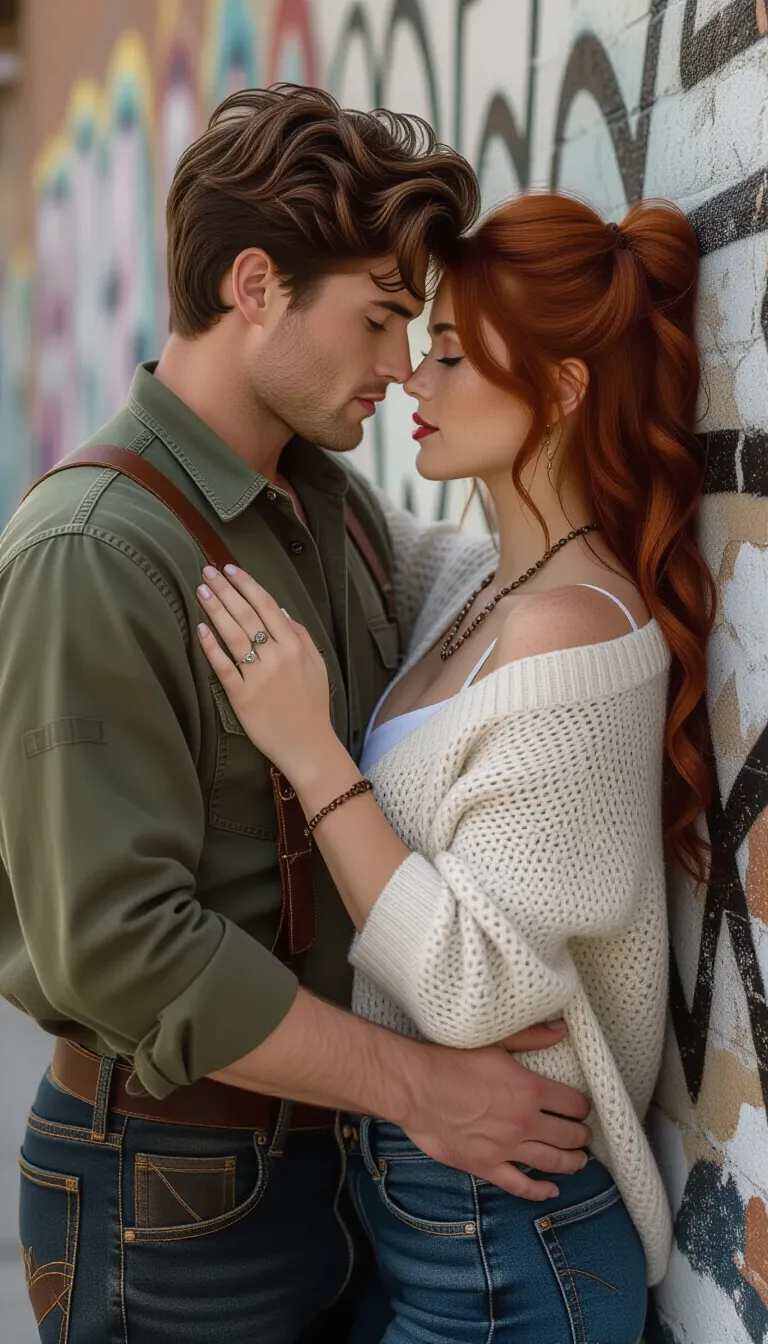
The man's hand is still on my shoulder. Heavy. Warm. I don't know his name. Some friend of my father's from the Shankill, a face I've seen at funerals and Friday nights, never learned the name attached to it. His fingers squeeze once, a gesture meant to comfort, and I stand very still in the cold hallway, letting the words settle into something I can carry.
"Son. Did you hear me?"
I hear him. I just can't make the words mean anything yet. My father. Dead. The heart attack took him fast, the man is saying, didn't suffer, went quick, a mercy really. The words blur together, meaningless, a Protestant hymn I don't know the verses to.
I think of Siobhan.
Her body warm against mine this morning. The rosary beads between my fingers, cool and smooth. Her voice reciting the Hail Holy Queen, the words foreign on my tongue but beautiful in her mouth. I think of her green eyes in the dawn light, the way she said I promise like she meant it, like she believed we could run away together and the world would let us.
I think of my father's hands.
The same hands that taught me to hold a hammer. That showed me how to read a grain, how to drive a nail straight, how to sand until the wood felt like skin. Hands that held my mother's face when she cried. Hands that built the fence in the back garden, the shed I played in as a boy, the coffin for my grandmother. Still now. Forever still. I can't make the image hold—his hands always moving, always working, always doing something.
"Declan." The man's voice sharper now. "Your mother needs you."
I nod. The motion feels foreign, like I'm watching myself from somewhere far away. The hallway swims. Damp brick. Wet pavement outside. The smell of diesel and chip shop grease seeping through the walls. A bus rumbles past, shaking the floor beneath my feet, and I think: She's out there somewhere. She doesn't know yet.
Thursday feels like a lifetime away.
I walk toward the hospital.
The streets are grey and wet, the sky low and heavy, pressing down on the rooftops like a held breath. Men in flat caps and women in headscarves move past me, their faces familiar and strange, citizens of a city that's supposed to be my home but feels like a country I'm visiting. I pass the chip shop, the pub, the Loyalist mural with its painted gunman and its slogan—NO SURRENDER—and I think about how my father painted that mural, how he spent three days on a scaffold with a brush in his hand, how proud he was when it was done. He'd point at it when we walked past. That's your father's work, son. That's what a man leaves behind.
I never told him about Siobhan.
I never told him about the butcher's back room, the way she smells like chalk dust and lavender, the way she says my name like it's a prayer she's learning by heart. I never told him about her green eyes or her freckles or the rosary beads wrapped around her wrist. I never told him because I knew what he'd say. I knew the word he'd use. Taig. Fenian. Devil's spawn. The same words he used when the news reported another bomb, another shooting, another dead boy from the other side. He didn't mean them cruelly—he meant them the way a man means the sky is grey, the way a man means the rain is wet. It was just the truth of where he was born, the truth of the world he'd been given. But she wasn't those words. She was the opposite of those words. She was everything those words couldn't name.
The hospital smells like bleach and disinfectant and something underneath, something that can't be scrubbed away. My mother is sitting in a plastic chair by the window, her hands folded in her lap, her eyes red and dry. She looks up when I walk in, and for a moment I see the girl she must have been before my father, before the Troubles, before the weight of this city bent her spine. Then she blinks, and she's old again.
"Declan." Her voice cracks. "He's gone."
I sit beside her. I take her hand. Her fingers are cold, the bones thin and fragile, and I think: This is what's left. This is what we become.
"I know, Ma."
"He went peaceful. The doctor said. He just—stopped." She presses her free hand to her mouth, holds it there, breathes through her fingers. "I was holding his hand. He was looking at me. And then he wasn't."
I don't say anything. There's nothing to say. I just sit there, holding her hand, watching the fluorescent lights flicker overhead, listening to the machines beep and hum in the rooms around us. The world keeps moving. That's the strangest part. The world doesn't stop for a dead man, even if he was your father.
The wake will be at the house. Three days. Three days of neighbours and friends and strangers passing through, shaking my hand, saying the right words, eating the sandwiches my aunts will make. Three days of whiskey and tea and murmured condolences, of men I've known my whole life sitting in my mother's living room, speaking in low voices about the old days, about my father's work, about the man he was. Three days of pretending I'm one of them. Three days of hiding the part of me that belongs to her.
I think about calling her.
I think about slipping out, finding a phone box, dialling the number she gave me—her neighbour's line, she said, ask for Mrs. O'Brien, that's the safe signal, that's how you reach me. I imagine her voice on the other end, the way it would catch when she heard mine, the way she'd say Declan like she couldn't believe I'd called.
But I can't. There are already people in the house. My mother's sisters arrived an hour ago, bustling through the door with casseroles and sympathy, taking over the kitchen, directing the flow of mourners with the efficiency of women who have done this before, too many times. And there are men. Men I know. Men who'd ask questions if they saw me leave. Men who'd follow.
Thursday. I tell myself. Thursday at dawn. I'll meet her at the butcher's. I'll hold her. I'll tell her everything. I'll let her green eyes and her freckles and her soft voice remind me that there's a world beyond this one, a world where a Protestant boy and a Catholic girl can love each other without getting killed.
But Thursday is three days away. And three days in a house full of mourners, surrounded by men who'd kill us both if they knew, feels like a lifetime.
The first night is the hardest.
The house is full. My father's body is in the front room, laid out in his best suit, his hands folded on his chest. My mother put a photograph of them on their wedding day on the table beside him, a small black-and-white image of two young people smiling at each other like the world was theirs. I look at it and try to find my father in that young man's face, try to see the hope in his eyes, the belief that his life would be different. I can't. He's a stranger to me, that young man. He's a ghost I never met.
I stand in the corner of the room, a glass of whiskey in my hand, and watch the mourners file past. They touch my father's hand, his forehead, the crucifix around his neck. They murmur prayers I don't know. They cross themselves—Protestants crossing themselves, which is strange, something they only do at funerals, when the old rituals come back. I don't cross myself. I think of Siobhan's rosary beads, the way she taught me the prayers, the way her voice smoothed out the foreign words until they felt like mine. I wonder if she'd be angry that I'm in a room full of people doing it wrong.
No. She'd understand. She always understands.
I close my eyes and she's there, behind my lids, her flame-red hair falling loose, her freckles scattered like constellations, her green eyes watching me with that soft, knowing look she gets when she's about to say something that will break my heart. I love you, she said this morning, her voice raw and true. I love you, and I'm terrified.
I open my eyes. The room is still full of mourners. My father is still dead. And she's still on the other side of the city, on the other side of a line I can't cross, at least not tonight.
"Declan."
I turn. My brother stands in the doorway, his face hard, his eyes flat. I haven't spoken to him since the night Siobhan told me he threatened her. Since I vowed to kill him if he touched her again. He looks at me now, and I see the same calculation behind his eyes—the weighing, the measuring, the decision about whether I'm still family or whether I've crossed a line he can't forgive.
He doesn't know about Siobhan. Not for certain. He suspects—I see it in the way he watches me, the way his jaw tightens when I leave the house. But he doesn't know. And I need to keep it that way.
"Da would want you to say something." His voice is low, meant for me alone. "At the funeral. A few words."
I shake my head. "I can't."
"You're his son."
"So are you."
"I can't speak in front of people." He says it like an accusation, like my ability to stand in front of a room and say words is a betrayal of who we are, a claim to something he can't have. "You can. You always could."
I look at him. I think about telling him the truth—about my father's hands, about the hammer, about the fence in the back garden and the shed I played in and the coffin he built. I think about telling him that I don't have words for that, that the only prayers I know now are Catholic ones, that the only person I want to speak in front of is a girl with green eyes who smells like chalk dust and lavender.
Instead, I say: "I'll think about it."
He nods, once, and turns away. The door closes behind him, and I'm alone again in the corner, whiskey in my hand, my father's body in the center of the room, the weight of three days pressing down on my chest like a stone.
I think of Siobhan. I think of her body warm against mine. I think of the rosary beads between my fingers. I think of her voice in the dawn light, reciting the Hail Holy Queen, the words foreign and beautiful and hers.
Thursday feels like a lifetime away.
But I'll wait. I'll stand in this house full of mourners, in this city full of lines I can't cross, in this life that's supposed to be mine but feels like someone else's. I'll wait for the three days to pass, for the wake to end, for the funeral to bury my father and his world with him. I'll wait until I can slip out at dawn, cross the city, and find her in the butcher's back room, waiting for me, her green eyes soft and her voice warm and her body ready to hold me.
And when I do, I'll tell her everything. I'll tell her about his hands. I'll tell her about the coffin he built. I'll tell her about the young man in the photograph, smiling like the world was his. And she'll understand. She always understands.
But tonight, I'm here. In this house. In this room. Surrounded by men who'd kill us both if they knew. My father's body lying still. My mother's tears falling silent. The weight of three days pressing down, and the memory of her voice, speaking words I don't know, holding a promise I don't deserve.
Thursday feels like a lifetime away.
But I'll wait.
I'll wait for her.
The second night is worse.
The whiskey has gone warm in my hand, the glass slick with sweat from my palm. I haven't drunk it. I've been holding it for three hours, letting it sit, letting it breathe, letting it be something to do with my hands so I don't reach for the phone, don't slip out the back door, don't walk across the city to find her.
The house has settled into the rhythm of mourning. My mother sits in the kitchen with her sisters, their voices a low murmur punctuated by the clink of teacups. The men have gathered in the front room, around my father's body, their conversations rising and falling like waves. They talk about the weather, about the match, about the price of timber. They don't talk about him. Not really. They talk around him, the way you talk around a hole in the ground, careful not to fall in.
I need air.
I set the glass down on the windowsill and move through the house, past the kitchen where my mother's eyes find me for a moment—searching, questioning—before she looks away. Past the front room where my brother stands with his back to the door, his shoulders tight, his hands empty. Past the hallway where the photograph of my father on his wedding day sits on the small table, the young man in the frame smiling at something the camera couldn't capture.
I step outside.
The Shankill Road is quiet tonight. The cold bites through my shirt, sharp and clean, a relief after the closeness of the house. The streetlamps cast pools of yellow light on the wet pavement, and the air smells of diesel and chip grease and something else—something metallic, like rain on iron. I stand on the front step, my hands in my pockets, and I breathe.
I think about walking. I think about turning left, heading toward the Falls Road, crossing the line I'm not supposed to cross. I think about finding her street, her door, her window. I think about throwing small stones at her glass until she appears, her hair loose, her eyes sleepy, her voice soft with surprise.
Declan? What are you doing here?
I needed to see you.
I take a step. Then another. I'm at the gate when I hear the voice behind me.
"Declan Morrow. I thought that was you."
I stop. I know that voice. I've known it my whole life, the way you know the sound of a door that always sticks, a floorboard that always creaks. I turn.
Billy Patterson stands on the pavement, a cigarette burning between his fingers, his face half-lit by the streetlamp. He's my father's age, or close to it—late fifties, with a gut that strains against his shirt and a face that's seen too many pints and too few fights he didn't start. He lives three doors down. He's been coming to our house for as long as I can remember, sitting in the kitchen with my father, drinking tea and talking about the old days.
"Billy." I nod. My voice is flat. I don't have the energy for more.
He takes a drag of his cigarette, the tip glowing orange in the dark. He exhales slowly, watching me, and I feel the weight of his gaze like a hand on my shoulder. "Heard about your da. Sorry for your loss."
"Thank you."
He nods, but he doesn't move. He stays where he is, blocking the pavement, the cigarette burning down between his fingers. I wait. I know what's coming. I've known men like Billy Patterson my whole life—the way they circle, the way they test, the way they wait for you to say something they can use.
"Saw you this morning," he says, and my stomach tightens. "Early. Walking back from the direction of the Falls Road."
I don't answer. I hold his gaze, my face still, my hands in my pockets.
"That's a long walk for a man with a dying father." He takes another drag. "Unless you had a reason."
The word hangs in the air between us. Reason. He doesn't say girl. He doesn't say Catholic. He doesn't have to. The silence says it for him, the way silence always does in this city, where everything is known and nothing is spoken.
I think of Siobhan. I think of her body warm against mine, her voice in my ear, her fingers in my hair. I think of the rosary beads between my fingers, the prayers she taught me, the words I said in the dawn light while her body moved above me. I think of the risk she takes every time she crosses the line to meet me, the danger she carries in her bones, the trust she gave me when she told me about my brother's threats.
I look at Billy Patterson. I see the calculation in his eyes, the weighing, the measuring. I see the question he's asking himself—whether to push, whether to probe, whether to carry what he suspects back into the house, into the wake, into the ears of men who'd act on it.
"My father was dying," I say. My voice is steady. "I was walking."
He holds my gaze for a long moment. The cigarette burns down. The ash falls, silent, to the pavement.
"Walking," he repeats. He says it like he's tasting the word, finding it thin, finding it false. "At dawn. On the Falls Road."
"I was walking."
He nods, slowly. He takes one last drag of the cigarette, then drops it, grinding it out with his boot. The motion is deliberate, final, a small violence performed in the space between two men who know exactly what the other is doing.
"Your da was a good man," he says. "A good Protestant man. He built things. He fixed things. He knew what side he was on."
I don't answer. I don't have to. He's not talking to me anymore. He's talking to the air, to the night, to the ghost of my father standing between us.
"You'd do well to remember that, Declan. In the days ahead." He turns, begins walking toward his house. "When the grief settles. When the world starts asking questions. You'd do well to remember who you are."
He doesn't look back. He doesn't need to. The words are already inside me, sinking into my bones, settling into the spaces where my grief and my love and my fear all live together, tangled and impossible.
I stand at the gate for a long time after he's gone. The cold seeps through my shirt, through my skin, into my chest. I think about going back inside. I think about the front room, my father's body, the mourners still filing past. I think about my brother, standing in the corner with his hard face and his flat eyes, watching me, waiting for me to slip.
I think about Siobhan.
I think about her green eyes, her freckles, her voice in the dawn light. I think about the way she said my name this morning, like it was a prayer, like it was the only word that mattered. I think about the rosary beads, still warm from her skin, still carrying the shape of her fingers.
And I think about Billy Patterson's words, settling into my chest like stones.
You'd do well to remember who you are.
I know who I am. I'm a carpenter's son. I'm a Protestant boy from the Shankill Road. I'm a man who builds things with his hands, who speaks rarely and deliberately, who learned to be invisible in a city that kills you for being seen.
But I'm also the man who loves a Catholic girl. I'm the man who learned to pray with her rosary beads. I'm the man who held her body in the dawn light and promised her a future, even though I don't know how to keep that promise, even though I don't know if I'll live long enough to try.
I turn and walk back into the house.
The warmth hits me first, then the smell—tea and whiskey and the faint, sweet scent of flowers. My mother looks up as I pass the kitchen, her eyes searching my face. I don't meet them. I can't. I don't know what she'd see if she looked too long.
I walk past the front room. My brother is still standing in the corner, his back to the door, his shoulders tight. He doesn't turn. He doesn't have to. I feel his awareness like a weight, the way you feel a gaze on your neck even when you can't see the eyes.
I stop in the hallway, in front of the photograph. My father on his wedding day, young and hopeful, his arm around a woman who looks at him like he's the only man in the world. I study his face, looking for something I recognize, something that connects the man in the frame to the man in the coffin. I find it in the set of his jaw, the way he holds his shoulders, the slight tilt of his head that says I'm not afraid.
I wonder if he was. I wonder if he ever stood in a hallway, in the middle of the night, surrounded by people who thought they knew him, and felt the weight of a secret pressing down on his chest. I wonder if he ever loved someone he wasn't supposed to love, crossed a line he wasn't supposed to cross, held a truth in his hands that would have destroyed him if anyone found out.
I'll never know. He's gone. The coffin he built is waiting for him, and in three days, they'll lower him into the ground, and the questions I never asked will go with him.
I reach out and touch the frame. My fingertip traces the edge of the photograph, the curve of his smile, the line of her arm around his waist.
"I'm sorry," I whisper. "I'm sorry I didn't know you better."
The words hang in the air, unanswered. The photograph stares back at me, frozen in a moment that can't be changed, a story that can't be told.
I let my hand fall. I turn. I walk back into the front room, past the mourners, past my brother, past my father's body lying still in the center of it all. I find my corner, my whiskey, my silence. I stand and I wait.
Thursday feels like a lifetime away.
But I'll wait. I'll stand in this house full of mourners, in this city full of lines I can't cross, in this life that's supposed to be mine but feels like someone else's. I'll wait for the three days to pass, for the wake to end, for the funeral to bury my father and his world with him.
And when I slip out at dawn, when I cross the city, when I find her in the butcher's back room, waiting for me, her green eyes soft and her voice warm and her body ready to hold me—I'll tell her everything.
I'll tell her about the photograph. I'll tell her about the coffin he built. I'll tell her about Billy Patterson's words, settling into my chest like stones. I'll tell her that I know who I am, but I don't know who I'm supposed to be anymore.
And she'll understand. She always understands.
But tonight, I'm here. In this house. In this room. Surrounded by men who'd kill us both if they knew. My father's body lying still. My mother's tears falling silent. The weight of three days pressing down, and the memory of her voice, speaking words I don't know, holding a promise I don't deserve.
I close my eyes. She's there, behind my lids, her flame-red hair falling loose, her freckles scattered like constellations, her green eyes watching me with that soft, knowing look. I love you, she said this morning. I love you, and I'm terrified.
I open my eyes.
The room is still full of mourners. My father is still dead. And she's still on the other side of the city, on the other side of a line I can't cross.
Not tonight.
But Thursday.
Thursday at dawn.
I'll be there.
The front room has settled into the rhythm of a wake—whiskey loosening tongues, laughter breaking through grief like light through clouds, the constant shuffle of feet on hardwood. Men I've known my whole life stand in clusters, their faces flushed with drink and memory, telling stories about my father that I've never heard. He was a different man to them. A drinking man. A laughing man. A man who told jokes and slapped backs and held his Guinness like a trophy.
I don't know that man.
The man I knew was quiet at the dinner table, his hands always moving—whittling, sanding, smoothing—his eyes fixed on something I couldn't see. The man I knew spoke in the language of wood and grain, of joints that fit perfectly, of edges that wouldn't splinter. He taught me to hold a hammer before I learned to hold a pencil.
I stand in my corner, the whiskey glass warm in my palm, untouched. My mother drifts through the room like a ghost, accepting hugs, pressing her handkerchief to her eyes, smiling a smile that doesn't reach. I watch her and I think about Siobhan's mother, the story she told about Thomas, the boy with the broken hands. Every woman in this city has learned to smile through grief. Every woman has learned to bury something.
My brother catches my eye from across the room. He raises his glass—a mocking salute, or maybe a genuine one. I can't tell anymore. I nod once, barely, and look away.
Thursday.
The word beats in my chest like a second heart.
I close my eyes and I'm there—the butcher's back room, the lamplight warm and golden, the smell of sawdust and meat and her. She's sitting on the edge of the block, her legs swinging, her hair loose around her shoulders. She's wearing that green cardigan, the one with the button missing, the one she thinks I haven't noticed she always wears when she's nervous.
And I'm standing in front of her, and I don't know what to say.
I've rehearsed it a hundred times since I left her at dawn. The words shift and rearrange, never settling into the right shape. My father died. Too blunt. I'm sorry I didn't come sooner. Too apologetic. I need you to hold me. Too vulnerable, even for her.
But maybe I don't need to say anything. Maybe I just need to be there, to let her see me, to let her read the grief in my shoulders and the fear in my hands. She always knows. She always understands.
I imagine her standing up, crossing the room, taking my face in her hands. Her palms are warm, smelling of chalk dust and lavender. She doesn't say anything. She just looks at me with those green eyes, soft and knowing, and waits.
I'm here, she'd say. Not a question. A statement. A fact.
I know, I'd say. And that would be enough.
I'd tell her about the hospital, about the hollow look in my mother's eyes, about the coffin my father built with his own hands. I'd tell her about Billy Patterson, the words settling into my chest like stones. I'd tell her about my brother, watching me from across the room, waiting for me to slip.
And she'd listen. She'd hold my hand. She'd trace the calluses on my palm with her thumb, the way she does, the way that makes my chest ache.
What do we do? I'd ask her.
And she'd look at me, her eyes steady, her voice low and sure. We keep going. We keep meeting. We keep loving each other, even when it's hard. Especially when it's hard.
I want to believe her. I want to believe that love is enough, that it can survive bullets and bombs and brothers who watch too closely. I want to believe that Thursday will come, and I'll cross the city, and I'll find her waiting for me, and we'll pick up where we left off, as if the world outside the butcher's back room doesn't exist.
But I'm not sure I believe it anymore.
I open my eyes.
The room is still full of mourners. My father is still dead. And I'm still here, on the Shankill Road, in a house full of men who'd kill me if they knew where my heart really lives.
A hand lands on my shoulder. I flinch, barely, before I catch myself.
"Alright there, son?"
It's Uncle George, my father's younger brother. He's drunk—his eyes are glassy, his breath thick with whiskey—but there's a softness in his face I haven't seen before. He looks old, suddenly. Old and tired and sad.
"Fine," I say.
"You're not drinking." He nods at the glass in my hand.
"Not thirsty."
He laughs, a wet, ragged sound. "Your father never said 'not thirsty' in his life. Man could drink a river dry and ask for more."
I don't know what to say to that, so I say nothing.
George's hand squeezes my shoulder. "He was proud of you, you know. Talked about you all the time. 'My Declan,' he'd say. 'Best carpenter in Belfast, and I'm not just saying that because he's my boy.'"
The words hit me in the chest, unexpected, sharp. I didn't know he talked about me. I didn't know he thought of me at all.
"He never said anything," I manage.
"He wouldn't. Not to you. That wasn't his way." George shakes his head, his eyes distant. "But he was proud. God, he was proud."
I look down at the whiskey in my hand. The amber liquid catches the light, and for a moment, I see my father's face in it—the set of his jaw, the slight tilt of his head, the way he looked at me when he thought I wasn't watching.
"Thank you," I say.
George nods, pats my shoulder once more, and shuffles back into the crowd. I watch him go, his shoulders rounded, his gait unsteady. He's the last of my father's generation. When he goes, the stories go with him.
I think about Siobhan again. I think about her telling me about her mother's love, Thomas with the broken hands. I think about the way she said it—quietly, carefully, as if the words themselves were fragile. She loved him. And he disappeared.
I wonder if that's our future. If I'll disappear one day, swallowed by the city, erased by the lines I tried to cross. If she'll be left with nothing but a memory and a story she tells her daughter, years from now, in a kitchen that smells of tea and grief.
I can't let that happen.
I don't know how to stop it, but I can't let it happen.
The night wears on. More mourners arrive. More whiskey flows. The stories grow louder, the laughter more desperate. My mother disappears into the kitchen and doesn't come back. My brother holds court in the corner, his voice carrying over the din, his eyes always, always finding mine.
I don't sleep.
I stand in my corner until the last mourner leaves, until the front door closes for the final time, until the house settles into a silence that feels heavier than the noise. My brother retreats to his room without a word. My mother's light goes out under the door.
I'm alone in the front room.
With my father's body.
The coffin is closed now—they sealed it after the last viewing, the lid fitting into place with a sound I'll never forget. I walk toward it, my footsteps loud in the silence, and stop a few feet away.
"I'm sorry," I whisper. "I'm sorry I didn't know you better. I'm sorry I didn't ask the questions. I'm sorry I let the silence stretch between us until it was too wide to cross."
The coffin doesn't answer.
"I met someone," I say. "She's Catholic. She's beautiful. She has green eyes and freckles and a voice that makes me believe things can be different. She taught me to pray with her rosary. She wants to run away with me."
I pause. The words hang in the air, fragile and dangerous.
"I think you'd like her. I think you'd understand." I swallow. "I think you'd tell me to be careful, and then you'd tell me to be happy. I think you'd hold both of those things in your hands and try to make them fit."
I reach out and touch the wood of the coffin. Smooth. Polished. Built by his hands.
"I don't know if I can do this. I don't know if I can cross the city, cross the lines, leave this life behind. But I know I can't stay. I know that much."
I let my hand fall.
"I'll be at her door at dawn on Thursday. I'll tell her everything. I'll let her decide if she still wants me, after she knows what I'm carrying."
The coffin is silent. The house is silent. The city is silent.
I turn and walk out of the room.
In the hallway, I stop in front of the photograph again. My father on his wedding day, young and hopeful, his arm around a woman who looks at him like he's the only man in the world. I study his face, and I think about all the things he never said.
"I'll say them," I whisper. "I'll say them for both of us."
I walk up the stairs, past my mother's closed door, past my brother's room, to the small attic space that's been mine since I was a boy. I lie down on the narrow bed, still dressed, still awake, and stare at the ceiling.
Thursday.
Two more days.
I close my eyes, and she's there—her green eyes, her freckles, her voice in the dawn light. I love you, and I'm terrified.
I love you too, Siobhan.
And I'm terrified too.
But I'll be there.
Thursday at dawn.
I'll be there.
The house is quiet now. I lie in my narrow bed, the ceiling a pale blur in the darkness, and I can't sleep. My father's body is downstairs, sealed in a coffin built by hands that shaped the banister I touched on my way up the stairs. The weight of it presses down on me, makes the air in the room feel thick and hard to breathe.
I reach into my pocket. My fingers find the rosary beads—hers, the ones she wrapped around my wrist in the butcher's back room, the ones I kissed before I left her at dawn. The crucifix is warm against my palm. I pull them out and let them coil in my hand, each bead a small, smooth stone.
I think of her voice, low and steady, reciting the Hail Holy Queen while I moved inside her. The memory sends a heat through my chest, a sharp ache that has nothing to do with grief.
I slide the first bead between my thumb and forefinger.
Hail Mary, full of grace. Her voice, but in my head now. I don't know the words, not really—I stumbled through them in the back room, her lips against my ear, her hands in my hair. But I remember the shape of them. The rhythm.
I move to the second bead.
I think of the first time I saw her, standing in the rain outside the library. She had no umbrella, her red hair darkened to copper, plastered to her cheeks. She was laughing at something—a friend, a joke, I never found out—and the sound cut through the grey street like a bell. I stood on the other side of the road and watched her until she disappeared around a corner, and I told myself I'd never see her again.
But I did. I kept seeing her. In the market, at a bus stop, walking home with her students. I started taking the long way to work just to pass her street. I was a fool, and I didn't care.
Third bead.
The night she finally spoke to me. I was buying bread at the bakery on the Falls Road—stupid, dangerous, I knew the rules—and she came in behind me. I felt her before I saw her, a warmth at my back. "You're Declan Morrow," she said. Not a question. I turned, and she was looking at me with those green eyes, fearless and terrified at the same time. "I've seen you watching me." I couldn't speak. I just stood there, holding a loaf of bread like an idiot. She smiled. "Are you going to say something, or are we going to stand here until the bread goes stale?"
Fourth bead.
Her hand on my chest. The butcher's back room. The first time I touched her, my fingers tracing the line of her collarbone, her breath catching. She said my name like it mattered, like it was the only word she wanted to say. I kissed her, and the world outside—the checkpoints, the bombs, the walls—it all fell away.
Fifth bead.
Her voice in the dark, teaching me the words. "Our Father, who art in heaven, hallowed be Thy name." I repeated them, clumsy and slow, and she didn't laugh. She pressed her forehead to mine and said, "You're doing it right. You're doing it perfectly."
I move to the sixth bead, and I stop. My hand is trembling.
I've never prayed. Not really. My father didn't believe, or if he did, he never showed it. My mother went to church on Christmas and Easter, more out of habit than faith. The rosary was something Catholics did, something we watched from the other side of the divide, something we were taught to distrust.
But Siobhan taught me the words. Siobhan placed the beads in my hands and told me they were just a way to focus, to slow down, to remember. And I remember her. I remember her green eyes and her freckles and the way she said my name.
I slide the seventh bead, and I let the memory fill me.
Pray for us sinners, now and at the hour of our death. I whisper it aloud, my voice raw in the dark room. "Pray for us. Pray for me." I don't know who I'm asking. Her God, maybe. The God she believes in. I don't know if He listens to Protestants, but I know He listens to her.
Eighth bead. Ninth. Tenth.
I think about Thursday at dawn. I think about crossing the city, stepping into the butcher's back room, seeing her face. I think about what I'll say. I think about telling her that my father is dead, that my brother suspects, that every man in the Shankill is watching me with eyes that know. I think about asking her to run away now, tonight, before the wake ends, before the next threat comes.
But I can't. Not yet. The wake stretches across three days, and I have to stand in that house, shake hands with men who'd kill us both, and pretend I'm still one of them.
The eleventh bead. I grip it hard, the edges pressing into my skin.
I hate them. I hate the walls and the flags and the names we call each other. I hate that I can't hold her hand in the street, that I can't tell my mother about the girl I love, that the only place we can meet is a butcher's back room with a dead bolt on the door.
Twelfth bead.
But I love her. I love her more than I thought I was capable of loving anything. I love her voice, her laugh, the way she bites her lip when she's thinking. I love the soft sound she makes when I touch her, the way she arches into me like she can't get close enough. I love the way she says my name, like it's something precious, something worth keeping.
I love her, and I'm going to lose her if I don't find a way out.
Thirteenth bead.
Hail, Holy Queen, Mother of Mercy. The words come back to me, her voice in my ear, her breath warm on my neck. She recited it slow, letting me hear each word, letting me learn the shape of it. To thee do we cry, poor banished children of Eve.
I'm one of the banished. I'm standing on one side of a line I didn't draw, and she's on the other, and the city between us is full of men who'd rather see us dead than together.
I close my eyes. The beads are warm in my hand, warm from my skin, warm from the memory of her fingers touching them, sliding them, counting them while she said words that made her safe.
"Siobhan," I whisper into the dark. Just her name. Just the sound of it.
I hold the crucifix against my lips. It tastes of metal and salt, and I remember kissing her, the taste of her mouth, the softness of her skin. I remember her telling me she loved me, her voice breaking, her hand on my cheek. I remember saying it back, and meaning it more than I've ever meant anything.
I don't know if God is listening. I don't know if Mary is watching. But I know she is somewhere across the city, in her bed, maybe holding her own rosary, maybe thinking of me.
I hope she's thinking of me.
I slide the last bead between my fingers. The rosary hangs loose in my hand, all the prayers spoken, all the memories visited. I place it gently on the nightstand, beside the candle, beside the photograph of a woman I've never met—my grandmother, maybe. I don't even know. I've never asked.
I lie back down. The ceiling is still there. The weight is still there. But something has shifted, something small and quiet, like a door opened a crack.
I think about Thursday. I think about the walk across the city, the streets I'll have to navigate, the risks I'll have to take. I think about Siobhan, waiting for me in the back room, the lamp flickering, her hair loose.
I think about taking her hand and walking out of Belfast. Walking south, toward the border, toward a place where no one knows our names. I think about a small cottage, a garden, a life where the only walls are the ones we build ourselves.
It sounds impossible. It sounds like a dream I'd wake from.
But I have her rosary. I have her voice in my head. I have Thursday at dawn.
And I have two more days to get through.
I close my eyes, and I let the darkness take me. The beads sit beside me, patient and warm, carrying her voice through the night.
I'll be there, Siobhan.
I swear it.
The last sound I hear before sleep is her laugh, low and quick, in the rain outside a library. And for a moment, the weight lifts. For a moment, I'm just a man who loves a woman, crossing a city to find her.