
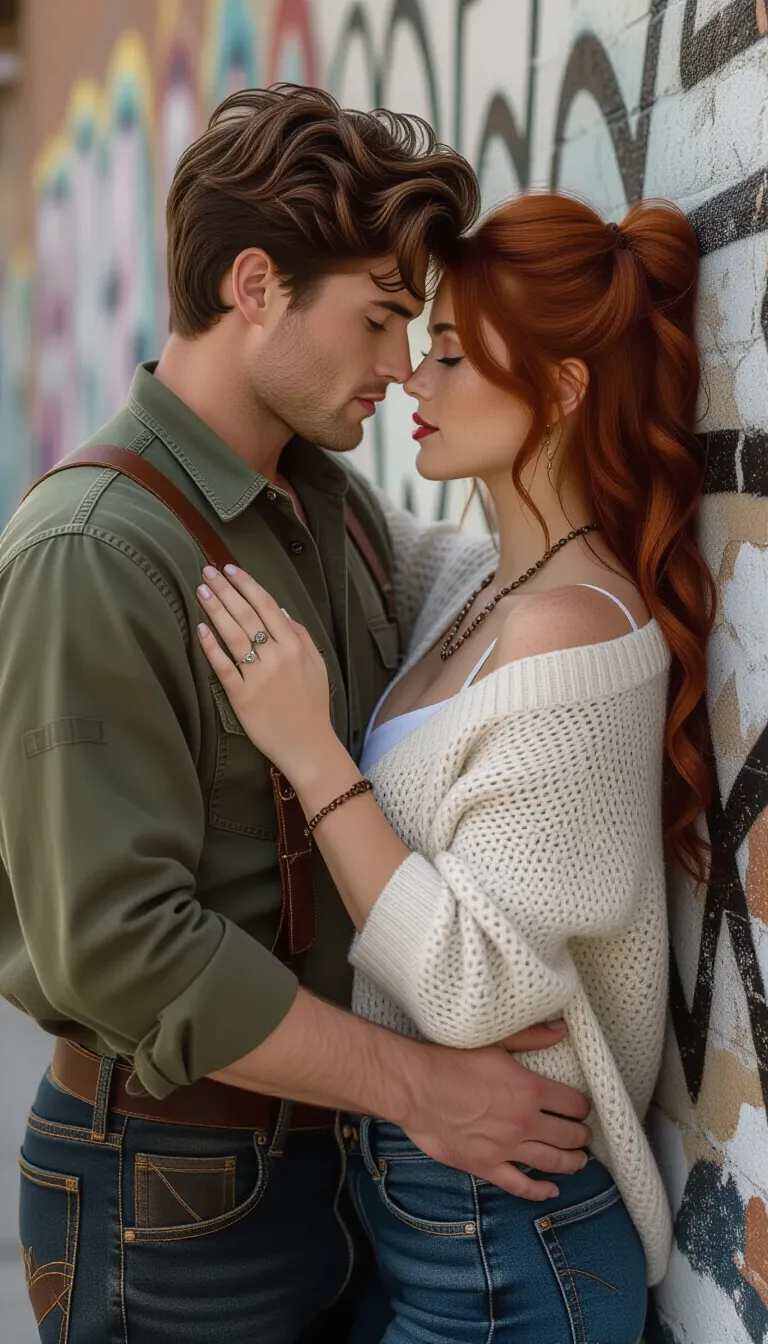
Declan's fingers found the ledger's worn leather edge. He'd been putting this off — sorting the smaller papers first, letting Flynn photocopy the loose receipts, anything to delay the moment he'd have to touch his father's secrets directly. The candle on the table flickered, casting his shadow long against the narrow room's rough-planked wall.
Beside him, Siobhan's hand rested on his thigh. Warm. Grounding.
He opened the ledger.
Not columns of numbers. Not dates or shipments. A photograph slid out from between the first pages, landing face-up on the scarred wood. Declan's breath stopped.
A woman. Dark hair, dark eyes that caught the candlelight like—like his father's eyes. The same set to the jaw. The same slight asymmetry in her smile. She stood in front of a stone cottage, one hand shielding her eyes from the sun. Young. Maybe twenty. Maybe younger.
Declan didn't move. Didn't blink.
"Declan?" Siobhan's voice came from far away. "What is it?"
He couldn't answer. His hand had started trembling, the photograph rattling against his fingertips. He set it down flat, as if that would stop the shaking.
Siobhan leaned closer. Her breath caught. "Who is she?"
"I don't know." His voice came out wrong — too quiet, too thin. "I've never—" He picked up the photograph again. Studied her face. The same high cheekbones he saw in the mirror every morning. "She has Da's eyes."
Siobhan's hand found his wrist. Squeezed.
He turned the page. Another slip of paper — thicker, yellowed, folded in thirds. The handwriting was his father's. He'd know it anywhere. The same blocky print that had once signed his school permission slips, that had written 'Happy Birthday Son' in a card he still kept in his toolbox.
If you're reading this, I'm already gone. Forgive me.
The words blurred. Declan blinked hard, pressed his thumb against the paper's edge until the crease bit into his skin. The candle hissed. Somewhere in the house, a floorboard creaked.
Siobhan said nothing. Just shifted closer, her shoulder against his, her warmth seeping through his shirt.
He read the rest silently. His father's voice, scratchy and thin on the aged paper, speaking about a daughter. A girl named Aoife. A secret he'd kept for twenty-eight years, carried like a stone in his chest, because the girl's mother had been a Catholic widow from the Republic and Robert would have used her as a weapon. Thomas had let her go, let her think he was dead, let her raise their daughter alone in a cottage outside Galway where the Troubles couldn't touch them.
The letter ended with two words: Find her.
Declan's hand dropped. The paper slithered onto the table, settling beside the photograph. Aoife. His sister. He had a sister.
His whole life, the silences at the dinner table, the way his mother's eyes would go distant when she talked about the man she'd married — it all made a different kind of sense now. His father hadn't just faked his death. He'd started over. Twice. Left two families behind to keep them safe, and ended up with neither.
"Declan." Siobhan's voice was soft, steady. "Talk to me."
He shook his head. Couldn't find the words. They were stuck somewhere behind the stone in his throat, behind the image of a woman with his father's eyes who didn't know she had a brother.
Siobhan picked up the photograph. Held it to the candlelight, studying the woman's face. "She looks happy."
"She doesn't know." His voice cracked. "She doesn't know any of it."
"Not yet."
He looked at her. Her green eyes were dark in the low light, her freckles soft as cinnamon on her cheeks. She wasn't looking at him with pity. She was looking at him like she was already planning the journey, already calculating how many miles to Galway, already ready to go.
"This isn't just about Robert anymore," he said. "This is—" He gestured at the photograph. "A whole life I didn't know about. A sister. Another family he left behind."
"He left to protect her."
"And me." The words came bitter, unexpected. "He left me too."
Siobhan set the photograph down. Turned to face him fully, her knee brushing his under the table. "He came back. When it mattered, he came back and hugged you in a stranger's house and wept in your arms. He may have been a coward for twenty-eight years, but he's not a coward anymore."
Declan stared at the letter. At the two words at the bottom. Find her.
"I don't know if I can," he said. "I don't know if I want to."
"You don't have to decide tonight."
He picked up the photograph again. Studied Aoife's face. She had their father's nose, too — a slight bump on the bridge from a childhood break that had never been set properly. Same as Declan. Same as the scar he'd gotten falling off his bike at seven.
He was looking at a stranger, but she was his blood. His only blood, now, besides his father and the brother who'd pointed a gun at him.
"What if she hates me?"
Siobhan took his hand, laced her fingers through his. "What if she doesn't?"
His laugh came out hollow. "You always do that."
"Do what?"
"Find the other side."
"Someone has to." She squeezed. "You carry enough darkness for two people, Declan Morrow. Let me carry the light for a while."
He looked at her. At the candlelight catching the copper in her hair, the soft line of her jaw, the way her thumb traced circles on the back of his hand like she was trying to memorize the feel of him. She'd come this far. She'd followed him into a Dublin safe house, into his father's arms, into the wreckage of his family. And she was still here, still holding on.
"I love you," he said. The words came easy now. They hadn't, once. Now they were the only things that made sense.
She smiled. Small, sad, but real. "I know."
He wanted to kiss her. Wanted to forget the photograph and the letter and the sister he'd never met. But the photograph was still there, and the candle was still burning, and somewhere in Galway a woman named Aoife was going about her night, not knowing she had a brother, not knowing her father was alive, not knowing the ledger on this table held her life's missing piece.
Declan turned the page. More entries, more names, more evidence. But he couldn't focus on them. The photograph burned at the edge of his vision. The letter lay open, its accusation and mercy laid bare.
Siobhan picked up the letter. She read it silently, her lips moving slightly over the words. When she finished, she folded it carefully, precisely, the way you fold a thing you plan to keep forever.
"We find her," she said. "After this is over. We find her, and we tell her the truth."
"And if she doesn't want to hear it?"
"Then at least she'll know. That's more than you had."
He nodded. She was right. She was always right, even when he didn't want to hear it.
The narrow room pressed in around them — the rough wooden walls, the single window showing only blackness beyond, the cracked ceiling where damp had stained the plaster. Outside, the sea crashed against the shore. Inside, the candle flickered, and Declan held a photograph of the sister he'd never known.
The story they were building wasn't just about justice. It was about a family he was only beginning to understand — a father who had loved and failed and loved again, a mother who had died believing her husband was already dead, a brother who had chosen violence and another brother who had chosen himself. And now, a sister. Alive. Somewhere in the world. Breathing the same air.
Siobhan laid her head on his shoulder. Her hair smelled of lavender and the sea. He pressed his cheek against her crown, closed his eyes, and let himself feel it — the weight, the terror, the fragile, blooming hope that maybe, after all this, there would be something left to build.
The photograph rested between them, a promise and a wound.
He didn't know how to find her. He didn't know how to tell her. He didn't know if he had the right to break into her life with a story thirty years old.
But his father had written Find her, and his father had come back, and maybe that meant something. Maybe it meant there was still time.
The candle guttered. Outside, the sea kept crashing, endless and patient, and Declan held his sister's face in his hands, and Siobhan held him, and the ledger waited open on the table, its secrets only half-told.
The candle guttered. Outside, the sea kept crashing, endless and patient, and Declan held his sister's face in his hands, and Siobhan held him, and the ledger waited open on the table, its secrets only half-told.
He set the photograph down. Carefully. Reverently. Like it might break if he pressed too hard.
Siobhan's hand was still on his thigh. Warm through the denim. Grounding him to this room, this moment, this body that had carried him through a Dublin night and into the wreckage of his father's second life.
He turned to her.
The candle threw shadows across her face—caught the green of her eyes, the soft line of her jaw, the freckles scattered like constellations across her nose. She was watching him. Not the photograph. Not the letter. Him.
"What?" she said. Soft. Almost a whisper.
He didn't answer. He leaned in instead.
His hand found her cheek—callused palm against her skin, the rasp of his thumb along her cheekbone. She didn't pull away. She leaned into him, her breath warm against his lips, her eyes falling half-closed.
He kissed her.
Slow. Deliberate. The way you kiss something you're terrified of losing.
Her lips parted under his, and he felt the sigh leave her—small, surrendered, like she'd been holding it since the photograph fell out of the ledger. His other hand found her waist, pulled her closer, the chair scraping against the floorboards as she shifted into him.
She tasted like tea and the salt from the sea air. Like home. Like something he'd spent twenty-eight years not knowing he needed.
He kissed her again. Deeper this time. His fingers threading into her hair, loosening the pins, letting the red fall across his hand like water.
She made a sound—low, in her throat—and his chest cracked open.
He pulled back. Just far enough to see her face.
Her lips were flushed. Her eyes dark. The candlelight flickered in her pupils.
"Thank you," he said. The words came rough, unexpected.
Her brow furrowed. "For what?"
"For being here. For staying. For—" He stopped. Swallowed. "For being the light."
She laughed. Soft, almost sad. "It's a candle, Declan. It's going to burn out in twenty minutes."
"Not the candle." He touched her chest, just above her heart. "You."
Her eyes glistened. She bit her lip—that tell, that habit she had when she was trying not to cry.
"You're going to make me weep," she said. "And then my nose will run, and I'll look like a mess, and you'll have to kiss me anyway."
"I'll kiss you anyway."
She smiled. Real this time. Bright enough to rival the candle.
He kissed her forehead. The bridge of her nose. The corner of her mouth. Each kiss slow, deliberate, grateful—like he was memorizing her by touch.
"I don't deserve you," he murmured against her skin.
"Stop."
"It's true."
"It's not." She cupped his face in both hands, forced him to meet her eyes. "You deserve everything, Declan Morrow. A cottage by the sea. A garden of roses. A sister who loves you. A future that doesn't taste of blood and secrets."
He closed his eyes. Let her words wash over him.
"And me," she said. "You deserve me. Because I chose you. And I keep choosing you."
When he opened his eyes, she was crying. Silent tears tracking down her freckled cheeks.
He kissed them away. One by one. Salt on his lips.
Then he kissed her mouth again—slower still, like they had all the time in the world, like the ledger could wait, like the police could wait, like the sister in Galway could wait one more hour while he held the only person who'd ever made him believe he was worth saving.
Her fingers found the collar of his shirt. Traced the edge of it. Slipped inside to rest against his collarbone, her palm warm on his skin.
He shivered.
"I love you," he said against her lips.
"I know." She smiled. Kissed him again. "I love you too."
The candle flickered. Outside, the sea kept crashing. Somewhere in Galway, a woman named Aoife was sleeping, not knowing she had a brother, not knowing her father was alive, not knowing the world was about to crack open for her too.
But here, in this narrow room, with Siobhan in his arms and the photograph resting safe between them, Declan Morrow let himself believe that maybe—just maybe—there was still time.
He kissed her one last time. Slow. Grateful. The way you kiss a prayer.
And outside, the sea kept crashing, endless and patient, waiting for whatever came next.
He pulled back slowly, his forehead resting against hers. The candle guttered—a brief flare of light, then settled into a lower, steadier flame. Outside, the sea kept its rhythm, endless and indifferent.
Siobhan's hand was still warm against his collarbone. Her fingertips traced the edge of his shirt collar, a small, grounding pressure.
"The ledger," she said. Soft. Not a question.
He nodded. Swallowed. "The ledger."
She didn't let go. Not yet. She held his gaze for three full breaths, as if she was memorizing this version of him—the one who'd just told her he loved her, who'd just learned he had a sister, who was still trembling with the shock of it.
Then she released him. Gently. Like she was setting down something fragile.
He reached for the ledger where it lay beside them on the narrow bed. The leather cover was cracked, worn smooth at the corners from years of handling. The photograph was still tucked inside—the woman with his father's eyes. His sister. Aoife.
He didn't look at it again. Not yet. He couldn't.
Instead, he opened the ledger to the first page. The handwriting was his father's—tight, deliberate, a man who'd learned to make every word count. Dates. Names. Shipments. A code of initials and numbers that must have made sense to someone.
"It's all here," he said. His voice sounded strange to his own ears. Hollow. "The guns. The payments. The names of everyone who took a cut."
Siobhan shifted closer. Her shoulder pressed against his. The warmth of her was steady, patient.
"Can you read it?" she asked.
"Most of it." He traced a line with his finger. "These are routes—into Derry, down to Dublin, across the border. He marked every crossing, every safe house."
He turned the page. More names. Some he recognized—men he'd grown up around, men his brother Tommy drank with, men who'd stood in his father's kitchen and called him "son" while they planned his uncle's next shipment.
His hand trembled. Just once. He pressed his palm flat against the page to still it.
"Declan."
He didn't look up.
"Declan." Her hand covered his. "We don't have to do this all tonight."
"We do." His voice was rough, scraping against the back of his throat. "Flynn said the police are coming. Robert's on the run. If we don't have everything ready—"
"Then we'll have it ready." She squeezed his hand. "But not by burning yourself out in one night. You just found out you have a sister. You just held your father for the first time in twenty-eight years. You're allowed to breathe."
He closed his eyes. The ledger blurred beneath his vision.
"I don't know how," he said. "I've never known how."
She was quiet for a long moment. Then she stood. He heard her cross the room, heard the creak of the floorboards near the window. When she spoke again, her voice came from above him.
"Then we'll start now."
He opened his eyes. She was standing at the small table where Flynn had spread their papers earlier, holding the candle. The flame cast long shadows across her face, catching the red in her hair, the freckles on her cheeks.
"Come here," she said. "We'll work together. One page at a time. I'll write down what you find."
He didn't move for a moment. Then he stood, the ledger in his hands, and crossed to the table. She pulled out a chair—the wood scraped against the floor—and sat down, setting the candle between them.
He sat across from her. The ledger felt heavy in his hands. Heavy with the weight of years, of secrets, of men who'd died because of what was written here.
"First page," she said. "Tell me what it says."
He opened it. Read the first line. His father's handwriting, dated October 1971. A shipment of twelve rifles, delivered to a farm outside Crossmaglen.
"Twelve rifles," he said. "October '71. Dropped at a farm—I know the place. It's still there."
She wrote it down. Her handwriting was neat, careful. The pen scratched against the paper.
"Who received them?" she asked.
He scanned the page. "Initials. R.M." He looked up. "Robert Morrow."
She didn't flinch. Just wrote it down.
They worked in silence for a time. The candle burned lower. The sea kept crashing. Page after page, shipment after shipment, the truth of what his uncle had done spread across the table like a wound being opened.
Siobhan didn't stop. Didn't waver. She wrote down every name, every date, every crossing. Her hand was steady. Her voice, when she asked a question, was calm.
He loved her more in that hour than he had in all the hours before.
He finished a page. Turned to the next. And stopped.
The handwriting changed. It was still his father's, but younger—less careful, the letters looser. Less a record, more a confession.
March 12, 1973. I met her today. Her name is Bridget. She has eyes like the sea after a storm. She doesn't know who I am. She doesn't know what I've done. She smiled at me, and I felt something I haven't felt since—
He stopped reading aloud.
"Declan?" Siobhan's voice was soft. "What is it?"
He stared at the page. His father's handwriting. His father's secrets. A woman named Bridget. Eyes like the sea.
"It's about Aoife's mother," he said. "My father—he met her in 1973. She didn't know who he was."
Siobhan set down the pen. She didn't reach for the page. She just waited.
He read the rest in silence. His father's voice—younger, desperate, aching—spilling across the page. A man who'd been running for two years, who'd buried his brother, who'd left his wife and son in a lie, who'd found a woman who looked at him like he was worth being looked at. And who'd told her nothing.
He closed the ledger. Gently.
"He never told her," he said. "He stayed with her for a year. He was there when Aoife was born. And then he left."
"Why?"
"Because he was afraid." His voice cracked. "Because Robert's men were looking for him. Because if they found him, they'd find her. And he couldn't—" He stopped. Swallowed. "He couldn't lose another person he loved."
The silence stretched. The candle flickered. Somewhere in the house, a clock ticked—Flynn's, probably, in the room below.
Siobhan reached across the table. Her fingers found his. Interlaced.
"Then we'll tell her," she said. "When this is over. We'll go to Galway. We'll find Aoife. And we'll tell her everything."
"What if she doesn't want to know?"
"Then we'll leave." She squeezed his hand. "But we'll try. Because that's what he would have wanted. And because she deserves to know she has a brother."
He looked at her. Her green eyes held the candlelight, held him, held everything he hadn't known he needed.
"You keep saying 'we,'" he said.
"Because it's 'we.'" She said it simply. Like it was obvious. "You and me. We."
He lifted her hand to his lips. Kissed her knuckles. One by one.
She smiled. Soft. Tired. Real.
"One more page," she said. "Then we sleep."
He nodded. Opened the ledger to the next entry. The handwriting was back to the careful, coded record of a man tracking the war he'd escaped.
They worked through the rest of the page. The candle burned to a stub. The room grew colder, the shadows longer.
When the last line was written, Siobhan set down the pen. The pages between them were covered—names, dates, shipments, routes. The skeleton of a conspiracy, laid bare on Flynn's small wooden table.
"That's enough for now," she said.
He didn't argue. His eyes ached. His shoulders were tight. The weight of the night pressed down on him, heavy and suffocating.
She stood. Came around the table. Took his hand and pulled him to his feet.
"Come to bed."
"I'm not—"
"I didn't ask if you were tired." Her voice was gentle but firm. "I said come to bed."
He followed her to the narrow bed. She lay down first, her back to the wall, and opened her arms. He lay beside her, his head on her chest, her fingers threading through his hair.
The photograph was still on the table. The ledger was closed. The sea kept crashing.
He closed his eyes. Her heartbeat was steady beneath his ear. Her hand moved through his hair in slow, patient strokes.
"We'll find her," she said. "We'll finish this. And then we'll go home."
"Where's home?"
Her hand paused. Then continued.
"Wherever you are," she said. "Wherever I am. We'll figure it out."
He let out a breath he hadn't known he was holding. His body softened against hers.
"Siobhan."
"Hmm?"
"Thank you."
She kissed the top of his head. "I know."
The candle died. The room went dark. The sea kept crashing, endless and patient, waiting for whatever came next.
Declan held on to her, and let himself believe that maybe—just maybe—there was still time to build something new.
Her fingers moved through his hair in slow, deliberate strokes. The darkness was complete now—no candle, no moon through the salt-crusted window, nothing but the sound of her breathing and the distant crash of the sea.
"Tomorrow," she said, her voice low and warm against the top of his head, "we'll plan."
He didn't answer. His cheek was pressed to the worn cotton of her shirt, his hand resting on her ribs, feeling them rise and fall. He was so tired—bone tired, the kind of tired that lived deeper than sleep.
"We'll talk to Flynn in the morning," she continued. Her thumb traced the shell of his ear, gentle, aimless. "See what he's found. Figure out where Robert might have gone."
"And my father?"
Her hand paused. Then resumed.
"Your father will have to decide what he wants to do. He's a grown man, Declan. He made his choices."
"He hid for twenty-eight years."
"And now he's back. Because of you." Her fingers combed through his hair, pushing it back from his forehead. "Because you went looking. Because you didn't give up."
He closed his eyes. Her heartbeat was steady under his ear. The rhythm of it, the warmth of her body, the way her hand never stopped moving—it was the only thing holding him together.
"I don't know what to do," he said. The words came out raw, unguarded. He hadn't meant to say them. But they were true.
Her hand slid to the back of his neck. Held him.
"You don't have to know tonight."
"I don't know tomorrow either."
"Then we'll figure it out tomorrow." She shifted beneath him, pulling him closer. Her lips pressed to his forehead. "That's what 'we' means. You don't have to carry it alone anymore."
His throat tightened. He pressed his face into her chest, breathing her in—lavender soap and chalk dust and something warmer underneath. Home. She smelled like home.
"What if I fail?"
"Then we fail together."
"That's not—"
"Declan." Her voice was soft but firm. The same voice she used with her students when they needed to stop arguing and listen. "I didn't come this far to leave you at the edge. I'm not going anywhere."
He was quiet for a long moment. The sea kept crashing. The dark pressed in around them, thick and complete, but her body was solid against his, her hand steady on his neck.
"I love you," he said. The words were small. Inadequate. But they were all he had.
Her arms tightened around him. Her lips found his hair, his temple, the corner of his eye.
"I know," she whispered. "I love you too."
He let himself sink into her. The tension in his shoulders, the ache in his jaw, the knot behind his ribs—all of it began to loosen, slowly, like ice giving way to spring.
"Tell me about the cottage again," she said. Her fingers were back in his hair, tracing lazy patterns on his scalp. "The one in Teelin."
He smiled against her chest. "You want to hear it again?"
"I always want to hear it."
He took a breath. Let it out slow.
"Whitewashed walls. Blue door. A yellow table in the kitchen." His voice was rough, thick with exhaustion. "The whole village smells of salt and turf smoke. There's a garden where you could grow roses."
"Roses," she repeated. "What color?"
"Red. Like your hair."
She laughed softly. "That's a lot of roses."
"Good soil out there. They'd grow tall."
Her hand continued its slow path through his hair. Her thumb traced the curve of his skull, gentle and unhurried, as if she had all the time in the world.
"And a porch," she said. "Don't forget the porch."
"Two chairs on the porch. Wooden. I'd build them myself."
"And we'd sit there in the evenings. Watch the sun go down over the sea."
"Drink tea. Read Yeats."
She laughed again, softer this time. "You and your Yeats."
"He understood." Declan shifted, turning his head so his cheek rested on her chest, looking up toward where her face would be in the darkness. "He knew what it meant to love something that was tearing itself apart."
Her hand stilled. She was quiet for a moment.
"Is that what we're doing?" she asked. "Loving something tearing itself apart?"
"No." He said it without hesitation. "We're building something new."
She let out a breath. Her fingers resumed their slow movement, tracing the line of his jaw, the edge of his ear, the hollow of his temple.
"Good," she said. "Because I'm tired of things falling apart."
He pressed a kiss to her collarbone. Felt her pulse jump under his lips.
"It won't be easy," he said. "Finding Aoife. Dealing with my father. Robert. The police. All of it."
"I know."
"And I can't promise—"
"Declan." She shifted, her hand sliding to cup his cheek, turning his face toward hers. He couldn't see her in the dark, but he could feel her—the warmth of her breath, the weight of her gaze. "I don't need promises. I need you. Here. With me. That's enough."
He didn't have words. He reached up instead, found her face in the darkness, traced the curve of her cheek with his thumb.
She turned her head. Pressed a kiss to his palm.
"I'll find her," he said. "I'll find my sister."
"We will."
"We will," he repeated. The word felt strange on his tongue. New. But not wrong.
She pulled him closer, her arms wrapping around him, her legs tangling with his under the thin blanket. He let himself be held. Let himself believe, for this one moment, that tomorrow would hold something other than fear.
"Sleep," she murmured. "I'll be here."
He closed his eyes. Her hand found his hair again, stroking slowly, steadily, a rhythm older than words.
The sea crashed against the rocks below. The dark pressed in. And Declan Morrow, for the first time in twenty years, let himself fall asleep in someone's arms, believing he might not have to face the morning alone.
The knock came hard and fast, three sharp raps against the door downstairs. Declan's eyes snapped open before he knew where he was—the narrow bed, the thin blanket, Siobhan's arm draped across his chest. Morning light bled through the salt-crusted window, pale and thin, and the sea had gone quiet below.
"Declan." Flynn's voice, muffled through the floorboards. "Get dressed. Now."
Siobhan stirred beside him, her hand finding his cheek before her eyes opened. She read his face in a heartbeat—the tension in his jaw, the way his body had gone still and hard—and sat up without a word, the blanket pooling around her waist.
"What is it?" she asked.
He was already swinging his legs over the side of the bed. "Don't know yet."
His trousers were on the chair by the window. He pulled them on, fastening his belt as he crossed to the door, his bare feet cold against the worn floorboards. Siobhan was behind him, pulling her dress over her head, her hair still loose and wild from sleep.
He opened the door. Flynn stood at the bottom of the stairs, his face gray in the morning light, a telephone receiver in his hand.
"They found him," Flynn said. "Robert. He crossed into the Republic last night. The Garda have him in custody outside Dundalk."
Declan's hand tightened on the doorframe. The wood bit into his palm. "When?"
"An hour ago. He tried to get to Dublin. Had a suitcase full of cash and a passport for Brazil." Flynn's voice was flat, reporter-flat, but there was something in his eyes—relief, maybe. Or caution. "Conlon called. They want you both at the station. Robert's asking for you."
The silence stretched. Declan could feel Siobhan behind him, her presence a warmth at his back, waiting.
"Asking for me," he repeated. The words tasted strange in his mouth.
"He won't talk to anyone else. Says he'll only give his statement to you."
"That's a trap."
"Probably." Flynn shrugged. "But Conlon says the evidence is solid. Patrick Malloy's confession, the ledger, your father's testimony—Robert knows he's finished. Maybe he wants to make peace. Maybe he wants one last chance to twist the knife."
Declan looked down at his hands. Still callused. Still steady. The same hands that had held a rifle at seventeen, that had traced the scars on his own body, that had held Siobhan through the night.
"Declan." Her voice behind him, soft and certain. He turned. She was dressed now, her hair pulled back, her green eyes steady on his. "Whatever you decide, I'm with you."
He looked at her for a long moment. The light caught the freckles across her nose, the faint crease of worry between her brows, the set of her mouth—not afraid, just ready. Waiting for him to choose.
"We need to talk to my father first," he said, turning back to Flynn. "Where is he?"
"Downstairs. He was already making tea when the call came."
Declan nodded. He took Siobhan's hand, felt her fingers lace through his, and led her down the narrow stairs.
Thomas sat at the small table by the window, a mug of tea untouched before him, his hands wrapped around the ceramic like he was holding something warm against the cold. He looked up when they entered, and for a moment, Declan saw what his father must have looked like at twenty—the same gray eyes, the same quiet watchfulness. The same weight.
"You heard," Thomas said. It wasn't a question.
"Flynn told us." Declan pulled out a chair for Siobhan, then sat across from his father. "He wants to see me. Robert."
Thomas's jaw tightened. He stared into his tea for a long breath, then set the mug down with a soft click against the wood.
"He'll try to hurt you," Thomas said. "One last time. That's all he has left."
"I know."
"He'll tell you it was my fault. That I started this. That if I hadn't—" Thomas stopped. His hand trembled, just slightly, before he pressed it flat against the table.
Declan watched the tremor. Watched his father's hand steady itself through sheer force of will. He thought of all the years Thomas had spent in that room above the hardware shop, waiting, believing his silence was protection. And he thought of the photograph tucked inside the ledger—a woman with his father's eyes, a sister he'd never known existed.
"I found something last night," Declan said. "In the ledger."
Thomas's eyes lifted. "What?"
Declan reached into his pocket. The photograph was still there, creased at the edges, worn soft as cloth. He slid it across the table.
Thomas picked it up. His face went pale, then gray, then something unreadable—not shock, not shame. Recognition.
"Her name is Aoife," Thomas said quietly. "She's your sister."
"I know." Declan's voice was flat. Even. "I read your letter."
Thomas set the photograph down, his fingers lingering on its edge. He didn't look up. "I was going to tell you. When this was over."
"When was she born?"
"Nineteen-seventy-two. The year after I left Belfast." Thomas's voice was barely above a whisper. "Her mother, Bridget—she was a widow. Her husband had been killed in the crossfire of a riot. I helped her fix her roof one afternoon, and I stayed. For a while."
"You left her too."
Thomas's head came up. There was pain in his eyes, old and deep and raw, but he didn't look away. "I didn't have a choice. Robert found out. He came to Galway, told Bridget I was wanted for murder, that she'd be arrested for harboring me. I had to disappear. I had to let them both go."
"But you didn't go to her after. When you faked your death. You went to Bangor, stayed hidden, and you never went back for her."
"I couldn't. If Robert knew she existed—if he knew I'd had another family—"
"You could have tried."
Thomas's face crumpled. Just for a second, a crack in the mask. Then he pressed his lips together and nodded, a single slow dip of his chin.
"You're right," he said. "I could have tried. I was a coward."
The silence hung between them, thick and heavy. Siobhan's hand found Declan's under the table, her thumb tracing circles on his palm. He held on to it like a lifeline.
"I'm going to find her," Declan said. "After this is over. I'm going to find my sister."
Thomas didn't answer. He just looked at the photograph, at the young woman he'd never seen grow up, and nodded again, slower this time.
"She looks like your mother," he said. "William's mother. Your grandmother."
Declan felt the words land somewhere deep in his chest. He didn't know what to do with them. He pocketed the photograph and stood.
"I need to get dressed," he said. "Flynn's driving us to Dundalk."
"Declan." Thomas's voice stopped him at the door. "Be careful. Robert has nothing left to lose."
He didn't turn around. "I know."
Upstairs, Siobhan helped him into his shirt—a clean one Flynn had lent him, still creased from the drawer. She stood close, her fingers working the buttons slowly, deliberately, her forehead nearly touching his chest.
"Talk to me," she said.
"I don't know what to say."
"What you're feeling. Tell me."
He looked down at her hands. The freckles on her knuckles. The way her fingers moved, steady and sure, even when everything else was falling apart.
"Anger," he said. "At him. At my father. At myself."
"Why yourself?"
"Because I didn't see it. Any of it. I spent twenty-eight years thinking I knew who my family was, and I didn't know anything."
She finished the last button. Her hands rested on his chest, warm through the fabric.
"You know now," she said. "And you're still standing. That's what matters."
"Is it?"
"Yes." She looked up, her eyes meeting his. "Because you could have walked away. You could have burned the ledger, let Robert disappear, gone back to Belfast and pretended none of this happened. But you didn't. You stayed. You kept going. That's not nothing, Declan. That's everything."
He closed his eyes. Her palm was warm against his cheek. He turned his head, pressed a kiss to her wrist, felt her pulse jump under his lips.
"I love you," he said. The words came out rough, scraped raw. "I don't say it enough. But I do."
"I know." She rose on her toes, her lips brushing his, soft and quick. "I know."
They went downstairs together. Flynn was already at the door, a coat on, his car keys in his hand. Thomas stood by the window, his tea still untouched, his gaze fixed on the gray morning sea.
"Ready?" Flynn asked.
Declan looked at Siobhan. She took his hand, squeezed once, and didn't let go.
"Ready."
The drive to Dundalk was silent. Flynn kept his eyes on the road, the gray sea sliding past on one side, green fields on the other. Declan sat in the back with Siobhan's hand in his, her thumb tracing that same circle on his palm, steady and patient.
The Garda station was a low concrete building at the edge of town, flags limp in the still air. Flynn pulled into the car park and killed the engine. The silence that followed was heavier than the drive.
Declan looked at the front door. Somewhere inside, his uncle was waiting.
"You don't have to do this alone," Siobhan said. Her voice was quiet, but it filled the car.
"I know." He squeezed her hand. "That's the only reason I can."
They walked in together. The station smelled of floor polish and stale tea. A desk sergeant looked up from his paperwork, recognition flickering in his eyes—not of Declan, but of the name. The name that had been in every news bulletin since dawn.
"Mr. Morrow." The sergeant stood. "He's in interview room two. Says he won't speak to anyone but you."
"Then I'll speak to him."
The sergeant hesitated, glancing at Siobhan. "He asked for you alone."
Declan felt her hand tighten on his. He didn't let go.
"She stays."
The sergeant nodded once, as if he'd expected that answer. He led them down a narrow corridor, past a row of empty chairs, past a water cooler that hummed in the silence. He stopped at a door with a small window, frosted glass, a number stenciled in black.
"He's in there. I'll be at the desk if you need me."
Declan's hand found the handle. Cold metal under his palm. He could feel Siobhan behind him, her presence a warmth at his back, and he thought of all the doors he'd opened alone—to the butcher's back room, to the empty house after his mother died, to the night he'd held a rifle and chosen not to fire. This was different. This time, he wasn't alone.
He pushed the door open.
Robert Morrow sat at a metal table, his hands cuffed in front of him. He was smaller than Declan remembered. Thinner. His gray hair was disheveled, his suit jacket gone, his sleeves rolled up to reveal forearms crossed with old scars. But his eyes were the same. Pale gray, like Declan's own. Like winter sky before snow.
Like family.
"Declan." Robert's voice was rough, but not broken. "I knew you'd come."
Declan stepped inside. Siobhan followed, closing the door behind her. The click of the latch was loud in the small room.
"Sit down," Robert said. "We have things to discuss."
Declan didn't sit. He stood at the edge of the table, his hands at his sides, his jaw tight. Siobhan moved to his side, close enough that her shoulder brushed his. He felt the contact like a current.
"I don't have anything to discuss with you."
"No?" Robert leaned back in his chair, the metal legs scraping against the floor. "Your father's been hiding for twenty-eight years. Your uncle's been running guns. Your brother's been lying to you your whole life. And you have nothing to discuss?"
"I know all of that."
"Do you know why?"
The question hung in the air. Declan felt it settle on his chest, heavy and cold.
"I know you killed my father."
Robert's eyes didn't waver. "Your father was a traitor. To his family. To his country. He was going to hand everything over to the Brits—names, routes, shipments. Everything your grandfather built. Everything I bled for."
"He was trying to stop the killing."
"He was trying to save his own skin."
Declan's hands curled into fists. He felt the old anger rising, the familiar heat behind his ribs, the thing he'd carried since he was eight years old and watching his mother fall apart. But it was different now. It had edges, sharp and clear, and he could see through it to the man sitting across from him.
A man who had chosen violence. Again and again. And called it loyalty.
"You ordered the shot," Declan said. "You told Patrick to pull the trigger. You made a nineteen-year-old boy into a murderer."
Robert's mouth twisted. "Patrick made his own choices. I didn't force him."
"You showed him forged evidence. You told him William was going to destroy the family."
"William was going to destroy the family."
"William was protecting us."
The words came out raw, scraped from somewhere deep. Declan heard them land, felt the silence they left behind. Robert stared at him, his pale eyes unreadable, and for a moment, Declan saw something flicker there. Something that might have been doubt. Or regret. Or just the reflection of the fluorescent light above.
"You don't know what you're talking about," Robert said.
"I know you're going to prison. I know the ledger is with a journalist who's already filed the story. I know Patrick is talking. I know you have nowhere to run."
Robert smiled. It was a thin, cold thing, no warmth in it. "You think that matters? You think prison stops anything? There are men inside who owe me favors. Men who'll make sure I'm comfortable. Men who'll make sure the business keeps running."
"The business is over."
"The business is never over, Declan. You think you can tear it down with a notebook and a journalist? You think the men who pay for my guns will just disappear because your father wrote their names in a ledger?"
Declan felt the weight of the words. Felt the truth in them. Robert wasn't wrong—this wasn't the end. There would be others. Other men, other guns, other streets soaked in the same blood. But that didn't mean this moment meant nothing.
"Maybe not," he said. "But it's a start."
Robert's smile faded. He looked at Declan, really looked, and something shifted in his expression. For a second, he looked old. Tired. Like a man who had been running for so long he'd forgotten what he was running from.
"Your father," Robert said, "was my brother."
"I know."
"I loved him. Before. When we were boys, I loved him more than anyone in the world."
Declan didn't answer. He didn't know what to say. He stood there, his hands still fists at his sides, and watched the man who had ordered his father's death struggle with a memory he couldn't escape.
"He was the smart one," Robert said. "The brave one. Our father used to say William would be the one to lead us. That he had the vision, the nerve. I was just the one who followed orders."
"You didn't follow orders. You gave them."
"Because he was gone. Because he left. He took the vision with him, and all that was left was the business. Someone had to run it."
"You could have stopped."
Robert laughed, a dry, bitter sound. "Stopped? You don't stop. Once you're in, you're in. The only way out is in a coffin, and I wasn't ready for that."
He looked down at his hands, cuffed on the table. The metal glinted under the harsh light. His fingers were trembling, just slightly, and Declan realized that Robert was scared. Not of prison. Not of the men who owed him favors. Of something else. Something he couldn't name.
"You found the photograph," Robert said. It wasn't a question.
"Yes."
"Your sister."
"Half-sister."
"Doesn't matter. She's family. Blood." Robert's eyes met his again. "I have a daughter too. Did you know that?"
Declan's chest tightened. "No."
Robert nodded, a slow, heavy movement. "She's twenty-two. Lives in London. Doesn't speak to me. Hasn't since she was sixteen. Her mother took her after the beatings got bad."
The confession hung in the air, raw and unexpected. Declan didn't know what to do with it. He looked at the man across from him—the uncle who had ordered his father's murder, who had run guns for thirty years, who had built an empire on blood—and saw something he hadn't expected. A hollowed-out man. A man who had lost everything, including the daughter he might have loved.
"I'm sorry," Declan said. And he meant it.
Robert's face crumpled. Just for a second, a crack in the armor. Then he pressed his lips together and looked away.
"She has your eyes," Robert said. "My daughter. She has my mother's eyes. Brown, like our grandmother's. I used to look at her and see the only good thing I ever made."
The silence stretched. Declan felt Siobhan's hand find his, threading through his fingers, holding tight. He held on.
"Why did you ask for me?" he said.
Robert looked at him for a long moment. The fluorescent light buzzed overhead, a sound that seemed to fill every corner of the room.
"Because you're the only one left who might understand," Robert said. "Patrick's talking. Your father's alive. Your mother's gone. Tommy's dead. That leaves you and me."
"Understand what?"
"What it costs. What it takes. What you have to give up to stay in this life." Robert leaned back in his chair, the metal legs scraping against the concrete floor. "You think you're out. You think because you walked away, because you chose her, because you handed over that notebook—you think that makes you clean."
"I know it doesn't."
"Good. Because it doesn't. You'll carry this for the rest of your life, Declan. Every name in that ledger. Every bullet those guns fired. You weren't the one pulling the trigger, but you knew. You knew, and you didn't stop it."
Declan's jaw tightened. He felt Siobhan's hand in his, her fingers steady, and he held on.
"I was a kid," he said. "I didn't know what I was part of."
"You knew enough to steal that car."
The words hit like a punch. Declan felt the air leave his lungs. He stared at Robert, searching for something—anger, denial, anything—but all he found was the truth staring back at him.
"You knew about that?"
"I know everything, Declan. I've always known everything. I knew the night you took it. I knew when Tommy came back without you. I knew when you stopped speaking for a year, and I knew when you started again." Robert's voice dropped, low and almost gentle. "I've been watching you your whole life. You think I didn't see you in that hedge at seventeen, rifle in your hands, ready to end a man you'd never met?"
The room went cold. Declan felt Siobhan's grip tighten, but he couldn't look at her. He couldn't look anywhere but at Robert's face, at the man who knew every shameful secret he'd ever carried.
"You were there," Declan said. It wasn't a question.
"I was the one who sent you. Tommy was supposed to pull the trigger, but you—you showed up instead. You volunteered. Do you remember?"
Declan remembered. He remembered the heat of that summer night, the smell of cut grass and exhaust, the weight of the rifle in his hands. He remembered the man's face in the crosshairs—a Catholic businessman, they'd said, a man who funded the IRA, a man who deserved to die. He remembered his finger on the trigger, the pressure building, the sweat on his brow.
And he remembered not pulling it.
"I couldn't do it," he said.
"No. You couldn't. And I've never known whether to be proud of you or disappointed." Robert's eyes met his, and for a moment, Declan saw something flicker in them. Something that might have been respect. "You stopped. You walked away. You chose to be something else."
"That's why you asked for me? To tell me you're proud?"
Robert laughed, a harsh, broken sound. "No. I asked for you because I want you to know the truth. All of it. Not just what your father wrote in that notebook. Not just what Patrick told the police. The real truth."
"Then tell me."
Robert was quiet for a long moment. The fluorescent light hummed. Somewhere down the hall, a door opened and closed.
"Your father didn't just fake his death to protect you," Robert said. "He faked it to protect her. The woman in Galway. Maeve. Your sister's mother."
"I know."
"You know the name. You don't know the rest." Robert leaned forward, his cuffed hands resting on the table. "Maeve was Catholic. Your father loved her. He loved her more than he loved your mother, more than he loved you, more than he loved anything."
Declan felt the words like a blade. He didn't move. Didn't breathe.
"He met her in 1970, at a pub in Galway. She was a widow—her husband had been killed in the civil rights marches. William was married to your mother, but he couldn't stay away. He went to her every chance he got." Robert's voice was flat, matter-of-fact. "When she got pregnant, he wanted to leave. To take her and the baby and disappear. But your mother found out. She threatened to tell the IRA that William was a informer if he left. So he stayed."
The words hung in the air, heavy and suffocating. Declan felt Siobhan's hand, warm and steady, and he held on like she was the only thing keeping him upright.
"He stayed with your mother," Robert continued, "but he never stopped loving Maeve. He sent her money. He visited when he could. He was there when Aoife was born—I know because I drove him to the hospital. He held that baby in his arms and cried."
"Why are you telling me this?"
"Because you deserve to know who your father really was. Not the saint you've built in your head. Not the hero who died for his family. A man who loved two women and failed both of them. A man who chose safety over courage, who let his brother run the business while he played dead."
Declan's hands were shaking. He pressed them flat against the table, trying to steady them.
"You're lying."
"I'm not. And you know I'm not." Robert's eyes were hard, unflinching. "You've seen the photograph. You've read the letter. You know what she looks like—your sister. She has his eyes. The same eyes you have."
Declan closed his eyes. The image of the photograph flashed behind his lids—a young woman with dark hair and gray eyes, standing on a rocky shore, smiling at someone off-camera. His father's eyes. His own eyes.
"What was her name?" he said. His voice was barely a whisper.
"Aoife. Aoife O'Malley. She lives in Galway, works at a bookshop near the university. She doesn't know about any of this—she thinks her father died before she was born." Robert paused. "You're the only family she has left."
Declan opened his eyes. He looked at Robert, at the man who had ordered his father's death, who had built an empire on blood, who was now sitting in a Garda station telling him about a sister he'd never met.
"Why?" he said. "Why are you telling me this now?"
Robert was quiet for a long moment. The fluorescent light buzzed. The room felt small, close, like the walls were pressing in.
"Because I'm going to prison for the rest of my life," Robert said. "And I want someone to know the truth. I want someone to tell her. To find her and tell her that her father loved her. That he thought about her every day. That he died trying to protect her."
"He didn't die. He's alive."
"He died the day he faked his death. The man who walked out of that house in 1971 wasn't the same man who walked in. He spent twenty-eight years hiding, waiting, hoping. That's not living, Declan. That's survival."
Declan didn't answer. He looked down at his hands, at the calluses and scars, at the hands that had held a rifle and a hammer and a woman he loved.
"I want to meet her," he said. "Aoife."
"Then meet her."
"Will she want to meet me?"
Robert smiled, a thin, sad thing. "I don't know. But you'll never know unless you try."
The door opened. A Garda stepped in, his expression neutral.
"Mr. Morrow, we need to transfer the prisoner to Dublin. You'll need to finish up."
Declan nodded. He stood, his legs unsteady, and felt Siobhan rise beside him. She didn't let go of his hand.
Robert looked up at him one last time. "Declan."
He stopped.
"I'm sorry." The words came out raw, broken. "For everything. For your father. For Tommy. For the life I took from you."
Declan stood there, looking at the man who had shaped so much of his life—the man he had hated, feared, and now, somehow, pitied.
"I know," he said. And he meant it.
He turned and walked out of the room, Siobhan at his side. The door closed behind them, and the fluorescent light hummed on, empty and indifferent.
They walked down the narrow corridor, past the empty desks and closed doors, past the vending machine that hummed in the corner, past the window that showed the dark street outside. Declan didn't speak. He couldn't find the words.
Siobhan stopped him at the exit, her hand on his arm.
"Declan."
He turned to look at her. Her green eyes were steady, warm, holding him like she had a thousand times before.
"We'll find her," she said. "After this is over, we'll go to Galway and find her together."
"What if she doesn't want to know me?"
"Then we'll come home. And you'll still have me."
He looked at her—at the woman who had crossed every line, broken every rule, risked everything to stand beside him. The woman who had held him while he cried, who had traced his scars and kissed them, who had promised him a cottage with a blue door and a yellow kitchen table.
"I love you," he said. "I don't say it enough. I don't know how to say it the way you deserve. But I love you."
She smiled, a soft, trembling thing. "You say it plenty."
"I mean it."
"I know." She reached up, her fingers brushing his cheek. "I know you do."
He leaned down and kissed her, slow and tender, in the fluorescent light of the Garda station corridor. Her lips were warm, familiar, the only thing that felt real in a world that had turned upside down.
When they pulled apart, she was still holding his hand.
"Come on," she said. "Let's go home."
He nodded. They walked out into the night, the door swinging shut behind them, and the dark street stretched out ahead, full of possibilities and shadows and a sister he had never known.
They walked out of the station into the cold night air, and the door swung shut behind them with a heavy click. The street was empty, the streetlights casting yellow pools on the wet pavement, and the silence settled around them like a blanket.
Declan's hand found hers without thinking. His fingers were cold, rough with calluses, but they wrapped around hers like he was afraid she might slip away. She squeezed back, and he looked at her—just for a moment, just long enough to see her face in the dim light—and then they walked.
The car was parked around the corner, a battered Ford that Flynn had loaned them. Declan unlocked her door first, a habit she'd noticed on the third day they'd known each other, and she slid into the passenger seat. He walked around the front, his boots echoing on the empty street, and climbed in beside her.
The engine turned over twice before catching. Declan sat there for a moment, his hands on the wheel, staring through the windshield at nothing. The heater wheezed, pushing cold air into the cabin.
She didn't speak. She didn't need to.
He put the car in gear and pulled away from the curb, the headlights cutting through the dark. The streets of the town scrolled past—closed shops, dark windows, a cat slinking along a wall. Everything looked ordinary, untouched, as if the world hadn't just cracked open and spilled out a lifetime of secrets.
The silence wasn't empty. It was full—full of Robert's confession, of the photograph of Aoife, of the weight of a father who had loved and lost and hidden. It was full of Declan's breath, steady and slow, and the warmth of her hand in his across the center console.
He drove one-handed, his right hand resting on the gear shift, his left wrapped around hers. She traced her thumb across his knuckles, feeling the ridges of old scars, the bones beneath the skin. He didn't pull away.
The road stretched out ahead, dark and winding, leading away from the lights of the town and into the countryside. The houses grew sparser, the streetlights disappeared, and soon there was nothing but the headlights and the stars and the low hum of the engine.
She watched his profile in the dim glow of the dashboard. His jaw was tight, his eyes fixed on the road, but there was something looser in his shoulders than there had been an hour ago. Something lighter. Like he had put down a weight he'd been carrying so long he'd forgotten it was there.
"Declan," she said, soft enough that she wasn't sure he'd hear.
He glanced at her, just for a second, then back at the road. "Yeah?"
"You okay?"
He didn't answer for a long moment. The tires hummed on the tarmac. A rabbit froze in the headlights, then bolted into the hedge.
"I don't know," he said finally. "I think I am. Maybe. For the first time in a long time."
She squeezed his hand. "That's okay. You don't have to know."
He nodded, a small, almost imperceptible movement. The road curved, and he followed it, his hands steady on the wheel.
They passed a sign for a village she didn't recognize, a pub with a single light burning in the window, a church with a spire silhouetted against the sky. The world was still there, still turning, still going about its business. It felt strange, somehow—that the earth hadn't stopped spinning while they'd been inside that station, while Declan had confronted the man who had shaped his life and walked away.
"She has his eyes," Declan said, his voice low, almost to himself.
She turned to look at him. "Who?"
"Aoife. The photograph. She has my father's eyes."
She waited. The road stretched on.
"I couldn't see it at first. I was too shocked. But when I looked again, there it was. The same color. The same shape. Like looking at a ghost."
"She's not a ghost," Siobhan said gently. "She's alive. Somewhere in Galway. Breathing, living, probably wondering who she is."
Declan's jaw tightened. "What if she doesn't want to know?"
"Then you'll have tried. And that's more than most people do."
He was quiet for a long moment. The headlights swept across a stone wall, a gate, a field of dark grass. The sky was clear, the stars sharp and cold.
"I used to think I knew who I was," he said. "I was Declan Morrow, carpenter, son of a dead man, brother of a bastard. I knew my place. I knew my limits. I knew what I deserved."
She felt his hand tighten around hers.
"And now?" she asked.
"Now I don't know anything." He let out a breath, a soft, almost-laugh. "My father's alive. I have a sister. My uncle is going to prison. And I'm sitting here, driving through the dark, holding the hand of a woman who should have walked away a hundred times."
He looked at her, and in the dim light, his gray eyes were soft, raw, open in a way she had never seen before.
"You're still here," he said. "Why?"
She lifted their joined hands and pressed her lips to his knuckles. "Because I love you."
"I know. But why?"
She thought about it. Not because she didn't know the answer, but because she wanted to give him the truth, not the easy answer.
"Because when I'm with you, I feel like I'm home," she said. "Not a place. A person. You're my home, Declan. And I don't run from home."
His breath caught. She felt it in his hand, in the slight tremor that ran through his fingers.
"I don't deserve you," he said.
"That's not for you to decide."
He pulled the car over.
There was no warning, no signal—just a slow drift to the shoulder, the tires crunching on gravel, the engine idling as he put the car in neutral. The headlights illuminated a stretch of empty road, a stone wall, a field beyond it, silver in the moonlight.
He turned to face her, and his eyes were wet.
"I don't know how to do this," he said, his voice cracking. "I don't know how to be the man you deserve. I don't know how to be a brother. I don't know how to forgive my father or forget what my uncle did. I don't know how to wake up tomorrow and not be scared that it's all going to fall apart."
She reached up, her fingers brushing his cheek. His skin was warm, rough with stubble, and he leaned into her touch like a man starving for it.
"You don't have to know," she said. "You just have to keep going. One step at a time. One day at a time. And I'll be right beside you."
"What if I fall?"
"Then I'll catch you."
"What if I can't get back up?"
"Then I'll sit with you until you can."
He closed his eyes, and a tear slipped down his cheek. She caught it with her thumb, wiped it away, and he opened his eyes and looked at her with an expression that made her chest ache.
"I love you," he said, and the words were raw, broken, honest. "I love you so much it scares me."
"I know." She leaned forward and kissed him, soft and slow, tasting salt and the faint trace of coffee. His hand came up to cup her jaw, his thumb tracing her cheekbone, and the kiss deepened, not with hunger but with something quieter—a promise, a claim, a homecoming.
When they pulled apart, he rested his forehead against hers, their breath mingling in the cold air.
"We should get back," she whispered.
"I know."
He didn't move.
She laughed softly, and he smiled, a real smile, small and fragile but real. He pulled back, put the car in gear, and pulled back onto the road.
The silence returned, but it was different now. Warmer. Shared.
She leaned her head against the window, watching the stars drift past, her hand still in his. The road wound through the dark countryside, past sleeping villages and silent fields, and she let herself believe, for the first time in weeks, that they might actually make it.
They drove for another hour before the lights of the house appeared ahead—a small cottage at the end of a lane, its windows dark. Flynn had given them the keys, told them to take as long as they needed. The sea was close; she could smell it, salt and cold and infinite.
Declan pulled up in front and killed the engine. The silence that followed was complete—no traffic, no voices, just the distant crash of waves and the wind in the grass.
He sat there for a moment, his hands on the wheel, his gaze fixed on the dark house.
"Come on," she said softly. "Let's go inside."
The cottage swallowed them whole.
The door swung closed behind them, and the silence changed — no longer the empty quiet of the car, but the living stillness of a place that had been waiting. Wood smoke lingered in the air, old and cold. A settle bed stood against the far wall, its quilt folded neat as a soldier's corner. The windows faced the sea, black glass now, but she could hear it — the slow exhale of waves against rock, steady as a heartbeat.
Declan stood in the center of the room, his hand still holding hers, his gaze moving across the walls like he was memorizing them. The ledger was tucked under his arm. He hadn't let go of it since they'd left Galway.
She watched him. The way his shoulders stayed tight, even here. The way his jaw worked, a muscle jumping just below his ear.
"Declan."
He blinked, looked at her. "Yeah."
"You can put it down."
He looked at the ledger like he'd forgotten he was holding it. Then he crossed to the table — a small thing, scarred and honest — and set it down. His hand stayed on the cover for a moment, his fingers spread, as if he could feel the weight of everything inside it through the leather.
She came up behind him. Didn't touch him. Just stood close enough that he could feel her there, a warmth at his back.
"What are you thinking?" she asked.
He let out a breath, slow and uneven. "I don't know how to stop."
"Stop what?"
"Running." He turned to face her, and his eyes were tired in a way that went deeper than sleep. "For twenty-eight years, I've been running from something — my father's death, my uncle's expectations, my own guilt. And now it's over. Robert's in custody. The story's going to break. My father's alive. I have a sister I've never met." He shook his head. "I don't know who I am when I'm not running."
She reached up and touched his face, her palm against his cheek, her fingers threading into his hair. "You're the man who stopped to let a woman in a red coat cross the street. You're the man who read Yeats by candlelight and told me about the sea. You're the man who held me in a hotel room and promised me a yellow kitchen table."
His breath shuddered. "That feels like a different life."
"It was three days ago."
He almost laughed. Almost. The sound was there, caught in his throat, but it came out as something else — a release, a surrender. He leaned into her touch, his eyes closing, and she felt the tension in his jaw finally, finally ease.
"Come here," she said.
She led him to the settle bed. He sat down heavily, the old frame creaking under his weight, and she sat beside him, close enough that their knees touched. She didn't let go of his hand.
The fire was already laid in the hearth — dry turf and kindling, waiting for someone to need it. She looked at it, then at him.
"Should I—"
"In a minute." His voice was rough. "Just... let me sit here with you for a minute."
So they sat. The wind picked up outside, rattling the windows, and the sea kept its steady rhythm, and the silence between them was not empty but full — full of everything they'd survived, everything they'd said, everything they still hadn't spoken.
After a long moment, he spoke.
"When I was a boy, my mother used to bring me to a cottage like this. In Donegal. Every summer, for one week. She'd rent it from an old woman who grew roses in her garden, pink ones, the color of a bruise." He paused. "I haven't thought about that in years."
"What do you remember?"
"The smell. Salt and roses and turf smoke. And the way she'd sit on the porch in the evenings, watching the sun set, not saying anything. Just... being still." His voice cracked. "I never understood that until now."
She squeezed his hand.
"I think," he said slowly, "I've been trying to get back to that cottage my whole life. That one week when everything was okay. When my father was still alive, and my mother still laughed, and the world hadn't shown me what it was capable of yet."
"You can have it again."
He looked at her. His eyes were wet, but he wasn't crying — not yet. "Can I?"
"We can." She lifted their joined hands, pressed a kiss to his knuckles. "A whitewashed cottage in Teelin. A blue door. A yellow kitchen table. Roses in the garden."
"That was just a dream."
"Dreams are just plans we haven't made yet."
He stared at her for a long moment. Then he leaned forward and kissed her — not hard, not hungry, but tender, careful, like she was something precious he was afraid of breaking. His lips were warm and dry, and he tasted of coffee and the salt from his own tears, and she kissed him back with everything she had.
When they broke apart, he rested his forehead against hers.
"I don't know how to find her," he said. "Aoife. I don't even know where to start."
"We'll start tomorrow." She traced his jaw with her thumb. "Tonight, we're here. We're safe. We're together. That's enough."
"Is it?"
"It has to be."
He closed his eyes. "You're right. I know you're right."
"But?"
"But I'm scared." The words came out small, honest, stripped of everything. "I'm scared of what I'll find. I'm scared she won't want to know me. I'm scared my father's lies have already cost me a sister I never got to have."
"And if she doesn't want to know you?"
He was quiet for a long time. "Then I'll still know she exists. And maybe that's enough. Maybe knowing is enough."
She pulled back to look at him. His face was half in shadow, the moonlight catching the lines around his eyes, the set of his mouth. He looked older than twenty-eight. He looked like a man who had carried too much for too long.
"It's not enough," she said. "And you don't have to pretend it is. Not with me."
His breath caught. His hand came up to cover hers, his fingers intertwining with hers, holding on like she was the only solid thing in a world that kept shifting under his feet.
"I don't know what I did to deserve you," he said.
"You stopped. You looked. You saw me." She smiled, small and sad and full of love. "That's all I ever needed."
He kissed her again, and this time there was hunger in it — not desperate, but deep, a need that went beyond the physical. His hand slid into her hair, his fingers tangling in the loose strands, and she felt the heat of him, the solid weight of his body beside hers.
They pulled apart, breathing hard.
"Should I light the fire?" she asked.
"In a minute."
"Should we eat?"
"In a minute."
She laughed, soft and warm. "What should we do in a minute?"
He looked at her, and his eyes were dark, and his voice was low. "I want to hold you. Just hold you. For as long as you'll let me."
Her chest ached. "That's a long time."
"Good."
They stood together, and she let him lead her to the settle bed. The quilt was rough under her hands, wool and age, and the frame creaked as they lay down, but none of it mattered. He pulled her close, her back against his chest, his arm around her waist, his breath warm against her neck.
The settle bed held them through the long hours of the night. Declan's arm stayed around her waist, his breathing slow and even against her neck, but she felt the tension in him — the way his fingers twitched against her hip when he dreamed, the way his grip tightened when a car passed on the road below.
She didn't sleep. She lay awake and listened to the sea, felt the rise and fall of his chest against her back, counted the minutes until dawn leaked gray through the salt-crusted windows. Somewhere in Galway, a woman named Aoife was sleeping. Somewhere in a cell, Robert Morrow was counting the hours until his hearing. And here, in this narrow bed, a man who had never let himself want anything was holding on to her like she was the only thing keeping him tethered to the earth.
When the light finally came, pale and thin through the glass, she turned in his arms. His eyes were open.
"You're awake," she said.
"Never slept."
"Neither did I."
His hand came up to cup her cheek, his thumb tracing the line of her jaw. The touch was soft, almost reverent, and she saw something in his eyes she couldn't name — not sadness, not fear, but something quieter. Something that looked like acceptance.
"We should go," he said. "Flynn will be waiting. And Conlon."
"Not yet." She pressed closer, her forehead against his. "Give me a minute."
He didn't argue. His arm tightened around her, pulling her into the warmth of his body, and they lay there in the gray morning light, the quilt rough against her skin, his heartbeat steady under her palm. The cottage smelled of salt and cold ash and the faint pine of the fire they'd never lit. Outside, gulls called over the water.
She felt his lips press against her hair.
"Thank you," he said. The words were barely a whisper.
"For what?"
"For staying awake with me. For not letting me drown in it."
She pulled back to look at him. His face was drawn, shadows beneath his eyes, but there was something new in the set of his mouth — not hope, not yet, but a kind of readiness. He was still scared. She could feel it in the tremor of his hand where it rested on her hip. But he wasn't running.
"I'll always stay awake with you," she said. "That's what this is. That's what we are."
He closed his eyes. When he opened them, they were wet.
"I don't know how to find her," he said. "I don't even know where to start."
"We'll figure it out." She traced the line of his collarbone, felt the warmth of his skin. "After the hearing. After Flynn's story runs. We'll go to Galway. We'll find her."
"And if she doesn't want to know me?"
"Then we'll come home. And you'll still have me. You'll still have your mother. You'll still have a cottage with a yellow kitchen table waiting for you."
He was quiet for a long moment. Then he leaned forward and kissed her, soft and slow, his lips moving against hers like he was memorizing the shape of her. She kissed him back with everything she had — all the fear, all the hope, all the love she'd been carrying since the moment he'd looked at her in that butcher's back room and said you came.
When they broke apart, she was breathing hard.
"We should get dressed," she said.
"In a minute."
"Declan—"
His hand slid to the back of her neck, pulling her close again, and his mouth found hers in the gray morning light. This kiss was different — slower, deeper, a conversation they'd been having all night without words. His fingers tangled in her hair, tugging loose the strands that had come free while she slept, and she felt the heat of his body through the thin cotton of her dress.
They broke apart, foreheads touching, breathing the same air.
"I love you," he said. The words came out raw, scraped clean of everything but truth.
"I know." She smiled, her hand covering his where it rested on her cheek. "I love you too."
They dressed in silence. Siobhan pinned her hair back with shaking fingers, checked her reflection in the warped glass above the washstand. Her eyes were red-rimmed, her cheeks flushed, but she looked like herself — tired and scared and fiercely, impossibly hopeful. Declan stood behind her, pulling on his shirt, and she watched his reflection watch her.
"Ready?" he asked.
She took a breath. Then another.
"Not even close." She turned to face him. "But let's go anyway."
He almost smiled. Almost. It was there in the corner of his mouth, in the softening of his eyes, and it was enough. He held out his hand, and she took it.
The cottage door opened onto a narrow lane that led down to the sea. The morning was cold and clear, the sky a pale blue that promised rain by afternoon. Gulls wheeled overhead, their cries sharp against the wind, and somewhere in the distance a dog barked, steady and insistent. Declan's car sat at the end of the lane, a battered Ford with rust creeping along the wheel wells.
They didn't speak as they walked. His hand was warm in hers, rough and callused, and she felt the steadiness of his grip — not desperate, not clinging, but present. Solid. A hand that had held her through confessions and confrontations and the long dark hours of the night. A hand she trusted with everything she had.
He opened the passenger door for her. She slid into the worn seat, the fabric cracked and cold through her dress, and watched him walk around the hood. He moved like a man carrying something heavy — not just the weight of the past few days, but the weight of a life he'd never let himself imagine, now laid out before him like a map he didn't know how to read.
He got in, turned the key. The engine coughed twice before catching.
They pulled onto the coast road, the sea gray and endless on their left. The wind whipped through the cracked window, carrying the smell of salt and wet stone, and she watched the landscape slide past — green fields divided by stone walls, whitewashed cottages with smoke rising from their chimneys, the occasional sheep standing motionless in the grass. It was beautiful in a way that hurt, this country that had given them so much pain and so much love.
Declan's hand found hers on the seat between them. His fingers intertwined with hers, his thumb tracing slow circles on her palm. The silence between them wasn't empty — it was full of everything they'd said in the night, everything they hadn't needed words for. The hum of the engine, the rush of wind, the steady rhythm of his breath beside her — it was enough. More than enough.
They drove through villages that blurred into each other, past pubs with painted signs and churches with steeples reaching for the sky. A bus stop with a woman holding a shopping bag, a boy on a bicycle, a dog sleeping in the middle of the road that Declan swerved around without comment. The world was going about its business, unaware that two people in a battered Ford were carrying the weight of a family's secrets, a country's history, a love that had survived everything thrown at it.
His thumb never stopped moving.
They reached the outskirts of Belfast as the clock in the dashboard read half ten. The city rose around them, gray and familiar, the peace walls still standing, the murals still shouting their loyalties in paint and defiance. Declan's grip on her hand tightened as they passed a checkpoint, the soldiers barely glancing at them, and she felt his body relax when they were through.
He pulled into a side street near the barracks where Conlon had asked them to come. The engine died, and the silence that followed was different — waiting, expectant. He didn't let go of her hand.
"Siobhan."
She turned to face him. His gray eyes were steady, focused, and for a moment she saw the man he'd become in the past weeks — not the guarded stranger who had watched her from across the butcher's counter, not the terrified boy who had confessed his guilt in a Dublin hotel room, but someone new. Someone who had walked through fire and come out the other side with his hands open.
"Whatever happens in there," he said, "whatever they ask, whatever they find — I want you to know something."
"What?"
"I'm not afraid anymore." His voice was low, steady, sure. "I mean, I am. I'm terrified. But it doesn't matter. Because I know what I'm fighting for. And it's worth everything."
Her throat tightened. "Declan—"
"You." His hand came up to cup her face, his thumb brushing the freckles across her cheekbone. "You're what I'm fighting for. A life with you. A cottage by the sea. A garden of roses." He almost smiled again. "A yellow kitchen table."
She laughed, the sound wet and broken. "You remembered."
"I remember everything." He leaned forward and kissed her, soft and quick and full of promise. "Let's go finish this."
She nodded, not trusting her voice. She took his hand, and they stepped out of the car together, the cold air hitting her face, the city spreading out around them like a patient waiting for its next wound. But she didn't feel cold. She felt his hand in hers, warm and steady, and she knew that whatever came next, they would face it together.
The barracks door opened before they reached it. Inspector Conlon stood in the doorway, his face unreadable, a folder tucked under his arm.
"Declan. Siobhan." He nodded at each of them. "Flynn's story is running in tomorrow's papers. And Robert Morrow has asked to see you."
Declan's hand tightened on hers.
"I know," he said. "I'm ready."
Conlon studied him for a moment, then stepped aside to let them pass.
They walked through the door together, fingers still intertwined. The silence before the storm was over. What came next was unwritten, uncertain, terrifying. But she wasn't afraid.
She had his hand. She had his heart. And for now — for this moment, for this breath, for this slant of light through the barracks window — that was enough.
The room was small and windowless, painted the pale green of every government building in the country. A metal table sat in the center, bolted to the floor, its surface scarred with the circles of a thousand coffee cups. Two chairs faced each other across it, empty and waiting.
Siobhan felt the cold of the corridor seeping through her dress as Conlon led them past a row of closed doors. Their footsteps echoed on the linoleum, a steady rhythm that matched the beat of her heart. Declan's hand never left hers.
"He's in here." Conlon stopped at a door with a small window, the glass reinforced with wire. "He asked to see you alone—"
"No." Declan's voice was flat. "She stays with me."
Conlon studied him for a long moment, then nodded. "I'll be outside. If you need anything, you knock." He unlocked the door and stepped aside.
Declan pushed the door open.
Robert Morrow sat at the far side of the table, his hands cuffed in front of him, the metal chain linking them to a ring bolted into the floor. He was smaller than she'd expected — a thin man in his fifties, his dark hair streaked with gray, his face lined with the kind of tiredness that sleep couldn't fix. He wore a cheap suit, the jacket rumpled, the tie loosened at his throat. When he looked up, his eyes found Declan and held.
They were gray. The same gray as Declan's. The same gray as the winter sky.
Declan stepped into the room. Siobhan followed, close enough to feel the heat of his body, close enough to feel the tremor that ran through his hand before he steadied it. She didn't let go.
The door clicked shut behind them.
Robert didn't speak. He just watched them, his gaze moving from Declan's face to their joined hands and back again. His mouth opened, then closed. For a long moment, the only sound was the hum of the fluorescent light above them, a thin buzzing that seemed to fill every corner of the room.
Declan pulled out the chair across from Robert and sat. Siobhan took the chair beside him, close enough that her shoulder brushed his. She felt the tension in his arm, the muscles held tight, and she pressed her leg against his under the table. A small thing. An anchor.
"You look like your father," Robert said finally. His voice was rough, scraped raw by something she couldn't name. "When he was young. Before everything."
Declan didn't answer. His jaw was set, his eyes fixed on Robert's face with an intensity that made her chest ache.
"I asked to see you because I wanted to say it to your face." Robert's hands shifted on the table, the cuffs clinking against the metal surface. "I'm sorry."
The word hung in the air between them, thin and useless and somehow still heavy.
"You ordered my father killed." Declan's voice was quiet. Not angry. Just quiet. "You told a nineteen-year-old boy to pull the trigger. You spent twenty-eight years running guns and destroying lives. And you're sorry."
Robert flinched. It was small — a tightening around his eyes, a slight withdrawal of his shoulders — but she saw it.
"I know it's not enough," he said. "I know there aren't words for what I've done. But I needed to say it. Before—" He stopped. Swallowed. "Before they take me away."
"Where are they taking you?"
"London. They're reopening the old cases. There are families who've been waiting twenty-eight years for someone to answer for what happened to their sons, their husbands, their fathers." His voice cracked on the last word. "I'm going to give them that. I'm going to tell them everything."
Declan was silent for a long moment. The fluorescent light buzzed. Somewhere in the building, a phone rang and stopped.
"Why?" he asked. "Why now?"
Robert looked down at his hands. When he spoke, his voice was barely above a whisper. "Because I saw your face. When they brought me in. I saw your face, and I saw my brother's face in it, and I realized I'd spent thirty years trying to kill something I couldn't escape." He looked up. "You're family, Declan. You're my blood. And I tried to destroy you."
Declan's hand tightened on hers. She felt the tremor run through him, felt him hold himself still by sheer force of will.
"I have a daughter," Robert said. "Did you know that?"
Declan's breath caught. She felt it in the way his shoulder tensed, the way his fingers went still.
"Her name is Ciara. She's twenty-three. She lives in Galway, works in a bookshop, doesn't know who I am. I've watched her from a distance for years. I've never spoken to her. I've never touched her face. Because I knew that if I did, if I let myself love her, I'd have to face what I'd done to deserve losing her."
Tears were running down Robert's face now, silent and steady. He didn't wipe them away.
"You have a sister," he said. "I know you found out. I know you know about Aoife. She's—" He stopped. Pressed his lips together. "She's a good girl. She teaches music at a school in Derry. She plays the piano like her mother did. I've never met her either. I've never had the courage."
The silence that followed was the heaviest thing Siobhan had ever felt. It pressed down on her chest, filled her lungs, made it hard to breathe. She wanted to say something, to break it, but she knew this wasn't her moment. This was Declan's. She could only sit beside him and hold his hand and let him find his own words.
When Declan spoke, his voice was raw.
"I spent my whole life hating you." He said it quietly, without venom. "I didn't know your name, but I hated you. For taking my father. For making my mother cry herself to sleep. For turning my brother into a monster. For every night I lay awake wondering if I was going to end up like the men who raised me."
Robert was crying openly now, his shoulders shaking, the cuffs rattling against the table.
"And now I'm sitting here," Declan continued, "and you're telling me you're sorry, and you have a daughter you've never touched, and you're going to spend the rest of your life in a prison cell, and I don't know what to do with that." His voice cracked. "I don't know how to hate you anymore."
Siobhan felt the tears on her own cheeks before she realized she was crying. She squeezed his hand, and he squeezed back, hard enough to hurt.
"You don't have to forgive me," Robert said. "I don't expect you to. I don't deserve it." He wiped his face with the back of his cuffed hand, a clumsy gesture that left his eyes red and swollen. "But I want you to know that the ledger is real. Every name, every date, every shipment. I kept it because I was afraid, and I kept it because I knew that someday someone would need it to put things right. I just didn't know that someone would be you."
Declan nodded slowly. A single, small movement.
"Is there anything else?" he asked. "Anything you haven't told me?"
Robert was quiet for a long moment. Then he reached into his jacket pocket, slow and deliberate, his eyes never leaving Declan's. Siobhan tensed, her body going tight, but Conlon had searched him, had cleared him, had let him in here with nothing but his words and his guilt.
He pulled out a photograph. It was creased and faded, the edges soft with age, and he slid it across the table toward Declan.
"This was taken in 1969," Robert said. "At a dance hall in Ballycastle. Your father and me, before everything. Before the Troubles. Before the money and the guns and the blood."
Declan picked up the photograph. His hand was trembling. Siobhan leaned closer to see it — two young men in suits, their arms around each other's shoulders, grinning at the camera with the easy confidence of youth. They looked nothing alike — one dark and wiry, the other fair and broad — but their smiles were the same. Open. Unafraid. Full of a future they couldn't have imagined.
"We were boys," Robert whispered. "We were just boys."
Declan stared at the photograph for a long time. His thumb traced the edge of it, careful, as if it might crumble in his hands. When he looked up, his eyes were wet.
"Why did you do it?" he asked. "Why did you order him killed?"