
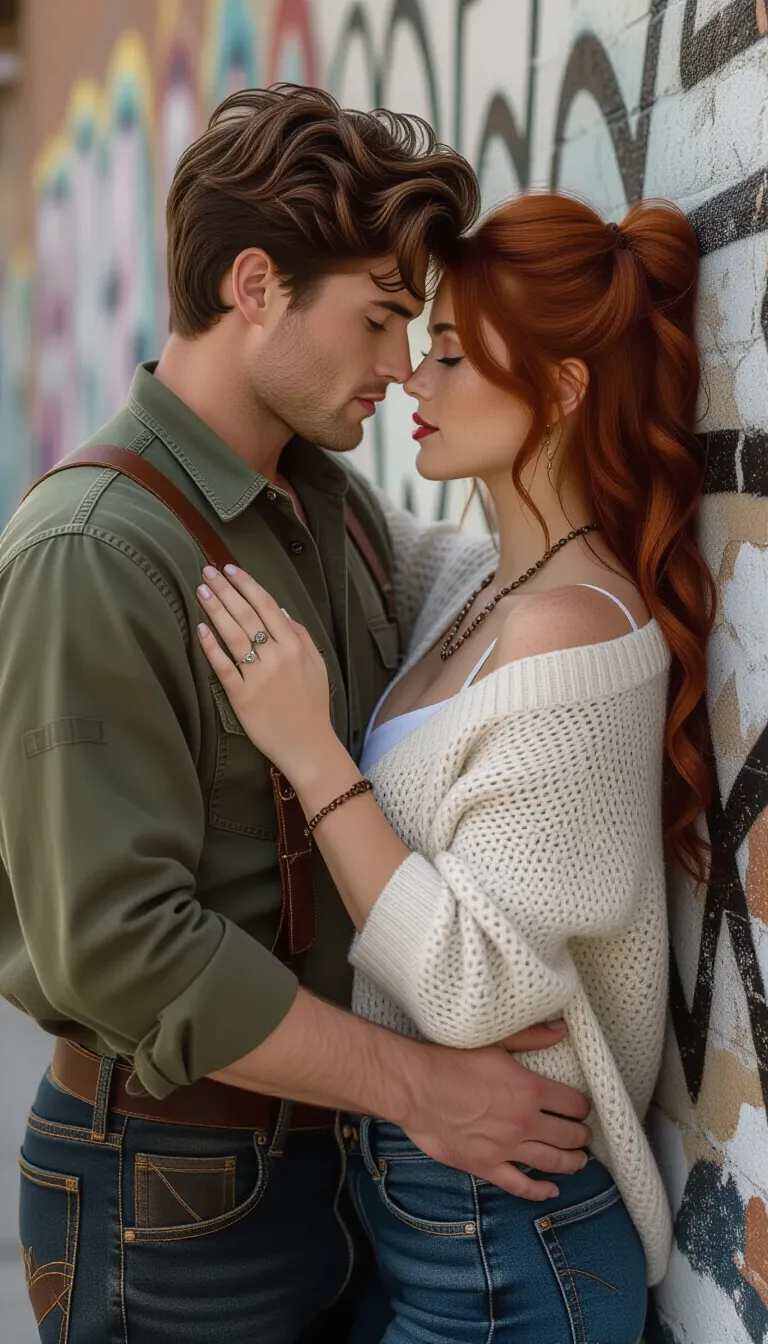
The narrow bed sagged beneath them, the thin mattress dipping in the middle so Declan's weight pulled her toward him whether she meant to lean or not. She didn't mean to resist.
The bare bulb cast shadows across his face—the hollow beneath his cheekbone, the line of his jaw, the way his eyes caught the light and held it gray and unreadable. The window rattled behind them, a loose pane somewhere, and beyond it the sea kept up its steady crash against the rocks below Flynn's house.
Siobhan's hand found the collar of his shirt. The fabric was soft, worn thin from years of washing, and she traced the edge where it met his neck—the warmth of his skin, the pulse jumping beneath her fingertips.
"Declan."
His name. Just that. She said it like she was checking he was real, like the sound of it might prove the day had happened at all.
He didn't answer. His hand came up to her wrist, and his thumb found the same spot she'd just touched on him—her pulse, fast and light, answering his.
She undid the first button. Then the second.
His chest rose beneath her fingers, a long breath he'd been holding since they'd climbed the stairs. The third button slipped through her fingers, and she had to look down to find it, her concentration breaking as the fabric fell open and she saw the first edge of the scar.
White. Pale against the warmer skin of his ribs. A line that ran from beneath his collarbone, curving down toward his sternum like a question mark.
Her fingers stopped on the fourth button.
"What—"
"Knife." His voice was low, steady. "Seventeen. A fight outside a pub in the Falls. I was on the wrong street at the wrong time."
She pushed the shirt open wider, and more of him emerged—the slope of his shoulder, the flat plane of his stomach, the smattering of hair across his chest. And the scars. Three of them, at least, in the half-light. One above his hip, round and puckered. One across his ribs, thin and precise, like a surgeon's cut made by a blade that wasn't a surgeon's.
"And this one?" Her voice was barely a whisper.
She touched the one below his collarbone. Her fingertip traced its edge, the raised tissue pale against his skin.
His jaw tightened. "That one was Tommy."
She didn't pull away. Her finger stayed, a light pressure against the scar, as if she could feel the story through her skin. "Your brother."
"He was seventeen. I was twelve. He was teaching me to use a knife, and I dropped it. He caught me before I hit the ground." A pause. "Caught me with his hand, not the blade. But I landed on it anyway."
Her hand flattened against his chest. The hair soft beneath her palm, the heart hammering steady and deep. She could feel the shape of him—not just the muscle and bone, but the boy he'd been, the man he'd become, the weight of every year written in the lines of his body.
"Siobhan."
She looked up.
His face was close—too close, not close enough. His gray eyes had gone dark, the pupils wide, and he was watching her with an intensity that made her breath catch.
"You're looking at me like I'm something," he said. "Like I'm—"
"You are."
"I'm not." His voice cracked. "I'm a carpenter who nearly became a killer. I'm a man who let his brother—"
"You let him go."
"After twenty-eight years of carrying the guilt."
"And you let him go." She pushed the shirt off his shoulders, and it fell behind him, pooling on the rough wool blanket. "You chose mercy. You chose me. You chose—"
He kissed her.
Not softly this time. His mouth came down on hers with a hunger that surprised her, that made her gasp against his lips, that sent her hands curling into the bare skin of his shoulders. He tasted of salt and need and something desperate, something that had been waiting too long and couldn't wait anymore.
She pulled him closer, and the narrow bed groaned, and the sea crashed beyond the window, and for a moment there was nothing but the press of his body against hers, the heat of his hands finding the small of her back, the way he said her name against her mouth like a prayer.
He pulled back. His forehead pressed against hers, his breathing ragged. "I'm sorry. I didn't mean to—"
"Don't." She bit her lip. "Don't apologize for wanting me."
"I do." His voice was rough. "God, Siobhan, I want you so much it terrifies me."
"Good."
She reached for the hem of her own sweater and pulled it over her head. The cold air hit her skin, raising goosebumps across her arms, but his hands found her waist a moment later, warm and rough and steady, and she didn't feel cold anymore.
"You're shaking."
"I'm not cold."
His thumbs traced her ribs, light enough to tickle, firm enough to hold. He moved slow, deliberate, as if memorizing every inch he touched. The curve of her waist. The ladder of her ribs. The warm skin beneath her collarbone, where her pulse beat visible and desperate.
She reached for his belt.
His hand caught hers, light, not stopping her. Just holding her there, at the edge of it, his eyes finding hers in the dim light.
"We don't have to—"
"I know."
"I just need you to know. If you want to stop, if you want to wait—"
"Declan." She turned her hand, laced her fingers through his. "I've been waiting my whole life for someone to look at me the way you do. I'm not waiting anymore."
He kissed her again, slower this time, his lips tracing a path from her mouth to her jaw to the hollow behind her ear. She tilted her head back, giving him room, and his mouth found the tender place where her neck met her shoulder, and she felt the small gasp escape her before she could stop it.
"Beautiful." His voice against her skin. "You're so beautiful."
She worked at his belt buckle, one-handed, clumsy. He laughed—a low, surprised sound—and she felt it vibrate through her chest where they were pressed together.
"What?"
"Nothing." He kissed her again, quick. "I just—I didn't think I'd ever laugh again. And here I am. Laughing. With you."
She got the belt open. His hands found the button of her jeans.
"Can I?"
She nodded. Her throat was too tight for words.
He undid the button. Pulled down the zipper. Slid his hand inside, warm against her hip, his thumb tracing the edge of her underwear. She closed her eyes, let herself feel it—the weight of his hand, the promise of more, the way her body was already responding, heat pooling low and insistent.
"Tell me if—"
"I will."
"I mean it. If you want to stop, if something feels wrong—"
"Declan." She opened her eyes. "I trust you. Do you trust me?"
His hand stilled. "With my life."
"Then trust me to tell you what I want."
He held her gaze for a long moment, something shifting in his face—a wall coming down, a door opening. Then he nodded, slow, and his hand moved lower.
She arched into his touch, her fingers finding his hair, pulling him closer. The narrow bed creaked as she shifted, and his knee found the space between her thighs, and the world narrowed to the heat of his body and the sound of his breathing and the sea outside, relentless and deep.
He kissed her again, deeper now, his tongue finding hers, and she felt the last of her hesitation dissolve. This was right. This was what she wanted. This man, with his scars and his guilt and his impossible hope, pressing her into a sagging mattress in a stranger's spare room, the evidence of two decades of pain locked in a notebook downstairs.
She pulled back, her breath coming fast. "I want to see you."
He stilled. "You—"
"All of you." She reached for the waistband of his jeans. "I want to see all of you."
He helped her. His jeans came off, then his boxers, and then he was bare before her in the dim light, his body a geography of scars and muscle and pale skin. She traced a line from his shoulder to his hip, following the path of a scar she hadn't noticed before, thin and white, curving along the muscle of his thigh.
"This one?"
"Barbed wire. I was climbing a fence in the dark."
"And this?" A small round scar on his forearm.
"Burn. From a soldering iron in my father's workshop. I was eight."
Her hand moved lower. "And this?"
She touched the pale mark near his hip, just above the line of his pubic hair.
He went quiet. His hand, which had been stroking her hair, stilled.
"Declan?"
"That one's from the night I was supposed to kill someone."
Her fingers stopped. She looked up at him, but his eyes were fixed on the ceiling, his jaw tight.
"I was seventeen. My brother gave me a rifle and told me to wait in a hedge on the Lisburn Road. A businessman was supposed to drive past. Catholic. Married. Two kids. I didn't know him. Didn't have any reason to want him dead. But Tommy said—" His voice cracked. "Tommy said it was time. Time to prove I was one of them. Time to become a man."
She didn't move. Her hand stayed on his hip, light, steady.
"I lay in that hedge for three hours. The rifle was cold against my cheek. I had him in my sights twice. Twice, Siobhan. And I couldn't pull the trigger."
"Because you're not a killer."
"Because I was a coward."
"No." She moved up, propping herself on her elbow, her face inches from his. "Because you had a conscience. Because you were sixteen years old and you knew killing a man you'd never met was wrong."
He turned his head, met her eyes. "I told Tommy I missed. I said he swerved. I let him think I'd failed. And then I came home and I sat in the bath and I held my arm under the water and I—" He stopped. Swallowed. "I didn't know what else to do with it. With the shame. So I made a mark. Something I could see. So I'd never forget."
Siobhan looked at the scar. Small, precise, neat. A razor blade, probably. Self-inflicted and hidden for years.
She touched it again, feather-light.
"You were a child," she said. "You were a child who chose mercy, even when it cost you everything."
"I should have told someone. I should have gone to the police, given them Tommy's name—"
"And what? Put your brother in prison? Watched your mother lose both her sons?"
He blinked. "How do you—"
"Because I know you." She kissed his shoulder. "I know you, Declan Morrow. I know you'd rather carry the guilt yourself than let anyone else suffer for it."
His hand came up to her face, cradling her cheek. His thumb traced the line of her jaw, the curve of her lip, the freckles scattered across her nose.
"How did I find you?" he whispered. "How did I deserve you?"
"You didn't find me. We found each other." She kissed his palm. "And you don't need to deserve me. You just need to stay."
He pulled her down, settled her against him, her body fitting into the curve of his like it had been made for it. The narrow bed held them both, barely, and the sea kept crashing, and the bare bulb flickered once before steadying.
"I'm not going anywhere," he said. "I've spent my whole life running. I'm done."
She lifted her head, looked down at him. His gray eyes held hers, and in them she saw something she'd never seen before—not hope, not fear, not the careful guardedness he wore like armor. Something raw and open and terrified and certain all at once.
"Then show me," she said.
He did.
Slowly, reverently, his hands moved over her like she was something sacred. He undressed her with a patience that made her breath catch, unfastening her bra and sliding it down her arms, his eyes following every inch of skin he revealed. When she was bare, he kissed her—not her mouth, but the hollow of her throat, the curve of her breast, the soft skin of her stomach. He kissed every scar she had, every freckle, every place she'd ever doubted herself, and with each kiss he said her name like it was the only word he knew.
"Siobhan."
A kiss to her ribs.
"Siobhan."
A kiss to her hip.
"Siobhan."
She tangled her fingers in his hair, pulling him up, and when his mouth found hers again she tasted tears—his or hers, she couldn't tell. It didn't matter.
"I love you," she said. "I love you, Declan Morrow. I love your scars and your guilt and your terrible hope. I love the way you say my name. I love that you let Patrick go. I love—"
He kissed her quiet.
And then he moved over her, the narrow bed groaning beneath them, and she felt the weight of him—solid, real, here. His forehead pressed to hers. His breath mixing with hers. His hand finding hers, lacing their fingers together against the thin pillow.
"I love you too," he said. "God help me, I love you too."
The sea crashed. The window rattled. The bare bulb flickered in the draft.
And Declan kissed her again, slower this time, letting the moment stretch and breathe and become something they'd carry forever. A narrow bed. A cold room. Two people who'd crossed a city and a war and their own worst selves to find each other here.
His hand traced down her side, over her hip, and when he touched her, she gasped—a sharp, surprised sound that she buried against his shoulder.
"Is this—"
"Yes." Her voice was barely a whisper. "God, yes."
He moved against her, and she felt the heat building, low and insistent, her body responding to his in a rhythm that felt older than language. She wrapped her legs around him, pulled him closer, and when he entered her she cried out—not from pain, but from the sheer overwhelming rightness of it, the way their bodies fit together like they'd been waiting their whole lives for this moment.
"Declan."
His name. His true name. Spoken into the dark, into the salt air, into the space between his heart and hers.
"I'm here," he said. "I'm right here."
He moved slowly, deliberately, each stroke a conversation, a promise, a prayer. The bed creaked beneath them. The sea kept its steady rhythm. And in the narrow room above Dalkey, two people who had spent their whole lives surviving finally let themselves live.
She came apart in his arms, her body trembling, her face pressed to his neck, and he followed a moment later, his breath catching, his hand gripping hers like she was the only thing keeping him tethered to the earth.
Afterward, they lay tangled together, the thin blanket pulled over them, the bare bulb still burning. The sea had softened, or maybe she'd stopped hearing it—stopped hearing everything except his breathing, slow and steady, evening out as sleep began to pull at him.
"Declan."
"Mm."
"Tomorrow we give Flynn the notebook. And then we go home."
He was quiet for a long moment. Then: "Where's home?"
She thought about the cottage. The blue door. The yellow table. The roses she'd plant in the garden, come spring.
"I don't know yet," she said. "But I'll know it when I see it."
His arm tightened around her, pulling her closer. "As long as you're there, I don't care where it is."
She smiled into the dark. Outside, the sea kept its watch. Inside, in the narrow bed, they held each other, and for the first time in a very long time, neither of them dreamed of running.
Morning came grey and salt-stained through the warped window, the light thin and watery. Siobhan woke first, as she always did, and for a long moment she lay still, counting his breaths, feeling the slow rise and fall of his chest beneath her cheek. The bare bulb had burned out sometime in the night, and the room felt smaller in the half-dark, the narrow bed an island, the sea a constant presence beyond the glass.
She shifted, and his arm tightened around her, reflex or instinct, a man who'd learned to hold on to what was his.
"Still here," she murmured.
His eyes opened, grey as the morning, unfocused for a beat before they found her. The corner of his mouth lifted. "Where else would I be?"
"I don't know." She traced the line of his collarbone, the skin warm beneath her fingers. "I keep expecting to wake up alone. Like this has all been—" She stopped. Shook her head.
"Don't," he said quietly. "Don't do that."
She didn't answer. Instead she pressed closer, fitting herself against him, and for a while they lay in silence, the sea filling the spaces between their breathing.
Eventually she said, "Flynn said he'd have the story ready by evening."
"I know."
"That gives us—" She calculated. "A day. Maybe two before it hits the papers."
"I know."
"Declan." She pulled back enough to look at him. "Once it's printed, there's no taking it back. Your uncle will know. Your mother will know. Everyone will know."
He was quiet for a long moment. His hand found hers, laced their fingers together against the thin pillow. "My mother deserves to know the truth," he said. "She's spent twenty-eight years believing my father abandoned her. That she wasn't enough to make him stay." His voice cracked on the last word, and he stopped, cleared his throat. "She deserves to know he loved her. That he faked his death to keep her alive."
Siobhan felt something twist in her chest. "And your uncle?"
"Robert can rot." The words came flat, hard, no hesitation. "He made his choices. He can face the consequences."
She watched his face, the set of his jaw, the way his eyes stayed steady on hers. This was the Declan she'd fallen in love with—not the boy who'd stolen a car, not the man who'd sat in a hedge with a rifle, but this version, the one who'd chosen mercy over revenge and was still standing, still whole, still hers.
"Then we do it," she said. "We give Flynn the notebook, we let him print the story, and we walk away."
"Walk where?"
She thought about the cottage. The blue door. The yellow table. The roses she'd plant come spring, if the ground ever thawed enough to let them root.
"West," she said. "Donegal. Teelin. Somewhere the sea's the only thing that watches us."
He was quiet. Then: "You'd really leave everything? Your family? Your teaching? Your—"
"I'd leave all of it." She said it without hesitation, and meant it. "There's nothing in Belfast for me anymore. No school that would have me back after this. No church that would welcome me. No family that—" She stopped, swallowed. "My mother's gone. My father's dead to me in every way that matters. I have my grandmother's rosary and a handful of memories and you." She touched his face. "That's enough."
He turned his head, kissed her palm. "It's not enough. You deserve a garden. A kitchen with a yellow table. A life that doesn't start with running."
"Then we build it." She said it like it was simple. Like they hadn't spent weeks crossing a war to find each other. "We find the cottage. We plant the roses. We paint the door blue. And we sit at that yellow table every morning and drink tea and watch the sea until we're old and grey and too tired to care who's knocking."
His laugh was low, rough, surprised out of him. "That's a lot of tea."
"I'm Irish. I can manage."
He pulled her closer, and she felt his chest shake with something that might have been a sob or a laugh or both. "I love you," he said. "I love you so much it terrifies me."
"Good." She pressed her forehead to his. "Terror keeps you honest."
They lay there until the light shifted, the grey morning turning to proper daylight, the sound of Flynn moving around downstairs filtering up through the floorboards. A kettle whistled. A door opened and closed. Footsteps crossed the room below them, then stopped.
"Declan."
"I heard."
She sat up, the blanket falling away, the cold air raising goosebumps on her arms. She found her clothes—her sweater, her jeans, her underwear—and dressed quickly, efficiently, the way you dress when you've learned not to linger. Declan watched her from the bed, his eyes tracing her movements, and when she turned to face him he was already standing, pulling on his trousers, his shirt, the same clothes he'd been wearing for days now, creased and salt-stained and smelling of her.
"Ready?" she asked.
He looked at her. The narrow bed. The cracked plaster. The sea beyond the window. The room they'd spent the night in, the room where they'd held each other and spoken of cottages and yellow tables and a future that felt, for the first time, possible.
"No," he said. "But let's go anyway."
She took his hand. He held on.
They walked downstairs together.
The stairs creaked under their weight. His hand stayed wrapped around hers as they stepped into the kitchen doorway. Flynn was at the table, a half-empty mug of tea cooling beside a stack of typed pages, his reading glasses pushed up on his forehead. He looked up when they entered, his eyes moving from their joined hands to Declan's face, and something in his expression shifted—a recognition of what was about to happen.
"You have it," Flynn said. Not a question.
Declan didn't answer. He reached inside his jacket and pulled out the leather-bound ledger. It looked smaller in the daylight, less dangerous—just a book, ink on paper, the kind of thing you'd find on a shelf in a hundred Dublin shops. But the weight of it was still there, pressed into his palm, a history written in names and dates and bodies buried in unmarked graves.
He held it for a moment, feeling the worn leather against his skin, the corners soft from decades of handling. Siobhan's thumb traced a slow circle on the back of his hand, grounding him, reminding him he wasn't alone in this room.
"Declan." Her voice was quiet. "It's just a book."
He looked at her. Her green eyes held his, steady as the tide coming in beyond the window, and he remembered the cottage he'd described in the dark of the narrow bed—the blue door, the yellow table, the roses she'd plant come spring.
"It's not," he said. "It's my father's life. My mother's grief. Every man who died because Robert Morrow wanted more power." He paused, his throat tight. "It's our chance to bury it all."
He stepped forward and set the ledger on the table between them. The sound it made—a soft thud against the worn wood—was the quietest thing he'd ever heard. It felt like a bomb going off. Or a door closing. Or both.
Flynn didn't reach for it immediately. He looked at Declan, then at Siobhan, then back at the book. His hands stayed flat on the table, as if he was giving them one last chance to take it back. "Once I file this story, there's no pulling it. Your uncle will have men looking for you before the ink dries. Your mother will know the truth, but she'll also know the danger you've put yourself in. Every name in that book becomes a target."
Declan felt the weight of the words settle in his chest. He thought of his mother in her small house in East Belfast, the curtains always drawn against the street, the photograph of his father on the mantelpiece that she'd kissed every night before bed. He thought of Patrick, the brother he'd lost to the same violence they were trying to end. He thought of the cottage by the sea, the one he'd described to Siobhan in the dark of the narrow bed, the one he was starting to believe might be real.
"I've been preparing for it my whole life," he said. "I just didn't know it until now."
Siobhan stepped closer, her shoulder brushing his, her hand finding his again. "We both have."
Flynn studied them for a long moment, his eyes moving from Declan's face to Siobhan's, and then he nodded. He picked up the ledger. He opened it, the pages crackling with age, the faint smell of old paper and dust rising from the binding. His eyes moved across the first entry, then the second, his lips moving silently as he read. He let out a long, slow breath. "Jesus, Mary, and Joseph."
Declan's hand tightened on Siobhan's. Her palm was warm, slightly damp against his. He squeezed. She squeezed back. They stood like that while Flynn read, the only sounds the turning of pages and the distant crash of the sea against the Dalkey cliffs.
The clock on the mantelpiece ticked. A dog barked somewhere down the street. The kettle on the stove sat cooling, forgotten. Declan watched Flynn's face as he read—the way his jaw tightened at one entry, the way he shook his head at another, the way his hand came up to rub his eyes when he reached the middle of the ledger.
"This goes back to '69," Flynn said finally, his voice rough. "The first arms shipment. Three months after the Troubles started." He looked up at Declan. "Your uncle didn't just profit from the violence. He helped start it."
Declan had known. Some part of him had always known. But hearing it spoken aloud, in a quiet kitchen in Dalkey, with the sea in his ears and Siobhan's hand in his—it landed differently. It landed like a stone dropping into deep water, sinking past the light, past the reach of air, settling into the dark where nothing could bring it back up.
"There's more," Declan said. "The last third. It's names of men Robert ordered killed. Dates. Methods. Payments made."
Flynn turned to the back of the ledger. His face went pale as he read. "There must be two dozen names here."
"Twenty-eight." Declan's voice was flat. "Including my father."
Flynn closed the book. He set it down carefully, as if it might break, and took off his glasses, rubbing the bridge of his nose. The silence stretched. A fly buzzed against the windowpane, trapped between the glass and the cold air outside.
"I've been a journalist for thirty-seven years," Flynn said. "I've seen a lot of darkness. But this—" He tapped the ledger with his finger. "This is the story that ends men's careers. Ends their lives, if they're not careful." He looked at Declan. "You understand what you're handing me? You could take this to the RUC. To the British authorities. You could—"
"The RUC has been in Robert's pocket since the start," Declan said. "The British Army turns a blind eye because he's useful. The only way this sees daylight is through a newspaper. Through a man who's not afraid to print it." He held Flynn's gaze. "My father trusted you. I'm trusting you too."
Something flickered in Flynn's eyes. He looked at the ledger again, then at the stack of typed pages beside his mug. "I've already started the piece. Background, context, the shape of the story. Once I integrate this—" He touched the ledger. "I can have it ready by morning."
"Morning?" Siobhan's voice was sharp. "I thought you said evening."
"That was before I knew the full scope." Flynn leaned back in his chair. "This isn't a story, it's an earthquake. I need to make sure every fact is double-checked, every name verified, every date confirmed. One mistake and they'll bury us both in libel suits." He looked at Declan. "Tomorrow morning. First edition. I'll have a copy boy run it to the press room myself."
Declan nodded slowly. A day. One more day of waiting, of looking over his shoulder, of feeling the weight of the ledger in the world before it became ink and paper and history. One more day before everything changed.
"We'll stay out of your way," he said. "We can—"
"You'll stay here." Flynn's voice was firm. "Both of you. Dalkey's quiet. No one knows you're here. And I need you close in case I have questions." He stood, picking up the ledger and the stack of typed pages. "There's food in the cupboard. Tea in the tin. The sofa pulls out into a bed." He paused at the door. "And Declan."
Declan looked up.
"Your father would be proud of you."
The words hit him low and hard, in the space between his ribs where the grief lived, the guilt, the years of not knowing. He opened his mouth to say something—he didn't know what—but Flynn was already gone, the door clicking shut behind him, his footsteps fading down the hallway toward the front room.
Silence settled over the kitchen. The clock ticked. The fly buzzed. Declan stood in the middle of the room, Siobhan's hand still in his, and let himself feel the weight of what they'd just done.
She turned him gently, her hands coming up to rest on his chest. "You did it."
"We did it."
She shook her head. "You did it. You placed the book on that table. You made the choice." Her fingers found the collar of his shirt, smoothing the worn fabric. "I'm just here to hold your hand."
"That's not nothing." His voice was rough. "That's everything."
She rose on her toes and kissed him, soft and slow, her lips warm against his. He let himself sink into it, into her, into the moment of stillness before the storm broke. His hands found her waist, pulling her closer, and she made a small sound against his mouth that could have been a sigh or a sob or both.
When she pulled back, her eyes were bright. "What do we do now?"
He looked past her, out the window, where the sea was grey and endless under a pale winter sky. A gull wheeled past, riding the wind, heading west toward the open water.
"We wait," he said. "And we trust Flynn." He looked back at her, at the red hair escaping from its pins, at the freckles scattered across her nose, at the woman who'd crossed a city and a war and her own life to stand beside him in this kitchen. "And we think about that yellow table."
Her smile was small, but it was real. "It's a good table."
"The best table." He touched her face, his thumb tracing the line of her cheekbone. "Solid oak. Four chairs. A vase in the middle for flowers you'll cut from the garden."
"Roses," she said.
"Roses."
She leaned into his hand, closing her eyes for a moment, and when she opened them again there was something settled in them, something that looked like peace. "Alright," she said. "We wait. And we think about the table."
He kissed her forehead, her temple, the corner of her mouth. She laughed, a low, warm sound that softened the edges of the room.
Behind them, the kettle sat cold on the stove. The sea kept crashing against the cliffs. Somewhere in the front room, Flynn was on the telephone, his voice low and urgent, weaving the first threads of the story that would bring down Robert Morrow.
But in the kitchen, there was only the two of them, and the promise of a table, and the long road ahead that they would walk together.
She took his hand. He held on.
The kitchen had gone quiet around them. The fly had stopped buzzing—or maybe it had finally found its way out. Declan didn't know. He only knew Siobhan's hand in his, her fingers warm and steady, and the way the grey light through the window had begun to shift toward evening.
"We should sleep," she said. "While we can."
He nodded. The narrow bed waited upstairs. The thought of it—of lying beside her in that small room, of the hours stretching out until morning—felt like both a gift and a trap. A gift because she would be there. A trap because the waiting would press in from all sides, and he'd have nowhere to put his hands except on her.
She led the way up the stairs. The wood creaked under their feet, and the cold air from the hallway slipped under his shirt. The spare room was exactly as they'd left it: the single cot against the wall, the rough wool blanket, the bare bulb casting its harsh light on the cracked plaster. The window was warped, and through the gap, he could hear the sea—a low, constant roar that had been there all along, underneath everything.
She let go of his hand and stood by the bed. The mattress sagged in the middle, the springs visible beneath the thin ticking. "It's not much," she said.
"It's a bed."
"It's a narrow bed."
He watched her reach up and begin unpinning her hair. The red came loose in waves, catching the light, falling past her shoulders. She shook her head once, and the strands settled against the collar of her cardigan. She was looking at him with something soft in her eyes, something that made his chest hurt.
"Come here," she said.
He crossed the room. The distance was three steps, maybe four. He closed it slowly, feeling the creak of the floorboards under his boots, feeling the weight of the moment settling around them like the dust motes in the light. When he reached her, she put her hands on his chest, flat against the fabric of his shirt, and he felt the heat of her palms through the cotton.
"You're still wearing your boots," she said, and smiled.
He didn't smile back. He couldn't. There was something pressing against the inside of his ribs, something he'd been carrying since Flynn closed the ledger, since the old journalist had said tomorrow morning. A fear that had been there all along, quiet and patient, waiting for the quiet moments to surface.
"Siobhan."
Her hands stilled. "What is it?"
He opened his mouth. The words were there, lined up like stones on a riverbank. But the sentence felt too big to speak, too heavy to push past his teeth. He looked down at her hands on his chest, at the way her fingers curled into the fabric, and he thought: What if this isn't enough? What if the ledger is just paper and ink, and Robert has men in every corner of this island, and we've walked into a trap and I've brought her with me?
"Declan." Her voice was soft, but it had an edge. "Tell me."
He swallowed. "What if the story isn't enough?"
She didn't look away. Her hands stayed on his chest, steady. "What do you mean?"
"Flynn's good. The ledger's solid. But Robert has been untouchable for thirty years. He's got police in his pocket. He's got priests who bless his work. He's got a network of men who would kill their own mothers if he told them to." His voice was low, rough, barely above a whisper. "What if the newspaper prints the story and nothing happens? What if he just—denies it, and the people who matter look the other way, and we've burned everything for nothing?"
She was quiet for a long moment. The sea kept crashing beyond the window. The bulb flickered once, twice, then steadied.
"Then we've still done the right thing," she said. "We've still told the truth. We've still stood up and said his name and put the evidence in the light." Her fingers pressed harder against his chest, as if she could push the certainty into him. "And if it's not enough—if the world doesn't change tomorrow—then we find another way. We don't stop. But we don't live in the fear of what might not happen."
He closed his eyes. Her voice was warm, steady, and it wanted to calm him. Part of him wanted to let it. But the fear was still there, coiled in his gut, whispering that she was wrong, that the world didn't work that way, that he'd seen too many good men die for nothing to believe in the power of a newspaper story.
She must have seen something in his face, because her hand left his chest and came up to his jaw, tilting his head down until he opened his eyes and met hers. Her green eyes were bright, almost fierce.
"I didn't cross Belfast for you to give up now," she said. "I didn't hold you in that hotel room while you told me about the car, about the rifle, about all the things you've carried—I didn't do any of that so you could stand here and let fear win." Her voice cracked at the edges. "We're in this. We're together. And whatever happens tomorrow, we face it together. Do you understand me?"
He looked at her. The red hair, the freckles, the set of her jaw. The woman who'd walked into a butcher's shop and changed everything. The woman who'd said his name like a prayer in the dark.
He understood.
He leaned forward and kissed her. It wasn't soft—it was hard and desperate, a kiss that said I'm afraid, I'm angry, I'm here, don't leave me. She kissed him back with the same ferocity, her hands sliding into his hair, pulling him closer. The kiss deepened, and he felt the fear shift, transform, become something else. Something that burned.
He pulled back, breathing hard. "I need you," he said. "I need to feel you. To know you're real."
She nodded, her eyes dark. "Then take off your shirt."
His hands moved to the buttons. He worked them slowly, one by one, his fingers clumsy with the speed of his heartbeat. The shirt fell open, and she watched him—watched his chest rise and fall, watched the scars that mapped his history across his skin. There was a long, pale line running from his collarbone to his ribs, the remnant of a blade that had caught him at seventeen. A ragged circle on his shoulder, where a bullet had grazed him. And below his ribs, on the left side, a small, neat scar that he'd put there himself, with a knife he'd held in the dark of his room at sixteen, because he'd refused to kill for men who called themselves soldiers.
Her breath caught. Her hand came up, trembling, and touched the scar below his ribs. Her fingers traced its edges, light as a whisper.
"You did this," she said. Not a question.
He nodded. "The night I refused. They told me I was a coward. They told me I'd betrayed my family, my community, my God. I sat in my room with the blade and I thought—" He stopped. "I thought maybe they were right. Maybe the only way to redeem myself was to—"
"Don't." Her voice was sharp, almost angry. "Don't you dare finish that sentence." She pressed her palm flat against the scar, as if she could cover it, erase it, protect the boy he'd been. "You were sixteen years old. You were brave enough to say no. Braver than any of them."
He felt something crack open in his chest. The fear was still there, but it had company now—something warmer, something that felt like being seen.
"And you're still brave," she said. "You walked into that bookshop. You faced Malloy. You put the ledger in Flynn's hands. You did all of it, and I was there, and I saw you." Her eyes met his. "I see you."
He couldn't speak. He cupped her face with both hands, cradling her jaw, and kissed her again—slower this time, deliberate, as if he was trying to memorize the shape of her lips, the taste of her, the way she sighed into his mouth. She responded by pushing his shirt off his shoulders, letting it fall to the floor, and then her hands were on his skin, tracing the lines of his back, the ridges of his spine.
"Your turn," he said against her mouth.
She stepped back and pulled her cardigan over her head. The blouse underneath came next, the buttons small and fiddly, and he watched her fingers work with a patience that made his pulse pound. When the blouse joined his shirt on the floor, she stood before him in her slip, thin cotton the color of cream, her shoulders bare, her collarbone catching the light.
He reached for her. His hands found the straps of the slip and pushed them down, one at a time. The fabric slid over her breasts, her stomach, her hips, pooling at her feet. She stood naked in front of him, and the bare bulb caught the red of her hair, the pale of her skin, the freckles scattered across her shoulders like a constellation he wanted to learn.
"You're beautiful," he said.
She smiled, a small, uncertain thing. "So are you."
He took her hand and led her to the narrow bed. The mattress sagged as they lay down, the springs groaning under their combined weight. He pulled the wool blanket over them, and the rough fabric scratched against his skin, but he didn't care. She was pressed against him, her body warm and soft, her legs tangling with his.
For a long moment, they didn't move. They just lay there, breathing together, listening to the sea. The fear was still there—he could feel it, a low thrum beneath his ribs—but it was quieter now, muffled by her presence, by the way her hand traced idle patterns on his chest.
"Declan."
"Mm?"
"We're going to be okay."
He wanted to believe her. He wanted to let the words sink in and take root. But he'd learned not to trust the world, not to trust the future, not to trust anything except the moment he was in. And in this moment, she was in his arms, and the sea was crashing, and the narrow bed held them both.
He kissed her forehead. "I know."
She looked up at him, and he could see that she didn't believe him either. But she didn't call him on it. Instead, she shifted closer, pressing her body against his, and kissed him on the mouth—a kiss that said then let's not talk about it.
His hand slid down her back, over the curve of her spine, coming to rest on her hip. He felt the warmth of her skin under his palm, the softness of her waist. She made a small sound against his mouth, and he deepened the kiss, his tongue finding hers, the taste of her filling him.
The narrow bed forced them close. There was no room for hesitation. Every inch of her was pressed against him—her breasts against his chest, her thighs against his, her hand sliding down his stomach, finding the button of his trousers. He gasped as her fingers worked the fastening, and then she was pushing the fabric down, and he kicked the trousers off, and they were skin to skin, nothing between them.
He rolled onto his back, pulling her on top of him. She straddled his hips, her hair falling around them like a curtain, the red strands brushing his face. He looked up at her, at the way the bare bulb caught the freckles on her nose, at the way her eyes were dark and heavy-lidded.
"I love you," he said.
She leaned down and kissed him, slow and deep. "I know."
He reached between them, his fingers finding her, slick and warm. She gasped against his mouth, her hips pressing into his hand. He guided himself to her, the tip of him at her entrance, and he looked up at her, asking without words.
She nodded. Her breath was ragged. "Yes."
He pushed up into her, slow, inch by inch. The heat of her surrounded him, pulled him in, and she cried out—a soft, broken sound that the sea swallowed. He held still, letting her adjust, his hands on her hips, his thumbs tracing circles on her skin.
"You're here," he said. "You're real."
She laughed, a breathless sound. "I'm here."
He began to move. The narrow bed creaked under them, the springs complaining, but neither of them noticed. There was only the rhythm of their bodies, the slap of skin against skin, the sound of her breathing, the way she said his name when she came, the way he held her through it, his own release building, cresting, breaking over him like the waves against the cliff.
Afterward, they lay tangled in the narrow bed, the wool blanket pulled up to their chins. The bulb still burned, casting its harsh light on the cracked plaster, but neither of them reached to turn it off. She had her head on his chest, her hand over his heart, and he watched the rise and fall of her breathing.
The fear was still there. It would be there in the morning, when the newspaper hit the streets, when Robert Morrow learned his name was in print. But for now, in this narrow bed, with her weight on him and the sea outside, it was a distant thing, a whisper he could almost ignore.
He kissed the top of her head. "Tomorrow," he said.
"Tomorrow," she repeated.
And they lay there, holding each other, waiting for the light.
A knock at the door. Three sharp raps, the wood thin enough that the sound rattled through the room like a rifle crack.
Declan's hand found hers under the blanket. His pulse jumped, but he didn't move. Didn't breathe.
"Declan?" Flynn's voice, muffled through the plaster. "You awake?"
Siobhan shifted beside him, her hair brushing his chest. She looked up at him, her green eyes dark in the harsh light, and he saw the same fear he felt mirrored back.
"Give us a minute," he called out. His voice came out rougher than he'd meant.
Flynn's footsteps retreated down the stairs, heavy and slow.
Declan let out a breath he hadn't realized he was holding. The bare bulb still burned above them, casting shadows on the cracked ceiling, and the wool blanket scratched against his skin. He didn't want to move. He wanted to stay here, in this narrow bed, with her weight on him and the sea outside. He wanted to pretend the knock had never come.
But it had. Flynn wouldn't have climbed the stairs unless he had news.
Siobhan sat up, the blanket pooling around her waist. Her hair fell across her shoulders, red against the pale of her skin, and she reached for her slip where it lay crumpled on the floor. She pulled it over her head, the cotton settling against her body, and the gesture was so ordinary, so human, that it made his chest ache.
"We knew it was coming," she said. Not a question.
"I know." He sat up, the mattress groaning beneath him. He found his trousers on the floor and pulled them on, the fabric cold against his skin. His shirt lay near the door, and he crossed the room to retrieve it, the floorboards creaking under his bare feet.
She was already standing, her cardigan in her hands. She didn't put it on. She just stood there, watching him, her fingers worrying the wool.
"What if it's bad news?" she asked.
"Then we deal with it." He crossed to her, took the cardigan from her hands, and held it open. She turned, sliding her arms into the sleeves, and he let his hands rest on her shoulders for a moment longer than necessary. "Together."
She leaned back against him, her head brushing his chin. The smell of her—lavender and salt and something underneath that was just her—filled his lungs. He wanted to breathe her in forever.
"Come on," he said. "Let's see what he wants."
They walked down the narrow stairs together, his hand in hers, the wood worn smooth by decades of feet. The house was small—a cottage really, the kind that dotted the coast, whitewashed walls and a slate roof that had weathered a hundred storms. Flynn's study was on the ground floor, the door ajar, a sliver of lamplight bleeding into the hallway.
Declan pushed the door open.
Flynn sat behind his desk, a wreath of smoke curling from the cigarette between his fingers. The ledger lay open in front of him, and next to it, a stack of papers covered in tight, cramped handwriting. His glasses sat low on his nose, and he looked up as they entered, his eyes tired behind the lenses.
"Good morning," he said, his voice cracked from the smoke.
"Is it?" Declan asked.
Flynn took a long drag of his cigarette. The tip glowed orange, and he exhaled slowly, the smoke drifting toward the ceiling. "I've been up all night. Reading. Cross-referencing. Making phone calls." He tapped the stack of papers. "The story is in good shape. The editor's been briefed. We're running it in the morning edition."
Declan felt something loosen in his chest. But not everything. "That's it? It's happening?"
"It's happening." Flynn crushed the cigarette into an overflowing ashtray. "But there's more."
Siobhan's hand tightened around his. "What kind of more?"
Flynn pulled another sheet from the pile—a photograph, grainy and black-and-white, the edges creased from folding. He slid it across the desk toward them. "This was taken three days ago. Outside a warehouse in Newry."
Declan picked it up. The photograph showed a man standing beside a lorry, his face half-obscured by a cap pulled low. He was tall, broad-shouldered, with a familiar set to his jaw. The caption on the back read: R. Morrow, believed to be inspecting goods at Newry depot, Feb 12.
His uncle. Robert Morrow.
Declan stared at the photograph. The man who'd ordered his father's death. The man who'd turned his brother into a killer. The man whose shadow had loomed over his entire life, and who he'd never even seen face to face.
"He's in the country," Flynn said. "I don't know for how long. But he's here, Declan. And once that story hits the streets, he's going to know who brought him down."
Declan set the photograph down carefully, as if it might burn him. "Let him. I've been running from him my whole life. I'm done running."
Siobhan took the photograph from the desk, studying it. Her expression was unreadable. Then she looked up at Flynn. "You said there was more."
Flynn leaned back in his chair, the leather creaking under his weight. "I made some calls. Quiet ones. There's a man I trust in the Garda—a detective inspector named Conlon. He's been building a case against Robert for years, but he's never had enough to make it stick. I told him what I have. He's coming down from Dublin this afternoon."
"He's coming here?" Declan asked.
"He'll need to take sworn statements. From you. From your father, if he's willing." Flynn looked at Declan over the rim of his glasses. "And from anyone else who can put Robert at the scene of a crime. That includes your brother."
Declan's jaw tightened. "Tommy won't talk."
"Maybe not. But the offer will be on the table. Conlon's prepared to offer immunity to anyone who testifies against Robert Morrow." Flynn picked up another cigarette, tapped it against the pack. "That includes your brother, if he's willing to trade."
Declan shook his head slowly. "Tommy's made his bed. He'll lie in it."
Flynn lit the cigarette, the flame flickering in the dim light. "That's his choice. But I needed you to know—everything's in motion now. There's no stopping it. By this time tomorrow, Robert Morrow's name will be on every front page in the country. And the only people who can bring him down for good are the ones who know the truth."
He paused, letting the words hang.
"Are you one of them, Declan?"
Declan felt Siobhan's hand slip into his. He looked at the photograph on the desk—Robert Morrow, half in shadow, standing beside a lorry full of guns that had probably killed his father and a dozen others just like him.
"I know what I saw," he said quietly. "I know what my father wrote in that notebook. I know what Patrick Malloy told me. And I know what my brother did." He met Flynn's eyes. "But most of that is hearsay. I was a boy when it happened. I was hiding under a table while my mother was told my father was dead."
Flynn nodded slowly. "Then we need your father. And we need the ledger." He gestured to the notebook on his desk. "Which I already have. But Thomas Morrow's testimony would be the nail in the coffin. A man thought dead for three decades, coming forward to tell the truth about his brother." He took a drag of his cigarette. "That's a story people remember."
Declan rubbed the back of his neck. His father was in hiding—had been for twenty-eight years. He didn't know if Thomas would be willing to come out into the open, to put himself in Robert's crosshairs.
But he also knew his father had been waiting a long time for this. Waiting for someone to finish what he'd started.
"I'll talk to him," Declan said. "But I can't promise anything."
Flynn smiled, thin and tired. "That's all I ask."
The study fell silent. The sea crashed against the cliffs beyond the window, relentless and indifferent. The morning light was beginning to creep through the curtains, pale and gray, the beginning of a new day.
Siobhan squeezed his hand. "We should eat something. Before we do anything else."
Declan looked at her. The bare bulb caught the red in her hair, the freckles on her nose, the shadows under her eyes. She looked exhausted, but she was standing. She was here.
"Yeah," he said. "Food."
Flynn waved a hand. "Kitchen's through the hall. Bread in the press, butter in the cold box. Tea's in the tin."
Declan helped Siobhan to her feet, and they walked out of the study together. The hallway was dim, the stairs creaking under their weight, and when they reached the kitchen, he let out a breath he hadn't known he was holding.
The kitchen was small, barely a galley, with a thick stone sink and a blackened range. A loaf of bread sat on the cutting board, wrapped in a cloth, and Declan found the tin of tea leaves on the shelf above. He filled the kettle and set it on the range, striking a match to light the burner.
Siobhan stood by the window, looking out at the sea. The light was growing stronger, silver and gray, and she wrapped her arms around herself, shivering slightly.
Declan crossed to her. He wrapped his arms around her from behind, pulling her close, pressing his chin to the top of her head. She leaned back into him, her hands coming up to cover his.
"Are you scared?" she asked.
"Terrified."
"Good. So am I."
They stood like that, watching the sea, as the kettle began to whistle. The world outside was waking up—gulls crying, a dog barking somewhere down the lane—but in this small kitchen, with her in his arms, the future felt distant, a story happening to someone else.
"We should get dressed," she said quietly. "Flynn's expecting us."
"Let him wait."
She laughed, a small, broken sound, and turned in his arms. Her face tilted up toward his, and he kissed her, slow and soft, like they had all the time in the world.
But they didn't. They both knew it.
The kettle screamed.
Declan pulled back, not quite letting her go, and reached for the kettle. He poured water over the tea leaves in the pot, the steam rising, and the smell of breakfast tea filled the small kitchen. He poured two cups, strong and dark, and handed one to her.
She wrapped her hands around the ceramic, the warmth seeping into her fingers, and he watched her take the first sip. Her throat worked as she swallowed, and she let out a small sound of satisfaction.
"That's good," she said.
He took a sip of his own. It was bitter and hot, and it burned his tongue, but he didn't care. She was here. She was drinking tea in his kitchen—in Flynn's kitchen—and the world was still turning.
They ate in silence, standing at the counter, tearing pieces of bread and buttering them. The loaf was dense and chewy, the butter cold and rich, and it was the best meal he'd had in weeks.
When they finished, Declan washed the cups in the stone sink, the water cold on his hands. Siobhan dried them with a rag, and when the cups were back on the shelf, she took his hand again.
"Let's get dressed," she said. "And then we face the day."
He nodded. "Together."
They climbed the stairs together, his hand in hers, the narrow hallway leading back to the small room with its bare bulb and thin mattress. The morning light was stronger now, falling through the warped windowpane, painting the cracked plaster in pale gold.
His clothes lay in a pile by the door. He reached for his shirt, pulling it over his head, and she found her cardigan, pulling it on over her slip. She didn't pin her hair up. She left it loose, a cascade of red that fell past her shoulders.
He looked at her, standing in the morning light, and thought: this is what I'm fighting for.
She caught his gaze and smiled. "What?"
"Nothing." He crossed to her, cupped her face in his hands, and kissed her forehead. "I love you."
Her smile widened. "I know."
They walked back down the stairs, the wood creaking under their feet, and when they reached the study, Flynn was on the phone, his voice low and urgent. He held up a hand as they entered, listening, then said, "Right. I'll call you back."
He hung up and looked at them, his expression unreadable.
"What is it?" Declan asked.
Flynn lit another cigarette. "Conlon just called. The RUC have picked up Patrick Malloy."
Declan's stomach dropped. "What?"
"They found him at a safe house in Armagh. He's being held for questioning." Flynn took a long drag. "They're going to put pressure on him. See if he'll trade Robert for a deal."
Declan stared at him. Patrick Malloy had confessed to killing his father—at nineteen years old, on Robert's orders, with forged evidence. He'd been waiting twenty-eight years for someone to finish what Thomas Morrow had started. And now the RUC had him.
"He'll talk," Declan said quietly. "He's been waiting his whole life to tell the truth."
Flynn nodded slowly. "That's what I'm counting on."
They stood in the study, the smoke curling around them, and Declan felt the weight of the day settling on his shoulders. The story was going to press. Conlon was coming. Patrick Malloy was in RUC custody. And Robert Morrow was somewhere in the country, probably unaware of what was bearing down on him.
For the first time in weeks, Declan allowed himself to believe that they might actually win. That Robert Morrow might finally face justice.
But he also knew the fight wasn't over. Robert had survived this long because he was ruthless and connected. He wouldn't go quietly.
Siobhan slipped her hand into his. "Whatever happens next," she murmured, "we face it together."
He nodded. He squeezed her hand. And he looked out the window, at the gray sea stretching to the horizon, and thought of a whitewashed cottage in Teelin with a blue door and a yellow table.
Somewhere out there was a future worth fighting for. And he was going to find it.
Flynn set down the phone and turned to them, the cigarette burning forgotten between his fingers.
"There's something else," he said, and his voice was different now—careful, measured, like a man walking through a room he knew was wired.
Declan felt Siobhan's hand tighten around his.
"What?"
Flynn took a long drag, held the smoke, let it out slow. "Your father called me this morning. Before you woke up."
The words landed like a physical blow. Declan's chest went hollow. "What?"
"Thomas rang me from Bangor. Said he'd been thinking about what you told him. About the notebook. About what comes next." Flynn crushed the cigarette in the ashtray, the motion deliberate. "He's on his way here."
Declan stared at him. His father. Coming here. To Dalkey. To Flynn's house.
"He's what?"
"I told him to stay put. That we had it handled. But he said—" Flynn paused, and something flickered in his eyes. "He said he'd spent twenty-eight years hiding while other people fought his war. He wasn't going to spend another day."
The room tilted. Declan's hand found the back of a chair, gripping it hard enough that the wood creaked. His father was coming. The man he'd mourned for two decades, the man he'd found alive four days ago in a dusty room above a hardware shop—that man was on his way to Dalkey.
"When?" Siobhan's voice was steady, grounding.
"He took the morning train from Bangor. Should be in Dublin by now." Flynn glanced at his watch. "If he caught the Dalkey connection, he'll be here within the hour."
An hour. His father would be here in an hour.
Declan's legs moved before his mind caught up. He walked to the window, pressed his palm against the cold glass, and stared at the sea. Gray and endless, the same water that had been there when his father taught him to fish on Strangford Lough, the same water that had been there the day the men came to the door.
He heard Siobhan's footsteps behind him. Felt her hand on his back, light and warm.
"Are you alright?" she asked.
He didn't answer for a long moment. The waves kept breaking. The gulls kept crying. The world kept turning, indifferent to the weight pressing down on his chest.
"I don't know," he said finally, his voice rough. "I don't know if I'm ready to see him again."
"You don't have to be ready." Her hand moved in a slow circle on his back. "You just have to be here."
He closed his eyes. Tried to breathe. The air smelled of salt and cigarette smoke and her lavender soap, and he held onto that—held onto her—because without her he might fold in on himself like a house of cards in the rain.
"What if I can't do this?" he whispered.
"You've done harder things." She stepped closer, her chest pressing against his arm. "You walked into your uncle's shop knowing he'd killed your father. You sat across from the man who pulled the trigger and let him go. You handed over the evidence that could get you killed." She paused. "You can stand in a room with your father."
He turned to look at her. Her green eyes were steady, sure, holding him like she'd been doing this for years instead of weeks.
"When did you get so brave?" he asked.
A ghost of a smile crossed her lips. "I learned it from a carpenter who refused to give up."
He kissed her. Quick and hard, a crush of mouth against mouth, and when he pulled back, her cheeks were flushed and her breath came faster.
"Stay with me," he said. "When he gets here. Don't leave me alone with him."
"I'm not going anywhere."
He believed her.
They spent the next hour in a strange, suspended state. Flynn made more tea. Declan paced the study, picking up books and setting them down without reading the spines. Siobhan sat on the windowsill, watching the street, her fingers tapping a rhythm against her knee.
At 11:47, she said, "He's here."
Declan stopped mid-stride.
A black taxi had pulled up outside. The door opened. And Thomas Morrow stepped out onto the pavement—a tall man in his late fifties, gray-haired now, wearing a worn brown coat that hung loose on his shoulders. He looked up at the house, and even from this distance, Declan could see his father's eyes, the same pale gray as his own.
His hand found Siobhan's. She squeezed back.
Flynn opened the front door before Thomas could knock. The two men exchanged a look—something passed between them, a silent acknowledgment—and then Thomas stepped inside.
Declan heard footsteps in the hallway. Low voices. Then Flynn appeared in the study doorway, his face unreadable.
"He's here," Flynn said, as if they didn't already know.
Declan nodded. He couldn't find his voice.
Thomas Morrow walked into the study.
He looked older than he had four days ago. The journey had worn him—dark circles under his eyes, a roughness to his jaw where he hadn't shaved. But his spine was straight, and his hands hung steady at his sides, and when he saw Declan, something broke open in his face.
"Son," he said.
The word hit Declan like a blow to the chest. He'd heard it a thousand times in his life, from his father's mouth, in that same soft Belfast accent. But he'd never heard it like this. Like it cost something to say. Like it meant everything.
"Da," he managed, and the word was barely a whisper.
Thomas crossed the room in three long strides. He stopped a foot away, his hands rising, hovering, as if he wasn't sure he was allowed to touch.
"Can I—" His voice cracked. "Can I hold you?"
Declan's throat closed. He nodded.
Thomas pulled him into his arms.
The embrace was hard and desperate, two men who had spent twenty-eight years apart trying to fit two decades of grief into a single moment. Declan felt his father's hands clench in the fabric of his shirt, felt his own arms wrap around his father's back, felt the tremor running through both of them.
"I'm sorry," Thomas whispered against his shoulder. "I'm sorry I stayed away. I'm sorry I let you think I was dead. I'm sorry for all of it."
Declan couldn't speak. His jaw was locked, his teeth pressed together, his eyes burning with tears he refused to let fall. He held his father tighter, pressing his face into the worn wool of his coat, breathing in the smell of him—old paper, tobacco, the faint salt of the sea.
They stood like that for a long time. Siobhan watched from the windowsill, her hand pressed to her mouth. Flynn lit another cigarette and stared at the ceiling, giving them the privacy of a man who knew when not to look.
When they finally pulled apart, Thomas's eyes were wet. He wiped his face with the back of his hand, a rough, embarrassed motion, and then he looked at Siobhan.
"You must be Siobhan."
She stood, smoothing her cardigan. "I am."
Thomas studied her for a long moment. Then he smiled—a small, tired smile that transformed his face, making him look years younger.
"Declan's mother had red hair," he said. "Not as bright as yours. But close."
Siobhan's hand went to her hair, a self-conscious gesture. "I've heard she was beautiful."
"She was." Thomas's voice went soft. "She was the most beautiful thing I ever saw." He looked at Declan. "You look like her, you know. Around the eyes."
Declan's throat tightened again. "I know."
They stood in the study, the four of them, the morning light falling through the window, painting them all in pale gold. The sea crashed beyond the glass. The gulls cried. And somewhere out there, Robert Morrow was still alive, and Patrick Malloy was in RUC custody, and a story was about to break that would shake Belfast to its foundations.
But for this moment, there was only this room. Only these four people. Only a father and son who had found each other again.
"I read the article," Thomas said finally. "Flynn faxed me a draft this morning." He shook his head slowly. "I didn't know how much Robert had done. I knew he was rotten. I knew he'd had me killed. But the scale of it—" He broke off, staring at nothing. "He's been running guns for thirty years. He's had men killed. He's destroyed families."
"He has," Flynn said quietly. "And tomorrow morning, everyone in Belfast is going to know it."
Thomas looked at Declan. "Are you sure about this? Once it's printed, there's no taking it back."
"I'm sure." Declan's voice was steady now, the hollow in his chest filling with something hard and certain. "He took everything from us. He took you. He took Mum. He turned Tommy into a monster. He turned me into—" He stopped. Swallowed. "He doesn't get to win."
Thomas held his gaze for a long moment. Then he nodded, slow and heavy.
"No," he said. "He doesn't."
Siobhan slipped her hand into Declan's. He held on, feeling her warmth, her pulse, the quiet certainty of her presence.
Flynn cleared his throat. "Conlon will be here in a few hours. He'll want to take your statement, Thomas. Formal, this time."
"I know." Thomas straightened his coat. "I've been waiting twenty-eight years to tell the truth. I can wait a few more hours."
He turned to Declan again, and his eyes were bright with something that might have been pride.
"Your mother would be proud of you," he said. "I know I am."
Declan's vision blurred. He blinked, hard, and the tears he'd been holding back finally spilled over, hot and silent, tracking down his cheeks. He didn't wipe them away. He let them fall.
"I love you, Da," he said, his voice breaking.
Thomas pulled him into another embrace, hard and fierce, and held him like he'd never let go.
"I love you too, son," he whispered. "I love you too."
Siobhan stepped closer, her hand finding Declan's back, and the three of them stood there together—a Catholic girl from the Falls and a Protestant boy from the Shankill and a man who'd been dead for twenty-eight years—held together by something stronger than blood or history or the walls they'd been born between.
Outside, the sea kept breaking. The sun climbed higher. And somewhere in a cell in Armagh, a man who had killed for Robert Morrow was beginning to talk.
But that was later. That was tomorrow. Right now, in this moment, there was only this:
Declan, with his father's arms around him and Siobhan's hand on his back, standing in a room full of light, believing for the first time in his life that maybe, just maybe, they were going to make it through.
The phone rang again, a sharp, insistent sound that cut through the low murmur of the study. Flynn glanced at it, then at Declan, and picked it up without a word.
"Flynn." A pause. His eyes narrowed. "Hold on." He held the receiver out, his face unreadable. "It's for you. It's Belfast."
Declan's chest went cold. He looked at Siobhan, saw the same fear flash through her eyes, and then he took the phone, his hand steady despite the sudden hammering in his ribs.
"Hello?"
The voice on the other end was low, rough, familiar in a way that made his stomach clench. "Declan. It's Conlon."
Declan's grip tightened on the receiver. "Inspector."
"We've got Patrick Malloy in custody. He's talking. He's given us names, dates, locations. Enough to bring down half the UDA in Belfast." There was a pause, the crackle of a bad line. "But there's a problem."
Declan's jaw tightened. "What kind of problem?"
"Your uncle knows. Someone tipped him off. He's gone to ground, and we've got a warrant out, but he's had time to burn evidence. We need you to stay put. Don't go back to Belfast until we've got him in custody."
Declan stared at the wall, the faded wallpaper, the crack running from the ceiling to the window frame. "How long?"
"A day. Maybe two. We're moving as fast as we can."
Declan's hand trembled, just slightly, and he pressed it flat against his thigh to still it. "And my father?"
"He's safe as long as he stays with you. We'll have a car pick him up when it's clear. But Declan—" Conlon's voice dropped, heavy with something that might have been warning. "Don't do anything stupid. You've got the evidence. You've got the story. Let us do our job."
Declan closed his eyes. The room was quiet except for the hum of the line and the distant crash of the sea. He could feel Siobhan's hand on his back, a warm, steady pressure, grounding him.
"I hear you," he said finally.
"Good. I'll call when it's done."
The line went dead.
Declan held the receiver for a long moment, listening to the dial tone, before he set it back in the cradle. He didn't turn around. He stood there, his hand still on the phone, his shoulders tight, his breath slow and deliberate.
"Declan." Siobhan's voice was soft, close. Her hand found his, fingers interlacing, and she stepped up beside him. "What is it?"
He turned to look at her. Her green eyes were steady, watching him with that quiet certainty he'd come to depend on, that anchor he hadn't known he needed until she'd walked into his life and refused to leave.
"Robert knows," he said. "He's gone. They've got a warrant, but they can't find him."
Thomas let out a long breath, running a hand through his graying hair. "He'll run. He's got contacts everywhere. England. Spain. America. He'll be gone before they even get close."
"Maybe." Declan's voice was flat, hollow. "Or maybe he'll stay. Maybe he'll try to finish what he started."
The words hung in the air, heavy and cold. Siobhan's hand tightened around his, and he held on, feeling her pulse, her warmth, the quiet rhythm of her breathing.
"Then we wait," she said. "We stay here, we wait, and we trust Conlon to do his job."
Declan looked at her. Her face was pale, but her jaw was set, her eyes hard with a determination that made something shift in his chest. She was scared. He could see it in the way she bit her lip, the way her fingers trembled against his. But she was here. She was staying.
"You could go," he said quietly. "Flynn could get you a train to Dublin. You'd be safe."
She shook her head, a single, sharp motion. "No."
"Siobhan—"
"No." Her voice was firm, cutting him off. "I'm not leaving you. Not now. Not ever." She stepped closer, her hand coming up to cup his face, her thumb tracing the line of his jaw. "We said we'd face this together. I meant it."
Declan's throat tightened. He leaned into her touch, his eyes closing, his breath shuddering out of him. "I don't deserve you."
"You don't get to decide that."
He let out a sound that was almost a laugh, cracked and raw, and he pulled her into his arms, holding her tight against his chest. She fit perfectly, her head tucked under his chin, her arms wrapped around his waist, her heartbeat steady against his.
Thomas watched them for a long moment, something soft and sad in his eyes. Then he turned to Flynn, who was lighting another cigarette, the smoke curling up toward the cracked ceiling.
"I need to make some calls," Thomas said quietly. "There are people who need to know I'm alive before they read it in the papers."
Flynn nodded, blowing a stream of smoke toward the window. "Use the phone in the kitchen. I'll make tea."
Thomas paused at the door, looking back at his son and the girl in his arms. His eyes were bright, but he didn't say anything. He just nodded, once, and disappeared into the hallway.
Flynn followed a moment later, his footsteps heavy on the creaking floorboards, leaving them alone.
The room was quiet. The sea crashed beyond the window, a steady, rhythmic sound that had been there before they arrived and would be there long after they left. The morning light slanted through the glass, painting golden lines across the floor, catching the dust motes that floated in the still air.
Declan didn't let go. He held her, his face buried in her hair, breathing in the scent of her—lavender and chalk dust and something warm and alive that was just her. She smelled like home. Like a future he hadn't dared to believe in until she'd walked into that butcher's back room and changed everything.
"I keep thinking this is going to end," he murmured against her hair. "That I'm going to wake up and you'll be gone, and this will all have been a dream."
She pulled back just enough to look at him, her hands still resting on his chest. "I'm not going anywhere."
"You don't know that." His voice was rough, raw. "You don't know what's coming. Robert could have men everywhere. He could—"
"Declan." She said his name softly, a gentle interruption, and he stopped. She reached up, her fingers tracing the line of his brow, the hollow of his cheek, the curve of his lips. "I know what's coming. I know the risks. I've known them since the first night I came to see you."
He swallowed hard. "And you stayed."
"And I stayed." She smiled, a small, sad, beautiful thing that made his chest ache. "Because you're worth the risk. Because we're worth the risk."
He kissed her then, hard and desperate, his hands framing her face, his thumbs brushing the soft skin beneath her eyes. She melted into him, her lips parting, her body pressing against his, and for a moment the world fell away—the phone call, the danger, the uncertainty, all of it gone, replaced by the heat of her mouth and the soft sound she made against his lips.
When they broke apart, they were both breathing hard. Her eyes were dark, her lips swollen, her cheeks flushed with color.
"Come with me," he said, his voice low, rough. "Upstairs."
She didn't ask where. She didn't ask why. She just took his hand and followed.
The stairs creaked under their feet as they climbed to the second floor, past the faded photographs on the walls, past the closed doors and the dust that had settled in the corners. The spare room was at the end of the hall, a narrow door that opened onto a narrow bed, the thin mattress sagging under a rough wool blanket. A bare bulb hung from the ceiling, casting harsh light on the cracked plaster, and cold air seeped through the warped window frame.
It wasn't much. But it was theirs, for now.
Declan closed the door behind them, the latch clicking into place. The sound was small, final, a threshold crossed. He turned to face her, and she was already watching him, her eyes dark and waiting, her breath coming quick and shallow.
He crossed the room slowly, each step deliberate, giving her time to say no. She didn't. She stood still, her hands at her sides, her chest rising and falling, her gaze locked on his.
When he reached her, he didn't kiss her. He reached for the buttons of her cardigan, his fingers working slowly, carefully, one by one. The fabric parted, revealing the thin cotton of her blouse beneath, the curve of her collarbone, the faint shadow of her bra.
She watched his hands, her breath catching as he slid the cardigan off her shoulders, letting it fall to the floor. Then she reached for his shirt, her fingers finding the buttons, undoing them with the same slow deliberation. The fabric fell open, and she pushed it back, baring his chest to the cold air.
Her hands touched his skin, light and tentative, tracing the lines of his ribs, the hollow of his stomach, the scars that marked him. She found the knife wound, a pale line running along his side, and she pressed her palm against it, feeling the raised tissue beneath her fingers.
"Who did this?" she asked, her voice barely a whisper.
"A fight. When I was seventeen." He swallowed. "I was trying to prove something. I don't even remember what."
She didn't ask more. She leaned in and pressed her lips to the scar, a soft, reverent kiss that made his breath hitch. Then she moved lower, her mouth tracing the line of his chest, the curve of his shoulder, the hollow of his throat.
He let her explore, his hands resting on her hips, his eyes closed, his breath coming in slow, shuddering waves. She touched him like she was memorizing him, like she was learning the geography of his body, every ridge and hollow and scar, every place he'd been hurt, every place he'd healed.
When her fingers found the thin, raised line on his inner arm, she stopped. She traced it once, twice, her touch feather-light, and then she looked up at him, her eyes bright with questions she didn't ask.
"That was the night I didn't pull the trigger," he said, his voice hoarse. "I sat in a hedge with a rifle aimed at a man I'd never met, and I couldn't do it. I walked home, and I—" He stopped, his throat closing. "I didn't know what else to do with the shame."
She pressed her lips to the scar, soft and warm, and held them there for a long moment. When she pulled back, her cheeks were wet.
"I'm glad you didn't pull the trigger," she whispered. "I'm glad you're here."
He broke then. He pulled her against him, his arms wrapping around her, his face buried in her hair, and he held her like she was the only thing keeping him tethered to the earth. She held him back, her hands spreading across his bare back, her nails grazing his skin, her breath warm against his chest.
They stood like that for a long time, wrapped in each other, the cold air seeping through the window, the sea crashing beyond the glass. Then she pulled back, her hands finding his, and she led him to the bed.
The mattress sagged under their weight as they sat down, the springs groaning in protest. She turned to face him, her knees brushing his, her hands still in his.
"I want to remember this," she said, her voice soft, steady. "I want to remember every second. The way the light looks. The way you're looking at me. The sound of the sea." She squeezed his hands. "I want to remember this moment, because I don't know what comes next. But I know I want this. I want you."
He lifted her hand and pressed his lips to her knuckles, one by one, his eyes never leaving hers. "I want you too," he said. "More than I've ever wanted anything."
She leaned in and kissed him, slow and deep, her tongue tracing his lower lip, her hands sliding up his chest to cup his face. He let her lead, let her set the pace, let her take what she needed. She kissed him like she was drinking him in, like she was trying to memorize the taste of him, the feel of his lips, the sound of his breath catching in his throat.
They fell back onto the mattress, the springs creaking, the rough wool scratching against his bare skin. She was on top of him, her hair falling around them like a curtain, her green eyes dark and bright, her breath warm against his lips.
"I love you," she said, the words falling out of her like a confession, like a prayer. "I love you, Declan Morrow."
He reached up and brushed a strand of hair from her face, tucking it behind her ear. "I love you too, Siobhan Connolly." He paused, a small, trembling smile crossing his lips. "Siobhan O'Shea."
She laughed, a soft, broken sound, and then she kissed him again, and there were no more words.
Outside, the sea kept breaking. The gulls cried. The sun climbed higher, casting long shadows across the floor. And in the narrow bed in Flynn's spare room, they held each other, their bodies tangled together, their hearts beating in time, believing for this one moment that they had all the time in the world.
The knock came from somewhere far away. Declan felt it more than heard it — a vibration through the floorboards, a dull thud that didn't belong in the space they'd carved for themselves. He was still tangled in her, his cheek pressed against her hair, her breath slow and warm against his chest. The sea murmured beyond the window. The world outside had ceased to exist.
The knock came again. Harder. Three sharp raps that cracked through the quiet like a rifle shot.
Siobhan stirred against him, her fingers tightening on his arm. "Declan."
"I heard it." He didn't move. Couldn't. His body was heavy with the weight of her, with the weight of everything they'd just given each other. He wanted to stay here, in this narrow bed, in this small room, where the only thing that mattered was the rise and fall of her breathing.
"Declan." She pushed herself up on one elbow, her hair falling across her face, her green eyes finding his. "It's Flynn."
He knew. Of course he knew. There was only one other person in this house, and Flynn had given them the room with a knowing look, a quiet nod that said he understood what this night meant. He wouldn't knock unless it was important.
Declan sat up, the rough wool blanket slipping from his shoulders. The cold air hit his bare skin, and he shivered, not from the temperature but from the sudden return of the world — the ledger, the uncle, the danger that waited beyond this door.
"I'll get it."
She reached for his hand, her fingers threading through his. "Together."
He looked at her — her flushed cheeks, her swollen lips, the marks of his hands still faint on her skin. She was beautiful in the harsh light of the bare bulb, beautiful in a way that made his chest ache. He wanted to tell her to stay, to hide, to let him handle whatever was coming. But he'd learned by now that she wouldn't listen.
He nodded. "Together."
They dressed in silence, the rustle of fabric and the creak of the floorboards filling the small room. She pulled her cardigan over her shoulders, her fingers working the buttons with practiced ease. He shrugged into his shirt, leaving it untucked, the fabric still warm from her touch.
The knock came a third time. Impatient now. Urgent.
"Coming," Declan called, his voice rough.
He opened the door. Flynn stood in the hallway, his face pale in the dim light, a sheaf of papers clutched in his hand. Behind him, the stairs stretched down into darkness, and somewhere below, a clock ticked the seconds away.
"I'm sorry to interrupt." Flynn's voice was low, careful. "But you need to see this."
Declan stepped aside, letting Flynn into the room. The journalist moved past them, his eyes sweeping over the narrow bed, the tangled sheets, the discarded clothes on the floor. He didn't comment. He didn't need to.
"What is it?" Siobhan asked. She stood close to Declan, her shoulder brushing his, her hand finding his again.
Flynn held up the papers. "The story broke. Earlier than I planned." He paused, his jaw tightening. "Someone leaked it."
Declan felt the blood drain from his face. "Leaked it? How?"
"I don't know." Flynn shook his head, frustration flickering in his eyes. "I was still writing the piece, still verifying the details. I stepped out for an hour, and when I came back, the phone was ringing off the hook. Someone at the paper — someone I trusted — they saw the notes and made a call."
"Who?" Siobhan's voice was sharp, her grip tightening on Declan's hand.
"Doesn't matter now. What matters is that Robert Morrow knows." Flynn met Declan's eyes. "He's already gone. Flew out of Dublin this morning, according to my source at the airport. London, then who knows where."
Declan's chest went cold. His uncle. The man who'd ordered his father's murder, who'd run guns for thirty years, who'd destroyed everything he touched — gone. Slipping through their fingers because someone couldn't keep their mouth shut.
"No," he said, the word coming out hollow. "No, he can't be—"
"He is." Flynn's voice was gentle, but the words cut deep. "I'm sorry, Declan. I should have kept the notes locked away. I should have—"
"Stop." Siobhan stepped forward, her eyes blazing. "Don't blame yourself. This isn't your fault." She turned to Declan, her hand cupping his face, forcing him to look at her. "Declan. Look at me."
He did. Her eyes were fierce, bright with a fire that matched the red of her hair.
"He ran," she said, her voice steady. "Robert Morrow ran. That means he knows we have something. That means the story is real, and he's scared. We can still find him. We can still—"
"He could be anywhere." Declan's voice cracked. "London. Paris. America. He has money, connections. He could disappear and never—"
"Declan." She said his name like a command, like a prayer. "Listen to me. We have the ledger. We have your father's testimony. We have Patrick Malloy's confession. Even if Robert Morrow runs to the other side of the world, the story is still true. The evidence is still real. He can run, but he can't hide forever."
He wanted to believe her. He wanted to let her words wrap around him and fill the hollow space in his chest. But he knew his uncle. He knew the reach of the Morrow name, the power that Robert had built over thirty years of blood and silence.
"There's more." Flynn's voice was quiet, reluctant. "The police are involved now. Someone tipped them off about the ledger. They'll want to talk to you both."
Declan's heart stopped. Then started again, pounding against his ribs. "The police?"
"They'll have questions. About the ledger, about your father, about—" Flynn paused, choosing his words carefully. "About everything."
Siobhan's hand found his again, her fingers cold but steady. "We knew this was coming," she said softly. "We knew it wouldn't be easy."
"I know." He closed his eyes, feeling the weight of the world pressing down on him. The narrow bed. The bare bulb. The sound of the sea beyond the window. He wanted to go back to the moment before the knock, when she was in his arms and nothing else existed.
But he couldn't. The world had found them.
"What do we do?" he asked, opening his eyes. He looked at Flynn, then at Siobhan. "What do we do now?"
Flynn set the papers down on the small table by the window. "First, you tell me everything you haven't told me yet. Every name, every date, every place your uncle has ever been. We put together a full accounting before the police arrive." He paused, his eyes grave. "Then we hope it's enough."
Siobhan squeezed his hand. "We can do this."
Declan looked at her — at the freckles scattered across her nose, at the quiet strength in her green eyes, at the way she stood beside him like she'd never consider standing anywhere else. She believed in him. She believed in them.
"Okay," he said, his voice rough but steady. "Okay. Let's do this."
He turned to the table, to the blank pages waiting for his words. Siobhan pulled the chair close beside him, her knee pressing against his, her hand still in his. Flynn sat across from them, pen in hand, ready to write.
Outside, the sea kept breaking. The gulls cried. The sun climbed higher, casting long shadows across the floor. And in the narrow bed's small room, they began to build the case that would bring down everything Robert Morrow had built — together, with nothing but each other and the truth.