
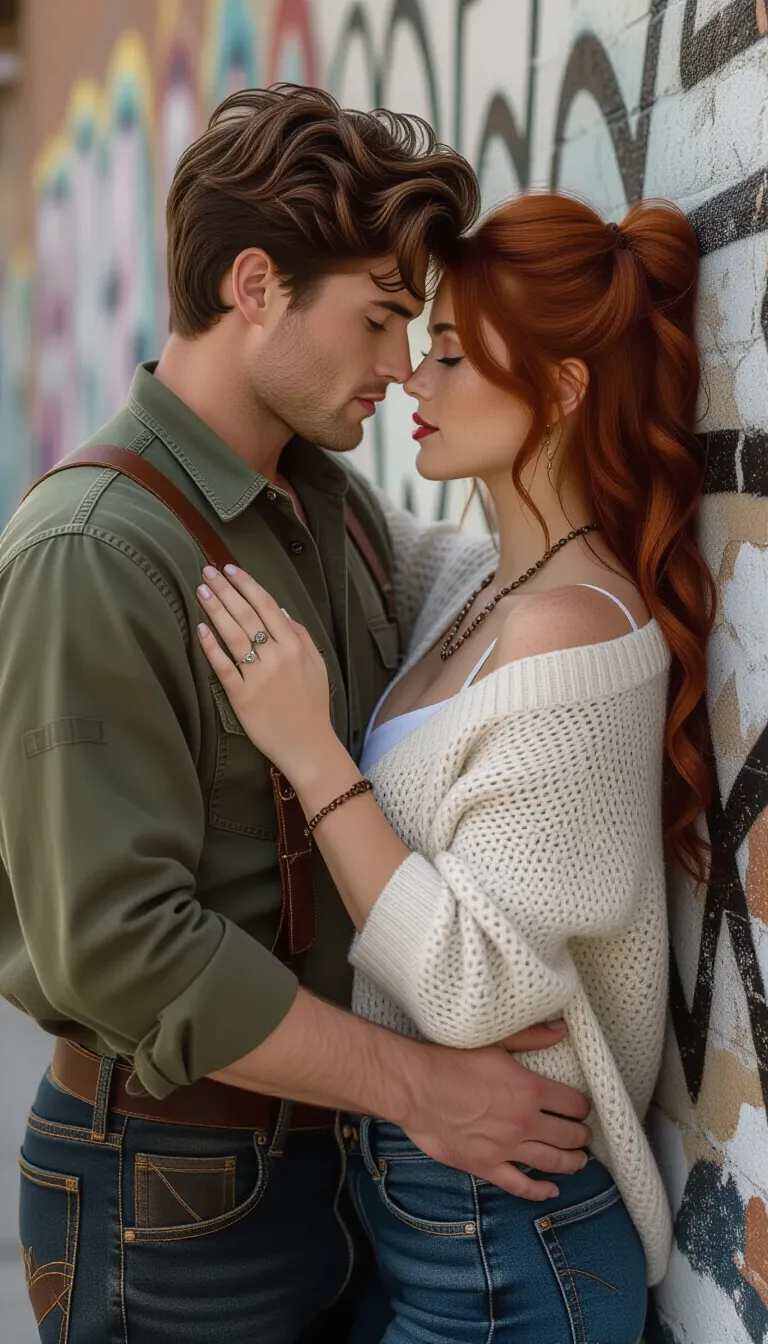
She felt it before she heard it. The change in him. A tightening in his shoulders, a stillness in his chest where his breath had been slow and even. Now it caught. Held. His hand on her back went still.
"Declan." She lifted her head from his shoulder. His eyes were open, fixed on the lamp flame, the light pooling in his irises like water over stone. "What is it?"
He didn't answer. His jaw worked, a muscle jumping beneath the stubble, and she watched him swallow—once, twice—like he was forcing something down that wanted to break free.
She touched his face. Her palm against his cheek, the rasp of his skin, the heat of him. "Stay with me," she said. "Wherever you are, come back."
His hand found her wrist. Not holding her there, just touching. Like he needed to know she was real.
"I never told anyone," he said. His voice was different. Not the flat practicality he used for plans, not the raw edge of grief she'd heard at the Coastguard station. This was something beneath both. A voice he'd buried so deep she almost didn't recognize it as his.
"You don't have to tell me."
"I know." He turned his head, pressing his lips to her palm. "That's why I'm going to."
The fire settled in the stove, a soft collapse of ember and ash. Rain tapped against the window, the only sound in the house. She shifted in his lap, settling her weight against him, her knees on either side of his thighs, her hands finding his shoulders.
He looked at the table. At his father's photograph, propped against the salt cellar. At the empty tin of beans, the two spoons, the smudged rim of her teacup.
"I was eight," he said. "It was November. Dark by four o'clock. My mother had made stew—I remember because it was the last thing she cooked before she stopped cooking for a while. She told me to go to bed, that Da would be home soon, that he'd come kiss me goodnight."
His voice was level. Too level. A man reading a report about someone else's life.
"I stayed awake. I don't know how long. I had this—this practice. Every night I'd count to a hundred, and by the time I reached it, I'd hear his key in the lock. That was the game. One hundred seconds, and he'd be home."
She ran her thumb along his jaw, a slow stroke. He leaned into it.
"I counted to a thousand that night. Two thousand. I don't know. I fell asleep somewhere around five hundred, I think. Woke up to my mother screaming."
His breath hitched. Just once. His hands came up to her hips, gripping her cardigan like he needed something solid.
"There were men at the door. Two of them. I didn't see their faces—I watched from the top of the stairs, through the banister. They told her there'd been an accident. That Da had been caught in crossfire. That they were sorry for her loss."
He laughed. A horrible sound, dry and broken. "Sorry for her loss. Like he'd misplaced his wallet."
She pressed her forehead to his. "Declan."
"I didn't cry. Not then. I stood at the top of the stairs and watched my mother fall—she just folded, right there in the doorway, and those men just stood there, holding their caps, waiting for her to get up so they could leave. And I didn't cry. I went back to my room and lay down and counted to a hundred again. Like if I got the number right, he'd still come home."
The fire popped. The rain kept falling.
"After that, I stopped expecting things to last." His voice cracked on the last word, the careful structure of his telling breaking open. "Love was something that happened to other people. People who didn't know—who hadn't learned—that it could be taken. That it would be taken. That the only way to keep anything was to not want it in the first place."
She felt his throat work against her palm. He was crying. Silent, his face still, but tears tracking down his cheeks, catching the lamplight.
"And then you." His voice was barely a whisper. "You came into that butcher's back room, and you looked at me like I was worth something. Like I was a man, not a ghost. And I didn't know what to do with that. I still don't."
She kissed his cheek. The salt of him, the heat of his skin. "You don't have to know."
"I'm afraid." The words came out raw, scraped from somewhere deep. "Every day. Every hour. I'm afraid I'll wake up and you'll be gone. That this—us—that it's just borrowed time. That love is something you lose, not something you hold."
She kissed his other cheek. The tears were falling faster now, and he wasn't hiding them, wasn't turning away. He was letting her see.
"I don't know how to do this," he said. "I don't know how to believe it won't end."
She pulled back, just enough to look at him. His gray eyes were wet, the lashes clumped, the lines of his face softened by something she'd never seen there before. Surrender. Not to despair—to her.
"Then don't believe," she said. "Just stay. One hour at a time. One breath. That's all I'm asking."
"And if I can't?"
"You already are." She traced the line of his cheekbone, following the track of a tear. "You're here. You're telling me. That's more than you've ever done. That's everything."
He kissed her. Not the desperate kiss from the cottage wall, not the slow hello of the morning. This was different—tentative, almost questioning, like he was asking permission to be held. She answered with her mouth, soft and open, her hands cradling his face.
When they broke apart, his forehead rested against hers. His breath shook.
"I love you," he said. Not like the first time, which had been a discovery. This was a confession. A laying down of arms. "I love you, and I'm terrified of what that means."
"I know," she said. "I love you too. And I'm terrified too."
She kissed his eyelids, each one, tasting salt. Kissed the bridge of his nose, the corner of his mouth, his jaw. Small, deliberate kisses, mapping the geography of his face like she was learning a country she'd spend the rest of her life in.
He let her. That was the thing. He let her.
His hands moved from her hips to her back, pulling her closer, pressing her against his chest. She could feel his heart, fast and hard, and beneath it, something loosening. A knot she hadn't known he carried, easing one strand at a time.
"I used to dream about him," Declan said into her hair. "Not often. But sometimes. He'd be standing at the end of my bed, and I'd try to speak, but no words would come. And he'd just look at me, disappointed. Like I'd failed him by growing up."
"You didn't fail him."
"I became my brother. For a while. I was that close—" he held up his thumb and finger, a hair's breadth apart "—to being exactly what he didn't want me to be."
"But you're not." She took his hand, pressed it flat against her chest, over her heart. "You're here. You're choosing something different. Every day, you choose it."
He looked at where their hands met. At her fingers interlaced with his, her rosary beads pressed between them.
"Your father," she said softly, "would be proud of you."
His breath broke. A sound that was almost a sob, caught in his throat and released. She pulled him against her, his face in her neck, his shoulders shaking, and she held him. The fire crackled. The rain fell. The lamplight held steady, a small sun in the dark kitchen.
She didn't speak. There was nothing to say that her hands weren't already saying. The slow stroke of his back. The press of her lips to his temple. The way she stayed, solid and warm, as the last of his walls came down.
When his breathing steadied, when the shaking stopped, he lifted his head. His eyes were red, his face wet, but there was something new in him. A quietness. A stillness that wasn't hollow.
"I'm still here," he said. Like it surprised him.
"You are."
"I've never said any of that. Not to anyone."
"I know."
"Why you?" His voice was wondering, not accusatory. "Why can I say it to you?"
She thought about it. The fire shifted, a log settling, sending a plume of sparks up the chimney.
"Because you trust me," she said. "And because I'll still be here tomorrow."
He kissed her again, slower this time. His hands found the hem of her cardigan, sliding beneath it, his palms warm against her back. She opened under his mouth, her fingers threading through his hair, pulling him closer.
The kiss deepened. His hands moved up her spine, counting each vertebra like he was memorizing her. She arched into him, a soft sound escaping her throat.
He broke the kiss, breathing hard. "Siobhan."
"Yes."
"I don't want to run from this. From us. Not anymore."
"Then don't."
She shifted, resettling in his lap, and felt him harden beneath her. His breath caught again, but this was different—sharp, electric. She pressed against him, a slow roll of her hips, and his hands tightened on her waist.
"Siobhan." Her name again, rougher this time.
"I'm right here." She kissed his jaw, his neck, the hollow of his throat. "I'm not going anywhere."
He stood, lifting her with him, her legs wrapping around his waist. She laughed—a soft, surprised sound—and he kissed her through it, walking them toward the narrow stairs.
The bedroom was dark, lit only by the spill from the kitchen. He laid her down on the mattress, the springs creaking beneath them, and hovered above her, his hands on either side of her head.
The lamplight caught his face. The tear tracks still visible. The openness in his eyes.
"You're beautiful," she said.
He shook his head, denying it, but she pulled him down, kissing him until he stopped.
"You are," she said against his mouth. "Not your face. Your heart. The one you think you buried."
He kissed her like she'd wounded him. Grateful and desperate, his mouth claiming hers, his hands finding the buttons of her cardigan and working them open with trembling fingers.
She let him. She helped him. And when the lamplight found her skin, her freckles, the curve of her breast, he stopped. Just looked at her.
"What?" she whispered.
"I want to remember this," he said. "Forever. This moment. You, in this light. The way you're looking at me."
She reached up, touched his face. "I'm not going anywhere."
"I know." He kissed her palm. "I think I finally believe it."
Outside, the rain kept falling. Somewhere in the city, men were hunting them. Tomorrow, they would hunt back. But tonight, in the lamplight, in the quiet of a safehouse that had held his father's secrets, Declan Morrow let himself be held.
And for the first time in twenty years, he didn't count the seconds until it ended.
The engine growled outside. Low and guttural, tearing through the rain-slick quiet of the street. Declan's hands froze at her waist, and Siobhan felt the shift in him — the way his body went from soft to steel in a single breath.
"Don't move," he whispered. His voice had changed. Flatter. Colder.
She didn't. She stayed still in his lap, her heart hammering now, her ears straining past the drum of rain on the roof. The engine idled for a long moment. Then cut out.
Silence. Just the rain. Just the fire.
Declan eased her off his lap, rising in one fluid motion. He crossed to the window, pressing himself flat against the wall beside it, and moved the curtain a fraction of an inch with two fingers.
"What do you see?" she whispered.
He didn't answer for a long time. Long enough that the fire shifted, sending shadows crawling across the ceiling. When he spoke, his voice was rough but steady. "Nothing. Dark car. No plates I can see. Engine's still warm."
"Is it—"
"Could be nothing." He let the curtain fall. "Could be Tommy's men. Could be Gorman. Could be someone lost."
"Do you believe that?"
He turned. In the lamplight, his face was hard and young and old all at once, and she saw the boy who'd counted to a hundred. "No."
Siobhan stood. Her legs felt unsteady, but she crossed to him anyway, stopping close enough to feel the heat coming off his body. "What do we do?"
"We wait."
"Wait for what?"
"To see if they knock." He looked down at her. "Or if they drive away."
The minutes stretched. Siobhan found herself counting — the way she counted breaths during Mass, the way she'd counted the seconds between lightning and thunder as a child. One. Two. Three. The fire popped. Four. Five. The rain kept falling. Six. Seven. The quiet stretched so thin she could hear her own pulse, the sound of blood moving through her, the whisper of Declan's breathing above her.
At nine minutes and forty-two seconds — she knew because she'd been counting, couldn't stop counting — the engine turned over. The growl faded, pulling away down the street, and the rain swallowed it completely.
Declan exhaled. His head dropped forward, his forehead touching hers. "Okay," he said. Just that. Okay.
"Okay," she echoed.
He didn't move. His forehead stayed pressed against hers, his breath warm on her lips, and she felt the tension bleeding out of him in slow waves. She lifted her hands, resting them on his chest, feeling his heart pound beneath her palms.
"I thought it was them," he said. His voice was small. "I thought—"
"I know."
"I can't lose you, Siobhan. Not now. Not—" His voice cracked. He pulled back, looking at her, his gray eyes bright and wet. "Not when I just found you."
"You won't." She said it like a prayer. "You won't lose me."
"You don't know that."
"I don't need to know it. I just need to believe it." She touched his face. "And I do."
He kissed her. Hard. Desperate and grateful, his hands finding her waist, pulling her against him like he was trying to press her through his skin and into his bones. She let him. She kissed him back with everything she had, her fingers threading through his damp hair, holding him close.
The kiss softened. Slowed. Became something tender and searching, his mouth moving over hers like he was learning her all over again. She felt his hands trembling at her waist, and she knew — this wasn't fear. This was the weight of everything he'd never said and everything he'd just told her, pressing against the inside of his ribs, desperate to be freed.
She broke the kiss, just barely. "Show me," she whispered.
"What?"
"Show me how you love me." She looked up at him, her green eyes holding his gray ones. "Not with words. With your hands. With your body. Show me that I'm real."
He made a sound. Low and broken, like something had come undone in his chest. Then his mouth was on hers again, and his hands were moving — sliding up her back, tangling in her hair, pulling the pins loose one by one until her red hair fell around her shoulders in a cascade of copper and lamplight.
"God," he breathed. "Siobhan."
She smiled against his mouth. "That's the first time you've said my name like that."
"Like what?"
"Like it means something you're afraid to lose."
He kissed her again, and this time there was no hesitation, no careful holding back. His hands found the hem of her cardigan and pushed it up, over her shoulders, down her arms. It fell to the floor. Her blouse followed, buttons scattering on the wooden floorboards, and she didn't care. She didn't care about anything except the way his hands felt on her skin, the way his mouth traced down her throat, the way he whispered her name like a confession.
"Bedroom," she managed. "Now."
He lifted her. She wrapped her legs around his waist, and he carried her up the narrow stairs, his boots heavy on the creaking wood. The bedroom was dark, lit only by the spill of lamplight from below, but he found the mattress, laid her down, hovered over her.
She reached up, touched his face. The tear tracks were still there, drying on his skin. She wiped them away with her thumb, and he turned his head, kissed her palm.
"I love you," he said. Not like a discovery. Not like a confession. Like a truth he'd carried so long it had worn grooves in his bones.
"I love you too."
He undressed her slowly. Not impatiently — deliberately, like every button and strap and hem was a thing worth savoring. She lay back, letting him look, letting him touch, letting him take his time. When she was bare beneath him, he sat back on his heels and just looked at her. The lamplight from below painted her in gold and shadow, her freckles dark against her skin, her hair spread across the thin pillow.
"I want to remember this," he said. His voice was hoarse. "Forever. This exact moment. You, in this light. The way you're looking at me."
She reached up, touched his face. "I'm not going anywhere."
"I know." He kissed her palm again. "I believe you."
He undressed himself, his movements slower now, less frantic. She watched him — the broad shoulders, the line of his spine, the scars she was still learning. He came down to her, skin against skin, and she gasped at the warmth of him, the weight of him, the way he fit against her like he'd been made to be there.
They moved together slowly. Not urgent, not desperate — tender and deliberate, his mouth tracing her collarbone, her fingers mapping the muscles of his back. She felt him everywhere: in the pressure of his hips, in the heat of his breath, in the way he whispered her name against her skin.
"Look at me," she said.
He did. His gray eyes found hers, and she saw everything — the grief, the hope, the terror, the love. All of it, open and raw and unguarded.
"I love you," she said again. "I'm not going anywhere. Tomorrow, we find Gorman. Tomorrow, we fight. But tonight—" She pulled him closer, her legs tightening around his waist. "Tonight, I'm yours. And you're mine. And nothing else matters."
He kissed her. Long and deep and slow, and she felt him move inside her, and she closed her eyes and let herself feel it — the fullness, the warmth, the way he held her like she was something precious, something he'd been given and was terrified of losing.
They found their rhythm together. Slow, building, each movement a sentence in a conversation they'd been having their whole lives. She felt the tension coil in her belly, felt it rise and grow, and she let herself go — let herself trust him, let herself fall, let herself shatter against the shore of his body.
He followed her. She felt it — the way his breath caught, the way his hands tightened on her hips, the way he said her name like a prayer and a surrender all at once.
After, they lay tangled together, the rain filling the silence. He traced patterns on her skin, his fingers moving in lazy circles, and she rested her head on his chest, listening to his heartbeat slow.
"Tomorrow," he said, "we find Gorman."
"Tomorrow."
"And then—" He stopped. She felt his throat work beneath her cheek. "And then we find out if I can be the man your father's letter said I could be."
She lifted her head, looked at him. "You already are."
He shook his head. "I don't know that."
"I do." She touched his face. "I've seen it. The way you held your father's photograph. The way you let yourself cry. The way you said 'I love you' and meant it." She kissed him softly. "That's the man. Not the one who pulls a trigger. The one who chooses not to."
He was quiet for a long moment. Then he pulled her closer, wrapping his arms around her, burying his face in her hair.
"Stay," he whispered. "Just stay."
"Always."
The fire settled downstairs, a log collapsing into ash. Outside, the rain kept falling, washing the streets clean, wiping away the night. Tomorrow, the city would wake with its scars still showing — the graffiti on the peace walls, the soldiers on the corners, the bullet holes in the doors. But here, in this dark room, in this borrowed house, Declan Morrow held Siobhan Connolly like she was the only solid thing in a world that kept trying to break apart.
And for a few hours, it was enough.
He didn't sleep. Not really. He lay there with her weight against his chest, her hair spread across his shoulder, her breathing slow and even, and he watched the ceiling splinter in the dark. The rain had softened to a whisper against the glass, and somewhere in the house a pipe ticked as it cooled.
She stirred once, murmured something he couldn't catch, and settled deeper against him. Her hand found his chest, palm flat over his heart, and he wondered if she could feel it racing through his ribs.
He kissed the top of her head. She didn't wake.
The fear was a living thing in his chest. Not the fear of Gorman, or of the men who wanted him dead, or of the cell waiting for him if he failed. Something older. Something he'd buried so deep he'd almost convinced himself it wasn't there.
He'd told her about his father. About the knock on the door, the way his mother collapsed, the years of silence that taught him love was something you lost. But he hadn't told her the rest. The part he'd never spoken to anyone.
She shifted, her thigh sliding between his, and he felt the warmth of her through the thin sheet. His arm tightened around her, pulling her closer, and she made a small sound—content, trusting—and he pressed his lips to her forehead and closed his eyes.
He didn't sleep. He lay there and felt the fear grow, and when the first gray light began to seep through the curtains, he was still awake, still holding her, still carrying the thing he'd never said.
She woke slowly. Her hand moved first, fingers tracing his chest, then her eyes opened—green and soft and still heavy with sleep. She looked up at him, and her lips curved into a slow smile.
"You're awake," she said. Her voice was rough, beautiful.
"Couldn't sleep."
Her smile faded. She propped herself up on one elbow, her hair falling across her face, and studied him. The morning light caught the freckles on her shoulders, the curve of her hip beneath the sheet.
"What is it?"
He looked at her. The woman who'd walked into a butcher's shop and changed everything. The woman who'd held him while he cried, who'd kissed his tears away, who'd said his name like it meant something. The woman who'd chosen him, knowing exactly what she was choosing.
"There's something I never told you," he said. His voice came out rough, scraped. "Something I never told anyone."
She didn't look away. Her hand found his face, her thumb tracing the line of his jaw. "Tell me."
The words stuck in his throat. He'd carried them so long they felt like part of him, like a scar he'd stopped noticing. But here, in the gray morning light, with her hand on his face and her green eyes watching him, he felt them breaking loose.
"I was eight when my father died." He swallowed. "I told you that. But I didn't tell you what I did after."
She waited. Her thumb still moved across his jaw, slow and steady, grounding him.
"I stopped talking. For almost a year. I just—" He shook his head. "I didn't see the point. The words couldn't bring him back. Couldn't make my mother stop crying. Couldn't make the men who killed him walk through the door so I could—" He stopped. His breath came shallow. "So I could ask them why."
Her eyes glistened, but she didn't cry. She just kept her hand on his face, steady, present.
She feels him tense beneath her, the way his breath catches and holds. The fire pops in the stove, a log collapsing into ash, and the rain keeps falling against the windows, steady and relentless. She waits. Her hand finds his face, her thumb tracing the line of his jaw, the same steady rhythm that grounded him last night.
"What do you mean?" she asks, her voice soft.
He stares at the wall, at the peeling paint, at the shadows that dance in the lamplight. His hand on her hip tightens, then relaxes. "That night. The night they came for him." He swallows. "I heard the knock. I was eight years old, and I knew—I knew it wasn't right. The way they knocked. Too hard. Too fast."
She doesn't move. Doesn't speak. Just keeps her hand on his face, steady, present.
"I should have stayed in my room. Should have let my mother answer. But I was—" He shakes his head. "I was curious. Stupid. I thought it might be my da, come back early, forgotten his keys." His voice cracks. "I opened the door before she could stop me."
The words hang in the air between them. She feels his throat work beneath her palm.
"Two men. Big men. They looked at me like I was nothing. Like I was a piece of furniture in their way. One of them said, 'Is your mother home, boy?' and I—" He stops. His breath comes shallow. "I called for her. I called her name, and she came, and she saw their faces, and she knew. Before they said a word, she knew."
Siobhan's eyes are wet, but she doesn't cry. She keeps her hand on his face, her thumb moving, slow and steady.
"They told her my father was dead. That he'd been shot. That there would be an investigation, but they wouldn't hold their breath." His voice turns flat, hollow. "She collapsed. Right there in the doorway. I watched her fall, and I couldn't—" He stops. Breathes. "I couldn't move. I stood there, holding the door, and I watched my mother fall, and I thought: this is my fault. If I hadn't opened the door, they would have knocked again. She would have answered. She would have been ready."
She presses her lips to his forehead. He closes his eyes.
"That's why I stopped talking," he says. "Because the last thing I said was her name. And after that, there was nothing worth saying."
She pulls back, looks at him. His gray eyes are wet, his jaw tight. She takes his face in both hands, holds him like he's something precious, something fragile.
"You were eight years old," she says, her voice firm but gentle. "Eight. You didn't know what was on the other side of that door. You were a child who wanted to see who had come to visit."
"I should have—"
"No." She shakes her head. "You don't get to blame yourself for a thing that men with guns did. You didn't pull the trigger. You didn't give the order. You opened a door." She leans closer, her forehead touching his. "That's all. You opened a door."
He looks at her. His breath is uneven, his hands shaking where they rest on her hips.
"I've carried that for twenty years," he says. "I've never told anyone."
"I know." She kisses his cheek, tasting salt. "I know you have."
She kisses the other cheek. Then his forehead. Then the corner of his mouth.
"You don't have to carry it anymore," she says. "Not alone."
He makes a sound—small, broken, not quite a word—and pulls her against him, burying his face in her hair. She holds him, her arms wrapped around his shoulders, her cheek pressed to the side of his head. The fire settles in the stove. The rain keeps falling.
They stay like that for a long time. She doesn't move. Doesn't rush him. Just holds him, her fingers combing through his hair, her breath warm against his neck.
When he finally pulls back, his eyes are red, but there's something different in them. Something lighter. Like a weight he's been carrying has shifted, just a little, just enough to let him breathe.
"Thank you," he says. His voice is rough, raw. "For listening. For not—" He stops. "For not running."
She smiles. It's a small smile, tender, a little sad. "Where would I run to?"
"Anywhere. Everywhere. Away from this." He gestures vaguely at the dark room, the rain, the weight of the city outside. "Away from me."
"I don't want away from you." She takes his hand, presses it to her chest, over her heart. "I want here. I want this. I want you."
He looks at their hands, at her fingers intertwined with his. "Even after everything I just told you?"
"Especially after." She lifts his hand, kisses his knuckles. "You trusted me with something you've never told anyone. That's not weakness, Declan. That's the bravest thing you've done."
He shakes his head, but she sees the corner of his mouth twitch—almost a smile.
"I don't know about brave," he says.
"I do."
She leans in and kisses him. Slow. Soft. Her lips move against his, and she feels the tension in his shoulders ease, feels his hand come up to cup her face, his thumb brushing her cheekbone. The kiss deepens, and she presses closer, her fingers curling into his shirt, the worn cotton warm from his body.
He pulls back, breathless, his forehead resting against hers. "I love you," he says. "I don't say it enough. I don't say it right. But I love you."
"You say it fine." She kisses the tip of his nose. "You say it every time you look at me like that."
He laughs—a short, surprised sound, like he'd forgotten he could. "Like what?"
"Like I'm the only thing in the world worth seeing."
He looks at her. The firelight catches his gray eyes, and she sees the truth of it written there. "That's because you are," he says.
She feels her heart stumble in her chest. She doesn't look away.
The fire pops again. The rain slows to a drizzle, then stops. The house settles around them, creaking and sighing like an old man finding his chair. She shifts in his lap, her thigh brushing against his, and she feels the heat of him through the thin fabric of his trousers. His hands find her waist, steadying her.
"We should sleep," he says, but his voice is low, rough, and his hands don't move.
"We should," she agrees, but she doesn't move either.
She looks at him. The shadows carve his face into something older, something harder, but his eyes are soft, watching her like she's the answer to a question he's been asking his whole life.
She kisses him again. Slower this time. Her lips part against his, and she feels his breath catch, feels his hands tighten on her waist. She shifts closer, her knees pressing into the chair on either side of his thighs, her body settling against his. He makes a sound—low, hungry—and his hand slides up her back, fingers tangling in her hair, pulling her closer.
The kiss breaks, and they're both breathing hard. She looks at him, her green eyes dark in the lamplight.
"Stay," she says. It's not a question.
"Always."
She feels his heartbeat under her palm, steady now, slower than it was. The fire pops and settles. The rain has stopped, and through the curtain she can see the first pale crack of moonlight breaking through the clouds.
"Finish it," she says. Her voice is soft, but it's not a request. "The story. Tell me the rest."
He looks at her, and she sees the flicker of resistance in his gray eyes. The instinct to close himself off again. But she holds his gaze, her hand still over his heart, and after a long moment, he nods.
"There's not much to tell," he says. "After that night, I stopped talking. For almost a year, I didn't say a single word."
He stares into the fire, and she sees his throat move as he swallows.
"My mother took me to doctors. Priests. They said it was shock. Trauma. That I'd talk when I was ready." He shakes his head. "But I wasn't ready. I didn't want to talk. What was there to say?"
She doesn't interrupt. Doesn't fill the silence. Just waits.
"It was Patrick who brought me out of it." His voice catches on the name. "My brother. Before he turned into who he is now. He sat with me every night in my room, reading from my father's Yeats book. The same poems my father used to read to us. He'd read them aloud, even though I never answered. He'd just sit there, his voice filling the dark."
She feels the weight of that image—a boy reading poetry to a silent brother in a house full of grief.
"And one night, I just… said the line with him. 'The peace of the long day is mine.' He stopped. Looked at me. And then he laughed—this surprised, cracked sound—and hugged me so tight I thought my ribs would break."
His eyes are wet again. He doesn't wipe them.
"That's when I knew love could be something you keep. Not just something you lose."
She lifts her hand from his chest to his face, her thumb tracing the line of his jaw. "Then he changed."
"He changed." Declan's voice is flat. "The Troubles changed him. The fighting. The loyalism. He fell in with men who turned his grief into rage, and he let them. By the time I was twelve, he wasn't the boy who read Yeats to me anymore. He was someone else. Someone I didn't recognize."
She sees the grief move through him—not for his father now, but for the brother he lost twice. "I'm sorry," she says.
"Me too." He takes a breath, lets it out slow. "I tried to reach him. For years. But he didn't want to be reached. He wanted revenge. Wanted blood. Wanted someone to pay for what happened to our da."
"And you wanted different."
"I wanted to live. To build something. To not let my father's death be the only thing that defined me." He looks at her then, and his eyes are clear, raw, open. "And then I met you. And I knew—I knew—that if I let the rage take me, I'd lose you. And I'd rather lose everything else."
Her chest tightens. She leans forward, pressing her forehead to his. "You didn't lose me."
"I know." His voice is barely a whisper. "That's what scares me."
She pulls back, searching his face. "Why does it scare you?"
"Because I've never had anything worth losing before."
The words land like stones in still water. She feels the weight of them, the honesty, the fear underneath.
She takes his hand, laces her fingers through his, and lifts it to her lips. She kisses his knuckles, one by one. Slow. Deliberate.
"Then let me be worth it," she says. "Let me be the thing you keep."
He stares at her, and something in his face shifts. The guardedness cracks. The walls she's been chipping at for weeks fall away entirely.
"You already are," he says. "You already are."
She kisses him. Not soft this time. Deep and hungry, her hand sliding into his hair, pulling him closer. He makes a sound against her mouth—surprise, want, relief—and his arms wrap around her, hauling her against him until there's no space left between them.
The chair creaks. She gasps, and he stands, lifting her with him, her legs wrapping around his waist. She clings to him, her mouth still on his, and he carries her across the kitchen without breaking the kiss.
The house is dark. The fire is dying. But she doesn't need light. She has his hands, his mouth, the sound of his breathing ragged against her ear.
He lays her down on the floor. Not the bed—the floor, in front of the stove, where the last of the fire casts a warm glow across the scarred boards. She looks up at him, her hair spread around her, her green eyes dark in the low light.
He kneels above her, his hands on either side of her head, his chest rising and falling fast.
"I don't know how to do this," he says. "I don't know how to be good at this."
"You are good at this." She reaches up, touches his face. "You're good at us."
He shakes his head, but he's smiling—a small, fragile thing. "I don't know what I'm doing."
"Neither do I." She pulls him down, kisses him again. "Let's figure it out together."
He settles over her, his weight a warm pressure against her body, and she feels the night open around them. The cottage settles. The moon breaks through the clouds, casting a sliver of silver light across the floor.
She feels his hand find the hem of her shirt. Feels his fingers brush her skin, tentative, questioning. She answers by arching into him, pressing closer, her hand covering his and guiding it higher.
He breathes her name against her neck, and she feels it everywhere.
This is not the desperate urgency of before. This is something slower. A rediscovery. His hands trace her like he's memorizing, his lips following the path of his fingers. She lets him. She watches him. She catalogues every breath, every shiver, every small sound he makes against her skin.
When he finally lifts his head and looks at her, his gray eyes are full of something she can't name. Wonder, maybe. Awe. As if he still can't believe she's real.
"What?" she asks.
"Nothing." He shakes his head. "Just—you're beautiful. That's all."
She feels herself flush. "You've seen me before."
"Yes." He traces her collarbone with his thumb. "But I keep thinking I'll wake up. That this is a dream I had in prison, and I'll open my eyes and be back in that cell."
The words hit her like cold water. She reaches up, her hand steady on his face, and holds his gaze. "You're not dreaming. I'm here. I'm not going anywhere."
He closes his eyes, and she sees the tension drain from his shoulders.
"I know," he says. "I know."
He kisses her again, and it feels like surrender. Like coming home. She wraps her arms around him and lets the moment swallow them both.
Outside, the city sleeps. The hunt waits for morning. But here, on the floor of a borrowed cottage, with the fire fading and the moonlight creeping across the boards, there is only this: his weight against her, her fingers in his hair, and the quiet rhythm of two hearts learning to beat together.
She holds him until he falls asleep, his head on her chest, his breath slow and even. She doesn't sleep. She watches the moon cross the window, tracks the shadows shift, listens for the sound of an engine that doesn't come.
When the first gray light of dawn touches the glass, she presses a kiss to his hair and lets herself believe, for just a moment, that they might make it out of this alive.
She feels him stir before she sees it—the subtle shift of muscle, the way his breath changes from slow sleep to something lighter, waking. The first pale light of morning bleeds through the curtainless window, washing the kitchen in gray and gold.
His hand finds her waist, a reflex, before his eyes open. He presses closer, his face still buried against her neck, and she feels the small sound he makes—half protest, half recognition.
"Morning," she says, her voice rough from the night.
He doesn't answer. His arm tightens around her, pulling her into the curve of his body, and she feels his lips brush her shoulder. A kiss, half-asleep, unconscious.
She strokes his hair, lets him have this moment. The quiet before the world finds them.
Outside, a bird calls. Distant traffic. The city waking up around them, carrying its secret weight of guns and grudges and men who will kill for a name spoken too loud in the wrong pub.
His eyes open. Gray and clear, meeting hers. There's a second when he's somewhere else—disoriented, readjusting—and then he remembers. She sees it cross his face. The cottage. The confession. The night on the floor. Her.
"You stayed," he says.
"I told you I would."
He shifts, propping himself on one elbow, looking down at her. His hair is a mess, dark auburn tangled from sleep, and there's a crease on his cheek from where it pressed against her cardigan. He looks younger like this. Softer.
"How long have you been awake?" he asks.
"A while."
"You should have woken me."
"You needed to sleep."
He holds her gaze, and she watches something settle in him. Acceptance, maybe. Or just the quiet acknowledgment that she's not going anywhere, that she'll keep choosing him even when he's asleep and useless to her.
"We should move," he says, but he doesn't move. His hand stays on her waist, his body warm against hers. "Before someone finds us."
"I know."
Neither of them gets up.
The fire is dead ash in the stove. The kettle is cold. The cottage holds its breath around them, and for a long moment, she lets herself pretend this is their life. Waking slow in a house that's theirs, morning light on a scarred table, nothing more urgent than breakfast and the shape of the day ahead.
But the hunt waits.
He sits up first. She feels the absence of his weight like a small grief, cold air rushing in where his body was. He reaches for his shirt, pulls it on, and the movement is mechanical—the same way he checked his revolver, the same way he scanned a room for exits.
"Gorman," she says. It's not a question.
He nods, buttoning his shirt. "He won't be hard to find. He's not the type to hide."
"What if O'Connell warned him?"
"Then we'll find him anyway." He stands, runs a hand through his hair, and she sees the shift happen—the softness of morning hardening into purpose. "He wants me to come. That's what this is. The frame, the setup—he wants me to find him."
She stands too, straightening her blouse, finding her cardigan on the floor by the stove. The fabric is cold, but she pulls it on anyway.
"Then we walk in knowing that," she says. "We don't play his game."
"What game do we play?"
"Ours."
He stops, looks at her. She sees the shift again—not from soft to hard, but from alone to not-alone. His shoulders drop a fraction, the tension releasing just enough for him to breathe.
"What did I do before you?" he asks.
"Lived alone. Liked it." She smiles, small and crooked. "Or so you told me."
"I lied." He crosses to her, takes her face in his hands. His thumbs trace her cheekbones, gentle, reverent. "I didn't know what alone meant until I had something to lose."
She kisses him. Quick. A promise before the day takes them.
He holds her for a breath longer, then lets go.
"Let's find him," he says.
She nods, and they turn toward the door.
The morning is cold and gray, the streets of East Belfast stirring to life. They step out together, and she feels the weight of the day settle on her shoulders. The hunt. The truth. The chance that they'll walk into a room and not walk out.
But his hand finds hers, and she holds on.
The hunt starts now.
His hand is on the latch. The metal is cold, worn smooth by years of use. He feels her beside him, the warmth of her shoulder brushing his arm, and the morning waits beyond the wood—gray light, damp air, the sound of a distant lorry grinding through gears.
He doesn't push the latch down.
His hand stays there, frozen, and he feels the weight of the day pressing against his chest. The hunt. The danger. The chance that this is the last time he'll stand in a doorway with her, the last time he'll feel her breath on his skin, the last time he'll have something to lose.
"Declan." Her voice is soft, questioning.
He turns. She's watching him, green eyes catching the dim light from the kitchen behind them, her hair pinned up but a few strands loose against her temple. She looks like she belongs here, in this rundown cottage, in his world. She looks like she's always been here.
He steps toward her. His hand leaves the latch and finds her waist, pulling her into the frame of the door—the narrow space between the table and the jamb, where the light is thin and the shadows hold them close. She comes without resistance, her hands rising to his chest, her brow lifting in question.
He doesn't answer with words.
He kisses her. Hard and sudden, his mouth claiming hers with a hunger that surprises them both. She makes a small sound against his lips, her fingers curling into his shirt, and he feels her yield into him, her body softening as she kisses him back.
It's not a goodbye. It's a promise. A reminder of what he's fighting for.
He breaks the kiss, rests his forehead against hers, his breath coming fast and uneven. Her lips are wet, her pulse fluttering under his thumb where it rests at her jaw.
"One more," he says, barely a whisper. "Before we go."
She doesn't ask what he means. She just nods, her eyes dark with understanding.
He kisses her again, slower this time, his hand sliding into her hair, the pins loosening, the red strands falling free around her shoulders. She tastes of tea and sleep and something that is only her, and he wants to memorize it, imprint it on his skin so he carries it into whatever comes.
Her hand finds his cheek, her thumb tracing the line of his jaw. She pulls back just enough to look at him, and he sees the same fear in her eyes that he feels in his chest. But there's something else too. Trust. Belief. The certainty that she chose this, chose him, and she'll keep choosing him.
"I love you," she says. Not a whisper. A statement. A fact.
He feels the words settle into him, warm and heavy, anchoring him to this moment, this doorway, this woman who smells of chalk dust and lavender and the rain that's starting to fall on the roof above them.
"I love you too." His voice cracks, but he doesn't care. "More than I know how to say."
She smiles, small and crooked, the same smile that undid him the first time she gave it.
"Then show me," she says. "After. When this is over."
He kisses her forehead, her temple, the corner of her mouth. "I will."
The rain picks up, tapping against the windows, filling the silence with a steady rhythm. The cottage creaks around them, old and tired, and for a long moment they stay there, wrapped in each other, the world held at bay by a thin door and their own stubborn refusal to let go.
But the hunt waits.
He feels it in his bones, the pull of the day ahead, the weight of the truth he still needs to uncover. Gorman is out there. The frame, the setup, the lies—they all point to him. And somewhere in the gray streets of East Belfast, a man is waiting for Declan to come looking.
He pulls back, his hands sliding down her arms until he holds her hands. Her fingers are warm between his, the rosary beads at her wrist pressing into his palm.
"Ready?" he asks.
She squeezes his hands. "Ready."
He turns back to the door, pushes the latch down, and pulls it open.
The air hits them, cold and wet, carrying the smell of wet concrete and exhaust. The street outside is empty, the houses across the way still dark, their curtains drawn. A cat slips into an alley. A newspaper lies sodden on the pavement.
He steps out first, scanning the street, his hand finding the familiar weight of the revolver in his waistband. She follows, pulling her cardigan tighter, her eyes sharp and watchful.
He takes her hand. She holds on.
The door clicks shut behind them, and they walk into the rain, into the morning, into the hunt—together.
The rain comes harder as they walk, slanting against the rooftops, pooling in the cracks of the pavement. Siobhan's cardigan darkens at the shoulders, the wool drinking the wet until it clings to her arms. She doesn't seem to notice. Her eyes are on the street ahead, scanning the windows, the doorways, the narrow gaps between houses where a man might wait.
Declan's hand is warm in hers despite the cold. She feels the calluses, the strength in his fingers, the way he holds her like she's the only solid thing in a world that keeps shifting under his feet.
They pass a boarded-up shop, its windows painted over, the brickwork scarred with graffiti. A black taxi rattles past, its tires hissing on the wet tarmac, and Siobhan watches it until it turns a corner and disappears.
The alley appears on their left—a narrow slit between two terraced houses, barely wide enough for a man to pass. The walls are damp, streaked with moss, and a rusted drainpipe runs down one side, dripping into a puddle that reflects the gray sky.
She stops.
Declan turns, his brow lifting in question, and she sees the concern flicker behind his gray eyes. He thinks she's spotted something. He thinks they're in danger.
She pulls him into the alley.
He stumbles after her, his boots splashing through the puddle, and before he can speak she has him pressed against the damp brick wall, her hands fisted in his shirt, her mouth finding his.
It's not soft. It's not careful. It's a claiming, a branding, a promise seared into his lips so he carries it into whatever comes. She kisses him like she's memorizing the shape of his mouth, the taste of him, the way his breath catches and his hands rise to her waist and pull her into him.
He makes a sound against her lips—half surprise, half surrender—and his fingers dig into her hips, grounding himself in the wet wool of her cardigan, the heat of her body beneath it.
She breaks the kiss just long enough to breathe, her forehead pressed to his, her eyes closed. The rain runs down her face, cold on her skin, but she doesn't feel it. All she feels is him—his warmth, his pulse hammering under her palm where it rests at his jaw.
"I need you to remember this," she says, her voice rough. "When we find him. When it gets hard. I need you to remember that I'm here. That I chose this. That I keep choosing you."
His throat works. His eyes are pale and bright in the dim light of the alley, and she sees the crack in his armor, the fear he carries like a second skin.
"Siobhan—"
"No." She shakes her head, her fingers tightening in his shirt. "Don't. Don't tell me it's dangerous. Don't tell me I should stay behind. I know what this is. I know what we're walking into. But I'm not letting you face it alone."
He stares at her. The rain drips from his hair, tracing a line down his temple, and she watches his jaw clench and release.
"I don't deserve—" he starts.
"Stop." Her voice cracks, and she presses her palm to his chest, over his heart. "Don't you dare. Don't you dare say you don't deserve this. You deserve everything, Declan Morrow. Everything. And I'm going to spend the rest of my life proving it to you."
His breath shudders out of him. His hands slide up her arms, her shoulders, until they cup her face, his thumbs tracing the rain from her cheeks. He looks at her like she's the only light in a world gone dark.
"I love you," he says, and the words are raw, scraped from somewhere deep. "I love you so much it terrifies me."
She smiles, small and trembling. "Good. Then you understand."
She kisses him again, softer this time, a slow exploration that tastes of rain and salt and the future they're fighting for. His hands thread into her wet hair, cradling her head, and she feels the tension in his shoulders begin to ease, just a little, just enough.
The alley is cold. The rain is cold. But his mouth is warm, and his chest is warm, and when she presses herself against him she can feel the steady beat of his heart, strong and sure, telling her that he's still here, still alive, still hers.
She pulls back, her hands sliding down to cradle his face, cupping his jaw in her palms. His eyes are closed, his lashes dark against his cheeks, and she watches him breathe, watches the way his lips part, the way his hands find her waist and hold on.
"Declan."
He opens his eyes.
"I'm not afraid," she says. It's not quite true, but she says it anyway, because she needs him to believe it. "Not with you."
He looks at her for a long moment. Then he reaches up, covers one of her hands with his, and turns his head to press a kiss to her palm.
"You make me braver than I am," he says quietly. "Every time I look at you, I think—maybe we can make it. Maybe there's a way through."
"There is," she says. "We find it together."
He nods. His smile is faint, but it's there, a crack of light in the gray morning.
She lets her hands fall, sliding down his chest, his arms, until she finds his hands. She laces their fingers together, the rosary beads at her wrist pressing into his palm, and she feels the familiar weight of them, the comfort of the ritual, the prayer she carries with her always.
"Ready?" she asks.
He squeezes her hands. "Ready."
She leads him out of the alley, back into the rain, back into the street where the hunt waits. The houses watch them with dark windows. The cars hiss past. The city breathes around them, indifferent and alive.
But she doesn't feel alone.
His hand is in hers. His step matches hers. And somewhere ahead, in the gray maze of Belfast, the truth is waiting to be found.
They walk together, the rain washing the alley from their skin, the taste of each other still on their lips, the promise of the morning sealed between them.
And for the first time in a long time, Siobhan believes they might actually make it through.
The black taxi slows beside them, its tires hissing through the wet street. Declan's hand tightens around hers, pulling her half a step behind him without thinking, his shoulders squaring as he turns to face the vehicle.
The window rolls down with a grinding whine. Inside, the driver is old, maybe seventy, with a face like crumpled parchment and eyes the pale blue of winter ice. He looks at them for a long moment, then jerks his head toward the back door.
"Get in." His voice is gravel and smoke. "Before someone sees you."
Declan doesn't move. His hand finds the small of her back, pressing her closer, and she feels the tension in his fingers—ready to push her away, to run, to fight. She watches his jaw work as he studies the old man's face.
"Who are you?" Declan's voice is flat, careful.
"Someone who knew your father." The driver glances in the rearview mirror, then back at them. "And someone who knows you're being hunted by men who'd sooner shoot you than ask questions. Now get in, before I change my mind."
The rain runs down Declan's face, collecting in the hollow of his throat. Siobhan watches him hesitate, watches the war play out across his features—the instinct to trust no one, the desperate need for answers, the fear of leading her into another trap.
She squeezes his hand. "Declan."
He looks at her. His eyes are pale and bright, searching hers for something—permission, maybe, or warning. She gives him neither. She just holds his gaze and waits, letting him decide.
He turns back to the taxi. "Where are you taking us?"
"Somewhere we can talk." The driver coughs, a wet, rattling sound. "I've got information about Gorman. About who's really pulling the strings."
Declan's breath catches. She feels it, the way his ribs lock beneath his coat, the way his hand spasms against her back.
"Why should I trust you?"
"You shouldn't." The old man shrugs. "But you're running out of options, son. And I'm running out of time." He taps his chest—a gesture that could mean heart, could mean lungs, could mean anything. "The cancer doesn't care about loyalties. It just takes."
The rain pounds harder. A car rounds the corner at the far end of the street, headlights cutting through the gray.
Declan opens the back door. "Get in," he says to her, his voice low.
She doesn't hesitate. She slides across the cracked vinyl seat, and he follows, pulling the door shut behind them. The taxi pulls away before the latch catches, throwing her against his side. His arm comes around her automatically, steadying her.
The driver watches them in the mirror. "Belt yourselves. I don't need a traffic stop ruining my morning."
Declan reaches across her, pulls the belt across her lap, clicks it into place. His hand lingers a moment, brushing her hip, before he does his own.
The taxi weaves through the narrow streets of East Belfast, past the terraced houses with their painted doors and net curtains, past the murals and the flags and the graffiti that maps the city's wounds. The driver doesn't speak. The radio is off. The only sound is the wipers scraping across the glass, the hiss of tires on wet tarmac, the labored breathing of the old man up front.
Siobhan watches the streets slide past. She doesn't know where they're going. She doesn't know if this is rescue or capture. But Declan's hand finds hers on the seat between them, and she holds on.
The taxi turns down a narrow lane, past a row of shuttered shops, and pulls to a stop outside a pub called The Anchor. The sign hangs crooked, the paint peeling, the windows dark with grime. It looks closed. It looks abandoned.
"Out," the driver says. "Back door's unlocked. Go through the kitchen and up the stairs. I'll be along."
Declan doesn't move. "How do I know this isn't a trap?"
The old man turns in his seat, fixing them with those pale eyes. "Your father saved my life in seventy-one. Pulled me out of a pub that was about to get bombed. Didn't know me. Didn't ask my name. Just grabbed my collar and dragged me out the back." He coughs again, wipes his mouth with the back of his hand. "I've been waiting twenty-three years to repay that debt. Today's the day."
The rain drums against the roof. The engine ticks as it cools.
Declan looks at her. She nods.
He opens the door.
The rain hits them immediately, cold and relentless, as they jog across the pavement to the pub's back door. It's unlocked, just like he said. Declan pushes it open, steps inside, and she follows, pulling the door shut behind them.
The kitchen is dark and still, smelling of stale beer and bleach. A single bulb burns over the prep table, casting weak light across the stainless steel. Declan moves through the space like he's done this before—checking corners, listening for footsteps—and she stays close, her hand on his back, feeling the tension in his muscles.
They find the stairs at the end of a narrow hallway. They climb. The wood creaks under their weight, and she counts the steps—twelve, thirteen, fourteen—until they reach a landing with a single door.
Declan opens it.
The room is small, cramped, with a sagging couch and a table littered with papers. A lamp burns on the table, casting a circle of yellow light across maps and photographs and handwritten notes. The curtains are drawn. The air is thick with cigarette smoke.
The old man is already there, sitting on the couch, lighting a cigarette with trembling hands. He looks up as they enter, and she sees the hollows in his cheeks, the yellow of his skin, the weariness that sits deeper than bone.
"Sit," he says. "We don't have much time."
Declan doesn't sit. He stands in the center of the room, water dripping from his hair, his coat, his hands. "Tell me about Gorman."
The old man takes a long drag of his cigarette, exhales slowly. "Gorman's a foot soldier. Always has been. He does what he's told, collects his pay, keeps his mouth shut." He taps ash into a saucer. "But the man giving the orders—the one who ordered your father killed, the one who's been running the operation from the start—he's still alive. And he's been watching you."
Declan goes still. "Who?"
The old man looks at him, and there's something in his eyes—pity, maybe, or grief. "Your uncle. Robert Morrow."
The name hangs in the air like smoke. Siobhan feels it land, feels the weight of it settle over Declan like a shroud. His face doesn't change, but his hands do—they curl into fists at his sides, the knuckles white, the tendons standing out like cords.
"That's not possible," he says, his voice flat. "My uncle's a shopkeeper in Bangor. He sells hardware."
"He runs guns," the old man says. "He always has. Your father found out. Tried to stop him. And Robert had him killed to keep him quiet."
Declan shakes his head, a small, jerking motion. "No. You're lying."
"I wish I was." The old man stubs out his cigarette, lights another. "I've got the papers. Bank records, ledgers, names. Everything your father collected before he died. I've been holding them for twenty-three years, waiting for the right moment." He gestures at the table. "They're yours now. Do with them what you will."
Siobhan looks at the papers, at the photographs spread across the table. She sees Robert Morrow's face—round, smiling, ordinary—in a dozen pictures taken at weddings and funerals and christenings. A man who looks like he's never held a gun in his life.
She looks at Declan. He's still standing in the center of the room, still as stone, his face a mask of control that's cracking at the edges.
"Declan." She says his name softly, reaching for his hand.
He doesn't take it. He walks to the table, picks up a photograph of his uncle, stares at it for a long moment. Then he sets it down carefully, precisely, as if the paper might break.
"Why now?" His voice is hoarse. "Why not tell me before?"
The old man coughs, wipes his mouth. "Because I was afraid. Because Robert's got reach. Because I thought if I stayed quiet, I'd die in my bed instead of in a ditch." He takes a drag of his cigarette. "But I'm dying anyway. And I figured I owed your father more than silence."
Declan doesn't respond. He stands there, hands flat on the table, staring at the evidence of his uncle's betrayal. Siobhan moves to stand beside him, close enough to feel the heat of his body, the tremor running through him.
"Declan." She says it again, softer. "Look at me."
He doesn't move.
She reaches up, cups his face in her hands, turns him toward her. His eyes are distant, lost, the gray of a storm at sea. She holds him there, her thumbs tracing the line of his jaw, the curve of his cheek, the rain still cold on his skin.
"I'm here," she says. "Whatever you decide, I'm here."
His breath shudders out of him. His hands come up to cover hers, holding them against his face, and he closes his eyes. For a moment, he's just a man—broken, grieving, trying to find his way through the dark.
Then he opens his eyes, and she sees the fire catch.
"Where is he?" Declan asks, turning to the old man. "Where's Robert?"
The old man stubs out his second cigarette. "He's at his shop in Bangor, same as always. He doesn't know I'm still alive. He doesn't know anyone's coming." He reaches into his coat, pulls out a key. "There's a lockbox in the back of my wardrobe. Everything you need is in it. Bank accounts. Safe houses. Names of every man who took money for your father's murder." He holds out the key. "Take it. End this."
Declan takes the key. It sits in his palm, small and heavy, a weight that could change everything.
"What's your name?" he asks.
The old man smiles, thin and tired. "Does it matter?"
"To me."
The old man looks at him for a long moment. Then he says, "Patrick O'Neill. But your father called me Paddy."
Declan nods. He tucks the key into his pocket, then reaches out and takes the old man's hand. "Thank you," he says. "For keeping the evidence. For telling the truth. For—" He stops, swallows. "For repaying the debt."
The old man—Paddy—holds his hand for a moment, then releases it. "Go," he says. "Before I change my mind. Before this kills me faster than the cancer."
Declan turns. Siobhan follows him down the stairs, through the dark kitchen, out into the rain. The taxi is still there, empty now, the engine cold.
They stand on the pavement, the rain washing over them, the key heavy in Declan's pocket. She watches him process what they've learned—the weight of it, the shape of it, the way it changes everything they thought they knew.
He looks at the key. Then he looks at her.
"It was my uncle," he says, and his voice cracks on the word. "My father's brother."
She takes his hand. "I know."
"I don't know what to do with that."
"You don't have to decide right now." She squeezes his fingers. "But we have the evidence. We have the truth. And we have each other."
He looks at her, and something in his face shifts—the grief settling into something harder, something like resolve. "We need to go to Bangor."
"I know."
"But not tonight." He shakes his head. "Tonight, I need to sit with this. I need to think. I need to—" He stops, his voice rough. "I need to not become him."
She nods. She understands. She's always understood.
She leads him away from the pub, away from the taxi, down the rain-soaked street, back toward the safehouse where they started. His hand is in hers, his step matching hers, and when he stumbles, she's there to catch him.
The rain falls. The city breathes. And somewhere in the dark, the truth waits to be faced.
But not tonight.
Tonight, they hold each other. Tonight, they survive.
Tomorrow, they fight.
She stops him at the threshold of the safehouse, her hand on his chest, the rain still streaming down her face. The key is cold in his pocket, a weight against his thigh that feels like it might pull him through the floorboards if he lets it.
"No," she says. "Not tomorrow."
He looks at her, and there's something in her eyes he hasn't seen before—not fear, not doubt, but a kind of terrible clarity, like she's already made a decision he hasn't caught up to yet.
"We go to Bangor tonight," she says. "Together."
The rain drips from his hair into his eyes. He doesn't wipe it away. "Siobhan—"
"I know what you're going to say." Her voice is steady, but her hand on his chest trembles. "That it's dangerous. That you don't want me there. That you need to do this alone." She shakes her head, and water flies from the ends of her hair. "I don't care. I've been waiting in safehouses and churches and Garda stations while you made choices about our future. Not anymore."
"It's my uncle." His voice cracks on the word. "This is my blood. My fight."
"And I'm your—" She stops. Swallows. Her green eyes hold his, and he watches her throat work as she searches for the word. "I'm yours," she says finally. "And you're mine. That means I don't get to hide while you face the fire. That means we burn together."
He stares at her. The rain falls between them, cold and endless, and he realizes he's never had anyone who refused to step away from the fire. His mother collapsed. His brothers ran. Every ghost in his life had taught him that love was something you lost, not something that held.
But she's still here. Soaking wet, shivering, her hand pressed against his chest like she's trying to memorize the rhythm of his heart.
"Siobhan." He says her name like a prayer, like a confession, like the only thing he's ever been sure of.
She reaches up and cups his face, her palm cold and wet against his jaw. "Take me to Bangor, Declan. Take me to meet your uncle. And when we're done—when we've faced him together—we go find that yellow table."
He laughs, a broken sound that catches in his throat. "You're mad."
"I'm in love," she corrects. "There's a difference."
He pulls her inside, through the door, into the dim kitchen where the fire has burned low and the lamplight pools amber across the scarred table. He doesn't let go of her hand. He doesn't think he can.
The key is in his pocket. His uncle is in Bangor. And she's standing in front of him, rain-soaked and fierce, her red hair plastered to her temples, her teacher's cardigan clinging to her shoulders like a second skin.
"We need to get dry first," he says, his voice rough. "We need to plan."
"Then get dry. Then plan." She doesn't move. "But we go tonight."
He nods. He doesn't know how to argue with her when she's like this—when her voice is steel and her eyes are fire and her hand in his feels like the only anchor he's ever had.
He leads her to the back bedroom, the one where his father's volume of Yeats still sits on the windowsill. He finds a towel in the wardrobe, threadbare but clean, and hands it to her. She takes it but doesn't use it. She just stands there, watching him, her breath shallow, her lips parted.
"What?" he asks.
"I keep thinking—" She stops. Bites her lip. "I keep thinking about what happens after. After we find the truth. After we face your uncle. After this is over."
"We buy the yellow table."
She laughs, but it's fragile, a thing that might shatter if he breathes too hard. "And then what? We live in a whitewashed house by the sea? We grow old? We have children who never know what it means to be afraid of the knock on the door?"
He crosses the room, takes the towel from her hands, and drapes it over her shoulders. He doesn't dry her—he just holds her, his hands on the towel's edges, his forehead resting against hers.
"I don't know what comes after," he says. "I've never let myself imagine it. Every time I tried, I stopped because I thought—" He swallows. "I thought I'd never live long enough to see it."
"But you're alive." Her voice is barely a whisper. "We're both alive."
"I know." He breathes her in—rain and lavender and something warmer underneath. "And I want to stay alive. With you. I want to see what happens when we stop running."
She closes her eyes. Her hands come up to grip his wrists, and he feels the tremble in her fingers, the way she's holding on like he might disappear if she lets go.
"Then let's go to Bangor," she says. "Let's face him. And then let's go home."
He kisses her. It's not the desperate, hungry kiss from the cottage wall, or the slow, tender kiss from the morning after. It's something else—something quieter, deeper, a promise sealed in the space between heartbeats. She opens to him, her lips parting, her breath warm against his, and he tastes rain and salt and the faint sweetness of the tea she drank hours ago.
His hands slide from the towel to her waist, pulling her closer, feeling the chill of her soaked clothes against his own. She shivers, but not from the cold—he knows the sound of her shiver now, knows when it's want and when it's fear.
This is want.
"We should get dry," she murmurs against his mouth.
"We should."
Neither of them moves.
She laughs, soft and breathless, and pulls back just enough to look at him. Her eyes are bright, her cheeks flushed, the rain still clinging to her lashes. She looks like a woman who's already decided, who's already crossed the line and isn't looking back.
"Take off my cardigan," she says.
He does. His fingers find the buttons, cold and stiff, and he works them open one by one, watching her face as he goes. She watches him back, her breath catching each time his knuckles brush her collarbone, her throat, the damp curve of her shoulder.
The cardigan falls to the floor. Her blouse is next, soaked through, translucent, clinging to the shape of her. He can see the outline of her bra beneath it, the dark rose of her nipples through the wet fabric, and his mouth goes dry.
"You're staring," she says.
"I'm memorizing."
She blushes. After everything they've done, after every inch of her he's touched and tasted and held, she still blushes, and it undoes him.
He reaches for the buttons of her blouse, but she catches his hands, pressing them flat against her chest. Her heart beats against his palms, fast and steady, a drum he could follow into any dark.
"Tell me what you're thinking," she says.
He doesn't answer at first. He's thinking about his father. About the knock on the door. About the years of silence that taught him love was something you lost, not something you held. He's thinking about the key in his pocket, and the uncle he hasn't seen in twenty years, and the weight of a truth that could destroy everything he has left.
But she's here. She's warm. And when he looks at her, he doesn't see the ghosts.
"I'm thinking about waking up tomorrow," he says, "and having you still here."
Her eyes soften. She lifts his hands from her chest and presses them to her lips, kissing his knuckles one by one, slow and deliberate, like she's saying a rosary over his bones.
"I'll be here," she says. "Tonight. Tomorrow. Every day after." She lowers his hands, holds them against her heart. "I made you a promise. I meant it."
He pulls her close, wraps his arms around her, buries his face in her wet hair. She holds him back, her arms around his neck, her body pressed against his, and for a long moment they just stand there, breathing together, the rain still dripping from their clothes onto the floorboards.
Then she pulls back, takes his hand, and leads him to the narrow bed.
They undress each other slowly, not for heat but for tenderness—each button undone a small surrender, each layer peeled away a small trust. He unlaces her boots, and she leans on his shoulder, her hand in his hair. She unbuttons his trousers, and he watches her fingers work, delicate and sure.
When they're bare, he pulls back the covers and she slides in first, her skin cold against the sheets. He follows, and she wraps herself around him, her legs tangling with his, her face pressed into the curve of his neck. He holds her there, his arms around her, his lips against her hair.
"Tell me something," she whispers. "Something you've never told anyone."
He's quiet for a long moment. The rain drums against the window, a steady rhythm like a heartbeat, like the world reminding them it's still turning.
"I used to think my father's death was my fault," he says. "I was eight. I'd been sick that week, and he'd stayed home to take care of me. If I hadn't been sick, he wouldn't have been home. He wouldn't have been there when they came."
She goes still against him. Her hand finds his chest, presses flat over his heart.
"I carried that for years," he continues, his voice low, cracked at the edges. "I never told anyone. Not my brothers. Not my mother. I told myself it was logic—if I hadn't been sick, the timing would have been different. But it wasn't logic. It was guilt. I was a child who believed he'd killed his father."
"Declan—"
"I know it's not true. I know that now. But the feeling—" He stops. Swallows. "The feeling never went away. It just buried itself somewhere deep, where I didn't have to look at it." He turns his head, looks at her in the dim light. "Until you. Until you made me feel like I deserved to live."
She presses her lips to his throat, soft and warm. Her hand slides from his chest to his face, cupping his jaw, turning him toward her.
"You do deserve to live," she says. "You deserve a yellow table and a whitewashed house and a life that doesn't hurt." Her thumb traces the line of his cheekbone, catching a wetness he hadn't realized was there. "You deserve to be loved."
He closes his eyes. The tears slide down his temples, into his hair, and she follows them with her lips, kissing them away, tasting the salt and the surrender.
"I love you," she whispers against his skin. "I love you, and I'm not going anywhere. Not to Bangor. Not to the end of the world. Not anywhere."
He pulls her on top of him, his hands finding her hips, her waist, the soft curve of her breasts. She settles over him, her thighs bracketing his, her hair falling around them like a curtain, like a world that contains only them.
"I love you," he says, and the words come easier now, like a muscle he's finally learning to flex. "I love you, and I'm terrified."
"I know." She leans down, kisses him softly. "So am I."
"But we go tonight."
"We go tonight."
She shifts against him, and he feels the heat of her, the wetness that has nothing to do with the rain. His hands tighten on her hips, and she gasps, a small sound that cuts through the dark like a blade of light.
"Siobhan—"
"Shh." She presses a finger to his lips. "I know. We need to go. We need to plan." She smiles, soft and crooked. "But we have an hour. Maybe two. And I want to spend them like this."
He pulls her down, kisses her deeply, and she opens for him like a door swinging inward on a room he's always wanted to enter. Her tongue meets his, slow and deliberate, and he feels the shape of her want in the way she rocks against him, the way her breath catches when his hands find her breasts.
He rolls them, pinning her beneath him, and she wraps her legs around his waist, pulling him closer. He looks down at her—her hair spread across the pillow, her freckles dark in the lamplight, her green eyes luminous and sure—and he knows he'll remember this moment for the rest of his life.
The moment she chose him. The moment he chose her back.
He lowers himself, his lips finding her throat, her collarbone, the soft swell of her breast. She arches beneath him, her fingers in his hair, her breath coming in short, sharp gasps. He takes his time, tracing the landscape of her body like a map he wants to memorize, every curve a country he's willing to fight for.
When he enters her, it's slow, deliberate, a joining that feels like a prayer. Her eyes close, her mouth opens, and she says his name like it's the only word she remembers.
He moves inside her, and she moves with him, a rhythm they've learned together, a language they've built from touch and breath and the space between words. The rain falls. The lamp flickers. And somewhere in the dark, the truth waits—his uncle, the evidence, the reckoning he's been running toward his whole life.
But not yet.
Here, in this narrow bed, in this cramped room, with her wrapped around him like she was made to hold him, he lets himself feel it: the love, the grief, the terror, the hope. All of it, at once, a tide that threatens to pull him under.
And he doesn't fight it. He lets it carry him.
She comes with a cry that she muffles against his shoulder, her body shuddering around him, and he follows a moment later, a release that feels less like an ending and more like a beginning.
Afterward, they lie tangled together, the sheets damp, the rain still falling. Her head rests on his chest, her hand over his heart, and he watches the lamplight cast shadows across the ceiling.
"We should go," she says eventually.
"I know."
Neither of them moves.
She laughs, soft and tired. "We're going to be late for our own reckoning."
"He's been waiting twenty-eight years. He can wait another hour."
She lifts her head, looks at him with those green eyes that see right through him. "An hour?"
"Maybe two."
She kisses him, quick and warm. "I'll hold you to that."
She gets up, finds her clothes, starts dressing. He watches her, the way she moves, the way she shakes out her damp hair, the way she catches his eye and smiles. And he thinks about his father's letter—the one that told him to live, to choose love, to find the yellow table.
He doesn't know what happens in Bangor. He doesn't know if he'll have the strength to face his uncle, or if the evidence will be enough, or if any of this will end the way he hopes.
But she's here. She's dressed. She's waiting for him.
He gets up. He finds his clothes. He reaches into his pocket and feels the key, cold and heavy, a weight that could change everything.
"Ready?" she asks.
He looks at her. Her hair is still damp, her cardigan buttoned crooked, her chin lifted like she's already facing the fire.
He's never seen anything more beautiful.
"Ready," he says.
She takes his hand, and they walk out together into the rain.
The rain hit them as soon as they stepped through the door, a cold slant that found the gap between Siobhan's collar and her skin. She shivered once, then Declan's arm came around her, pulling her close, and the shiver became something else entirely.
"There's a rank," he said, nodding down the street. "Quarter mile. Maybe less."
They walked fast, heads down, his hand finding hers in the dark. The streetlamps cast weak orange pools that the rain turned to shimmer, and she watched the way the light caught the sawdust still in his hair, the way his jaw was set against the cold. He was thinking about his uncle. She could feel it in the tension of his shoulder, the way his grip tightened on hers whenever a car passed.
The taxi rank was empty except for one car, an old Ford with a dented bumper and a driver who looked like he'd been asleep for a decade. Declan tapped on the window, and the man jerked awake, blinking at them through the rain-smeared glass.
"Bangor," Declan said. "The harbor."
The driver eyed them both, taking in Declan's wet hair, Siobhan's crooked cardigan, the way they stood pressed together like they were holding each other up. "Twenty quid," he said.
Declan didn't argue. He pulled the door open, gestured for Siobhan to climb in first, and slid in beside her, his thigh pressing against hers, his hand finding hers again as the cab pulled away from the curb.
The city passed in streaks of light and shadow. Street after street of terraced houses, their windows dark, their doors painted in colors that had faded under years of rain and smoke. She watched the familiar landmarks slide past—the church where she'd first learned to pray, the school where she'd taught children to read, the corner shop where Mrs. O'Malley had winked at her and said God would forgive her for loving a Protestant.
She'd laughed then. She wasn't laughing now.
Declan's thumb traced a slow circle on the back of her hand. "You're thinking," he said.
"Always."
"What about?"
She turned to look at him. The streetlights flickered across his face, catching the hollows under his eyes, the set of his mouth. He looked exhausted. He looked like a man who'd carried a weight for so long he'd forgotten what it felt like to put it down.
"About how we got here," she said. "About what happens when we arrive."
"We find the truth."
"And if the truth doesn't change anything?"
He was quiet for a long moment. The cab hit a pothole, and she felt his grip tighten, steadying her. "Then we change what we can."
"That's very philosophical for a carpenter."
He almost smiled. "I read."
"Yeats."
"And your grandmother's rosary," she said softly. "What did you find?"
He shook his head. "I'll tell you. I'll tell you all of it."
"Not yet."
"Not yet."
The cab fell silent again, the only sounds the hum of the engine and the rhythmic thump of the windshield wipers. She leaned her head against his shoulder, felt the steady beat of his heart beneath his damp shirt, and closed her eyes.
She didn't sleep. But she let herself rest in the warmth of him, in the solid reality of his body beside hers, in the knowledge that whatever waited in Bangor, they would face it together.
The driver took the coastal road, and she opened her eyes to see the sea stretching out on her left, dark and endless, the white tips of waves catching the moonlight. She'd always loved the sea—the way it kept going, the way it didn't care about the small dramas playing out on the shore. It was a comfort, somehow, to know that the water would still be here long after they were gone, long after the Troubles were a footnote in a history book no one read.
"Beautiful," she said.
Declan followed her gaze. "My father used to bring me here. To the harbor. He'd show me the boats and tell me stories about the men who sailed them. He said the sea was the only thing that belonged to no one and everyone at the same time."
"He sounds like he was a good man."
"He was." Declan's voice cracked. "He was the best man I ever knew."
She sat up, turned to face him fully. The streetlights were gone now, replaced by the dark of the coast road, and she could barely make out his features. But she could feel him—the tension in his shoulders, the way his breath came shallow, the way he was holding himself together by sheer force of will.
"Declan."
He didn't answer.
She reached up, her fingers finding his jaw, turning his face toward hers. "Whatever happens tonight, I'm here. I'm not leaving."
"You might have to."
"I won't."
"Siobhan—"
"I made a promise."
He was silent for a long moment. Then he leaned forward, his forehead pressing against hers, and she felt his breath warm on her lips. "I don't deserve you."
"That's not for you to decide."
She kissed him. Soft, slow, a kiss that tasted of rain and salt and the future she wanted to build. He kissed her back, his hand coming up to cup her cheek, and for a moment the world outside the cab ceased to exist.
The driver cleared his throat. "Bangor harbor," he said. "Where do you want me to stop?"
They pulled apart, and she felt the loss of his warmth like a physical weight. Declan leaned forward, pointed past the driver's shoulder. "The old hardware shop. Corner of Queen's Parade."
The driver nodded, pulled a left, and they were suddenly in the heart of Bangor, the streets narrower, the buildings older. The rain had eased to a drizzle, and she could see the harbor in the distance, the masts of fishing boats rising like bare trees against the grey sky.
The cab stopped outside a shop with a faded sign that read "Morrow & Son — Hardware & Supplies." The windows were dark, the door locked, but there was a light on in the upstairs window.
Declan paid the driver, and they stepped out into the damp night. The cab pulled away, its taillights disappearing around a corner, and they were alone in the empty street.
She looked at the shop. It was unremarkable—a brick building with a peeling green door, a display window full of rusted tools, a sign that had seen better days. But she could feel the weight of it, the history pressed into the walls like sediment.
Declan stood beside her, the key cold in his hand, his eyes fixed on the light in the upstairs window.
"He's home," he said.
"Are you ready?"
He didn't answer. He just took her hand, squeezed it once, and started walking toward the door.