
The cottage sat at the end of a lane so narrow the branches scraped both sides of O'Connell's car, and when he killed the engine the silence was absolute. Declan stepped out into air that smelled of damp stone and rotting leaves, the roof of the cottage sagging in the middle like an old horse resigned to the weight.
O'Connell handed him a key from a ring thick with rust. "Cousin's place. She's in Canada. No one knows about it." He looked at them both, something tired in his eyes. "Stay tonight. Figure out tomorrow."
The car pulled away, gravel crunching under tires, and then there was nothing but the sound of wind moving through gaps in the stone walls.
Declan pushed the door open. Inside, the kitchen was a museum of abandonment—a wooden table with three legs, a chair against the wall, a cold stove. Dust motes swam in the dim light filtering through grimy windows. Damp wood and cold stone and the sharp smell of rusting iron filled the air, and somewhere water dripped in a steady, patient rhythm.
He set his father's photograph on the table, facing the chair. Then he stood there, hands on his hips, looking at nothing.
Siobhan closed the door behind them. The latch clicked into place, and the sound was too loud in the stillness.
"Declan."
He didn't turn.
She crossed the room, her footsteps soft on the flagstones. The dust rose around her ankles, disturbed after years of stillness. She stopped behind him, close enough to see the tension in his shoulders, the way his hands hung open at his sides instead of curling into fists.
She reached out and touched his back. Just her palm, flat against his shirt, feeling the heat of him through the fabric.
He exhaled. A long, slow breath that seemed to carry something out of him.
Then he turned.
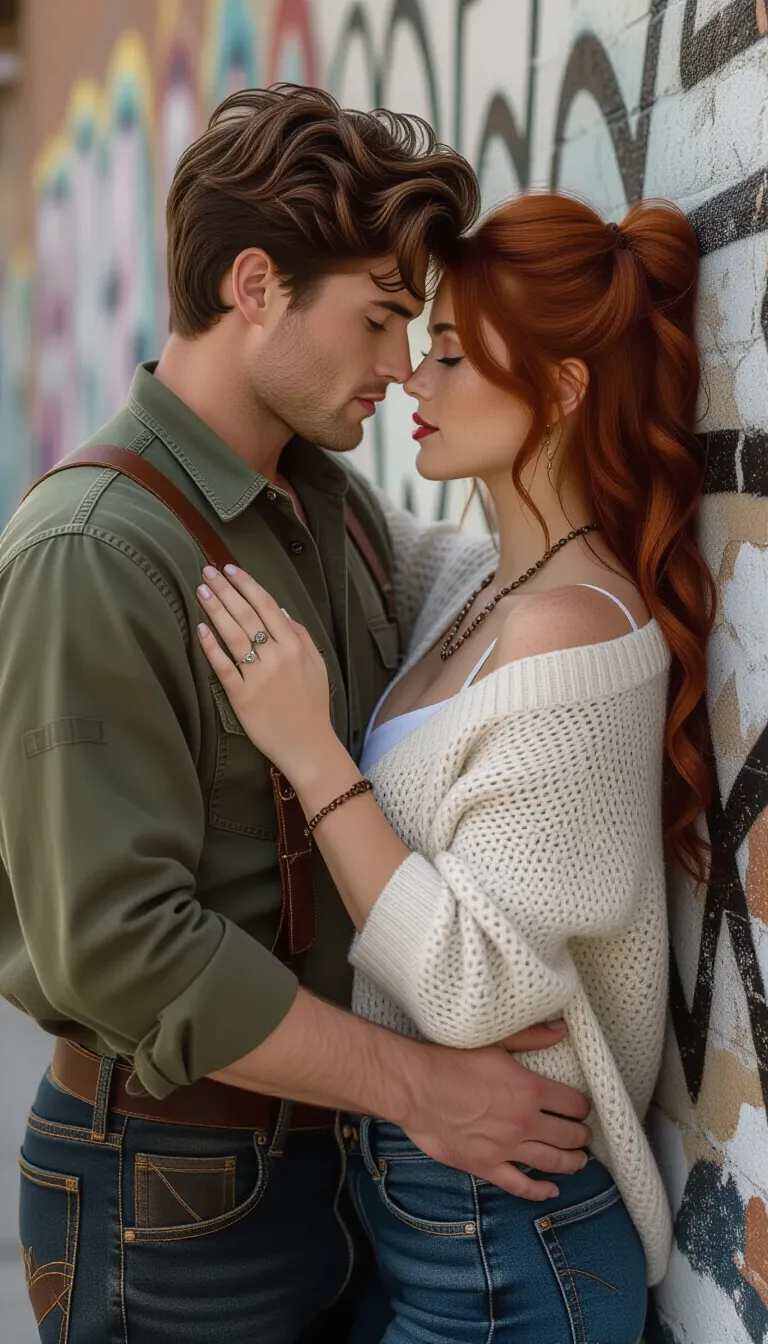
His hands found her waist, but instead of pulling her close, he pushed her gently against the wall—not hard, not rough, just a pressure that said stay. His forehead dropped to hers, and she felt the weight of the day, the brothers' blood, the note, the running—all of it pressing down on him, pressing down on them both.
She closed her eyes. His breath was warm on her lips.
"I keep thinking," he said, his voice low, barely a whisper, "that I'm going to wake up. That this isn't real. That I'm still in the cell, and none of it happened."
"It's real," she said.
His mouth found hers.
Not gentle. Not yet. A kiss that pressed her head back against the wall, his body following, crowding her into the damp stone. His hands stayed at her waist, fingers gripping the fabric of her cardigan like he needed something to hold onto, and she felt the tremor running through him — not cold, not fear of the men hunting them, but something deeper. Something that lived in the space between his ribs and had been waiting to surface.
She kissed him back, and his breath hitched against her lips.
He pulled away just enough to look at her. The light from the grimy window caught the side of his face, and she saw it then — the thing he'd been carrying since the cell, since the note, since O'Connell's warning. Not the weight of running. Not the weight of being hunted. The weight of almost having her and losing her before he'd said everything.
"Declan."
He shook his head, a small motion, like he couldn't find the words. His thumb traced the curve of her waist, once, twice, a nervous rhythm. "I keep thinking about the cell," he said. "Not the walls. Not the cold." He swallowed. "The silence. The way nothing moved. And I thought — if I never got out — there were things I never told you."
"Tell me now," she said.
He kissed her again, slower this time, his hand moving from her waist to her jaw, tilting her face up. His palm was rough against her skin, calluses catching on her cheek, and she felt the pressure of everything he wasn't saying pressed into the kiss — the days in the cell, the nights on the boat, the photograph of his father that sat on the crooked table behind them.
When he broke the kiss, his forehead stayed against hers. "I'm terrified," he said, the words barely above a whisper. "Not of dying. That I can live with. But losing you before I've said — before you know —"
"I know."
"No." His jaw tightened. "You don't. You can't. I spent twenty-eight years not saying anything. Not feeling anything. And then you walked into that butcher's back room and I —" He stopped. His breath came uneven, and she felt it on her lips, warm and shaking. "I don't know how to say it so you understand."
She reached up and touched his face. Her fingers found the line of his jaw, the stubble rough under her fingertips, and she traced it slowly, watching his eyes close. "Then show me."
His eyes opened. Something passed through them — relief, or surrender, or permission he'd been waiting to give himself. His hand slid from her jaw down her neck, over her collarbone, resting at the top button of her cardigan.
He didn't undo it.
He just stood there, palm flat against her chest, feeling her heartbeat under his hand. His own was visible in the pulse at his throat, quick and unsteady.
"You're shaking," she said.
"I know."
She covered his hand with hers, pressing it harder against her chest. "Feel that?"
He nodded.
"That's real. I'm here. I'm not leaving."
He pulled his hand free and used both to cup her face, thumbs tracing the line of her cheekbones, the curve of her lips. He looked at her like he was memorizing her, like he was afraid the memory would have to last.
"Siobhan."
"Yes."
"I need you to know." He paused, searching for the shape of it. "Not just that I love you. That you saved me. That night in the butcher's, when you showed up — you didn't just come to warn me. You walked into something you didn't have to walk into, and you stayed. And every day since, you've stayed. When they put me in the cell. When I came out broken. When they killed Frank and Tommy and pinned it on me. You stayed." His voice cracked on the last word. "I don't know how to repay that."
She pulled his head down and kissed him, hard, her fingers threading into his hair, and he made a sound against her mouth — something between a sob and a breath — and his hands moved from her face to her waist to her back, pulling her into him like he was trying to merge them into one body.
When she pulled back, her hands found the top button of his shirt.
She didn't undo it.
Her fingers rested there, feeling the heat of him through the fabric, watching his eyes watch her hands. The dust in the kitchen hung suspended in the dim light. The dripping water marked time somewhere behind them. His breathing was shallow, waiting.
She slid the button free.
One.
His throat moved as he swallowed.
Two.
His hands tightened on her waist.
Three.
"Slow," she said, and it wasn't a request. It was a gift — time, space, room for him to say whatever he hadn't said.
Four. Five. The shirt fell open, and she spread her palms across his chest, feeling the warmth of his skin, the hair coarse under her fingers, the scar she found just below his collarbone — a raised line, old, that she traced with her thumb.
He closed his eyes. "My father taught me to carve," he said, his voice rough. "I was twelve. The knife slipped."
She kept her thumb on the scar, feeling the history of it. "You still carve?"
"Haven't since he died." Pause. "I want to again. At that house. With the yellow table."
She pressed a kiss to his chest, just below the scar, and felt him shiver.
His hand came up to the back of her head, fingers threading through her hair, and she heard him exhale — not a sigh, but a release. The tension in his shoulders dropped, just slightly, and he leaned his forehead against the top of her head.
"Tell me," she said against his skin, her lips brushing his chest, "what you were going to say. In the cell. What you thought about."
His hand stilled in her hair. For a long moment, the only sound was the dripping water and his breathing, slow and deliberate.
"I thought about the first time I saw you," he said. "At the market. You were buying flowers. Pinks. You held them up to the light to check the petals, and your hair was down, and the sun caught it, and I couldn't move." A pause. "I stood there like an eejit for three minutes watching you choose flowers."
She smiled against his skin. "I thought you didn't notice me."
"I noticed everything." His voice dropped. "I noticed the way you bite your lip when you're thinking. The way you talk with your hands. The way you stand up straighter when you're scared, like you're daring someone to knock you down." He pulled back, tilting her chin up to look at him. "I've been noticing you my whole life, Siobhan. I just didn't know it until you walked into that room."
Her eyes glistened. She blinked, once, twice, and then she pushed his shirt off his shoulders, letting it fall to the floor behind him. The kitchen air hit his skin and she saw him tense, then relax, then reach for the hem of her cardigan.
He paused, his fingers at the hem. "Yeah?"
"Yeah."
He pulled it up, slow, his knuckles brushing her ribs as he lifted it over her head, and then his hands found her blouse, the thin cotton, the buttons smaller than his fingers were used to. He fumbled with the first one, and she laughed — a soft, surprised sound that broke the weight of the moment.
"Sorry," he said, but he was almost smiling. "Fingers aren't working."
She undid the buttons herself, watching his eyes follow her hands, and when the blouse fell open she let him look. His gaze moved over her — the curve of her neck, the line of her collarbone, the plain white bra that did nothing to hide the way her breathing had quickened.
His hands came up, slow, and he traced the edge of the fabric at her shoulder. "You're beautiful," he said, and it was so simple, so unadorned, that she felt something crack open in her chest.
She pulled him close, skin to skin, and felt his arms wrap around her, his face burying in her hair. They stood like that, pressed together in the dim kitchen, the dust settling around them, the cold stone at her back and his heat at her front, and she felt the terror in him — the fear that this would end, that someone would take it away, that he would wake up in the cell again and find that none of it had been real.
She held him tighter.
"I'm not going anywhere," she said into his shoulder. "I don't care who's after us. I don't care what they've pinned on you. I'm staying."
His arms tightened around her, and she felt his breath against her neck, warm and uneven. His hands moved across her back, tracing the ridges of her spine through the thin fabric of her bra, and she felt the question in his fingers — can I, is this okay, tell me if —
She answered by reaching behind her back and unhooking the clasp.
The fabric loosened, and she let it fall, and his hands found her bare skin, and he made a sound — low, almost reverent — as his palms settled against her back, drawing her closer.
He kissed her again, deeper now, his hands moving from her back to her waist to her hips, and she felt the wall against her shoulders, solid and real, and his body against hers, solid and real, and the dripping water marking time somewhere behind them, patient and steady.
His mouth traced down her jaw, her neck, the hollow at her collarbone, and she arched into him, her fingers finding his hair, holding him there. The scar under his ribs pressed against her palm. The hair on his chest caught against her skin. The heat between them built, slow and careful, like they were both afraid to rush, both afraid to break the spell.
She felt his hand slide down her side, over her hip, settling at the waistband of her skirt. He paused there, fingers resting against the fabric, and lifted his head to look at her.
His eyes were dark, his breathing unsteady, but there was a question in them — not "can I," but "are you sure," and she realized with a start that he wasn't asking about now. He was asking about tomorrow. About the running. About what came after.
She answered by covering his hand with hers and pressing it flat against her hip.
His forehead dropped to hers. "I love you," he said, and the words were raw, scraped out of him. "I love you, and I'm sorry I didn't say it sooner. I'm sorry I made you wait. I'm sorry I —"
She kissed him quiet, and he melted into her, his hand sliding from her hip to the button of her skirt.
He undid it slowly, and she felt the fabric loosen, and his hand found the bare skin of her waist, and the cold air hit her thighs, and she felt completely, terrifyingly, wonderfully exposed.
He pulled back to look at her, and the expression on his face — wonder, disbelief, love — made her chest ache.
"I want to remember this," he said. "Right here. This moment. I want to remember every second of it."
She reached for him, her hands finding his belt, and he caught her wrists, gently.
"Not yet," he said. "I want to —" He stopped, searching for the words. "I want to look at you first. I want to remember what you look like right now. In this light. In this place."
He stepped back, just enough to see her, and his gaze traveled over her — bare from the waist up, her skirt hanging loose on her hips, her hair falling around her shoulders, her lips swollen from his kisses. The dim light caught the curve of her breast, the freckles across her chest, the rise and fall of her breathing.
"You're the most beautiful thing I've ever seen," he said.
She reached for him again, this time not for his belt but for his hands, pulling them back to her waist. "Come here," she said. "I want to feel you."
He came. His body pressed against hers, skin to skin, and she felt everything — the rough fabric of his trousers against her thighs, the heat of his chest against hers, his hands on her back, his mouth finding hers again, slower now, deliberate. His hands traced down her sides, over her hips, and settled on her thighs, squeezing gently, and she felt the strength in them, the years of carpentry in the way his fingers knew how to hold.
And then, without breaking the kiss, he crouched.
She made a sound — surprise, pleasure, something caught in her throat — as his hands guided her skirt down, pooling at her feet, and his lips found the inside of her thigh. His stubble scraped against the sensitive skin, and her hands flew to his shoulders, gripping hard.
"Declan —"
He looked up at her, his mouth still pressed against her thigh, and she saw the hunger in his eyes, the need to worship, to prove, to show her what she meant.
"Let me," he said. "Please."
She nodded, unable to speak, and he turned his attention back to her skin, his mouth pressing kisses up the inside of her thigh, slow and deliberate, taking his time. His hands held her hips, steadying her, and she felt the cold wall against her back, his hot mouth against her skin, the impossible tenderness of his lips tracing patterns she could feel deep in her bones.
She was shaking, she realized. Not from cold. From the weight of being seen this completely.
He pressed a kiss to the damp fabric between her legs, and she gasped, her knees going weak. He held her steady, his hands firm on her hips, and did it again, slower this time, dragging his mouth across the thin cotton.
"Declan." His name came out broken. "Please."
He hooked his fingers into the waistband of her underwear and pulled them down, slow, letting them fall to join her skirt on the dusty floor. She stepped out of them, and he looked at her, fully bare in the dim light, and the wonder in his eyes made her feel like the most precious thing in the world.
He pressed his mouth to her, and she cried out — a sharp, broken sound that echoed off the stone walls — and he held her there, his arms around her thighs, his tongue finding her, tasting her, learning her. Her hands fisted in his hair, and she heard herself saying his name over and over, a prayer, a plea, a confession.
He was slow. Deliberate. Patient. He took his time like he had all the time in the world, like there was nowhere to run, like the men hunting them didn't exist, like the only thing that mattered was her, right now, in this abandoned kitchen with the dust settling around them.
She felt the pressure building, coiling in her stomach, and she tried to warn him — "I'm —" — but he only pressed closer, his mouth relentless, his hands gripping her hips to keep her from pulling away. He wanted her to fall apart, she realized. He wanted to catch her when she did.
She came with a cry that she muffled against her own hand, her body shuddering against him, and he held her through it, steadying her, his mouth gentling as she came down. She collapsed against him, her legs trembling, and he rose to catch her, pulling her into his arms, pressing kisses to her neck, her shoulder, her jaw.
She felt him hard against her hip, and she reached for his trousers, her fingers working the button, the zip, pushing the fabric down. He stepped out of them, kicking them aside, and she pushed against his chest until he stepped back, letting her look at him the way he'd looked at her.
He was beautiful. Broad-shouldered and scarred and trembling under her gaze, his cock hard and aching, his hands open at his sides like he was offering himself to her.
She touched him, light, tracing the length of him with her fingertips, and he sucked in a breath, his jaw tightening. She wrapped her hand around him, and he closed his eyes, his head dropping back.
"Siobhan —"
"I know," she said, and she guided him forward, toward her, her hand still wrapped around him. "I know."
He pressed her back against the wall, and she felt the cold stone against her shoulders, her spine, the sharp edge of a rough-cut block. He lifted her, and she wrapped her legs around his waist, her back sliding against the wall as he positioned himself at her entrance.
He stopped there, just at the edge, his forehead pressed to hers, both of them breathing the same air, suspended in the moment before.
"I love you," he said. "I'll never stop saying it. I'll say it every day for the rest of my life."
"Then say it," she whispered.
He said it. And then he pushed inside her, slow, filling her, and she felt the stretch, the warmth, the impossible rightness of being joined to him in this ruined place, the dust still settling around them, the water still dripping somewhere in the darkness.
He moved against her, slow and deep, his mouth finding hers, and she felt the tears on his cheeks before she realized he was crying — silent, steady, released. She held his face, kissing the salt away, and he pressed into her, deeper, as if he was trying to disappear into her.
"I'm here," she said against his lips. "I'm here. I'm not leaving."
He came with a broken sound, buried in her, his body shuddering, and she held him through it, her legs tight around him, her arms wrapped around his shoulders. He stayed inside her, his forehead against her neck, his breathing harsh and uneven.
After a long moment, he pulled back just enough to look at her. His eyes were red, his cheeks wet, but there was something new in his face — something unburdened, something free.
"I remember," he said, his voice rough, barely a whisper. "I'll always remember this. Right here. You and me."
She kissed him, soft and slow, and felt him smile against her lips.
The dust settled around them. The water dripped in the darkness. Somewhere beyond the walls of the cottage, men were hunting them, a future was uncertain, a war was still being fought. But here, in this ruined kitchen, the only thing that mattered was the weight of him in her arms, the heat of his skin, the certainty of his love pressed against her heart.
She held him tighter.
And for the first time in days, she felt like they might actually make it through.
She held him for a long time, his weight against her, his breath evening out against her neck. The stone wall was cold against her back, but she barely felt it. All she felt was him — the tremor still running through his shoulders, the damp heat of his skin, the way his fingers pressed into her hips like he was afraid she'd dissolve if he let go.
He stirred finally, pulling back just enough to look at her. His eyes were red-rimmed, his cheeks still wet, but there was something lighter in his face. A crack in the armor. A breath of air.
"I should probably put you down," he said, and his voice cracked on the last word, almost a laugh.
"Probably." She didn't let go of his shoulders. "Are you going to?"
"No." He kissed her, soft, and she felt his mouth curving into a smile against hers. "Not yet."
She laughed, a quiet, breathless sound, and held him tighter. He was still inside her, softening now, and she felt the intimacy of it — not the heat, but the trust. The willingness to stay joined even after the urgency had passed.
Eventually he lowered her, slow, her feet finding the dusty floor. He stayed close, his hands on her waist, and she felt the cool air against her skin, the sudden emptiness where he'd been. She missed him immediately.
He looked down at her, and she saw the hunger and the tenderness and the fear all tangled together in his gray eyes.
"I don't know what comes next," he said. "I don't know how we get out of this. I don't know who killed them or why they want me to take the blame." He lifted his hand, traced the line of her jaw with his thumb. "But I know I want to wake up next to you tomorrow. And the day after. And every day after that."
She covered his hand with hers, pressing his palm flat against her cheek. "Then we figure it out. Together."
He nodded, and she saw the trust in his eyes — not hope, not yet, but trust. He believed her.
The kitchen was cold, the fire long dead, and she felt the chill settling into her bones. She was still bare, her clothes scattered across the dusty floor, and she shivered.
He noticed before she could hide it. "Come on." He bent, retrieved her underwear from the floor, held it out to her. "There's a bedroom upstairs. I saw it when we came in. There might be blankets."
She took the fabric from him, and their fingers brushed. "And then what?"
"And then we sleep." He pulled on his trousers, fastened them, but didn't bother with his shirt. "And in the morning, we figure out what O'Connell knows. Who else might know. Where we go from here." He stopped, looked at her. "But first, we sleep."
She dressed in silence, pulling her skirt back up, fastening her blouse. Her underwear was damp, and she folded it, tucking it into her skirt pocket rather than putting it back on. He watched her, and she felt the weight of his gaze — not hungry, not demanding. Just watching. Like he was memorizing her.
The stairs creaked under their weight, old wood groaning in protest. The hallway upstairs was narrow, the walls lined with faded paper curling at the edges. Three doors. He pushed the first one open — empty, the bed frame stripped, a single bare mattress on the floor.
"It's something," he said.
"It's enough."
She stepped inside. The room was small, the window grimy, the moonlight filtering through in pale, dusty beams. The mattress was thin, stained, but it was better than the kitchen floor. She sat down on the edge, felt the springs sag under her.
He stood in the doorway, his shirt still unbuttoned, his chest bare in the dim light. The bruise on his jaw from Gorman was fading to yellow at the edges. The scar above his collarbone caught the light.
"You're staring," she said.
"I'm looking." He crossed the room, sat beside her, close enough that she could feel the heat of him. "There's a difference."
"Is there?"
"Staring is for strangers. Looking is for—" He stopped, and she heard the hesitation in his voice, the vulnerability he was trying to cover. "For someone you want to remember."
She reached out, touched his face, her fingers tracing the curve of his cheekbone. "I'm not going anywhere, Declan."
"I know." He turned his head, pressed a kiss to her palm. "I'm still learning to believe it."
They lay down together on the thin mattress, her back against his chest, his arm wrapped around her waist. He was warm, solid, his breath steady against her hair. The bed was narrow, forcing them close, and she felt every inch of him pressed against her — his thighs against the back of hers, his chest against her spine, his arm a band of heat across her stomach.
The silence settled around them, thick and soft. Somewhere outside, an owl called, low and mournful. The wind rattled the window pane.
"Siobhan."
"I'm awake."
His arm tightened around her. "My father's letter. He said to live. Not to die for a cause. Not to spend my life looking back." He paused, and she felt his breath catch. "I think I'm starting to understand what he meant."
She turned in his arms, facing him, her nose brushing his. "What do you mean?"
"I spent twenty-eight years being angry. Being afraid. Being careful." He touched her face, his fingers tracing the line of her brow, the bridge of her nose, the curve of her lips. "I don't want to be careful anymore. I want to live. I want to build something. I want to build it with you."
"That sounds like a proposal," she said, and she meant it to sound light, teasing, but her voice came out raw, honest.
He was quiet for a long moment. Then: "Maybe it is."
She felt her heart stop, then start again, faster. "Declan—"
"I'm not asking you to marry me tonight." He smiled, a small, tired smile. "I'm asking you to stay. To keep choosing me. To build that yellow table with me, even if it takes years."
She kissed him, her hand sliding into his hair, and he made a sound against her lips — relief, she realized. Relief that she understood, that she was still there, that she hadn't run.
"Yes," she said against his mouth. "Yes, I'll stay. Yes, I'll choose you. Yes to the yellow table."
He kissed her back, deep and slow, and she felt the promise in it. Not just passion, but intention. A future, written in the dark.
They settled again, her head on his chest, his hand in her hair, and she listened to his heartbeat slowing, deepening, pulling toward sleep. She was drowsy herself, the exhaustion of the last days pressing down on her, but she didn't want to close her eyes. She wanted to hold this moment, to press it into her memory, to carry it through whatever came next.
His breathing evened out, and she felt the tension leave his body, his arm going heavy around her. He was asleep. Finally. Truly.
She lay awake a little longer, watching the moonlight shift across the dusty floor, feeling his heart beat against her cheek. She thought about the men who had died, the note blaming Declan, the danger waiting for them outside this room. She thought about O'Connell, about what he knew and what he wasn't telling them. She thought about Mary Morrow, waiting in Belfast, not knowing if her son was alive or dead.
But under all of it, there was warmth. There was his arm around her, his breath in her hair, the promise of morning.
She closed her eyes.
And for the first time in weeks, she slept without dreaming of running.
She surfaced slowly, like rising through deep water. The mattress beneath her, the weight of his arm across her stomach, the cold air on her shoulder where the blanket had slipped. She blinked, and the dim light of the cottage resolved around her — dust motes suspended in gray morning, the cracked window, the smell of damp wool and rust.
He was awake.
His gray eyes were open, watching her, and there was something in them she hadn't seen before. Not hunger. Not fear. Something quieter, like he was memorizing the shape of her face in this light, the exact way her hair spread across his arm, the slow rhythm of her breathing.
"How long have you been awake?" Her voice came out rough, still thick with sleep.
"Long enough." His hand moved, his fingers tracing the line of her shoulder, the curve of her collarbone, light enough to be a question. "You talk in your sleep."
She felt heat rise to her cheeks. "What did I say?"
"You said my name." His voice was low, almost a whisper. "Three times."
She pressed her face into his chest, hiding, and she felt the vibration of his quiet laugh, his hand coming up to cradle the back of her head. His fingers threaded through her hair, and she felt the calluses catch on the strands, and she thought: I want to feel this for the rest of my life.
"I was watching you breathe," he said, and the words were simple, plain, but they landed in her chest like a stone in still water. "The way your chest rises. The way your lips part. The way you frown when you're dreaming something you don't like."
"I frown?"
"You furrow your brow. Right here." He touched the space between her eyebrows, feather-light. "I counted the freckles on your nose. Twenty-three."
She laughed, soft and surprised. "You counted my freckles."
"I had time." His smile was small, tired, but real. "I was thinking about the last time I watched someone sleep. It was my mother, after my father died. She'd fall asleep in the chair by the window, still holding his coat. I'd watch her breathe, and I'd think: she's still here. She's still here."
She felt his voice catch on the last words, and she reached up, her fingers finding his jaw, holding him steady. "I'm still here," she said.
"I know." He turned his head, pressed a kiss to her palm. "That's what I was thinking about. That I get to watch you now. That you'll be here in the morning. That I don't have to be careful anymore."
The air between them shifted. She felt it in the way his hand stilled on her hip, in the way his breathing slowed, in the way his eyes held hers with an intensity that made her chest ache.
"Declan."
"Siobhan." He said her name like it was a prayer, like it was the only word that mattered. "Tell me you're afraid."
She was. Of course she was. Afraid of the men hunting him. Afraid of the truth they hadn't uncovered. Afraid of the note that blamed him for deaths he didn't cause. Afraid of waking up one morning and finding this — this warmth, this weight of his body against hers — gone.
"I'm afraid," she said.
"Good." His hand slid to her waist, pulling her closer. "Me too."
She felt the word land — good — and understood. He wasn't asking her to be brave. He was asking her to be honest. To meet him in the fear, not pretend it wasn't there.
"What are we going to do?" she asked.
He was quiet for a long moment. His hand traced the curve of her hip, the dip of her waist, the ridge of her ribs through the thin fabric of her shirt. "We find out who killed the Millar brothers. We clear my name. And then —"
"And then?"
"And then we find that house. The one with the yellow table. The one I told you about on the boat."
She felt the future in his words, fragile and real, and she wanted to hold it, to press it against her heart like a photograph. "You really believe we'll get there."
"I have to." He said it simply, without drama, like a fact of physics. "Because if I don't believe it, then the men who killed my father win. And I'm done letting them win."
The morning light was growing stronger, the dust motes turning from gray to gold. She could hear birds outside, a distant rooster, the sound of wind moving through bare branches. The world was waking up. And she was here, in this narrow bed, wrapped around a man who had counted the freckles on her nose.
She kissed him. Not because she wanted something from him, but because she needed to give him something. A promise. A seal on the words they'd spoken in the dark.
His hand came up to her face, his fingers sliding into her hair, and he kissed her back with the same quiet intensity — not desperate, not hungry, but sure. His thumb traced her cheekbone. His breath mingled with hers. The kiss said: I see you. I choose you. I am still here.
When they broke apart, his forehead rested against hers, and she felt his breath warm on her lips.
"We should get up," she said, but she didn't move, and neither did he.
"In a minute," he said.
The minutes stretched. The light moved across the floor. She felt his heartbeat against her palm, steady and slow, and she let herself believe, just for this moment, that the world outside this room didn't exist. That there were no dead men, no notes, no danger waiting. That there was only this: his arm around her, his breath in her hair, the promise of a future they were building together.
She closed her eyes.
And for a little while longer, she stayed.
She opened her eyes. The light had shifted, gold fading toward white, and she knew the morning was slipping away from them. She knew there was a world outside this room, a world that wanted him dead and her complicit. She knew they had to move, had to plan, had to face whatever waited beyond the cottage walls.
But she didn't move.
She lay there, her palm flat against his chest, feeling the slow, steady rhythm of his heart beneath her fingers. His arm was draped over her waist, heavy and warm, and his breath was soft against her hair. She could feel the rise and fall of his ribs, the quiet sigh that escaped him when she shifted closer.
She turned her face toward his. His eyes were open, watching her, and she realized he'd been watching her the whole time.
"Hi," she said.
"Hi."
She reached up, her fingers tracing the line of his jaw, the slight stubble that had grown overnight. His skin was warm, and she felt the muscle beneath twitch at her touch. She let her thumb trail across his lower lip, and she felt his breath catch, felt the way his hand tightened on her waist.
She kissed him.
Slowly. Like she had all the time in the world. Like the danger outside didn't exist. Like this moment was the only one that mattered.
She kissed him with her eyes open, watching him, watching the way his lashes lowered, the way his pupils dilated, the way his mouth softened against hers. She felt his hand slide up her back, pulling her closer, and she let herself sink into him, into the warmth of his body, into the taste of his mouth, into the quiet, steady certainty of being held by someone who had chosen her.
The kiss wasn't desperate. It wasn't hungry. It was deliberate, careful, like she was memorizing the shape of him. The way his lips fit against hers. The way his breath mingled with hers. The way his fingers curled into the fabric of her shirt, not pulling, just holding, like she was something precious, something he was afraid to break.
She broke the kiss slowly, drawing back just enough to see his face, her forehead resting against his.
"That," she said, her voice barely above a whisper, "was a hello."
His hand came up, his fingers sliding into her hair, cradling the back of her head. His thumb traced the curve of her ear, and she felt the touch everywhere.
"Hello," he said.
She kissed him again. Slower this time, if that was possible. Like she was tasting him, learning him. She felt his mouth open beneath hers, felt the soft sound he made, felt the way his body relaxed into hers, and she thought: this is what it feels like to be home.
She drew back again, and this time she saw the question in his eyes, the uncertainty, the fear that she was about to say goodbye.
"And that," she said, her hand finding his, her fingers lacing through his, "was a promise."
He looked at her for a long moment. The light caught the gray of his eyes, and she saw something there, something raw and unguarded, something he didn't have words for.
He kissed her. Not slow, not careful. He kissed her like he was drowning and she was air, and she felt the shift, felt the need in him, felt the desperation he'd been holding at bay. His hand pressed against the small of her back, pulling her into him, and she felt his heart hammering against her chest, and she held him, held him through it, let him take what he needed.
When he finally broke the kiss, his breathing was uneven, his forehead pressed against hers, and she could feel the tension in his shoulders, the way he was holding himself back.
"I don't know how to do this," he said.
"Do what?"
"Be this happy. And this terrified. At the same time."
She felt the words land, felt the weight of them, and she reached up, cupping his face in her hands. "Neither do I. But I think we figure it out together."
He closed his eyes, and she felt him exhale, felt the tension drain from his body, just a little. Just enough.
"Together," he repeated.
"Together." She kissed his forehead, his nose, the corner of his mouth. "We get up. We eat whatever's in that kitchen. We figure out what to do next. And we do it together."
He opened his eyes, and there was a smile there, small and tired but real. "You're very practical in the morning."
"Someone has to be." She sat up, the sheet pooling around her waist, and she felt the cool air on her skin, felt the weight of the day settling on her shoulders. She looked back at him, still lying there, still watching her, and she wanted to crawl back into his arms, to stay in that narrow bed forever.
But that wasn't the world they lived in.
She swung her legs over the side of the bed, her feet finding the cold floor, and she stood. The room was small, barely enough space for the bed and a rickety wardrobe, but the morning light was soft and golden, and she could see dust motes dancing in the air. She found her shirt on the floor, pulled it over her head, and buttoned it slowly, feeling his eyes on her.
"You're staring," she said.
"I know."
She turned, and he was sitting up now, the sheet pooled around his hips, his chest bare, his hair a mess. He looked young, unguarded, like the boy he must have been before the world got its hands on him.
"What are you thinking?" she asked.
He was quiet for a moment, his eyes tracing her face, her hair, the way the morning light caught the freckles on her collarbone. "I'm thinking that I don't deserve this."
"Declan—"
"No, I know. I know you're going to say I do. But I'm thinking about all the things I've done, all the ways I've failed, all the people I've let down. And I'm thinking that somehow, despite all of it, I'm here. With you. And I don't understand how I got so lucky."
She crossed the room, sat down beside him, took his hand. "You got lucky because you showed up. Because you chose to live. Because you read your father's letter and listened." She squeezed his hand. "And because I'm stubborn and I don't give up easily."
He laughed, a short, surprised sound, and she felt the warmth of it spread through her chest.
"That too," he said.
She kissed him again, quick and soft, then stood. "Come on. We need to figure out what we're doing today."
He nodded, swung his legs over the side of the bed, and reached for his trousers. She watched him dress, watched the way his hands moved, efficient and sure, and she thought about the future they'd talked about on the boat. The house with the yellow table. The garden. The ordinary life they were fighting for.
She wanted it. With a fierceness that surprised her.
They made their way downstairs, the old wooden stairs creaking beneath their feet. The kitchen was cold, the fire having burned down to ash hours ago, and she wrapped her arms around herself as she crossed to the counter. There was a tin of tea, a half-loaf of bread, a jar of jam. Enough to get them through the morning.
She put the kettle on the stove and lit the burner, the blue flame flickering to life. Behind her, she heard Declan moving, heard the scrape of a chair on the stone floor, and she turned to find him sitting at the table, his father's photograph in his hands.
"What are you thinking?" she asked.
He looked up, and his eyes were distant, lost in a memory. "I'm thinking about what he would say. If he could see me now."
"What would he say?"
Declan was quiet for a long moment. She watched his thumb trace the edge of the photograph, watched the way his jaw tightened, the way his shoulders curved forward.
"He'd say 'I told you so.'" A small, sad smile. "He always said I would find my way. That I was too stubborn not to. That I had too much of him in me to stay lost."
She crossed to him, stood behind his chair, and wrapped her arms around his shoulders. She pressed her cheek against his hair, and she felt him lean into her, felt the weight of him against her chest.
"He was right," she said.
"I know." He set the photograph down, his hand finding hers, his fingers lacing through hers. "I just wish he could have seen it."
The kettle began to whistle, and she released him, moving to pour the water into the teapot. The sound filled the silence, and she let it, let the ordinary ritual ground her. Tea. Bread. Jam. The simple things that held the world together.
She brought the pot to the table, two cups, the loaf of bread. She sat down across from him, and they ate in silence, the morning light growing stronger, the dust motes dancing in the golden air.
And for a little while, the danger outside felt very far away.
Declan set down his father's photograph, his thumb lingering on the edge of the frame, tracing the outline of his father's smile. He looked up at her, and there was something different in his eyes—not the distant grief of a moment ago, but a sharp, focused clarity.
"I have a plan," he said.
Siobhan set down her tea, the cup making a soft sound against the wood. She watched him, waited. He was leaning forward now, his elbows on the table, his hands clasped in front of him, and she could see the carpenter in the way he held himself—measuring, calculating, building something in his mind before he spoke it aloud.
"O'Connell said they're framing me for the Millar brothers. That means someone wants me out of the way. Someone who knew I was looking for them." His voice was low, steady, the voice of a man who'd spent the night thinking instead of sleeping. "That someone is connected to Fletcher. To the men who killed my father."
"You think it's Gorman." She said it flat, not a question.
He met her eyes, and she saw the answer there. "Gorman knew where I was. He knew I was asking questions. And he's the one who gave me that bruise." He touched his jaw, where the purple stain was fading to yellow at the edges. "He's RUC. He has access. He has motive. And he's the one who showed up at the safe house with word of Frank's death."
She picked up her tea again, wrapping her hands around the warm cup, letting the heat ground her. "So what's the plan?"
"We don't run to Dublin. We run to ground. We find out where Gorman lives, where he drinks, where he keeps his secrets. And we make him tell us who gave the order."
"And if he won't talk?"
Declan's jaw tightened, and she saw the storm pass behind his eyes—the same storm she'd seen in the betting shop, in the Coastguard station, in every moment he'd had to choose between the man he wanted to be and the man the world had made him. "Then we find another way."
She set down her cup and reached across the table, her fingers finding his. "That's not an answer."
"It's the only one I have."
She held his gaze, and she saw the fear there, buried beneath the certainty. He was terrified—not of Gorman, not of the RUC, not of the men who wanted him dead. He was terrified of becoming the thing he'd sworn not to be. The man who killed without cause. The man who let revenge hollow him out.
"Declan." She said his name softly, and he looked at her, really looked, and she saw the crack in his armor. "We're not going to become them. We're going to find the truth. And then we're going to give it to the Garda, to the newspapers, to anyone who will listen. But we're not going to become them."
He was quiet for a long moment, and she watched the tension in his shoulders ease, watched the storm settle. He squeezed her hand, and she felt the calluses against her palm, the roughness of hands that had built things, that had held her, that had refused to become weapons.
"How do you do that?" he asked.
"Do what?"
"Make me believe things can be different."
She smiled, small and tired, and she lifted his hand to her lips, pressing a kiss to his knuckles. "Because I've seen you choose differently. Again and again. And I believe in you."
He closed his eyes, and she watched his breath slow, watched the fight drain out of him. When he opened them again, there was something new there—hope, fragile and stubborn, like a sapling pushing through rubble.
"Okay," he said. "We find Gorman. We find the truth. Together."
"Together."
She released his hand and stood, crossing to the counter to pour more tea. The kettle was still warm, and she let the steam rise around her face, let the familiar ritual calm her. Through the window above the sink, she could see the fields stretching out, grey-green and misty, the Mourne Mountains a soft shadow on the horizon. The world was still there. Still waiting.
"We'll need to move before dark," she said, turning back to him. "O'Connell said we had two days before the heat got too close. That was yesterday."
Declan nodded, reaching for his tea. "There's a bus to Newry at noon. From there, we can catch the train to Belfast. Gorman lives in East Belfast, near the shipyards. I know the streets."
"And if he's not there?"
"Then we find someone who knows where he is."
She crossed back to the table, sitting down across from him. The bread was gone, the jam jar nearly empty, but the tea was still warm, and the morning light was growing brighter, bleaching the dust motes white.
"What about the lockbox?" she asked. "The evidence we gave the Garda?"
Declan's mouth tightened. "Reilly has it. He's the only one I trust. But if Gorman is connected, he might have people inside the station. We can't rely on it."
"So we're on our own."
"We've been on our own since the beginning." He said it without bitterness, just a fact, and she felt the truth of it settle in her chest. They had no one to rely on but each other. No safety net. No backup. Just the two of them, and the road ahead, and the truth they were fighting to uncover.
"Then we'd better get moving." She stood, brushing the crumbs from her skirt, and she felt the shift in her body—the readiness, the resolve. She was tired, bone-deep tired, but she was also awake, alert, alive in a way she hadn't been since this all began.
Declan stood too, and he crossed to her, his hands finding her waist, pulling her close. She leaned into him, her forehead against his chest, and she felt his heartbeat under her cheek, steady and strong.
"Thank you," he said, his voice rough, his breath warm against her hair.
"For what?"
"For staying. For believing. For not giving up on me."
She pulled back, looking up at him, and she saw the gratitude in his eyes, the wonder, the disbelief that she was still here. She reached up, her fingers tracing the line of his jaw, the bruise that was fading, the stubble that was growing in rough and dark.
"I made a promise," she said. "I meant it."
He kissed her then, soft and slow, and she felt the tenderness in it, the care, the way he held her like she was something precious, something worth protecting. She kissed him back, and she let herself believe, just for a moment, that they could make it through this.
When they broke apart, he was smiling—a real smile, small and tired but real.
"We should pack," he said.
"We should pack," she agreed.
They moved through the cottage, gathering their few belongings, checking the corners for anything they might have left behind. Siobhan found her cardigan hanging on a hook by the door, and she pulled it on, the wool soft and familiar against her skin. Declan tucked his father's photograph into his inside pocket, his hand lingering over it for a moment, a silent goodbye.
Outside, the morning was crisp and cold, the mist burning off the fields, revealing the green hills stretching toward the sea. She stood on the threshold, breathing deep, and she felt the weight of the day settle on her shoulders—the plan, the danger, the uncertainty of what lay ahead.
But she also felt his hand slip into hers, warm and steady, and she felt the strength of it, the promise.
"Ready?" he asked.
She looked at him—his grey eyes, his auburn hair catching the light, the bruise on his jaw, the quiet resolve in his face—and she squeezed his hand.
"Ready."
They walked together down the lane, the cottage disappearing behind them, the road ahead stretching out, unknown and waiting. And for the first time in days, she felt something like peace settle in her chest—not safety, not certainty, but the quiet knowledge that whatever came, they would face it together.
They walked in silence for a while, the lane curving between hedgerows still wet with morning. The mist was burning off in patches, revealing fields of sheep and stone walls, the kind of quiet that felt almost foreign after everything they'd been through.
Siobhan's hand was still in his, her fingers warm despite the cold air. She was watching the road ahead, her jaw set, her mind working through something. He could feel it in the way her grip tightened, loosened, tightened again.
"What will we do when we find him?" she asked.
The question hung in the air between them, simple and impossible. Declan kept his eyes on the road, feeling the weight of his father's photograph against his chest, the lockbox evidence still fresh in his mind.
"I don't know," he said. The truth came out flat, honest, useless.
She stopped walking. He stopped too, turning to face her. Her green eyes were sharp, searching, but not accusing. Just looking. Just waiting.
"You must have thought about it," she said. "You've had hours. Days."
"I thought about finding him. I thought about what he knows. I didn't get past that."
She bit her lower lip, that habit she had when she was working through something. Then she stepped closer, her hand coming up to rest on his chest, over the photograph, over his heart.
"We need a plan, Declan. Not just a destination."
He nodded, and he felt the truth of it settle in his bones. They'd been running on instinct since the beginning—reacting, surviving, one step ahead of the next bullet. But instinct wouldn't be enough when they found Gorman.
"He was there," Declan said slowly. "That night. Fletcher said Gorman and Reid pulled the trigger, and Frank and Tommy held the doors. Gorman's the one who actually did it. He's the one who—" His voice cracked, and he stopped, swallowing hard.
Siobhan's hand pressed gently against his chest, grounding him. "What do you want from him?"
He thought about it. Really thought about it. The rage was still there, buried deep, but it wasn't the first thing anymore. His father's voice on that tape—*live, son, live*—had changed something fundamental in him.
"I want the truth," he said. "I want to know who gave the order. Fletcher said it wasn't him. He said it came from above. If Gorman knows who that was, we can prove I didn't kill the Millar brothers."
"And if he doesn't tell you?"
"Then I make him."
She didn't flinch at that, didn't look away. She'd seen him at his worst, his most dangerous, and she was still here. Still standing in front of him, her hand on his chest, her eyes steady.
"How?" she asked.
He exhaled, long and slow. "I don't know that either."
A small smile flickered at the corner of her mouth—sad, knowing, but warm. "So we're walking into Belfast with no plan, no backup, and a target on your back. That's what we're doing."
"That's what we're doing."
She laughed, a soft sound that carried no humor but all the warmth she had left. "God help us both."
"He hasn't so far."
"Maybe we haven't asked the right way." She reached up, her fingers tracing the line of his jaw, the fading bruise. "We could turn back. We could take the boat to Scotland. Start over."
"You know I can't do that."
"I know." She said it without disappointment, without pressure. Just a fact. "But I had to ask. I had to know if you'd even consider it."
"Would you?" he asked.
She was quiet for a long moment, her hand still on his face, her eyes searching his. "I'd consider anything that kept us alive. But I wouldn't ask you to run from the truth. That's not who you are. And it's not who I am either."
He leaned forward, pressing his forehead to hers, breathing her in—chalk dust and lavender, the faint salt of her skin. "I love you," he said, and the words came easy now, natural, like they'd been waiting in his chest all along.
"I love you too." She said it like a promise, like a prayer. "So we find Gorman. We get the truth. And then we figure out the rest."
He pulled back, looking at her—the freckles scattered across her nose, the green of her eyes, the way the morning light caught the copper in her hair. "And if the truth leads to someone we can't touch? Someone with money, power, protection?"
She held his gaze. "Then we find a way to touch them anyway."
He believed her. That was the terrifying, wonderful thing. He believed her completely.
They started walking again, her hand back in his, their pace steady and deliberate. The lane curved around a bend, and the village came into view below them—a cluster of whitewashed houses, a church spire, the grey ribbon of the road leading south.
"Gorman's place is near the shipyards," Declan said, his mind shifting to logistics. "We'll get off the train at Great Victoria Street and walk east. He lives above a pub called The Anchor. Used to, anyway. If he's still there, we'll find him."
"And if he's not?"
"Then we find someone who knows where he went. He has a sister in Bangor. A brother in Liverpool. He's not hard to track."
"You've thought about this more than you said."
He glanced at her, and there was no judgment in her face, just curiosity. "I've thought about it every day since I read my father's letter. I just didn't know how to say it out loud."
She squeezed his hand. "You're saying it now. That's what matters."
The village grew closer, and he could see the bus stop at the edge of the main street, a rusted sign and a bench where an old man sat reading a newspaper. The morning was warming, the mist almost gone now, the sky a pale washed blue.
"There's something else," Siobhan said, her voice lower, careful. "Something I've been thinking about since last night."
He looked at her. "What?"
"The way O'Connell found us. At the hotel in Newry. He said Mary Morrow told him where we were, but—" She stopped, biting her lip again. "But your mother doesn't know where we went after the boat. We didn't tell her about the hotel. We didn't tell anyone."
Declan slowed, the weight of her words settling in his chest. "O'Connell said she sent him. He had a note from her."
"He had a note. But Mary Morrow wouldn't have known the hotel. We didn't even know the hotel until we found it."
He stopped walking, turning to face her fully. The sun was in his eyes now, and he squinted against it, his mind churning. "You think O'Connell was lying?"
"I don't know what I think. But I know it doesn't add up. And we're walking into Belfast with a plan that depends on trusting what he told us."
Declan ran a hand through his hair, the sawdust long gone but the habit lingering. "If O'Connell is connected to whoever is framing me, then we don't just have Gorman to worry about. We have whoever sent O'Connell."
"Who knew we were going to Newry?" she asked. "Who knew about the safe house, the boat, any of it?"
He thought back, tracing the chain. "Margaret Millar knew we were at the safe house. She warned us. Then we took the boat across the lough, and we didn't tell her where we were going. The café owner in the village didn't know our names. The bus driver didn't ask. The hotel—" He stopped. "The hotel didn't ask for ID, but we used cash. Your cash."
"And O'Connell found us within hours."
The silence stretched between them, thick and heavy. Declan felt the cold settle in his stomach, the familiar weight of betrayal circling closer.
"He's the only one who could have found us," Declan said slowly. "Unless your parents have connections I don't know about."
"My parents think I'm dead or in England. They're not looking for me."
"Then it's O'Connell."
She nodded, her jaw tight. "Or someone he works for."
The bus was coming down the road now, a blue single-decker rattling over the potholes. The old man folded his newspaper and stood, brushing off his coat.
Declan looked at Siobhan, and he saw the fear in her eyes—not for herself, but for both of them. The plan they'd been building was already cracked, and they hadn't even reached the train yet.
"We still go," he said. "But we don't trust anyone. Not O'Connell, not the cops, not anyone. We find Gorman on our own terms, and we get out before anyone knows we're there."
"And if Gorman is dead too? If someone's been cleaning up the loose ends?"
He hadn't thought of that. He should have. "Then we find the person doing the cleaning."
The bus pulled up, its brakes hissing, the door folding open. The driver, a heavyset man with a grey moustache, looked them over with the lazy disinterest of someone who'd seen everything.
"Newry?" Declan asked.
"Aye. Get on."
They climbed aboard, taking seats near the back, away from the old man and his newspaper. The bus lurched forward, the village slipping past the windows—a post office, a pub, a church, the fields opening up again.
Siobhan leaned into him, her head on his shoulder, her hand finding his. He felt her warmth through his coat, felt the rhythm of her breathing, steady and alive.
"We're going to be okay," she said. Not a question. A statement. A choice.
He kissed the top of her head, the red hair soft against his lips. "We're going to be okay."
He didn't know if he believed it. But he wanted to. And for now, that was enough.
The bus rumbled on, carrying them south toward Newry, toward the train, toward whatever waited in Belfast. And in the back of his mind, a new question formed, sharp and cold and insistent:
If O'Connell was connected to the men who killed the Millar brothers, who else was connected? And how deep did the rot go?
He held Siobhan's hand tighter, and he watched the fields pass, and he prepared himself for the answers he might find. Whatever they were, whatever they cost, he was ready.
He had to be.
"Tell me what you're really afraid of, Declan."
Her voice was quiet, steady, cutting through the rumble of the bus. He felt the question land in his chest like a stone dropped into still water, the ripples spreading outward, disturbing things he'd buried deep.
The fields slid past, green and indifferent. A farmhouse, a tractor, a line of laundry hanging limp in the still air. Ordinary life, continuing on the other side of the glass, unreachable.
He didn't answer at first. He watched his own reflection in the window, ghosted over the landscape, a man he barely recognized anymore. Dark auburn hair too long, grey eyes hollowed out by the weeks since he'd last slept through the night.
"Dying," he said finally. "You'd think it's dying."
"But it's not."
He turned to look at her. She was watching him, her green eyes unblinking, her hand warm in his. She wasn't going to let him deflect. She never did.
"No," he said. "It's not dying."
He looked away, out the window again, and the words came slow, dragged up from somewhere deep. "I'm afraid that we get to Belfast and we don't find the truth. We find more questions. More running. More hiding. And one day you look at me, and you realize you've given up everything for nothing."
She didn't speak. She let him keep going.
"I'm afraid that I'm not enough. That the man I am—the carpenter with the sawdust in his hair and the brother who was a murderer and the father who died because he tried to do the right thing—that I'm not enough to build the life you deserve. That you'll wake up one morning in that house with the yellow table, and you'll realise you could have had a man who wasn't carrying all of this."
His voice cracked on the last word, and he pressed his lips together, jaw tight.
The bus hit a pothole, rattling through them, and he felt her grip tighten on his hand.
"And I'm afraid," he said, quieter now, "that I'll become my father. That I'll try to do the right thing, and it'll get me killed, and you'll be left alone. That I'll leave you with nothing but a letter and a photograph, and you'll spend the rest of your life wondering if I loved you enough to stay."
The silence that followed was thick, heavy, filled with everything he'd just laid bare. He could feel his heart beating in his throat, could feel the vulnerability like a wound left open.
"Declan."
He turned to face her, and she was crying. Not sobbing—just tears tracking silently down her freckled cheeks, her lower lip caught between her teeth.
"I'm not going anywhere," she said. "Do you hear me? I chose this. I chose you. Not because you're perfect. Not because you're carrying nothing. Because you're carrying it, and you're still trying to build something good."
She lifted his hand and pressed it to her chest, over her heart. He could feel it beating, steady and strong.
"This is yours," she said. "It's been yours since the butcher's back room. And it's not going to stop being yours just because the road gets harder."
He watched her, and something in his chest cracked open. Not broke—cracked, like ice giving way, letting light through.
"And if you die," she said, her voice hard now, fierce, "I will find you in whatever comes next, and I will kill you again for leaving me. So don't."
He laughed, a short, broken sound that surprised them both. "That's a hell of a threat."
"I mean it."
"I know you do."
He lifted her hand from his chest and pressed a kiss to her palm, his lips lingering on the warm skin. Then he tucked her hand back against his chest, holding it there, holding her.
"I'm afraid of losing you too," she said softly. "Every day. Every time we walk into a room where I don't know who's waiting. Every time you go quiet."
He looked at her, really looked, and saw the fear she carried. The same fear, mirrored back at him. The same determination not to let it win.
"Then we don't let it," he said. "We don't let the fear decide."
She nodded, wiping her eyes with her free hand, a wobbly smile pulling at her lips. "We don't let it decide."
The bus slowed, pulling into a small stop outside a petrol station. No one got on. The driver checked his watch, lit a cigarette, and let the engine idle for a long moment before pulling back onto the road.
The fields gave way to scattered houses, then a small town—shops with awnings, a church spire, a pub with a faded Guinness sign. Life going on, ordinary and unremarkable.
"What happens when we find Gorman?" she asked.
He thought about it. "We ask him who gave the order. We ask him who's been cleaning up the loose ends. And then we decide what to do with the answer."
"And if the answer points back to O'Connell?"
"Then we find O'Connell."
"And if O'Connell is connected to someone higher?"
He turned to look at her, and she saw the answer in his eyes before he spoke it.
"Then we go higher."
She nodded, accepting it. "And if it goes all the way up? Policing, politics, the whole thing?"
"Then we burn it down."
She didn't flinch. She just held his gaze, and he saw the fire in her. The same fire that had walked into a butcher's back room and told a stranger she was brave enough to love him.
"Good," she said. "I'll find the matches."
The bus rumbled on, carrying them south, and the afternoon light began to shift toward amber. The world outside softened, the edges blurring, and for a few minutes they sat in silence, hands clasped, breathing together.
Declan thought about his father's letter, folded in his coat pocket, the paper soft from being read and re-read. Choose love over revenge. Live.
He was trying. Every day, he was trying.
And she was trying with him. That was the part that still amazed him—that she'd chosen to walk into this fire, not despite the danger, but because loving him was worth the risk.
"Tell me about the yellow table," she said, her voice soft.
He smiled, a small, genuine thing that felt unfamiliar on his face. "What do you want to know?"
"Everything. Why yellow?"
She asked it quiet, her voice barely carrying over the rumble of the bus. No accusation in it. Just a question, like she really wanted to know.
He turned to look at her. The amber light caught the edges of her hair, turned the pins to copper, and he thought about how she'd looked in that cottage kitchen, telling O'Connell she'd burn it all down with him. Not for him. With him.
"That I'll get it wrong," he said.
"Get what wrong?"
"Living." He said it like the word tasted foreign. "I've spent twenty-eight years learning how to survive. How to keep my head down. How to read a room for exits and threats. I don't know how to do this." He gestured vaguely — at her, at the road ahead, at the future they'd talked about on the boat.
She didn't look away. "You're doing it right now."
"Am I?"
"You're alive. You're here. You're not running." She squeezed his hand. "That's a start."
He shook his head slowly. "It's not that simple."
"Make it simple."
He was quiet for a long moment, watching the fields slide past. A farmer stood at a gate, watching the bus go by, one hand raised to shield his eyes from the low sun. Ordinary. Unremarkable. A man who went home to his wife every night and worried about the price of feed.
"I'm afraid I'll wake up one morning," Declan said, his voice rough, "and find out I've become him."
"Your father?"
"No." He swallowed. "My brother."
The word hung between them. He'd never said it like that before — never named the fear that lived in the back of his throat, the one that woke him in the dark hours before dawn.
"Declan—"
"I see it in myself sometimes," he said, cutting her off, not cruel but urgent, like he needed to get it out before he lost his nerve. "The way he could turn off feeling. The way he could decide a man was dead and not flinch. I have that in me. I know I do."
She was watching him with those green eyes, steady and unblinking, and he couldn't read what she was thinking.
"I felt it," he said, quieter now. "When I had Fletcher in front of me. I could have killed him. I wanted to. And it scared me how easy it would have been."
"But you didn't."
"No."
"That's the difference."
He shook his head. "It's not that simple."
"Yes, it is." She turned in her seat, facing him fully, her hand still wrapped around his. "Your brother would have pulled the trigger. He would have enjoyed it. You stood in front of the man who helped kill your father, and you chose not to. That's not the same blood, Declan. That's a different man entirely."
He wanted to believe her. God, he wanted to believe her.
"And what about you?" he asked, deflecting, because the weight of her faith in him was almost unbearable. "What are you afraid of?"
She didn't answer right away. Her thumb traced a slow, absent circle on the back of his hand, and he watched her think, watched her decide whether to tell the truth.
"That I'll lose myself in this," she said finally. "That I'll wake up one day and not recognize who I've become. That the woman who walked into that butcher's shop—the one who thought she knew right from wrong, who believed in confession and forgiveness and the goodness of people—that she'll be gone. Replaced by someone harder. Someone who lies to policemen and threatens men in betting shops and runs through the dark with a gun in her hand."
She let out a breath, shaky and raw.
"I'm afraid I'll look in the mirror and not know her."
He lifted their joined hands and pressed a kiss to her knuckles. "Then we don't let that happen."
"How?"
"We hold onto each other. We remind each other who we were. Who we're trying to be."
She smiled, a small, fragile thing. "That sounds like a plan."
"It's not much of one."
"It's better than nothing."
The bus rumbled on, the amber deepening to gold as the sun sank lower. The world outside was softening, shadows growing longer, and for a moment it was almost possible to pretend they were just two people on a bus, going somewhere ordinary.
"Siobhan."
"Yeah?"
"Thank you."
"For what?"
He turned to look at her, and she saw the weight in his gray eyes, the cracks he let her see. "For asking. For staying. For not letting me disappear into the version of myself I'm afraid of becoming."
She reached up and touched his face, her fingers tracing the line of his jaw, the bruise that was fading to yellow and purple. "I'm not going anywhere."
He turned his head and kissed her palm, the same gesture from before, but this time it felt different. Not desperate. Not grateful. Something quieter. Something that felt like a promise.
The bus slowed, pulling into another small stop. A woman with a shopping bag got on, nodded at the driver, and took a seat near the front. She didn't look at them. Didn't care about the two young people in the back, hands clasped, heads close together.
Declan watched her settle, and something in his chest eased. Ordinary people. Ordinary lives. Going home to ordinary evenings.
Someday, maybe.
"Tell me more about the yellow table," he said.
She laughed, surprised. "You already know everything."
"I want to hear it again."
She leaned her head against his shoulder, and he felt her relax into him, the tension bleeding out of her frame.
"It's round," she said, her voice soft, almost sleepy. "Big enough for four, but it's mostly just us. There's a vase on it, always, with wildflowers in the summer and dried branches in the winter. And we sit across from each other every morning, drinking tea, reading the paper, talking about nothing."
"What kind of tea?"
"Strong. With milk. The way you make it."
He closed his eyes. He could see it. The yellow table, the wildflowers, the steam rising from two mugs. Her across from him, hair down, wearing that cardigan, smiling at something he'd said.
"It sounds perfect," he said.
"It will be."
The bus lurched forward, and the evening light stretched across the fields, painting everything gold. He held her hand and let himself imagine it. The yellow table. The garden she wanted. The life they were running toward.
It was still there. He could still see it.
And that, he realized, was the difference between a man who survives and a man who lives.
A man who lives has something to reach for.
He pressed a kiss to the top of her head, and she sighed, content, safe in the circle of his arm.
Gorman's safehouse sat at the end of a terraced row in East Belfast, squeezed between a derelict chippy and a boarded-up newsagent's. The front door was painted a faded blue, the paint blistered and peeling, and the windows were dark even though it was barely past twilight. No lights on. No movement behind the net curtains. The kind of house you'd walk past a hundred times and never remember.
Declan led her up the short path, his key already in hand—brass, old, worn smooth at the edges. He unlocked the door quickly and stepped inside without hesitation, pulling her with him, closing the door behind them before the street lamps could catch their shapes. The lock clicked shut, and she heard him slide the bolt home.
Inside, the house smelled of damp plaster and stale cigarette smoke, the air heavy and still. A narrow hallway stretched ahead, the wallpaper faded to an indistinct beige, a single bare bulb hanging from a twisted wire at the top of the stairs. The floorboards creaked under her feet, each step a small betrayal of their presence.
"Wait here," he said. His voice was low, careful. He disappeared into the dark kitchen, and she heard him draw the curtains, the sound rough and final. Then the click of a small lamp coming on, casting a weak amber glow across the room.
She followed him in. The kitchen was cramped—a gas cooker with two rings, a sink stained brown around the drain, a wooden table with four mismatched chairs. A calendar from 1978 hung on the wall, the pages never turned, the days frozen somewhere she couldn't reach. On the counter sat a kettle, a jar of instant coffee, a half-empty bottle of whiskey.
Declan stood by the sink, his back to her, both hands gripping the edge. She could see the tension in his shoulders, the way he held his breath before letting it out slow. He stood there for a long moment before he finally turned, and when he did, his face was stripped bare.
"I used to come here with my father."
She didn't move. Didn't speak.
"He'd meet men here. Sometimes they'd stay the night. I'd sleep in the back room on a mattress, and in the morning he'd make me tea and we'd walk down to the chippy before it opened, and he'd pretend everything was normal." He swallowed. "It was never normal. But here, inside this house, it felt like it could be."
She crossed the room and stood beside him, close enough to feel the heat coming off his skin. "Declan."
He shook his head, a small, almost imperceptible motion. "I don't know why he brought me here. Maybe he thought I'd need to know where it was. Maybe he thought I'd need the same shelter someday."
"Did you?"
He looked at her then, his gray eyes dark in the dim light. "I didn't think I would. But here we are."
She reached out and touched his hand, and he opened his palm to meet hers, their fingers lacing together. The contact was simple, quiet, and she felt him exhale, something in him giving way.
"I wonder if he knew," Declan said. "When he brought me here, all those years ago. I wonder if he knew I'd end up here, running from the same kind of men, carrying the same kind of weight."
"Maybe he hoped you'd find a different way out."
He was quiet for a long time. The silence settled around them, thick and heavy, the only sound the faint hum of the refrigerator.
"I keep trying to remember his voice," he said finally, his own voice cracking. "I've got the tape, I've got the letter. But when I try to hear him in my head, the way he said my name, the way he laughed—I can't hold onto it."
She squeezed his hand. "What did he sound like?"
Declan closed his eyes. "Quiet. Careful. Like he was always thinking three sentences ahead. But when he told a joke—and he did, sometimes, when Mom wasn't listening—he'd laugh first, before he even finished the punchline, and it was this rusty, surprised sound, like he'd forgotten he knew how."
She smiled, a soft, sad thing. "He sounds like you."
His eyes opened, and he looked at her. Something passed between them—recognition, maybe, or the shock of being seen.
"You think so?"
"I do."
He lifted their joined hands and pressed his lips to her knuckles, a gesture so tender it made her chest ache. He held her hand there, against his mouth, and she felt his breath, warm and unsteady.
And then the moment shifted.
She felt it in the way his grip tightened, the way his eyes darkened, the way his breath changed—from sad to something hungrier, more urgent. He pulled her closer, her body pressing against his, and his free hand found her waist, his fingers curling into the fabric of her cardigan.
"I keep thinking about losing you," he said, his voice rough. "Every time we stop, every time we rest, I start thinking about all the ways I could lose you."
"I'm here," she said. "I'm right here."
"I know." His forehead dropped to hers. "That's what terrifies me."
She felt the weight of him, the heat of his body, the tremor in his hands. He wasn't trying to kiss her. He was holding himself still, waiting, as if he needed her permission to cross the last inch between them.
She gave it by closing the distance herself.
Her lips met his, soft and slow, and he made a sound low in his throat—relief, need, something that was almost a sob. He kissed her like he was trying to memorize the shape of her mouth, his hand sliding up her back, pressing her closer until there was no space left between them.
They kissed like that for a long time, standing in the dim kitchen of the safehouse that had once been his father's, the world outside held at bay by the drawn curtains and the locked door. When they finally broke apart, both of them breathing hard, she saw something new in his eyes. Not just desire. Not just fear. Something closer to hope.
"Show me the rest of the house," she said.
He nodded, and took her hand, and led her up the creaking stairs.
The landing was small, three doors leading off it. He opened the first—a cramped bathroom with a rust-stained tub and a sink with a single cold tap. The second was a bedroom with a narrow bed, the sheets folded tight, a single pillow. A photograph sat on the windowsill: a woman with dark hair, smiling at someone off-camera. His mother, she guessed, from before everything went wrong.
The third door was the back bedroom. He hesitated before opening it, his hand resting on the knob a moment too long. Then he pushed it open, and she saw a room that was almost empty: a mattress on the floor, a wooden chair, a stack of books in the corner. The walls were bare, the curtains thin, the air cold and still.
"This is where I slept," he said. "When he brought me here."
She stepped inside, her fingers brushing the wall, the windowsill, the spine of the topmost book. A volume of Yeats, the cover worn soft. She picked it up and opened it, and saw his father's handwriting in the margins—small, neat notes, observations, questions.
"He read this to you?"
"Every time." Declan stood in the doorway, watching her. "He'd sit on the chair and I'd lie on the mattress, and he'd read poems until I fell asleep. I didn't understand half of them. But I loved the sound of his voice."
She set the book down carefully, reverently. "He was trying to give you something beautiful."
"He was trying to give me something that couldn't be taken away."
She turned to face him. "You carry all of it. The poems. The mornings at the chippy. The way he laughed. It's still inside you, Declan. You just have to let yourself feel it."
He crossed the room and took her face in his hands, his thumbs tracing her cheekbones, his eyes searching hers. "How did I find you?"
"The same way I found you," she said. "By accident. By grace. By sheer stubborn refusal to walk away."
He kissed her again, slower this time, deeper—a kiss that felt like surrender and promise all at once. She felt his hands move from her face to her shoulders, down her arms, settling at her waist. He held her like she was something precious, something fragile, and she held him back the same way.
When they broke apart, she was trembling. Not from cold. From the weight of everything they had not said.
"We should eat something," she said, her voice small. "Before..."
"Before what?"
She looked up at him. "Before the world catches up to us again."
He nodded, and they went back down to the kitchen, where she found a tin of beans in the cupboard, and he lit the gas stove with a match, and they made a meal out of what was left behind.
They ate standing up, facing each other across the small table, the lamplight casting long shadows across the faded wallpaper. The beans were lukewarm and under-salted, from a dented tin, and she ate them like they were the best thing she'd ever tasted.
"Tomorrow," he said, setting down his fork. "We find Gorman. We find out who killed the Millars and why they're pointing at me."
"You think Gorman knows?"
"He was Fletcher's man. He kept the books. He might not know who pulled the trigger, but he knows who paid."
"And if he won't talk?"
He was quiet for a moment. "Then we find someone who will."
She reached across the table and took his hand. "We do this together."
"Together," he agreed.
The house settled around them—creaks and groans, the whisper of wind through a crack in the window frame. Outside, the street was quiet. Too quiet. She thought about the men who were looking for them, the dead brothers, the note that had been left like a calling card.
Tomorrow, they would find the answers.
Tonight, they had each other.
She let go of his hand and walked around the table, and when she reached him she sat in his lap, her arms around his neck, her forehead against his. He held her, and she felt his heart beating, steady and strong, against her chest.
"Tell me again," she whispered. "About the yellow table."
He smiled, a real smile, and she felt it against her skin. "It's round," he said, his voice soft, "and it sits in a kitchen with a window that faces east, so the morning light hits it first thing. There's a vase with wildflowers, and two mugs of strong tea, and across from me is the most beautiful woman I've ever known."
"What's she doing?"
"She's laughing," he said. "At something I've just said. And I'm watching her, and I'm thinking about how lucky I am, and I'm trying to memorize the sound."
She pressed her lips to his, soft and warm, and when she pulled back, her eyes were wet.
"We'll get there," she said. "I promise you, Declan. We'll get there."
He held her tighter, and she closed her eyes, and the quiet of the house wrapped around them like a blanket—a small, fragile shelter, waiting for the storm to pass.
Her breath was warm against his neck, the quiet of the house pressing in around them like a held breath. She could feel his chest rise and fall beneath her cheek, steady and slow, and she let herself count the beats—five, ten, fifteen—before she spoke.
"Tomorrow," she whispered, her lips brushing his skin, "we find Gorman."
His arms tightened around her. "We find Gorman," he repeated, the words soft, almost a prayer.
"And if he tells us the truth—"
"He won't."
She pulled back just enough to look at him. "Then we make him."
A flicker of something crossed his face—pride, maybe, or fear dressed in different clothes. He traced a finger along her jaw, following the line of it down to her chin, tilting her face toward the lamplight. "You sound like you've done this before."
"I've read enough books," she said, and a small smile tugged at her mouth. "And I've been teaching teenagers for four years. Same skill set, different stakes."
He laughed, a low, quiet sound that rumbled through his chest and into hers. She felt it like a second heartbeat.
"We need Gorman alone," he said, his voice dropping the laughter, settling into something harder. "No O'Connell. No one else. Just him and the questions."
"And after Gorman?"
He was quiet for a long moment. The clock on the mantle ticked. Somewhere outside, a dog barked twice and fell silent.
"After Gorman," he said slowly, "we find out who's been pulling the strings. Fletcher's dead. The Millar brothers are dead. Someone wanted them gone, and they wanted my name attached."
"To silence you," she said. "Or to make you disappear."
"Or both."
She let that settle, let the weight of it press against her ribs. They were so close to the edge of something—truth, or violence, or both. She could feel it in the way his fingers curled against her hip, in the tension that had crept back into his shoulders.
"What if we don't find him?" she asked. "What if Gorman's already gone?"
"Then we find the next name." He said it simply, like it was the most natural thing in the world. "Fletcher had a notebook. Gorman kept the books. Someone kept the money."
"The money flows somewhere," she finished, and he nodded.
"Exactly."
She shifted in his lap, turning so she could face him fully, her knees bracketing his hips, her hands resting on his shoulders. "And if the money leads back to the UVF? Back to the men who gave the orders?"
He met her eyes, and in the dim light, his gray irises looked almost black—two dark pools that held more than she could name. "Then I go to the Garda with everything. The notebook. The tape. The evidence we already gave them. And I let them do their job."
"You trust them to do it?"
"I trust that if I give them enough, they won't have a choice."
She traced her thumb across his collarbone, feeling the warmth of his skin beneath the thin cotton of his shirt. "And if someone inside the Garda is part of it?"
He didn't flinch. "Then we go to Dublin. To the press. To anyone who'll listen."
"That's not a plan, Declan."
"It's the start of one." He caught her hand, pressed his lips to her palm, held it there for a long moment. When he spoke again, his voice was rougher. "I didn't say I had all the answers. I just said we'd find them."
She closed her eyes, let the warmth of his mouth seep into her skin. "Together."
"Together."
The word hung between them, fragile and fierce all at once. She opened her eyes and found him watching her, something unreadable in his gaze.
"What?" she asked.
"Nothing." He shook his head, but a smile touched the corner of his mouth. "Just—I never thought I'd have this. Someone to plan with. Someone to come home to."
"You haven't come home yet."
"I will." He said it with such certainty that she felt it in her chest, a warmth that spread through her like honey. "I'll come home to you, Siobhan. Every time."
She kissed him then, soft and slow, letting the kiss say everything she couldn't put into words. His hands found her waist, her hips, her thighs—holding her like she was the only solid thing in a world that kept shifting beneath them.
When she finally pulled back, her forehead rested against his, her breath mingling with his in the narrow space between them.
"We should sleep," she whispered. "We have a long day tomorrow."
"We should," he agreed, but neither of them moved.
The lamp flickered, casting shadows across the faded wallpaper. The house settled around them—a groan from the floorboards above, the whisper of wind through the chimney. She could feel the night pressing against the windows, dark and patient, waiting for them to step back into it.
"Tell me one more thing," she said. "About the yellow table."
He smiled, and she felt it against her skin. "What do you want to know?"
"What's the first meal we eat there?"
He thought for a moment, his thumb tracing lazy circles on her hip. "Toast," he said finally. "Tea. The way my mother used to make it—strong enough to stand a spoon in."
"And what do we talk about?"
"Nothing important. The weather. Whether the roses need pruning. Whether the cat's gotten into the neighbour's garden again."
"We don't have a cat."
"We will. A fat ginger one with an attitude problem."
She laughed, and the sound was bright and surprising in the quiet room. He watched her with an expression she couldn't name—tender, maybe, or wondering, or both.
"I love you," she said, and the words came easily, like they'd been waiting on her tongue for years.
His hands stilled on her hips. His eyes found hers, and in them she saw something raw and unguarded, a vulnerability he showed no one else.
"I love you too," he said, and the words were rough and full and true.
They sat there in the lamplight, wrapped in each other, the plan for tomorrow whispered and sealed. Outside, the night pressed on, full of danger and uncertainty. But here, in this small kitchen with its faded wallpaper and dented tins, she believed—really, truly believed—that they would make it through.
She rested her head on his shoulder, closed her eyes, and let the warmth of him carry her toward sleep.
Tomorrow, they would find Gorman.
Tonight, they had this.