
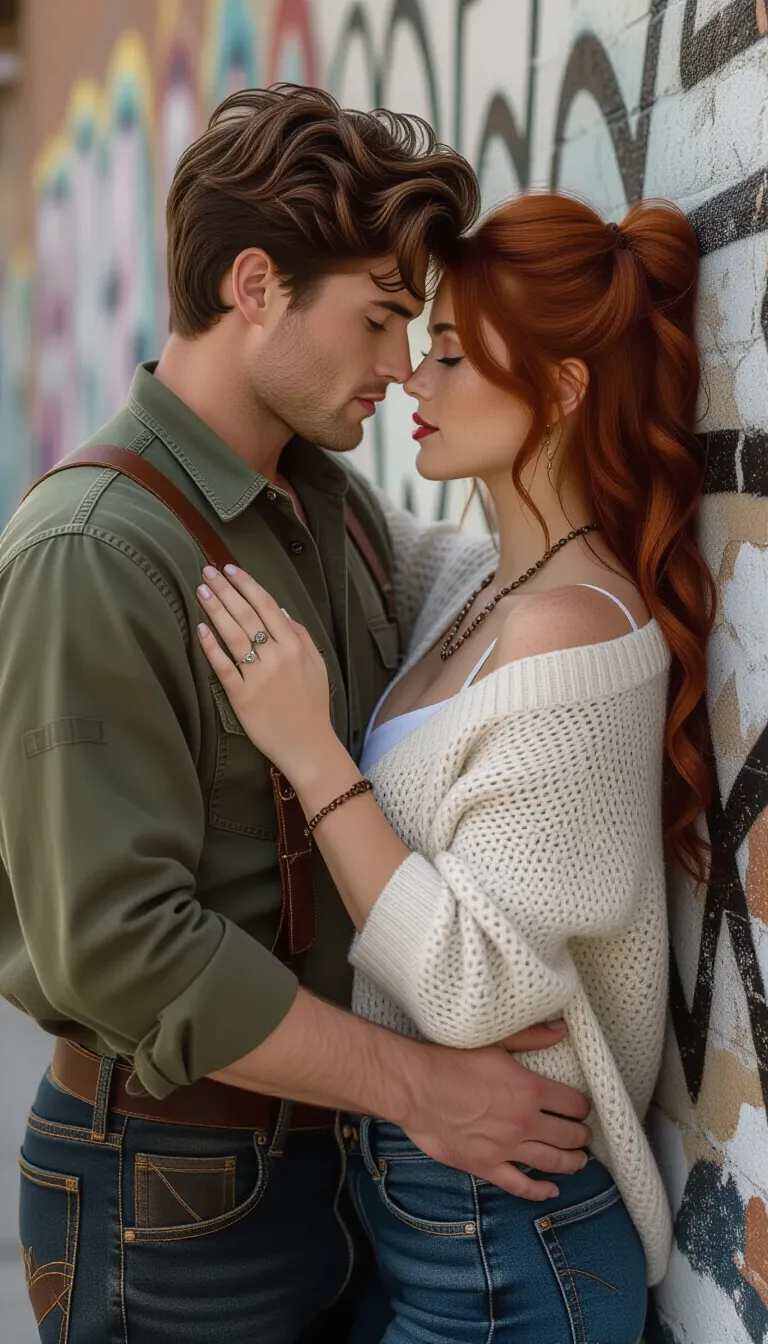
The green door clicked shut behind them, and the silence of Mrs. Byrne's empty house settled like dust—thick, undisturbed, older than either of them. Declan's hand found the lock without looking, thumb sliding the bolt home, and the sound of it was final in a way that made Siobhan's breath catch.
Rough-hewn wood splintered under her palm as her back met the kitchen table. The edge bit into her thighs through her skirt, and she felt the grain through her cardigan, catching at the wool. His hands were on her waist, then her hips, fingers curling into the fabric like he was anchoring himself against a tide.
"Declan—"
He kissed her. Not gentle. Not the careful, desperate kisses of the alley. This one was different—slower, deeper, like he was tasting the shape of her mouth, memorizing the way she trembled when his tongue found hers. His hand slid up her side, calluses catching on her ribs through the thin cotton, and stopped at her jaw.
His thumb found her pulse. Fast. Scared. Alive.
"I can feel it," he murmured against her lips. "Your heart."
She couldn't answer. His thumb pressed lightly, counting, and she felt seen in a way that stripped her bare—not of clothes, but of all the walls she'd built since she'd first walked into that butcher's back room.
Her hair was coming loose. Pins scattered across the worn wood, and she heard them land—tiny metal sounds that marked the unraveling. His fingers tangled in the red waves, pulling gently, and her head tilted back, exposing her throat to the gray light filtering through the dusty window.
"I thought we'd lost it," she whispered. "In the warehouse. I thought—"
"Don't." His voice cracked. "Don't say it."
He kissed her throat, just below her jaw, and her fingers tightened in his hair. The key in his pocket dug into her hip through his trousers, and she felt the hard shape of it—brass, worn smooth by a hand she'd never know. A future pressed between them, or the promise of one.
The table creaked as she shifted, and his hand slid down her spine, pulling her closer. She felt him—hard against her thigh, the heat of him through denim and cotton, the way his breath stuttered when she arched into him.
"The letter," she said. "It's still in your—"
"I know."
"And the names. The key."
"I know."
He pulled back, just enough to meet her eyes. Gray winter sky, the same color it had been in the lane when the scarred man had told him about his father, the same color it had been when he'd read the letter in the bothy, the same color it had been when he'd told her he loved her in the rain beneath the dolmen.
Gray like stone. Gray like something that would not break.
"They're still there," he said. "They'll still be there in the morning. But you—" He touched her cheek, knuckles brushing the freckles scattered across her nose. "You're here. Now. And I need—"
He stopped. Swallowed.
"I need to feel something that isn't hate. Just for a while."
She understood. The bullet she'd fired, the blood on her hands, the weight of what they'd done and what they still had to do—it all lived in her chest like a second heartbeat, ugly and persistent. But under his hands, it quieted.
She kissed him. Soft. A question.
He answered with his hands—sliding under her cardigan, finding the warm skin of her waist, palming the curve of her ribs. His thumb traced the edge of her bra, and she felt the heat of him through the cotton, patient and insistent.
"Declan." His name in her mouth. Raw. Bare.
He lifted her onto the table, and she felt the wood shift beneath her, rough and solid. Her skirt rode up, and his hand found her thigh, calluses rough against the sensitive skin above her knee. She bit her lip, and he watched her do it—watched her mouth, watched her eyes flutter closed.
"Look at me."
She did. Green meeting gray, the only light in the dim kitchen.
"I want to remember this," he said. "Every second. If tomorrow comes for us, I want to remember exactly how you looked—here, in this house, with your hair falling loose and your heart beating under my hand."
Her hand found his chest, over his heart. Steady. Stronger than she'd expected.
"Then stay here," she said. "Stay with me. Don't think about the war."
He lowered his head, pressing his forehead to hers. His breath was warm on her lips, uneven, and she felt the weight of him—all the years of silence, the secrets, the violence he'd carried since he was a boy learning to keep his head down in a city that wanted him dead.
"I don't know how," he whispered.
"Try."
His hand slid higher, up her thigh, his thumb pressing into the heat between her legs through her underwear. She gasped, her hips arching into his hand, and she heard herself make a sound she didn't recognize—small, desperate, hungry.
"Like that?" he asked, his voice rough.
"Yes."
He kissed her again, deeper this time, his tongue finding hers as his thumb pressed harder. She was wet—she could feel it through the cotton, slick and warm, and the knowledge of it made her cheeks flush. He knew. He could feel it. The way her body responded to him, the way she opened for him like a lock finding its key.
"Siobhan." Her name in his mouth, reverent and broken. "I love you."
She couldn't answer with words. She pulled him closer, her legs wrapping around his hips, drawing him against her. He was hard—she felt him through his trousers, pressed against her thigh, and the heat of it made her dizzy.
His hand slid up her stomach, under her bra, finding her breast. His thumb circled her nipple, and she arched into his touch, her head falling back, her hair pooling on the rough wood behind her.
"I want to see all of you," he said. "But I'm afraid—"
"Don't be."
"I'm afraid if I do, I'll never be able to leave."
She reached for him, her hand finding the button of his trousers, fingers moving with practiced hesitation. She'd never done this—not like this, not with meaning, not with someone she was choosing to give herself to.
His hand stopped hers. Not pushing her away—just holding her there, her fingers against the brass button, his hand over hers.
"Not yet," he said. "I want to—I need to—"
He couldn't finish. He lowered his head, pressing his lips to her collarbone, then lower, to the hollow of her throat. His hand slid down her body, over her hip, pressing her into the table as he knelt.
She felt the shift of air, the rough wood against her bare thighs as he pushed her skirt higher. His hands found her hips, thumbs pressing into the bone, and he looked up at her—gray eyes from between her legs, questioning, waiting.
"Can I?"
She nodded. Couldn't speak.
His mouth found her through the cotton, warm and wet, and she bucked against him, her hands gripping the edge of the table. He pulled the fabric aside, and she felt his breath on her—hot, intimate, the most vulnerable she'd ever been—and then his tongue found her, slow and deliberate, and she stopped thinking entirely.
The world narrowed to his mouth, his hands holding her hips steady as she twisted and gasped, the rough wood biting into her palms, the distant sound of rain against the window. She heard herself—small sounds, broken words, his name over and over like a prayer—and she didn't care. Let the whole street hear. Let the war come for them tomorrow.
He found the rhythm she needed, patient and relentless, and she felt the tension coiling in her stomach, her thighs, her chest. He pressed two fingers inside her, and she cried out, her hips meeting his hand, chasing the wave that was building, building—
"Declan—"
He didn't stop. His tongue moved faster, his fingers curling, and she shattered against his mouth, her body arching off the table, her hands twisting in his hair. She heard herself say his name again, broken and raw, and he held her through it, gentle, never stopping until she was trembling and spent.
He rose, his lips slick, his eyes dark. He kissed her, and she tasted herself on him—salt and woman and heat—and she pulled him closer, desperate for more.
"Your turn," she breathed.
He shook his head. "Not yet."
"Declan—"
He kissed her again, softer this time. "I want to feel this. All of it. If we rush—"
"We've been rushing for days."
"Exactly." He pressed his forehead to hers. "I don't want to rush this."
Her hand found the front of his trousers, cupping him through the fabric. He groaned, his eyes closing, his jaw tight.
"Let me," she said. "Please."
He didn't answer. He kissed her instead, hard and hungry, and she used the distraction to work the button free. His breath stuttered as she slid her hand inside, finding him—hot, hard, velvety soft against her palm.
"Siobhan." Warning. Pleading.
She stroked him, slow, learning the shape of him, the way his hips pressed into her hand, the sounds he made when she found a certain rhythm. He was beautiful like this—unraveling, the careful mask gone, every secret written in the lines of his face.
"I want—" He stopped, swallowed. "I want to be inside you."
Her breath caught. "Then—"
"Not here." He pulled back, his hand cupping her cheek. "Not on a table in a stranger's kitchen. When I take you, I want it to be somewhere that matters. Somewhere—" His voice broke. "Somewhere that feels like ours."
She wanted to argue. Her body ached for him, empty and desperate. But she understood. This wasn't just about sex. It was about claiming something the war couldn't touch.
"Promise me," she said. "Tonight?"
He nodded. "Tonight. When we find a bed that's ours, even if it's just for one night."
She kissed him, soft and slow, tasting the future on his lips. His hand found hers, fingers interlacing, and they stayed like that—breath mingling, heartbeats slowing, the rain a steady rhythm against the glass.
The key pressed into her hip. The letter waited in his pocket. The names of the men who killed his father were written on paper that would burn in her memory whether she wanted it to or not.
But for this moment, there was only the green door, the worn table, the gray light, and his hands in her hair.
For this moment, the war could wait.
She felt the shift of air, the rough wood against her bare thighs as he pushed her skirt higher. His hands found her hips, thumbs pressing into the bone, and he looked up at her—gray eyes from between her legs, questioning, waiting.
"Can I?"
She nodded. Couldn't speak.
His mouth found her through the cotton, warm and wet, and she bucked against him, her hands gripping the edge of the table. He pulled the fabric aside, and she felt his breath on her—hot, intimate, the most vulnerable she'd ever been—and then his tongue found her, slow and deliberate, and she stopped thinking entirely.
The world narrowed to his mouth, his hands holding her hips steady as she twisted and gasped, the rough wood biting into her palms, the distant sound of rain against the window. She heard herself—small sounds, broken words, his name over and over like a prayer—and she didn't care. Let the whole street hear. Let the war come for them tomorrow.
He found the rhythm she needed, patient and relentless, and she felt the tension coiling in her stomach, her thighs, her chest. He pressed two fingers inside her, and she cried out, her hips meeting his hand, chasing the wave that was building, building—
"Declan—"
He didn't stop. His tongue moved faster, his fingers curling, and she shattered against his mouth, her body arching off the table, her hands twisting in his hair. She heard herself say his name again, broken and raw, and he held her through it, gentle, never stopping until she was trembling and spent.
He rose, his lips slick, his eyes dark. He kissed her, and she tasted herself on him—salt and woman and heat—and she pulled him closer, desperate for more.
"Your turn," she breathed.
He shook his head. "Not yet."
"Declan—"
He kissed her again, softer this time. "I want to feel this. All of it. If we rush—"
"We've been rushing for days."
"Exactly." He pressed his forehead to hers. "I don't want to rush this."
Her hand found the front of his trousers, cupping him through the fabric. He groaned, his eyes closing, his jaw tight.
"Let me," she said. "Please."
He didn't answer. He kissed her instead, hard and hungry, and she used the distraction to work the button free. His breath stuttered as she slid her hand inside, finding him—hot, hard, velvety soft against her palm.
"Siobhan." Warning. Pleading.
She stroked him, slow, learning the shape of him, the way his hips pressed into her hand, the sounds he made when she found a certain rhythm. He was beautiful like this—unraveling, the careful mask gone, every secret written in the lines of his face.
"I want—" He stopped, swallowed. "I want to be inside you."
Her breath caught. "Then—"
"Not here." He pulled back, his hand cupping her cheek. "Not on a table in a stranger's kitchen. When I take you, I want it to be somewhere that matters. Somewhere—" His voice broke. "Somewhere that feels like ours."
She kissed him first. Hard. Her hand still inside his trousers, still wrapped around him, and she pulled his mouth down to hers and swallowed whatever protest he might have made.
He groaned against her lips, his hips pressing into her hand, and she felt the war in him—the wanting that fought against the waiting, the part of him that wanted to lift her off the table and take her right there on the cold linoleum floor.
"Don't think," she breathed against his mouth. "Just feel."
His hand found her jaw, tilting her face up, and he kissed her like he was drowning—deep and desperate, his tongue sliding against hers, his breath coming fast through his nose. She stroked him slowly, deliberately, feeling every inch of him twitch and harden in her palm, and he broke the kiss with a sound that was almost a sob.
"Siobhan—"
"Shh." She kissed the corner of his mouth, his cheek, the shell of his ear. "I know. You want to wait. I know."
Her thumb traced the head of him, and his whole body shuddered.
"But I want to feel you," she said. "I want to know what I'm waiting for."
He didn't answer. He kissed her instead—slower this time, deeper, his hand sliding down her neck to her collarbone, then lower, finding her breast through her blouse. She arched into his touch, and the movement pressed his length more firmly into her hand, and they both froze for a breathless moment.
"Tell me to stop," he said, his voice rough. "If you want me to stop."
"I don't."
He looked at her then—gray eyes dark, pupils blown wide, the careful mask gone completely. He looked young and scared and hungry, and she loved him so fiercely in that moment that it hurt.
"I want to remember this," she said. "Every detail. The rain. The light. Your hands."
He kissed her wrist, her palm, the inside of her elbow. "The way you taste."
She laughed, soft and broken. "That too."
He pulled back, just enough to look at her. "Kiss me again."
She did.
She kissed him with everything she had—all the fear and hope and hunger of the past five days, all the moments she'd watched him sleep and wondered if he'd wake, all the times she'd pressed her hand to his chest just to feel his heart still beating. She kissed him like the war didn't exist, like the names in his pocket were just words, like the green door was a wall that could keep out every bullet and every ghost.
His hand found her thigh, sliding up under her skirt, and she felt his fingers against her wetness—still sensitive from before, still aching. He touched her gently, almost reverently, and she gasped into his mouth.
"I want—" she started.
"I know." He kissed her again, soft. "But not here. Not yet."
"Then make me forget anyway."
He smiled—a real smile, the kind that reached his eyes and made him look like the boy he might have been before the Troubles stole his childhood. "That I can do."
He kissed down her neck, her collarbone, the hollow of her throat. His hand stayed on her, fingers moving in slow circles, never quite enough to push her over the edge again but enough to keep her trembling. She let her head fall back, her hand still loose around him, and she felt the rain against the window, the rough wood of the table beneath her thighs, the impossible tenderness of his mouth on her skin.
"Tell me something," she said, her voice barely a whisper. "Something I don't know."
He paused, his lips against her shoulder. "What kind of something?"
"Something about you. Before the war. Before Belfast."
He was quiet for a long moment, his fingers still moving, patient and steady. Then: "I used to build birdhouses."
She opened her eyes, looking down at him. "Birdhouses?"
"When I was a kid. My da—" He stopped, swallowed. "My da bought me a book about it. How to build them, where to place them, what kind of birds liked what kind of houses. I made a dozen, maybe more. Hung them in the trees behind our house."
"What kind of birds?"
"Robins, mostly. Blue tits. A pair of blackbirds nested in one and stayed two seasons." He met her eyes. "I haven't thought about that in years."
She reached up, touched his cheek. "That's beautiful."
"It's just birdhouses."
"It's not." She pulled him down, kissed him softly. "It's proof that you were a boy. That you had a childhood. That there was a time before all this."
He closed his eyes, leaned his forehead against hers. "I don't remember that boy."
"I do." She stroked his hair. "He's still in there. I've seen him."
He let out a shaky breath. "When?"
"When you read Yeats. When you look at me like I'm something precious. When you kiss me like you're not afraid of what comes next."
He opened his eyes. They were wet. "I am afraid."
"I know. So am I." She smiled, soft and sad. "But we're afraid together. That has to count for something."
He kissed her again, slow and deep, and she felt the change in him—the relaxation of his shoulders, the gentle pressure of his hand on her thigh, the way his mouth softened against hers. The edge of desperation was still there, but wrapped now in something quieter. Something that felt like trust.
His hand slid out from under her skirt, found hers on the table, interlaced their fingers. He pressed his forehead to hers and they breathed together—slow, steady, matched.
"I love you," he said. "I don't know if I've said it enough. I love you, Siobhan Connolly. I love your freckles and your temper and the way you bite your lip when you're thinking. I love that you shot a man for me and didn't flinch. I love that you smell like chalk dust and lavender and something I can't name."
Tears slid down her cheeks, hot and silent. "Declan—"
"Let me finish." He squeezed her hand. "I love that you believed me when I said I'd die for you. I love that you made me believe I could live for you instead. I love that you're here, in this stranger's kitchen, with rain on the windows and my hand in yours, and you're not running."
She laughed through her tears. "Where would I run to?"
"Anywhere. Away from me. Away from this."
"I'd rather be here." She lifted his hand, pressed her lips to his knuckles. "I'd rather be anywhere with you."
He kissed her forehead, her closed eyelids, the tip of her nose. His hand slid to her waist, pulling her closer, and she felt his warmth through the thin cotton of her blouse. She let her head fall to his shoulder, her hand still resting on his chest, and felt his heart beating under her palm—fast and strong, a rhythm she wanted to memorize.
"What happens tomorrow?" she asked, her voice small.
He was quiet for a moment. "We go to Carlingford. We find the men who killed my father. We figure out what comes after."
"And if they find us first?"
"Then we run. Together." He tilted her chin up, met her eyes. "Or we fight. Together. Either way, we don't separate."
She nodded, a shudder running through her. "Promise?"
"I promise."
Outside, the rain had softened to a drizzle, the gray light fading toward evening. The kitchen had grown dim, shadows pooling in the corners, and the rough wood of the table was warm and worn beneath her thighs. She could see the green door from where she sat, its paint chipped, the lock solid and true.
"We should find a bed," she said quietly. "Before it gets dark."
He nodded, but didn't move. "Just a few more minutes."
She smiled, settling deeper into his arms. "Just a few more minutes."
They stayed like that—intertwined on the kitchen table, the key and letter pressing against her hip through his pocket, the rain a soft percussion against the glass. She counted his heartbeats, one hundred and twelve of them, before he finally stirred.
"Ready?" he asked.
She looked at him. At his gray eyes, his too-long hair, his callused hands still holding hers. At the boy who built birdhouses and the man who'd killed for her and the future that waited somewhere between them.
"Yes," she said. "Take me to bed, Declan Morrow. Make me forget my own name."
He smiled, and it was the most beautiful thing she'd seen in days. "I can do that."
He helped her off the table, her legs shaky, her skirt still twisted. He straightened her blouse, tucked a strand of hair behind her ear, kissed her once more—soft and sweet and full of promise.
"This way," he said, taking her hand.
They walked through the dim kitchen, past the cold stove and the empty sink, toward a narrow hallway and a staircase that creaked under their weight. The war was still out there, waiting. The names were still in his pocket. But for this moment, there was only the dark house, the rain, and his hand in hers, leading her forward.
She followed him into the shadows, into the unknown, into whatever came next.
She followed him, and she wasn't afraid.
His foot found the first step. The wood groaned under his weight, a low complaint that seemed to fill the narrow hallway. Behind him, her breath caught—a soft hitch he felt through the air more than heard. He stopped.
The silence settled around them like dust. Somewhere in the house, water dripped into a sink. A clock ticked on a wall he couldn't see. And beneath that, the rhythm of her heartbeat, fast and fragile, reaching for him through the dark.
He turned. She stood one step below him, her face tilted up, her red hair catching what little light bled through a curtained window at the stair's end. Her eyes were dark pools, unreadable, and her hand trembled in his.
"Are you alright?" he asked, the words barely a whisper.
She nodded. Then shook her head. Laughed a little, breathless and raw. "I don't know. I feel like I should be afraid. Of all of it. But I'm not. I'm just—" She pressed her free hand to her chest, feeling the beat. "I'm just here."
He lifted their joined hands, pressed her knuckles to his mouth. Her skin tasted of salt and the faint sweetness of lavender. "That's enough," he said. "Being here. That's all I need."
She stepped up to stand beside him on the first tread, her body pressing against his side. The stair was narrow. They couldn't stand side by side without touching from hip to shoulder. He felt the warmth of her, the curve of her waist, the trembling in her ribs.
"Declan."
"Yes?"
"Nothing." She shook her head, her cheek brushing his collar. "I just wanted to say your name. In a quiet place. With no one listening."
He said hers back. "Siobhan." He let the syllables sit in the dark, unclaimed by the war, by the names in his pocket, by the morning that would demand everything from them. "Siobhan Connolly."
She kissed his jaw, soft and swift, a brush of warmth that made his eyes close.
The next step groaned under his weight when he climbed it. She followed, the third step crying out beneath her. They climbed slowly, one at a time, the staircase complaining with each footfall, and between the groans there was only the sound of their breathing and the racing of her heart—he could hear it now, a wild percussion in the quiet.
On the landing, the floorboards leveled. A long hallway stretched before them, doors on either side, all closed. At the far end, a window showed the bruised sky, the last of evening bleeding into night. No light came from under any of the doors. The house was empty. They were alone.
He stopped at the first door, his hand on the knob. The brass was cool and tarnished under his fingers. He didn't turn it.
"What is it?" she asked, her voice small in the corridor.
"I want to remember this," he said. "Every second of it. The way you're standing. The way the light catches your hair. The sound of your breathing." He turned to face her, his back against the door. "Promise me you'll remember it too."
"I will." She stepped closer, her hands finding his chest, resting flat over his heart. "I promise."
He pressed her against the wall beside the door, gentle but deliberate, his forearms caging her. Her head thudded softly against the floral wallpaper, and her hands slid up to his shoulders, her fingers curling into the fabric of his shirt.
He kissed her. Slow. Deep. The kind of kiss that said everything he didn't have words for—that he was terrified, that he was grateful, that he loved her more than he'd ever loved anything, that the names in his pocket felt like stones but her mouth felt like mercy.
She answered with the same language. Her tongue sliding against his. Her fingers threading into his hair. The small sound she made in her throat, a hum that vibrated through his chest and pooled low in his belly.
His hand found the door behind him, turned the knob. It clicked open.
The room was small—a single bed pushed against the wall, a nightstand with a lamp, a crucifix hanging above the headboard. The sheets were white and smelled of line-dried linen. A window faced the back garden, the glass streaked with rain, the world beyond smudged and softening into dark.
He led her inside, closed the door behind them. The latch engaged with a soft click, and the silence of the room wrapped around them like a held breath.
She stood beside the bed, her hands at her sides, watching him. Her hair was loose now, spilling over her shoulders, and in the dim light filtering through the window, her freckles were constellations he wanted to memorize.
"You're so beautiful," he said. "I don't think I've said that enough either."
She reached for the buttons of her blouse. Her fingers were steady, purposeful, and he watched them—the way she undid each button slowly, the skin of her throat appearing, then the delicate hollow at the base of her neck, then the lace edge of her brassiere.
She let the blouse fall, and the sound it made hitting the floor was like a door opening.
His hands found her waist, sliding under the waistband of her skirt, and he knelt. Not to worship. Not to beg. Just to be level with her, to press his cheek against her stomach, to feel her hands in his hair, to hear her heartbeat from this new altitude.
"Declan." She said his name like a prayer.
"I'm here."
He looked up at her. Her face was half in shadow, her eyes bright with something that could have been tears or could have been want. He couldn't tell. He didn't need to.
He reached up, unhooked her brassiere, and she let it slide from her shoulders. Her breasts were small and pale, the nipples dark and already peaked. She crossed her arms, a flicker of shyness, and he caught her wrists, gently, and drew them apart.
"Don't," he said. "Don't hide from me."
She let her arms fall. Let him look.
He pressed his mouth to her sternum, to the warm skin between her breasts, to the thrum of her heart under his lips. She gasped, her hands fisting in his hair, and he stayed there for a long moment, listening to her rhythm, feeling the tensile strength of her body under his hands.
He stood, his hands finding her hips, and walked her backward until the backs of her knees hit the bed. She sat. Then lay back, her hair spreading across the white pillowcase, her eyes never leaving his.
He stood at the bedside, looking down at her. The evening light had almost gone, but he could still see the lines of her—the hollow of her throat, the curve of her hip, the way her fingers reached for him in the dark.
He undressed in a slow, deliberate rhythm. Shirt off. Belt unbuckled. Trousers puddled at his ankles. He stepped out of them and stood before her in nothing but his skin, the scar on his ribs silver in the dim light, the calluses on his hands catching the shadows.
She reached for him, her fingers brushing the curve of his hip, and he felt the touch like a brand. His cock was hard, aching, but he didn't move to take her. Not yet. He lay beside her, drawing her against him, skin to skin, and felt the full length of her press against his body.
"I love you," she said, her lips against his throat.
"I love you too." He traced the line of her spine, from the nape of her neck to the small of her back, feeling each vertebra, the delicate architecture of her living, breathing body. "I love every part of you. Every scar. Every freckle. Every word you haven't said."
She kissed his shoulder, his collarbone, the hollow at the base of his throat. Her thigh slid between his, the heat of her pressing against him, and he felt himself harden further, his breath catching.
"I don't know what happens tomorrow," she said, her voice thick. "I don't know if we'll find them, or if they'll find us first, or if there's any way out of this that doesn't end with both of us dead."
"Don't."
"But I know this." She lifted her head, met his eyes in the near-dark. "I know that I'm here. With you. In this bed. In a stranger's house, with the war outside and the names in your pocket, and I choose it. I choose you. Every time."
She lay beneath him, her body soft and open, her hands tracing the lines of his shoulders, the curve of his spine, the places where muscle met bone. Her skin was warm against his, the heat of her seeping into him like a promise he was afraid to believe.
He kissed her throat, the hollow behind her ear, the corner of her mouth. Each kiss a question. Each kiss an answer. Her fingers found the scar on his ribs, traced it slowly, and he felt the touch like a current running through him.
"Tell me what you need," he said, his lips against her jaw.
Her breath caught. Her hand stilled on his chest. The silence stretched between them, filled with the sound of rain against the window, the creak of the old house settling around them.
"I need you to stay," she said finally. "That's all. Just stay."
He lifted his head, looked down at her. Her eyes were dark in the dim light, her lips parted, her hair a spill of flame across the white pillow. She looked like something he'd dreamed once and never expected to hold.
"I'm not going anywhere." He traced her cheekbone with his thumb, the curve of her jaw, the soft skin beneath her ear. "I'm right here."
She pulled him down, her mouth finding his, and the kiss was different now—slower, deeper, less desperate. A kiss that had time. A kiss that believed in tomorrow.
His hand slid down her side, over the curve of her hip, along the outside of her thigh. She shivered under his touch, her leg curling around his, drawing him closer. The heat of her pressed against him, and he felt himself harden, felt the ache building low in his belly.
He wanted to be slow. He wanted to memorize every inch of her, every sound she made, every tremor of her body under his hands. But the wanting was a fire in his blood, and his hands were shaking with the effort of restraint.
She felt it. Of course she did. Her hand found his, guided it lower, pressed his palm against the heat between her thighs. She was wet, slick and ready, and the sound she made when his fingers found her was a gasp that broke against his mouth.
"Declan." Her voice was a thread, fraying. "Please."
He positioned himself at her entrance, the tip of him pressing against her, and he stopped. He hovered there, his forehead against hers, their breath mingling in the dark.
"Look at me," he said.
She opened her eyes. They were bright, wet, full of something that made his chest ache.
"I love you," he said. "I need you to know that. Whatever happens tomorrow, whatever we find, whatever's waiting for us—I love you. And I will spend the rest of my life proving it, if you let me."
She smiled, a tremulous thing that barely held. "Then prove it."
He pushed forward, the barest increment, and the heat of her swallowed him, her body opening around him like a door he'd been afraid to walk through. Her breath left her in a rush, her fingers digging into his shoulders, and he stopped immediately, his forehead pressed to hers, his whole body trembling with the effort of holding still.
"Are you—"
"Yes." Her voice was barely a whisper. "God, yes. Don't stop."
He pushed deeper, slowly, feeling every inch of her give way, the tight heat of her drawing him in, and the sound she made—a broken, grateful thing—went through him like a blade. He buried his face in her neck, breathing her in, the salt of her skin, the lavender soap still clinging to her hair, and he felt her hand on the back of his head, holding him there.
"I'm here," she said. "I'm here."
He moved, a slow, rolling thrust that made her gasp, her hips rising to meet him, and the rhythm found them like something they'd known all their lives but never spoken aloud. The bed creaked beneath them, the rain against the window a constant drum, and the world outside—the names in his pocket, the war waiting at the door, the ghosts of fathers and brothers—shrank to nothing but the space between their bodies.
Her hand slid down his back, tracing the curve of his spine, and she arched into him, her breath hitching in a way that made his chest ache. He watched her face in the dim light—the way her eyes fluttered closed, the way her lips parted, the way the freckles across her nose seemed to blur as the color rose in her cheeks—and he felt something crack open inside him, something he'd been holding closed since he was a boy watching his mother cry in the kitchen.
"Look at me," he said. His voice was rough, scraped raw.
She opened her eyes. They were dark, wet, full of light.
"I want you to see me," he said. "When you—I want you to see me."
She nodded, her hand coming up to cup his jaw, her thumb tracing the line of his cheekbone. "I see you," she said. "I see all of you."
He moved again, deeper, slower, and she took him fully, her legs wrapping around his waist, pulling him closer, and the feeling of her—the heat, the pressure, the way she said his name like a prayer—pushed him toward the edge too fast. He pulled back, slowed, his breath ragged against her throat.
"Not yet," he said. "Not yet."
Her laugh was a soft, broken thing. "Don't you dare."
He smiled against her skin, and the smile felt foreign, like a muscle he hadn't used in years. He kissed her throat, the hollow behind her ear, the corner of her mouth, and each kiss bought him a moment, a breath, a chance to hold the feeling before it slipped away.
Her hand slid between them, her fingers finding where they joined, and the touch sent a jolt through him that nearly undid everything. He caught her wrist, gently, and pressed it to the pillow above her head.
"Not yet," he said again.
"Declan." Her voice was a plea, fraying at the edges. "I need—"
"I know." He kissed her, slow and deep, his tongue sliding against hers, and he felt her surrender in the softening of her body, the way her hips pressed against him demandingly even as her mouth yielded. "I know what you need. Let me give it to you."
He pulled back, shifted his weight, and the new angle made her gasp, her hands fisting in the sheets. He watched her face as he moved—watched the flutter of her eyelids, the way her lips formed his name without sound, the flush spreading down her chest—and he memorized every detail, every moment, every breath.
The rhythm built slowly, a tide rising, and he felt her climbing toward something, her body tightening around him, her breath coming in short, sharp gasps. He wanted to push her over, wanted to feel her break apart beneath him, but he held back, staying at the edge, drawing it out, because he never wanted this moment to end.
"Declan." Her voice cracked. "Please."
"I've got you." He pressed his forehead to hers, his eyes closed, his breath mingling with hers. "I've got you."
He moved faster, deeper, and he felt her surrender—felt the moment she stopped thinking, stopped holding back, stopped being afraid—and she cried out, her body arching against his, her nails raking down his back, her voice a raw, broken thing that sounded like his name and something more.
The feeling of her around him, pulsing and tight and warm, pushed him past the edge he'd been holding, and he followed her, his body tensing, his breath catching, his face buried in her neck as he poured himself into her and felt her hold him through it, her hands stroking his hair, her lips pressing soft kisses to his temple.
They lay still, tangled together, their breath slowing in the dark. The rain had softened to a drizzle, tapping gently against the window, and somewhere in the house a pipe creaked, settling into the silence.
He lifted his head, looked down at her. Her eyes were closed, her lips parted, her hair a wild tangle of red against the white pillow. She looked younger in the dim light, softer, like a girl who'd never learned to be afraid.
"Siobhan."
She opened her eyes, slow and heavy-lidded, and smiled—a real smile, warm and full and unguarded.
"That's going to be hard to top," she said.
He laughed, a surprised sound that escaped before he could stop it, and she laughed with him, their bodies shaking together in the narrow bed, and for a moment the war was just a story someone had told them about a different world.
"I love you," he said, because he couldn't say anything else, because the words had to come out or they'd choke him.
"I know." She traced the line of his jaw, the curve of his lips. "I love you too."
He rolled onto his back, drawing her with him, and she settled against his side, her head on his chest, her hand splayed over his heart. He could feel each beat, steady and real, and he counted them like a prayer.
"What happens tomorrow?" she asked, her voice soft.
He stared at the ceiling, at the cracks in the plaster, at the way the shadows pooled in the corners. The names were still in his pocket, pressed against his hip. The key was on the nightstand, cold and heavy. The letter from his father was folded into his coat, a ghost he carried everywhere.
"Tomorrow," he said, "we find them."
She didn't flinch. Didn't pull away. She pressed closer, her lips brushing his chest, and said, "Together."
"Together."
The rain stopped. The house settled into silence. And they lay there, naked and warm and alive, while outside the window the first pale light of dawn began to creep across the sky, thin and gray and full of promise.
The world narrowed to the space between them—her breath against his chest, his hand tracing the curve of her spine, the slow thrum of two hearts finding the same rhythm. The narrow bed held them like a boat on a vast sea, and for a long moment neither spoke, the silence a language they were still learning.
Her fingers wandered across his collarbone, tracing the hollow at the base of his throat, the ridge of his shoulder, the scar on his ribs she'd found earlier. Each touch was a question he answered with stillness, with surrender, with the softening of muscles he'd held tight for so long they'd forgotten how to let go.
"Your heart's slowing down," she said, her voice drowsy against his skin.
"So's yours."
She lifted her head, her hair falling across his chest in a tangle of red and copper. In the gray light filtering through the thin curtains, her eyes were the color of moss after rain, soft and deep and full of something that made his chest ache.
"I can hear it," she said. "When I put my ear to your chest. It's like... a drum. Far away. Steady."
He ran his hand through her hair, the strands slipping between his fingers like water. "What else do you hear?"
She was quiet for a moment, her ear pressed to his heart again. "Rain. On a roof somewhere. A door closing in another house. And you. Just you."
He closed his eyes. The words settled into him like warmth from a fire, spreading through the cold spaces he'd carried so long he'd forgotten they were there.
They lay still, breathing together, and the quiet wrapped around them like a blanket too thin for the winter but enough for now. Somewhere in the house a floorboard creaked, settling into the cold. The pipes groaned once, then fell silent. The world outside held its breath.
She shifted, propping herself up on one elbow, looking down at him. Her hand found his face, her thumb tracing the line of his jaw, the dip beneath his lower lip, the small scar above his eyebrow he'd gotten falling out of a tree when he was twelve.
"Tell me something," she said. "Something I don't know."
He thought about it. The things he hadn't told her—the nights he'd lain awake after his father's death, the way he'd learned to read a room for exits before he'd learned to read a book, the time he'd held a gun on a man and watched him beg and had felt nothing at all.
"I used to have a dog," he said. "When I was a boy. A collie named Finn. He followed me everywhere."
Her smile was soft, crooked. "What happened to him?"
"He got old. Couldn't walk much by the end. I carried him up the stairs to my room every night so he could sleep at the foot of my bed." He paused, the memory sharp and clear, the weight of the dog in his arms, the smell of fur and earth and something that was fading. "Da said we should put him down. I wouldn't let him. Finn died in his sleep three weeks later, curled up on my feet."
She was quiet, her hand still on his face.
"I buried him in the field behind our house," he said. "Under the oak tree. I carved his name into the bark so I'd remember where he was."
"Do you still remember?"
"Every day."
She leaned down and kissed him, soft and slow, her lips lingering against his like she was tasting the memory he'd given her. When she pulled back, her eyes were bright, catching the thin light from the window.
"I used to climb the bell tower at St. Mary's," she said. "After school. Before anyone knew. I'd sit up there and watch the city and pretend I could see the whole world."
"Did anyone ever catch you?"
"Father Brennan, once. He told me girls weren't meant for heights. Told me I'd break my neck and give my mother a heart attack." She laughed, a soft, breathy sound. "I told him I'd rather break my neck than break my spirit. He never spoke to me again."
He smiled, the expression pulling at muscles that felt brittle with disuse. "That's my girl."
"Always was," she said. "Even when I didn't know it yet."
She settled against him again, her head finding its place on his chest, her hand splaying over his heart. He could feel the beat of it under her palm, steady and true, a promise he hadn't known he was making.
The light through the curtains shifted, growing thinner, grayer, the first true signs of dawn bleeding into the sky. He watched it creep across the ceiling, painting the cracks in the plaster, the water stains, the shadows of the furniture that stood sentinel in the corners.
"What do you think it'll be like?" she asked, her voice soft, almost dreamy. "The house by the sea."
He let the image form—white walls, a blue door, windows that opened to the sound of waves. A garden where she could grow things, flowers or vegetables or whatever she wanted. A room with a desk where he could work, wood shavings on the floor, the smell of sawdust and salt air.
"Small," he said. "But warm. A fire in the winter. A porch where we can sit in the summer and watch the light change."
"A garden?"
"If you want one."
"I want roses," she said. "Red ones. And a bench where I can sit and read while you work."
"Done."
"And a dog."
He laughed, the sound surprising him. "A dog?"
"A collie," she said. "Like Finn. We'll call him Finn the Second."
"Finn the Second," he repeated, testing the name. "He'll have big paws to fill."
"He'll manage." She pressed a kiss to his chest, right over his heart. "He'll have you to show him how."
The words settled into him, warm and heavy and real. He held her tighter, his arm around her waist, his hand resting on the curve of her hip. The future they were building was fragile, made of hope and unlikely odds, but in this moment it felt solid. Real. A thing he could hold.
Her breathing slowed, deepened, and he felt her body relax against his, the tension seeping out of her muscles like water finding its level. He watched her face in the growing light—the flutter of her eyelids, the soft part of her lips, the faint crease between her brows that smoothed as she drifted toward sleep.
He didn't close his eyes. He couldn't. Every second felt borrowed, stolen from a world that wanted them dead, and he was going to hoard every one.
He traced the line of her back, the dip of her waist, the curve of her hip. Her skin was warm, soft, dotted with freckles he'd spent the night mapping. He pressed a kiss to her forehead, her temple, the corner of her mouth, each one a seal on a promise he'd made in the dark.
"Siobhan," he whispered.
She stirred, her eyes fluttering open, cloudy with sleep. "Mm?"
"Thank you."
She blinked, focusing on him. "For what?"
He didn't have the words. For staying. For choosing him. For being the thing that made the world worth surviving. For looking at him like he was something good when everyone else had seen only a Protestant, a carpenter, a man with blood on his hands.
"For everything," he said. "For being here. For not leaving."
She reached up, her hand cupping his cheek, her thumb brushing the corner of his eye where something wet and traitorous had gathered. "I'm not going anywhere, Declan Morrow. You're stuck with me."
"Good."
She smiled, that slow, unguarded smile that made him believe in things he'd stopped believing in years ago. "Good."
She closed her eyes again, her hand still on his face, her body pressed against his, and he felt her drift back toward sleep, her breath evening out, her fingers slackening against his skin.
He lay there, watching the light grow, the room taking shape around them—the dresser with its cracked mirror, the wardrobe with its door slightly ajar, the window with its thin curtains that did little to keep out the cold. The key sat on the nightstand, brass and heavy, a promise of a future he didn't know how to reach. The names were in his pocket, folded into paper that felt heavier than lead. The letter from his father was somewhere in his coat, a ghost he carried everywhere, a truth he was still learning to hold.
But here, in this narrow bed, with her warm and soft and alive against him, the weight was bearable. The future was possible. The war was somewhere else, a separate country he could visit later, when he had to.
He pressed another kiss to her hair, closed his eyes, and let himself believe, for just a moment, that they would make it.
That the house by the sea was waiting.
That the dawn breaking through the curtains was the first light of a world where they could breathe.
Her hand moved in her sleep, finding his, their fingers interlacing over his heart. He held on, tight and gentle, and let the quiet have them.
The rain had stopped. The house was still. And somewhere outside, the world was waking up, full of danger and hope and everything they were running toward.
The sound came from nowhere — an engine, low and rumbling, cutting through the quiet like a blade through skin.
Declan's eyes snapped open. His body went rigid beneath her, every muscle locking into place, the softness of the last hour evaporating like mist off the Lagan. Siobhan stirred against him, her fingers tightening on his chest, and he felt her breath catch as she registered the change in him before she heard what he'd heard.
"Declan—"
"Shh."
He was already moving, sliding out from under her with a quietness that felt practiced, ancient, a thing his body knew without his mind telling it. The cold air hit his skin and he didn't flinch. He crossed to the window in three steps, pressing himself against the wall beside it, his hand finding the edge of the curtain and pulling it back a fraction of an inch.
The street below was gray and wet, the cobblestones gleaming like fish scales in the weak dawn light. A car — a dark sedan, make he couldn't identify from this angle — had pulled to a stop at the end of the lane, idling with the sort of patience that meant business.
Not a delivery. Not a lost driver. This was a car that had found what it was looking for.
"How many?" Siobhan's voice was low behind him, and he heard the rustle of her gathering the sheet around herself, heard her feet on the floorboards.
"One car. Can't see how many inside."
The engine cut. The silence that followed was worse — a held breath, a room waiting for a door to open.
Declan's mind moved through options like a man counting bullets. The back door. The garden wall. The lane that ran behind the houses, if it wasn't blocked. The roof, if they could reach it. The cellar, if Mrs. Byrne had one, if it wasn't a death trap.
His trousers were on the chair by the dresser. His shirt was on the floor somewhere. The revolver was in his coat pocket, hanging from the bedpost.
He was crossing to it when the knock came.
Three sharp raps, authoritative, unhurried. The knock of a man who knew exactly which door he was standing at.
Siobhan's hand found his arm, her fingers digging into his skin hard enough to leave marks. He looked at her — her eyes wide, her hair a tangled mess of red against the white sheet she'd wrapped around herself, her lips still swollen from the night before.
He saw the fear in her. He also saw something else. Something steady. Something that said she'd already made her peace with whatever came next.
"Get dressed," he whispered. "Quietly. Stay behind me."
She didn't argue. She moved, grabbing her clothes from the floor, pulling them on with the economy of someone who'd learned to dress in a hurry. He did the same, his fingers finding the buttons of his shirt, the zip of his trousers, the weight of the revolver settling into his hand like a familiar tool.
The knock came again. Harder this time. A fist, not knuckles.
"Mrs. Byrne." A man's voice, rough with a Belfast accent that thickened the vowels. "Open the door. Police."
Declan's blood went cold. RUC. They'd found them. Or someone had talked. Or the car from Dublin had been followed. Or any of a hundred ways this could end, all of them bad, all of them ending with a cell or a bullet.
Siobhan was at his side, fully dressed now, her hair still loose, her feet bare on the cold floor. She looked at the revolver in his hand, then at his face.
"Don't," she said. Her voice was steady. "If we shoot our way out, we're dead. You know that."
"If we open that door, we're dead."
"Maybe." She took his hand, the one holding the gun, and pressed it between both of hers. "But maybe not. Maybe it's just a check. Maybe they don't know we're here."
"They knocked on this door."
"They knocked on Mrs. Byrne's door. They might not know who's inside."
He wanted to argue. He wanted to find the back door, break through the garden wall, run until his lungs gave out. But she was right, and he hated it, and he loved her for it, and the combination of those two things made him feel like he was being split open from the inside.
The knock came a third time. "Mrs. Byrne, last warning. Open the door or we'll—"
Declan moved before he could think about it. He crossed to the top of the stairs, the revolver hidden at his side, his voice steady and rough with sleep. "Hold your horses. I'm coming."
He heard Siobhan's sharp intake of breath behind him. He didn't look back. He couldn't afford to see her face, because if he saw her face he'd lose his nerve, and if he lost his nerve they were both dead.
He descended the stairs one at a time, his bare feet silent on the worn wood. The kitchen was below him, the green door solid and brutal in the gray light filtering through the windows. He could see the shape of a man through the frosted glass — tall, broad-shouldered, his cap pulled low.
Declan stopped at the bottom of the stairs. He took a breath. He tucked the revolver into the back of his waistband, pulled his shirt down over it, and crossed to the door.
He unlocked it.
The man on the other side was not RUC. He was mid-fifties, heavy-set, with a face that had seen more pubs than churches. He wore a flat cap and a tired overcoat, and his eyes widened when he saw Declan standing there in his shirtsleeves, barefoot, sleep-rumpled.
"Who the hell are you?" The man's voice was suspicious, but not hostile. Curious, more than anything. "Where's Mrs. Byrne?"
Declan's mind moved. Names. Stories. A reason to be here. "She's not here. Left yesterday. Said I could stay until the end of the week."
"Left? Left where?"
"Didn't say. Said she'd be back Sunday."
The man squinted at him, his eyes traveling over Declan's face, his clothes, the slight bulge at his back that the shirt didn't quite hide. Declan held still, let himself be read, kept his breathing even.
"You're not from here," the man said finally.
"No."
"Where you from?"
"Belfast."
The man's expression flickered — a tightening around the eyes that Declan recognized. The look of a man who'd just found a piece he didn't like in a puzzle he hadn't known he was solving.
"Belfast," the man repeated. "That right."
"That right."
A long silence. The man's hand drifted toward his coat pocket, and Declan's body tensed, ready to move, ready to reach for the revolver and end this before it could begin. But the man's hand stopped, hovered, and then returned to his side.
"You know a man named Robert Fletcher?"
The name hit Declan like a fist to the chest. Fletcher. The loyalist commander. The man who'd ordered his father's death. The name from O'Connell's list, folded in his pocket, pressed against his heart like a splinter.
"No," Declan said. "Should I?"
The man studied him for another long moment. Then he shook his head. "Probably not. Fletcher's been asking questions, that's all. Looking for a man and a woman, came through from Dublin. Thought they might be here."
"They're not."
"Clearly." The man's lips twitched — not quite a smile, but close. "Tell Mrs. Byrne I stopped by when she gets back. Tell her Seamus was looking for her."
"I'll do that."
The man turned, walked back down the path, his boots loud on the wet stones. Declan watched him go, his hand still resting on the doorframe, his heart hammering so hard he was certain the man could hear it.
The car door opened. The man got in. The engine coughed to life, and the sedan pulled away, its tires splashing through puddles, disappearing around the corner at the end of the lane.
Declan closed the door. He leaned his forehead against the wood, his breath coming shallow and fast, his hands shaking.
He felt her before he heard her. Her arms around his waist, her cheek pressed between his shoulder blades, her voice a whisper against his shirt. "That was close."
"Too close."
"He knew you were lying."
"He knew." Declan turned, pulling her into his arms, holding her tight enough that he could feel her heartbeat against his own. "He knew and he let us go anyway."
She pulled back, looking up at him. "Why?"
"I don't know." He shook his head. "But we can't stay. We have to move. Now."
She nodded, her jaw tight, her eyes clear. She didn't argue. She didn't hesitate. She just turned and walked back up the stairs, already gathering their things, already moving toward the next step of a journey that felt like it would never end.
Declan stood in the kitchen, the green door at his back, the revolver pressed against his spine, and he let himself feel it — the fear, the relief, the love that was so large it threatened to crack him open.
He followed her upstairs.
Declan stood at the green door, his hand closed around the brass key in his pocket, the folded paper with the names pressing against his chest. The wood grain was rough under his palm, splintered in places, worn smooth where hands had touched it over decades. He could feel her behind him, the weight of her gaze, the silence that wasn't silence at all — it was the sound of a decision waiting to be made.
"Declan."
Her voice was soft but steady. He turned. She stood at the bottom of the stairs, the revolver tucked into her waistband, his mother's Saint Christopher medal around her neck, her hair a dark cap against her skull where they'd cut it short. She looked smaller somehow, and fiercer, and so beautiful it made his chest ache.
"I have the key," he said. "And the names."
"Then we go." Not a question. A statement. A choice she'd already made.
He pulled the paper from his pocket, unfolded it, looked at the names written in O'Connell's careful hand. Robert Fletcher. Thomas Gorman. Samuel Reid. Three men who'd killed his father, who were living in Carlingford, who had no idea he was coming. The paper trembled in his fingers. He folded it again, pressed it back against his heart.
"Carlingford," he said. "Fletcher lives in a house on the quay. Gorman runs a pub on the main street. Reid works at the shipyard."
"You want to find them."
"I want to look them in the eye." He paused, his throat tightening. "I want to know why."
She crossed the room, her bare feet silent on the flagstones. She stopped in front of him, close enough that he could smell the soap from Mrs. Byrne's bathroom, could see the faint shadows under her eyes, the small cut on her lip from where she'd bitten it during the night. She reached up, her fingers brushing his jaw, and he leaned into her touch like a man starved for warmth.
"Then we find them," she said. "Together."
He kissed her. Soft and slow, a promise more than a passion. When he pulled back, her eyes were bright, her breath shallow.
"We need a car," he said.
"The shed out back. Mrs. Byrne mentioned it — an old Ford, she said. Keys hanging by the back door."
He looked at her, surprised. She smiled, a thin, tired smile that didn't quite reach her eyes. "I asked before you came downstairs. While you were staring at the door."
"You're always three steps ahead."
"Someone has to be." She reached for his hand, her fingers interlacing with his. "Come on. The sooner we move, the less time Seamus has to change his mind and tell someone we were here."
They moved through the house together, their footsteps quick and deliberate. The kitchen was warm, the coals still glowing in the grate, a half-empty cup of tea on the table where she'd left it. Declan grabbed two apples from a bowl on the counter, wrapped them in a tea towel, tucked them into his coat. Small things. Practical things. The habits of a man who'd learned to survive.
The back door opened onto a narrow garden, overgrown with weeds, a single rose bush struggling against the wall. The shed leaned against the fence, its roof sagging, its door hanging crooked on rusted hinges. He pulled it open, and there it was — a Ford Anglia, pale blue, dusty, its tires low but intact. He reached above the doorframe, his fingers finding a nail, a ring of keys hanging from it.
"We're lucky," she said, standing behind him, her voice low.
"Lucky doesn't last." He unlocked the car, slid into the driver's seat. The engine coughed twice, three times, then caught, rattling to life with a sound that seemed too loud in the quiet morning. She climbed in beside him, closed the door gently, as if noise itself was a weapon.
He drove them out of the lane, past the green door, past the corner where Seamus's car had disappeared, past the sleeping houses with their curtains drawn and their secrets locked inside. The road wound through fields, past stone walls and sheep and the distant blue of the mountains, and neither of them spoke. There was nothing to say that they hadn't already said.
The sun climbed higher. The road unspooled. And Declan drove toward Carlingford with the names in his pocket and the woman he loved at his side, and the future waited for them like a held breath.
She reached across the seat, her hand finding his, her fingers tracing the calluses on his palm. He looked at her. She was watching the road ahead, her profile sharp against the morning light, her jaw set, her eyes clear.
"What are you thinking?" he asked.
She was quiet for a long moment. Then she said, "I'm thinking that I've never been to the sea."
"Carlingford's on the coast."
"I know." She turned to him, and there was something in her eyes — a hope so fragile it looked like fear. "When this is over, I want to stand on the beach. Just stand there and watch the water. And not run from anything."
He squeezed her hand. "We will."
"Promise?"
"I promise."
She smiled, and he felt it like a blade slipping between his ribs — clean and sharp and true. He looked back at the road, at the fields and the sky and the distant line of the sea, and he let himself believe it. Just for a moment. Just for the space of a breath.
Then they rounded a bend, and he saw the checkpoint ahead.
A Land Rover parked across the road, two soldiers in green, a third man in civilian clothes leaning against the hood. British Army. Regulars. The kind of checkpoint that made the heart stop and the hands sweat. The kind you couldn't avoid if you were driving this road, not unless you knew every field and farm track between here and the coast.
Declan's foot eased off the accelerator. His hands tightened on the wheel, his knuckles white.
"Declan." Her voice was calm, but he heard the edge underneath. "I don't have papers."
"Neither do I."
He kept driving, slow and steady, his mind racing through options, through lies, through the weight of the revolver pressed against his spine. He could turn around. Drive back the way they'd come. Find a track, a field, a way around. But the soldiers had already seen them. The civilian was watching, his head turned, his hand lifting in a slow, deliberate wave.
Declan pulled over.
He killed the engine. The silence rushed in, thick and heavy, broken only by the distant cry of a bird and the sound of boots on gravel.
"Let me do the talking," he said.
"Declan—"
"Let me do the talking." His voice was firm, but not harsh. He looked at her, held her gaze. "Whatever happens, stay quiet. Stay behind me. And if I tell you to run, you run."
She opened her mouth to argue. Then she closed it, nodded once, her hand finding his and squeezing.
The soldier reached the window. He was young, maybe twenty-two, with a face that hadn't yet learned to hold a grudge. He tapped on the glass, and Declan rolled it down, the cold air rushing in, carrying the smell of diesel and wet grass.
"Morning, sir. Where are you headed?"
Declan kept his voice even. "Carlingford."
"Business or pleasure?"
"Visiting family."
The soldier's eyes flicked to Siobhan, then back to Declan. "And the young lady?"
"My wife."
The lie came easy. So easy it scared him.
The soldier studied them for a long moment. Then he said, "Papers, please."
Declan reached into his coat, his fingers brushing the folded paper with the names, the key, the revolver. He pulled out his wallet, took out his driver's license, handed it through the window. His hand was steady. His heart was a war drum in his chest.
The soldier looked at the license, looked at Declan, looked at the license again. "Declan Morrow. Belfast address."
"That's right."
"You're a long way from home, Mr. Morrow."
"Family, like I said."
The soldier handed the license back. "Your wife's papers?"
Declan's throat went dry. His mind raced, scrambling for a lie, a distraction, anything. But before he could speak, Siobhan leaned forward, her hand touching his arm, her voice warm and apologetic.
"I'm sorry, Officer. I left my bag at the house — we were in such a rush this morning. My mother-in-law's not been well." She smiled, sheepish and sweet, the picture of a flustered young wife. "I can give you my name, if that helps. Siobhan Morrow. I'm a teacher at St. Mary's in Belfast."
The soldier hesitated. He looked at her, at her short hair, her freckled face, her steady green eyes. Then he nodded, stepping back from the window.
"Keep your papers with you next time, Mrs. Morrow. There's a lot of trouble on these roads."
"I will. Thank you, Officer."
The soldier waved them through. Declan started the engine, his hands shaking, his breath coming shallow and fast. He pulled away, slow and calm, resisting the urge to floor the accelerator, to flee, to disappear into the morning light.
They drove in silence for a long time. Past the checkpoint, past the next bend, past the fields and the farms and the slow rise of the mountains.
When they were clear, she let out a long, shuddering breath. "That was too close."
"You were brilliant."
"I was terrified."
"You hid it well." He glanced at her, a small smile touching his lips. "Mrs. Morrow."
She laughed — a short, surprised sound, like she'd forgotten she could. "It sounded right, didn't it?"
"It did."
She looked at him, her eyes soft. "Siobhan Morrow." She tested the name. "I think I like it."
His chest tightened. He looked back at the road, but he was smiling. "So do I."
The road curved, and the sea appeared — a silver line on the horizon, vast and patient and eternal. Declan drove toward it, the key in his pocket, the names against his heart, and the woman he loved beside him, her hand in his, her breath steady, her future written in the lines of her face.
Carlingford was waiting.
And somewhere in that town, three men were about to learn that the past doesn't stay buried.
The road curved through the coastal hills, the sea a constant presence on their left, gray and endless under the afternoon sky. Declan drove with one hand on the wheel, the other resting on Siobhan's thigh, her fingers laced through his. The checkpoint was an hour behind them now, but the tension hadn't left his shoulders.
She watched him. He could feel her gaze on the side of his face, patient and waiting. The silence between them had changed — no longer the tight, breathless quiet of fear, but something softer. A space that didn't need filling.
"We should talk about it," she said finally.
"About what?"
"Carlingford. The men. What happens when we find them."
His jaw tightened. The names burned in his pocket — Robert Fletcher, the two brothers. Men he'd never met, whose faces he couldn't picture, who had killed his father and gone on living. "I find them. I ask them why. And then I decide."
"Decide what?"
He didn't answer. The road narrowed, hedgerows closing in on both sides, the sea disappearing behind a rise of green.
"Declan." Her voice was gentle but firm. "Look at me."
He glanced at her, then back at the road. "I don't know what I'm going to do, Siobhan. I only know I have to face them."
"I'm not asking what you're going to do. I'm asking if you're ready."
The question landed somewhere deep in his chest, a stone dropped into still water. He pulled the car over, the tires crunching on gravel, and killed the engine. The silence rushed in — birdsong, wind through the hedges, the distant crash of waves.
He turned to face her. Her green eyes were steady, unafraid. She had cut her hair for him, fired a gun for him, lied to soldiers for him. And now she was asking him the one question he'd been afraid to ask himself.
"I don't know," he said. The admission tasted like ash. "I've been running so long I forgot to stop and ask if I'm ready to stop running."
She reached out, her fingers brushing his jaw. "You don't have to be ready alone."
"I know." He leaned into her touch, closing his eyes. "That's what scares me."
"Why?"
"Because if something happens to you —"
"Nothing's going to happen to me."
"You don't know that." His voice cracked. "These men killed my father. They're loyalists. They won't hesitate —"
"Are you ready to face them?"
The question hung between them, raw and honest. He watched her face, looking for the flicker of doubt he expected—the same doubt that gnawed at his own chest. But her green eyes held steady, unblinking.
"I'm not asking if you're scared," he said, his voice low. "I'm asking if you're ready to walk into that town with me, knowing what we might find. Knowing what I might do."
She kept her hand on his jaw, her thumb tracing the line of his cheekbone. "I've been ready since I pulled that trigger in the warehouse."
"That was different. That was survival. This is—" He stopped, searching for the word. "This is deliberate."
"I know." She leaned closer, her forehead almost touching his. "And I'm still ready. Because I'm not walking into that town for revenge, Declan. I'm walking into it for you."
His breath caught. The weight of her words settled into his bones, heavy and warm. "I don't deserve—"
"Don't." She cut him off, her voice firm. "Don't start that. We're past that now."
He looked at her for a long moment, the afternoon light catching the gold in her eyes. Then he reached up, covering her hand with his, pressing her palm against his cheek. "I love you."
"I know." She smiled, a small, sad curve. "I love you too."
He let out a breath he didn't realize he'd been holding, and the tension in his shoulders eased, just slightly. "Then we go together."
"Together."
He turned back to the ignition, the engine catching with a low growl. The road ahead curved through the hills, the sea appearing in glimpses between the hedgerows. Carlingford was maybe twenty minutes away, maybe less. He didn't know what they'd find there—names, faces, answers. Maybe blood.
But he knew one thing. He wouldn't face it alone.
Siobhan's hand stayed on his thigh, her fingers warm through the fabric of his trousers. She watched the road with him, her profile sharp against the gray sky, her red hair—cropped short now, still unfamiliar—catching the wind from the open window. She looked different. Stronger. Like someone who had already survived the worst.
"Tell me about them," she said quietly.
"The men?"
"Yes."
He gripped the wheel. "Robert Fletcher. I don't know much about him. O'Connell said he's a loyalist commander, runs operations out of Carlingford. The other two are brothers—he didn't give me names, just said they're the ones who did the killing."
"Did he say how?"
"Bullets. A lot of them." He heard his own voice go flat, clinical. "They found my father in a field outside Newry. He'd been shot seven times."
She was silent for a moment. Then her hand tightened on his leg. "I'm sorry."
"Don't be. It's not your fault."
"I know. But I'm still sorry."
He glanced at her, and something in her face—the quiet grief, the steady presence—made his chest ache. She was carrying this with him, piece by piece, without flinching. He didn't deserve her. But he was too selfish to let her go.
The road dipped, and Carlingford appeared below them—a cluster of gray stone buildings huddled around a harbor, the sea stretching out beyond, flat and silver. Fishing boats bobbed at the quay. Smoke rose from chimneys. It looked peaceful. Ordinary.
And somewhere in those narrow streets, three men were living their lives, unaware that the past was about to catch up with them.
He slowed the car as they entered the town. Narrow streets, whitewashed cottages, a pub on the corner with a faded sign. He pulled over near the harbor, killing the engine. The silence felt loud.
"Where do we start?" Siobhan asked, her voice low.
He reached into his pocket, pulling out the brass key O'Connell had given him. The safe house. "First, we find somewhere to leave the car. Then we find a place to think. Then we find them."
She nodded, her hand still on his leg. "And then?"
He looked at her, the key cold in his palm, the names burning in his chest. "And then I ask them why. And I decide if the answer matters."
She held his gaze, unflinching. "Whatever you decide, I'm with you."
He leaned over and kissed her—soft, brief, a promise sealed. Then he opened the door and stepped out into the salt-tinged air of Carlingford, the town that held his father's killers.
Siobhan got out beside him, the car door clicking shut. She slipped her hand into his, their fingers lacing together. The sea wind caught her short red hair, and she smiled—not a happy smile, but a determined one.
"Let's go find them," she said.
He squeezed her hand. "Together."
They walked toward the narrow streets, the key in his pocket, the names against his heart, and the woman he loved beside him. Carlingford was waiting.
Declan stopped walking.
His hand tightened around hers, and he pulled her sideways, into a narrow gap between two buildings—a slip of an alley, barely shoulder-width, the walls damp with salt and moss. The street noise faded to a murmur. The air smelled of wet stone and something floral, climbing roses tumbling over a garden wall somewhere above.
She turned to face him, her eyes questioning. "Declan—"
He didn't let her finish. He stepped into her, backing her against the brick, his hands finding her waist, her hips, pulling her close. She let out a soft sound, surprise or want, and he kissed her—not soft, not slow, but hungry, desperate, the kiss of a man who had seen his father's letter and walked through a warehouse of blood and was still standing, somehow, still breathing.
Her hands came up, fingers threading into his hair, holding him like she was afraid he'd disappear. He pressed his forehead to hers, breathing hard, their breath mingling in the narrow space between them.
"I needed that," he said, his voice rough. "I needed you."
"I'm here," she whispered. "I'm right here."
He closed his eyes, letting the sound of her voice settle something in his chest. The names were still there—Fletcher, the brothers—burning like coal. The key was still cold in his pocket. But here, in this alley, with her body warm against his, the world shrank to the space between them.
He opened his eyes. She was watching him, her green eyes searching his face, reading the lines of tension he couldn't hide.
"You're scared," she said. Not a question.
He didn't answer for a long moment. Then: "I don't want to lose you."
"You won't."
"You don't know that." His voice cracked. "I walked into that warehouse ready to die. I was fine with it. But now—" He stopped, his jaw tightening. "Now I have something to lose. And it terrifies me."
She reached up, her thumb tracing the line of his cheekbone, the stubble rough against her skin. "I'm not going anywhere. I told you that. Whatever happens in this town, we face it together."
He covered her hand with his, pressing it against his cheek, holding it there like a lifeline. "I don't deserve you."
"Stop saying that."
"It's true."
"It's not." She pulled her hand free and grabbed his collar, pulling him down until their faces were inches apart. "You deserve love, Declan Morrow. You deserve a future. You deserve to walk out of this town with your head high and your heart whole. And I'm going to make sure you do."
He stared at her, something breaking open in his chest. "Siobhan—"
"No more apologies. No more doubts." She kissed him, soft and firm, a seal on the words. "We find them. We get answers. And then we leave. Together."
He let out a shaky breath, his hands sliding around her waist, pulling her into a proper embrace. She fit against him like she was made for it, her head tucking under his chin, her arms wrapping around his back. He could feel her heartbeat, steady and strong, or maybe that was his own.
They stood like that for a long moment, the alley quiet around them, the sounds of Carlingford—a dog barking, a child laughing, a car engine turning over—drifting in from the street. Ordinary sounds. A town that didn't know it was harboring ghosts.
She pulled back first, looking up at him. "Better?"
He managed a small, tired smile. "Getting there."
She smiled back, and for a second, the weight on his shoulders felt lighter. Then she reached up and smoothed his collar, the gesture so domestic, so ordinary, that it made his chest ache.
"Come on," she said, taking his hand. "Let's find a place to think."
He nodded, but he didn't move. He looked at her—the sharp line of her jaw, the freckles scattered across her nose, the way her cropped red hair curled against her temple. She was beautiful. She was brave. She was his.
"I love you," he said. Simple. Direct. The only truth that mattered.
Her eyes softened. "I love you too."
She squeezed his hand, and he let her lead him out of the alley, back into the gray afternoon light of Carlingford. The key was still in his pocket. The names were still burning. But her hand was warm in his, and for now, that was enough.
They walked in silence, the narrow streets winding between cottages and shops. A fishmonger was hosing down his stoop, the water running in rivulets toward the gutter. A woman hung laundry in a garden, clothespins between her teeth. No one looked at them twice. They were just a young couple, passing through.
He found what he was looking for at the end of a side street—a pub, small and unassuming, its sign faded to illegibility. The door was propped open, and the sound of a radio drifted out, tinny and distant.
"In here," he said, and she followed without question.
The pub was empty, save for a man behind the bar polishing glasses. He looked up as they entered, his eyes scanning them with idle curiosity, then returning to his work.
Declan led her to a table in the corner, away from the windows, his back to the wall. Old habits. She sat across from him, her knee brushing his under the table, a small point of contact that grounded him.
The barman ambled over. "What can I get you?"
"Two pints," Declan said. "And a bit of information, if you have it."
The barman's eyebrows rose, but he didn't refuse. He returned with the pints, setting them down with a practiced ease, and leaned against the next table. "Depends on the information."
Declan took a slow drink, letting the bitter taste settle on his tongue. Then he set the glass down and met the barman's eyes. "I'm looking for a man named Robert Fletcher."
The barman's expression didn't change, but something in his posture shifted—a subtle tension, a guardedness. "What's your business with him?"
"That's between me and him."
The barman studied him for a long moment. Then he nodded, once. "Fletcher keeps a house on the north end of town. Big place, white walls, blue shutters. You can't miss it. But if you're planning trouble, you'll find his men watching the approach."
"And the brothers?"
"Brothers?"
"The ones who work with him."
The barman's eyes flickered, a shadow passing over his face. "I don't know any brothers." He straightened, his tone final. "Drink your pints. Enjoy the town. And if you've got any sense, you'll forget about Fletcher."
He walked back to the bar, picking up his glass and towel, the conversation over.
Siobhan leaned in, her voice low. "He knows more than he's saying."
"I know." Declan took another drink, his mind turning. "But he gave us a location. That's a start."
"A big house with watchers. Sounds like a fortress."
"Then we'll find another way in."
She looked at him, her green eyes steady. "We could wait. Watch the house. Learn their patterns."
He considered it. It was the smart play—patient, careful. But patience had a cost. Every hour they spent in Carlingford was an hour someone could recognize them, an hour the news could catch up.
"We'll watch tonight," he said. "Then we decide."
She nodded, lifting her pint. "Tonight."
They clinked glasses, the sound small and defiant in the quiet pub. Outside, the afternoon light was beginning to fade, the shadows lengthening across the streets of Carlingford. The town was settling into evening, unaware of the storm gathering in its midst.
And somewhere in a white house with blue shutters, three men were living their lives, unaware that a carpenter and a schoolteacher had arrived to ask questions the past had not yet answered.
Declan didn't look at her when she said it. He was watching the barman's back—the set of his shoulders, the way his hands moved along the towel. Too deliberate. Too careful.
"Stay here."
He stood, crossing the few feet to the bar in three strides. The barman didn't turn around, but his hands stopped moving.
"You know more than you're telling me."
No question this time. A statement.
The barman set down the glass and turned slowly, his face settling into something hard and unsurprised. "I told you what you need to know."
"You told me what you wanted me to hear." Declan leaned forward, his voice dropping. "The brothers. The ones who worked with Fletcher. You know their names."
"I don't—"
"You flinched."
The barman's jaw tightened. Behind him, the radio crackled, some pop song fading into static.
"I'm not here to cause you trouble," Declan said, quieter now. "I'm here because a man I never got to know was murdered. By Fletcher. By the brothers. And I need to understand why."
The barman's eyes flicked to Siobhan, still sitting at the table, her hands wrapped around her pint. Then back to Declan.
"You're Morrow's boy."
The words landed like a punch. Declan felt them in his chest, cold and sharp.
"You knew my father."
"Knew of him." The barman's voice was low, almost a whisper. "Everyone in certain circles knew of him. The man who crossed lines nobody was supposed to cross. Protestant who worked for the Catholics. Informant. Betrayer. Hero. Depends who you ask."
"What do you call him?"
The barman was quiet for a long moment. Then he reached under the counter and pulled out a bottle of whiskey, pouring two fingers into a glass and sliding it across the bar.
"I call him a man who died for what he believed in. Which is more than most of us can say."
Declan stared at the glass. The amber liquid caught the dim light, swaying slightly from the motion.
"The brothers," he said again.
The barman sighed, a long exhale that seemed to drain the tension from his shoulders. "The Millar brothers. Frank and Tommy. They ran with Fletcher in the early days, before he got big enough to need proper soldiers. They were the ones who did the work Fletcher didn't want his hands dirty with."
"They killed him."
"That's what I heard." The barman picked up his towel again, wiping at a spot on the counter that wasn't there. "Word was, your father had information that would have brought down a dozen men, Fletcher included. The Millars found out where he was staying. They didn't give him a chance to talk."
Declan's hand found the glass. He didn't drink. He just held it, feeling the weight, the cold against his fingers.
"Where do I find them?"
The barman's eyes met his. "You don't. You walk away. You take that pretty girl and you go somewhere far from here and you live a life your father never got to have."
"I can't."
"You can."
"I won't."
The barman studied him, something shifting in his expression—respect, maybe. Or pity. It was hard to tell.
"They live on the south end of town," he said finally. "Above a betting shop on Harbour Street. Frank runs the place, Tommy handles the collections. They're not hard to find."
"And Fletcher?"
"Fletcher keeps to his house. He doesn't come into town much. Too many people would recognize him, and too many of those people want him dead."
Declan nodded, filing the information away. He reached into his pocket and pulled out a few notes, setting them on the counter. "For the drinks. And the information."
The barman didn't touch the money. "Be careful, son. The Millars aren't men you reason with. And Fletcher's got a long memory."
"So do I."
He turned and walked back to the table, sliding into the seat across from Siobhan. The whiskey was still sitting on the bar, untouched.
"Well?" she asked.
He told her. The Millar brothers. Harbour Street. The betting shop. Fletcher's isolation.
She listened without interrupting, her fingers tracing the rim of her glass. When he finished, she was quiet for a moment, processing.
"We can't take them all at once," she said. "The house, the brothers, Fletcher's men. That's not a fight—that's a suicide mission."
"I know."
"So we pick one. We find the weakest point and we press."
He looked at her, really looked at her—the steadiness in her green eyes, the set of her jaw. She wasn't afraid. She was calculating, planning, already three steps ahead.
"The brothers," he said. "They're the ones who pulled the trigger. If we can get to them, we can learn what they know. Maybe find a way to Fletcher that doesn't involve walking through his front door."
"And if they won't talk?"
"They'll talk."
She held his gaze. Then she nodded, once, and finished her pint.
"Then let's go find a betting shop."
They stood together, leaving the empty glasses on the table. The barman watched them go, his face unreadable, the radio still crackling its distant song.
The door swung shut behind them, and the evening air of Carlingford wrapped around them—salt and fish and the faint, sweet smell of blooming gardens.
Declan took her hand. She squeezed back.
"Harbour Street," she said.
"Harbour Street."
They walked into the gathering dusk, the shadows lengthening around them, the white house with blue shutters waiting somewhere in the north end of town. But that was for later.
Right now, they had brothers to find.